How we make this list: we compare pricing pages, product documentation and public user reviews. Rankite is independent; if a vendor ever pays for a featured spot, that listing is clearly labeled Partner.
Key takeaways
- Most employee portal vendors price by quote and want an annual contract, so budget at least a full year and ask for per-user math on the record.
- Jostle is the only reviewed platform that publishes real per-user prices, starting near $2.50 per user per month, which makes it the simplest pick for mid-size teams that need a yes from finance fast.
- LumApps, Simpplr, Unily and Workvivo all earned 2026 analyst recognition, and they sit at the premium end for companies that need multilingual, AI-assisted intranets at scale.
- Frontline-heavy businesses should look at MangoApps and Staffbase first, since both are built for workers who never sit at a desk.
Quick comparison
| Tool | Best for | Starting price | Free plan |
|---|
 LumApps LumApps | Large companies on Microsoft 365 or Google Workspace | See website | Free trial |
 Unily Unily | Global enterprises with complex multilingual needs | See website | Free trial |
 Simpplr Simpplr | Mid-market to enterprise teams that want fast deployment | See website | Free trial |
 Workvivo Workvivo | Companies that want a social, high-adoption employee app | See website | Free trial |
 Appspace Appspace | Companies that also need signage and room booking | See website | Free trial |
 Jostle Jostle | Mid-size teams that want transparent pricing | $2.50 per user/month (billed annually) | Free trial |
 MangoApps MangoApps | Frontline-heavy industries like retail and healthcare | See website | Free trial |
 Happeo Happeo | Small to mid-size companies, especially Google shops | See website | Free trial |
 Staffbase Staffbase | Large distributed workforces with many deskless workers | See website | Free trial |
Is your product missing or out of date?
We review this list regularly. Vendors can request a listing, send updated pricing or ask about featured placement.
The best employee portal software
#1
LumApps
Best for: Large companies on Microsoft 365 or Google Workspace
Visit lumapps.com
Starting priceSee website
Free planFree trial
LumApps positions itself as an AI employee hub rather than a plain intranet. It pulls communication, no-code workflows, microlearning and integrations into one place, connecting to Microsoft, Google, ServiceNow and Workday with more than 50 no-code connectors. More than seven million employees use it, and the vendor was named a Leader in both the 2026 Gartner Magic Quadrant for Intranet Packaged Solutions and the Forrester Wave for Intranet Platforms in Q2 2026.
Buyers get intranet pages, targeted campaigns, knowledge search, onboarding journeys and mobile access in one annual subscription, with support through email and an online help desk. The honest catch is cost and commitment. Pricing is quote-based, small and mid-size companies will find it steep, and typical rollouts stretch three to six months with real content migration work.
Choose LumApps when your company already runs on Microsoft 365 or Google Workspace and needs one governed hub for HQ and the frontline.
What we like- Deep Microsoft 365 and Google Workspace integration
- Leader in the 2026 Gartner Magic Quadrant for Intranet Packaged Solutions
- AI-assisted search and content workflows
Watch out for- Quote-only pricing with annual contracts
- Typical rollouts run three to six months
- Small teams pay enterprise rates
#2
Unily
Best for: Global enterprises with complex multilingual needs
Visit unily.com
Starting priceSee website
Free planFree trial
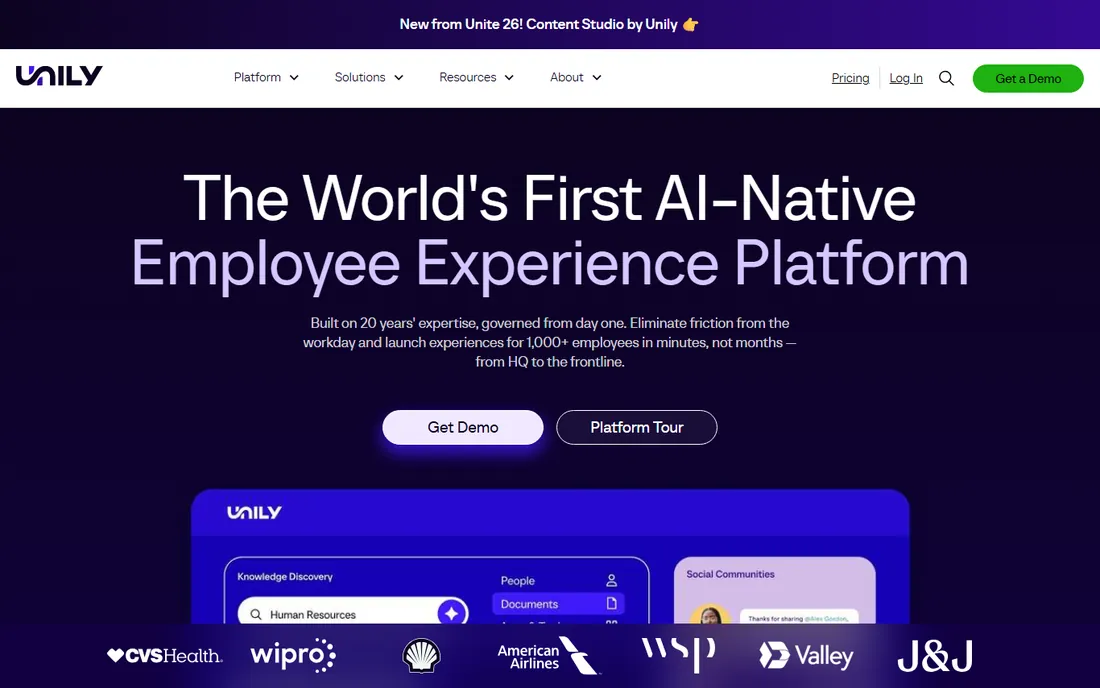
Unily markets itself as an AI-native employee experience platform. Two products carry that claim: Unily Glass, a conversational AI layer that answers questions and triggers actions across HR, IT and CRM systems, and Indi, an agent that helps admins design and publish branded intranet experiences. The platform serves companies with 1,000 to more than 100,000 employees, with customer stories that include CVS Health, British Airways and Wipro.
It excels at the hard parts of global scale: personalized content targeting, multi-channel publishing, governance workflows and analytics. Its Bring-Your-Own-AI approach lets companies connect Microsoft 365 Copilot or other existing AI investments. The catch is scope: Unily is built for very large companies, and smaller buyers will find the sales process and implementation heavy.
Shortlist Unily when you operate across countries, languages or business units and need one brand-consistent hub.
What we like- Strong multilingual publishing and localization
- Unily Glass conversational AI and Indi page-building agents
- Proven at 100,000+ employees
Watch out for- Built for very large companies, so pricing and scope overwhelm smaller teams
- Implementation needs dedicated internal owners
#3
Simpplr
Best for: Mid-market to enterprise teams that want fast deployment
Visit simpplr.com
Starting priceSee website
Free planFree trial
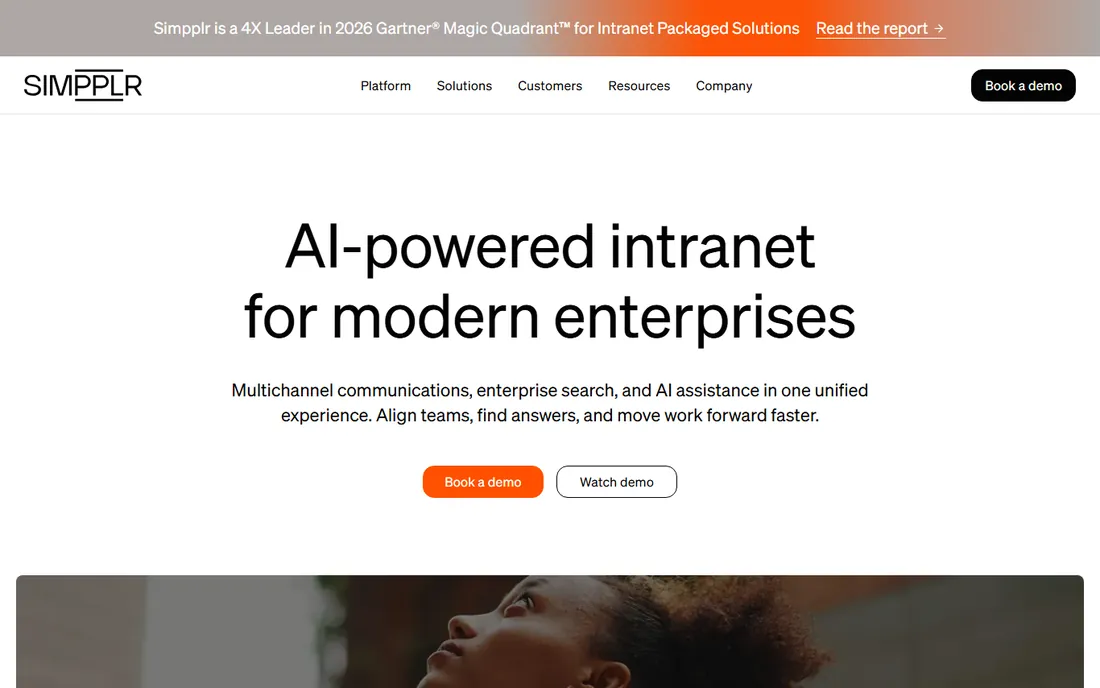
Simpplr sells Simpplr One, an AI-powered intranet and employee experience platform with multichannel communication, enterprise search and AI assistance in one package. The company reports more than two million active users and over 1,000 customers, and it was named a Leader in the 2026 Gartner Magic Quadrant for Intranet Packaged Solutions and the Forrester Wave for Intranet Platforms.
Pricing is volume-based and tailored to organization size, complexity and support level, with no per-user list price published. The subscription includes the intranet and employee experience features, four releases per year, technical support, customer success oversight and training. Analysts point to Simpplr as one of the fastest enterprise deployments in the category, typically four to eight weeks, which is a genuine advantage on a tight timeline.
The downside is transparency. Without published prices, you negotiate in the dark, and third-party estimates put Simpplr in the mid-to-high range. Pick Simpplr when you want a modern intranet live in weeks and have the budget for enterprise software.
What we like- Deployment in four to eight weeks, among the fastest in the category
- Four product releases a year with global support included
- 95 percent customer retention
Watch out for- No public prices or named plans, everything is quote-based
- Enterprise focus means higher cost than simple intranets
#4
Workvivo
Best for: Companies that want a social, high-adoption employee app
Visit workvivo.com
Starting priceSee website
Free planFree trial
Workvivo is now a Zoom company, and it leans into that identity: one digital headquarters where updates, conversations, knowledge and recognition live in a feed employees actually open. The platform combines posts, chat and calls, livestreams, knowledge hubs, onboarding journeys and AI features like natural-language answers and automatic catch-up summaries.
It integrates with 60-plus HR tools plus Google Workspace, Microsoft 365 and Slack. Workvivo was named a Leader in the 2026 Gartner Magic Quadrant for Intranet Packaged Solutions. The trade-off is that it publishes a plan structure but no prices; quotes are built from license count and scope, so you will not know the real number until you talk to sales.
Consider Workvivo when adoption is your biggest worry. Its social design pulls people in, which solves the dead-intranet problem that kills many portals.
What we like- Familiar social feed that drives strong adoption
- 60+ integrations with HR and productivity tools
- Named a Leader in the 2026 Gartner Magic Quadrant
Watch out for- Pricing is quote-only with no public per-user rates
- Smaller companies may pay for more platform than they need
Starting priceSee website
Free planFree trial
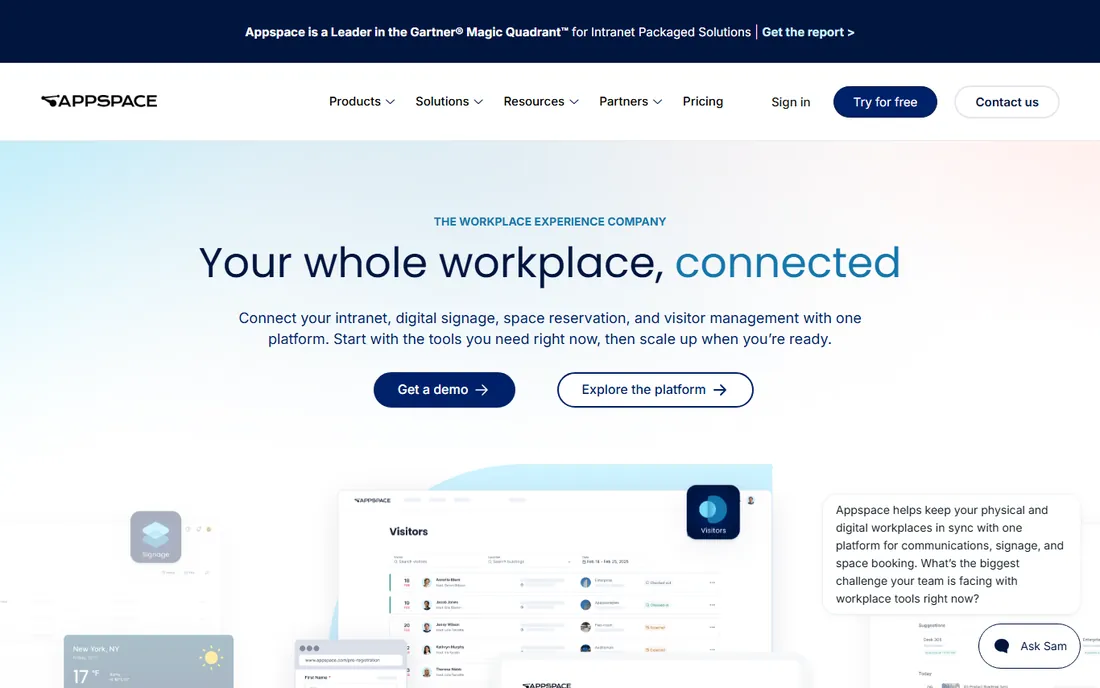
Appspace acquired Igloo Software in September 2025, adding more than 325 customers and deep intranet expertise to a platform that already covered digital signage, space reservation and visitor management. Existing Igloo customers keep full support and can move to the wider Appspace platform.
The value proposition is consolidation: one vendor for the intranet, the employee mobile app, meeting room screens, desk booking and visitor check-in, managed through a single admin interface. Appspace integrates with the apps and collaboration tools teams already use, and it was recognized in the Forrester Wave for Intranet Platforms in Q2 2026.
The watch-out is focus. If you only need an intranet, a broad workplace platform can be more than you want to buy and administer. Because the Igloo integration is recent, ask for a clear roadmap before committing to a migration path.
What we like- Combines intranet with digital signage, space reservation and visitor management
- Recognized in the Forrester Wave for Intranet Platforms, Q2 2026
- Plugs into existing collaboration tools
Watch out for- The 2025 acquisition of Igloo means the product roadmap is still converging
- Platform is broad, so intranet-only buyers may overpay
#6
Jostle
Best for: Mid-size teams that want transparent pricing
Visit jostle.me
Starting price$2.50 per user/month (billed annually)
Free planFree trial
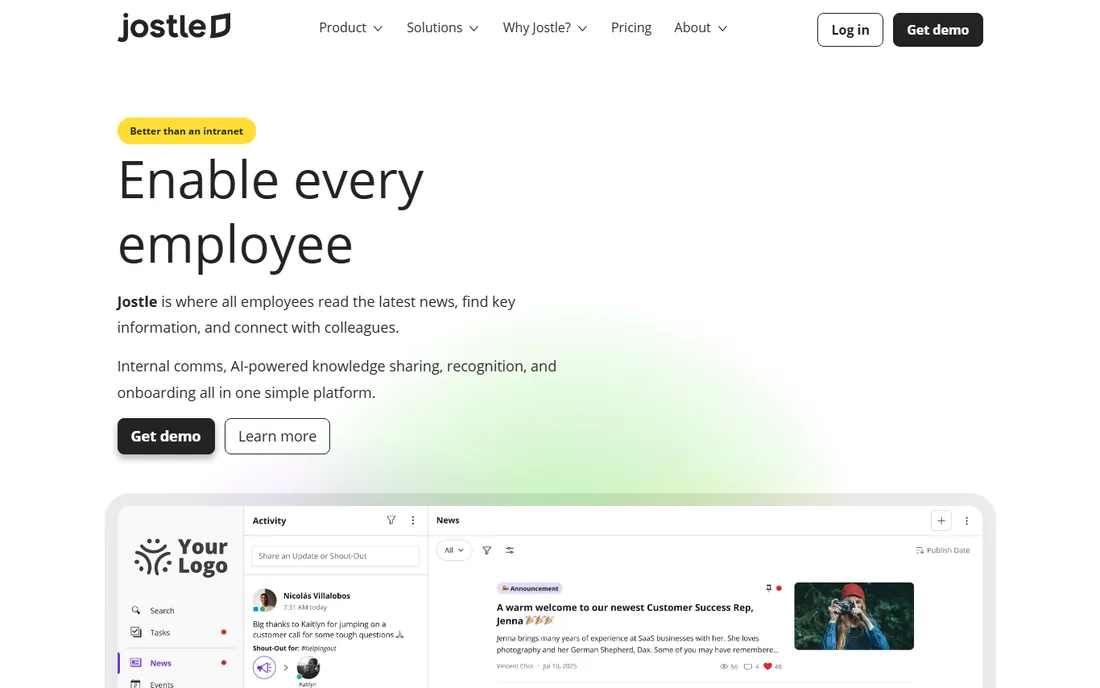
Jostle calls itself better than an intranet, and its differentiator is honesty about price. Plans scale by user count with Bronze from about $2.50 per user per month, Silver near $4.98 and Gold near $6.64 for 500 users, with Platinum quote-based. Every plan includes mobile apps, SSO and provisioning, governance controls, Google Workspace and Microsoft 365 integrations, AI features and free onboarding.
The platform covers the intranet basics well: targeted news with read-tracking, a structured knowledge library with permissions that sync to Google Drive and OneDrive, an employee directory with org charts, shout-outs and recognition, discussions and weekly digest emails. Canadian-founded with an easy admin model, it wins when a lean team needs a portal live without consultants.
The catch is scale and depth. Companies that need deep customization or complex multilingual publishing will hit the edges of what Jostle offers. For most companies under a few thousand employees, though, it is the least painful way to get a working employee portal.
What we like- Published prices starting near $2.50 per user per month
- Free implementation and onboarding on every plan
- SSO, mobile apps and integrations included at all tiers
Watch out for- Less suited to global enterprises with heavy customization needs
- Advanced modules are add-ons above the base tiers
#7
MangoApps
Best for: Frontline-heavy industries like retail and healthcare
Visit mangoapps.com
Starting priceSee website
Free planFree trial
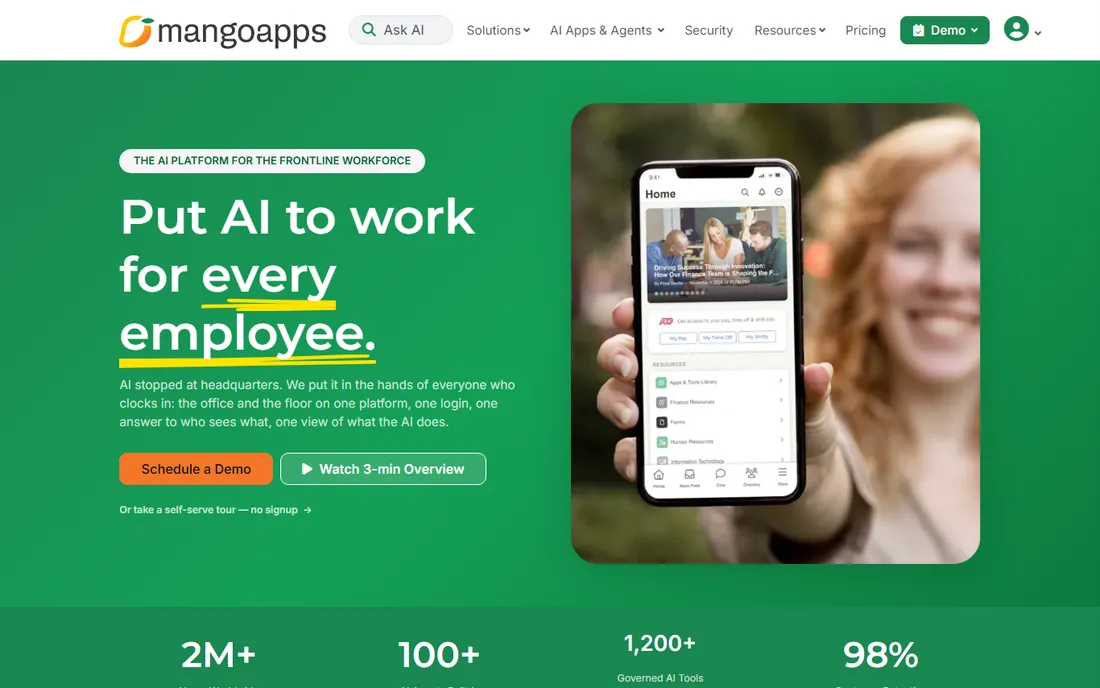
MangoApps has spent nearly two decades on the frontline workforce, and it shows. Employees without a desk, corporate email or laptop get a full employee app with schedules, tasks, training, safety checks, shift coverage and HR self-service, all under one login. The company reports more than two million users, 98 percent customer retention and 90 percent-plus adoption within 90 days, backed by an adoption guarantee.
The platform is modular: start with one suite such as Employee Experience or Frontline Operations and expand later. More than 200 integrations cover HRIS, payroll and ITSM systems, and AI agents are built into everyday workflows, from shift coverage to inspections. MangoApps' own site cites roughly $19 per seat per month as a starting point for smaller organizations, but real quotes are customized. Deployment options include SaaS, private cloud, customer VPC or on-premise, which helps regulated industries.
Choose MangoApps when most of your workforce works shifts, drives routes or staffs stores and clinics. Ask how frontline licenses are counted, because all-employee reach is the whole point of the platform.
What we like- Built for deskless workers for 18+ years, no corporate email required
- Adoption guarantee backed by named customer success managers
- HITRUST, SOC 2 Type II, ISO 27001 and FedRAMP certification
Watch out for- Modular quote-based pricing that needs a sales conversation
- Enterprise minimums of 200 users on some plans
#8
Happeo
Best for: Small to mid-size companies, especially Google shops
Visit happeo.com
Starting priceSee website
Free planFree trial
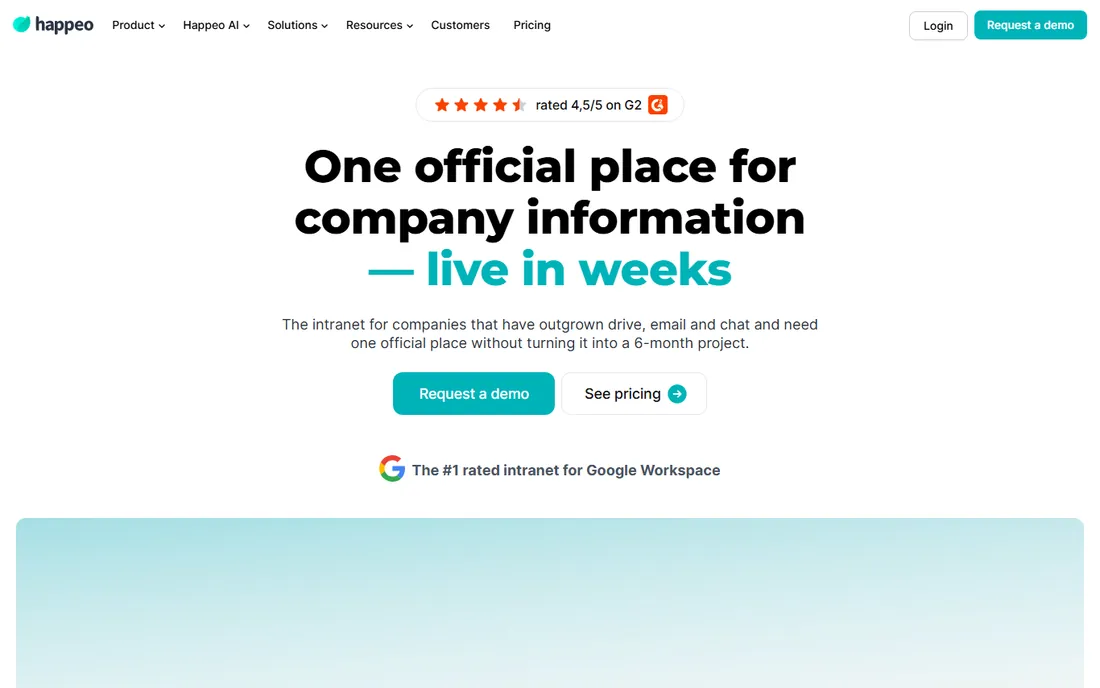
Happeo pitches the intranet for companies that have outgrown shared drives, email and chat but do not want a six-month implementation project. Knowledge spaces give HR, IT and onboarding pre-built, structured pages. Connected search spans Happeo, Google Drive, Gmail and Slack with permission-based results. Internal comms tools handle announcements, read tracking, polls and analytics.
Three tiers cover the range: Starter for simple intranets under 100 users, Growth with lifecycle management, scheduled posts and advanced analytics, and Enterprise with federated search, SSO, APIs and custom widgets. The company reports a 4.5 out of 5 rating on G2, and security includes ISO 27001 certification, GDPR compliance and SSO.
The trade-off is pricing opacity. For a product aimed at small and mid-size companies, Happeo still sells by quote, and the upper tiers have user minimums of 75. It fits best when your company runs on Google Workspace and needs one official place for information without enterprise software weight.
What we like- Purpose-built for companies that have outgrown Drive and email
- Connected search across Google Drive, Gmail and Slack
- Live in weeks, not months
Watch out for- Quote-based pricing despite the SMB focus
- Growth and Enterprise tiers carry minimums of 75 users
#9
Staffbase
Best for: Large distributed workforces with many deskless workers
Visit staffbase.com
Starting priceSee website
Free planFree trial
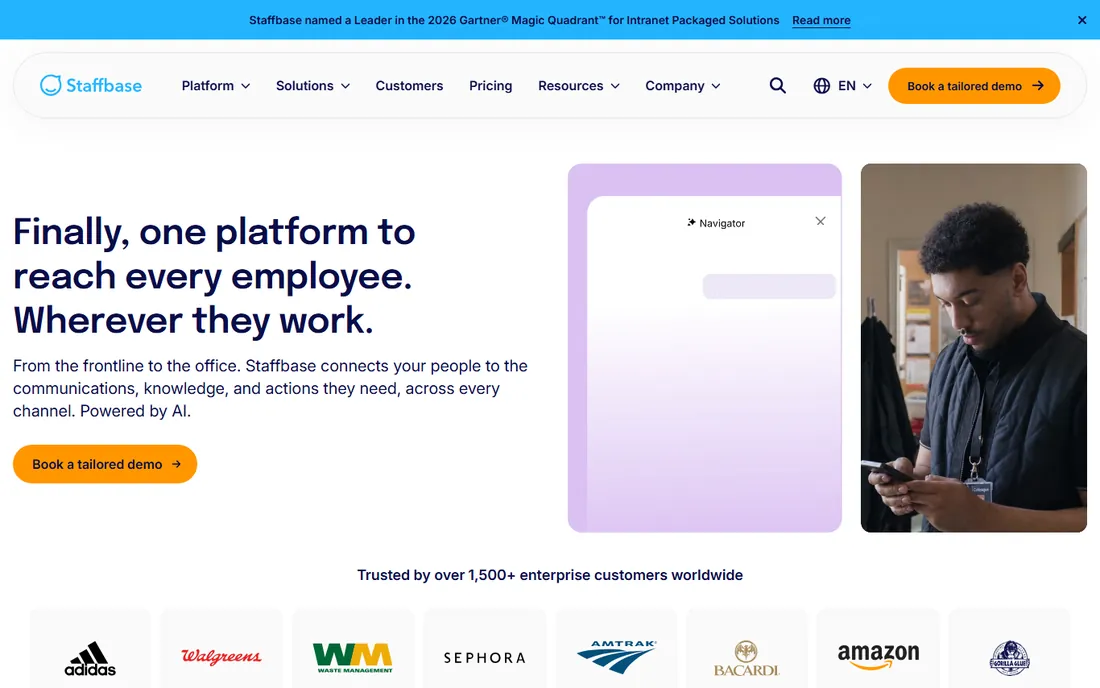
Staffbase describes itself as an AI-native intranet and employee experience platform, and its pitch is reach: intranet, employee app, email campaigns, digital signage and an AI assistant, all governed from one place. It reports more than 1,500 enterprise customers worldwide.
The platform is genuinely strong for frontline workforces. The employee app is mobile-first and offline-ready for shift workers, drivers and retail staff, and the company reports 94 percent monthly active usage among its hardest-to-reach customers. Modular packages let you buy the intranet, the app, SMS or signage separately, with native integrations for Microsoft 365, ServiceNow and Workday. Average deployment runs three to four months with a dedicated success team.
Pricing is quote-based and annual, and independent quotes for a 350-person deployment have ranged from roughly $34,000 to $61,000 per year for the app plus intranet. Staffbase is the pick when a large, distributed company needs every channel from one vendor and is ready to pay for it.
What we like- Modular platform covering intranet, employee app, email, signage and AI assistant
- Mobile-first design with 94 percent monthly active usage reported by frontline customers
- Dedicated success teams and migration support
Watch out for- Quote-only pricing with annual contracts
- Average deployment takes three to four months
How we chose
We started with the platforms that appear most often in 2026 intranet shortlists, analyst reports and public reviews. For every tool we read the vendor pricing page, documentation, feature lists and integrations, and we cross-checked with public reviews on G2, Capterra and TrustRadius, community discussions and analyst coverage from Gartner, Forrester and ClearBox.
Where vendors sell by quote, which is most of this category, we wrote "See website" instead of guessing. We did not claim hands-on testing; this guide is built from documented facts, published prices and what real buyers report.
What to check before you sign anything
An employee portal is a multi-year commitment, so the contract matters as much as the features.
Pricing and contracts
Most vendors sell annual subscriptions priced per user or per employee. Ask whether pricing is per named user or per active employee, whether frontline-only licenses exist at a lower price, and how prices change at renewal. Jostle publishes prices, which gives you a benchmark to judge quote-only vendors against.
Integrations and data
Confirm native integrations for your HRIS, file storage and communication tools, plus SSO and provisioning. Ask how data exports work if you ever leave, and whether exports include content, files and usage history.
Security and governance
Verify SOC 2, ISO 27001 or equivalent certifications, and ask regulated-industry questions about data residency and audit logs. Check how content ownership works: the best platforms assign owners, review dates and expiry workflows so stale pages do not mislead employees.
Budget planning: what employee portals really cost
Sticker prices in this category are misleading because so few vendors publish them. Jostle starts near $2.50 per user per month at the Bronze tier, while enterprise quotes for Staffbase or Simpplr often land in the tens of thousands per year for a few hundred employees. MangoApps cites roughly $19 per seat per month as a starting point for smaller organizations.
Budget beyond the license. First-year costs include implementation, content migration, integrations and training, which can match or exceed the subscription itself. Multi-year deals usually bring discounts of 10 to 20 percent, but only commit to them after a successful first year.
Frequently asked questions
What is the difference between an employee portal and an intranet?
The terms overlap heavily. An intranet usually means the internal website with news, documents and directory. An employee portal is the broader front door: the intranet plus apps, tools, self-service and integrations behind one login. Judge products on features rather than the label.
How much does employee portal software cost?
Simple platforms start around $2.50 to $5 per user per month with transparent pricing, like Jostle. Enterprise platforms such as LumApps, Simpplr, Unily and Staffbase sell by quote and typically cost tens of thousands of dollars per year for a mid-size company. Always ask for the full first-year cost including implementation.
Do I need an employee portal if we already use Microsoft 365 or Google Workspace?
Maybe not a big one. SharePoint, Viva Connections or Google Sites cover portal-like features. A dedicated portal earns its place when you need better targeting, analytics, frontline mobile access or governance than the suite provides out of the box.
How long does it take to implement?
Simple platforms can go live in a few weeks, especially when you migrate existing content as-is. Enterprise intranets typically need three to six months including content audit, migration, integrations and training. Content cleanup usually takes longer than configuring the software.
Can frontline workers without corporate email use these platforms?
Some can. MangoApps, Staffbase and Jostle are built to enroll deskless workers without corporate email, often with mobile numbers or simple identity options. Platforms designed around Microsoft 365 identities are harder for frontline rollouts, so ask how non-desk employees sign in and whether they are billed differently.
Is a free plan or trial available?
Most vendors offer a free trial, usually 14 to 30 days, but few offer a free tier. Jostle offers a free trial alongside its published paid plans.
Sources we checked (20)
- https://www.lumapps.com/
- https://www.unily.com/
- https://www.simpplr.com/
- https://www.workvivo.com/
- https://appspace.com/
- https://www.appspace.com/blog/igloo-press-release/
- https://www.socialedgeconsulting.com/post/appspace-acquires-igloo
- https://www.mangoapps.com/
- https://www.mangoapps.com/articles/best-employee-intranet-frontline-teams
- https://www.happeo.com/
- https://www.happeo.com/blog/intranet-cost
- https://staffbase.com/
- https://connecteam.com/reviews/staffbase/
- https://blog.jostle.me/blog/best-intranet-software
- https://www.softwareadvice.com/community/jostle-profile/
- https://axerosolutions.com/blog/simpplr-pricing/
- https://axerosolutions.com/blog/workvivo-pricing/
- https://www.itqlick.com/lumapps/pricing
- https://www.selecthub.com/c/employee-experience-software/
- https://www.trustradius.com/compare-products/mailfence-vs-mangoapps
Is your product missing or out of date?
We review this list regularly. Vendors can request a listing, send updated pricing or ask about featured placement.

Shihab Mia · Founder, Rankite
Shihab has spent more than a decade helping SaaS and e-commerce brands grow through search. He writes Rankite's software buying guides from pricing pages, documentation and public user reviews. More about Shihab.