How we make this list: we compare pricing pages, product documentation and public user reviews. Rankite is independent; if a vendor ever pays for a featured spot, that listing is clearly labeled Partner.
Key takeaways
- If you want to start measuring this week without a sales call, Persefoni's free Pro plan is the only serious option on this list that lets you begin at no cost.
- European mid-market companies facing CSRD deadlines should shortlist Coolset and Greenly first, since both were built around EU disclosure rules rather than retrofitted for them.
- When most of your footprint sits in the supply chain, Green Project Technologies and Sweep are built for supplier data collection, which is where Scope 3 inventories usually stall.
- Industrial companies that need to connect emissions to capital spending will get more from SINAI's abatement cost modeling than from a pure accounting tool.
Quick comparison
| Tool | Best for | Starting price | Free plan |
|---|
 Watershed Watershed | Large enterprises needing audit-grade inventories | See website | No |
 Persefoni Persefoni | Teams that want to start free and scale up | Free $0 (Pro plan); Advanced custom | Yes |
 Greenly Greenly | Mid-market companies, especially in Europe | See website | No |
 Sweep Sweep | Complex organizations with many business units | See website | No |
 Coolset Coolset | EU companies with CSRD reporting obligations | €6,000 to €30,000/year | No |
 SINAI SINAI | Industrial firms planning decarbonization investments | See website | No |
 Green Project Technologies Green Project Technologies | Enterprises tackling supply chain emissions | See website | No |
 Sphera Sphera | Enterprises already running EHS programs | See website | No |
 IBM Envizi IBM Envizi | Large organizations standardizing on IBM | See website | No |
Is your product missing or out of date?
We review this list regularly. Vendors can request a listing, send updated pricing or ask about featured placement.
What "emissions management" actually covers
The label gets stretched across products that do different jobs, so it helps to know what you are actually buying. At minimum, emissions management software calculates your greenhouse gas inventory across Scope 1 (your direct emissions), Scope 2 (purchased energy) and Scope 3 (everything upstream and downstream, from suppliers to product use). Most tools on this list also handle the reporting layer: formatted disclosures for frameworks like the GHG Protocol, CDP, SBTi, California's SB 253 and the EU's CSRD.
The split that matters most is accounting versus action. Some platforms stop at measurement and disclosure, giving you a defensible number and an auditor-friendly paper trail. Others add reduction planning: marginal abatement cost curves, scenario modeling, supplier engagement and target tracking. Buy the second kind only if someone on your team will actually run the reduction program; otherwise you are paying for modules that sit idle. Contract terms also deserve a look before you commit, since several vendors in this space sell annual platform licenses with data-volume or entity-count limits that can push the real price well above the headline figure.
The best emissions management software
Starting priceSee website
Free planNo
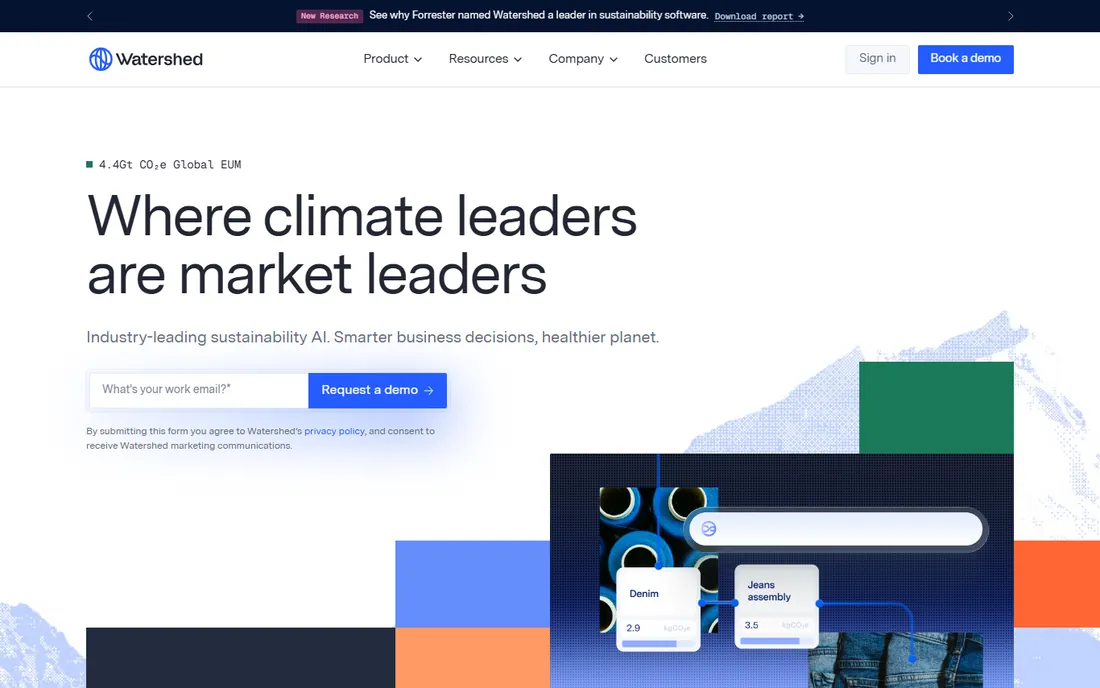
Watershed is the choice for companies that treat carbon data the way they treat financial data. It pulls activity data from ERP, procurement, travel and cloud billing systems, applies emission factors and produces an inventory that is structured for third-party assurance. For a multinational running dozens of entities, that automation is the difference between a credible disclosure and a spreadsheet held together by one analyst.
The catch is that Watershed sells like enterprise software, because it is enterprise software. Pricing is custom, implementation is a project rather than a signup, and a 200-person company will find the platform oversized for its needs. If you have a dedicated sustainability team and auditors asking hard questions, the rigor justifies the cost. If you do not, start somewhere lighter.
What we like- Deep integrations with finance and operations systems
- Strong audit trail for assurance
- Detailed Scope 3 coverage
Watch out for- Quote-only enterprise pricing
- More platform than a small team can absorb
Starting priceFree $0 (Pro plan); Advanced custom
Free planYes
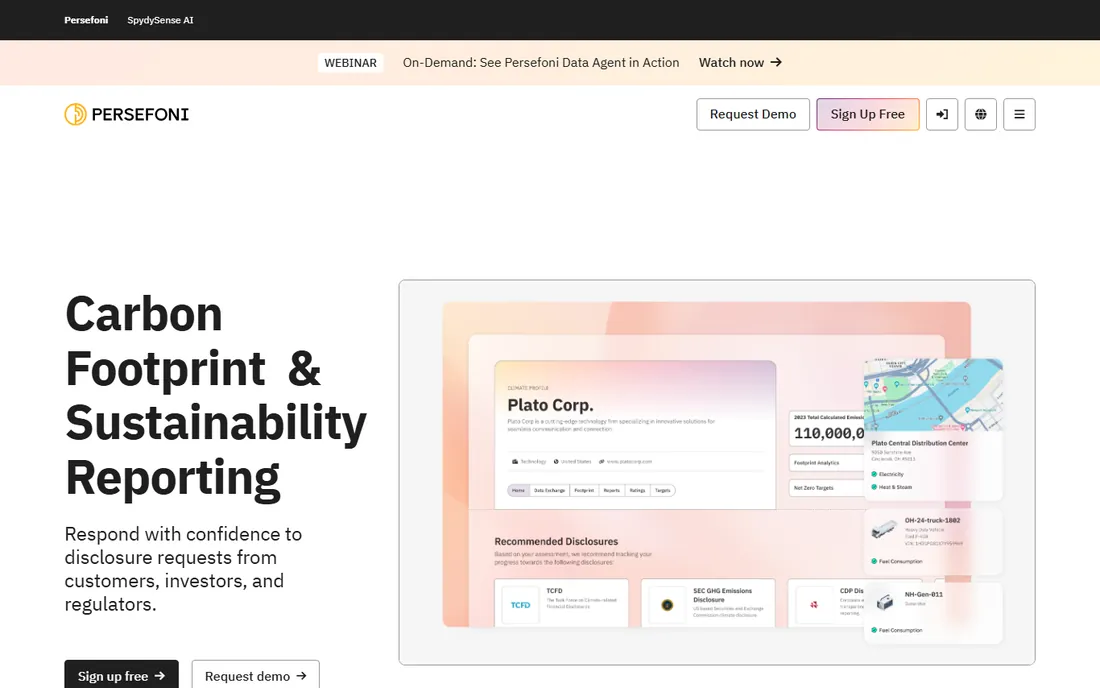
Persefoni takes the unusual step of giving away a real carbon accounting product. The free Pro plan covers Scope 1, 2 and 3 footprints, which makes it the fastest way to produce a first inventory and see where your emissions actually sit. Its investor-facing roots show in financed-emissions features that banks and private equity firms use to measure portfolio carbon, a niche most competitors handle weakly.
Free has edges, though. The Pro plan is a starting point, not a full compliance stack, and companies with complex supply chains or assurance requirements will graduate to the custom-priced Advanced tier. Treat the free tier as a paid pilot of your own data readiness: if you cannot assemble decent activity data in Persefoni, no paid platform will fix that for you.
What we like- Free Pro plan with no credit card required
- AI-assisted carbon accounting
- Strong investor and portfolio reporting
Watch out for- Advanced capabilities sit in the custom-priced tier
- Enterprise features need a sales conversation
Starting priceSee website
Free planNo
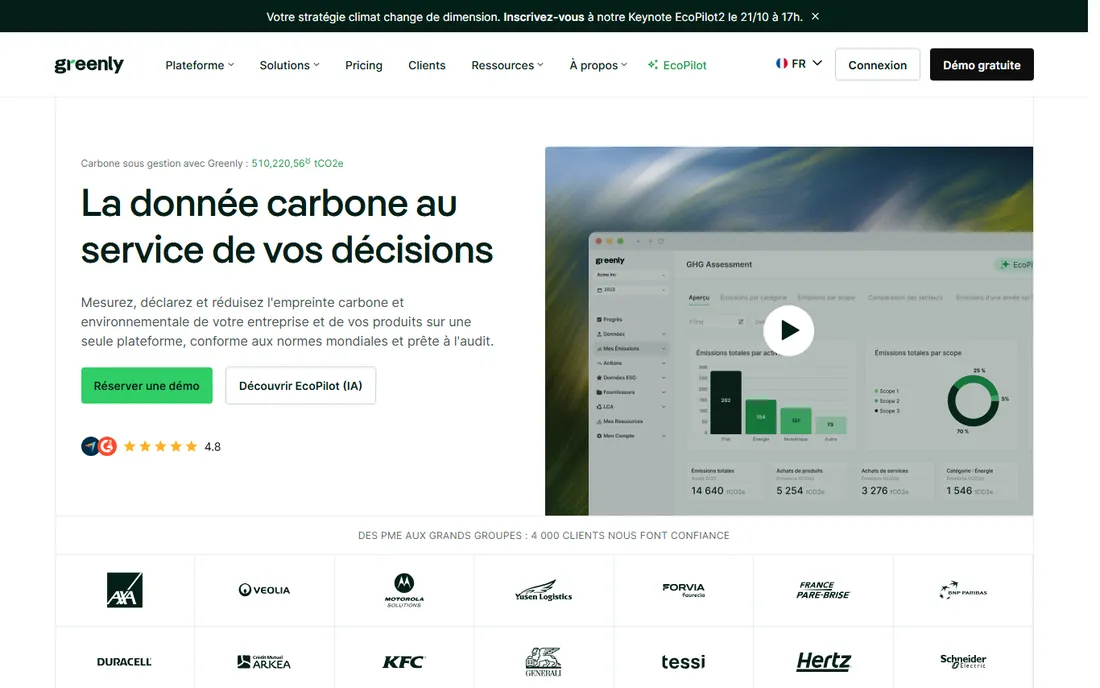
Greenly built its name making carbon accounting approachable for companies without a sustainability department. The workflow walks you through data collection with plain-language guidance, and it extends beyond corporate footprints into product life-cycle assessments, which matters if customers ask about the footprint of what you sell rather than how you operate. Its client base skews toward European mid-market firms dealing with CSRD.
One development to factor in: Greenly acquired fellow carbon accounting vendor Normative in September 2026, combining two of the industry's largest emissions datasets. Mergers like this can eventually mean a stronger product, but in the short term they create roadmap uncertainty. Ask direct questions about which platform your contract will run on before you sign.
What we like- Guided, approachable workflow for first-time reporters
- Product-level carbon assessments
- 4,000 claimed customers
Watch out for- Pricing is not published
- Platform roadmap in flux after a major merger
#4
Sweep
Best for: Complex organizations with many business units
Visit sweep.net
Starting priceSee website
Free planNo
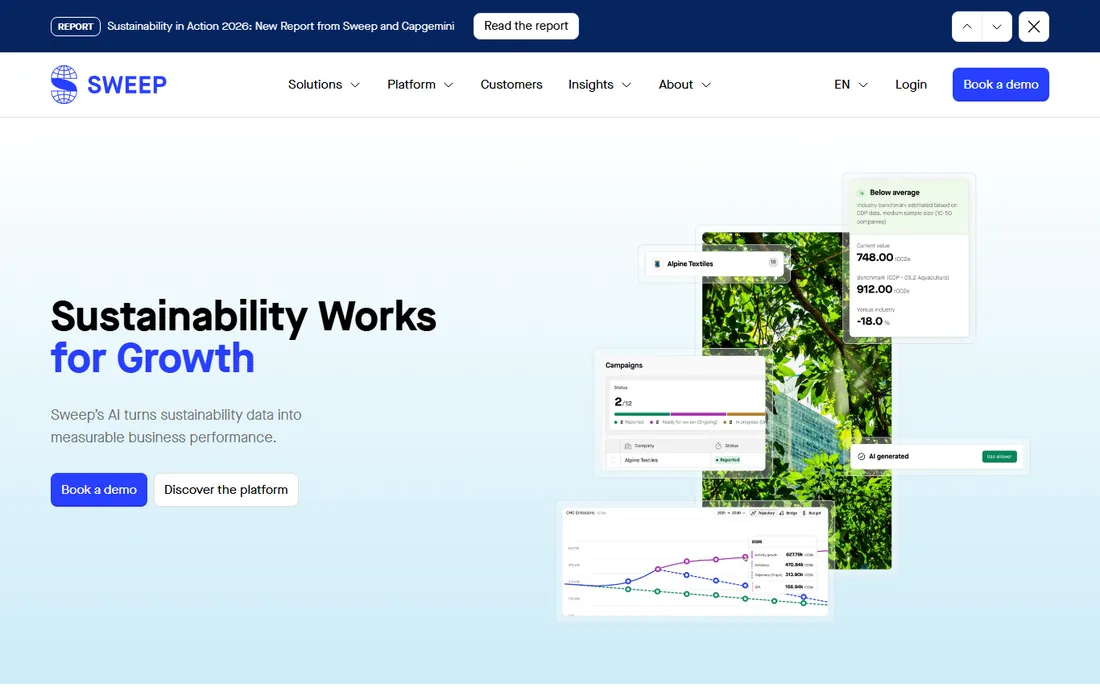
Sweep organizes your climate program the way your company is actually organized. Its "trees" structure lets you model divisions, regions or product lines separately, assign data collection to the right owners and roll everything up into one inventory. That design pays off in sprawling organizations where a single top-down spreadsheet always breaks. The built-in AI assistant, Sweepy, can map purchase data to emission factors, draft disclosures and build dashboards from plain-language requests.
The trade-off is accessibility. There is no published pricing and no self-serve trial, so evaluation runs through the sales team. Smaller companies may also find the platform's depth unnecessary. But if your reporting spans many entities and frameworks, from CSRD to California SB 253, Sweep's report-once-file-everywhere approach saves real labor.
What we like- Flexible "trees" model mirrors real org structures
- AI assistant handles mapping and drafting
- Broad framework coverage
Watch out for- No public pricing and no free trial
- Better suited to mid-size and large firms
Starting price€6,000 to €30,000/year
Free planNo
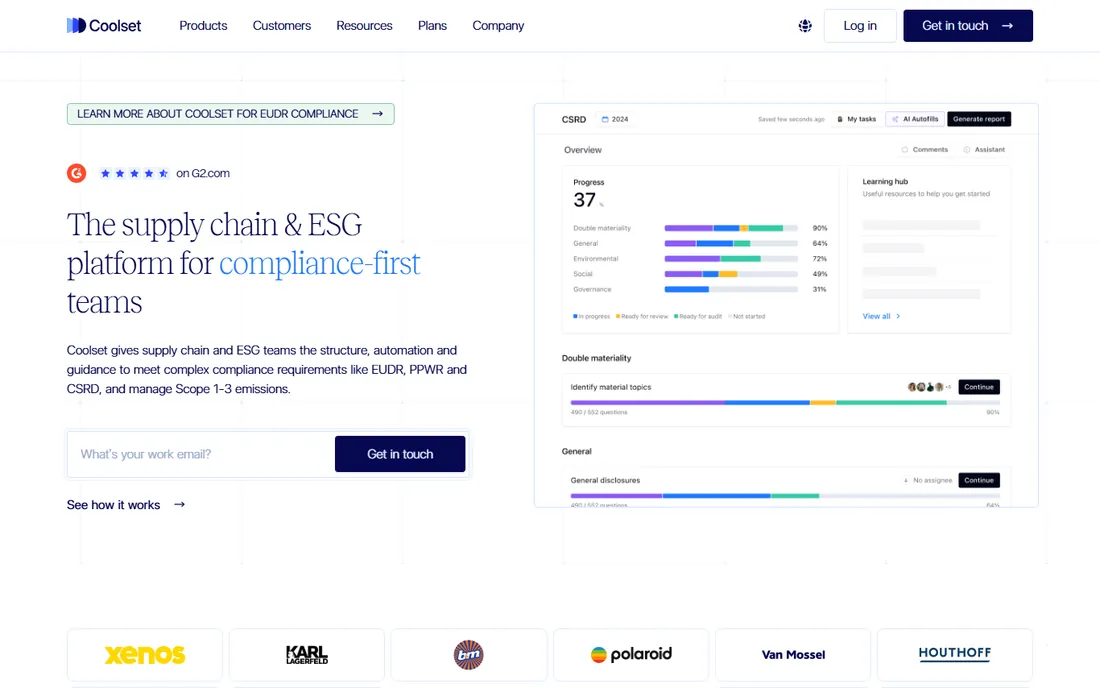
Coolset is the compliance-first pick for European mid-market companies. Its carbon calculations run on TÜV Rheinland-certified methodology, and the platform connects emissions data directly to CSRD disclosures, double materiality assessments and supply-chain obligations like EUDR and CBAM. Few competitors tie the accounting and the regulatory filing together this tightly. The published annual range of €6,000 to €30,000, with no implementation fees, is refreshingly transparent for this category.
That focus is also the limitation. If your reporting obligations are mostly American, much of Coolset's regulatory machinery adds little value. And while the price band is public, your exact quote will depend on company size and modules. Still, for an EU company staring down its first CSRD filing, Coolset shortens the path considerably.
What we like- TÜV Rheinland-certified GHG methodology
- Purpose-built CSRD, EUDR and CBAM workflows
- Published price band
Watch out for- Euro-denominated pricing
- EU regulatory focus is less relevant outside Europe
#6
SINAI
Best for: Industrial firms planning decarbonization investments
Visit sinai.com
Starting priceSee website
Free planNo
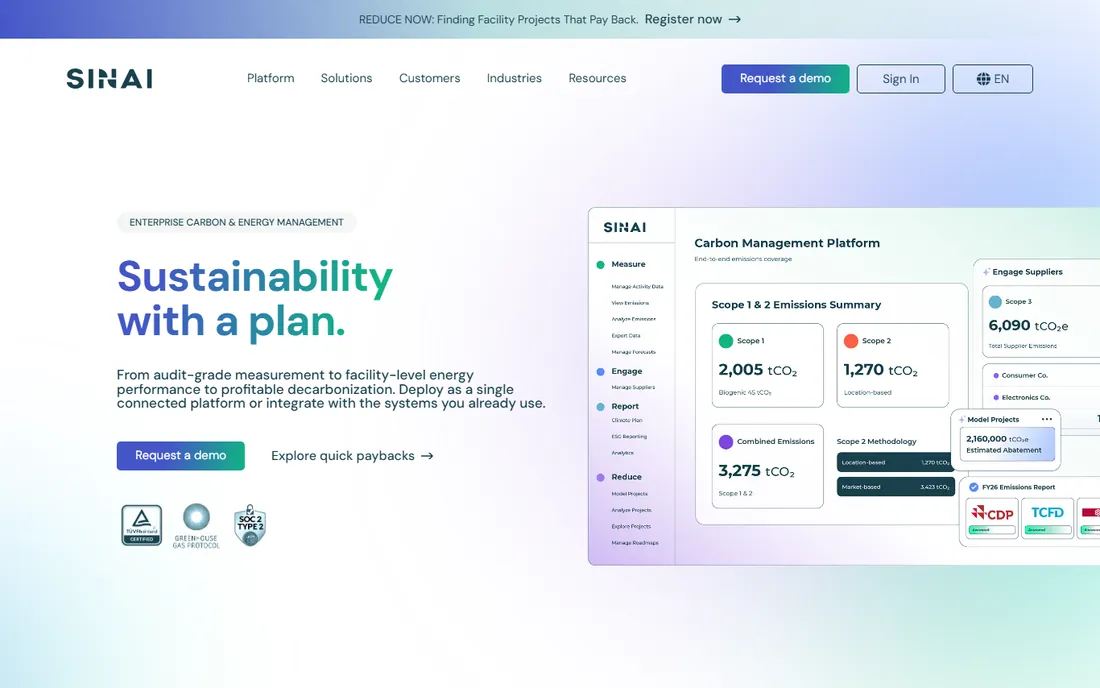
SINAI, formerly SINAI Technologies, answers a different question than most carbon accounting tools. Instead of stopping at "what did we emit," it models what it costs to emit less: which reduction projects pay back, in what order, and how internal carbon pricing changes investment decisions. For steel, cement, manufacturing and energy companies, where decarbonization is a capital allocation problem, that framing is far more useful than another dashboard.
The platform's industrial DNA means it is less natural for service or software companies with simple footprints. It is also an enterprise sale with custom pricing. But if your board wants to see the financial return on each tonne of CO2 avoided, SINAI is built for exactly that conversation, and independent analysts have rated its decarbonization modeling among the strongest in the market.
What we like- Marginal abatement cost curves link carbon to capex
- Internal carbon pricing engine
- Recognized strength in hard-to-abate sectors
Watch out for- Analytical depth can overwhelm non-technical teams
- Quote-based pricing
Starting priceSee website
Free planNo
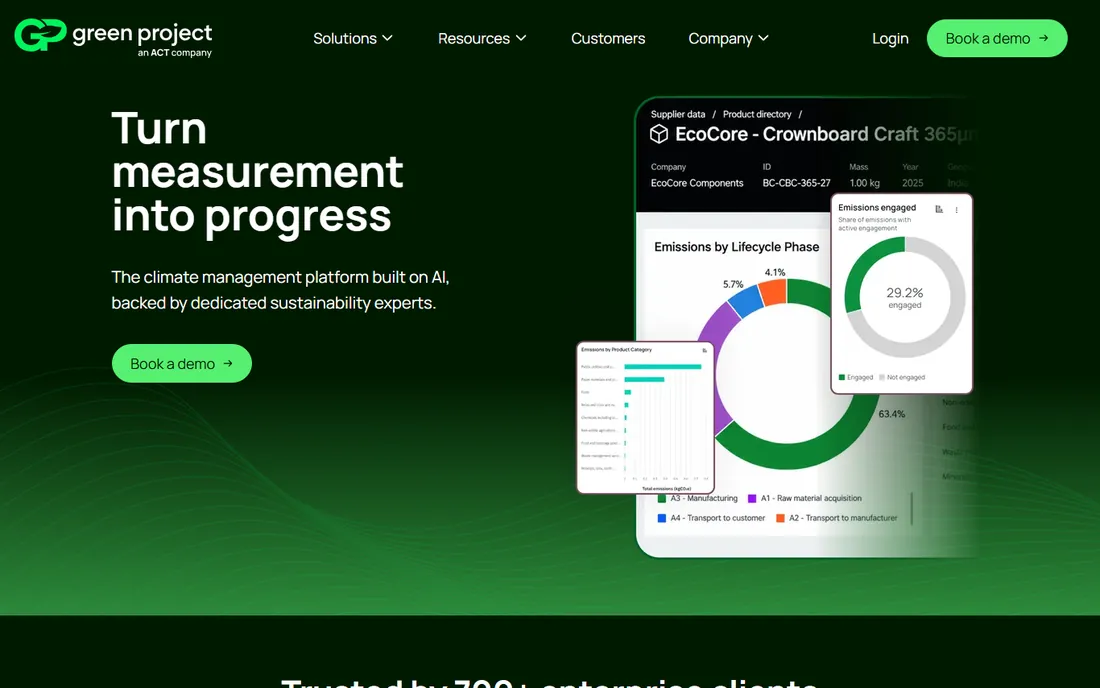
Green Project Technologies acquired the Emitwise platform in July 2025, folding its carbon accounting technology into a broader decarbonization suite. The result, marketed as suite50, combines three pieces: supplier engagement tools, audit-ready carbon accounting and a renewable energy procurement marketplace. For companies whose Scope 3 dwarfs everything else, getting suppliers measured and then actually buying clean energy through the same vendor is a coherent proposition.
Backing by ACT Group, a decarbonization solutions provider, gives the platform unusual depth in energy procurement, and customers include names like Microsoft. The downside is packaging complexity: figuring out whether you need one module or all three takes a proper scoping call. Pricing is quote-based. Treat the Emitwise lineage as a plus, since that technology was well regarded for supply-chain carbon data.
What we like- Supplier engagement plus renewable energy procurement in one suite
- Technology absorbed from Emitwise
- Large supplier network
Watch out for- Three-product suite can be confusing to scope
- Pricing requires a sales conversation
Starting priceSee website
Free planNo
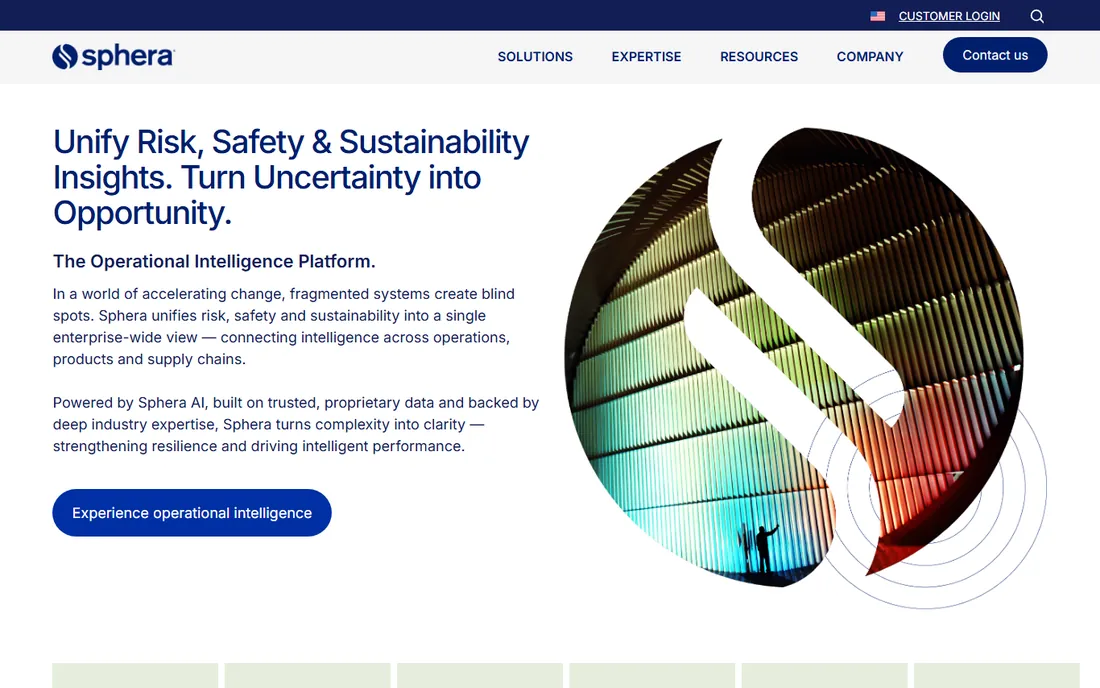
Sphera comes at emissions from the operations side. It is a long-established enterprise platform for environment, health, safety and sustainability, and its carbon management modules inherit that operational depth. The standout asset is data: Sphera's GaBi life-cycle databases are among the most comprehensive emission factor libraries available, which matters when you need defensible product footprints rather than spend-based estimates.
Breadth is the double-edged sword. Companies already running Sphera for EHS get carbon management inside a system their teams know. Everyone else faces a large implementation and enterprise pricing with no public numbers. Sphera fits industrial enterprises that want one operational platform, not companies looking for a quick carbon accounting signup.
What we like- Massive GaBi life-cycle inventory database
- Combines EHS, risk and sustainability
- Audit-grade data controls
Watch out for- Broad suite means long implementations
- Pricing is enterprise-scale and opaque
#9
IBM Envizi
Best for: Large organizations standardizing on IBM
Visit ibm.com
Starting priceSee website
Free planNo
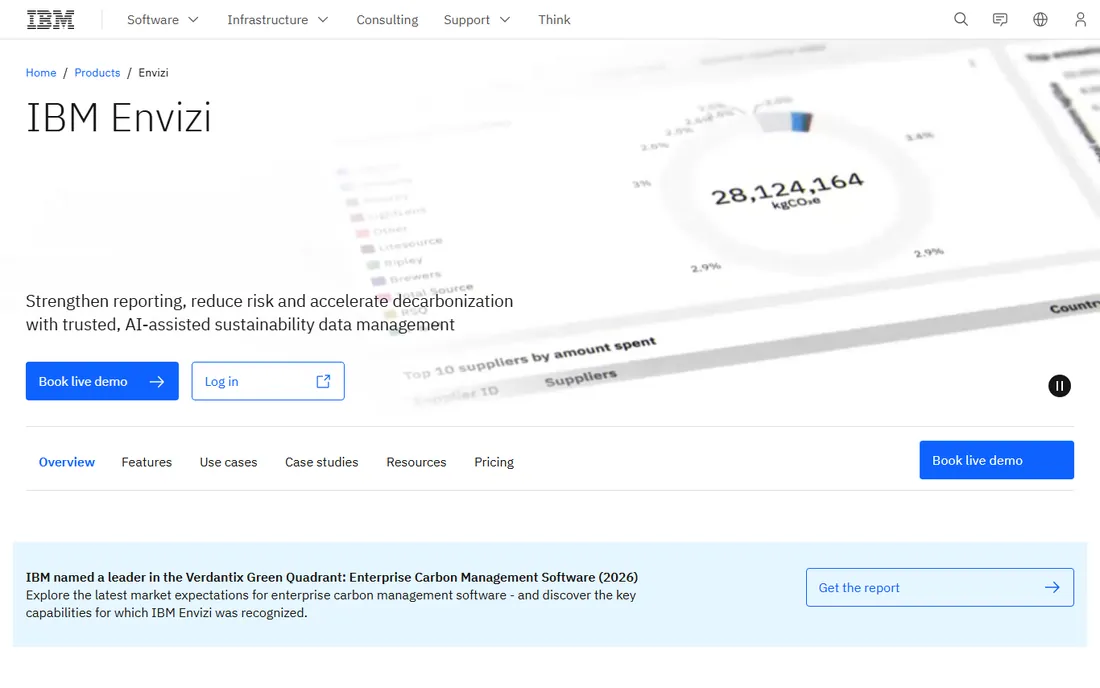
IBM Envizi structures sustainability as modules you combine: emissions management for Scope 1, 2 and 3, ESG reporting frameworks, and decarbonization planning with forecasting. The emissions calculation engine is built on the GHG Protocol, and the platform is genuinely strong at ingesting messy operational data, from utility bills to interval meter feeds to ERP exports, with automated health checks on data quality. Every change is logged, which auditors like.
Pricing is based on the data volume you manage and gets scoped during the sales process, so budget conversations happen late. Implementation is also a project, not a product signup. Envizi makes the most sense for large organizations already invested in IBM's ecosystem, or those that need its particular strength in utility and building-level data.
What we like- Modular design lets you buy only what you need
- Strong utility and interval-meter data capture
- Finance-grade audit trails
Watch out for- Pricing scales with data volume and is scoped in sales
- Implementation effort is real
How we chose
We started from each vendor's own site: the homepage, product pages, pricing pages and documentation, all checked in October 2026. Prices shown above come from the vendor's own published pages; where a vendor does not publish pricing, we say so instead of repeating third-party estimates. We excluded products that no longer exist as standalone offerings, including Emitwise and Plan A, both acquired in the past year, and Normative, which Greenly acquired in September 2026. We weighed framework coverage, Scope 3 depth, audit readiness, company-size fit and whether a smaller team could realistically get value, drawing on public reviews and analyst assessments where available.
Why your Scope 3 number will be wrong the first time
Almost every company underestimates Scope 3 on the first attempt, and the miss is rarely small. The cause is structural: Scope 1 and 2 come from bills and meters you already have, while Scope 3 comes from suppliers who have never measured anything and purchasing data that was never coded for carbon. Most first inventories lean on spend-based emission factors, which multiply dollars spent by industry averages, and those averages can be off by multiples for any specific supplier.
The fix is a data-quality ladder, and the better platforms are built around it. You start with spend-based estimates to find hotspots, then replace the biggest categories with supplier-specific data, collected through engagement workflows like the ones Green Project and Sweep provide. Each cycle tightens the number. Budget for this explicitly: the software license is often the smaller cost next to the staff time or consultant help needed to chase supplier data. A platform that makes supplier outreach easy is worth more than one with a prettier dashboard.
How auditors check your carbon math
As disclosure rules tighten, more inventories face limited assurance from external auditors, and the review is less mysterious than it sounds. Auditors test three things: completeness (did you include all material sources), accuracy (are the emission factors appropriate and current) and traceability (can every number be followed back to source data). The platforms built for assurance, like Watershed, Persefoni and IBM Envizi, keep full audit trails showing which factor was applied to which activity, when, and by whom.
What trips companies up is usually documentation, not math. A defensible factor from an outdated database, a spreadsheet edit with no version history, or a Scope 3 estimate with no record of its assumptions will all draw findings. When evaluating tools, ask to see the audit trail before you ask about the dashboard. Also confirm the emission factor libraries update on a schedule and note which ones are embedded; Sphera's GaBi data and Coolset's TÜV-certified methodology exist precisely to survive this scrutiny.
Frequently asked questions
What is emissions management software?
It is software that measures a company's greenhouse gas emissions, usually across Scope 1, 2 and 3, and helps report them against frameworks like the GHG Protocol, CDP or CSRD. Stronger platforms add reduction planning, supplier engagement and target tracking. The category overlaps with carbon accounting software; the terms are used interchangeably by most vendors.
How much does emissions management software cost?
It ranges from free to six figures annually. Persefoni offers a free Pro plan, Coolset publishes a €6,000 to €30,000 annual band, and most enterprise platforms like Watershed, Sweep and IBM Envizi are quote-based, typically starting in the tens of thousands per year. Implementation and supplier data collection often cost as much as the license itself.
Do I actually need Scope 3 tracking?
If any regulation or major customer applies to you, yes. California's SB 253, the EU's CSRD and most enterprise supplier programs require Scope 3 disclosure, and Scope 3 is usually the largest share of a company's footprint. Even without a mandate, you cannot set a credible net-zero target while ignoring the supply chain.
Can this software handle CSRD reporting?
Several tools on this list were built with CSRD in mind, notably Coolset, Greenly and Sweep. They map emissions data to the European Sustainability Reporting Standards and produce auditor-ready outputs. US-focused companies should check whether a vendor's CSRD module adds cost without benefit.
How long does implementation take?
A self-serve start like Persefoni's free plan can produce a first footprint in weeks if your data is organized. Enterprise platforms typically take three to six months including data integration, supplier onboarding and assurance preparation. The longest phase is almost always collecting decent Scope 3 data, not configuring the software.
Should a small company buy emissions management software?
Only if someone will use it. A company under 100 people with a simple footprint can often start with Persefoni's free tier or a consultant-built inventory. Paid platforms earn their keep when you have multiple entities, assurance requirements or a supply chain to engage. Buying enterprise software for a problem a spreadsheet still solves is the most common waste in this category.
Sources we checked (13)
- https://watershed.com/
- https://persefoni.com/
- https://persefoni.com/pricing
- https://greenly.earth/
- https://www.prnewswire.com/news-releases/greenly-and-normative-join-forces-to-create-global-carbon-accounting-leader-302881909.html
- https://www.sweep.net/
- https://www.coolset.com/
- https://www.coolset.com/academy/top-carbon-accounting-software-tools
- https://sinai.com/
- https://www.greenprojecttech.com/
- https://emitwise.com/
- https://sphera.com/
- https://www.ibm.com/products/envizi
Is your product missing or out of date?
We review this list regularly. Vendors can request a listing, send updated pricing or ask about featured placement.

Shihab Mia · Founder, Rankite
Shihab has spent more than a decade helping SaaS and e-commerce brands grow through search. He writes Rankite's software buying guides from pricing pages, documentation and public user reviews. More about Shihab.