How we make this list: we compare pricing pages, product documentation and public user reviews. Rankite is independent; if a vendor ever pays for a featured spot, that listing is clearly labeled Partner.
Key takeaways
- Shopify Plus starts at $2,300 per month on a 3-year term and is the simplest path to scale, but the variable platform fee above high revenue thresholds deserves a careful read of your contract.
- BigCommerce renamed its plans in June 2026 to Core, Growth, Scale, and Performance, and automatic upgrades tied to sales volume mean your plan can change without you clicking anything.
- Adobe Commerce and Salesforce Commerce Cloud do not publish prices. Budget by GMV share or license band, and model total cost at two to three times the license for implementation and integrations.
- Open-source options like WooCommerce and nopCommerce have no license fees, but hosting, development, and maintenance usually exceed the subscription cost of a hosted platform within the first year.
- Shift4Shop's $41 per month End-to-End plan and Wix's $29 per month Core plan are legitimate budget options, but both have ceilings that growing catalogs and B2B requirements will eventually hit.

#1
Shopify Plus
Best for: Growing brands that want the fastest path to scale without managing infrastructure
Visit shopify.com
Starting priceFrom $2,300/month (3-year term); $2,500/month (1-year term)
Free planNo

Shopify Plus is the default recommendation for mid-market ecommerce for a simple reason: it removes infrastructure from your list of worries. Hosting, security, checkout performance at 10,000-plus checkouts per minute, and 99.99 percent uptime are Shopify's problem, not yours. The Plus tier adds what growing brands actually need: checkout customization, Shopify Functions for custom promotions and discounts, native B2B selling for wholesale alongside direct-to-consumer, and nine expansion stores for international markets included in the fee.
Shopify publishes its Plus pricing, which is rare at this tier: $2,300 per month on a 3-year term or $2,500 per month on a 1-year term, with a variable platform fee for more complex, higher-volume businesses. Read that variable-fee clause before you sign, because it replaces the flat fee above certain revenue levels. Also budget for apps: the ecosystem is vast, but the monthly app bill on a serious Plus store routinely runs into the hundreds. If your team can live within Shopify's opinionated structure, this is the lowest-friction way to scale.
What we like- Published pricing, 9 expansion stores included, checkout customization, native B2B tools, huge app ecosystem
Watch out for- Above a revenue threshold the flat fee switches to a variable platform fee, which changes the math for very large stores

#2
BigCommerce
Best for: Mid-market stores that want strong built-in features without heavy app reliance
Visit bigcommerce.com
Starting price$39/month (Core); Growth $105/month; Scale $399/month
Free planNo (15-day free trial, no credit card required)
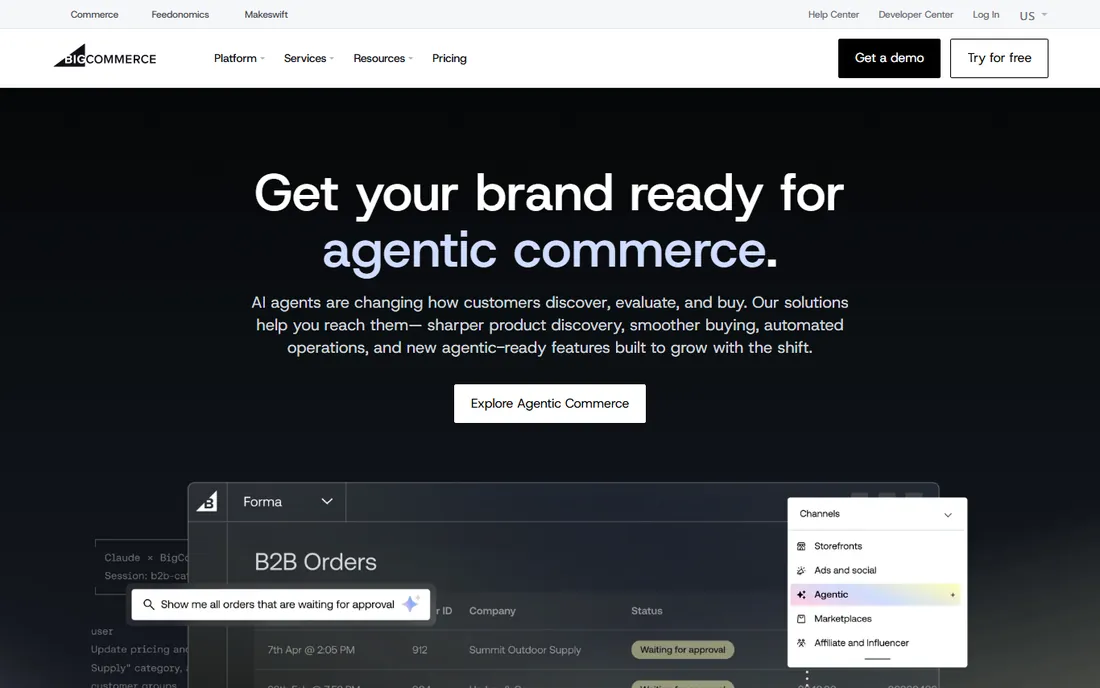
BigCommerce has always positioned itself as the platform that includes more out of the box, and for medium businesses that translates directly into a lower app bill. Abandoned cart recovery, customer segmentation, faceted search, and multi-storefront management arrive on the mid tiers rather than as paid add-ons. The open SaaS architecture gives developers full API and code access, which matters when you outgrow drag-and-drop and need real integrations with an ERP or PIM.
In June 2026 BigCommerce renamed its plans: Standard became Core at $39 per month, Plus became Growth at $105, Pro became Scale at $399, and Enterprise became Performance starting at $1,499 per month billed annually. The important mechanic is automatic upgrades based on trailing twelve-month GMV, so a good quarter can move you from Growth to Scale on its own. That is fair in principle, but put someone in charge of watching the thresholds. The 15-day fully functional trial, which can actually take payments, is one of the more generous evaluations in the industry.
What we like- More built-in functionality than Shopify, so fewer paid apps
- No platform transaction fees on approved gateways
- Multi-storefront support
Watch out for- Plans auto-upgrade when your trailing 12-month sales cross thresholds, which can surprise finance

#3
Adobe Commerce
Best for: Companies that need deep customization, complex B2B, or full control of hosting
Visit business.adobe.com
Starting priceSee website (quote-based)
Free planNo
Adobe Commerce, formerly Magento Commerce, is the heavyweight option for businesses with complex requirements. Multi-brand and multi-storefront operations from a single admin, company accounts with purchase approvals and quoting for B2B, AI-powered product recommendations and semantic search, and PCI Level 1 compliance come standard. You can run it on your own infrastructure, on Adobe's managed cloud, or as the newer multi-tenant SaaS service, which is more deployment flexibility than any competitor offers.
The honest math is what kills most mid-market evaluations. Adobe does not publish prices; industry estimates put the license around $22,000 per year on-premises and $40,000 per year on cloud for smaller merchants, scaling with GMV. Implementation partners routinely estimate total cost at two to three times the license once development, hosting, extensions, and support are included. If you have an in-house development team and genuinely complex needs, that can be money well spent. If you do not, Magento Open Source gives you the same codebase free, but then you own every upgrade and security patch yourself.
What we like- Unlimited customization, native B2B module, strong merchandising and AI search, choice of on-premises, cloud, or SaaS deployment
Watch out for- No published pricing
- Total cost of ownership typically runs two to three times the license

#4
Salesforce Commerce Cloud
Best for: Brands already invested in the Salesforce ecosystem that want unified customer data
Visit salesforce.com
Starting priceSee website (percentage of GMV, quote-based)
Free planNo
Salesforce Commerce Cloud, built on the Demandware platform Salesforce acquired in 2016, makes the most sense for one specific buyer: a mid-market or larger brand already running Salesforce CRM. When commerce, marketing, and service share one customer record, personalization and lifecycle marketing get dramatically easier. The platform handles B2C, B2B, direct-to-consumer, order management, and point of sale, and Salesforce runs all hosting, upgrades, and security.
Pricing is a share of gross merchandise value rather than a flat subscription, with B2C editions reported around 1 to 3 percent of GMV and B2B licensed separately. On $10 million of annual GMV, that is $100,000 to $300,000 per year for the platform alone, before implementation that commonly runs into six figures. The GMV model aligns Salesforce's incentives with your growth, which sounds nice until growth makes the bill painful. Get the rate, the measurement definition of GMV, and the B2B licensing question answered in writing before you model anything.
What we like- Deep integration with Salesforce CRM, Marketing Cloud, and Service Cloud
- Proven at very high scale
- AI-driven personalization
Watch out for- GMV-based pricing means the platform gets more expensive exactly as you succeed
- B2C and B2B require separate licenses

#5
WooCommerce
Best for: WordPress-centric businesses that want full ownership and unlimited flexibility
Visit woocommerce.com
Starting priceFree (open source; hosting and extensions extra)
Free planYes, the core platform is free
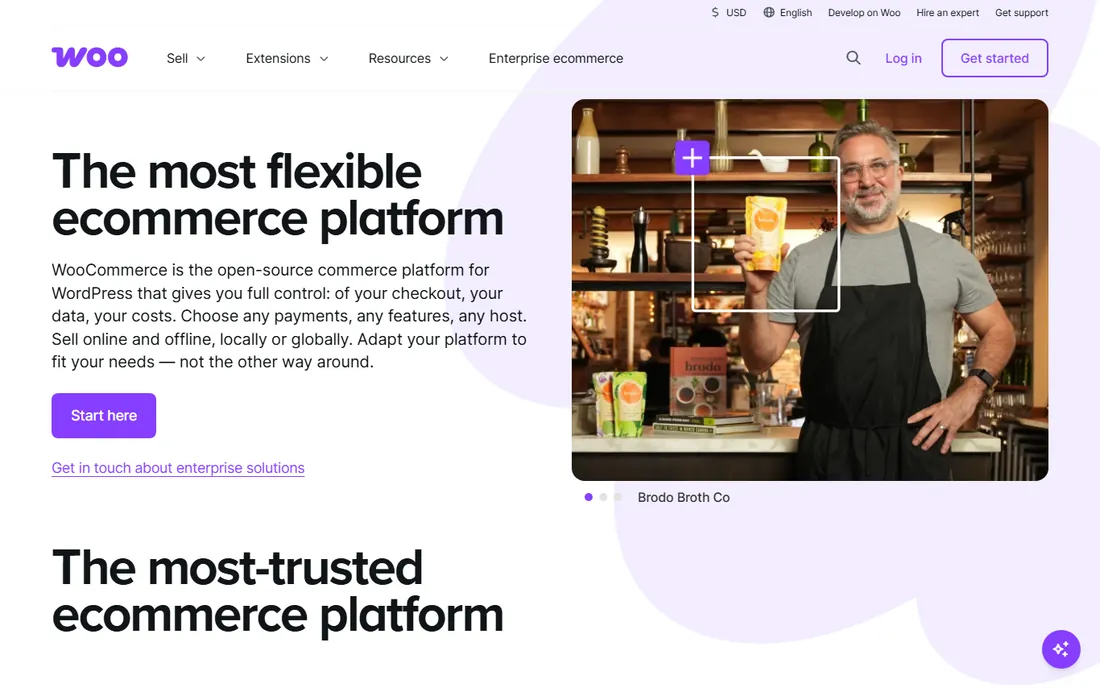
WooCommerce is the open-source commerce platform for WordPress, and its pitch is ownership: your checkout, your data, your hosting, your costs. There is no platform transaction fee and no revenue cap forcing you onto a higher tier. For content-driven brands already invested in WordPress, keeping commerce and content on one stack simplifies the team and the tech.
Free is the beginning of the budget, not the end. Realistic mid-market costs include managed WordPress hosting, premium extensions for subscriptions, bookings, or B2B pricing, a maintained theme, and either an in-house developer or an agency retainer for updates and security. Industry estimates commonly put serious WooCommerce operations at $200 to $1,500 per year for the basics plus development time. The platform scales fine technically, but it scales on your labor. Choose WooCommerce when control matters more than convenience, and go in with eyes open about who handles the 2 a.m. outage.
What we like- No license fees ever
- Complete control of data, checkout, and hosting
- Enormous extension and developer ecosystem
Watch out for- You own performance, security, and updates
- Extension and hosting costs add up fast

#6
Shift4Shop
Best for: US merchants that want enterprise-level features at a small-business price
Visit shift4shop.com
Starting price$41/month (End-to-end plan; $0 platform fee with Shift4 payments)
Free planYes, conditionally (End-to-end plan free for US merchants processing with Shift4)
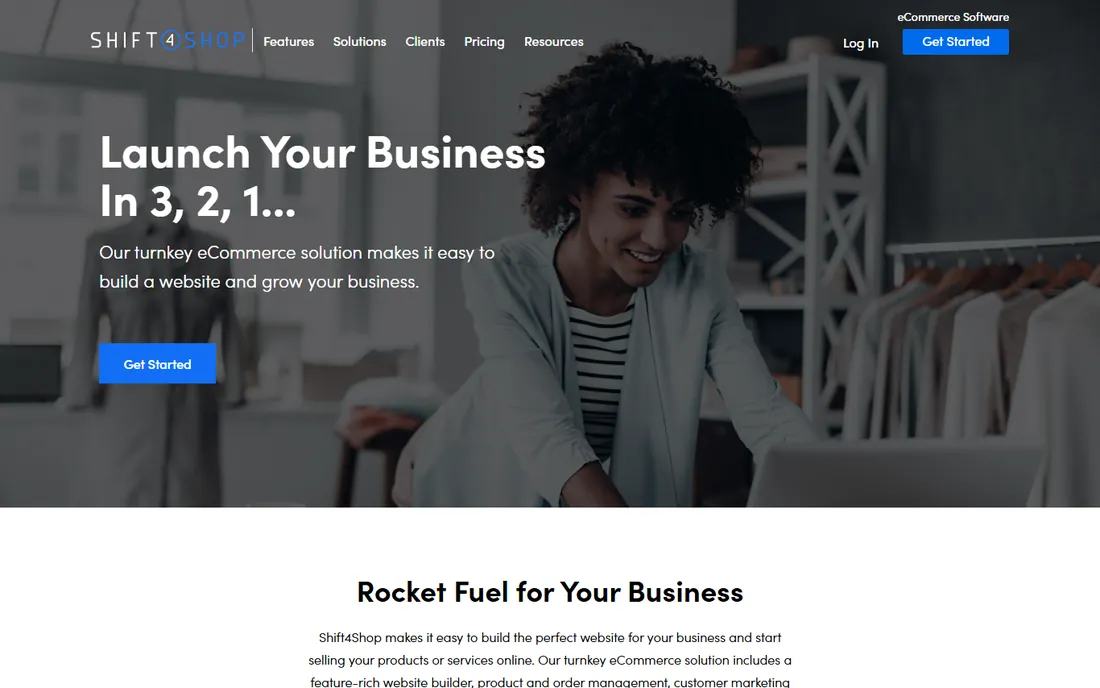
Shift4Shop, formerly 3dcart, has one of the most generous feature-to-price ratios in ecommerce. The End-to-End plan is published at $41 per month with what the company calls a $229 per month value in enterprise features, and US merchants processing through Shift4 can get a $0 platform fee. There are no platform transaction fees, abandoned cart recovery and a real CRM are built in, and the API access is genuinely useful for integrations.
The catch is the fine print. The free tier requires US location and Shift4 payment processing, with minimum processing expectations, and the company's own site shows different prices on different pages, so confirm your exact quote at signup. The admin interface feels dated next to Shopify or BigCommerce, and the app ecosystem is smaller. For a mid-market merchant that values built-in features over polish and can live with the payments lock-in, the value is hard to argue with.
What we like- Very deep built-in feature set with no transaction fees
- 100-plus free themes
- 24/7 US-based support
Watch out for- Dated admin interface
- Free plan is US-only and tied to Shift4 payments
- Pricing pages show conflicting numbers

#7
nopCommerce
Best for: Businesses with .NET development resources that want a free, customizable platform
Visit nopcommerce.com
Starting priceFree (open source, self-hosted)
Free planYes, the platform is free and open source
nopCommerce is the serious open-source alternative for the Microsoft stack: a free ASP.NET Core shopping cart with multi-store, multi-vendor, and B2B capabilities that would cost five figures a year elsewhere. There are no license fees, no transaction fees, and no revenue tiers. For companies already running .NET infrastructure with developers on staff, it can be the cheapest path to a genuinely capable mid-market store.
The constraint is the ecosystem. Fewer developers know nopCommerce than WooCommerce or Magento, fewer agencies specialize in it, and managed hosting for mission-critical stores starts around $199 per month for the vendor's own fully managed private cloud. Budget realistically for implementation and ongoing maintenance, because the license being free does not make the project free. It fits best where .NET expertise already exists in-house.
What we like- Completely free with no transaction or monthly fees
- Multi-store and multi-vendor support
- Strong B2B feature set
Watch out for- Requires ASP.NET hosting and .NET developers, a smaller talent pool than PHP or JavaScript
- You manage everything

#8
Volusion
Best for: Smaller mid-market catalogs that want a simple hosted platform with honest pricing
Visit volusion.com
Starting price$35/month (Personal); Professional $79/month; Business $299/month
Free planNo (14-day free trial, no credit card required)
Volusion is still standing, still independent, and still publishing its prices: Personal at $35 per month, Professional at $79, Business at $299 per month with annual billing, and a custom Prime tier. Every plan includes hosting, SSL, unlimited bandwidth, and no platform transaction fees, and the 14-day trial needs no credit card. For a mid-market business with a focused catalog and a non-technical team, the simplicity is a feature.
The limits are real and automatic. Each plan carries a trailing-twelve-month GMV cap, $50K on Personal, $100K on Professional, $400K on Business, and crossing it moves you up a tier whether you planned for it or not. Personal caps you at 100 products, and API access requires Business. Volusion fits businesses that will stay inside those guardrails; if your catalog or revenue is about to explode past them, price the next tier before you commit.
What we like- Published pricing with no surprises
- No platform transaction fees
- Straightforward admin for non-technical teams
Watch out for- GMV caps trigger automatic upgrades
- 100-product limit on Personal
- Smaller app and integration ecosystem

#9
Wix
Best for: Design-led small-to-mid businesses that want the store and the website on one simple platform
Visit wix.com
Starting price$29/month (Core, billed annually)
Free planYes, but it does not support selling online
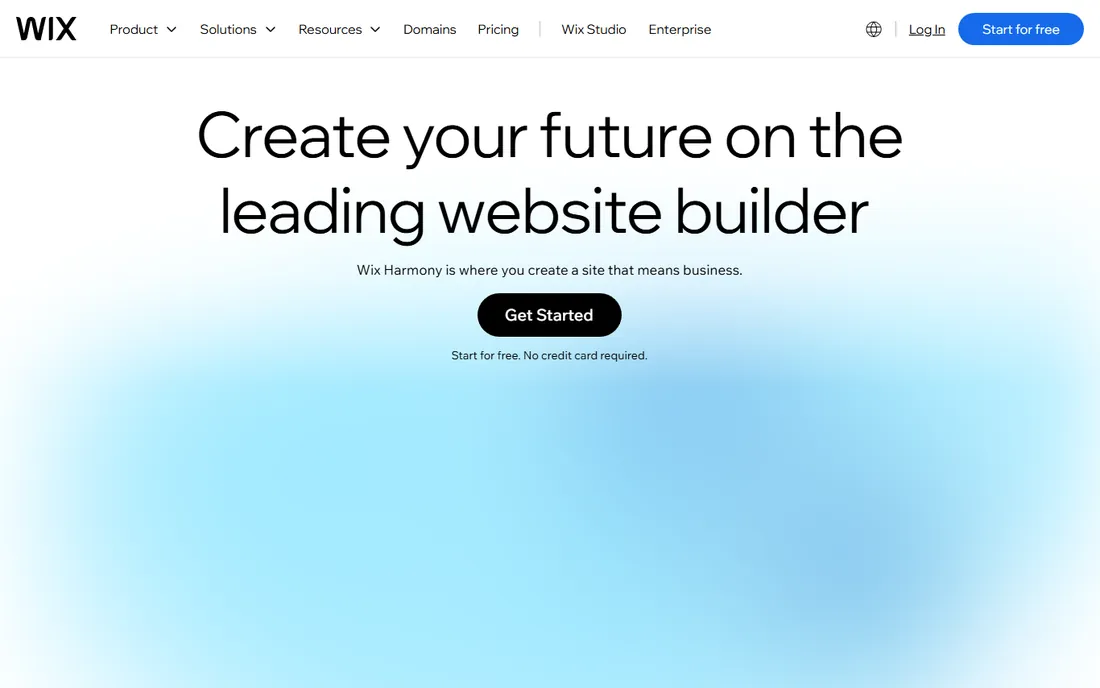
Wix earns its place as the on-ramp for design-conscious businesses. The Core plan at $29 per month billed annually adds basic ecommerce with up to 50,000 products, Business at $39 adds abandoned cart recovery and marketplace selling, and Business Elite at $159 brings advanced ecommerce with unlimited storage. Everything lives in one visual builder, so the marketing site and the store never feel like two systems bolted together.
Be honest about the ceiling. Wix handles straightforward B2C beautifully but lacks the B2B depth of Shopify Plus, BigCommerce, or Adobe Commerce, and very high-volume sellers cannot negotiate processing rates the way they can elsewhere. It is the right choice when simplicity and design control matter most and your catalog logic stays simple. When wholesale portals, complex pricing rules, or ERP integrations enter the picture, plan your migration path early.
What we like- Easiest store builder to learn
- Ecommerce, bookings, and marketing in one dashboard
- No platform transaction fees
- 14-day money-back guarantee
Watch out for- Tops out earlier than dedicated commerce platforms
- Advanced B2B and complex catalog needs will outgrow it
How to choose without getting burned
Start with your actual requirements, not the vendor's demo. Write down your must-haves: B2B or wholesale selling, multi-storefront or multi-brand, subscriptions, international currencies and taxes, ERP or PIM integration, and who on your team will run the store day to day. Then eliminate platforms that cannot do all of them natively or through a well-supported integration. A platform that needs three apps and a developer to meet a core requirement is the wrong platform, no matter how nice the demo looks.
Model the three-year cost, not the sticker price
The subscription is the smallest line item for most mid-market stores. Add payment processing at your real volume, the apps or extensions you will actually install, theme or design costs, implementation or migration fees, and ongoing development or agency support. A $79 per month platform with a $2,000 per month app stack is a $2,079 per month platform. For quote-based platforms like Adobe Commerce and Salesforce Commerce Cloud, insist on the license fee, the GMV measurement definition, renewal terms, and what triggers a price increase, all in writing.
Watch the growth penalties
Several platforms tax your success. BigCommerce and Volusion auto-upgrade plans when trailing sales cross thresholds. Shopify Plus switches high-revenue stores to a variable platform fee. Salesforce charges a percentage of GMV by design. None of these are deal-breakers, but each one needs a line in your financial model. Ask every vendor: what exactly happens to my bill when revenue doubles.
Test the boring parts during the trial
Everyone tests the storefront. Few buyers test returns and refunds, discount stacking, tax configuration for their nexus states, bulk product imports, and the mobile admin experience. These unglamorous workflows are where mid-market stores bleed time daily. Use the trial period, BigCommerce's 15-day trial can even take real payments, to run your actual operational scenarios, not the vendor's happy path.
Quick comparison
| Tool | Best for | Starting price | Free plan |
|---|
| Shopify Plus | Growing brands that want the fastest path to scale without managing infrastructure | From $2,300/month (3-year term); $2,500/month (1-year term) | No |
| BigCommerce | Mid-market stores that want strong built-in features without heavy app reliance | $39/month (Core); Growth $105/month; Scale $399/month | No (15-day free trial, no credit card required) |
| Adobe Commerce | Companies that need deep customization, complex B2B, or full control of hosting | See website (quote-based) | No |
| Salesforce Commerce Cloud | Brands already invested in the Salesforce ecosystem that want unified customer data | See website (percentage of GMV, quote-based) | No |
| WooCommerce | WordPress-centric businesses that want full ownership and unlimited flexibility | Free (open source; hosting and extensions extra) | Yes, the core platform is free |
| Shift4Shop | US merchants that want enterprise-level features at a small-business price | $41/month (End-to-end plan; $0 platform fee with Shift4 payments) | Yes, conditionally (End-to-end plan free for US merchants processing with Shift4) |
| nopCommerce | Businesses with .NET development resources that want a free, customizable platform | Free (open source, self-hosted) | Yes, the platform is free and open source |
| Volusion | Smaller mid-market catalogs that want a simple hosted platform with honest pricing | $35/month (Personal); Professional $79/month; Business $299/month | No (14-day free trial, no credit card required) |
| Wix | Design-led small-to-mid businesses that want the store and the website on one simple platform | $29/month (Core, billed annually) | Yes, but it does not support selling online |
Is your product missing or out of date?
We review this list regularly. Vendors can request a listing, send updated pricing or ask about featured placement.
The most expensive ecommerce mistake is not overpaying for a platform. It is staying on the wrong one eighteen months too long. The symptoms are consistent: checkout workarounds held together by apps, a catalog that takes a developer to update, B2B customers getting a worse experience than retail buyers, and finance surprised by plan upgrades or GMV-based bills. By the time these hurt enough to force a migration, you are replatforming under pressure, which is the most expensive way to do it.
The antidote is a platform review tied to revenue milestones, not calendar years. When you cross roughly $1 million in annual online revenue, audit whether your platform still fits: can it handle your B2B requirements, your international plans, and your integration roadmap for the next three years. The platforms in this guide split cleanly at that line. Wix, Volusion, and Shift4Shop serve the climb up to it. BigCommerce, Shopify Plus, WooCommerce, and nopCommerce carry you through it. Adobe Commerce and Salesforce Commerce Cloud make sense once you are well past it and the complexity justifies the cost.
Migration itself deserves a budget line. Data migration, theme rebuild, SEO redirect mapping, integration rework, and staff retraining commonly cost as much as a year of platform fees on a mid-market store. That is not an argument against switching. It is an argument for choosing with a three-year horizon the first time, so you only pay it once.
Frequently asked questions
What is the best ecommerce platform for a medium-sized business?
There is no single winner. Shopify Plus is the safest all-around choice for growing brands that want managed infrastructure and fast scaling. BigCommerce suits stores that prefer built-in features over apps. Adobe Commerce and Salesforce Commerce Cloud fit complex B2B or enterprise-adjacent needs with larger budgets. WooCommerce and nopCommerce work when you want ownership and have development resources.
How much does an ecommerce platform cost for a mid-size business?
Published starting prices range from free for WooCommerce and nopCommerce to $29 per month for Wix Core, $35 for Volusion Personal, $41 for Shift4Shop, $39 to $399 for BigCommerce's self-serve tiers, and from $2,300 per month for Shopify Plus. Adobe Commerce and Salesforce Commerce Cloud are quote-based and typically start in the tens of thousands per year. Realistic total budgets including apps, processing, and development run several times the subscription.
Is Shopify Plus worth it for a medium business?
Shopify Plus is worth it when your revenue justifies the $2,300 per month starting price and you value managed infrastructure, checkout customization, native B2B, and expansion stores over deep code-level control. Below roughly $1 million in annual revenue, Shopify Advanced at $399 per month or BigCommerce usually delivers better value.
Can I use WooCommerce for a medium-sized business?
Yes, many mid-market stores run on WooCommerce. It works best when you have WordPress expertise in-house or on retainer, because you own hosting, performance, security, and updates. Budget for managed hosting, premium extensions, and ongoing development. If you want a platform where someone else handles infrastructure, choose a SaaS option instead.
What is the cheapest ecommerce platform for a growing business?
WooCommerce and nopCommerce have no license fees, making them cheapest on paper, though hosting and development add real cost. Among hosted platforms, Wix Core at $29 per month and Volusion Personal at $35 per month are the lowest starting prices, and Shift4Shop's End-to-End plan can be free for qualifying US merchants. Compare three-year total cost, not just the monthly fee.
Do I need B2B features in my ecommerce platform?
If wholesalers, distributors, or corporate buyers represent a meaningful share of revenue, yes. Native B2B features like company accounts, custom price lists, quoting, and purchase approvals, found in Shopify Plus, BigCommerce, Adobe Commerce, and nopCommerce, beat bolting wholesale onto a B2C platform with apps. If B2B is a future possibility rather than a current need, choose a platform with a credible B2B roadmap.
How we chose
We started from vendor pricing pages, product documentation, and published feature lists, then checked real-world usage through public reviews on G2, Capterra, and Reddit threads from store owners and developers. We compared B2B capabilities, integration ecosystems, pricing models including GMV-based tiers and automatic upgrades, and fit for medium-sized businesses specifically, excluding platforms aimed only at tiny startups or large enterprises. We did not claim hands-on testing of any product; every price comes from the vendor's own site, and anything we could not verify on a vendor page is listed as "See website."
Sources we checked (16)
- https://www.shopify.com/plus
- https://www.shopify.com/plus/pricing
- https://www.bigcommerce.com
- https://www.bigcommerce.com/pricing
- https://business.adobe.com/products/commerce.html
- https://www.salesforce.com/commerce/pricing/
- https://woocommerce.com
- https://shift4shop.com/
- https://nopcommerce.com
- https://docs.nopcommerce.com/en/installation-and-upgrading/installing-nopcommerce/everleap-fully-managed-hosting.html
- https://volusion.com/
- https://www.volusion.com/pricing/
- https://www.wix.com
- https://wix.com/pricing
- https://elogic.co/blog/magento-pricing-explained/
- https://elogic.co/blog/what-is-salesforce-commerce-cloud/
Is your product missing or out of date?
We review this list regularly. Vendors can request a listing, send updated pricing or ask about featured placement.

Shihab Mia · Founder, Rankite
Shihab has spent more than a decade helping SaaS and e-commerce brands grow through search. He writes Rankite's software buying guides from pricing pages, documentation and public user reviews. More about Shihab.