How we make this list: we compare pricing pages, product documentation and public user reviews. Rankite is independent; if a vendor ever pays for a featured spot, that listing is clearly labeled Partner.
Key takeaways
- Manufacturers on SAP or Microsoft Dynamics should shortlist Sana Commerce first: it reads pricing and inventory live from the ERP instead of syncing copies overnight.
- OroCommerce is the deepest pure-B2B platform here, with corporate account hierarchies, custom pricing and workflows built in rather than bolted on.
- BigCommerce (B2B Edition) and Shopify Plus get you live fastest if your needs are standard; Adobe Commerce and Spryker fit complex, custom builds with developer resources.
- nopCommerce is free and open source with real B2B features, which makes it the budget path for manufacturers with in-house technical staff.
Quick comparison
| Tool | Best for | Starting price | Free plan |
|---|
 BigCommerce BigCommerce | Manufacturers wanting SaaS simplicity with real B2B features | From $29/month (standard plans); B2B Edition custom-quoted | Free trial |
 Shopify Plus Shopify Plus | Manufacturers that also sell direct and want a polished storefront | From $2,500/month | No |
 Adobe Commerce Adobe Commerce | Complex catalogs and custom B2B builds with developer resources | See website (custom quote, typically enterprise-level) | No |
 OroCommerce OroCommerce | Manufacturers wanting the deepest purpose-built B2B feature set | See website (custom quote) | No |
 Sana Commerce Sana Commerce | Manufacturers running SAP or Microsoft Dynamics ERPs | See website (custom quote) | No |
 Spryker Spryker | Enterprises wanting composable, API-first commerce they fully control | See website (custom quote) | No |
 Cloudfy Cloudfy | Mid-market manufacturers wanting fast ERP-integrated ordering | See website (custom quote) | No |
 nopCommerce nopCommerce | Manufacturers with developers who want a free, own-it-outright platform | Free (open source; no monthly or transaction fees) | Yes (the platform itself is free) |
 WooCommerce WooCommerce | Small manufacturers already running WordPress | Free (plugin; hosting and extensions extra) | Yes (core plugin free) |
Is your product missing or out of date?
We review this list regularly. Vendors can request a listing, send updated pricing or ask about featured placement.
Your biggest distributor still emails a spreadsheet on Monday, your sales rep retypes it into the ERP on Tuesday, and the customer calls on Thursday asking why the price changed. Every manufacturer knows this workflow, and every manufacturer knows it does not scale. A B2B ecommerce platform moves that ordering online with customer-specific pricing, credit limits, approvals and ERP sync built in. The nine platforms below are the ones manufacturers actually buy, from SaaS tools you launch in weeks to open-source platforms you own outright.
#1
BigCommerce
Best for: Manufacturers wanting SaaS simplicity with real B2B features
Visit bigcommerce.com
Starting priceFrom $29/month (standard plans); B2B Edition custom-quoted
Free planFree trial
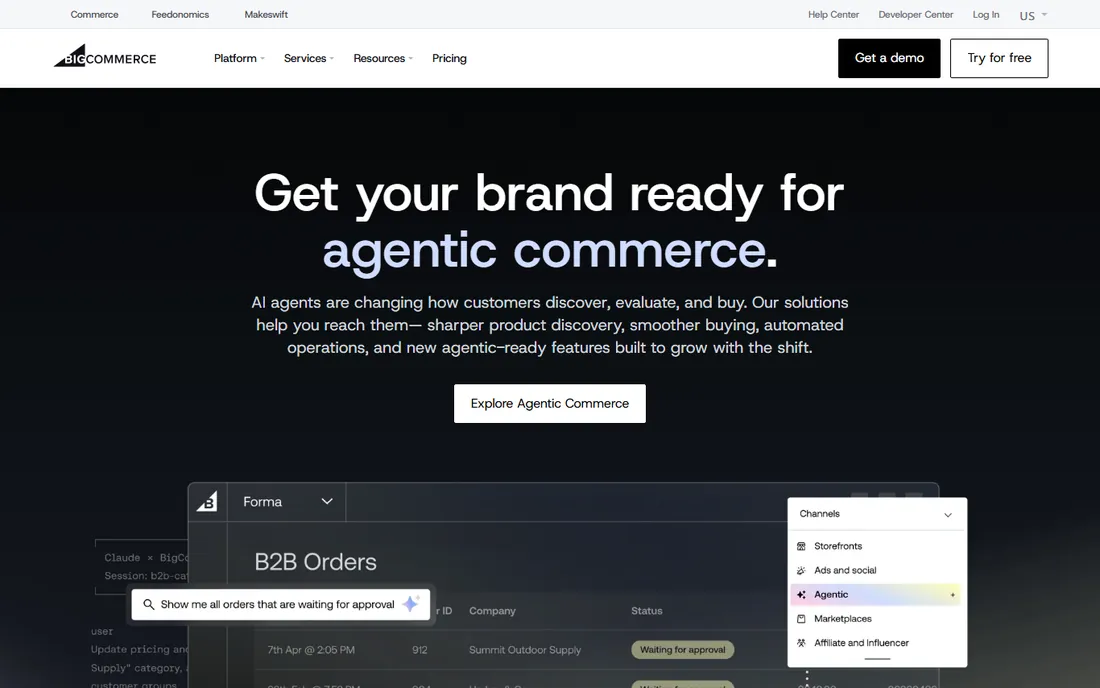
BigCommerce is the fastest credible route to B2B ecommerce for manufacturers without an IT department. The standard plans (from $29 per month) handle catalog, checkout and payments, while B2B Edition layers on the manufacturer essentials: buyer company accounts with multiple users and roles, customer-specific price lists, quote-to-order workflows and quick bulk reordering. Because it is SaaS, upgrades, security and PCI compliance are BigCommerce's problem.
The trade-off is ceiling. Truly exotic requirements (multi-level approval chains tied to ERP credit data, complex configurators) get easier on Adobe Commerce or OroCommerce. And B2B Edition pricing is quote-based, so budget for a sales conversation. For the large middle of manufacturers whose needs are standard B2B, this is the pragmatic pick.
What we like- B2B Edition adds company accounts, custom price lists, quote management and bulk ordering on a SaaS platform
- No transaction fees on any plan
- Strong API for ERP integration
Watch out for- The deepest B2B features require the custom-quoted B2B Edition
- Very complex product configuration still favors Adobe or Oro
- Annual sales thresholds can push growing stores into higher tiers
#2
Shopify Plus
Best for: Manufacturers that also sell direct and want a polished storefront
Visit shopify.com
Starting priceFrom $2,500/month
Free planNo

Shopify Plus wins when the buying experience matters as much as the ordering logic. If you sell to distributors and also run a DTC brand store, Plus lets both live on one platform with company accounts, volume pricing and net payment terms for trade buyers. The theme and app ecosystem means you launch something beautiful in weeks, and every freelancer knows Shopify.
The price is the filter: $2,500 per month starting, before the apps and agency hours a B2B build usually needs. And Shopify's B2B features, while real, are younger than the specialists': manufacturers with heavy ERP-driven pricing logic often find Sana or Oro a more natural fit. Choose Shopify when storefront quality and speed beat back-office depth.
What we like- The best-looking storefronts with the least effort
- B2B features (company profiles, price lists, payment terms) built into Plus
- Huge app ecosystem and easy hiring
Watch out for- $2,500 per month entry price before apps and development
- B2B depth lags OroCommerce and Sana on ERP-native workflows
- Complex manufacturing catalogs often need workarounds
Starting priceSee website (custom quote, typically enterprise-level)
Free planNo
Adobe Commerce (the platform formerly known as Magento) is the custom-build champion. If your catalog has 100,000 SKUs with parametric attributes, your pricing rules fill a spreadsheet, and your buyers need requisition lists and multi-step approvals, Adobe bends further than any SaaS tool. The B2B module covers company accounts, quotes, credit and order approvals natively.
The cost is real money and real complexity: licenses are quote-based at enterprise levels, implementations run into six figures for complex builds, and you need developers who know the platform. Manufacturers with standard needs should not pay this tax. Those with genuinely complex requirements and the team to manage it get the most flexible platform here.
What we like- Enormous flexibility for custom catalogs, pricing rules and workflows
- Mature B2B module (quotes, requisition lists, company accounts)
- Huge partner and extension ecosystem
Watch out for- Quote-based enterprise pricing with significant implementation costs
- Needs experienced developers or an agency
- Upgrades and maintenance are your responsibility
#4
OroCommerce
Best for: Manufacturers wanting the deepest purpose-built B2B feature set
Visit oroinc.com
Starting priceSee website (custom quote)
Free planNo
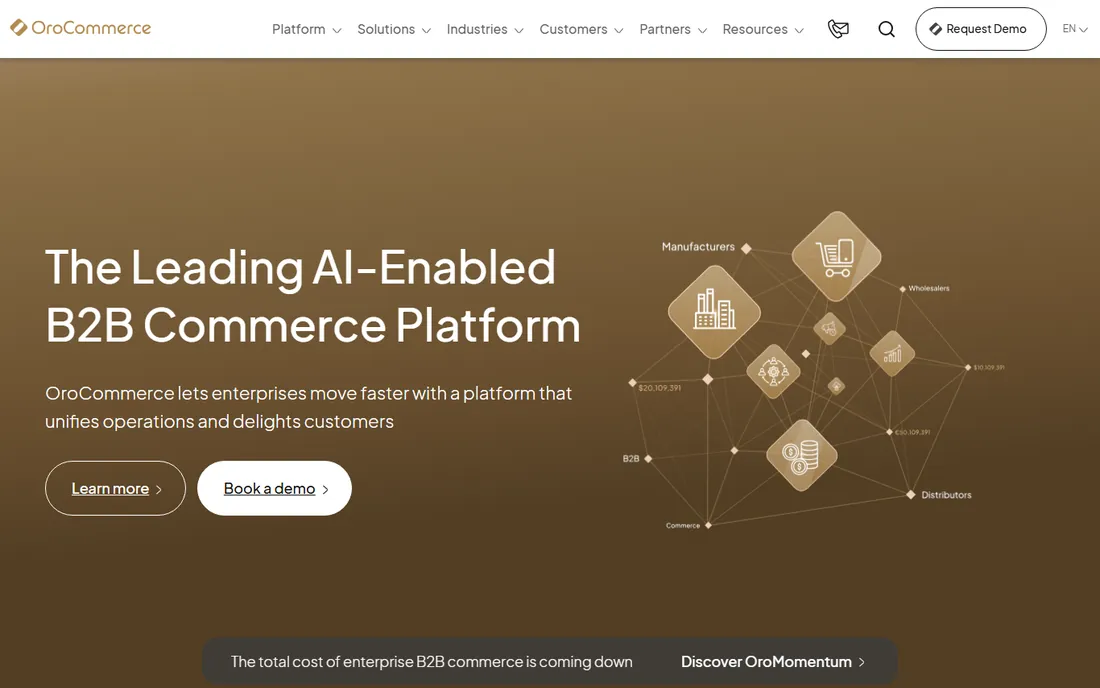
OroCommerce was built B2B-first rather than adapted from B2C, and it shows in the details: customer account hierarchies that mirror how manufacturers actually sell, pricing that varies by account and contract, workflow automation for approvals, and multi-site management for brands and regions. The platform bundles CRM, content and marketplace capabilities instead of making you integrate them.
Its customers skew toward industrial manufacturers and distributors with real complexity (the site names companies in batteries, steel, chemicals and building materials). Pricing is quote-based and implementations are partner-led, so this is a considered purchase, not a signup. For B2B depth per dollar of license, it leads this list.
What we like- B2B modeled at the core: corporate account hierarchies, custom pricing, workflows and multi-website support
- Built-in CRM, CMS and marketplace features
- Strong manufacturing and distribution customer base
Watch out for- Quote-based pricing
- The depth that specialists love can overwhelm simpler needs
- Implementation partners matter, so vet them
Starting priceSee website (custom quote)
Free planNo
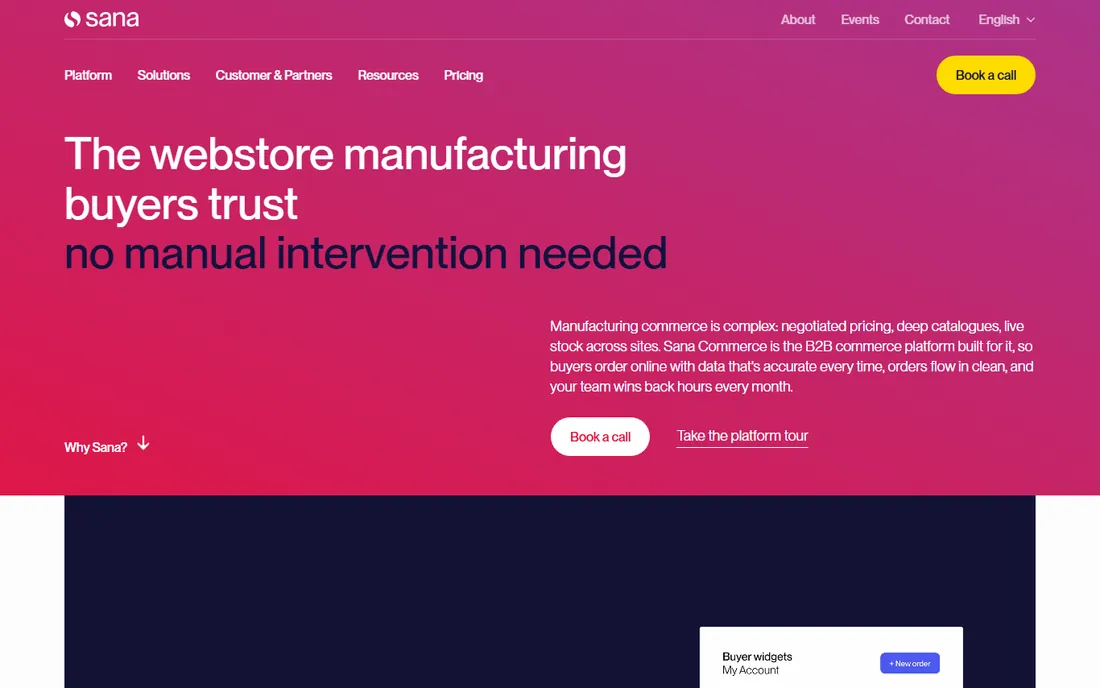
Sana Commerce's entire pitch is one architectural decision: instead of keeping its own copy of your data and syncing with the ERP, it reads pricing, stock, customer terms and order history directly from SAP or Microsoft Dynamics the moment a buyer loads the page. Your online store and your back office can never disagree, because there is only one source of truth. No middleware to license, host or maintain.
That focus is also the limit: if you run Epicor, Infor, NetSuite or anything else, look elsewhere. For the huge population of manufacturers on SAP ECC, S/4HANA or Dynamics 365, though, this is the shortest path to a store that respects the pricing and credit logic already in the ERP. Quote-based pricing; expect a discovery process that maps your ERP setup.
What we like- Reads pricing, inventory and customer data live from SAP or Dynamics with no middleware and no overnight sync
- Customer-specific prices and terms always match the ERP
- Strong fit for machinery, automotive and industrial manufacturers
Watch out for- Only for SAP and Microsoft Dynamics shops
- Quote-based pricing
- Less useful if your ERP is something else
#6
Spryker
Best for: Enterprises wanting composable, API-first commerce they fully control
Visit spryker.com
Starting priceSee website (custom quote)
Free planNo
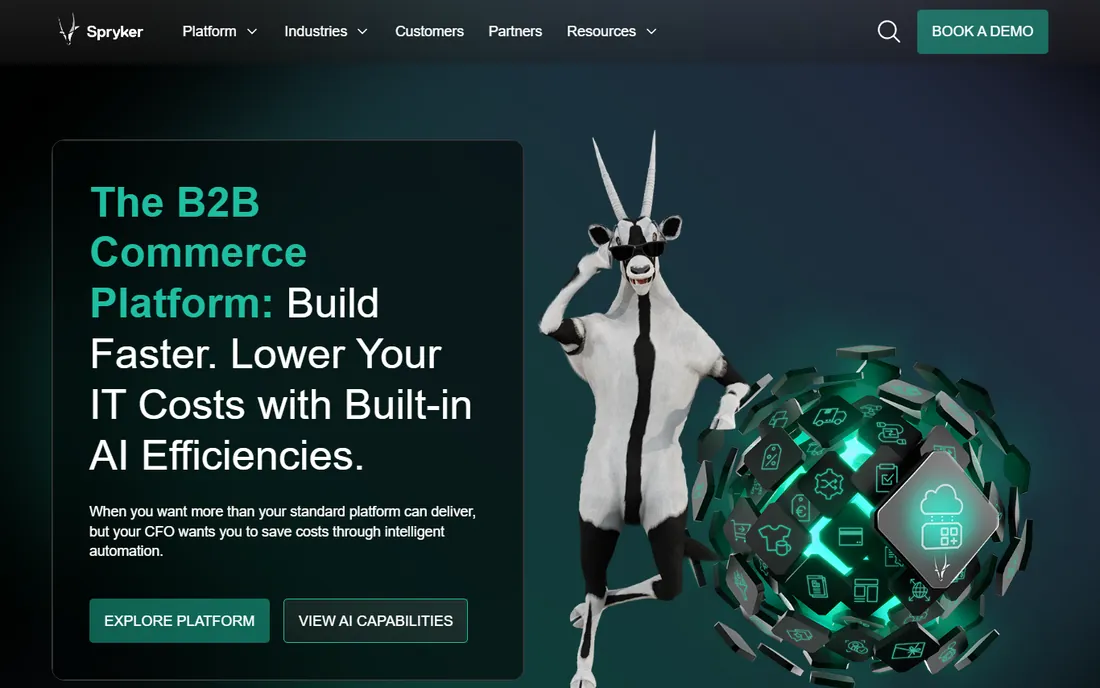
Spryker is the engineer's choice: a composable commerce platform where you assemble exactly the capabilities you need from modules and APIs. Headless by design, it connects to any storefront, portal or device, and the state machine lets you configure custom workflows without hard-coding them. Manufacturers running multiple business models (B2B portal plus distributor marketplace plus DTC) on one platform are its natural audience.
This is an enterprise purchase in every sense: custom quotes, significant implementation, and a development team that stays involved. If your requirements fit inside BigCommerce B2B or Sana, you do not need this. If they genuinely do not, Spryker gives architects the most control of any platform here.
What we like- Headless and composable by design: connect any storefront or touchpoint via API
- Modular architecture adapts to unusual business models
- Strong for marketplaces and complex B2B scenarios
Watch out for- Quote-based enterprise pricing
- Requires serious development resources
- Overkill for standard B2B needs
#7
Cloudfy
Best for: Mid-market manufacturers wanting fast ERP-integrated ordering
Visit cloudfy.com
Starting priceSee website (custom quote)
Free planNo

Cloudfy does one thing: B2B order portals for manufacturers, wholesalers and distributors, with ERP integration as the core competence rather than an afterthought. Seventeen years in the niche shows in the details: complex ordering, account-specific pricing, credit terms and custom contracts work out of the box, and the company talks about implementations in weeks rather than quarters.
The trade-off is vendor size: you are betting on a specialist, not a platform giant, so diligence on support and roadmap matters. Pricing is quote-based. For mid-market manufacturers who want to stop retyping emailed orders without an enterprise project, Cloudfy deserves a demo alongside Sana and BigCommerce.
What we like- Built exclusively for B2B over 17 years: manufacturers, wholesalers, distributors
- Bi-directional ERP sync with implementations measured in weeks
- Account-specific pricing, credit terms and contracts handled natively
Watch out for- Smaller vendor than the hyperscalers, so vet longevity and support
- Quote-based pricing
- Less suited to DTC-heavy strategies
#8
nopCommerce
Best for: Manufacturers with developers who want a free, own-it-outright platform
Visit nopcommerce.com
Starting priceFree (open source; no monthly or transaction fees)
Free planYes (the platform itself is free)
nopCommerce is the open-source answer: a free ASP.NET commerce platform with no monthly fees and no transaction fees, which you host and customize without limits. Multi-store and multi-vendor features handle B2B-plus-B2C scenarios, and the marketplace offers plugins, themes and language packs for the gaps.
Free software still costs engineering time. You own hosting, security, PCI scope and upgrades, and B2B features like customer-specific pricing need configuration rather than arriving prebuilt. For manufacturers with in-house .NET developers, the total cost still undercuts SaaS enterprise tiers quickly. Without developers, the SaaS options above are cheaper in practice.
What we like- Completely free with no transaction fees and unlimited customization
- Multi-store and multi-vendor features cover B2B and B2C
- Large community and 800+ integrations
Watch out for- You host, secure and maintain it
- B2B depth needs configuration and plugins rather than arriving turnkey
- ASP.NET stack narrows the hiring pool versus PHP
Starting priceFree (plugin; hosting and extensions extra)
Free planYes (core plugin free)
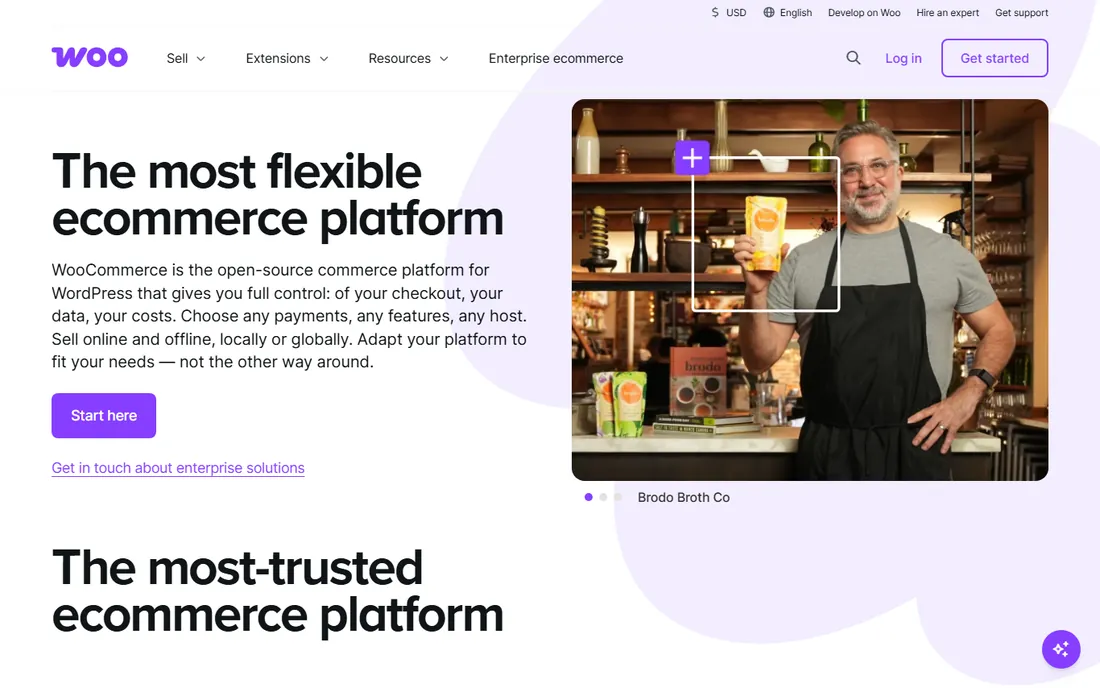
WooCommerce makes sense for one specific manufacturer: the small one already on WordPress. The core plugin is free, and B2B extensions add wholesale roles, tiered pricing, bulk order forms and tax exemptions. Your marketing site and your ordering portal share one CMS, and any WordPress freelancer can help.
The honest math: the extensions, hosting, security and maintenance add up, and a catalog past tens of thousands of SKUs with complex pricing rules strains the architecture. This is the entry ramp to B2B ecommerce, not the destination for complex manufacturers. Start here if you are small and WordPress-based; plan to graduate to BigCommerce, Sana or Oro as complexity grows.
What we like- Free core plugin on the WordPress you may already run
- B2B extensions add wholesale pricing, bulk order forms and tax exemption handling
- Enormous freelancer pool
Watch out for- B2B features come from paid extensions that add up
- Performance and maintenance are yours
- Scaling past mid-size catalogs needs careful engineering
SaaS, open source, or ERP-native: pick your architecture
These nine platforms cluster into three architectures, and the choice shapes everything downstream. SaaS platforms (BigCommerce, Shopify Plus, Cloudfy) get you live fastest with the vendor handling hosting, security and upgrades; you trade control and pay forever. Open-source platforms (Adobe Commerce, nopCommerce, WooCommerce) give you ownership and unlimited customization; you trade speed and carry the maintenance burden.
ERP-native (Sana Commerce) is the third path: the commerce layer lives on your ERP's data in real time. For manufacturers whose pricing, inventory and credit logic already live in SAP or Dynamics, this eliminates an entire category of sync bugs and duplicate data entry. The catch is ERP lock: it only works with the ERPs it supports. Decide the architecture before comparing features, because features do not transfer across architectures.
What to check before you sign
Start with your ERP, not the demo. List the systems a platform must integrate with (ERP, CRM, PIM, tax, shipping), and demand a live integration demo against your data, not slides. Customer-specific pricing is the number one B2B requirement manufacturers under-specify: confirm exactly how price lists, contracts, volume tiers and credit limits flow from your ERP to the storefront.
Then price the whole project, not the license. Implementation, data migration, integrations, training and first-year support routinely exceed the license fee on quote-based platforms. Ask for three reference customers in manufacturing at your revenue size, and call them. Finally, confirm who owns the data and what exit looks like: export formats, contract terms and what happens to your store if you leave.
How we chose
We focused on platforms manufacturers actually buy for B2B selling: SaaS B2B editions, enterprise commerce suites, ERP-native tools, and the open-source options. For each we opened the vendor's homepage, confirmed current B2B positioning and checked pricing on the vendor's own pages. Quote-based enterprise pricing is marked "See website" rather than estimated. Manufacturer fit was judged on B2B-specific features (account hierarchies, custom pricing, ERP integration) rather than generic storefront polish.
Frequently asked questions
What is the best ecommerce platform for a manufacturing company?
It depends on your ERP and complexity. Sana Commerce fits SAP and Dynamics shops best; OroCommerce offers the deepest pure-B2B feature set; BigCommerce B2B Edition is the fastest SaaS route; nopCommerce is the free open-source path. Shortlist two or three and demo them against your actual ERP data.
How much does B2B ecommerce cost for manufacturers?
SaaS starts around $29 per month (BigCommerce standard) to $2,500 per month (Shopify Plus), with B2B editions quote-based. Enterprise platforms (Adobe Commerce, OroCommerce, Sana, Spryker) are custom-quoted, and implementations often exceed the license cost. Open source (nopCommerce, WooCommerce) is free to license but needs hosting and development.
Should manufacturers use Shopify for B2B?
Shopify Plus works when the storefront experience and speed matter most, especially for brands selling both B2B and direct. Its B2B features are real but younger than the specialists'. Manufacturers with heavy ERP-driven pricing logic usually fit better on Sana Commerce or OroCommerce.
What does ERP integration mean for B2B ecommerce?
It means the storefront reads and writes the same data as your back office: pricing, inventory, customer terms, orders and invoices. The best integrations (like Sana's direct ERP connection) show live ERP data with no sync delay; weaker ones copy data overnight, which creates mismatches.
Can a manufacturer start with WooCommerce and upgrade later?
Yes, and many do. WooCommerce plus B2B extensions is a reasonable entry ramp for small manufacturers on WordPress. Plan the upgrade path early: keep product data clean and structured so migration to BigCommerce, Sana or Oro does not require rebuilding your catalog from spreadsheets.
Do B2B platforms support quotes, approvals and credit limits?
The serious ones do. Look for quote-to-order workflows, requisition lists, multi-user company accounts with roles, approval chains, and credit limit enforcement at checkout. Confirm these against your actual sales process in the demo, because every vendor defines "approvals" slightly differently.
Sources we checked (9)
- https://www.bigcommerce.com
- https://www.shopify.com
- https://business.adobe.com
- https://oroinc.com
- https://sana-commerce.com/
- https://cloudfy.com/
- https://www.nopcommerce.com/
- https://spryker.com
- https://woocommerce.com
Is your product missing or out of date?
We review this list regularly. Vendors can request a listing, send updated pricing or ask about featured placement.

Shihab Mia · Founder, Rankite
Shihab has spent more than a decade helping SaaS and e-commerce brands grow through search. He writes Rankite's software buying guides from pricing pages, documentation and public user reviews. More about Shihab.