How we make this list: we compare pricing pages, product documentation and public user reviews. Rankite is independent; if a vendor ever pays for a featured spot, that listing is clearly labeled Partner.
Key takeaways
- Gorgias is the strongest fit for Shopify and BigCommerce stores that want support and sales handled in one thread, with pricing tied to ticket volume instead of seats.
- Tidio and Crisp give small stores the cheapest way in, with free plans that cover the basics and paid plans that stay under $50 a month.
- Intercom and Zendesk suit larger operations investing in AI agents, automation, and cross-channel reporting, at a noticeably higher per-seat price.
- If your team already works inside a helpdesk, Freshchat, Help Scout, and Re:amaze add chat without forcing a second system on anyone.
Quick comparison
| Tool | Best for | Starting price | Free plan |
|---|
 Tidio Tidio | Small stores wanting chat plus AI on a budget | From $29/month | Yes |
 Gorgias Gorgias | Shopify and BigCommerce support in one thread | From $10/month | Free trial (7 days) |
 Intercom Intercom | Larger brands investing in AI support | From $29/seat/month | Free trial (14 days) |
 LiveChat LiveChat | A proven chat widget, now with AI agents | From $19/user/month (billed annually) | Free trial (14 days) |
 Zendesk Zendesk | Teams already running Zendesk for support | From $55/agent/month (Suite Team, billed annually) | Free trial |
 Freshchat Freshchat | Teams that want a free start with room to grow | Free ($0 for up to 10 agents) | Yes |
 Crisp Crisp | Small teams that dislike per-seat pricing | From $45 per workspace/month | Yes |
 Re:amaze Re:amaze | Small ecommerce teams living in chat | From $29/team member/month | Free trial |
 Help Scout Help Scout | Email-first teams adding chat carefully | From $25/user/month | Yes |
Is your product missing or out of date?
We review this list regularly. Vendors can request a listing, send updated pricing or ask about featured placement.
#1
Tidio
Best for: Small stores wanting chat plus AI on a budget
Visit tidio.com
Starting priceFrom $29/month
Free planYes
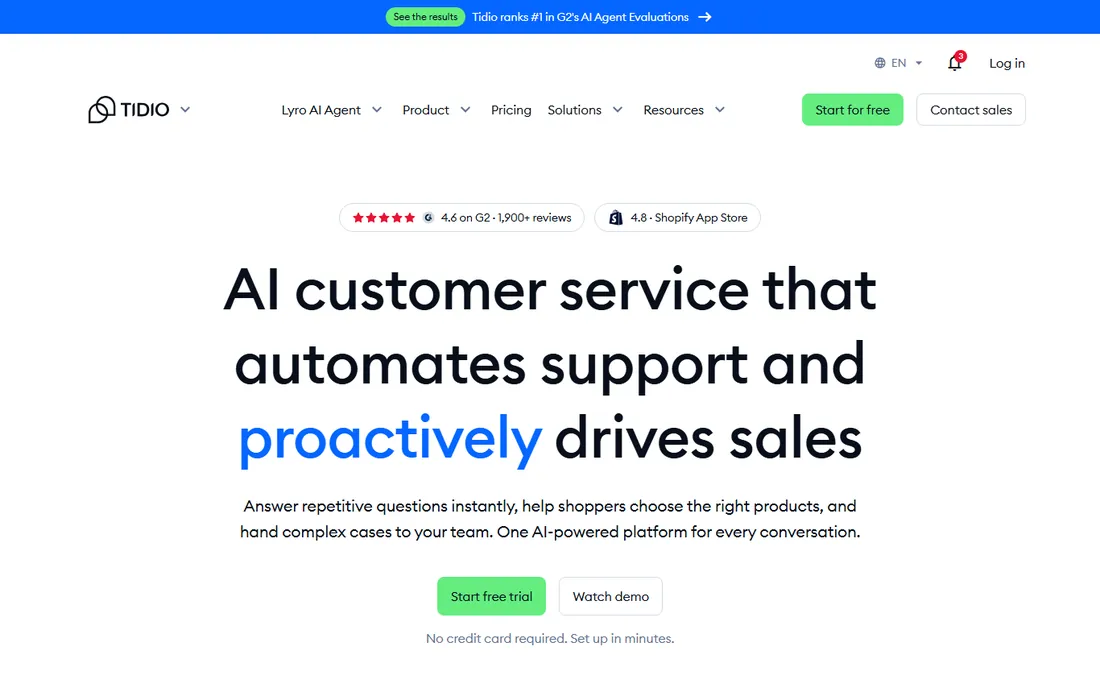
Tidio is the default recommendation for a small store that needs to look responsive this week, not next quarter. The widget goes live in minutes on Shopify or WordPress, and the free plan handles real conversations rather than acting as a demo. That matters because most stores at this size just need to answer "where is my order" and "do you ship to my state" without hiring anyone new.
The paid plans start at $29 a month and add Lyro, the AI agent, plus chatbot flows that can recommend products and recover abandoned carts. Watch the pricing model before you commit. Tidio charges on billable conversations, so a store with heavy chat traffic can climb tiers faster than a per-seat tool would. For low to moderate volume, though, it is hard to beat on value.
What we like- Free plan covers the basics
- Lyro AI agent answers routine questions
- Fast setup on Shopify and WordPress
Watch out for- Paid plans scale with conversation volume
- Deeper automation sits on higher tiers
Starting priceFrom $10/month
Free planFree trial (7 days)

Gorgias treats chat as one channel inside a support ticket, not as a standalone widget. When a shopper messages you, the agent sees order history, tracking status, and refund options in the same sidebar, and can edit an order or issue a refund without switching tabs. That single design choice removes most of the back-and-forth that makes chat support slow.
Pricing starts at $10 a month and scales on the number of tickets, which suits stores with seasonal spikes better than per-seat pricing does. You are not paying for agents who sit idle in February. The tradeoff is that a store with high contact volume can see the bill climb, and the platform assumes you run on Shopify or BigCommerce. Outside those two, much of the magic disappears.
What we like- Built for ecommerce ticket workflows
- Order data appears beside every chat
- Ticket-based pricing
Watch out for- Costs rise with ticket volume
- More than a light store needs
Starting priceFrom $29/seat/month
Free planFree trial (14 days)
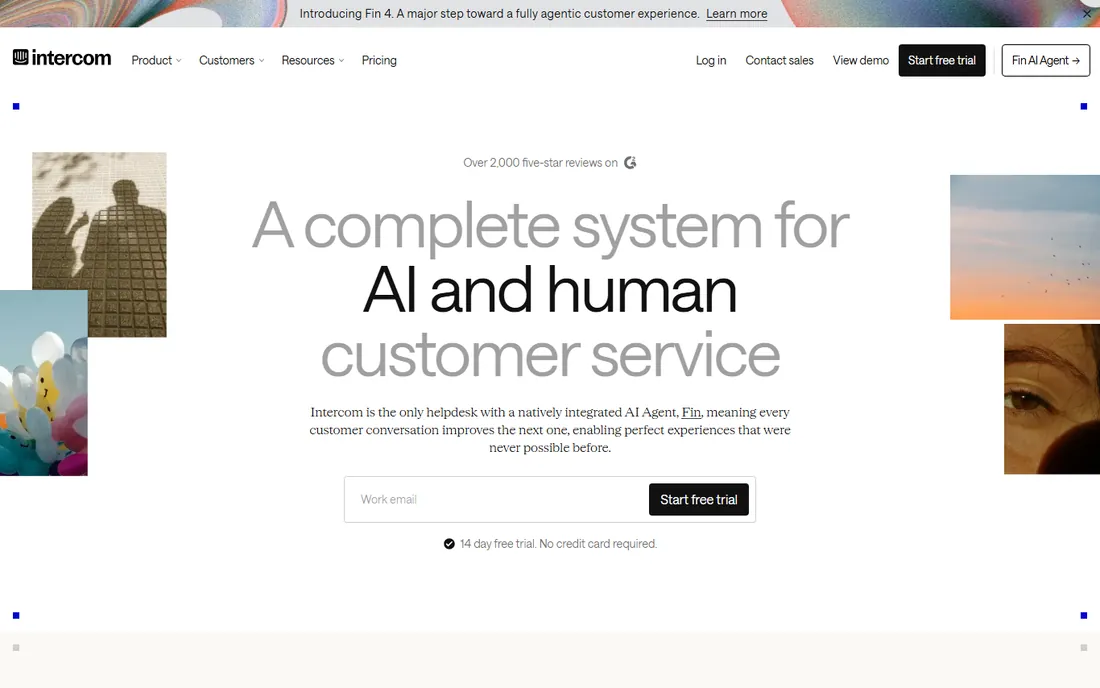
Intercom plays a different game from the chat widgets above it on this list. It is a full customer communication platform where chat is the front door to AI agents, automated workflows, and detailed reporting. The Fin agent answers routine questions on its own, and human agents step in only when the conversation needs judgment. For a brand doing serious volume, that division of labor is the whole point.
The pricing reflects it. Plans start at $29 per seat per month, and AI resolutions cost extra per resolution. A lean team with good deflection can keep costs sane, but the bill grows with both headcount and automation usage. Implementation also takes effort. This is not a tool you configure in an afternoon. It fits companies with someone owning support operations, not a founder doing it between other jobs.
What we like- Fin AI agent resolves a large share of chats
- Strong automation and reporting
- Wide integration library
Watch out for- Per-seat plus per-resolution pricing adds up
- Setup needs real configuration work
Starting priceFrom $19/user/month (billed annually)
Free planFree trial (14 days)
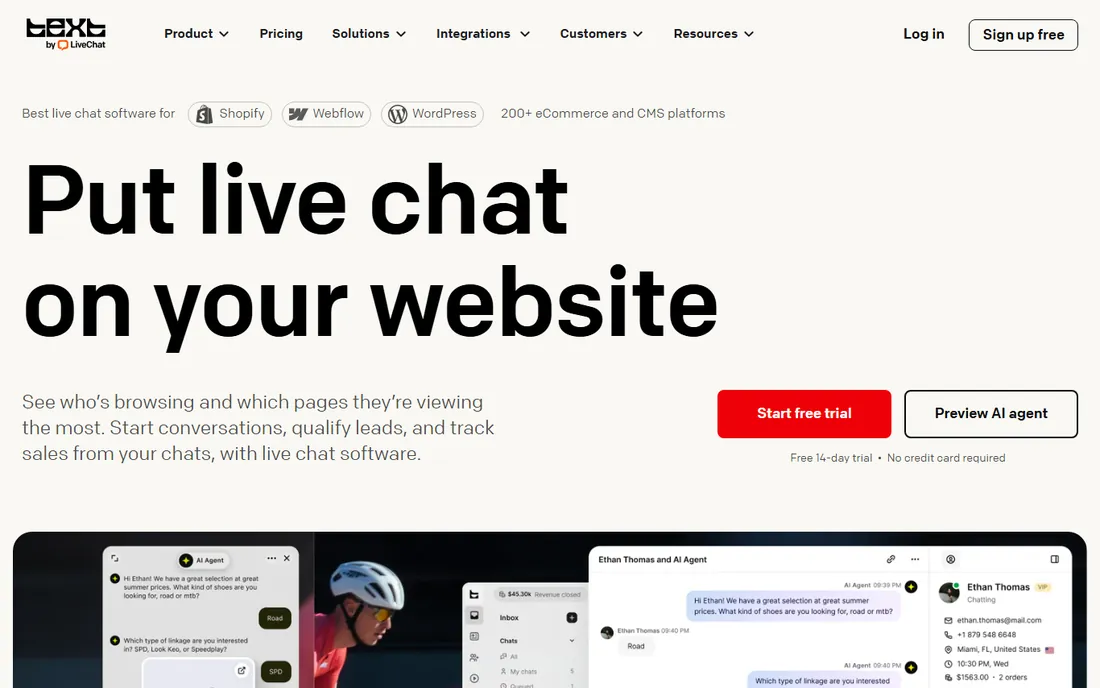
LiveChat spent years as the reference point for website chat, and the widget still loads fast and behaves well on mobile. What changed is the packaging. New trials now start on Text, the company's new product, which bundles the chat widget with a shared inbox, ticketing, and an AI agent under one subscription. Existing LiveChat customers keep their plans, but new buyers should evaluate Text on its own terms.
Plans start at $19 per user per month on annual billing, with a 14-day trial that does not ask for a credit card. The entry tier includes a small allowance of AI resolutions each month, which is enough to test whether automated answers actually deflect tickets for your store. If your needs are simple and you liked the classic LiveChat widget, confirm the Text feature set covers them before you commit.
What we like- Fast and reliable widget
- New Text product adds AI agents and a shared inbox
- 14-day trial with no card required
Watch out for- New signups are routed to Text plans with a different feature mix
- Advanced reporting sits on higher tiers
Starting priceFrom $55/agent/month (Suite Team, billed annually)
Free planFree trial

Nobody buys Zendesk just for a chat bubble. You buy it because support already runs there: email, social, phone, and messaging in one queue, with AI agents deflecting the routine work and Copilot helping agents write better replies. The chat widget inherits all of that, including the reporting that larger teams need to staff properly.
The price is the honest catch. The Suite Team plan, which includes messaging and live chat, starts at $55 per agent per month on annual billing. For a store that only wants chat on its product pages, that is overkill. For a company with a real support operation and plans to grow it, the per-agent cost buys a platform that smaller tools cannot match.
What we like- Chat and messaging inside a complete support suite
- AI agents and Copilot assistance
- Proven at large scale
Watch out for- Expensive when you only need chat
- The full suite takes admin work to configure well
Starting priceFree ($0 for up to 10 agents)
Free planYes
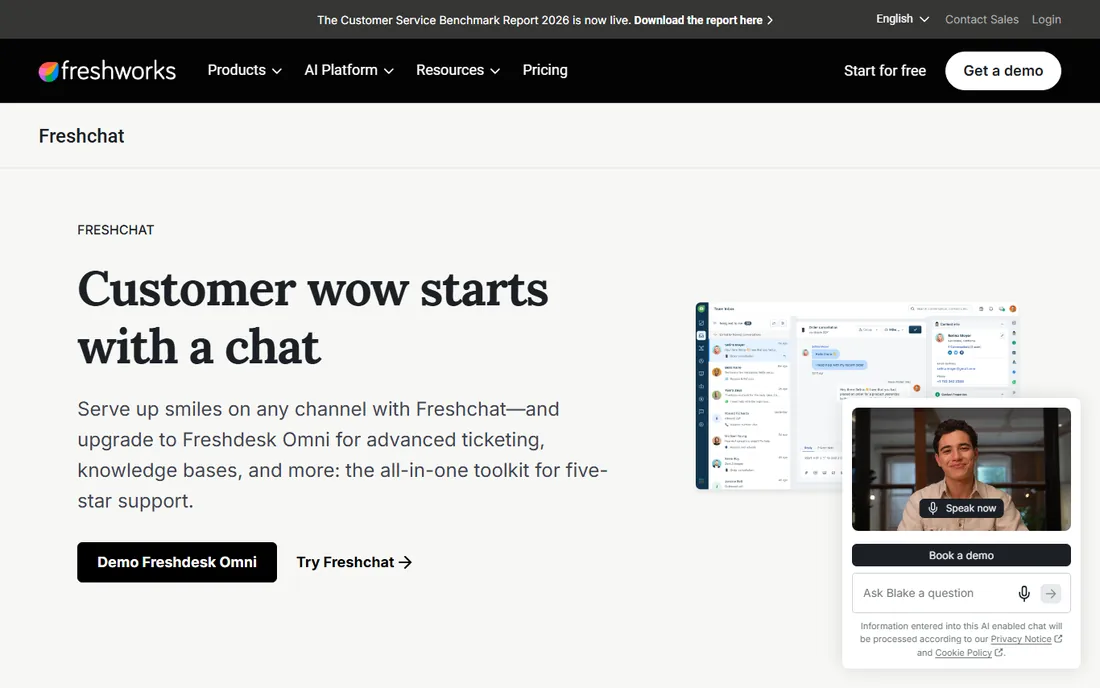
Freshchat's free plan is unusually generous: up to 10 agents at no cost, which covers most small stores completely. The interface feels current, the widget is easy to restyle, and the basics (canned replies, chat routing, mobile apps) all work without paying. For a store testing whether live chat moves the needle, this is the lowest-risk experiment available.
Growth starts at $19 per agent per month on annual billing and adds the Freddy AI agent, deeper automation, and better reporting. The step up is reasonable, but know that the most capable AI and analytics features sit higher still. Freshchat also benefits from the wider Freshworks family, so if you later need a CRM or helpdesk from the same vendor, the pieces connect.
What we like- Generous free tier for up to 10 agents
- Clean and modern interface
- Freddy AI on paid plans
Watch out for- Stronger features need the paid tiers
- Integration marketplace is smaller than the leaders
Starting priceFrom $45 per workspace/month
Free planYes
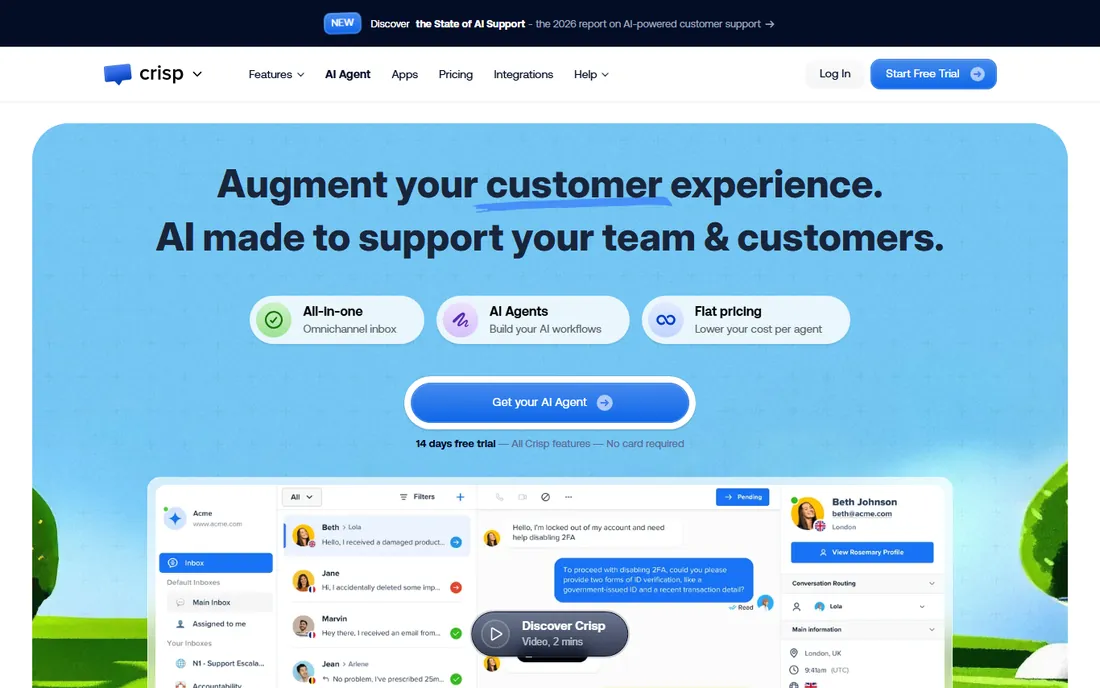
Crisp charges per workspace, not per agent, which changes the math for growing teams. The Mini plan at $45 a month covers several seats, so adding your fifth or sixth support person does not raise the bill. That flat structure, plus unlimited conversations on paid plans, makes costs predictable in a way per-seat and per-conversation tools cannot match.
The product itself is a tidy shared inbox: website chat, email, and social messages in one place, with a knowledge base, chatbot builder, and co-browsing for hands-on troubleshooting. The free plan covers two agents, enough for a founder-led store. Larger teams should note the limits: the ticketing side is lighter than a true helpdesk, and the most advanced automations sit on the higher tiers.
What we like- Flat per-workspace pricing instead of per agent
- One inbox for chat, email, and social
- Co-browsing built in
Watch out for- Helpdesk depth trails Zendesk
- AI and automation are lighter than the AI-first tools
Starting priceFrom $29/team member/month
Free planFree trial
Re:amaze never tried to be everything to everyone. It is a shared inbox for small ecommerce teams, with chat, email, Facebook, and Instagram messages landing in one queue, and a chat widget tuned for stores. The automation covers the greatest hits: order status replies, FAQ deflection, and proactive messages on the cart page. Setup is measured in hours, not weeks.
Pricing starts at $29 per team member per month on the Basic plan, with a flat $59-a-month Starter option for very small teams. That simplicity is the appeal and the limit. If you outgrow it and need advanced analytics, workforce management, or a deep integration catalog, you will be shopping again. For a store doing under a few hundred tickets a month, it may be all you ever need.
What we like- Designed around online stores
- Shared inbox for chat, email, and social
- Clear and simple pricing
Watch out for- Fewer integrations than bigger platforms
- Reporting is basic next to enterprise tools
Starting priceFrom $25/user/month
Free planYes
Help Scout built its reputation on shared inboxes that feel like personal email, and its chat product follows the same philosophy. Conversations read like messages from a person, not a ticket system, which suits brands that compete on warmth. The free plan covers the basics for tiny teams, and the Standard plan starts at $25 per user per month.
Be clear about what you are buying. Chat here extends an email-first support style; it does not match the AI agents, proactive selling tools, or deep ecommerce workflows of the chat-native options above. If most of your support already happens over email and you want chat as a polite addition, Help Scout fits. If chat is your main sales channel, look higher up this list.
What we like- Human, email-like tone for support
- Free plan for very small teams
- Simple to administer
Watch out for- Chat is a side product, not the core
- Automation is lighter than chat-first rivals
How we chose
We started from vendor homepages and current pricing pages, checking each tool's actual plans, free tiers, and trial terms rather than relying on review-site summaries. Then we weighed the features that matter specifically to online stores: order data inside the chat, cart recovery, platform integrations for Shopify and BigCommerce, and pricing models that make sense at store scale. We read public reviews on G2 and Capterra for recurring complaints, and we favored tools with a clear fit for a defined buyer over tools trying to serve everyone.
What to check before you buy
A chat tool fails in predictable ways. Run through these checks with your actual store before you sign anything.
Match the tool to your ticket mix
Count how your support conversations break down. If most are "where is my order" and "can I change my address," you want order data in the sidebar and one-click actions, which points toward Gorgias or Re:amaze. If most are pre-sale questions on product pages, a proactive chat widget with product recommendations matters more, which favors Tidio, LiveChat, or Intercom.
Model the pricing on your numbers
Per-seat, per-conversation, and per-ticket pricing behave very differently as you grow. A five-person team on a $25-per-seat tool pays $125 a month, flat. The same team on a conversation-based tool might pay $29 in a quiet month and triple that in December. Pull your last quarter of chat volume and run it through each vendor's calculator before committing.
Test the mobile experience yourself
Most store traffic is mobile, and many chat widgets still feel like desktop afterthoughts. Open your store on your phone, start a chat, and try to complete a real task like tracking an order. If the widget covers the buy button or the keyboard behaves badly, shoppers will not use it no matter how good the agent side looks.
Confirm the AI answers from your content
AI agents are only as good as the knowledge behind them. Ask each vendor how the agent learns: does it read your help center, your product pages, or just a FAQ you upload? A tool that grounds answers in your actual catalog will deflect more tickets than one working from a generic script.
How the pricing models actually work
Chat pricing falls into four patterns, and the cheapest headline number is rarely the cheapest at your volume. Per-seat pricing (Intercom, Zendesk, Help Scout) is predictable: you pay for each agent, and usage does not move the bill. Per-workspace pricing (Crisp) is even simpler for growing teams, since new hires do not add cost. Usage-based pricing (Tidio's conversation tiers, Gorgias's ticket tiers, Intercom's AI resolutions) starts cheap and scales with success, which is fair but demands forecasting. Freemium (Freshchat's 10-agent free tier, Crisp's 2-seat free plan) is genuinely free at small scale, with the upgrade path clearly marked. Map your expected headcount and conversation volume for the next year, then pick the model that stays flat while you grow.
Frequently asked questions
Do I need live chat if I already have email support?
Email works for problems that can wait a day. Chat catches the shopper who is deciding right now, which is why stores see it lift conversion on product and checkout pages. The two channels serve different moments, and most stores end up running both.
What is the difference between live chat and an AI chatbot?
Live chat connects the shopper to a person. An AI chatbot answers on its own from your content and hands off to a person when it cannot help. Most tools on this list now bundle both, so the real question is how good the handoff feels when the bot gives up.
How much should a small store pay for live chat?
Anywhere from nothing to about $100 a month. Free plans from Freshchat, Tidio, and Crisp cover early-stage stores, and the first paid tiers from Tidio, Re:amaze, and LiveChat sit between $19 and $45 a month. Pay more only when chat volume or AI usage justifies it.
Will live chat slow down my store?
A well-built widget loads asynchronously and adds little to page weight. Problems come from widgets that load large scripts synchronously or fire tracking on every page. Test your page speed with the widget installed before you judge, and most vendors publish installation guides for keeping it light.
Can chat software handle order lookups and returns?
The ecommerce-focused tools can. Gorgias, Re:amaze, and Tidio's Shopify integrations pull order status into the conversation, and some let agents edit orders or start returns without leaving the chat. Generic chat widgets can link to your order pages but will not take action on the order itself.
Sources we checked (11)
- https://www.tidio.com/
- https://gorgias.com/
- https://www.intercom.com
- https://www.livechat.com/
- https://www.livechat.com/pricing/
- https://www.zendesk.com/
- https://www.zendesk.com/pricing/
- https://www.freshworks.com/live-chat-software/
- https://crisp.chat
- https://www.reamaze.com
- https://www.helpscout.com/
Is your product missing or out of date?
We review this list regularly. Vendors can request a listing, send updated pricing or ask about featured placement.

Shihab Mia · Founder, Rankite
Shihab has spent more than a decade helping SaaS and e-commerce brands grow through search. He writes Rankite's software buying guides from pricing pages, documentation and public user reviews. More about Shihab.