How we make this list: we compare pricing pages, product documentation and public user reviews. Rankite is independent; if a vendor ever pays for a featured spot, that listing is clearly labeled Partner.
Key takeaways
- Product analytics (Mixpanel, Amplitude, PostHog, Heap) and web analytics (GA4, Matomo) answer different questions; most companies eventually need one of each.
- Free tiers are generous in 2026: Amplitude offers 2M events per month free, PostHog is free for 97% of its users, and GA4 is completely free.
- PostHog is the best value for engineering-led teams, bundling analytics, session replay, feature flags, and experiments in one platform.
- Heap, now part of Contentsquare, remains the only serious option for teams that cannot instrument every event manually.
- Segment is not analytics at all; it is the data pipeline that feeds clean event data into everything else.
Quick comparison
| Tool | Best for | Starting price | Free plan |
|---|
 Mixpanel Mixpanel | product teams wanting fast, clean funnels | See website | Yes |
 Amplitude Amplitude | enterprises with data teams | See website | Yes |
 PostHog PostHog | all-in-one for engineering-led teams | See website | Yes |
 Heap Heap | autocapture without manual instrumentation | See website | Yes |
 Pendo Pendo | analytics plus in-app guidance | See website | No |
 Matomo Matomo | privacy-first analytics with data ownership | See website | Yes |
 Google Analytics Google Analytics | free web and marketing analytics | Free | Yes |
 Segment Segment | customer data pipeline to every tool | See website | Yes |
Is your product missing or out of date?
We review this list regularly. Vendors can request a listing, send updated pricing or ask about featured placement.
The best data tracking software
Data tracking software is really two categories wearing one name. Product analytics tools track what users do inside your app. Web analytics tools track who visits your site and where they came from. The eight tools below cover both, plus the data pipeline that connects them, so you can build the tracking stack your actual questions require.
Starting priceSee website
Free planYes
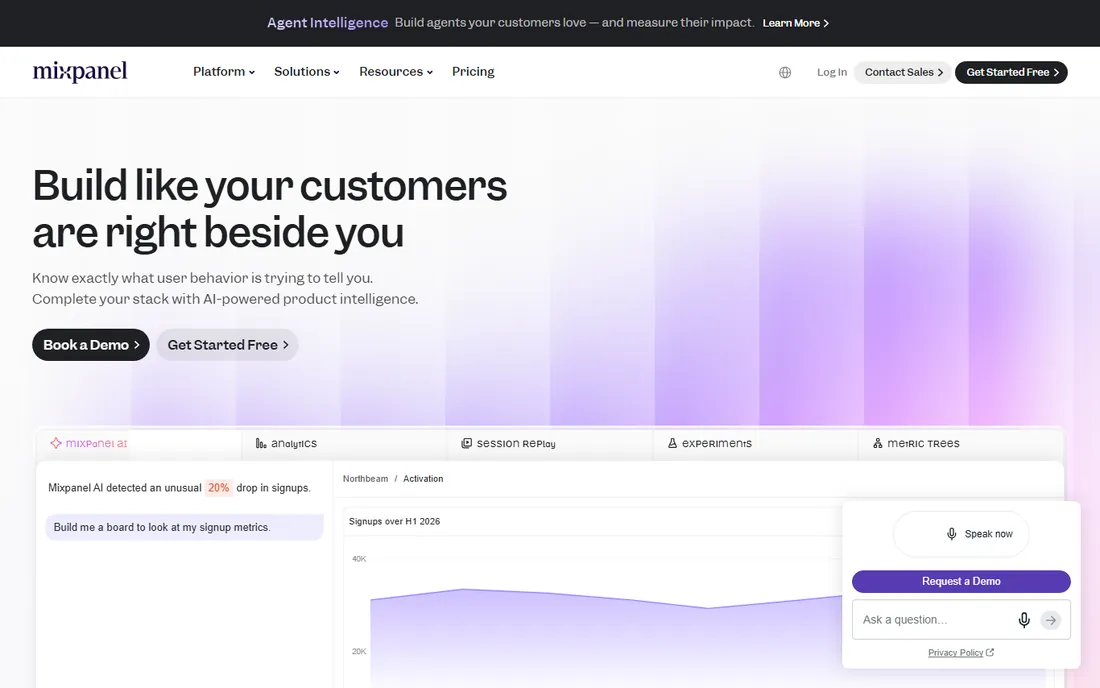
Mixpanel has been the default product analytics choice for over a decade, and the 2026 product keeps it there for good reason. The query speed is genuinely best in class, the funnel and cohort interfaces are the ones product managers learn fastest, and the free tier covers most pre-revenue SaaS products comfortably. When a PM needs to answer "where do users drop off" without filing an engineering ticket, Mixpanel is the tool they reach for.
The platform has expanded into an AI-era product intelligence suite with feature flags, experiments, and agent integrations via MCP, so it now touches more of the workflow than pure analytics. The honest catch is the bill at scale. Usage-based pricing past the free tier climbs fast, mid-volume SaaS products routinely land in four figures monthly, and the add-ons for replay and experimentation are separate meters. It is the best daily-use analytics tool, priced like one.
What we like- Fastest queries and cleanest funnel UX in the category
- Generous free tier
- AI features like Spark AI and MCP integrations for modern workflows
Watch out for- Usage-based pricing scales steeply past the free tier
- Session replay and experiments cost extra
Starting priceSee website
Free planYes
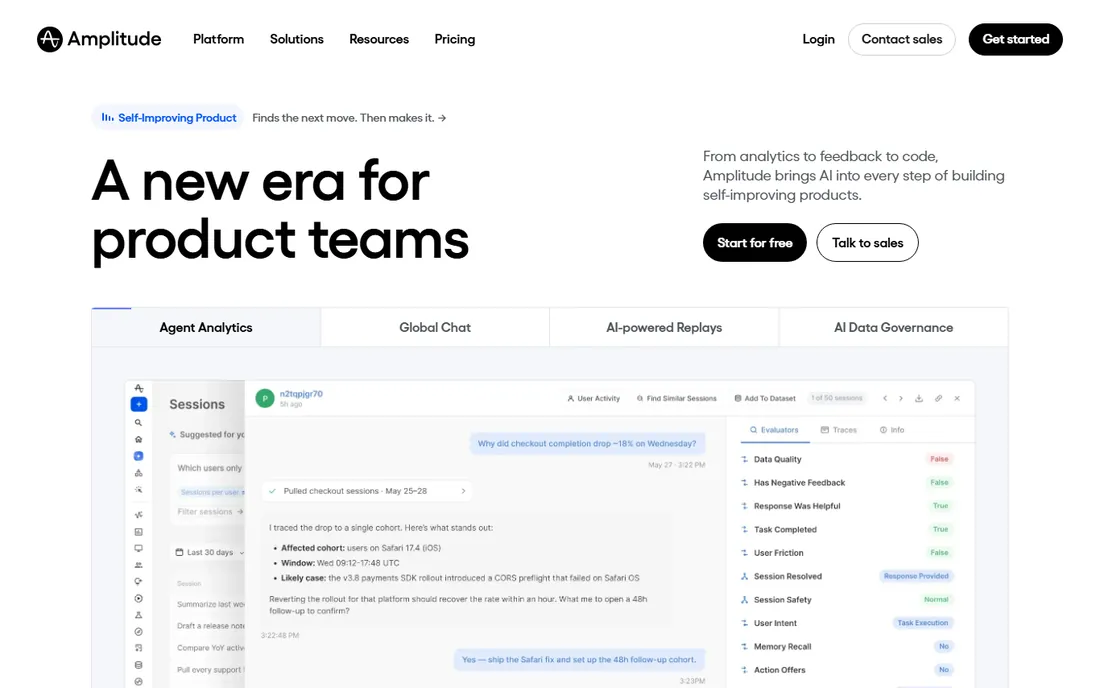
Amplitude is the enterprise answer to product analytics. Where Mixpanel optimizes for the PM's daily workflow, Amplitude goes deeper: behavioral cohorts, predictive forecasting, anomaly detection, and warehouse-native queries that data teams can build on. The 2026 positioning as an AI-powered platform, with agents that resolve issues and surface insights, pushes it further toward autonomous analytics.
The free tier is legitimately the most generous in the category at 2M events per month, and the vendor states that plainly on its homepage. That makes Amplitude viable for startups long before they need its enterprise features. The honest catch is the learning curve and the pricing cliff. The depth that data teams love overwhelms teams without analysts, and anything beyond the self-serve Plus tier moves into custom quotes. Choose Amplitude when you have the team to wield it.
What we like- Most generous free tier at 2M events per month
- Predictive analytics and anomaly detection lead the category
- Strongest data governance story
Watch out for- Real depth requires a data team to exploit
- Enterprise pricing beyond Plus is a sales conversation
Starting priceSee website
Free planYes
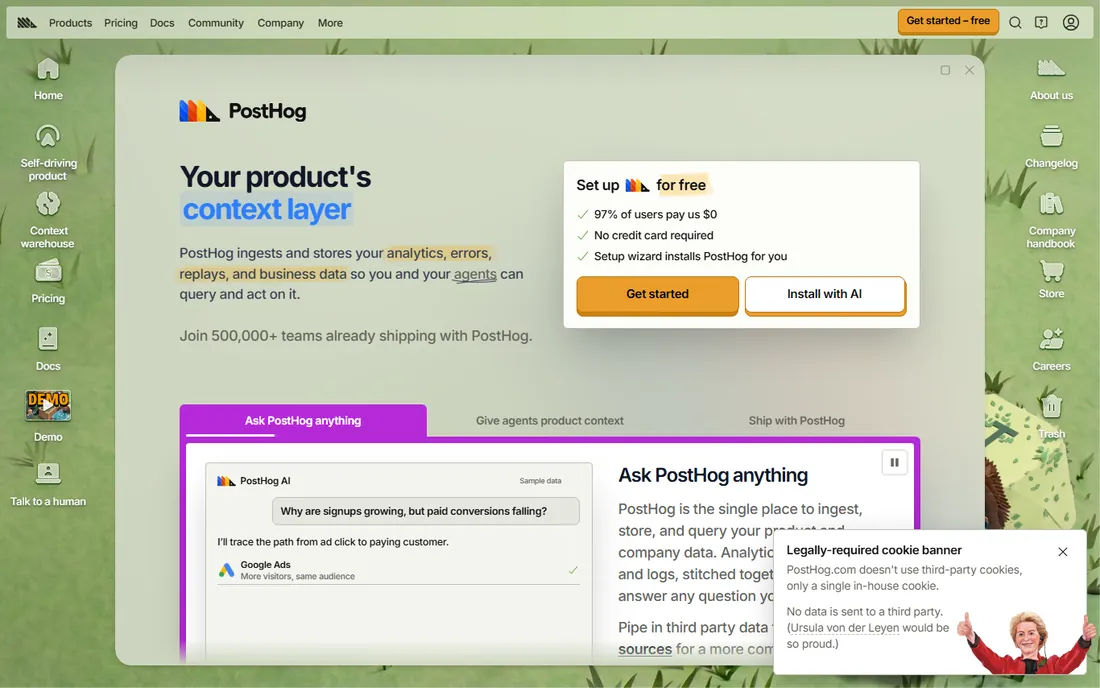
PostHog is the engineer's analytics platform, and its pitch is consolidation. Instead of paying for Mixpanel plus FullStory plus LaunchDarkly plus an experimentation tool, you get product analytics, session replay, feature flags, A/B testing, surveys, error tracking, and a data warehouse in one open-source platform. The vendor says 97% of users pay $0, which tells you how far the free tiers stretch.
Self-hosting is the differentiator nobody else offers: run the whole platform on your own infrastructure for compliance or data residency. The HogQL query layer gives technical teams SQL access to everything. The honest catch is polish. The funnel and cohort experience is good but not Mixpanel-good for non-technical daily users, and the per-product usage pricing, while cheap at scale, takes real effort to forecast. For engineering-led startups, it is the obvious default.
What we like- Analytics, session replay, feature flags, experiments, and surveys in one
- Open source with self-hosting option
- 97% of users pay nothing
Watch out for- Funnel UX less polished than Mixpanel
- Per-product usage meters complicate bill forecasting
#4
Heap
Best for: autocapture without manual instrumentation
Visit heap.io
Starting priceSee website
Free planYes
Heap's founding insight remains unmatched: instead of requiring engineers to instrument every button and page, one snippet captures everything automatically, and you define events retroactively whenever a question arises. For teams without dedicated analytics engineering, that removes the biggest bottleneck in data tracking. The data science layer then surfaces friction points and conversion correlates you did not know to look for.
Heap now operates as part of Contentsquare, combining autocapture analytics with experience analytics. The integrated session replay directs you to the exact moment that matters rather than making you watch hours of footage. The honest catch is the acquisition: Heap's independent future is over, and long-term roadmap decisions now serve Contentsquare's strategy. Autocapture is also a double-edged sword at scale, since capturing everything means paying for everything.
What we like- Automatic capture of every interaction with no manual event tagging
- Retroactive analysis of anything you captured
- Integrated session replay
Watch out for- Now part of Contentsquare, so the independent roadmap is history
- Autocapture datasets get expensive at scale
Starting priceSee website
Free planNo
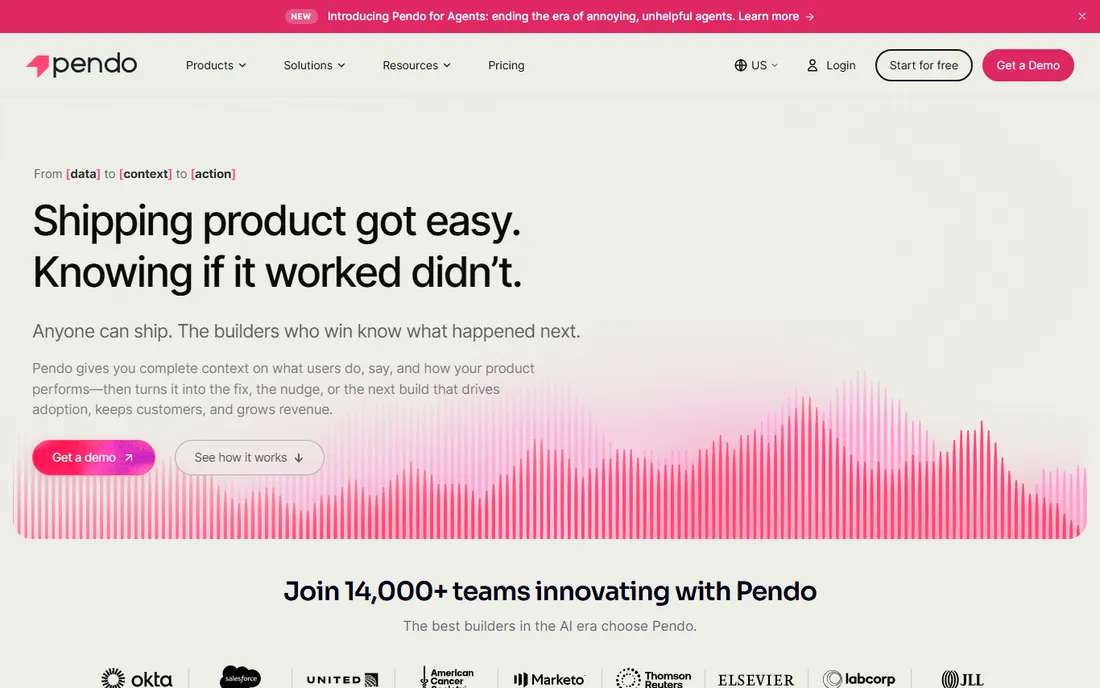
Pendo's thesis is that knowing what users do is only half the job; the other half is doing something about it inside the product. Its platform pairs product analytics with no-code in-app guides, onboarding flows, and messaging, so the insight "users miss this feature" becomes a targeted guide the same afternoon. For product-led growth teams, that closed loop is the whole value proposition.
The 2026 platform extends into agent analytics for AI-era products, and the install is famously light, often under an hour. With 14,000-plus teams including large enterprises, the enterprise credentials are solid. The honest catch is pricing accessibility. There is no meaningful free tier for serious use, pricing is quote-based, and the platform's breadth means you are buying into a product experience suite rather than a focused analytics tool. It earns its keep when adoption and onboarding are the metrics that matter.
What we like- Closes the loop from analytics to in-app guides and messaging
- Strong for onboarding and feature adoption
- Enterprise-grade with 14,000-plus teams
Watch out for- Quote-based pricing with no real free tier
- Broader than pure analytics, which adds complexity
Starting priceSee website
Free planYes
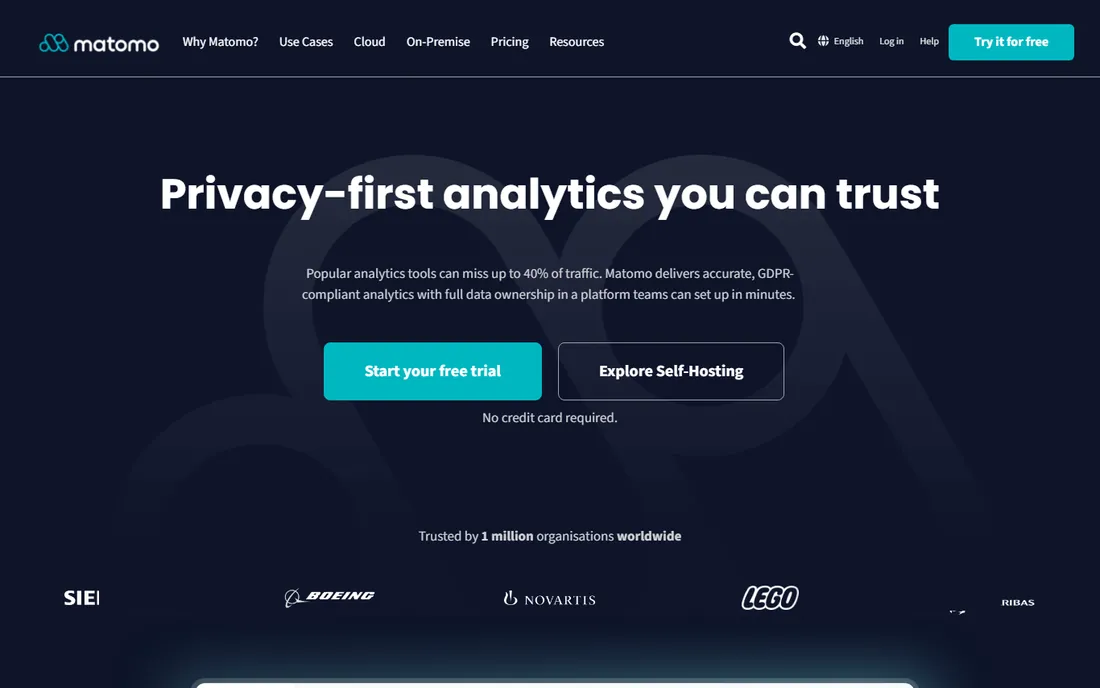
Matomo is the answer for organizations that refuse to hand their visitor data to Google. It is a full web analytics platform, free and open source when self-hosted, with heatmaps, session recordings, funnels, A/B testing, and e-commerce tracking included rather than gated behind tiers. Privacy is architectural: cookieless tracking, data anonymization, and on-premise hosting keep you compliant with GDPR without consent-banner contortions.
The Google Analytics importer makes migration practical, and the vendor offers a 21-day cloud trial for teams that prefer managed hosting. Over a million organizations use it, including public sector bodies that cannot legally use GA. The honest catch is operational. Self-hosting is free but it is still hosting, with updates and maintenance on you. And as product analytics, Matomo covers web behavior well but does not match the event-depth of Mixpanel or Amplitude for app analytics.
What we like- Free and open source when self-hosted, with 100% data ownership
- GDPR-compliant by design with cookieless options
- GA importer eases migration
Watch out for- Self-hosting requires maintenance
- Product analytics depth trails Mixpanel and Amplitude
Starting priceFree
Free planYes
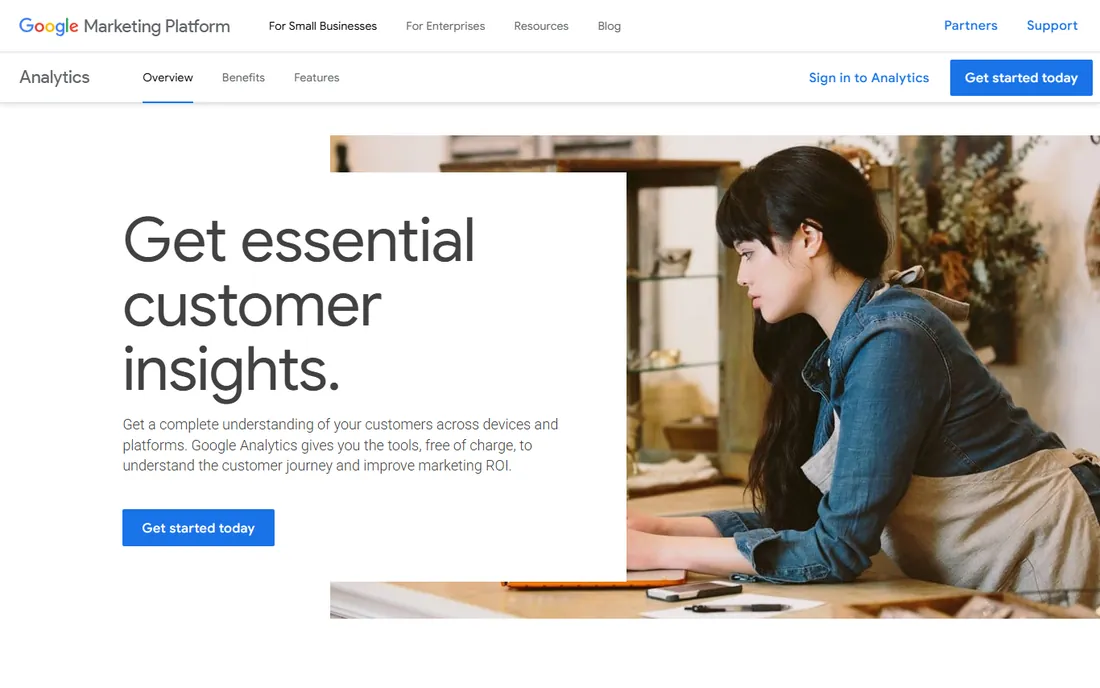
Google Analytics 4 is the free baseline of web measurement, and its price, zero, makes it the default starting point for every website. It tracks traffic sources, user journeys across web and app, conversions, and audiences, and it connects natively to Google Ads for closed-loop marketing measurement. Google's machine learning adds predictive metrics like churn probability and revenue forecasting at no cost.
Every marketer already speaks GA, which is an underrated advantage when hiring and reporting. The honest catch is the one practitioners repeat constantly: GA4 is web analytics for marketing, not product analytics. Its event model, funnels, and exploration tools frustrate product teams used to Mixpanel, sampling appears at high volumes, and privacy regulation keeps eroding its data completeness in Europe. Use it as the free complement to a real product analytics tool, never as the replacement.
What we like- Completely free with no event limits for standard use
- Deepest integration with Google Ads
- Everyone already knows how to use it
Watch out for- Not a product analytics tool, whatever Google's marketing says
- Sampling and privacy limitations frustrate power users
Starting priceSee website
Free planYes
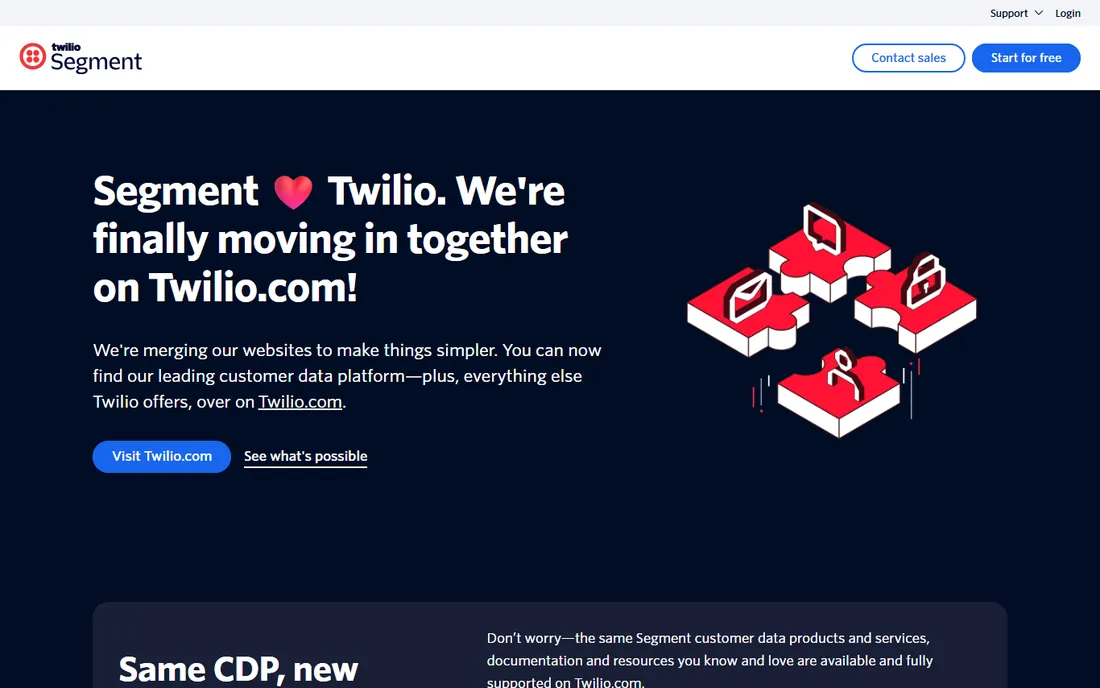
Segment solves a different problem from everything else here: instrumentation chaos. Instead of adding seven SDKs to your app, you add Segment once, and it routes clean, consistent event data to your analytics tools, warehouse, email platform, and ad destinations. When your Mixpanel, your warehouse, and your marketing tools all disagree about what happened, Segment is the fix.
Now operating under Twilio, it combines the customer data platform with communications infrastructure, which strengthens the activation story. The 750-plus integration library means the destination you need is almost certainly supported. The honest catch is category clarity. Segment does not show you a single chart; it is plumbing. You still need analytics tools on top of it, so it adds cost rather than replacing it. It earns that cost when data consistency across tools becomes a real business problem.
What we like- One integration sends clean data to 550-plus destinations
- The canonical CDP for serious data stacks
- Now combined with Twilio's communications platform
Watch out for- It is infrastructure, not analytics, so budget it on top of analytics tools
- Pricing scales with tracked users
We started from the tools that dominate product analytics and web analytics discussions: G2 and Capterra categories, practitioner comparisons, and engineering community consensus. We verified each vendor's homepage to confirm the product exists today and fits data tracking rather than adjacent categories. We covered the full tracking stack: product analytics (Mixpanel, Amplitude, PostHog, Heap, Pendo), web analytics (GA4, Matomo), and the data pipeline (Segment). We did not claim hands-on testing. Pricing in this category is largely usage-based or quote-based, so we say "See website" where the meter makes a single number misleading, and we note free tier sizes from vendor pages.
Product analytics vs web analytics: which do you need
The confusion between these categories wastes more analytics budget than anything else. Web analytics (GA4, Matomo) answers marketing questions: where did visitors come from, which campaigns convert, how does the funnel perform by channel. Product analytics (Mixpanel, Amplitude, PostHog, Heap) answers product questions: what do users do inside the app, where do they get stuck, which behaviors predict retention.
A content or ecommerce site can often run on web analytics alone. A SaaS product cannot; it needs product analytics to understand its own usage. Most growing companies end up with both, plus a data pipeline like Segment when the tools multiply. If you can only buy one thing this quarter, buy the one that answers the question your next big decision depends on.
Keeping tracking costs under control
Analytics pricing punishes careless instrumentation. Every tool here meters some version of event volume, and chatty apps with autocapture enabled can generate bills that shock finance. The cheapest cost control is event hygiene: track the events you actually analyze, name them consistently, and audit quarterly for dead events nobody has charted in months.
Second, match the tool to the volume. Free tiers cover most early-stage products entirely, Amplitude's 2M events and PostHog's broad free usage mean many startups pay nothing for years. Third, consider self-hosting where offered: PostHog and Matomo both offer it, which converts a scaling usage bill into fixed infrastructure cost. The most expensive analytics stack is the one nobody maintains, so assign an owner before you sign.
Frequently asked questions
What is the best data tracking software for a SaaS startup?
PostHog is the strongest default for engineering-led startups because it bundles analytics, session replay, feature flags, and experiments with a generous free tier. Product-led teams that prioritize ease of use often prefer Mixpanel, whose funnel UX is the cleanest in the category.
Is Google Analytics enough for product analytics?
No. GA4 is excellent free web analytics for marketing measurement, but its event model and exploration tools frustrate product teams. Pair it with a dedicated product analytics tool like Mixpanel, Amplitude, or PostHog for in-app behavior analysis.
How much does product analytics software cost?
Free tiers cover most early-stage products: Amplitude offers 2M events per month free, PostHog is free for the vast majority of users, and GA4 is completely free. Paid pricing is usage-based and scales with event volume; expect hundreds to low thousands per month at mid-market scale, with enterprise contracts quoted individually.
What is the difference between Mixpanel and Amplitude?
Mixpanel optimizes for the product manager's daily workflow with the fastest queries and cleanest funnel UX. Amplitude goes deeper with predictive analytics, behavioral cohorts, and data governance for enterprises with dedicated data teams. Both are excellent; the choice usually follows team structure.
Do I need Segment if I have Mixpanel or Amplitude?
Not at first. Segment becomes valuable when you send data to many destinations and need consistency between your analytics, warehouse, and marketing tools. Small teams with one analytics tool can integrate directly and add Segment when the stack grows.
Which analytics tool is best for privacy compliance?
Matomo is the privacy-first choice, offering cookieless tracking, full data ownership, and self-hosting for GDPR compliance. PostHog also offers self-hosting and EU data residency. GA4 faces the most regulatory headwinds in Europe.
Sources we checked (10)
- https://mixpanel.com
- https://amplitude.com
- https://posthog.com
- https://heap.io/
- https://www.pendo.io/
- https://matomo.org
- https://marketingplatform.google.com/about/analytics/
- https://segment.com/
- https://brainforge.ai/resources/amplitude-vs-mixpanel-vs-posthog/
- https://clickwebstudio.com/blog/saas-analytics-stack-2026
Is your product missing or out of date?
We review this list regularly. Vendors can request a listing, send updated pricing or ask about featured placement.

Shihab Mia · Founder, Rankite
Shihab has spent more than a decade helping SaaS and e-commerce brands grow through search. He writes Rankite's software buying guides from pricing pages, documentation and public user reviews. More about Shihab.