How we make this list: we compare pricing pages, product documentation and public user reviews. Rankite is independent; if a vendor ever pays for a featured spot, that listing is clearly labeled Partner.
Key takeaways
- Snowflake and Databricks lead the cloud data platform market, with Snowflake stronger on SQL analytics and Databricks on engineering and AI workloads.
- BigQuery, Redshift and Microsoft Fabric make sense when you are already committed to Google, AWS or Microsoft.
- Palantir Foundry suits organizations with complex operational data and serious governance needs.
- Starburst, Firebolt and ClickHouse offer strong alternatives for federated queries, speed and open-source flexibility.
- Domo covers teams that want the warehouse and the dashboards from one vendor.
- Pricing is usage-based almost everywhere: the platform decision is really a cost-control decision.
Quick comparison
| Tool | Best for | Starting price | Free plan |
|---|
 Snowflake Snowflake | SQL analytics at enterprise scale | See website | Free trial |
 Databricks Databricks | Lakehouse for engineering and AI workloads | See website | Free trial |
 Google BigQuery Google BigQuery | Serverless analytics on Google Cloud | See website | Yes |
 Amazon Redshift Amazon Redshift | Analytics inside AWS | See website | Free trial |
 Microsoft Fabric Microsoft Fabric | All-in-one analytics on Microsoft | See website | Free trial |
 Palantir Foundry Palantir Foundry | Operational data with heavy governance | See website | No |
 Domo Domo | Warehouse plus BI in one subscription | See website | Free trial |
 Starburst Starburst | Querying data where it lives | See website | Free trial |
 Firebolt Firebolt | High-speed analytics engineering | See website | Free trial |
 ClickHouse ClickHouse | Open-source analytical database | See website | Yes |
Is your product missing or out of date?
We review this list regularly. Vendors can request a listing, send updated pricing or ask about featured placement.
Starting priceSee website
Free planFree trial
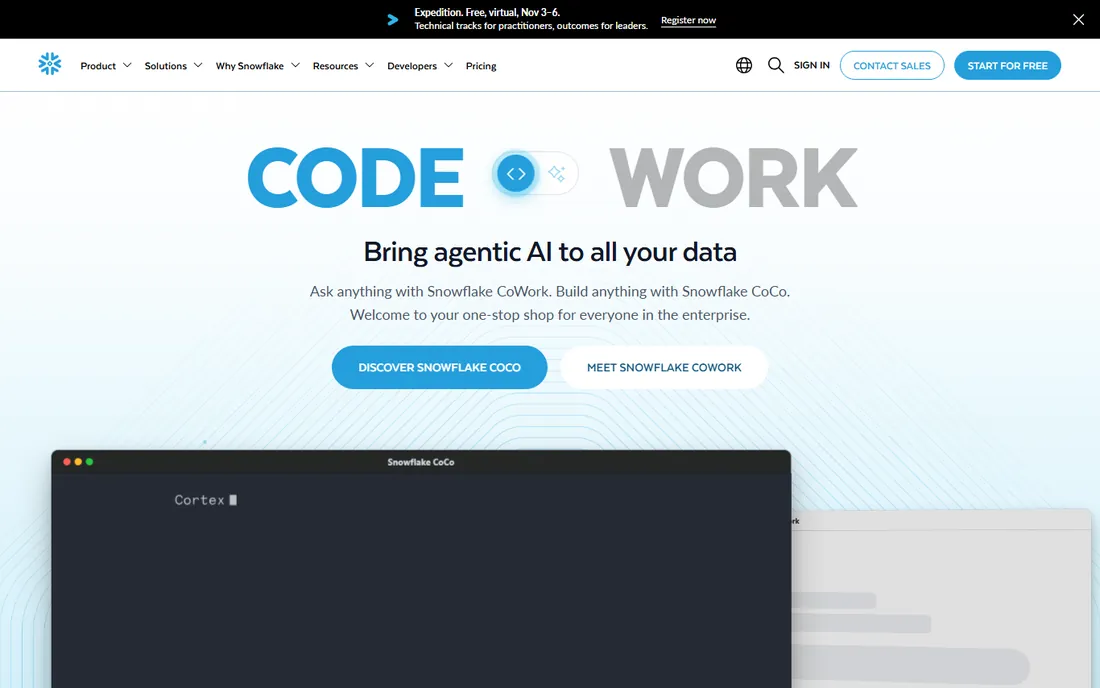
Snowflake made the cloud data warehouse boring in the best way: no servers to manage, storage and compute billed separately, and SQL that analysts already know. Enterprises run everything from finance reporting to customer analytics on it, and the marketplace for sharing data between companies is genuinely useful. The ecosystem of dbt, Fivetran, and BI tools around Snowflake is the largest in the category.
The billing model is the thing to respect. Compute charges accrue whenever queries run, and an unoptimized dashboard refreshing every five minutes becomes a line item. Teams that implement resource monitors, auto-suspend and query governance do fine; teams that do not get an unpleasant invoice. Snowflake is the safe default for SQL-first analytics organizations, provided someone owns the cost controls from day one.
What we like- Separates storage and compute so teams scale independently
- Huge partner and integration ecosystem
- Near-zero administration
Watch out for- Costs surprise teams that do not govern compute
- Less native support for heavy ML engineering
- Data egress and multi-cloud add complexity
Starting priceSee website
Free planFree trial
Databricks built the lakehouse category: one platform where data engineers build pipelines, analysts run SQL and data scientists train models on the same data. Delta Lake adds transactions and versioning to cheap object storage, which removed the old choice between a warehouse and a lake. Its AI features for building LLM applications on enterprise data are now a major reason companies choose it.
The flexibility costs simplicity. Teams without data engineering skills find Databricks harder to adopt than Snowflake, and the usage-based pricing across many workload types needs active management. For organizations where analytics, engineering and AI share one platform and one team, Databricks is the most complete answer. For a finance team that just needs dashboards, it is more platform than necessary.
What we like- Unifies data engineering, SQL analytics and machine learning
- Delta Lake brings reliability to data lakes
- Strong AI and LLM tooling
Watch out for- Steeper learning curve than pure SQL warehouses
- Cost management needs engineering discipline
- Overkill for simple BI reporting
Starting priceSee website
Free planYes
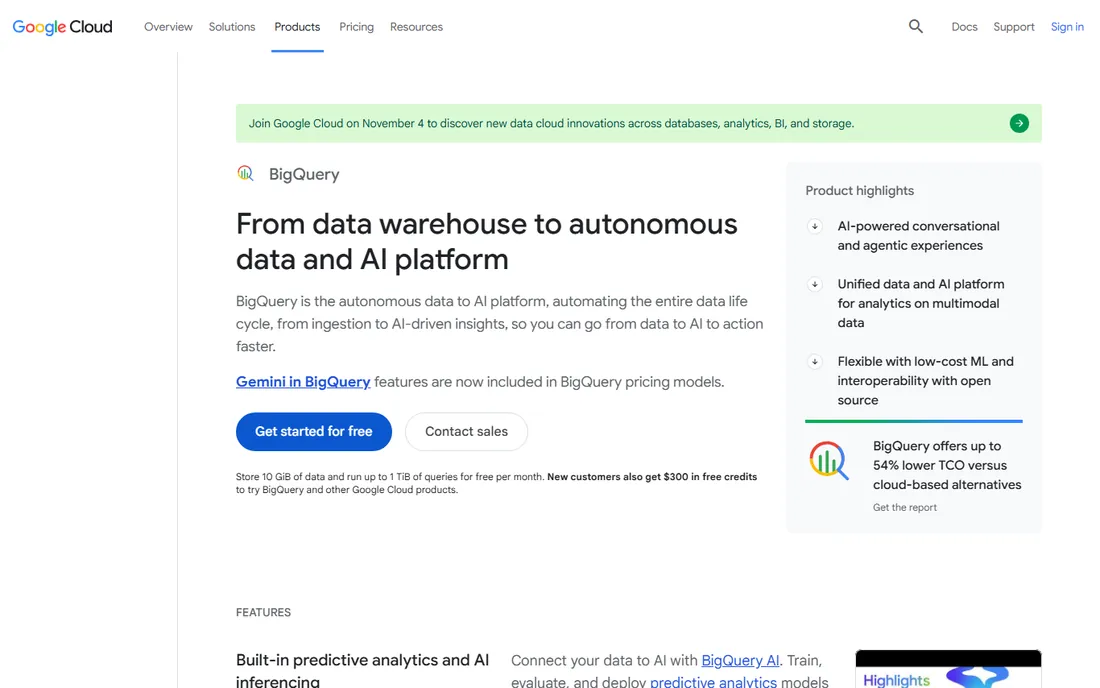
BigQuery's pitch is radical simplicity: point it at data, run SQL, pay for what you scan. There is no warehouse to size, no cluster to tune, and the free tier (generous monthly allowances for storage and queries) lets small teams run real analytics for nothing. For ad-hoc exploration of large datasets it remains one of the fastest options available.
The on-demand model bills per byte scanned, so a careless SELECT * over terabytes costs real money. Partitioning, clustering and the flat-rate editions exist precisely to control this, but they require knowledge. Organizations already on Google Cloud get the smoothest experience with native integrations across the stack. It is the easiest serious data platform to start on and one of the easiest to overspend on without governance.
What we like- Truly serverless with no cluster to manage
- Generous free tier for getting started
- Excellent for huge ad-hoc queries
Watch out for- On-demand query pricing punishes unoptimized SQL
- Best inside Google Cloud
- Data transfer costs need watching
Starting priceSee website
Free planFree trial
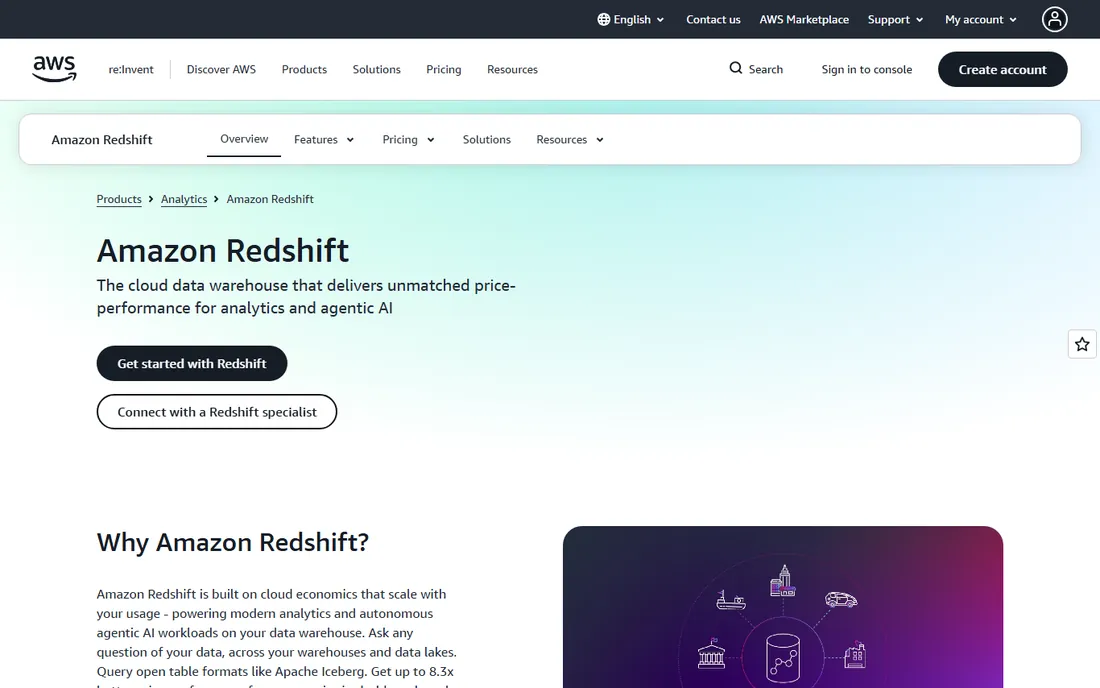
Redshift is the incumbent cloud warehouse, and inside AWS-heavy organizations it is often the pragmatic choice. Data already in S3 queries in place, IAM handles security, and the serverless option removed the old cluster-sizing headache. It is mature, well documented and predictable, with a free trial for evaluation.
It no longer leads on innovation or simplicity. Teams choosing fresh tend to compare it against Snowflake and BigQuery on ease of use and find it heavier. The economics work best with AWS commitments and steady workloads. If your company runs on AWS and your data lives in S3, Redshift keeps everything in one cloud with one bill. If you are cloud-agnostic, the newer platforms usually win on experience.
What we like- Deep integration with the AWS ecosystem
- Serverless option removes cluster management
- Mature and predictable
Watch out for- Feels less modern than Snowflake or BigQuery
- Best value requires AWS commitment
- Admin overhead on provisioned clusters
Starting priceSee website
Free planFree trial
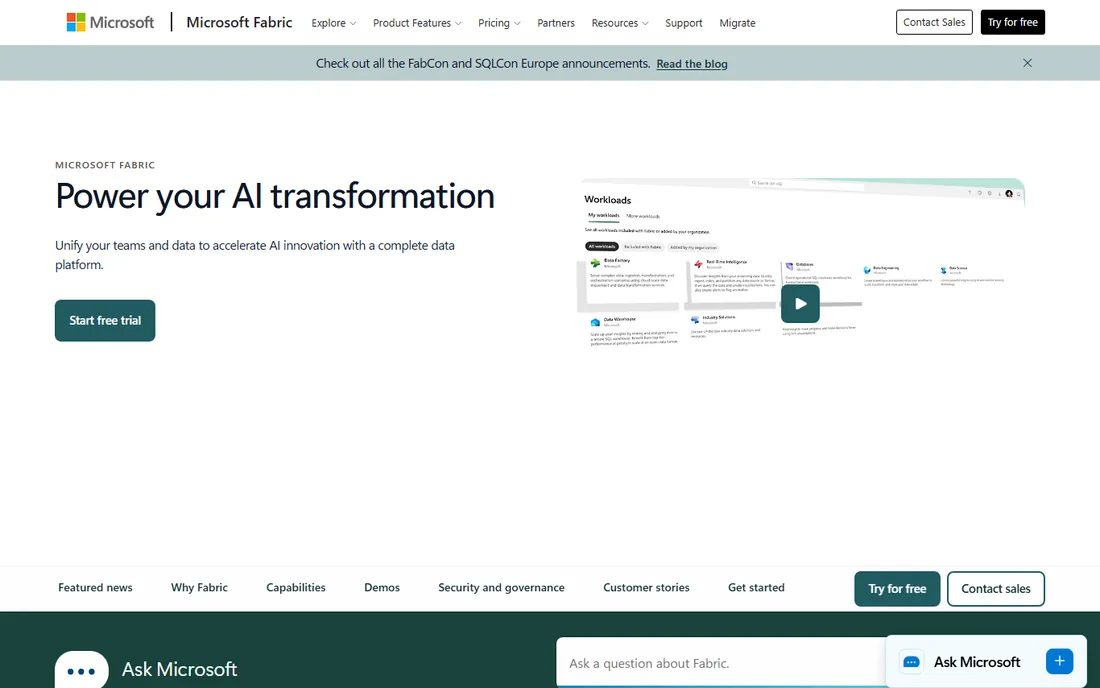
Microsoft Fabric consolidates the company's analytics sprawl, data factory, Synapse, Power BI, into one SaaS platform with OneLake as the shared storage layer. For organizations standardized on Microsoft 365 and Azure, the pitch is compelling: your Excel and Power BI users get governed data without a separate stack, and copilot features bring natural language querying to business users.
It is the newest major platform here and still maturing; buyers report rough edges and evolving pricing. The capacity-based pricing model takes study to understand. Outside the Microsoft ecosystem the value proposition thins considerably. But for the enormous base of companies running on Microsoft, Fabric is the strategic direction and the integration with tools people already use is a genuine advantage.
What we like- One platform from ingestion to Power BI
- OneLake unifies data storage
- Natural fit for Microsoft shops
Watch out for- Newer platform still maturing
- Capacity-based pricing confuses buyers
- Best inside the Microsoft ecosystem
Starting priceSee website
Free planNo

Foundry is not a warehouse with dashboards; it is an operating system for organizational data, modeling real entities like patients, aircraft or supply chains in an ontology that applications build on. Governance, lineage and access control are the deepest in the industry, which is why regulated and mission-critical organizations choose it. When data decisions carry operational or safety consequences, Foundry's rigor matters.
The commitment is correspondingly large: enterprise pricing, long implementations and a real organizational change program. Standard reporting and analytics teams will find it heavyweight. It belongs on the shortlist for complex institutions where data governance is the primary requirement, not for companies that need dashboards next quarter.
What we like- Exceptional data governance and access controls
- Ontology models real-world operations
- Proven in defense, health and industry
Watch out for- Enterprise pricing and long implementations
- Overkill for standard BI
- Requires significant organizational commitment
Starting priceSee website
Free planFree trial
Domo sells speed: connect sources, model lightly, and build dashboards in one platform without assembling a modern data stack. Business-led teams get from question to dashboard in days, and the connector library covers the SaaS tools mid-size companies actually use. For organizations without a data engineering team, that all-in-one character is the whole appeal.
Sophisticated data teams eventually want more: the modeling layer is lighter than dbt, and heavy usage gets expensive. Domo fits best where business users drive analytics and IT stays light. Companies with dedicated data engineers usually assemble Snowflake or BigQuery plus a separate BI tool and get more control for similar money.
What we like- Combines data platform and visualization in one tool
- Fast time to insight for business teams
- Huge connector library
Watch out for- Pricing scales steeply with usage
- Power users outgrow the modeling layer
- Enterprise data teams often prefer best-of-breed
Starting priceSee website
Free planFree trial
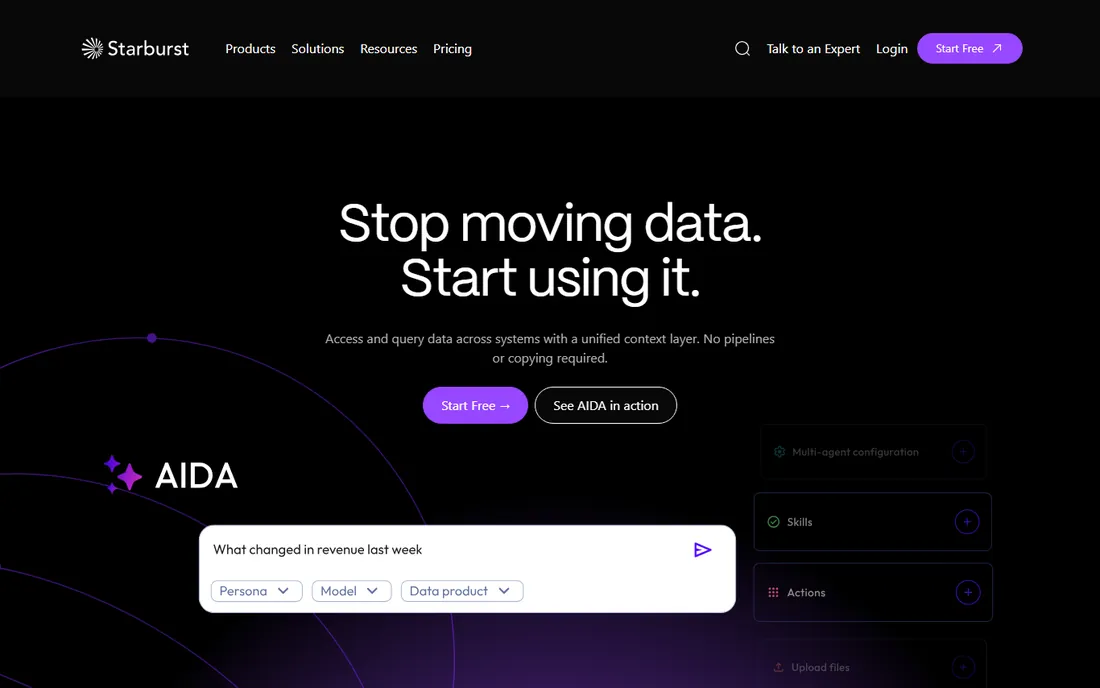
Starburst, built on open-source Trino, lets analysts run SQL across data wherever it sits: S3, Snowflake, Postgres, Elasticsearch and more, without centralizing everything first. For organizations with data spread across systems that cannot or should not move, federation beats migration. The open-source roots mean no lock-in at the query layer.
Query performance is bounded by the slowest source, and complex federations need tuning. It is an additional platform to operate, not a replacement for storage. The fit is specific but real: decentralized organizations, post-merger data estates, and teams that need one SQL interface over many systems. Everyone else is usually better served centralizing in a warehouse first.
What we like- Federated SQL across warehouses, lakes and databases
- Built on open-source Trino
- Avoids costly data movement
Watch out for- Performance depends on underlying sources
- Another layer to manage
- Pricing is enterprise-oriented
Starting priceSee website
Free planFree trial
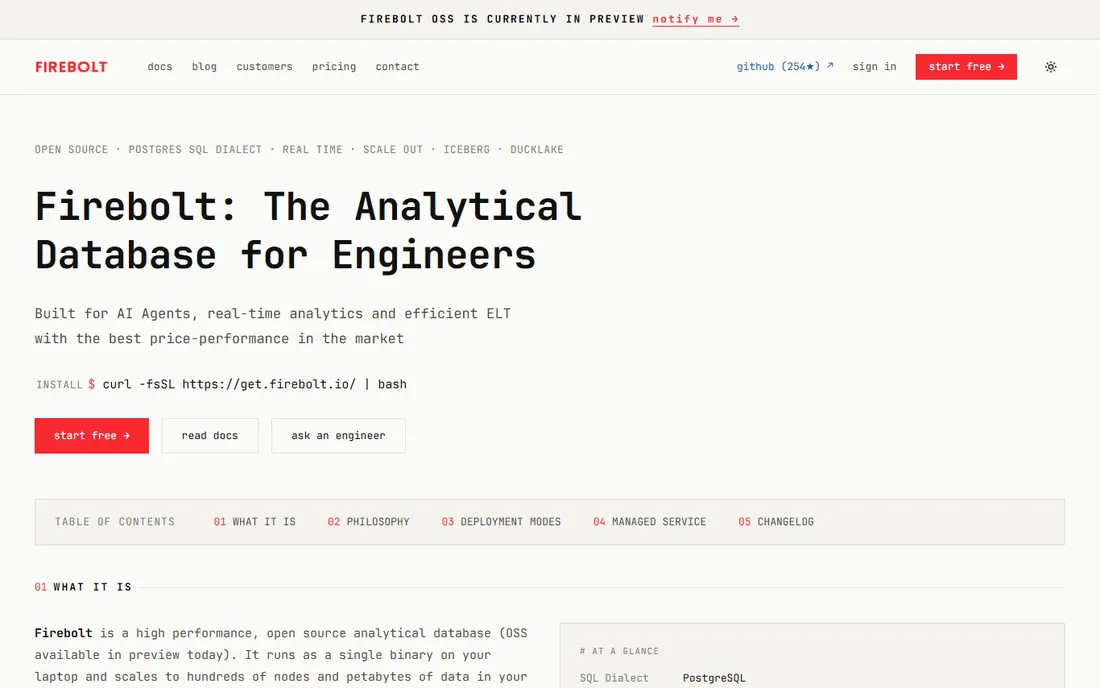
Firebolt is an engineering-led warehouse built for speed: sub-second queries on large datasets with efficient resource use. It targets the demanding middle of the market, SaaS companies embedding analytics in their products and data teams with heavy, repeated query workloads, where performance per dollar matters more than ecosystem size.
The ecosystem is proportionally smaller: fewer connectors, fewer community resources, fewer consultants who know it. As a younger company it carries more vendor risk than Snowflake or the cloud giants. For teams whose workload is performance-sensitive and who have the engineering skill to evaluate properly, Firebolt's benchmarks are impressive. For everyone else, the safe incumbents remain safer.
What we like- Very fast query performance for analytics workloads
- Efficient compute usage
- Good fit for customer-facing analytics
Watch out for- Smaller ecosystem than the giants
- Fewer native integrations
- Company is younger with a shorter track record
Starting priceSee website
Free planYes
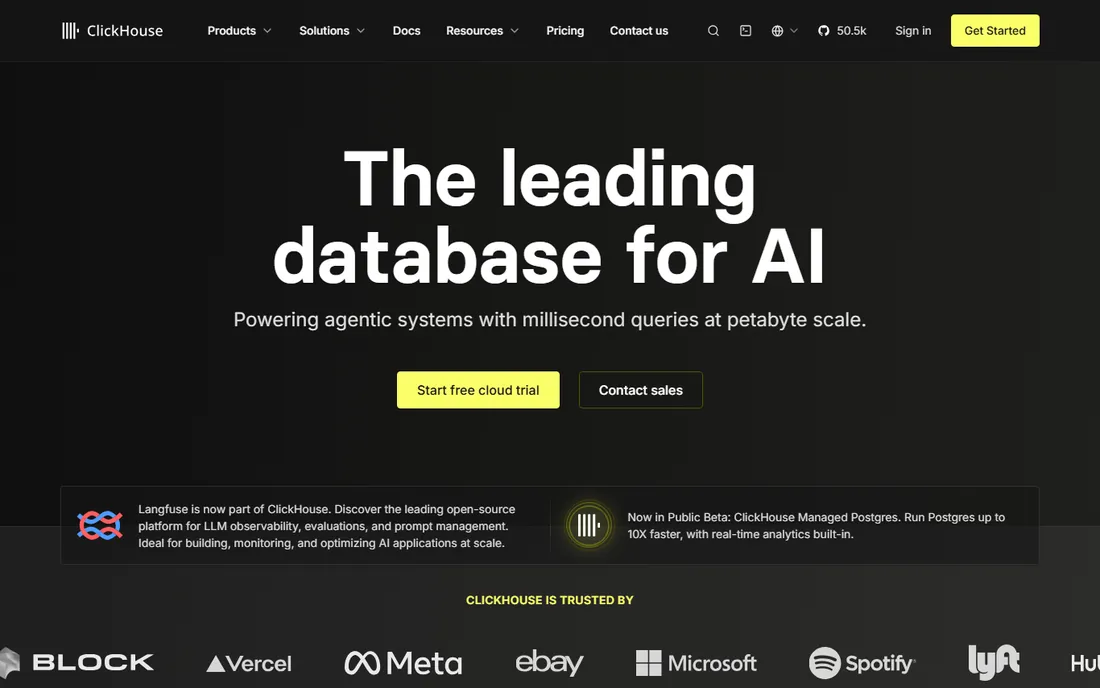
ClickHouse is the open-source analytical database that ate the real-time analytics world: absurdly fast aggregations over billions of rows, a massive community, and adoption everywhere from startups to hyperscalers. Self-hosting is free, which makes it the budget option for teams with infrastructure skills, and ClickHouse Cloud offers managed hosting for teams without them.
Self-hosting means owning operations: upgrades, scaling, backups and tuning are your problem. The managed cloud removes that but adds cost. It is narrower than a full data platform, focused on analytics queries rather than the whole pipeline-to-dashboard story. For real-time dashboards, event analytics and cost-sensitive scale, ClickHouse is unmatched. For general enterprise BI with governance requirements, the bigger platforms fit better.
What we like- Open source with blazing analytical performance
- Huge community and adoption
- Cloud offering plus self-hosting
Watch out for- Operational burden if self-hosted
- Less hand-holding than SaaS warehouses
- Real-time focus is narrower than general platforms
The real decision: cost control
Every modern data platform except ClickHouse self-hosted bills on usage, and usage grows with success. The platform choice matters less than the governance you put around it: resource monitors, query timeouts, auto-suspend policies, and someone whose job includes watching the bill. Before signing, model your costs at 10x current volume, because the platform that is cheap at a terabyte can be punishing at a petabyte.
Also decide where compute lives. Centralizing in one warehouse simplifies governance but creates a single growing bill. Federated approaches like Starburst avoid moving data but push performance questions to each source. There is no free answer; there is only the tradeoff your team is equipped to manage.
How we chose
We selected platforms that serve as primary analytical data stores or full data platforms, not point BI tools. We reviewed vendor documentation, pricing pages, engineering benchmarks and practitioner discussions, and we checked current product status for each vendor. We included open-source, cloud-native and enterprise-governance options because buyers genuinely span that range.
What to evaluate in a trial
Run your actual queries, not the vendor's demo dataset. Take your three slowest, most expensive reports and your most complex transformation, and run them on each finalist with realistic data volumes. Measure wall-clock time and, critically, the cost per run, because performance without price is only half the answer.
Test the failure modes too. What happens when two teams run heavy jobs simultaneously. How does the platform handle a schema change mid-pipeline. How long does recovery take when something breaks at 2am. And evaluate the ecosystem honestly: the availability of people who know the platform, dbt support, and your BI tool's native connector quality all determine whether the platform succeeds in practice or just in the POC.
Frequently asked questions
What is a data platform?
A data platform stores, processes and serves data for analytics and applications. It typically includes storage, a query engine, pipeline tooling and governance, and often connects to BI tools for visualization. Snowflake, Databricks and BigQuery are the best-known examples.
Snowflake vs Databricks: which is better?
Snowflake for SQL-first analytics teams that want simplicity and low administration. Databricks for organizations combining data engineering, analytics and machine learning on one platform. Many large companies use both for different workloads.
How much do data platforms cost?
Almost all use usage-based pricing: you pay for compute, storage and sometimes data transfer. Small teams can start free or under a few hundred dollars monthly; enterprise deployments run from tens of thousands to millions annually. Always model costs at scale and set up billing alerts from day one.
Do I need a data platform or just a BI tool?
A BI tool visualizes data; it still needs somewhere to query it from. Small companies often start with the database they have plus a BI tool, and adopt a dedicated data platform when queries slow down, data grows, or governance becomes necessary.
What is a lakehouse?
A lakehouse combines data lake economics (cheap object storage, open formats) with warehouse reliability (transactions, schema enforcement). Databricks pioneered the term with Delta Lake; the major platforms have all moved in this direction.
Is open source like ClickHouse viable for business?
Yes, with the right team. ClickHouse powers production analytics at large companies. The tradeoff is operational responsibility versus license cost: self-hosting is free but needs skilled operators, while managed cloud options cost money but remove the burden.
Sources we checked (10)
- https://www.snowflake.com/en/
- https://www.databricks.com/
- https://cloud.google.com/bigquery
- https://aws.amazon.com/redshift/
- https://www.microsoft.com/en-us/microsoft-fabric
- https://www.palantir.com/
- https://domo.com/
- https://www.starburst.io/
- https://www.firebolt.io/
- https://clickhouse.com/
Is your product missing or out of date?
We review this list regularly. Vendors can request a listing, send updated pricing or ask about featured placement.

Shihab Mia · Founder, Rankite
Shihab has spent more than a decade helping SaaS and e-commerce brands grow through search. He writes Rankite's software buying guides from pricing pages, documentation and public user reviews. More about Shihab.