How we make this list: we compare pricing pages, product documentation and public user reviews. Rankite is independent; if a vendor ever pays for a featured spot, that listing is clearly labeled Partner.
Key takeaways
- If you want lineage without a six-figure contract, start with Secoda or Select Star. Both publish real prices and ship a free tier, which is rare in this category.
- Collibra, Alation, and Informatica are the safe enterprise picks, but none publishes list pricing. Budget at least $60,000 a year for Alation and well into six figures for Collibra or Informatica before services.
- Monte Carlo earns its place because it ties lineage to incident response. When a pipeline breaks, you see the blast radius, not just a diagram.
- DataHub is the only serious open-source option here. It costs nothing in licenses and plenty in engineering time, so it suits teams that can self-host.
Quick comparison
| Tool | Best for | Starting price | Free plan |
|---|
 Atlan Atlan | Mid-size to large data teams on a modern cloud stack | See website | Free trial |
 Collibra Collibra | Regulated enterprises that need formal governance | See website | Free trial |
 Alation Alation | Large firms standardizing analytics and AI governance | See website | Free trial |
 Monte Carlo Monte Carlo | Data teams that want lineage tied to incident response | See website | Free trial |
 Secoda Secoda | Small data teams that need value in days, not months | $99/month (Starter, billed annually) | Yes |
 Select Star Select Star | Analytics teams that want automated column-level lineage fast | $270/month (Pro, billed annually) | Yes |
 Informatica Informatica | Enterprises already invested in Informatica or Salesforce | See website | Free trial |
 Ataccama Ataccama | Mid-to-large firms that want catalog, quality, and MDM in one platform | See website | Free trial |
 DataHub DataHub | Engineering-led teams that want open source and full control | $0 (open source) | Yes |
Is your product missing or out of date?
We review this list regularly. Vendors can request a listing, send updated pricing or ask about featured placement.
The best data lineage software
#1
Atlan
Best for: Mid-size to large data teams on a modern cloud stack
Visit atlan.com
Starting priceSee website
Free planFree trial
Atlan built its name as the friendlier alternative to the old guard, and the product still feels that way. Connectors pull metadata automatically from warehouses, BI tools, dbt, and orchestrators, then render column-level lineage that analysts can follow without filing a ticket with data engineering. The glossary, ownership, and policy controls sit in the same workspace, so documentation happens where people already work.
The honest catch is commercial, not technical. Atlan names its tiers but does not publish rates, and add-on modules for AI assistance, active metadata, and query-log processing stack up fast. Training is also a separate line item that can reach five figures. Negotiate the lineage depth you need in writing: which of your systems get column-level lineage at the quoted tier matters more than the total connector count.
What we like- Automated column-level lineage across 80+ sources
- Interface business users actually open
- Named a Leader in the 2026 Gartner Magic Quadrant for D&A Governance
Watch out for- No public list pricing, every figure comes from a sales conversation
- AI and active-metadata add-ons can lift the subscription 20 to 40 percent
Starting priceSee website
Free planFree trial
Collibra is the governance-first choice, and it shows in every workflow. Stewardship runs through configurable multi-step approval chains, the business glossary supports inheritance and semantic linking, and compliance reporting is a first-class feature rather than an export. Banks, insurers, and healthcare firms with GDPR or similar obligations keep choosing it for exactly these reasons.
What you give up is speed and simplicity. Rollouts are measured in quarters, onboarding in months, and the bill starts around $170,000 a year for the base platform on its AWS Marketplace listing before services. Smaller teams also report the classic failure mode: a year of implementation, an empty catalog, and analysts who never log in. Buy Collibra when compliance requires it, not when you just want prettier lineage diagrams.
What we like- Deepest stewardship workflows and policy engine in the category
- Purpose-built compliance reporting
- 78 Fortune 500 customers per the vendor
Watch out for- Implementations typically run 6 to 12 months with a systems integrator
- The interface demands real training before analysts adopt it
#3
Alation
Best for: Large firms standardizing analytics and AI governance
Visit alation.com
Starting priceSee website
Free planFree trial

Alation effectively invented the machine-learning data catalog back in 2012, and a decade-plus of enterprise deployments shows in the depth of the product. Natural-language search, collaborative curation, and a glossary hub make it a comfortable home for both analysts and stewards. Its AWS Marketplace listing starts at $60,000 for a 12-month contract, which makes it the cheapest entry point among the legacy enterprise trio.
The pricing story beyond that anchor is murky. Reviewers consistently describe a layered fee model where connectors, governance apps, and professional services push totals into the hundreds of thousands. Implementation bundles for analytics or governance each run around $30,000, and training passes are sold separately. Alation fits organizations that already run a formal data program and can staff it; it is not a lightweight first catalog.
What we like- Pioneer of the ML-driven catalog with strong search and curation
- Broad enterprise adoption across industries
- Guided trial available
Watch out for- No published pricing and a fee model reviewers call complex
- Integrations can demand significant technical effort
Starting priceSee website
Free planFree trial
Monte Carlo approaches lineage sideways: instead of starting from documentation, it starts from monitoring. Machine-learning monitors watch freshness, volume, schema, and distribution across your tables, and when something breaks, the lineage graph shows exactly which dashboards and downstream models are affected. For teams that live in incident channels, that context is worth more than any catalog page.
Budgeting is the pain point. The company sells prepaid credits (about $0.18 each on the Start tier, with a table monitor consuming roughly 1.75 credits a day) and its AWS Marketplace contract starts at $50,000 for twelve months, but dollar figures for the main tiers are not published. Independent estimates land between $50,000 and $150,000 a year. Shortlist Monte Carlo when data downtime is the problem you are actually trying to solve.
What we like- End-to-end lineage wired directly into anomaly detection and alerting
- Setup measured in hours on standard warehouses
- Strong dbt and Slack integrations
Watch out for- Pricing is entirely quote-based and notoriously hard to budget
- Alert noise needs tuning before the team trusts it
#5
Secoda
Best for: Small data teams that need value in days, not months
Visit secoda.co
Starting price$99/month (Starter, billed annually)
Free planYes
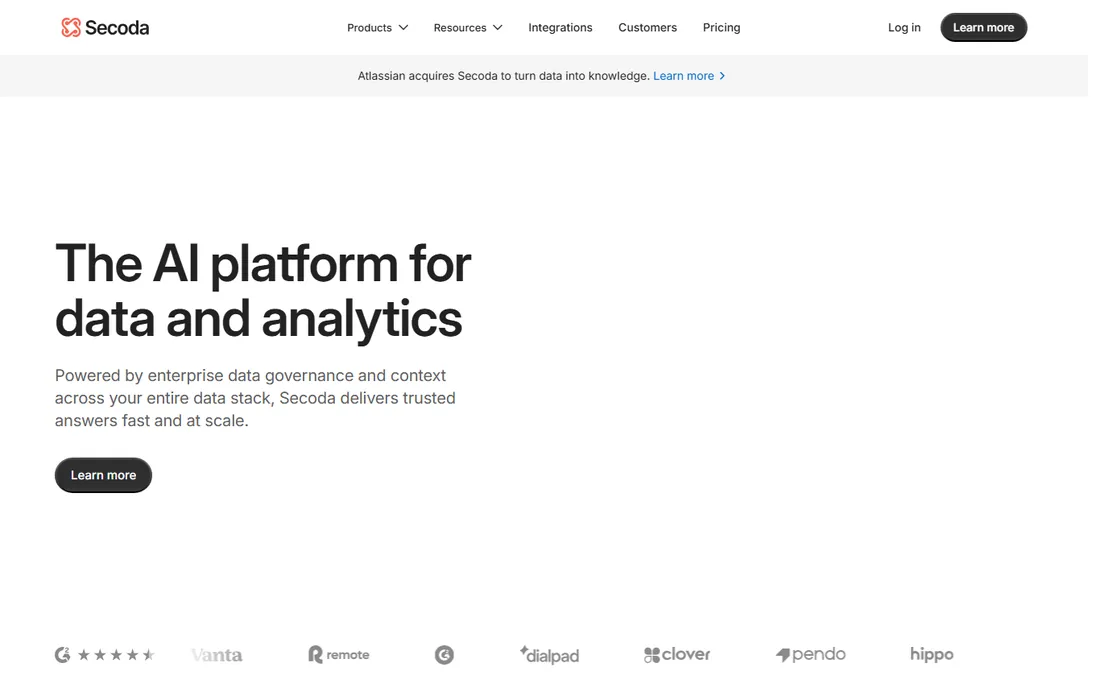
Secoda is the anti-enterprise pick, and that is its appeal. A free plan covers one editor, 500 resources, and two integrations, and the paid Starter tier runs $99 a month billed annually with dbt, Airflow, and Slack integrations included. The Premium tier adds automated PII detection and full data lineage at $499 a month billed annually. You can be running the same week you sign up.
The trade-off is scope. Secoda does discovery, documentation, and lineage well for standard modern stacks, but it is not a policy engine and will not satisfy a bank examiner. Confirm that your specific sources get the lineage depth you need before committing, since connector coverage is where mid-tier catalogs usually disappoint. For a team of ten to fifty that just needs to stop guessing where data comes from, it is the pragmatic buy.
What we like- Genuine free plan and published pricing, rare in this space
- AI-assisted search across tables, columns, and dashboards
- Setup does not need consultants
Watch out for- Lineage depth varies by connector, so verify your stack is covered
- Younger vendor with a thinner track record than the incumbents
#6
Select Star
Best for: Analytics teams that want automated column-level lineage fast
Visit selectstar.com
Starting price$270/month (Pro, billed annually)
Free planYes
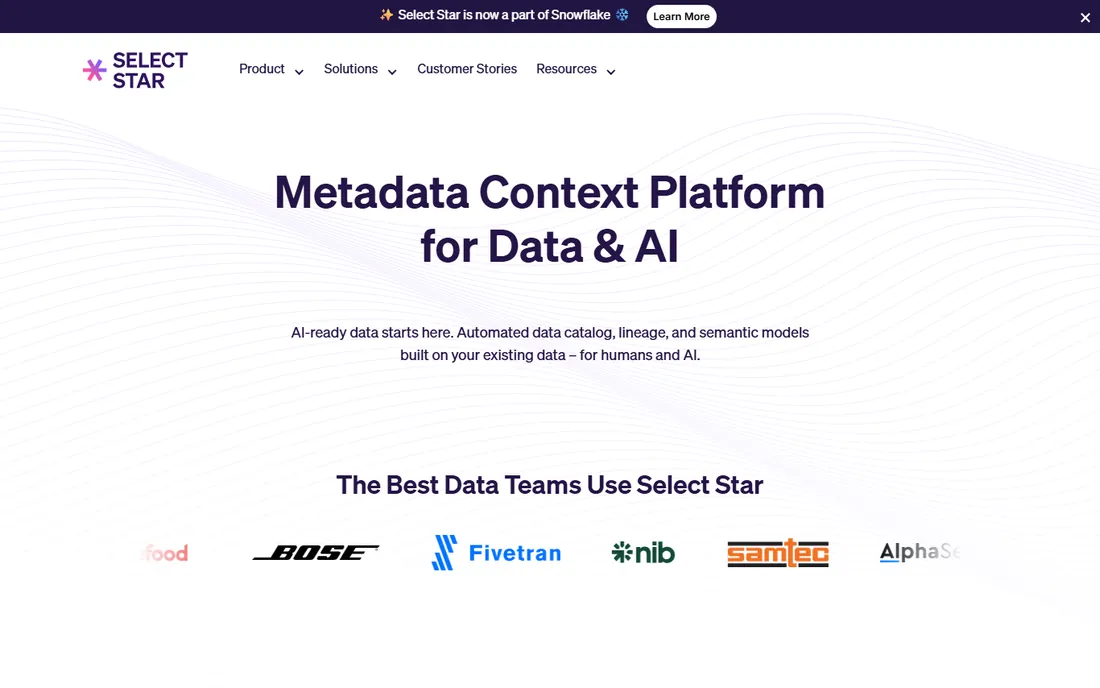
Select Star promises the shortest path from signup to lineage graph, and reviewers generally say it delivers. Connect a warehouse and it auto-detects column-level lineage, builds entity-relationship diagrams, and populates documentation within a day. Pricing is refreshingly concrete: a free Light plan (one source, 100 tables, 10 users), Pro at $300 a month or $270 billed annually, and Growth at $900 a month or $810 billed annually with SAML SSO and API access.
The limits are the thing to read carefully. Each tier caps data sources, tables, and users, with overages at $50 a month per 100 extra tables, so a growing estate can outgrow Pro faster than expected. The integration list also skews toward the usual suspects (Snowflake, BigQuery, Redshift, Tableau, dbt) and thins out beyond them. It is an excellent fit for a single-stack analytics team; heterogeneous enterprises will hit walls.
What we like- Automatic column-level lineage with a 15-minute setup claim
- Transparent per-plan limits on sources, tables, and users
- Free Light plan for tiny estates
Watch out for- Narrower integration list than Atlan or Alation
- Enterprise tier is quote-only and jumps quickly
Starting priceSee website
Free planFree trial
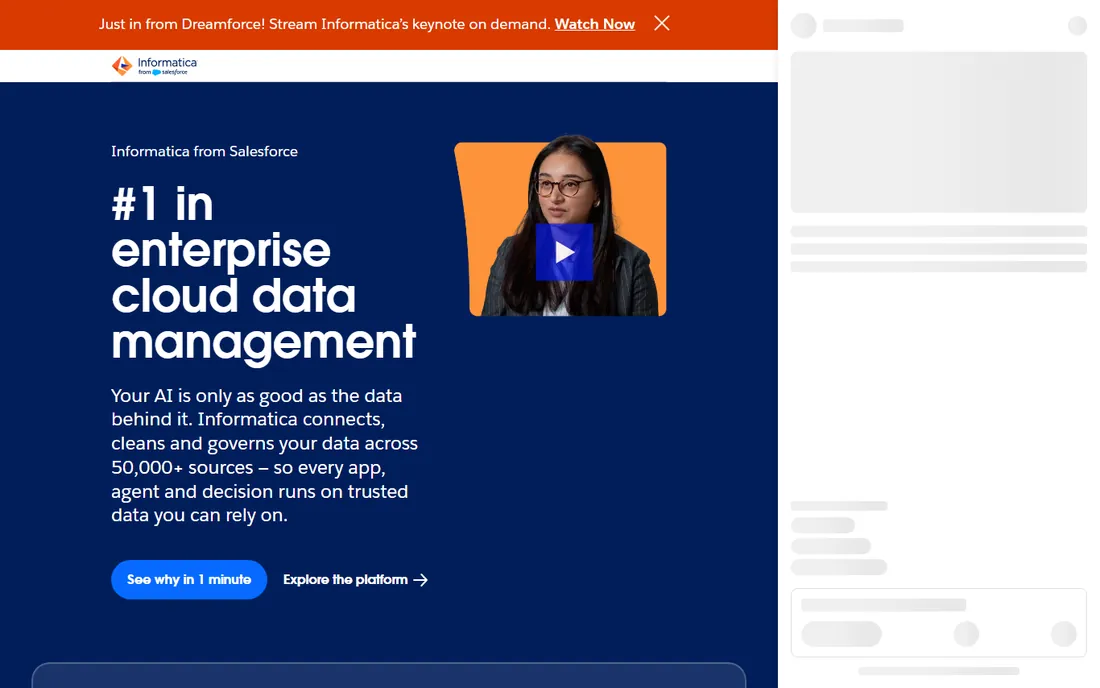
Informatica is the everything vendor: its Intelligent Data Management Cloud bundles the enterprise catalog with data integration, quality, observability, and master data management. If your estate includes mainframes, SAP, and three clouds, few competitors can scan all of it. Note the ownership change: Salesforce completed its acquisition of Informatica in November 2025, so expect packaging to drift toward the Salesforce model over time.
Pricing is the industry's favorite cautionary tale. There is no public list; you buy Informatica Processing Units and consume them across services, with one public anchor of 120 IPUs a month for $131,760 a year on AWS Marketplace. Reviewers warn that a poorly designed job can burn through IPUs fast, so demand metering alerts and a Flex IPU annual model if your usage is spiky. This is a platform for companies with a data platform team, not a first catalog purchase.
What we like- Catalog, integration, quality, and MDM under one roof
- Enormous connector library including legacy systems
- 30-day trial of the cloud platform
Watch out for- Consumption-based IPU pricing that reviewers call hard to forecast
- Implementation services routinely add $150,000 to $300,000 in year one
#8
Ataccama
Best for: Mid-to-large firms that want catalog, quality, and MDM in one platform
Visit ataccama.com
Starting priceSee website
Free planFree trial
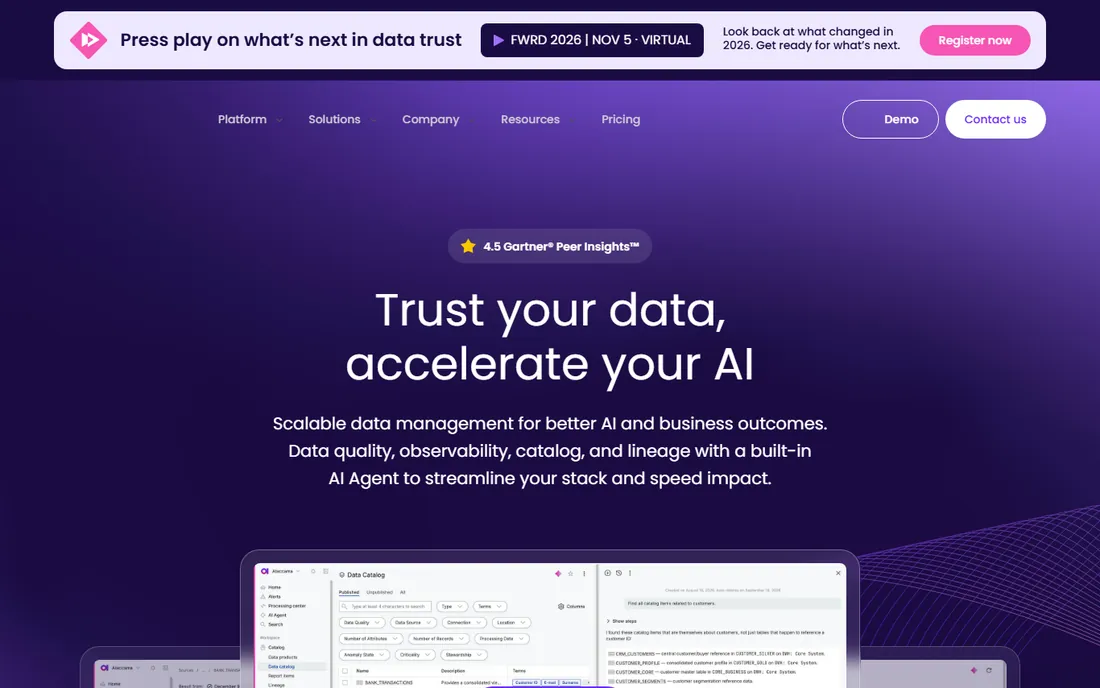
Ataccama ONE takes the unified-platform bet: instead of buying a catalog from one vendor and data quality from another, you get lineage, profiling, matching, and mastering in one place. Customers consistently praise how quickly new data quality rules go live, sometimes within a day, and the lineage views tie naturally into the quality scores. For organizations consolidating tools, that consolidation is the whole pitch.
The catch is that unified usually means enterprise-priced and enterprise-complex. Pricing is undisclosed on the vendor site, with third-party estimates starting around $90,000 annually and rising with modules and data volumes. Smaller teams report the learning curve hitting harder than expected. Evaluate Ataccama when you need quality and mastering alongside lineage; if you only need lineage, simpler tools cost less.
What we like- Data quality, catalog, lineage, and master data management in a single product
- AI-assisted stewardship that cuts manual rule work
- Strong security certifications including SOC 2 Type II
Watch out for- No public pricing and estimates start near $90,000 a year
- Sophistication means a steeper learning curve for small teams
Starting price$0 (open source)
Free planYes
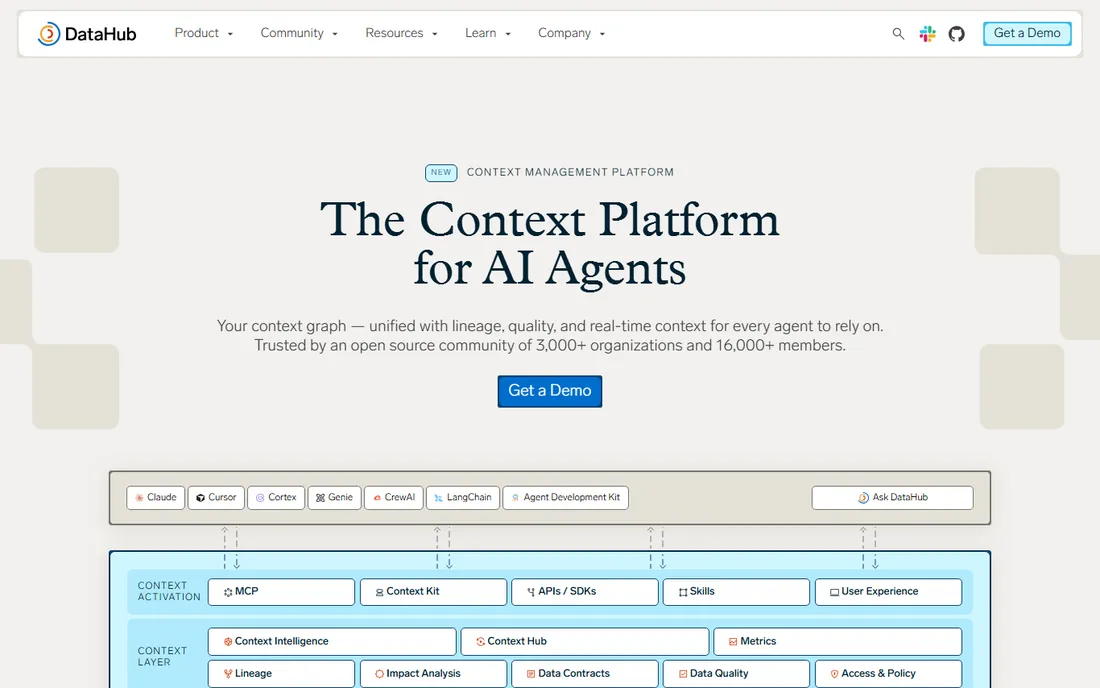
DataHub started inside LinkedIn, was open-sourced in 2020, and is now the most widely adopted open metadata platform in the industry. You get dataset and column-level lineage, a searchable catalog, domains, data products, and governance workflows for the price of your own infrastructure. For teams with platform engineering capacity, it is the only option here with zero license cost and zero vendor lock-in.
Be honest about the total cost. Running DataHub in production means operating Kafka, Elasticsearch, and MySQL (or their managed equivalents), upgrading regularly, and building any missing connectors yourself. Acryl Data, the commercial company behind the project, sells a managed cloud edition for teams that want the platform without the operations burden. Choose DataHub when engineering time is cheaper than enterprise licenses at your company.
What we like- Free Apache 2.0 licensed platform with lineage, discovery, and governance
- Huge community with 10,000-plus GitHub users
- Runs anywhere including your own VPC
Watch out for- You operate it, which means real DevOps effort
- The managed cloud edition is quote-based like everything else here
How we chose
We did not test-drive these platforms with live data, and you should be skeptical of anyone who claims they did across nine enterprise products. Instead we worked from primary sources: each vendor's pricing page and documentation, analyst evaluations from Gartner and Forrester, and practitioner reviews on G2, Capterra, and Reddit. We checked that every product is sold today under its current name, that it actually ships lineage features (not just a catalog with a lineage tab on the roadmap), and that it fits companies from roughly 50 to 5,000 employees. Prices come from vendor pages where published and from AWS Marketplace listings or recent buyer reports where they are not.
What to check before you buy
Lineage is the headline, but four quieter factors decide whether the purchase works out. First, confirm lineage depth per connector. Most vendors promise column-level lineage in marketing and deliver table-level lineage on half your stack; ask for the list in writing. Second, count your data sources against plan limits, because several mid-tier tools charge overages per hundred tables and the bill compounds. Third, ask who will actually use it. A catalog nobody opens is a failed project regardless of feature depth, so run a two-week trial with three analysts before signing anything. Fourth, price year two, not just year one. Implementation, training, and add-on modules routinely double the first-year license cost on enterprise deals.
The pricing reality in 2026
This category has a transparency problem, and you should plan around it. Only Secoda, Select Star, and DataHub publish numbers you can budget from; everyone else quotes. A practical rule of thumb from recent buyer reports: budget $25,000 to $50,000 a year for a mid-market catalog, $60,000 to $100,000 for Alation-class deployments, and $150,000-plus for Collibra or Informatica once services are included. Always get the quote to name which systems get column-level lineage, how overages are metered, and what the annual uplift cap is. If a vendor will not put lineage depth in writing, that tells you everything about the depth.
Frequently asked questions
What is data lineage software?
Data lineage software maps where data comes from, how it transforms as it moves through pipelines, and where it ends up. When a dashboard breaks or a compliance officer asks for proof, you trace the path instead of guessing. Most tools pair lineage with a data catalog, search, and documentation features.
How much does data lineage software cost?
Mid-market tools with published pricing run $99 to $900 a month. Enterprise platforms are quote-based: expect roughly $60,000 a year at the low end (Alation) and $150,000 to $500,000-plus for Collibra or Informatica including implementation. Open-source DataHub costs nothing in licenses but needs engineering time to operate.
Do I need a data catalog to get data lineage?
In practice, yes. Nearly every lineage product here ships inside a catalog or governance platform, because lineage without search, ownership, and documentation is just a diagram. Monte Carlo is the partial exception: it leads with observability and treats lineage as incident context.
Which data lineage tool is easiest to set up?
Secoda and Select Star are built for fast setup, with both claiming value within days and offering free tiers to prove it. DataHub can be running locally in an afternoon via Docker, though production hardening takes longer. Collibra and Informatica sit at the other extreme, with implementations measured in months.
Can open-source tools handle enterprise data lineage?
DataHub does, at companies far larger than most readers of this guide. The trade is operational: you run the infrastructure, manage upgrades, and build missing connectors. If your team has platform engineering capacity, it is the cheapest credible option. If not, a managed mid-tier tool usually costs less than hiring for it.
What is the difference between table-level and column-level lineage?
Table-level lineage shows that table A feeds table B. Column-level lineage shows that column revenue in table A feeds column net_revenue in table B through a specific transformation. Column-level is what you need for impact analysis and compliance, and it is the detail to confirm per connector before you buy.
Sources we checked (18)
- https://www.decube.io/post/data-catalog-pricing
- https://atlan.com/know/how-to-choose-collibra-vs-alation/
- https://www.selecthub.com/p/data-governance-tools/alation-data-catalog/
- https://www.integrate.io/blog/informatica-cost/
- https://medium.com/@moid_55108/monte-carlo-pricing-and-alternatives-what-one-monitored-table-actually-costs-ec36f1f2033e
- https://www.spotsaas.com/product/secoda/pricing
- https://www.spotsaas.com/product/selectstar
- https://www.saasworthy.com/product/selectstar/pricing
- https://www.selecthub.com/p/data-governance-tools/ataccama-one/
- https://github.com/datahub-project/datahub/blob/HEAD/docs/faq.md
- https://atlan.com/
- https://www.collibra.com/
- https://www.alation.com/
- https://montecarlodata.com/
- https://secoda.co/
- https://www.selectstar.com/
- https://informatica.com/
- https://datahubproject.io/
Is your product missing or out of date?
We review this list regularly. Vendors can request a listing, send updated pricing or ask about featured placement.

Shihab Mia · Founder, Rankite
Shihab has spent more than a decade helping SaaS and e-commerce brands grow through search. He writes Rankite's software buying guides from pricing pages, documentation and public user reviews. More about Shihab.