How we make this list: we compare pricing pages, product documentation and public user reviews. Rankite is independent; if a vendor ever pays for a featured spot, that listing is clearly labeled Partner.
Key takeaways
- Cloud bills surprise everyone once: the fix is FinOps tooling, and the entry point is often free (Kubecost, Vantage, Infracost, Harness and nOps all have free tiers).
- Kubernetes shops start with Kubecost (free Foundations tier, Business from $449/month); multicloud teams start with Vantage (free Starter, Pro at $30/month).
- Automation is where the money is: ProsperOps and nOps manage commitments for a share of savings, while Infracost ($250/month) stops waste before deployment.
- The enterprise tier (Flexera, CloudZero, Finout, Anodot) is custom-quoted and suits companies where cloud spend is a board-level number.
Quick comparison
| Tool | Best for | Starting price | Free plan |
|---|
 Flexera One Flexera One | Enterprises governing cloud, software assets and hybrid estates together | See website (custom quote) | No |
 Harness CCM Harness CCM | Engineering teams already running Harness for delivery | Free ($0/month tier includes Cloud Cost Management) | Yes |
 Kubecost Kubecost | Kubernetes teams that need cost allocation by namespace and workload | Free (Foundations tier); Business from $449/month | Yes |
 Vantage Vantage | Startups and mid-market teams wanting self-serve FinOps | Free (Starter); Pro $30/month | Yes |
 Infracost Infracost | Teams that want costs visible before infrastructure ships | Free (CI/CD); Starter $250/month | Yes |
 CloudZero CloudZero | SaaS companies that think in unit economics | See website (custom quote) | No |
 nOps nOps | AWS-heavy teams that want savings on autopilot | Free (Cloud Management Platform); Commitment Management from a share of savings | Yes |
 Finout Finout | Companies unifying cloud, SaaS and AI spend in one bill | See website (custom quote) | No |
 ProsperOps ProsperOps | Companies that want commitment discounts without managing them | See website (share of realized savings) | No |
 Anodot Anodot | Enterprises that need AI watching spend for anomalies | See website (custom quote) | No |
Is your product missing or out of date?
We review this list regularly. Vendors can request a listing, send updated pricing or ask about featured placement.
Every engineering leader has a version of this story: the Monday the cloud bill arrives 40 percent higher than expected, nobody can explain why, and finance starts asking uncomfortable questions. The best cost management software in 2026 exists so that story stops happening. These ten FinOps tools cover the spectrum from free Kubernetes dashboards to enterprise platforms that govern millions in spend, each with a different theory about where cloud waste actually lives.
#1
Flexera One
Best for: Enterprises governing cloud, software assets and hybrid estates together
Visit flexera.com
Starting priceSee website (custom quote)
Free planNo
Flexera One is the governance answer: one platform for what the company spends on cloud, what it owns in software licenses, and how the two overlap. For enterprises where the CIO needs a single view of technology spend, the combination of IT asset management and FinOps is genuinely differentiating. Rightsizing, forecasting and policy enforcement run across hybrid estates, not just one cloud.
The trade-off is weight. Flexera sells to large organizations through quotes and implementations, and cloud-native startups will find it slower and heavier than the self-serve tools below. It also thinks in governance terms, which suits finance-led FinOps programs more than engineering-led ones. When cloud spend is a board-level number and software audits are a real risk, Flexera belongs on the shortlist.
What we like- Combines FinOps with software asset management, a rare pairing
- Strong hybrid visibility across cloud and data center
- Mature governance, forecasting and sustainability reporting
Watch out for- Enterprise pricing by quote only, with implementation to match
- Heavier than cloud-native teams need
#2
Harness CCM
Best for: Engineering teams already running Harness for delivery
Visit harness.io
Starting priceFree ($0/month tier includes Cloud Cost Management)
Free planYes
Harness Cloud Cost Management wins on placement: it lives where deployments happen. Engineers see what a release costs, which service burns budget, and where anomalies appear, without opening a separate FinOps tool. The free tier includes CCM, which makes it the cheapest credible entry on this list for teams already in the Harness ecosystem. Cost perspectives, budgets and anomaly detection cover the fundamentals.
The limitation is context. Harness CCM is excellent at answering "what did we spend and where," especially tied to delivery activity, but dedicated platforms go deeper on allocation models, chargeback and FinOps process. Teams that chose Harness for CI/CD get cost management close to free and should turn it on. Teams shopping for a standalone FinOps platform should compare the specialists below.
What we like- Cost visibility inside the CI/CD platform engineers already open
- Free tier includes CCM functionality
- Ties spend to deployments, services and environments naturally
Watch out for- The full value assumes Harness adoption
- Standalone buyers get less than from a dedicated FinOps platform
#3
Kubecost
Best for: Kubernetes teams that need cost allocation by namespace and workload
Visit kubecost.com
Starting priceFree (Foundations tier); Business from $449/month
Free planYes
Kubecost is what Kubernetes teams install first. It breaks cluster spend down by namespace, deployment, pod and label, which is exactly the granularity engineers need to act on. The Foundations tier is free up to 250 cores combined, and the open-source heritage means documentation, community answers and integrations are abundant. IBM's ownership through Apptio gives it enterprise staying power.
Know the boundaries. Kubecost sees Kubernetes brilliantly and everything else barely, so multicloud estates pair it with a broader platform. The paid Business tier starts around $449 per month, which surprises teams that assumed the free tier scaled cheaply. For any organization running serious Kubernetes workloads, Kubecost is the default starting point, and often the ending point for the container half of the bill.
What we like- The standard for Kubernetes cost visibility, now backed by IBM
- Genuinely free Foundations tier up to 250 cores
- Open-source roots with a huge community
Watch out for- Kubernetes-only, so non-container spend needs another tool
- Paid tiers jump to $449 per month, a real step from free
#4
Vantage
Best for: Startups and mid-market teams wanting self-serve FinOps
Visit vantage.sh
Starting priceFree (Starter); Pro $30/month
Free planYes
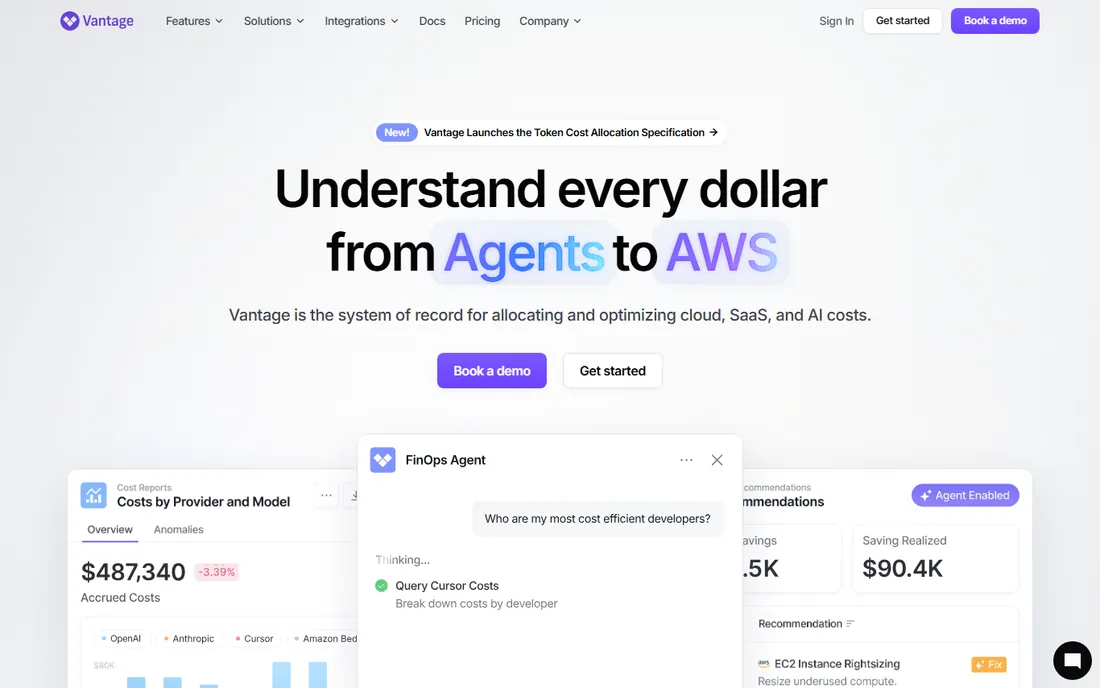
Vantage is the FinOps tool for teams that want to sign up and see their spend in an afternoon. The Starter tier is free up to $2,500 of tracked monthly spend, Pro runs $30 per month up to $7,500, and Business $200 up to $20,000. Coverage spans the big three clouds plus Kubernetes and SaaS providers, with virtual tagging, budgets and anomaly alerts that punch above the price.
The model is honest about its lane. Vantage optimizes for visibility and self-serve speed rather than enterprise FinOps process: chargeback workflows, deep allocation models and procurement-grade reporting are thinner than at CloudZero or Flexera. For startups through mid-market, that trade is exactly right. It is the fastest path from "we have no idea" to "we know where every dollar goes."
What we like- True self-serve signup with a free Starter tier up to $2,500 in tracked spend
- Clean interface engineers actually open
- Per-service cost tracking across AWS, Azure, GCP and SaaS
Watch out for- Tracked-spend caps mean growing companies graduate to paid tiers
- Less depth on enterprise chargeback than the quoted platforms
#5
Infracost
Best for: Teams that want costs visible before infrastructure ships
Visit infracost.io
Starting priceFree (CI/CD); Starter $250/month
Free planYes
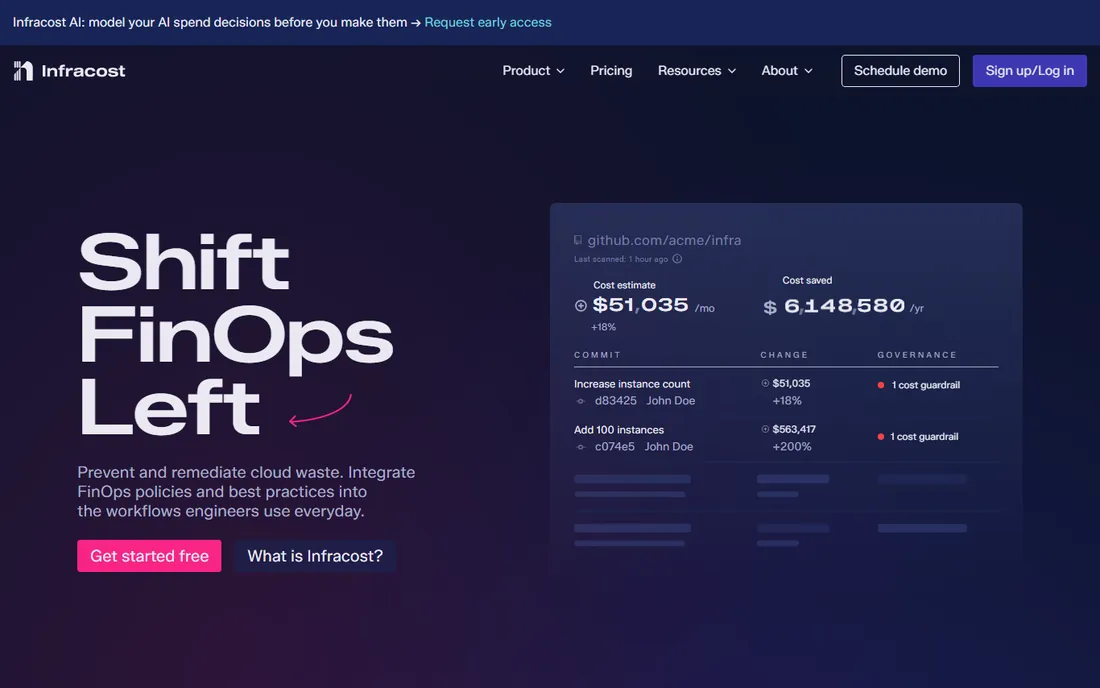
Infracost attacks waste at its source: the pull request. By estimating the cost of Terraform, CloudFormation or CDK changes before they deploy, it makes cost a code-review conversation instead of a month-end surprise. The free CI/CD tier covers 1,000 runs monthly, Starter at $250 adds volume and support, and policies can hard-block changes that exceed cost thresholds.
The scope is deliberately narrow. Infracost estimates what infrastructure will cost; it does not monitor what running systems actually spend, which is where Kubecost, Vantage and CloudZero live. Mature FinOps programs use both: Infracost to prevent waste, observability tools to find it. For platform teams standardizing on infrastructure as code, putting cost estimates in every PR is the highest-impact FinOps investment available.
What we like- Shows cost impact directly in pull requests, shifting FinOps left
- Free CI/CD tier with 1,000 runs per month
- Policies can block PRs that breach cost guardrails
Watch out for- Focused on infrastructure-as-code estimates, not on observing running spend
- The full Cloud platform at $1,000 per month is a jump
Starting priceSee website (custom quote)
Free planNo
CloudZero's pitch is that total cloud spend is the wrong number and cost per unit is the right one. The platform allocates spend to customers, features, teams and products, so engineering and finance discuss the same metrics: what does one more customer cost us, which features burn margin. For SaaS companies where those questions decide pricing and roadmap, this framing is more useful than any dashboard of totals.
The buyer profile is specific: software companies with meaningful cloud spend and an engineering culture. Pricing is entirely custom, and the sales process matches. Infrastructure-heavy or non-SaaS companies get less from the unit-economics framing. But for its target buyer, CloudZero turns cloud cost from an ops problem into a business metric, which is the whole point of FinOps.
What we like- Cost per customer, per feature and per team, the metrics SaaS finance actually uses
- Engineering-friendly allocation without perfect tagging
- Strong anomaly detection and forecasting
Watch out for- Custom-quoted pricing with no public numbers
- Aimed at software companies, less natural for other industries
#7
nOps
Best for: AWS-heavy teams that want savings on autopilot
Visit nops.io
Starting priceFree (Cloud Management Platform); Commitment Management from a share of savings
Free planYes
nOps sells outcomes, not dashboards. Its commitment management buys and adjusts Reserved Instances and Savings Plans automatically, and Compute Copilot optimizes EC2 and spot usage, with nOps taking a share of the realized savings. The Cloud Management Platform itself is free, which means visibility costs nothing and the paid portion funds itself from savings it generates.
The model demands scrutiny in the way all gain-share deals do: understand exactly what counts as savings and what percentage applies. AWS is the home turf; multicloud estates should verify coverage. But for AWS-heavy teams that know they are overpaying and lack the staff to manage commitments manually, nOps is the closest thing to a money printer in FinOps, provided the contract terms are clear.
What we like- Automates Reserved Instance and Savings Plan management instead of just recommending
- Free platform tier for visibility
- Savings-share pricing means you pay from results
Watch out for- AWS-centric, with other clouds secondary
- The share-of-savings model needs careful contract reading
#8
Finout
Best for: Companies unifying cloud, SaaS and AI spend in one bill
Visit finout.io
Starting priceSee website (custom quote)
Free planNo
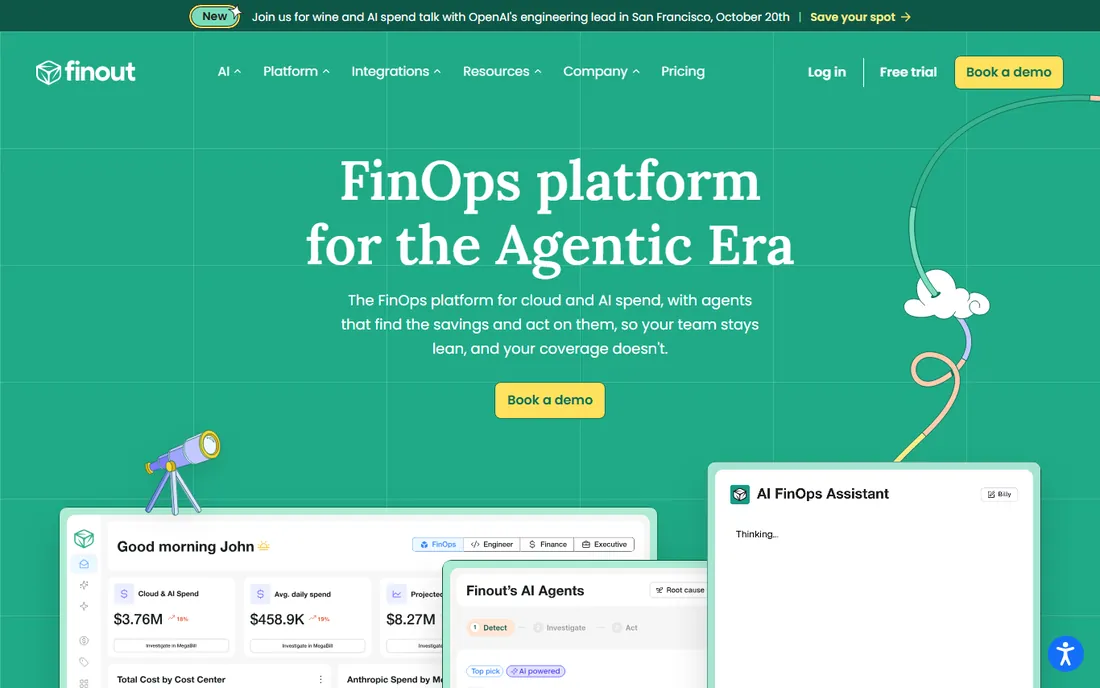
Finout's insight is that the "cloud bill" now includes SaaS subscriptions, AI API spend and Kubernetes alongside AWS and Azure, and finance wants one number. The MegaBill pulls it together, allocates costs without requiring perfect tagging discipline, and presents it in terms business units understand. For companies whose spend sprawls across a dozen vendors, the unification is the feature.
The youth shows in enterprise credentials: fewer reference customers at massive scale than Flexera or CloudZero, and quoted pricing that requires a sales process. But the product direction matches where spend is going, toward AI and SaaS as much as infrastructure. Teams drowning in vendor sprawl should evaluate Finout against the single-cloud-native tools, because the problem it solves is increasingly the real one.
What we like- MegaBill concept unifies cloud, SaaS, Kubernetes and AI provider spend
- Code-free allocation that avoids tag-taxonomy projects
- Fast time to value for multicloud estates
Watch out for- Custom pricing with no public numbers
- Newer vendor with a smaller track record than the incumbents
#9
ProsperOps
Best for: Companies that want commitment discounts without managing them
Visit prosperops.com
Starting priceSee website (share of realized savings)
Free planNo
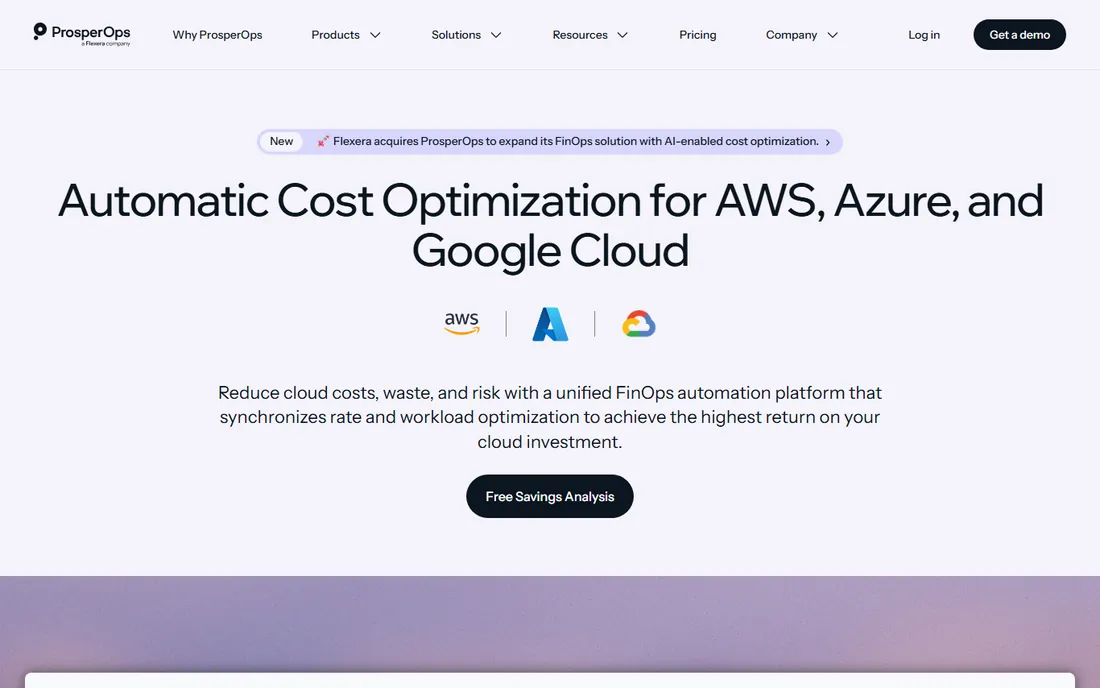
ProsperOps does one thing completely: it manages your Reserved Instances and Savings Plans better than a human team can, adjusting continuously as usage shifts. The pitch is freedom from the spreadsheet-and-calendar ritual of commitment management, with savings that compound because the algorithm never sleeps. Pricing is a share of realized savings, so the cost scales with the value.
The narrowness is the point and the limitation. ProsperOps does not do cost visibility, allocation or anomaly detection; it assumes you have those or do not need them. Pair it with Vantage or Kubecost for the full picture. For companies spending six figures annually on AWS or Azure compute, handing commitments to an autonomous optimizer typically beats manual management within a quarter, and the gain-share model means the ROI math is self-evident.
What we like- Fully autonomous management of AWS and Azure commitments
- Algorithm adjusts to usage changes without human intervention
- You pay a share of savings delivered
Watch out for- No free tier and no published prices
- Scoped to commitment optimization, not full FinOps visibility
#10
Anodot
Best for: Enterprises that need AI watching spend for anomalies
Visit anodot.com
Starting priceSee website (custom quote)
Free planNo
Anodot built its name on anomaly detection: machine learning that learns normal spend patterns and flags the abnormal before the bill arrives. Rebranded toward the Umbrella FinOps positioning, it now wraps detection in broader cost management for enterprises and MSPs. For organizations where a single undetected spike costs more than the tool, dedicated detection has a clear ROI.
The question every buyer should ask is whether they need it standalone. Vantage, CloudZero and most platforms here include anomaly detection, and native cloud tools do basic versions free. Anodot's edge is detection depth and the MSP-friendly model. Enterprises with complex, spiky spend across many accounts get value from a specialist. Everyone else should check what their primary platform already detects before adding another tool.
What we like- AI-driven anomaly detection tuned for time-series cost data
- Strong forecasting
- Now positioned as Umbrella for broader FinOps coverage
Watch out for- Custom enterprise pricing
- Anomaly detection is a feature buyers often get bundled elsewhere
How we chose
We started with the searches FinOps buyers run: cloud cost management software, FinOps tools, and Kubernetes cost optimization. For each candidate we checked the vendor's own pricing page, read public reviews on G2 and Capterra and practitioner discussion on Reddit and in the FinOps Foundation community, and compared cloud coverage, allocation depth, automation, and fit for startups versus enterprises. Where a vendor publishes no price we wrote "See website" rather than guessing. Every tool here is a real product, available today.
FinOps in plain terms
FinOps is the discipline of making cloud spend accountable, and it has three stages. Visibility comes first: knowing what you spend, where, and on what. Every tool on this list does visibility, from Kubecost's free tier to Flexera's enterprise dashboards. Most companies stop here and wonder why the bill never drops. Visibility without action is just expensive awareness.
Optimization is the second stage: rightsizing instances, buying commitments, deleting idle resources. This is where tools diverge. Some recommend and wait for a human (Vantage, CloudZero). Some act automatically (nOps, ProsperOps). Some prevent the waste before it exists (Infracost in the pull request). The automation tier is where FinOps pays for itself, because recommendations nobody implements are just another dashboard.
Accountability is the third stage: chargeback, budgets, and unit economics that make teams own their spend. CloudZero's cost-per-customer and Finout's MegaBill serve this stage. Mature organizations run all three stages; most companies should sequence them in order. Buy visibility first, add automation when you know where the waste is, and build accountability once the numbers are trustworthy. Skipping straight to chargeback with bad data just creates arguments.
Choosing between visibility and automation
The fundamental choice in this category is whether you want to see the waste or eliminate it. Visibility tools (Vantage, Kubecost, CloudZero's dashboards) make the spend legible and leave decisions to humans. Automation tools (nOps, ProsperOps, Infracost's guardrails) make decisions themselves. Neither is wrong, but they suit different organizations.
Choose visibility first if your problem is understanding: spend spread across teams with no tagging, a bill nobody can explain, finance asking for forecasts. Vantage's free tier or Kubecost for Kubernetes answers these in days. Choose automation when you already know where the waste is and lack the hands to fix it: commitments unmanaged, idle resources piling up, PRs shipping expensive infrastructure. That is the nOps, ProsperOps and Infracost moment.
Most maturing setups end up with both, and the combination matters more than either alone. Infracost in the pipeline prevents new waste; Kubecost or Vantage finds existing waste; nOps or ProsperOps harvests the commitment savings automatically. Budget them as a stack, not as competing options. The companies with the lowest cloud bills are not the ones with the best dashboard. They are the ones where the waste gets fixed without a meeting.
Frequently asked questions
What is cloud cost management software?
Software that tracks, allocates and optimizes what you spend on cloud infrastructure. The category, often called FinOps tooling, covers visibility dashboards, Kubernetes cost allocation, anomaly detection, automated savings (commitments, rightsizing) and cost controls in the deployment pipeline. Native cloud tools cover the basics; third-party platforms add multicloud views and automation.
How much does FinOps software cost?
Free tiers are common: Kubecost, Vantage, Infracost, Harness and nOps all start free. Paid entry points run $30 per month (Vantage Pro), $250 (Infracost Starter) and $449 (Kubecost Business). Enterprise platforms are custom-quoted, and some (nOps, ProsperOps) charge a share of the savings they generate rather than a flat fee.
What is the difference between FinOps and cloud cost management?
The terms overlap heavily. Cloud cost management describes the practice of monitoring and reducing cloud spend. FinOps implies the fuller discipline from the FinOps Foundation: engineering, finance and product collaborating with shared accountability, covering visibility, optimization and chargeback. Most vendors use the terms interchangeably.
Do I need a FinOps tool if I use AWS Cost Explorer?
Cost Explorer answers "what did we spend" for AWS only. Third-party tools add multicloud coverage, Kubernetes allocation, anomaly detection, automated optimization and unit economics that native tools lack. Companies early in the journey or single-cloud can start native. Multicloud estates, Kubernetes shops and companies wanting automation outgrow native tools fast.
What is Kubecost, and is it really free?
Kubecost is the standard open-source-rooted tool for Kubernetes cost monitoring, now part of IBM. The Foundations tier is free up to 250 cores combined, which covers many real clusters. Paid Business tiers start around $449 per month for advanced features. It is Kubernetes-only, so pair it with a broader platform for non-container spend.
How do savings-share pricing models work?
Vendors like nOps and ProsperOps charge a percentage of the cloud savings they generate (commonly around a fifth of net savings) rather than a flat subscription. The appeal is self-funding: no savings, no fee. Read the contract carefully to understand how savings are measured, what baseline is used, and what happens when usage drops for unrelated reasons.
Sources we checked (3)
- https://www.infracost.io/pricing
- https://www.g2.com/categories/cloud-cost-management
- https://www.capterra.com/cloud-cost-management-software/
Is your product missing or out of date?
We review this list regularly. Vendors can request a listing, send updated pricing or ask about featured placement.

Shihab Mia · Founder, Rankite
Shihab has spent more than a decade helping SaaS and e-commerce brands grow through search. He writes Rankite's software buying guides from pricing pages, documentation and public user reviews. More about Shihab.