How we make this list: we compare pricing pages, product documentation and public user reviews. Rankite is independent; if a vendor ever pays for a featured spot, that listing is clearly labeled Partner.
Key takeaways
- The best corporate learning platform depends on your audience: Docebo wins for multi-audience enterprise training, TalentLMS for fast SMB deployment, Cornerstone for talent-integrated enterprises.
- Docebo publishes a rare honest number: its main tier is $9 per user with a 250-user minimum, while most enterprise LMS pricing hides behind custom quotes.
- 360Learning's collaborative model turns subject matter experts into course creators, solving the content bottleneck that stalls most learning programs.
- AI is now table stakes across the category: every platform here offers AI course creation, recommendations, or agents in 2026.
- Implementation timelines vary enormously: TalentLMS goes live in days, Cornerstone can take three to six months.
Quick comparison
| Tool | Best for | Starting price | Free plan |
|---|
 Docebo Docebo | AI-powered enterprise learning | $9/user/month | No |
 Cornerstone OnDemand Cornerstone OnDemand | talent-integrated enterprise LMS | See website | No |
 TalentLMS TalentLMS | fast SMB training deployment | See website | Yes |
 LearnUpon LearnUpon | multi-audience training portals | See website | No |
 Absorb LMS Absorb LMS | polished learner experience | See website | No |
 360Learning 360Learning | collaborative peer-created learning | See website | No |
 Degreed Degreed | skills intelligence and upskilling | See website | No |
 Litmos Litmos | rapid deployment at scale | See website | No |
Is your product missing or out of date?
We review this list regularly. Vendors can request a listing, send updated pricing or ask about featured placement.
Corporate learning platforms have converged on AI in 2026, which makes the differentiators more about fit than features. The right platform is the one that matches your primary audience, integrates with your HR stack, and can actually be administered by the team you have. These eight cover the full spectrum from SMB-friendly to enterprise-grade.
Starting price$9/user/month
Free planNo
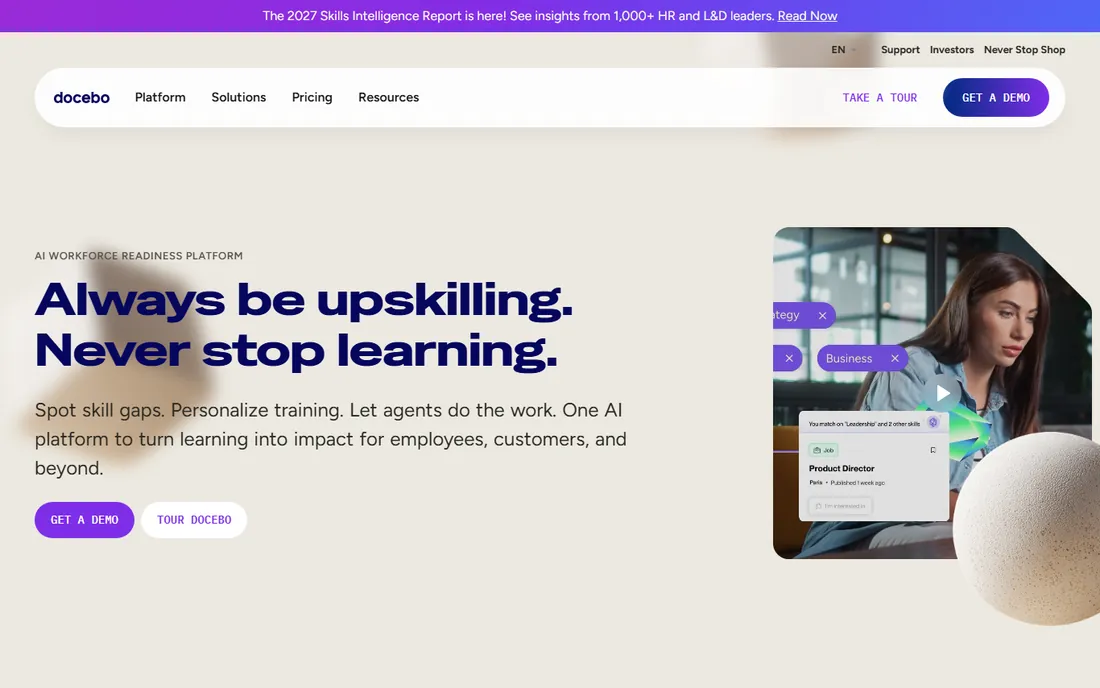
Docebo is the AI-first enterprise LMS, and it stands out in a category where pricing is usually a secret. The vendor states plainly that its main tier costs $9 per user with a 250-user minimum, which gives mid-market buyers a real number to plan around. Beyond pricing honesty, Docebo's differentiator is multi-audience training: employees, customers, and partners managed centrally with personalization for each.
The AI layer handles content tagging, recommendations, and full course generation through Docebo Creator, while the 30,000-course marketplace fills gaps in your own catalog. With 50-plus language support and deep HRIS integrations, it is built for global scale. The honest catch is implementation weight. Four to twenty weeks is a real project, and companies under the 250-user floor pay for seats they do not have. It is an enterprise platform that happens to be honest about it.
What we like- Rare transparent enterprise pricing at $9 per user
- Manages multiple audiences from one platform
- 30,000-course content marketplace
Watch out for- Implementation runs 4 to 20 weeks
- Smaller companies may find the platform oversized
Starting priceSee website
Free planNo
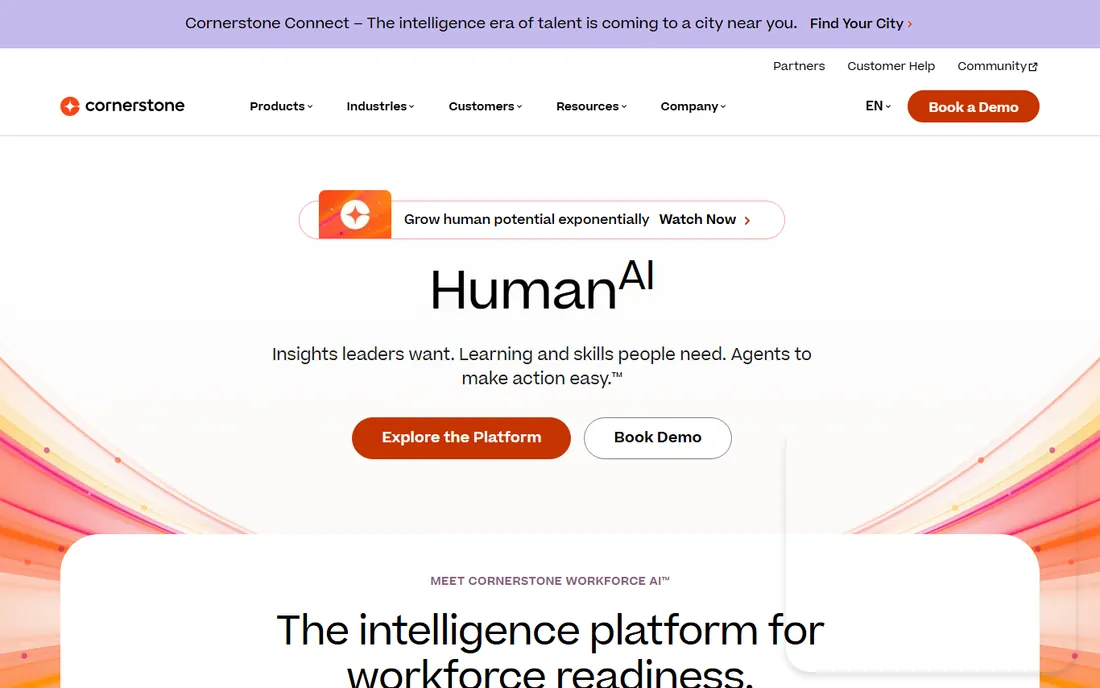
Cornerstone is the enterprise standard for a reason: it treats learning as one part of a talent ecosystem that includes performance, recruiting, and succession planning. For large organizations in regulated industries, that integration matters more than any single learning feature. Compliance training, certification tracking, and leadership development all live in one system with one data model.
The 2026 platform adds Workforce AI and readiness agents that map skills gaps and reskilling timelines, pushing the suite toward workforce planning, not just course delivery. The honest catch is gravity. Cornerstone is the heaviest implementation on this list, both in time (three to six months is typical) and in contract complexity, with per-module quoting. Choose it when learning must connect to talent strategy, not when you just need courses online quickly.
What we like- Deepest integration of learning with performance and talent management
- Strong compliance and certification tracking
- FedRAMP and enterprise-grade security
Watch out for- Quote-based modular pricing
- Three-to-six-month implementations are the heaviest here
Starting priceSee website
Free planYes
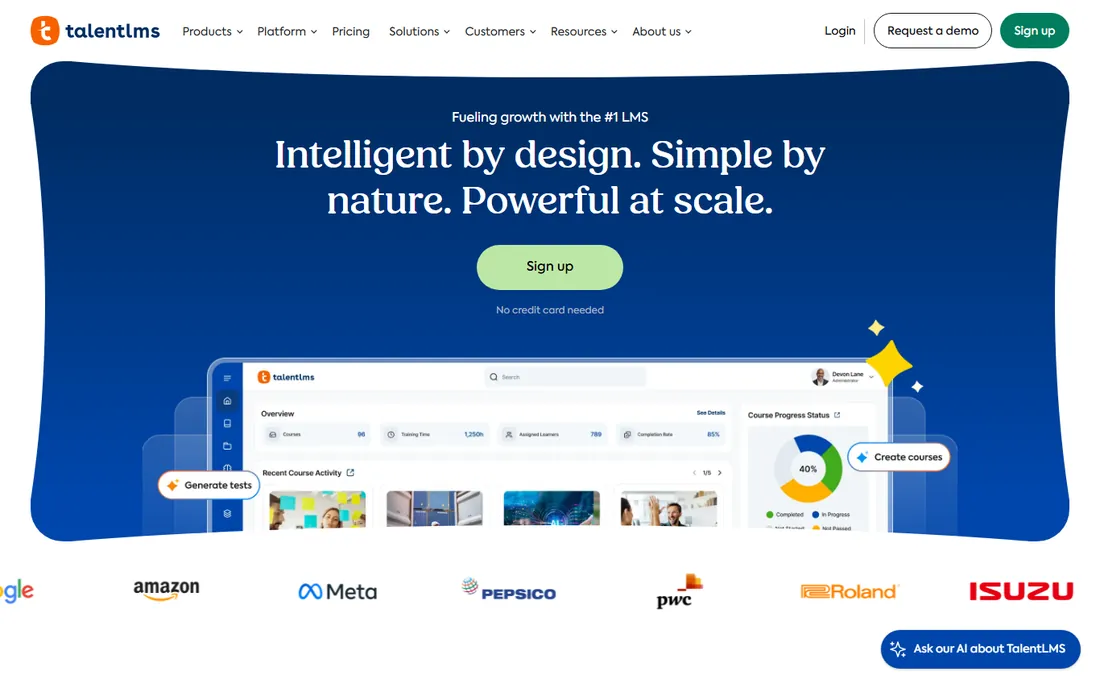
TalentLMS is the platform for teams that need training running this week, not next quarter. Sign-up takes seconds, no credit card is required, and the vendor claims you go live twice as fast as the industry average. For SMBs without a dedicated L&D team, that speed-to-value is the whole argument. Branches let you run separate portals for employees, partners, and customers from one account.
The built-in AI creates courses and assessments faster, translates them for global teams, and turns learner data into skills visibility. A 1,000-plus course library covers compliance and soft skills out of the box, and gamification keeps completion rates healthy. The honest catch is the ceiling. Enterprises with sophisticated skills mapping or content curation needs will outgrow it, typically within a year or two. It is the best starting point in corporate learning, priced and packaged like one.
What we like- Live in days with no IT required
- Transparent pricing and a real free plan
- Built-in AI course creation and translation
Watch out for- Hits limits with sophisticated skills mapping
- Enterprise governance features trail the big suites
Starting priceSee website
Free planNo
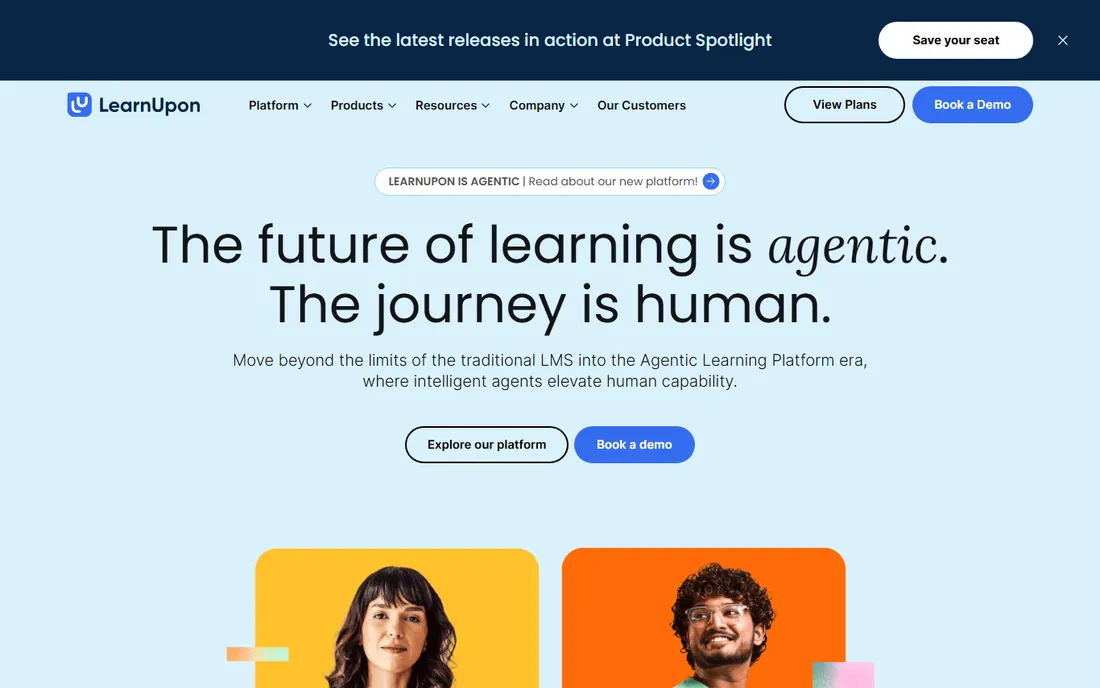
LearnUpon has repositioned as an Agentic Learning Platform, and the agentic framing is more than marketing: AI agents handle content freshness, assessment generation, personalized recommendations, and the administrative grind that consumes L&D teams. With 1,700-plus organizations and 31 million users, the scale is proven.
The core strength remains multi-audience management. Learning Portals create fully branded environments for employees, customers, and associations from a single account, each with separate catalogs, permissions, and reporting. For companies whose training spans internal staff and external customers, that consolidation replaces two or three systems. The honest catch is pricing opacity and positioning. Quotes are custom, and teams that only train employees may find the external-audience machinery more than they need.
What we like- Multi-tenant portals for employees, customers, and partners from one account
- Agentic AI automates admin work
- 31M-plus learners served
Watch out for- Quote-based pricing
- Best fit for external audiences means pure internal teams may overpay
Starting priceSee website
Free planNo
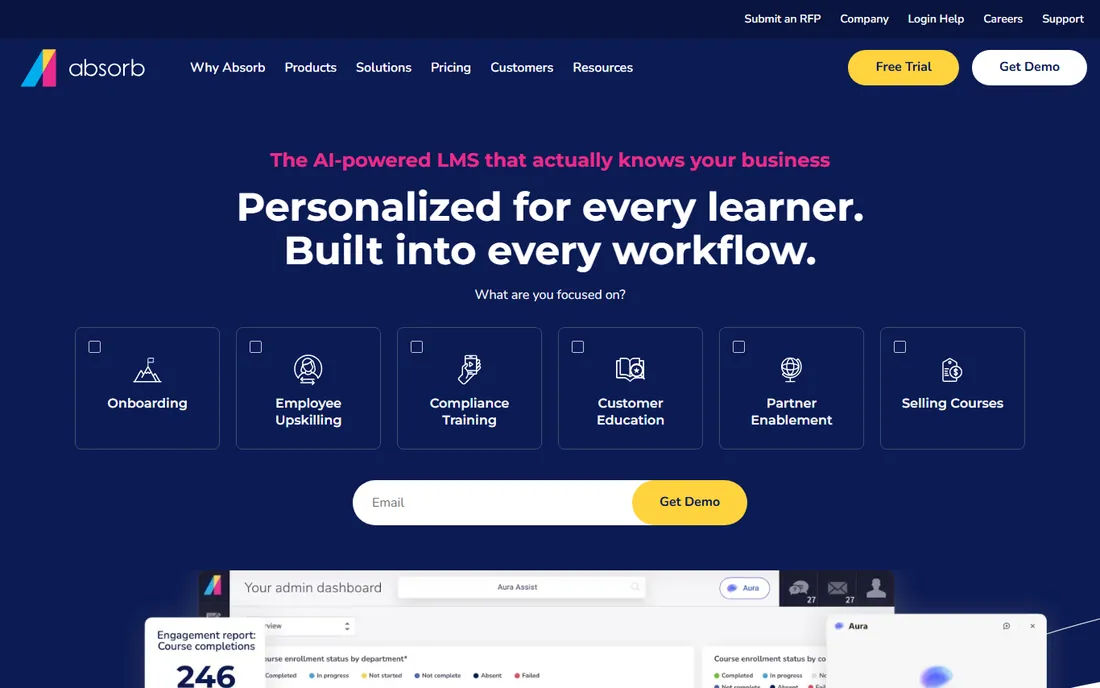
Absorb LMS earns its reputation on experience: both the learner interface, which users consistently rate as the most intuitive in the category, and the admin side, where smart automation removes the busywork that bloats L&D headcount. Absorb Create generates entire courses in minutes with quizzes, videos, translations, and voice-overs, while Absorb Skills builds personalized upskilling paths from 12,000-plus job skills.
The platform covers the full corporate range: onboarding, compliance, customer education, partner enablement, and course sales through built-in e-commerce. Integrations span ADP, Workday, and Salesforce, and migration support helps you escape your current LMS. The honest catch is commercial. Pricing is quote-based and positioned at the premium end, which puts genuine Absorb deployments out of reach for small teams. Mid-market and enterprise buyers get the value.
What we like- Intuitive admin UI with smart automation
- AI course creation and personalized upskilling paths
- E-commerce for selling courses
Watch out for- Quote-based pricing
- Premium positioning puts it out of SMB reach
Starting priceSee website
Free planNo
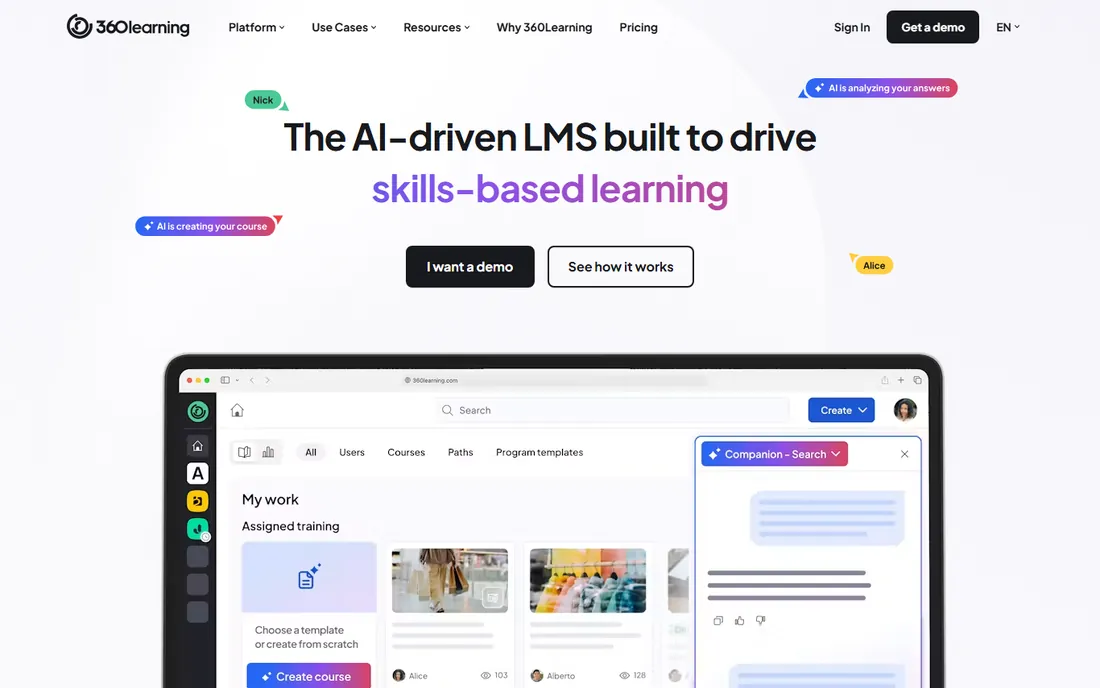
360Learning's bet is that your experts already know what your people need to learn, and the platform's job is to turn that expertise into courses fast. The collaborative authoring workflow lets subject matter experts create interactive content with AI assistance while L&D keeps oversight. For companies where knowledge lives in people's heads rather than slide decks, this solves the content creation bottleneck that stalls every other LMS rollout.
The AI Companion personalizes content and provides real-time mentoring, while automated skill-gap detection connects learners with internal experts. Deep integrations with Workday, SAP, BambooHR, and 80-plus more systems keep enrollment automatic. The honest catch is cultural. Collaborative learning needs experts willing to create and a culture that values peer knowledge; pure compliance-driven organizations will not use the platform's best features. It is a philosophy as much as a product.
What we like- Turns subject matter experts into course creators
- Collaborative authoring solves the content bottleneck
- Strong HCM integrations
Watch out for- Requires cultural buy-in for peer learning
- Less suited to top-down compliance programs
Starting priceSee website
Free planNo
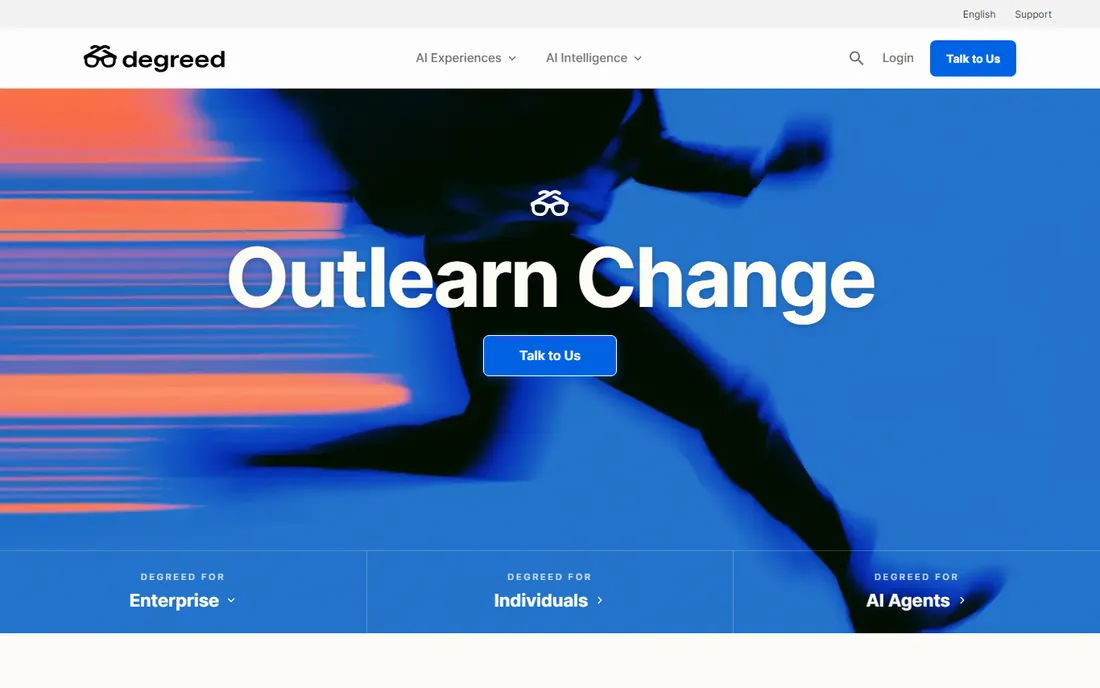
Degreed plays a different position from the LMS vendors: it is a learning and upskilling platform focused on skills intelligence rather than course administration. It aggregates everything people learn, from internal courses to external content to on-the-job experience, into unified skill profiles that show what the workforce can actually do. For enterprises building skills-based organizations, that visibility is the missing layer.
The 2026 platform extends into AI coaching and agent-facing learning infrastructure, reflecting where corporate learning is heading. Clients include AstraZeneca, Ford, HSBC, and Verizon, which signals the enterprise weight class. The honest catch is category fit. If your primary need is compliance tracking and certification management, a traditional LMS serves you better. Degreed is for companies that have moved past completions and want to measure capability.
What we like- Skills intelligence connects learning to workforce capability
- Aggregates internal and external learning in one profile
- Enterprise client roster
Watch out for- More LXP than traditional LMS, so compliance tracking is not the strength
- Enterprise-only pricing
Starting priceSee website
Free planNo
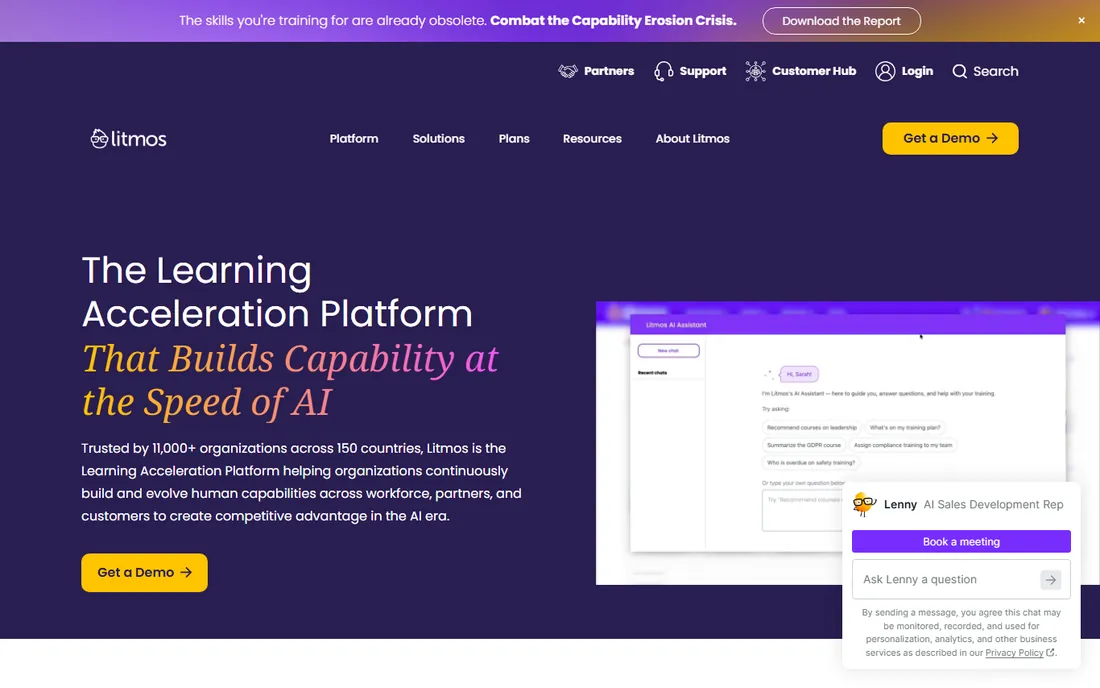
Litmos positions itself as the Learning Acceleration Platform, and the positioning fits: this is the LMS for companies that need training live fast and at scale. With 11,000-plus organizations across 150 countries, it has the deployment muscle that smaller vendors lack. The platform covers the full corporate range from onboarding and compliance to sales enablement and partner training.
AI-assisted content creation, contextual microlearning embedded in workflows, and a library of ready-to-deploy courses compress the time from decision to trained workforce. The operational simplicity is deliberate: lean L&D teams can run serious programs without the headcount that enterprise LMS platforms usually demand. The honest catch is tiering. The features that make Litmos compelling at scale sit behind higher-tier plans, and some users find the reporting tools limiting. It is the pragmatic enterprise choice when speed matters more than depth.
What we like- Rapid deployment with operational simplicity
- Trusted by 11,000-plus organizations in 150 countries
- AI-assisted content creation and microlearning
Watch out for- Advanced features gated behind higher tiers
- Reporting tools frustrate some power users
We drew the shortlist from 2026 LMS comparisons, G2 and Capterra corporate learning categories, and practitioner consensus about which platforms actually win deployments. We verified every vendor homepage to confirm the product exists today and serves corporate training rather than academic or creator markets. We balanced the enterprise suites (Docebo, Cornerstone, Absorb, Degreed), the mid-market specialists (LearnUpon, 360Learning, Litmos), and the SMB entry point (TalentLMS). We did not claim hands-on testing. Pricing is quote-based across most of this category, so we use "See website" except where the vendor publishes a real number, as Docebo does.
The fastest way to shortlist is by audience, not features. Training employees only? TalentLMS gets you live in days; Cornerstone or Absorb serve you at enterprise scale. Training customers and partners too? Docebo, LearnUpon, and 360Learning handle multi-audience delivery from one platform, which beats running separate systems. Selling courses? Absorb and TalentLMS both include e-commerce.
The second filter is your L&D team's capacity. A two-person team cannot administer Cornerstone; they can run TalentLMS or Litmos. A mature L&D org with skills strategy needs Docebo's AI or Degreed's skills intelligence. The platform that fits your team beats the platform with the longest feature list every time.
Budgeting for an LMS in 2026
Expect the pricing conversation to be the hardest part of the purchase. Most enterprise platforms quote custom contracts based on active users, modules, and implementation scope, with realistic minimums around $25,000 per year for Docebo-class platforms. SMB options are transparent: TalentLMS publishes plan tiers, and 360Learning prices around $8 per user per month.
Budget beyond the license. Implementation services, content migration, and integrations routinely add 50 to 100 percent to the first-year cost for enterprise platforms. And watch the AI surcharges: several vendors now meter advanced AI features separately. Get the full three-year cost in writing, including the renewal clause, before you sign.
Frequently asked questions
What is the best corporate learning platform in 2026?
There is no single winner. Docebo leads for AI-powered enterprise learning across multiple audiences, Cornerstone for talent-integrated enterprises, TalentLMS for SMBs that need to launch fast, and 360Learning for collaborative peer-created learning. Match the platform to your audience and team capacity.
How much does a corporate LMS cost?
SMB platforms like TalentLMS start under $100 per month with published tiers. Mid-market and enterprise platforms typically start around $25,000 per year with custom quotes. Docebo is unusually transparent at $9 per user per month with a 250-user minimum. Implementation and migration services add significantly to first-year costs.
How long does LMS implementation take?
TalentLMS can go live in a day or two. 360Learning typically needs two to four weeks. Docebo runs four to twelve weeks depending on integrations. Cornerstone is the heaviest at three to six months for a full enterprise deployment. Plan your timeline around your go-live deadline.
Can employees create their own training content?
Yes, though the experience varies widely. 360Learning is built for employee-generated content with AI assistance for non-designers. Docebo and TalentLMS include authoring tools as secondary features. Cornerstone's authoring targets L&D teams rather than individual contributors.
What is the difference between an LMS and an LXP?
A traditional LMS administers formal training: courses, completions, compliance, certifications. An LXP like Degreed focuses on discovery and skills, aggregating learning from many sources into personalized development. Many 2026 platforms blend both, with Docebo and Absorb covering the middle ground.
Do these platforms integrate with HR systems?
All eight integrate with major HRIS platforms. Cornerstone has the deepest native integration since it offers its own talent suite. Docebo connects to Workday, SAP SuccessFactors, and BambooHR via API. The others support major HRIS systems through native connectors or Zapier. Confirm your specific HRIS before signing.
Sources we checked (10)
- https://docebo.com/
- https://www.cornerstoneondemand.com
- https://talentlms.com/
- https://learnupon.com/
- https://www.absorblms.com
- https://360learning.com/
- https://degreed.com/
- https://litmos.com/
- https://lmspedia.org/best-corporate-lms/
- https://www.techno-pulse.com/2026/04/best-ai-learning-management-systems-in.html
Is your product missing or out of date?
We review this list regularly. Vendors can request a listing, send updated pricing or ask about featured placement.

Shihab Mia · Founder, Rankite
Shihab has spent more than a decade helping SaaS and e-commerce brands grow through search. He writes Rankite's software buying guides from pricing pages, documentation and public user reviews. More about Shihab.