How we make this list: we compare pricing pages, product documentation and public user reviews. Rankite is independent; if a vendor ever pays for a featured spot, that listing is clearly labeled Partner.
Key takeaways
- Ansys Fluent and Simcenter STAR-CCM+ are the two commercial CFD giants, with Fluent leading on physics breadth and STAR-CCM+ on integrated multiphysics workflows.
- OpenFOAM is the free, open-source standard for research and anyone with the expertise to run it from the command line.
- SimScale and SimFlow bring CFD down to accessible budgets: SimScale runs in a browser with a free community plan, and SimFlow has a free desktop version with no time limit.
- COMSOL Multiphysics is the pick when fluid flow is one physics among several, coupling fluids with heat, structures, and chemistry.
- Lattice Boltzmann tools (PowerFLOW, Fidelity CFD) dominate automotive and aerospace aerodynamics with overnight transient results.
Quick comparison
Is your product missing or out of date?
We review this list regularly. Vendors can request a listing, send updated pricing or ask about featured placement.
The best cfd software
Computational fluid dynamics software simulates how liquids and gases move, transfer heat, and exert forces, replacing expensive physical prototypes with virtual ones. The eight tools below span the commercial leaders, open-source options, and cloud disruptors, and every vendor page was verified today.
Starting priceSee website
Free planFree trial
Ansys Fluent is the industry-leading CFD code and the default answer for commercial fluid simulation. It covers laminar and turbulent flows, multiphase, combustion, chemical reactions, and heat transfer in one package, backed by decades of validation against experimental data. The GPU-native solver now runs massively parallel cases far faster than CPU-only workflows.
The ecosystem is part of the value: PyFluent scripting, shape optimization tools, multiphysics coupling with Mechanical and Icepak, and two major releases per year. Engineers who know Fluent are hireable anywhere, which matters for teams building CFD capacity. The honest catch is cost and depth. Licenses run into the tens of thousands annually, and extracting value from the full physics library demands genuine CFD expertise. For aerospace, automotive, energy, and biomedical engineering teams with budget, Fluent is the safe choice.
What we like- Broadest physics library of any commercial solver
- GPU-native solver for fast results
- Huge validation record and talent pool
Watch out for- Enterprise pricing is quote-based
- Complex models need real expertise
Starting priceSee website
Free planFree trial
Simcenter STAR-CCM+ is Siemens' answer to the whole-product simulation problem. It combines automated meshing, flow solving, heat transfer, particle dynamics, reactive flows, fluid-structure interaction, aeroacoustics, and design exploration in a single integrated platform. The automated mesh generation cuts preparation time, which is where CFD projects usually stall.
The multiphysics engine goes beyond fluid flow into electrodynamics, rheology, and real-world conditions, with flexible power licensing: unlimited cores for a fixed price, pay-per-hour sessions, or usage-based models. A free student version trains the next generation. The honest catch is the enterprise weight: pricing is quoted, implementation is serious, and simple problems do not need this much machinery. For automotive, aerospace, marine, and energy companies running complex multiphysics, it is Fluent's chief rival.
What we like- Automated meshing and end-to-end workflow in one interface
- True multiphysics from one CFD platform
- Flexible power licensing
Watch out for- Quote-based enterprise pricing
- Heavyweight for simple problems
Starting price$0
Free planYes
OpenFOAM is the leading free, open-source CFD software, distributed by the OpenFOAM Foundation under the GPL. Written in C++, with around 1.5 million lines of code, it spans industry, government research, and academia worldwide. There are no license fees, no per-core charges, and no vendor lock-in.
The freedom is total: customize solvers, automate cases, couple physics, and scale to supercomputers. Universities and research labs live on OpenFOAM, and many commercial engineers prototype in it. The honest catch is the interface, or lack of one. OpenFOAM is command-line driven, every boundary condition and solver parameter is on you, and results quality depends entirely on your numerics knowledge. For teams with CFD expertise and no budget, nothing else comes close.
What we like- Completely free with no license fees
- Infinitely customizable C++ source
- Massive academic and industry user base
Watch out for- Command-line driven with a steep learning curve
- You provide the expertise and support

#4
COMSOL Multiphysics
Best for: coupled multiphysics simulation
Visit comsol.com
Starting priceSee website
Free planFree trial
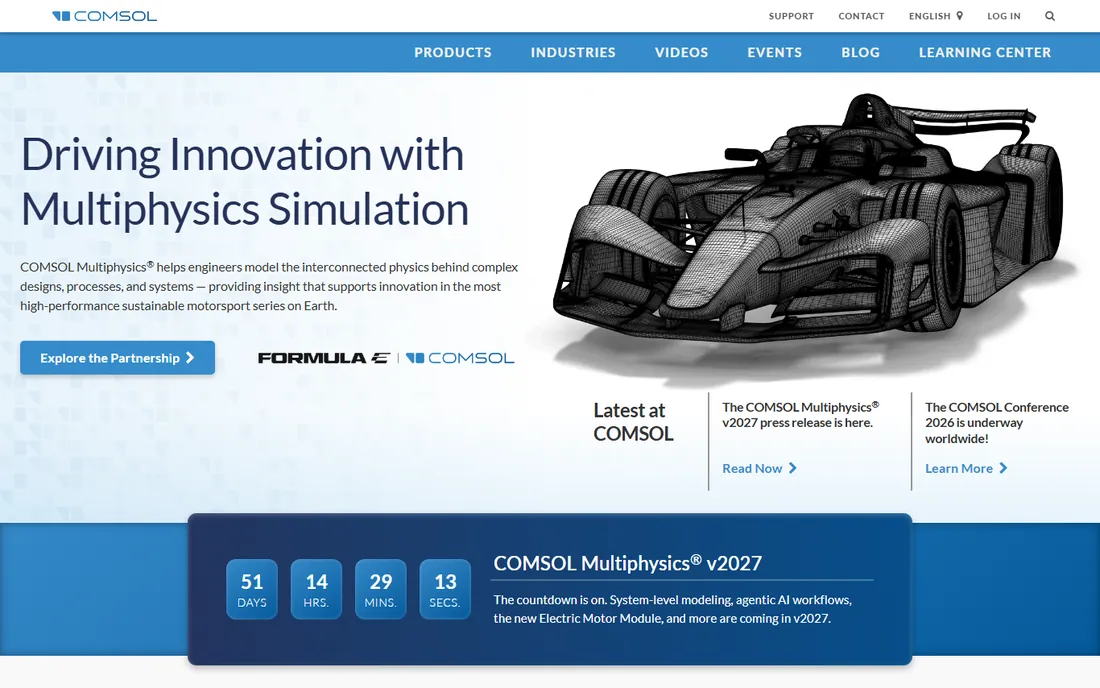
COMSOL Multiphysics approaches CFD sideways: the CFD Module is one add-on among dozens, and its power is coupling fluid flow with electromagnetics, structural mechanics, heat transfer, and chemical engineering in a single consistent interface. For devices where the fluid is only part of the story, battery thermal runaway, microfluidic lab-on-chip devices, acoustic streaming, this unified approach beats chaining separate tools.
The Model Builder combines physics in any order, and COMSOL Compiler deploys simulation apps for non-experts. Electronics, microfluidics, and medical device teams are the core audience. The honest catch is that for massive pure-CFD problems, dedicated solvers scale better, and pricing is quoted per configuration. If your product needs fluids plus something else, COMSOL is the natural pick.
What we like- Fluid flow coupled with heat, structures, and chemistry in one interface
- Consistent modeling environment across physics
- Strong for electronics and microfluidics
Watch out for- Quote-based pricing
- Large-scale pure CFD trails dedicated solvers
Starting priceSee website
Free planYes (Community)
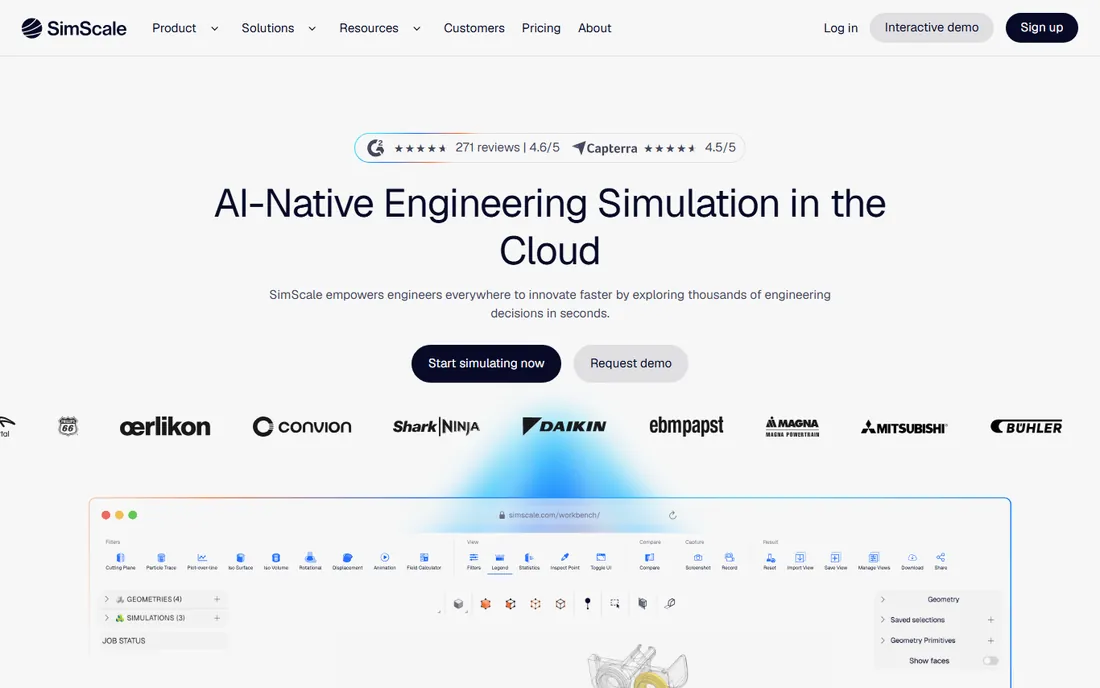
SimScale moved CFD to the cloud before it was fashionable, and in 2026 it is an AI-native engineering platform. Run full CFD in a browser: OpenFOAM, lattice Boltzmann, and immersed boundary solvers covering incompressible, compressible, multiphase, and conjugate heat transfer flows. Engineering AI automates meshing and setup; Physics AI gives near-instant flow predictions within about 5 percent of full CFD accuracy.
The community plan makes the platform free to start, and the platform handles CFD, FEA, thermal, and electromagnetics in one place. With 900,000-plus registered engineers, it has become the democratization route for teams without CFD specialists. The honest catch is that community plan projects are public, and serious physics needs a paid subscription. For design engineers who want simulation early in the process, SimScale is the easiest on-ramp.
What we like- Runs entirely in a browser with no HPC to manage
- Free community plan to start
- AI-assisted setup and instant predictions
Watch out for- Public projects on the free tier
- Advanced physics needs paid plans
Starting price€8,000/year
Free planYes
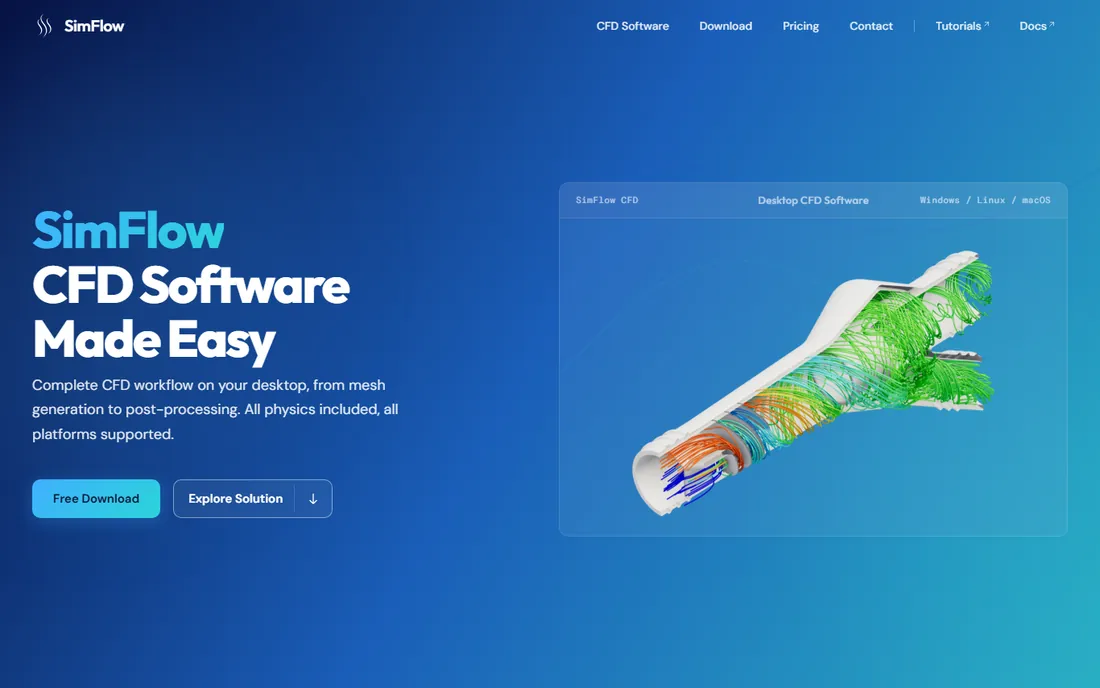
SimFlow is a desktop CFD package built on OpenFOAM with the graphical interface OpenFOAM never had. CAD import, meshing, setup, solving, and post-processing live in one visual workflow on Windows, Linux, and macOS. The free version includes all physics models with a 200,000 mesh node limit and one CPU, with no signup and no time limit.
Commercial plans are transparently priced: Professional at 8,000 EUR per year with unlimited mesh and CPUs, Enterprise at 10,000 EUR per year with floating licenses. No per-core fees, no hourly charges. The honest catch is the mesh cap on the free tier and the smaller support organization versus Ansys or Siemens. For engineers who want OpenFOAM's solvers with a real interface and a free tier that never expires, SimFlow hits the sweet spot.
What we like- Free version with no time limit and full physics
- Transparent pricing with no per-core fees
- OpenFOAM-based with a proper GUI
Watch out for- Free tier caps at 200,000 mesh nodes
- Smaller vendor than the giants
Starting priceSee website
Free planFree trial
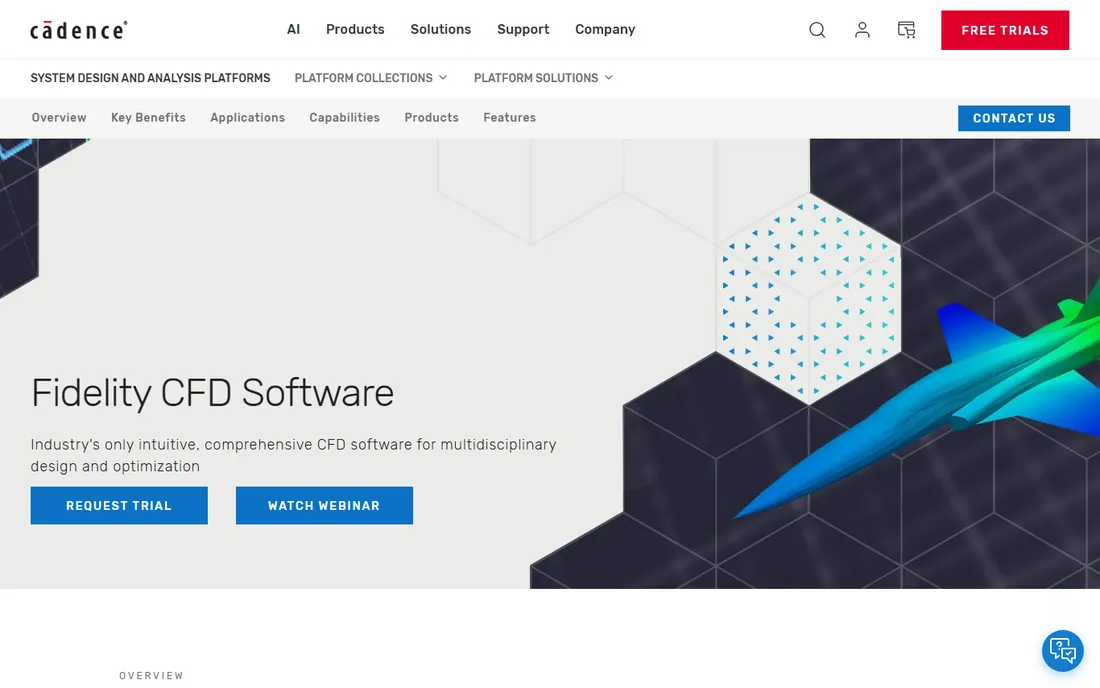
Cadence Fidelity CFD, built from the NUMECA and Pointwise acquisitions, is the specialist's choice for rotating machinery and marine applications. Fidelity Fine Turbo handles the 1D-to-3D turbomachinery workflow with automated performance curves. Fidelity Fine Marine is a virtual towing tank for hull resistance, propulsion, and seakeeping. The Fidelity Charles solver brings large eddy simulation to practical turnaround times with GPU acceleration.
America's Cup teams trust Fidelity Marine for hull hydrodynamics, which says something about the accuracy. Python scripting, ML-driven design optimization, and meshing that cuts preprocessing from days to hours round out the package. The honest catch is positioning: this is a specialist tool for turbomachinery, marine, and aerospace, with enterprise pricing to match. For those industries, the specialization is exactly the point.
What we like- Specialized solvers for turbomachinery and marine
- High-order LES with GPU acceleration
- Automated meshing cuts days of prep
Watch out for- Quote-based enterprise pricing
- Specialist positioning narrows the audience

#8
SIMULIA PowerFLOW
Best for: automotive and aerospace aero
Visit 3ds.com
Starting priceSee website
Free planNo
SIMULIA PowerFLOW from Dassault Systemes is the Lattice Boltzmann CFD tool that automotive aerodynamics runs on. The inherently transient solver handles aerodynamics, aeroacoustics, and thermal management with automated domain discretization, no manual volume or boundary layer meshing. For predicting wind noise, drag, and real-world turbulent conditions, it is the benchmark.
The physics are tailored: moving geometries, heat exchangers, porous media, realistic on-road wind conditions, and coupling with PowerTHERM for conjugate heat transfer. It scales across thousands of HPC cores. The honest catch is the enterprise reality: quote-based pricing, and the Lattice Boltzmann focus means some physics are better served elsewhere. For automotive and aerospace teams chasing aero and aeroacoustic performance, PowerFLOW is the standard.
What we like- Lattice Boltzmann transient solver with no volume meshing
- Industry standard for vehicle aeroacoustics
- Highly scalable on HPC
Watch out for- Quote-based enterprise pricing
- Lattice Boltzmann focus narrows the physics range
How we chose this CFD software
We covered the CFD market's segments: the two commercial leaders, the open-source standard, multiphysics specialists, cloud platforms, and budget desktop options. We drew the shortlist from engineering community consensus, practitioner comparisons, and industry usage patterns, then verified every vendor page to confirm the product exists today. We did not claim hands-on testing. Commercial CFD pricing is quote-based across the board, so we used "See website" for enterprise tools and stated real figures where vendors publish them.
Matching the solver to the problem
The honest truth about CFD is that the best software is the one matched to your problem and your team's skills. Transient aerodynamics with separation points to Lattice Boltzmann tools like PowerFLOW or Fidelity CFD. Rotating machinery points to Fidelity's turbomachinery suite. Coupled physics points to COMSOL or STAR-CCM+. Custom research points to OpenFOAM.
The second truth is that mesh quality and setup expertise matter more than the solver. A well-set-up OpenFOAM case beats a sloppy Fluent run. Budget for training and validation time regardless of which tool you choose, and validate against experiments or published benchmarks before trusting any result.
Frequently asked questions
What is the best CFD software?
For commercial engineering, Ansys Fluent and Simcenter STAR-CCM+ lead. For free open-source CFD, OpenFOAM. For cloud-based CFD, SimScale. For affordable desktop CFD with a free tier, SimFlow. For coupled multiphysics, COMSOL Multiphysics. For automotive aerodynamics, SIMULIA PowerFLOW. For turbomachinery and marine, Cadence Fidelity CFD.
Is there free CFD software?
Yes. OpenFOAM is completely free and open source with no license fees. SimFlow offers a free version with no time limit, capped at 200,000 mesh nodes. SimScale has a free community plan. Simcenter STAR-CCM+ offers a free student version. Several vendors offer trial licenses.
How much does CFD software cost?
Commercial CFD is quote-based and typically runs into tens of thousands of dollars per seat annually, with HPC costs on top. SimFlow publishes transparent pricing at 8,000 EUR per year for Professional. OpenFOAM costs nothing but requires in-house expertise, which has its own cost.
What is the easiest CFD software to learn?
SimScale is the easiest on-ramp, with browser-based setup and AI assistance. SimFlow's graphical interface makes OpenFOAM approachable. Autodesk-style CAD-integrated tools are gentle for design engineers. OpenFOAM is the hardest, with a command-line interface and a steep learning curve.
Which CFD software is best for automotive aerodynamics?
SIMULIA PowerFLOW is the industry standard for vehicle aerodynamics and aeroacoustics, using Lattice Boltzmann methods. Ansys Fluent and Simcenter STAR-CCM+ are also strong. SimScale offers cloud-based vehicle aerodynamics for teams without dedicated CFD resources.
OpenFOAM vs Ansys Fluent: which should I choose?
Choose OpenFOAM if you have CFD expertise, a limited budget, and need customization. Choose Fluent if you need validated physics models, support, GPU acceleration, and a talent pool of trained engineers. Many organizations use both: OpenFOAM for research, Fluent for production.
Sources we checked (10)
- https://www.ansys.com/products/fluids/ansys-fluent
- https://www.plm.automation.siemens.com/global/en/products/simcenter/STAR-CCM.html
- https://openfoam.org
- https://comsol.com/
- https://simscale.com/
- https://sim-flow.com/
- https://www.cadence.com/en_US/home/tools/system-analysis/computational-fluid-dynamics/fidelity.html
- https://www.3ds.com/products-services/simulia/products/powerflow/
- https://www.lorric.com/en-in/Articles/Industrial-database/all/CFD-software
- https://en.actualidadmotor.com/CFD-software-for-aerodynamic-and-fluid-study/
Is your product missing or out of date?
We review this list regularly. Vendors can request a listing, send updated pricing or ask about featured placement.

Shihab Mia · Founder, Rankite
Shihab has spent more than a decade helping SaaS and e-commerce brands grow through search. He writes Rankite's software buying guides from pricing pages, documentation and public user reviews. More about Shihab.
 Ansys Fluent
 Simcenter STAR-CCM+
 OpenFOAM
 SimScale
 SimFlow
 Cadence Fidelity CFD