How we make this list: we compare pricing pages, product documentation and public user reviews. Rankite is independent; if a vendor ever pays for a featured spot, that listing is clearly labeled Partner.
Key takeaways
- Most certificate management tools price by quote, not by published plan, so this comparison focuses on fit and features rather than per-seat numbers.
- DigiCert and Sectigo pair a public certificate authority with lifecycle management, which suits teams that buy certs and manage them in one place.
- Keyfactor and AppViewX are the strongest choices when you manage internal PKI across many environments rather than buying public SSL certs.
- With public TLS lifespans shrinking toward 47 days, automated renewal is now the feature that matters most.
- SSL.com and GlobalSign work well for smaller teams that need a handful of certs with a simple account portal rather than full CLM.
Quick comparison
| Tool | Best for | Starting price | Free plan |
|---|
 DigiCert DigiCert | enterprises standardizing on one CA plus CLM | See website | Free trial |
 Sectigo Sectigo | mid-size teams wanting turnkey certificate automation | See website | Free trial |
 Venafi Venafi | large environments with machine identity sprawl | See website | Free trial |
 Keyfactor Keyfactor | teams managing internal PKI and EJBCA | See website | Yes |
 AppViewX AppViewX | regulated enterprises needing crypto visibility | See website | No |
 GlobalSign GlobalSign | long-standing CA customers using managed PKI | See website | No |
 Entrust Entrust | government and enterprise PKI plus identity security | See website | Free trial |
 SSL.com SSL.com | small teams buying and renewing certs cheaply | See website | No |
Is your product missing or out of date?
We review this list regularly. Vendors can request a listing, send updated pricing or ask about featured placement.
Certificate expiry outages are embarrassing in a way few IT failures are. The website goes down, the warning page flashes, and everyone knows it was preventable. The tools below exist to make sure that never happens, by discovering every certificate you own, automating renewals, and keeping private keys under control. Here are eight worth a look.
Starting priceSee website
Free planFree trial
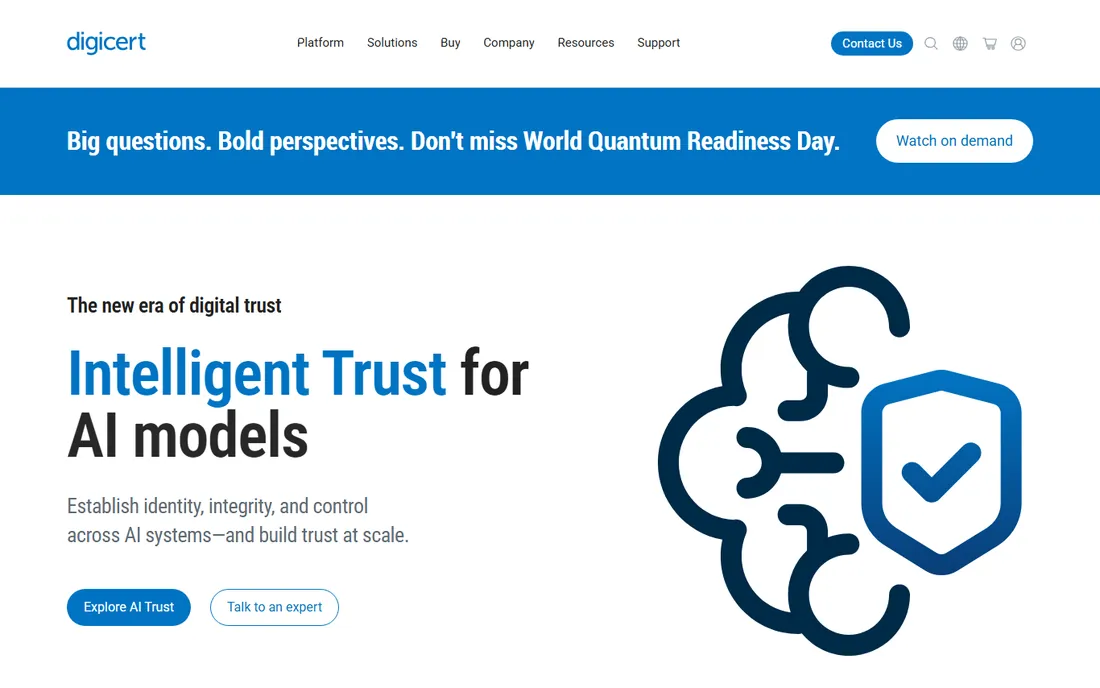
DigiCert is the safe enterprise pick, and sometimes the safe pick is the right one. As one of the biggest public certificate authorities, it issues the certs and then manages them in the same Trust Lifecycle Manager platform, so you stop juggling a CA vendor and a separate management tool. That combination matters when auditors ask for a clean inventory.
What stands out in 2026 is how much of the lifecycle DigiCert automates: discovery of unknown certs across your network, ACME-based provisioning, and renewal workflows that keep working as public TLS lifespans shrink. The platform also covers private PKI and code signing, so it stretches beyond web server certs. The honest catch is cost and complexity. DigiCert quotes everything, list prices are not published, and smaller teams may find the onboarding heavier than they want for a dozen domains.
What we like- One of the largest public CAs, so issuance and management live together
- Trust Lifecycle Manager handles public and private certs
- Strong automation integrations for DevOps and cloud
Watch out for- Enterprise pricing with no public list prices
- Can be more than a small shop needs
#2
Sectigo
Best for: mid-size teams wanting turnkey certificate automation
Visit sectigo.com
Starting priceSee website
Free planFree trial
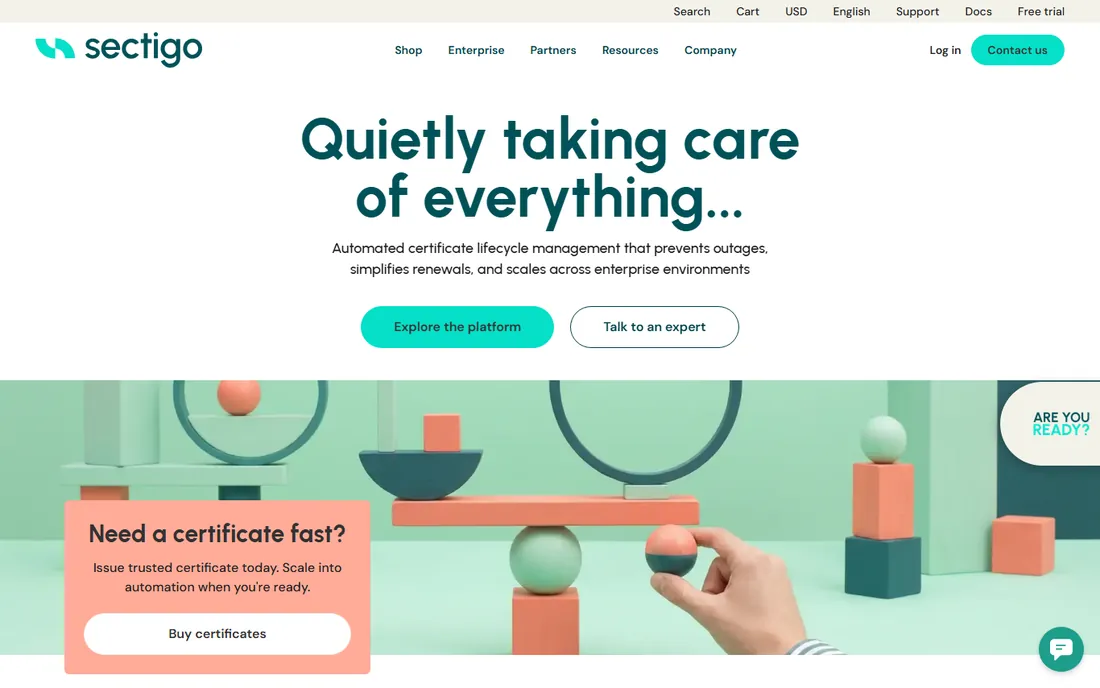
Sectigo has quietly built one of the friendliest CLM products for teams that are not huge. Sectigo Certificate Manager is cloud-native and turnkey, which means you can stand it up without the long services engagement that older PKI platforms demanded. It discovers, issues, automates, and renews certs across teams and environments, and it handles certificates from both Sectigo and third-party CAs.
The company leans hard on automation as the answer to shorter certificate lifespans, and reviewers consistently mention the dashboard and alerting as practical rather than flashy. With 50+ integrations and a broad customer base, it fits the classic mid-market scenario: a few hundred certs, a small security team, and no appetite for building PKI tooling in-house. The downside is the usual enterprise opacity. Pricing for SCM is quote-based, so budget approval means a sales conversation, and the single-cert pricing Sectigo publishes does not tell you what the management platform costs.
What we like- Cloud-native Certificate Manager with fast setup
- Manages public and private CAs in one console
- Wide integration library for common platforms
Watch out for- Enterprise CLM still priced by quote
- Brand recognition lags behind DigiCert in some circles
#3
Venafi
Best for: large environments with machine identity sprawl
Visit venafi.com
Starting priceSee website
Free planFree trial
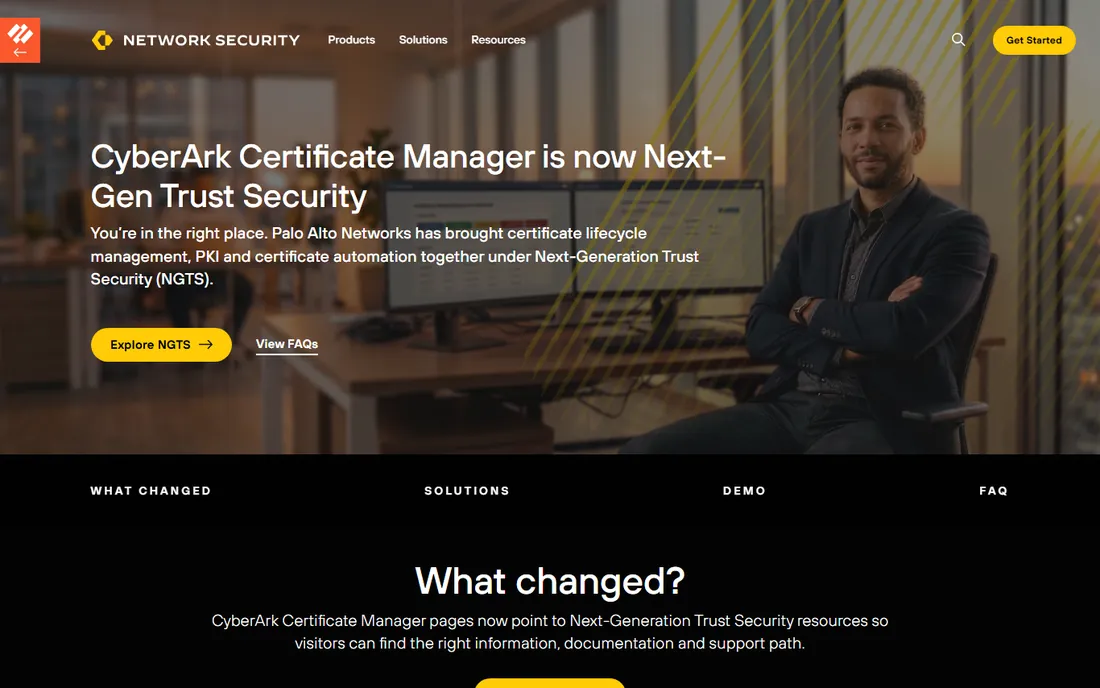
Venafi built its name on a specific problem: the thousands of machine identities (certs, keys, secrets) that pile up in large companies and that nobody fully tracks. TLS Protect, now sold under the NGTS (Next-Generation Trust Security) banner at Palo Alto Networks after the Venafi acquisition, remains the reference product for this job. It discovers every certificate, enforces policy on issuance, and automates renewal across data centers, clouds, and Kubernetes.
For organizations where certificate sprawl is genuinely a risk, meaning thousands of certs across teams that issue them independently, Venafi is hard to beat. The SaaS option with a free trial gives smaller proof-of-concept projects a way in without standing up infrastructure. The catch is identity confusion: venafi.com now redirects to Palo Alto Networks pages explaining the NGTS transition, and documentation lives in new places. New buyers should expect an enterprise sales process and to ask pointed questions about which product line (self-hosted or cloud) fits them.
What we like- Purpose-built for machine identity management at scale
- Strong policy and risk controls
- TLS Protect Cloud offers a SaaS route with a trial
Watch out for- The product line has moved into Palo Alto Networks NGTS branding, which confuses research
- Squarely enterprise, with enterprise sales cycles
Starting priceSee website
Free planYes
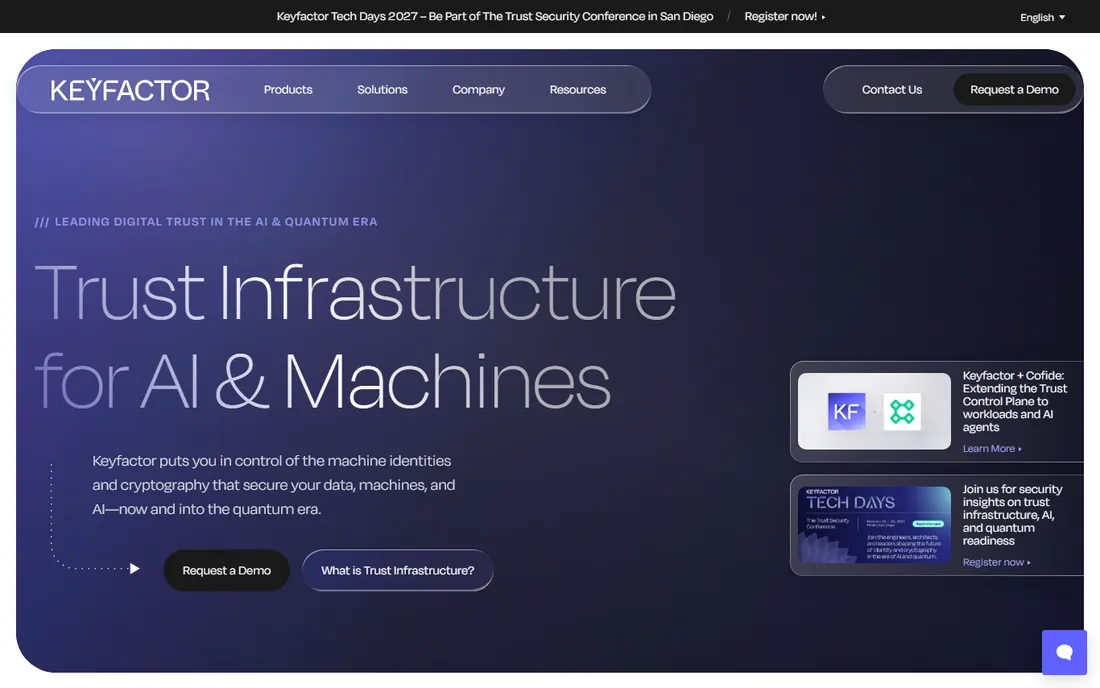
Keyfactor takes a different angle from the big public CAs: it is about the trust infrastructure you run yourself. Its flagship connection to the open-source world is EJBCA, the widely used open-source PKI and certificate authority software, whose Community edition is free and genuinely capable. That makes Keyfactor the rare vendor where you can start at zero cost and grow into the commercial Command platform as needs get serious.
The commercial side adds the control plane: discovery, issuance policy, automation, and crypto-agility reporting across your whole estate, with serious depth in IoT and manufacturing use cases where device certificates number in the millions. Keyfactor also talks post-quantum migration more concretely than most competitors. The honest catch is that private PKI is never truly simple. The software is excellent, but somebody on your team still needs to understand certificate policy, key ceremonies, and revocation, and the commercial pricing is quote-only.
What we like- Open-source EJBCA Community gives a genuinely free PKI starting point
- Strong for private PKI and IoT device identity
- Respected post-quantum readiness story
Watch out for- Commercial platform pricing is opaque
- Running your own PKI still demands real expertise
Starting priceSee website
Free planNo
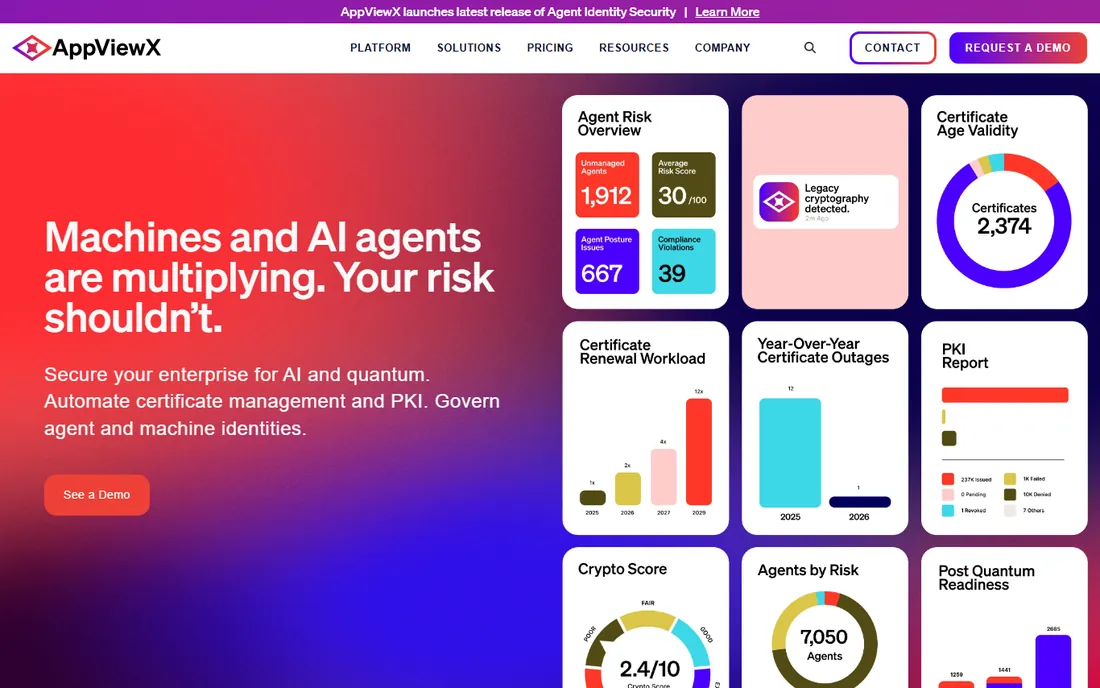
AppViewX has become one of the analyst favorites in certificate lifecycle management, and the 2026 IDC MarketScape leadership recognition backs that up. The platform covers the full lifecycle, discovery through remediation, across any environment, and its crypto-resilience scorecards give security leaders a readable answer to "how exposed are we" as certificate lifespans shrink and post-quantum work begins.
It also extends beyond certificates into agent identity security, SSH, and code signing, which appeals to teams consolidating identity tooling. The product is clearly built for regulated industries with compliance reporting needs rather than for a startup with ten domains. The catch is accessibility. There is no free tier and no public pricing, so evaluation means engaging with sales, and the total cost conversation happens behind closed doors.
What we like- Named a leader by IDC and KuppingerCole for CLM
- Crypto-resilience scorecards show where you stand
- Closed-loop automation from discovery to remediation
Watch out for- No free plan or public trial
- Enterprise focus with enterprise pricing
Starting priceSee website
Free planNo
GlobalSign is one of the old hands of the certificate world, a certificate authority since 1996, and that longevity counts for something in trust infrastructure. For organizations that buy their certs from GlobalSign, the Atlas management portal and managed PKI offerings keep issuance and lifecycle in one relationship, with strong support that long-time customers consistently praise.
CloudSSL is worth noting for platforms and hosting providers that need to issue certs for partner domains at volume without burdening those partners. The honest catch is that GlobalSign is first a CA and second a management platform. If what you need is best-in-class automated CLM with deep DevOps integration, the dedicated platforms above will feel more purpose-built. GlobalSign fits best when the buying decision starts with "we want our CA to also handle management" rather than the other way around.
What we like- CA operating since 1996 with deep institutional trust
- Atlas portal simplifies cert management
- Managed PKI and CloudSSL options for partners
Watch out for- Management tooling feels less modern than dedicated CLM platforms
- Pricing by quote for managed services
#7
Entrust
Best for: government and enterprise PKI plus identity security
Visit entrust.com
Starting priceSee website
Free planFree trial
Entrust sits at the intersection of certificates and identity security, which is exactly where large regulated organizations live. Its platform spans PKI, certificate lifecycle management, key management, and hardware security modules from one vendor, so a bank or agency can consolidate cryptographic infrastructure instead of stitching point products together. The guided demos of the cloud-based cryptographic asset management platform make the scope tangible.
The 60-day trial for managed PKI is generous by enterprise standards and gives teams real time to evaluate. Entrust's history with governments and financial institutions means compliance and audit features are first-class, not bolted on. The catch is portfolio sprawl: Entrust sells identity verification, card issuance, HSMs, and PKI, so figuring out which product you actually need takes work, and the buying process is unapologetically enterprise.
What we like- Full cryptographic asset platform covering PKI, CLM, key management, and HSMs
- Deep roots in government and financial services
- 60-day trial for managed PKI
Watch out for- Broad portfolio can make the product line confusing
- Enterprise sales process
#8
SSL.com
Best for: small teams buying and renewing certs cheaply
Visit ssl.com
Starting priceSee website
Free planNo
SSL.com is the budget end of this list, and there is nothing wrong with that. It is a real certificate authority selling DV, OV, and EV certificates at publicly listed prices that are often far below the big-brand CAs, which makes it the natural pick for a small business that needs five or ten certs and a simple account portal to renew them. No sales call required.
For the best SSL certificate management tool in the small-team sense, meaning "buy, install, get reminded before expiry," SSL.com covers the job. The account dashboard handles ordering, validation, and renewal notices without the weight of an enterprise platform. The honest catch is scale. Once you pass a few dozen certificates, or you need automated provisioning into CI/CD pipelines, the lack of true CLM features shows, and you will be shopping the top half of this list.
What we like- Publicly listed certificate prices that undercut the big CAs
- Simple account-based management
- Good fit for a handful of domains
Watch out for- Management features are basic compared to true CLM platforms
- No automation depth for large estates
We started from the vendors that appear consistently across G2 and Capterra certificate lifecycle management categories, analyst reports such as the IDC MarketScape for CLM, and practitioner discussion on forums like Reddit's sysadmin and netsec communities. We checked each vendor's homepage and product pages to confirm the product exists today and fits certificate management rather than adjacent categories. We looked at feature breadth (discovery, automation, renewal, private PKI), integration depth, and fit for different company sizes, from small teams buying a few certs to enterprises running internal PKI. We did not claim hands-on testing. Pricing information comes from vendor pricing pages where published; where vendors price by quote, we say so instead of repeating third-party estimates.
Start by counting what you actually have. Run a discovery scan, even a free one, before you buy anything. Most teams find 20 to 50 percent more certificates than they expected, including forgotten ones on old servers and wildcard certs nobody owns. That inventory number decides which tier of tool you need.
Then weigh three questions. First, do you buy public certs, run private PKI, or both? Public-cert-heavy teams fit naturally with DigiCert, Sectigo, GlobalSign, or SSL.com; private-PKI-heavy teams should look at Keyfactor, Venafi, or AppViewX. Second, how much automation do you need? If developers spin up services constantly, ACME support and API-first provisioning are non-negotiable. Third, what is your renewal risk tolerance? With public TLS lifespans dropping toward 47 days, manual renewal processes that worked at one-year lifespans will break. Whatever you buy, automated renewal with alerting is the feature that prevents the 2 a.m. outage.
Why certificate lifespans keep shrinking, and why it matters
The CA/Browser Forum has been shortening maximum public TLS certificate lifespans for years, and the direction is clear: from 398 days down toward 47 days. Shorter lifespans reduce the damage from compromised keys, but they multiply renewal work. A team that renews 100 certificates once a year at 398-day lifespans will soon renew them roughly eight times a year.
This is the structural reason certificate management tools have moved from nice-to-have to essential. Manual processes, spreadsheets, and calendar reminders do not survive the math. Any tool you shortlist should demonstrate automated discovery, policy-based issuance, and renewal automation that works across your servers, load balancers, CDNs, and cloud services without human babysitting.
Frequently asked questions
What is the best certificate management tool for a small business?
For a small business with a handful of domains, SSL.com or Sectigo usually make the most sense. SSL.com keeps costs low with public list prices and a simple portal, while Sectigo Certificate Manager adds real automation if you expect to grow past a few dozen certificates.
How much does certificate lifecycle management software cost?
Most enterprise CLM platforms price by quote based on certificate volume, so published prices are rare. Expect the conversation to start in the low five figures annually for mid-size deployments and rise with volume. Public CAs like SSL.com and GlobalSign publish per-certificate prices, which can be tens of dollars per year for basic DV certs.
Do I need a CLM platform or just a certificate authority?
If you manage fewer than about 50 certificates and renew them manually without pain, a CA with a decent portal is enough. Past that point, or if you run private PKI, use multiple CAs, or operate in regulated industries, a CLM platform pays for itself the first time it prevents an expiry outage.
What is the difference between CLM and PKI?
PKI is the underlying infrastructure: certificate authorities, keys, policies, and revocation that make certificates work. CLM (certificate lifecycle management) is the management layer on top: discovering certificates, automating issuance and renewal, and enforcing policy across your PKI and public CAs.
Can open-source tools handle certificate management?
Partly. Keyfactor's EJBCA Community edition gives you a capable open-source CA and PKI, and ACME clients like Certbot automate issuance from free CAs. What open source does not give you out of the box is the unified discovery, policy enforcement, and reporting dashboard that commercial CLM platforms provide.
What happens when a certificate expires?
Visitors see a browser security warning, API integrations fail TLS handshakes, and services that depend on mutual TLS stop communicating. For e-commerce or SaaS, that means direct revenue loss plus a public embarrassment that is entirely preventable with automated renewal.
Sources we checked (8)
- https://digicert.com/
- https://sectigo.com/
- https://venafi.com/
- https://keyfactor.com/
- https://appviewx.com/
- https://www.globalsign.com
- https://www.entrust.com
- https://ssl.com/
Is your product missing or out of date?
We review this list regularly. Vendors can request a listing, send updated pricing or ask about featured placement.

Shihab Mia · Founder, Rankite
Shihab has spent more than a decade helping SaaS and e-commerce brands grow through search. He writes Rankite's software buying guides from pricing pages, documentation and public user reviews. More about Shihab.