How we make this list: we compare pricing pages, product documentation and public user reviews. Rankite is independent; if a vendor ever pays for a featured spot, that listing is clearly labeled Partner.
Key takeaways
- Business continuity software manages the full resilience lifecycle: business impact analyses, recovery plans, incident response and testing. Spreadsheets collapse once the program grows past a few departments.
- Riskonnect and Fusion Risk Management lead for enterprises that want continuity integrated with broader risk and GRC programs.
- Everbridge is the pick when crisis communication and critical event response matter as much as the plans themselves. Its 360 AI Prepare (formerly BC in the Cloud) covers the planning side.
- Mid-market firms and financial institutions get strong value from Quantivate, Ncontracts and Continuity2 without enterprise-platform overhead.
- Pricing is almost entirely quote-based. Budget for annual contracts and confirm which modules and user counts the quote covers.
Quick comparison
| Tool | Best for | Starting price | Free plan |
|---|
 Riskonnect Riskonnect | global organizations integrating continuity with enterprise risk | See website | No |
 Fusion Risk Management Fusion Risk Management | enterprises mapping dependencies across complex operations | See website | No |
 Everbridge Everbridge | organizations where alerting people is half the battle | See website | No |
 Quantivate Quantivate | mid-market firms that want integrated GRC without enterprise cost | See website | No |
 MetricStream MetricStream | highly regulated global enterprises with mature GRC programs | See website | No |
 LogicManager LogicManager | organizations with structured ERM programs that value documentation | See website | No |
 Ncontracts Ncontracts | financial institutions managing continuity plus vendor risk | See website | No |
 Continuity2 Continuity2 | mid-size firms that want a dedicated, ISO-aligned BCM tool | See website | No |
Is your product missing or out of date?
We review this list regularly. Vendors can request a listing, send updated pricing or ask about featured placement.
The best business continuity management software
#1
Riskonnect
Best for: global organizations integrating continuity with enterprise risk
Visit riskonnect.com
Starting priceSee website
Free planNo
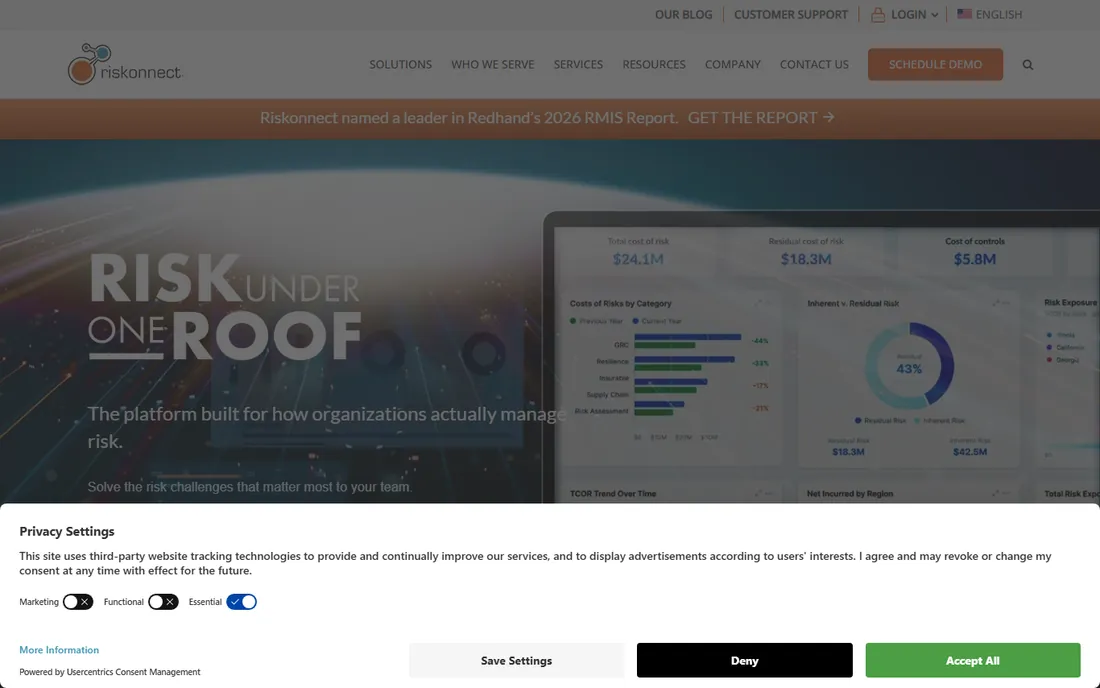
When a regional bank loses a data center, the response involves continuity plans, crisis communications, vendor failover and regulatory notifications. Riskonnect is built for that kind of multi-threaded disruption. It combines business continuity, crisis management and incident response with broader enterprise risk and GRC capabilities, so recovery plans connect to the risk data they depend on.
The platform ships configurable templates aligned with ISO 22301, DORA, CPS 232 and other resilience standards, plus industry frameworks for finance and healthcare. Pricing is quote-based and the platform needs real configuration to shine. For organizations where continuity is a regulatory obligation, not just an IT exercise, it is the market leader.
What we like- Unifies BCM with GRC in one data model
- Configurable templates for ISO 22301, DORA and others
- Real-time readiness dashboards
Watch out for- Quote-only pricing
- Broad platform needs upfront configuration
#2
Fusion Risk Management
Best for: enterprises mapping dependencies across complex operations
Visit fusionrm.com
Starting priceSee website
Free planNo
Fusion's signature capability is seeing how everything connects. Its dependency mapping shows which processes depend on which systems, vendors and people, so a business impact analysis reflects reality instead of assumptions. Resilience modeling lets planners test scenarios and see where single points of failure hide.
That power comes with implementation weight. Fusion deployments are projects, and the platform expects a formal BCM team to run it. Pricing is quote-based. Large enterprises with complex operations get the most from it; smaller firms will find lighter tools faster to value.
What we like- Visual dependency mapping
- Resilience modeling
- Strong executive dashboards
Watch out for- Heavy implementation
- Pricing behind sales
Starting priceSee website
Free planNo
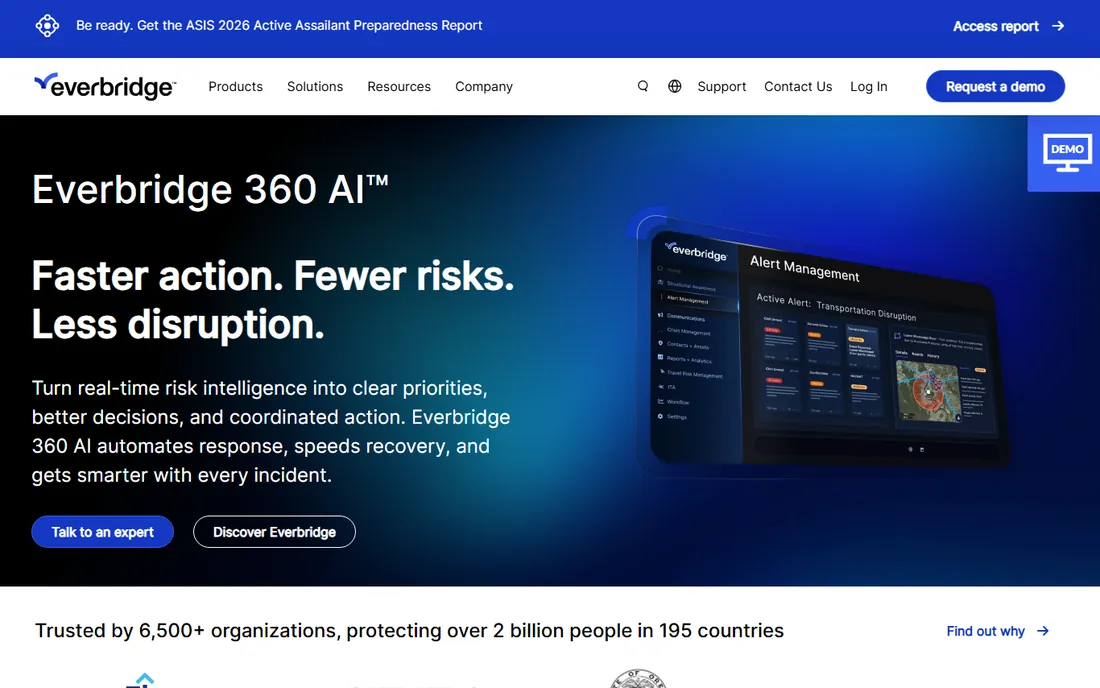
Everbridge approaches continuity from the response side. Its critical event management platform sends targeted alerts across every channel, tracks who acknowledged, and escalates automatically. In September 2026 it connected continuity planning directly to live event response with its 360 AI Bridge, and its planning product (formerly BC in the Cloud) is now Everbridge 360 AI Prepare.
If your biggest continuity risk is reaching ten thousand employees during a disruption, Everbridge is the answer. If your biggest need is meticulous plan documentation and testing, the pure BCM platforms go deeper. Pricing is quote-based.
What we like- Best-in-class mass notification
- Connects plans to live critical events
- Global reach
Watch out for- Full BCM depth trails the pure-play platforms
- Enterprise pricing
#4
Quantivate
Best for: mid-market firms that want integrated GRC without enterprise cost
Visit quantivate.com
Starting priceSee website
Free planNo
Quantivate targets the middle of the market: companies big enough to need real continuity software but not big enough to fund a Riskonnect implementation. It offers business continuity alongside risk management, compliance and vendor management modules, so a mid-market firm can run its whole GRC program in one place.
It will not match the enterprise platforms on modeling depth or global scale. Pricing is quote-based but positioned below the top tier. For regional banks, healthcare systems and mid-size manufacturers, it hits the value sweet spot.
What we like- Affordable relative to enterprise platforms
- BCM plus risk and compliance modules
- Approachable implementation
Watch out for- Less depth for global enterprise complexity
- Smaller analyst footprint
Starting priceSee website
Free planNo
MetricStream is the GRC incumbent. Its business continuity module sits inside a mature governance, risk and compliance framework used by large banks, insurers and multinationals. Regulatory depth, board-ready reporting and audit trails are the strengths; this is software built for organizations that answer to multiple regulators.
The cost is complexity. Implementations are long, the learning curve is real, and pricing reflects the enterprise positioning. Buy MetricStream when continuity must live inside an existing enterprise GRC program, not as a standalone purchase.
What we like- Deep regulatory alignment
- Strong reporting and audit trails
- Broad GRC ecosystem
Watch out for- Steep learning curve
- Enterprise pricing and long implementations
#6
LogicManager
Best for: organizations with structured ERM programs that value documentation
Visit logicmanager.com
Starting priceSee website
Free planNo
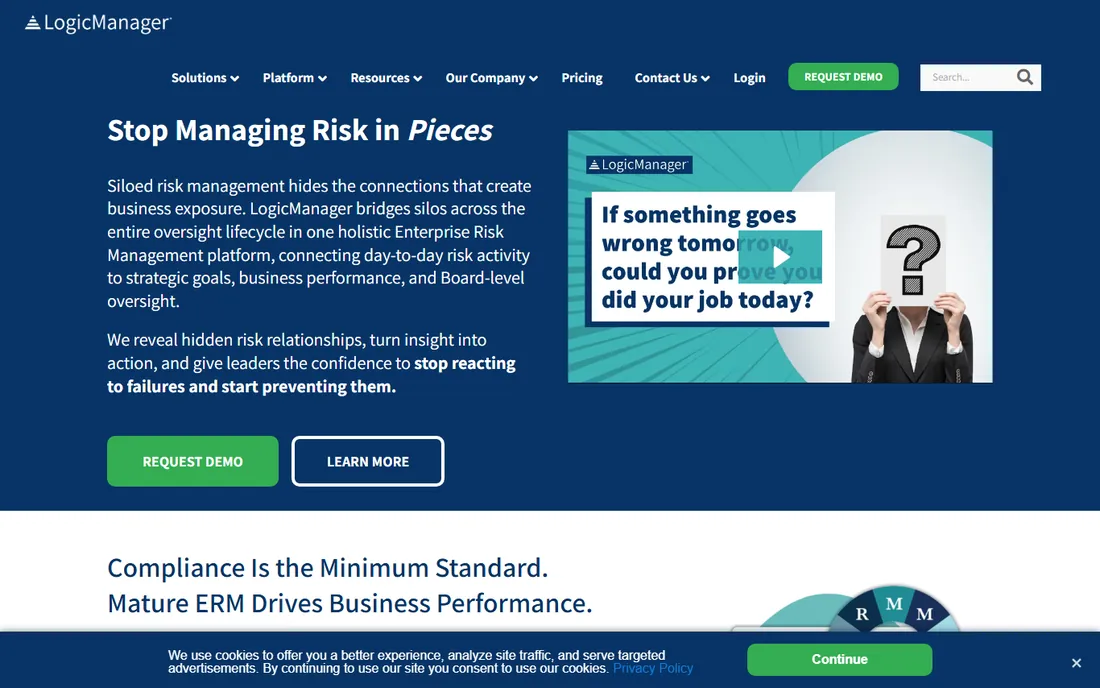
LogicManager's strength is discipline. It gives enterprise risk management programs consistent documentation, clear accountability for every control and plan, and workflows that keep the program honest between audits. The business continuity capabilities cover impact analysis, planning and testing with the same rigor.
Crisis execution is not its emphasis. If you need mass notification and live incident coordination, pair it with a tool like Everbridge. Pricing is quote-based. Choose LogicManager when the buyer is a risk officer who cares about defensibility and documentation.
What we like- Consistent documentation and accountability tracking
- Customizable governance workflows
- Good for audit readiness
Watch out for- Less focus on crisis execution
- Configuration-heavy
#7
Ncontracts
Best for: financial institutions managing continuity plus vendor risk
Visit ncontracts.com
Starting priceSee website
Free planNo
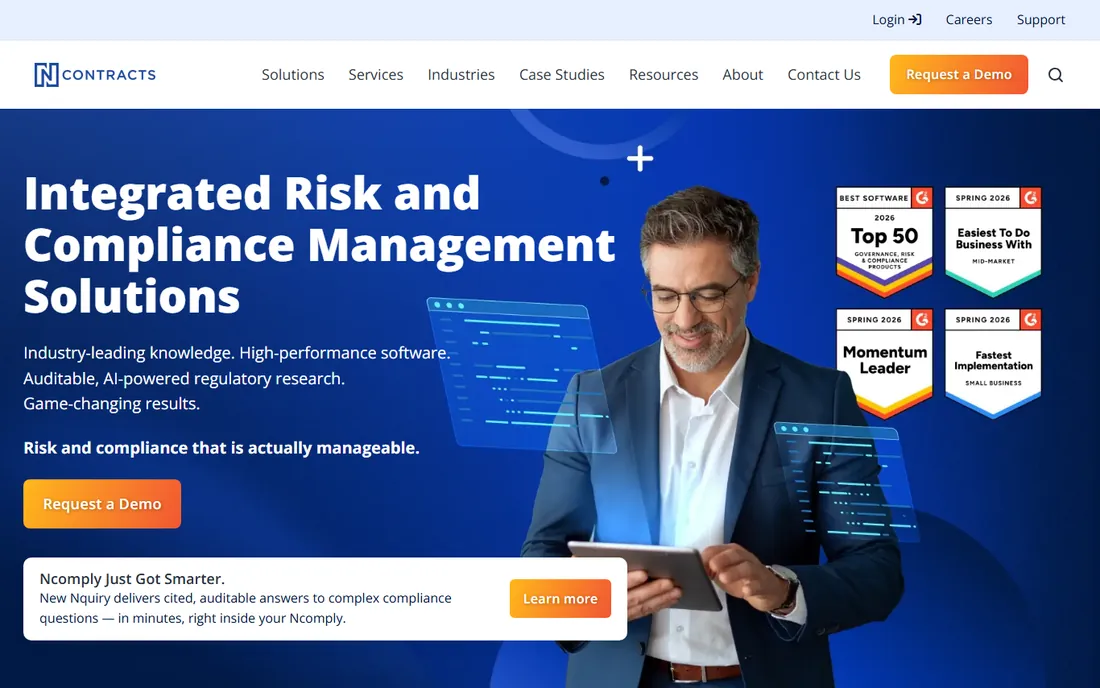
Ncontracts is built for one audience: banks, credit unions and other financial institutions. Its business continuity tools come with the regulatory alignment those firms need, plus vendor management that tracks whether critical third parties can meet their own recovery obligations. Remediation tracking and BIAs run in dashboards designed for compliance teams, not IT generalists.
Outside financial services the fit narrows, which is fine because that is not the target. Pricing is quote-based. For a community bank or credit union building its first formal continuity program, Ncontracts speaks the regulator's language out of the box.
What we like- Strong regulatory alignment for banks and credit unions
- Vendor continuity oversight
- User-friendly dashboards
Watch out for- Narrower fit outside financial services
- Quote-based pricing
Starting priceSee website
Free planNo
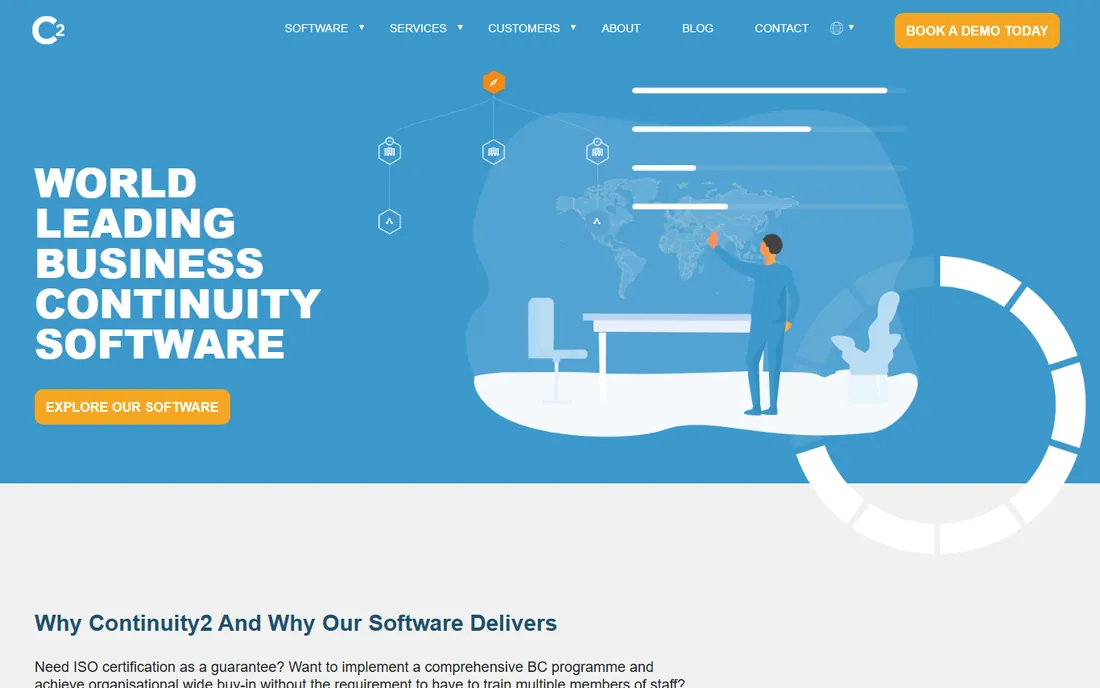
Continuity2 takes the opposite approach from the GRC suites: it does business continuity and nothing else. Plan documentation, business impact analysis, testing and incident management are built around ISO 22301 discipline, without the overhead of a full governance platform around them.
The focus is also the limit. Crisis communication, threat intelligence and broad risk management live elsewhere, so firms that need those will integrate or buy up. Pricing is quote-based. For mid-size organizations that want structured continuity plans without buying a GRC empire, it is the dedicated choice.
What we like- Purpose-built for BCM, not a GRC add-on
- ISO 22301 alignment
- Focused plan documentation
Watch out for- Smaller integration ecosystem
- Less crisis communication capability
What to look for before you buy
Start with the program you actually have. A company running continuity in spreadsheets needs plan standardization, automated workflows and centralized reporting first. A company with a mature program needs dependency mapping, scenario modeling and executive dashboards. Buying Fusion-level modeling for a spreadsheet-stage program wastes money; buying a documentation tool for a mature program wastes time.
Second, decide how much crisis execution matters. If your continuity plan assumes you can reach and coordinate thousands of people during a disruption, mass notification and incident response are core requirements, which favors Everbridge. If your plans are mostly about IT recovery runbooks, the pure BCM platforms fit better.
Third, check the regulatory templates. ISO 22301 alignment is table stakes; DORA, CPS 232, and industry frameworks matter if they apply to you. Ask which templates ship out of the box versus which need professional services to build.
Fourth, get the quote scoped properly. Quote-based pricing means the proposal defines the purchase: modules, user counts, entities covered, and implementation services. Confirm all four in writing, and ask what the renewal looks like before you sign year one.
Who should own the decision
Continuity software fails most often when nobody owns it after the purchase. The platform gets configured, the plans get imported, and then the program drifts because maintaining it is nobody's full-time job. Before you buy, name the owner: a resilience manager, a risk officer, or an operations lead with real authority to chase department heads for plan updates.
The second ownership question is executive sponsorship. Recovery priorities are business decisions, not IT decisions. If leadership will not sign off on recovery time objectives and test schedules, the software becomes an expensive document repository. Get the sponsor and the owner in place first, and the tool choice gets much easier.
How we chose
We selected BCM platforms that exist today and cover the real continuity lifecycle: impact analysis, planning, incident response and testing. We verified each vendor homepage and excluded one product that has been absorbed into Everbridge's platform. Pricing facts come from vendor pages and documentation checked in October 2026; BCM vendors rarely publish prices, so those are listed as See website. Confirm live pricing with each vendor.
The spreadsheet problem
Most continuity programs start in Excel, and most outgrow it the same way. Plan formats drift across departments. Nobody knows which version is current. Testing schedules live in someone's calendar. When the auditors arrive, assembling evidence takes weeks.
Continuity software earns its price by fixing exactly that: standardized templates, automated review cycles, centralized reporting and audit trails. The platform matters less than the discipline it enforces. Whatever you buy, the win comes from every department maintaining its plans in the same system on the same schedule. Software cannot create that discipline, but it can make it much harder to avoid.
Frequently asked questions
What is business continuity management software?
Software that manages an organization's ability to keep operating during disruptions. It covers business impact analyses, recovery plan documentation, incident management, emergency communication and testing, replacing the spreadsheets many programs start with.
How much does BCM software cost?
Almost all vendors use quote-based pricing tied to company size, modules and user counts. Expect annual contracts. Mid-market tools like Quantivate and Continuity2 position below the enterprise platforms, but get a written quote scoped to your organization.
What is the difference between BCM software and disaster recovery software?
Business continuity covers the whole organization: people, processes, facilities and IT. Disaster recovery is the IT subset: restoring systems and data. BCM platforms include DR planning as one component; DR point tools do not cover the business side.
Do small businesses need BCM software?
Most small businesses do not need an enterprise BCM platform. A documented plan, tested backups and a communication list cover the essentials. Mid-market firms with regulatory obligations or complex operations are where dedicated software starts paying off.
What is ISO 22301?
The international standard for business continuity management systems. It defines requirements for planning, implementing and improving continuity programs. Most BCM platforms align their templates and workflows to it, and certification against it is common in regulated industries.
Can BCM software replace our crisis communication tool?
Some of it can. Everbridge built its business on mass notification and now covers planning too. Pure BCM platforms like Riskonnect and Fusion include incident management but are weaker on large-scale alerting. If alerting is critical, verify that capability specifically.
Sources we checked (6)
- https://riskonnect.com/best-business-continuity-software-compare-features-and-benefits/
- https://learn.g2.com/best-business-continuity-management-software
- http://sprinto.com/blog/business-continuity-management-software/
- https://www.g2.com/categories/business-continuity-management-software
- https://www.everbridge.com/newsroom/article/everbridge-connects-business-continuity-planning-to-real-time-critical-event-response-with-everbridge-360-ai-bridge/
- https://www.everbridge.com/blog/business-continuity-management-bcm-software-vs-spreadsheets/
Is your product missing or out of date?
We review this list regularly. Vendors can request a listing, send updated pricing or ask about featured placement.

Shihab Mia · Founder, Rankite
Shihab has spent more than a decade helping SaaS and e-commerce brands grow through search. He writes Rankite's software buying guides from pricing pages, documentation and public user reviews. More about Shihab.