How we make this list: we compare pricing pages, product documentation and public user reviews. Rankite is independent; if a vendor ever pays for a featured spot, that listing is clearly labeled Partner.
Key takeaways
- Stock and ETF commissions are $0 at every major US broker now, so the real differences are options pricing, tools, and research.
- Fidelity and Charles Schwab are the best all-rounders for most investors, combining $0 trades with deep research and retirement tools.
- Interactive Brokers wins for serious and international traders with 175+ markets and the lowest margin rates.
- tastytrade has the best options pricing structure: $1 per contract to open, $0 to close, capped at $10 per leg.
- Webull is the strongest mobile-first pick for active traders who want advanced charting without paying for a platform.
Quick comparison
| Tool | Best for | Starting price | Free plan |
|---|
 Fidelity Fidelity | Best all-rounder for most investors | $0 trades ($0.65/contract options) | No |
 Charles Schwab Charles Schwab | Full-service investing with human backup | $0 trades ($0.65/contract options) | No |
 Interactive Brokers Interactive Brokers | Serious and international traders | From $0 commissions | No |
 E*TRADE E*TRADE | Clean design with serious trading tools underneath | $0 trades ($0.65/contract options) | No |
 Webull Webull | Mobile-first active trading | $0 trades | No |
 tastytrade tastytrade | Options traders who trade in size | $0 stocks/ETFs; $1/contract options to open ($10 max/leg), $0 to close | No |
 TradeStation TradeStation | Strategy backtesting and automated trading | See website | No |
Is your product missing or out of date?
We review this list regularly. Vendors can request a listing, send updated pricing or ask about featured placement.
Seven brokerages, one honest ranking
Commissions are no longer the deciding factor. Every broker on this list charges $0 for online stock and ETF trades, which means the choice comes down to what you actually do: buy and hold index funds, trade options weekly, or run automated strategies. Pick the broker whose strengths match your behavior, not the one with the flashiest app. All seven are SIPC members, which protects securities up to $500,000 per customer if the firm fails. Investing involves risk, and you can lose money; nothing here is financial advice.
Starting price$0 trades ($0.65/contract options)
Free planNo
Fidelity is the easiest recommendation for the average investor. Online US stock and ETF trades cost $0, options cost $0.65 per contract, and there are no account minimums or annual fees on retail brokerage accounts. The research offering is genuinely deep: proprietary screeners, third-party reports, and planning tools that walk you from first paycheck to retirement drawdown.
What sets Fidelity apart is how well it serves both ends of the spectrum. Beginners get fractional shares starting at $1 and a clean mobile app, while active traders get Active Trader Pro with real-time analytics. Customer service is consistently rated among the best, with 24/7 phone support from trading specialists. The weaknesses are minor: the desktop platform looks its age, and dedicated options traders will find tastier tools elsewhere. For buy-and-hold investors and everyone in between, it is the default answer.
What we like- $0 online US stock and ETF trades
- Excellent research and retirement planning tools
- Fractional shares from $1
Watch out for- Active Trader Pro desktop platform feels dated
- Options interface less intuitive than specialists
#2
Charles Schwab
Best for: Full-service investing with human backup
Visit schwab.com
Starting price$0 trades ($0.65/contract options)
Free planNo
Schwab pairs $0 online stock, ETF, and options trades ($0.65 per contract) with something no app-only broker offers: more than 400 physical branches and round-the-clock human support. After absorbing TD Ameritrade, Schwab inherited thinkorswim, the professional-grade trading platform that active traders swear by, and it is included free.
The platform lineup covers every level, from the simple Schwab mobile app to thinkorswim's advanced charting, paper trading, and strategy testing. Fractional shares start at $5, and the satisfaction guarantee promises fee refunds if you are unhappy. The honest knocks: uninvested cash sits in a sweep with modest yield compared with some competitors, and mutual funds outside the OneSource no-transaction-fee list can cost up to $74.95 per purchase. If you want a broker your parents could walk into, this is it.
What we like- $0 online stock and ETF trades
- Thinkorswim platform included
- 400+ US branches and 24/7 service
Watch out for- Cash sweep yields trail some rivals
- Mutual fund transaction fees on non-OneSource funds
Starting priceFrom $0 commissions
Free planNo
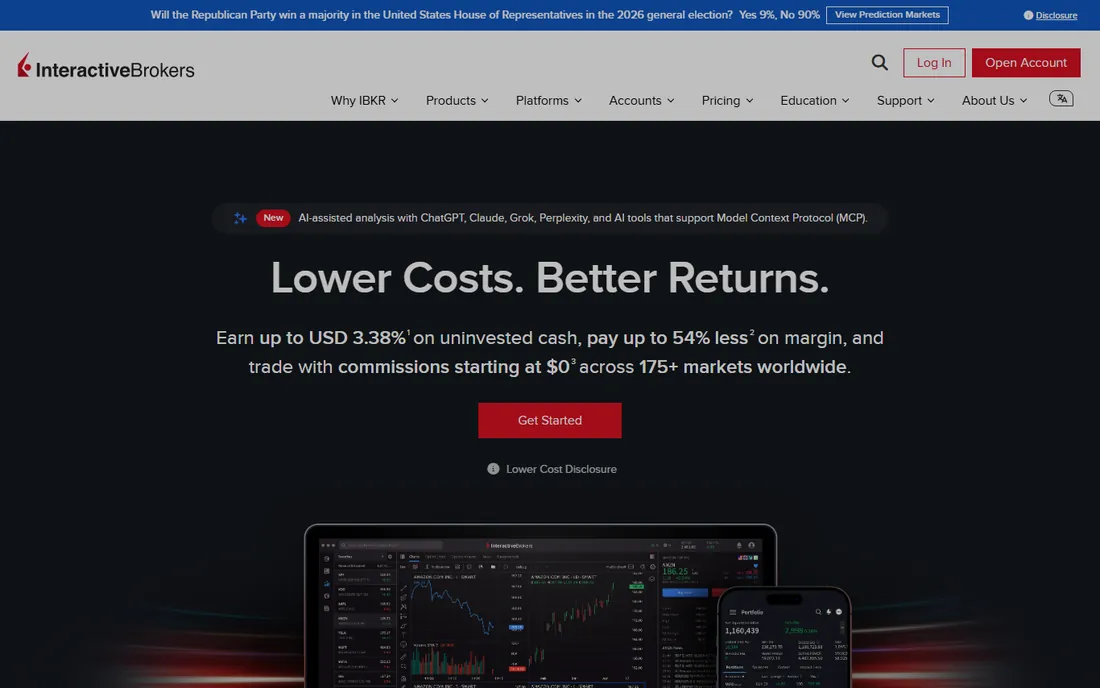
Interactive Brokers is the professional's broker. Commissions start at $0, with IBKR Lite providing commission-free US stock and ETF trades for casual investors and IBKR Pro offering tiered pricing that gets cheaper the more you trade. The real story is breadth: 175+ markets across 36 countries, forex, bonds, futures, and options on one account, plus margin rates that undercut every retail competitor by a wide margin.
The Trader Workstation platform is powerful and famously unforgiving, with a learning curve that assumes you know what a conditional order is. Research and fundamentals tools are excellent, and the firm now even connects AI assistants like ChatGPT and Claude to accounts for portfolio analysis. Small or infrequent traders may find the experience austere and support slow. But if you trade size, trade globally, or borrow on margin, nothing else is priced like this.
What we like- Access to 175+ markets worldwide
- Lowest margin rates in the industry
- IBKR Lite offers commission-free US stock/ETF trades
Watch out for- Platform complexity overwhelms beginners
- Customer service is thin for small accounts
#4
E*TRADE
Best for: Clean design with serious trading tools underneath
Visit etrade.com
Starting price$0 trades ($0.65/contract options)
Free planNo
ETRADE, now part of Morgan Stanley, charges $0 commission for online US-listed stock, ETF, mutual fund, and options trades, with a standard $0.65 per contract options fee that drops to $0.50 for customers making 30+ trades per quarter. The two-platform setup works well: the standard web and mobile experience is clean and beginner-friendly, while Power ETRADE delivers advanced charting, strategy tools, and futures trading for active traders.
Account variety is a quiet strength, covering taxable accounts, IRAs, 529s, and small-business retirement plans in one login. Banking integration through Morgan Stanley Private Bank makes cash management smooth. The platform lacks some of the third-party research integrations Schwab bundles, and the options fee discount requires real volume to earn. For investors who want polish without sacrificing depth, it sits comfortably in the top tier.
What we like- $0 online stock, ETF, and options trades
- Power E*TRADE platform is excellent
- Strong Morgan Stanley backing
Watch out for- Options contract fee drops only for high-volume traders
- Fewer third-party integrations than Schwab
Starting price$0 trades
Free planNo

Webull took the tools that used to cost professionals hundreds a month and put them in a free phone app. Stocks, ETFs, and options trade with $0 commissions, and the charting package includes dozens of indicators, drawing tools, and Level 2 data that rival desktop platforms. Extended-hours trading runs 4 AM to 8 PM Eastern, and paper trading lets you test strategies with real-time quotes.
The audience is clear: self-directed active traders who live on their phones. There are no mutual funds, no financial advisors, and no hand-holding; retirement planning content is thin compared with Fidelity or Schwab. Support is ticket and chat based, which frustrates during outages. But for commission-free trading with genuinely professional analytics and no account minimums, Webull remains the value leader for the DIY crowd.
What we like- $0 commissions on stocks, ETFs, and options
- Professional-grade charting free on mobile
- Extended-hours trading
Watch out for- No mutual funds
- Customer service is thinner than legacy brokers
- Limited retirement planning tools
Starting price$0 stocks/ETFs; $1/contract options to open ($10 max/leg), $0 to close
Free planNo
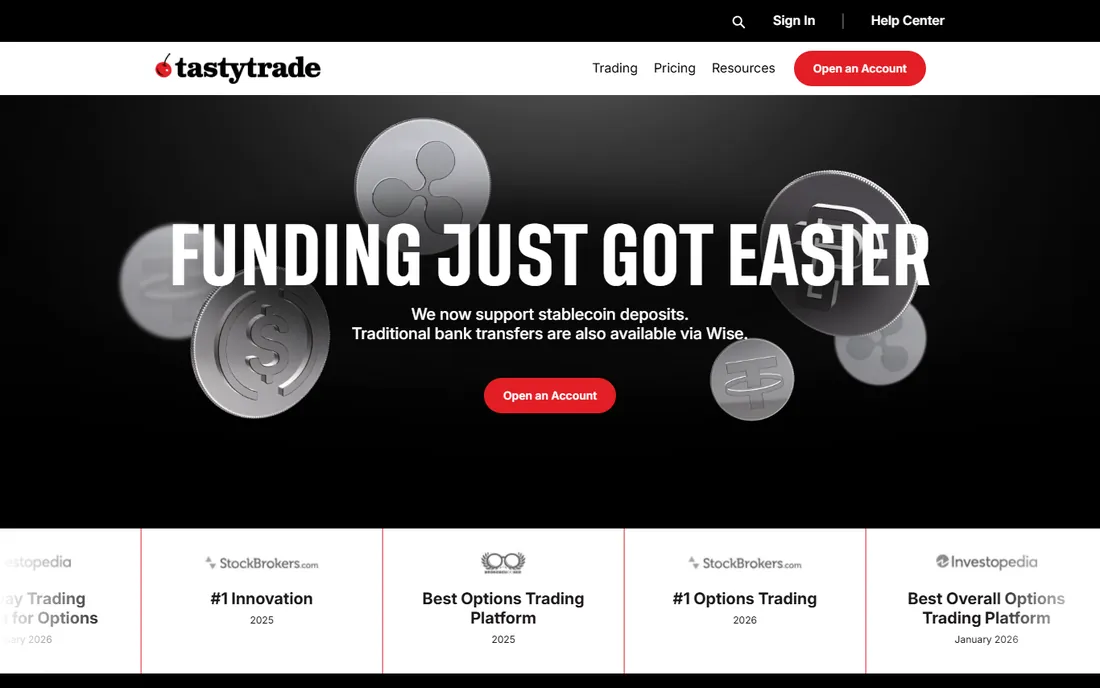
tastytrade rebuilt options pricing around how options traders actually behave. Stocks and ETFs are $0. Options cost $1 per contract to open, capped at $10 per leg, and $0 to close. That cap is the whole pitch: a 50-contract position costs $10 to open, the same as 10 contracts, while a standard $0.65-each-way broker would charge $65 round trip. Futures run $1 per contract per side, $0.75 for micros.
The platform matches the pricing: built for multi-leg strategies, with probability analysis, curve visualization, and backtesting over 10+ years of data. Everything else is stripped away, which is the point and the limitation. There are no mutual funds, the interface assumes options literacy, and accounts are US-only. The $60 IRA closing fee is worth knowing before opening retirement accounts. For active derivatives traders, the math is compelling.
What we like- $0 to close options positions
- $10 per-leg cap favors large trades
- Platform built specifically for derivatives
Watch out for- Not for beginners or mutual fund investors
- US residents only
- $60 IRA closing fee
Starting priceSee website
Free planNo
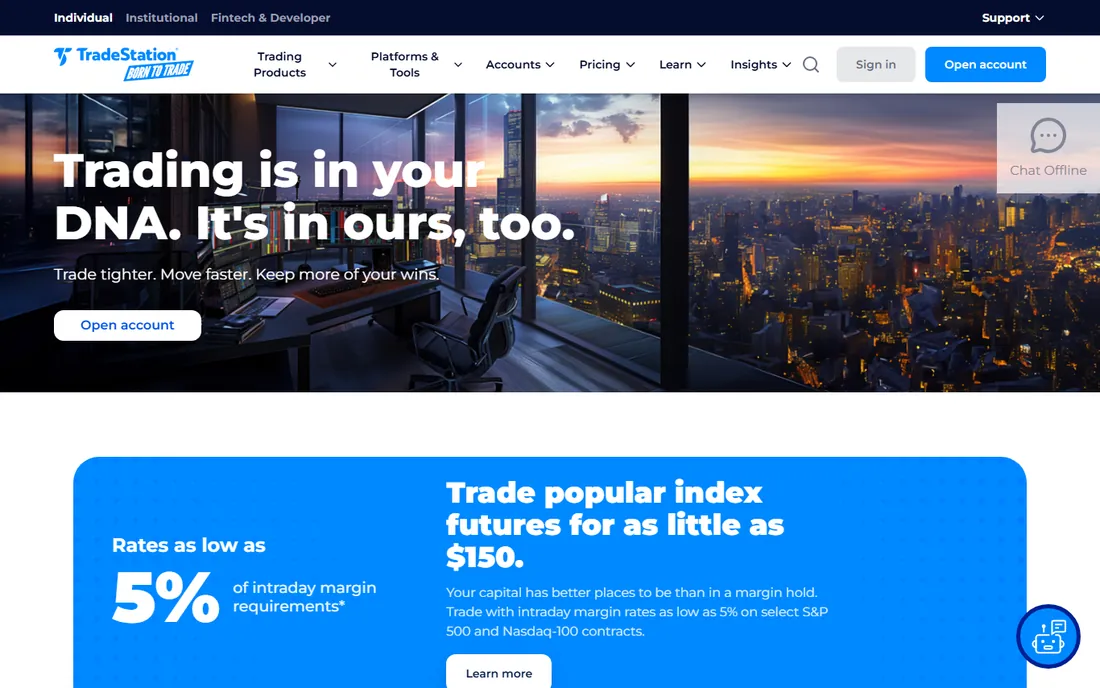
TradeStation's heritage is in systematic trading: its EasyLanguage scripting and backtesting engine let traders code, test, and automate strategies with decades of historical data. The TS SELECT pricing plan offers $0 commissions on US stocks and ETFs, with per-contract pricing on options and futures. The newer TITAN X desktop platform modernizes the experience, and the firm was named Broker of the Year in the 2025 TradingView Broker Awards.
This is a specialist tool. Casual investors will find the platform complex and may trip over the $10 monthly inactivity fee if their balance or activity falls below thresholds. But for traders who build and automate strategies, the combination of $0 equity trades, deep historical data, and a real scripting language has no equal at this price. Beginners should start elsewhere; quants should start here.
What we like- $0 stock and ETF trades on TS SELECT
- Legendary backtesting and strategy automation
- TradingView Broker of the Year 2025
Watch out for- Desktop platform has a steep learning curve
- Inactivity fees can hit small accounts
- Overkill for buy-and-hold
The $0 commission era: what brokers actually make money on
When every broker charges $0 for stock trades, the revenue comes from elsewhere, and you should know where. The biggest source is payment for order flow: market makers pay brokers for the right to execute your trades, which is how $0 commissions are funded at Webull, E*TRADE, Schwab, and others. Fidelity notably does not accept payment for order flow on stock trades, routing instead for price improvement.
Other revenue lines include margin interest, which varies enormously between brokers and matters if you borrow; cash sweep programs, where uninvested cash earns the broker more than it earns you; options contract fees; and premium subscriptions or managed portfolios. None of this makes $0 brokers a bad deal, but it explains why comparing margin rates and cash yields matters more than comparing stock commissions, which are identical.
What to check before you fund an account
Match the broker to your actual behavior. Buy-and-hold index investors should weight research, retirement tools, and customer service, which favors Fidelity and Schwab. Options traders should compare per-contract fees and closing costs, where tastytrade's structure wins for size. International investors need multi-currency and foreign market access, which points to Interactive Brokers.
Then check the fine print that bites later: margin rates if you borrow, cash sweep yields on idle money, transfer-out fees if you leave, and inactivity fees at TradeStation. Confirm SIPC membership, which all seven have, and understand it protects against firm failure, not market losses. Finally, use paper trading or a small starter deposit before moving a full portfolio; every platform here offers one or both.
How we chose
We compared current commission schedules from each broker's own pricing pages and account disclosures, prioritizing what investors actually pay: stock, ETF, and options commissions, margin rates, and account fees. Platform quality was judged from vendor documentation and long-standing public reviews on StockBrokers.com, Investopedia, and Reddit's investing communities. We did not claim hands-on testing. Niche and international-only brokers were excluded to keep the list focused on platforms available to US investors.
Frequently asked questions
Are $0 commission brokers really free?
Stock and ETF trades are genuinely $0 at all seven. Brokers earn money through payment for order flow, margin interest, cash sweep spreads, and options contract fees. Your trades cost nothing out of pocket, but you are still the product in the order-flow model at most brokers.
Which broker is best for beginners?
Fidelity and Schwab are the safest starting points: $0 trades, fractional shares, deep educational libraries, and human support when you get stuck. Webull suits beginners who are comfortable learning on their own and want a modern mobile app.
Do I need $2,000 to open a brokerage account?
No. None of these brokers require a minimum to open a standard cash account. The $2,000 figure is the regulatory minimum for a margin account, which applies at every US broker. Pattern day trading requires $25,000 in a margin account by FINRA rule.
What is SIPC protection?
The Securities Investor Protection Corporation protects up to $500,000 in securities and cash per customer, including $250,000 for cash, if your brokerage firm fails. It does not protect against market losses. All seven brokers here are SIPC members.
Should I trade options as a beginner?
Options carry significant risk and most beginners lose money trading them. Learn the mechanics with paper trading first, understand that every strategy has defined risks, and never trade with money you cannot afford to lose. tastytrade and thinkorswim both offer paper trading.
Can I transfer my existing investments to a new broker?
Yes, through an ACATS transfer, which moves stocks, ETFs, and most funds between brokers electronically, usually in under a week. Your current broker may charge a transfer-out fee, and some proprietary funds cannot transfer. The receiving broker often reimburses the fee for larger accounts.
Sources we checked (10)
- https://www.interactivebrokers.com
- https://www.schwab.com/compare-us?cid=31218429%7C6316021%7C215335013%7C383602946&dclid=CJCeu57f74kDFZoMTwgdYO8VLA&gclid=EAIaIQobChMI-7PjmN_viQMVNYCuBR3f2BpvEAEYASAAEgJgv_D_BwE
- https://www.fidelity.com/investing/brokerage-account
- https://www.morganstanley.com/press-releases/etrade-no-fee-index-mutual-funds-announcement-morgan-stanley
- https://webull.com/
- https://www.webull.com/pricing
- https://tastytrade.com
- https://tradestation.com/
- https://www.stockbrokers.com/review/tradestation?utm_source=stocktrader.com&utm_medium=online-stock-brokers&utm_campaign=tradestation&ref=st-osb
- https://investormint.com/investing/brokers/tastytrade-review
Is your product missing or out of date?
We review this list regularly. Vendors can request a listing, send updated pricing or ask about featured placement.

Shihab Mia · Founder, Rankite
Shihab has spent more than a decade helping SaaS and e-commerce brands grow through search. He writes Rankite's software buying guides from pricing pages, documentation and public user reviews. More about Shihab.