How we make this list: we compare pricing pages, product documentation and public user reviews. Rankite is independent; if a vendor ever pays for a featured spot, that listing is clearly labeled Partner.
Key takeaways
- CURRY and BESA are the commercial standards for clinical EEG and MEG source analysis, with vendor support and validated workflows that matter for patient-facing work.
- Brainstorm, MNE-Python, EEGLAB, FreeSurfer, SPM and AFNI are free and open source, and they power most published research in the field.
- BrainVision Analyzer is the natural choice for labs already recording with Brain Products hardware.
- The right pick depends on your modality: EEG and MEG source imaging, structural MRI segmentation, or functional MRI statistics each have a different front-runner.
Quick comparison
| Tool | Best for | Starting price | Free plan |
|---|
 CURRY Neuroimaging Suite CURRY Neuroimaging Suite | clinical EEG and MEG source analysis | See website | Free trial |
 BESA Research BESA Research | EEG and MEG source imaging with MRI integration | See website | Free trial |
 BrainVision Analyzer BrainVision Analyzer | labs recording with Brain Products EEG hardware | See website | Free trial |
 Brainstorm Brainstorm | open-source MEG and EEG analysis with a friendly interface | See website | Yes |
 MNE-Python MNE-Python | scripted, reproducible EEG, MEG and iEEG analysis | See website | Yes |
 FreeSurfer FreeSurfer | cortical surface reconstruction and MRI segmentation | See website | Yes |
 SPM SPM | fMRI and PET statistical analysis | See website | Yes |
 EEGLAB EEGLAB | MATLAB-based EEG processing and exploration | See website | Yes |
 AFNI AFNI | fMRI analysis with powerful visualization | See website | Yes |
Is your product missing or out of date?
We review this list regularly. Vendors can request a listing, send updated pricing or ask about featured placement.
Recording brain data is the easy part. Turning a million channels of EEG squiggles or a stack of MRI slices into a map you can publish or act on is where the software earns its place. The tools below fall into two camps: commercial packages built for clinical throughput and support, and open-source toolboxes that dominate research. Both are legitimate; the choice comes down to your modality, your budget and whether you need a vendor standing behind the results.
Starting priceSee website
Free planFree trial
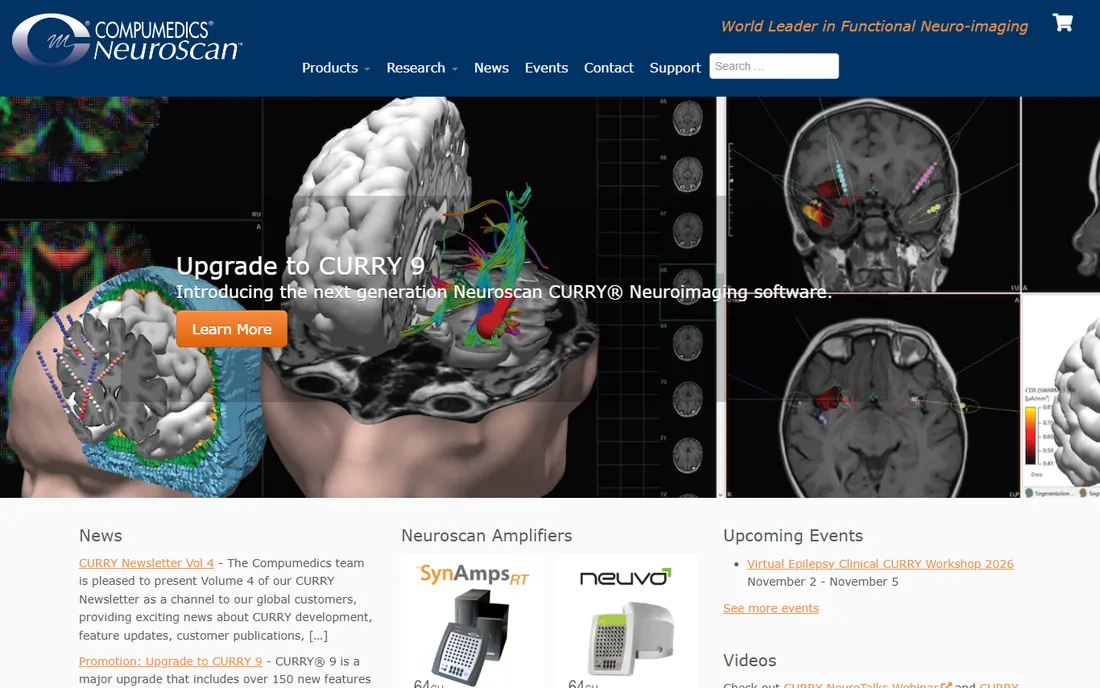
CURRY, from Compumedics Neuroscan, is one of the longest-standing names in clinical neuroimaging. It brings EEG and MEG recording analysis together with MRI coregistration, so a lab can move from raw data to a source-localized brain map without stitching together three different programs. The dipole fitting, distributed source models and connectivity analysis are the methods clinicians and epilepsy researchers reach for, and the workflows are documented and validated in a way that matters when results go into a patient record.
The trade-off is the commercial model. Pricing is quoted per configuration, and you will deal with a sales process rather than a download button. It also assumes a Windows environment and a GUI-driven workflow, which suits clinical staff but frustrates researchers who want to script everything. If your work is patient-facing, the validation and support are worth the cost; if it is exploratory research, the open-source tools below do similar science for free.
What we like- Integrated EEG, MEG and MRI workflows in one package
- Validated pipelines suited to clinical use
- Strong source localization methods
Watch out for- Commercial pricing is quote-based
- Windows-centric with less scripting flexibility than open-source options
#2
BESA Research
Best for: EEG and MEG source imaging with MRI integration
Visit besa.de
Starting priceSee website
Free planFree trial
BESA has been a fixture in EEG source analysis for decades, and its head modeling is still a reference point. The software handles the full chain from artifact-corrected raw data through source montages, time-frequency analysis and MRI overlay, and its integration with MATLAB lets researchers drop into scripts when the GUI runs out of road. Few products have as many citations behind their methods.
Like CURRY it is a commercial product with quote-based pricing, so expect an institutional purchase process. The interface is functional rather than beautiful, and new users face a learning curve before the advanced features click. A trial is available through the vendor's order form, and it is worth taking, because BESA's approach to source modeling either fits your lab's thinking or it does not, and you will know within a week.
What we like- Respected source analysis with realistic head models
- MATLAB integration for custom pipelines
- Used widely in published research
Watch out for- The interface shows its age
- Pricing is quote-based and aimed at institutional budgets
Starting priceSee website
Free planFree trial
If your lab records on Brain Products hardware, Analyzer is the path of least resistance. It reads the native data formats perfectly, the electrode layouts match your caps, and the processing history tracks every step for reproducibility. The transform-based workflow, where you chain processing nodes visually, makes complex pipelines readable and shareable between lab members.
Outside the Brain Products world it is less compelling, since competing tools read the same open formats. Pricing is commercial and quoted. But for the many labs standardized on Brain Products amplifiers, the tight hardware integration and the vendor's training resources make it the default choice, and the free trial lets you confirm the fit with your own data.
What we like- Purpose-built for Brain Products amplifiers and caps
- Visual workflow editor with drag-and-drop processing
- Solid artifact correction tools
Watch out for- Most valuable inside the Brain Products ecosystem
- Commercial license with quote-based pricing
Starting priceSee website
Free planYes
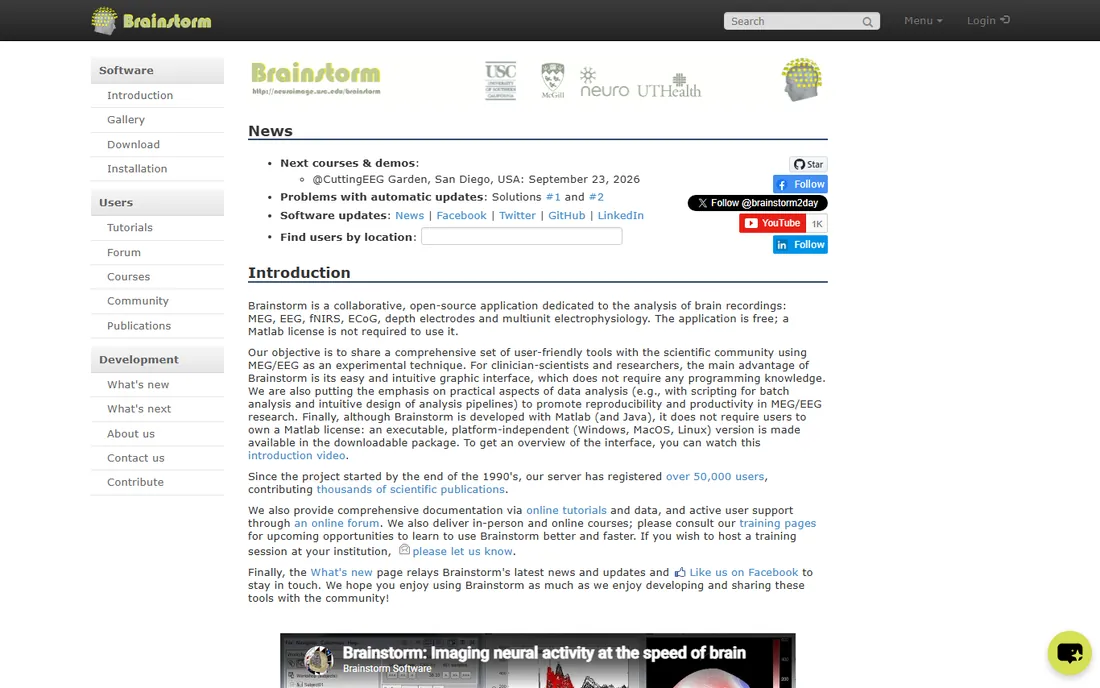
Brainstorm is the friendliest entry point into serious brain mapping. Developed with support from USC and McGill, it offers source imaging, time-frequency analysis and MRI coregistration through a graphical interface that a graduate student can learn in days rather than months. It reads data from most major MEG and EEG systems, and the documentation includes step-by-step tutorials with sample datasets.
It runs on MATLAB, which means your institution needs a license or you need to work within its constraints, though an increasing amount works with the free Octave alternative. For huge datasets or highly custom analyses, script-based tools like MNE-Python scale better. But for labs that want rigorous analysis without a programming prerequisite, Brainstorm is the best free option available.
What we like- Completely free
- Polished GUI that non-programmers can learn
- Handles MEG, EEG, sEEG, ECOG and NIRS
Watch out for- MATLAB dependency for the full experience
- Very large datasets can strain the interface
#5
MNE-Python
Best for: scripted, reproducible EEG, MEG and iEEG analysis
Visit mne.tools
Starting priceSee website
Free planYes
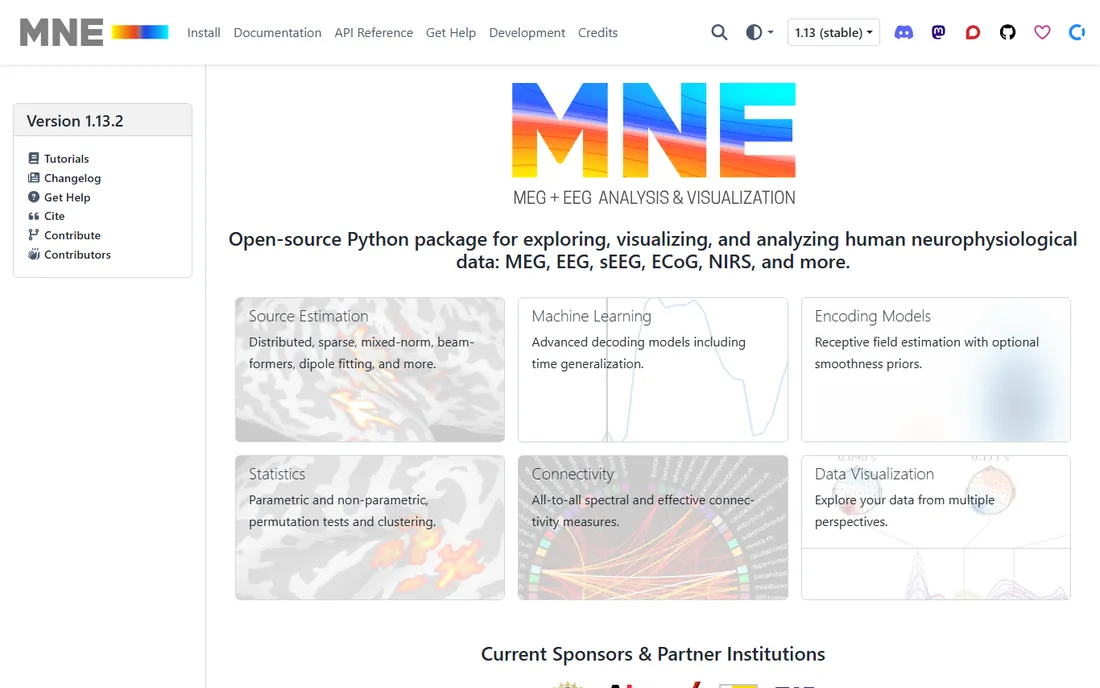
MNE-Python is the workhorse of modern electrophysiology research. Everything is a script, which means every analysis is reproducible, version-controlled and shareable, exactly what reviewers and collaborators want. The library covers preprocessing, source localization, time-frequency analysis, statistics and visualization, and it interoperates with the broader Python scientific stack, so your EEG results can flow straight into machine-learning models.
The price of that power is the command line. There is no point-and-click interface, and researchers without Python experience face a real learning curve. But the documentation is among the best in science software, the community is active, and most published methods in the field have an MNE implementation or tutorial. For a research lab building a long-term analysis pipeline, this is usually the right foundation.
What we like- Free and open source
- Full Python scripting for reproducible pipelines
- Huge community and excellent documentation
Watch out for- Requires Python skills
- No polished GUI for non-programmers
Starting priceSee website
Free planYes
FreeSurfer, from Massachusetts General Hospital, turns structural MRI scans into detailed models of the cortical surface. Its measurements of cortical thickness, surface area and subcortical volumes are the standard in thousands of published studies, and the automated segmentation pipeline runs with minimal manual input. It also supplies the anatomical surfaces that EEG and MEG source analysis tools need for realistic head models.
Patience is required: a full recon-all run takes several hours per subject even on good hardware, so large studies need cluster time. It runs on Linux and Mac, with Windows users reaching for a virtual machine or container. Quality control of the automated output is a skill in itself. None of that stops it from being the default choice for structural brain mapping in research.
What we like- Free
- The standard for cortical thickness and surface-based analysis
- Highly cited and trusted methods
Watch out for- Full reconstructions take many hours per subject
- Linux and Mac only, no native Windows
Starting priceSee website
Free planYes
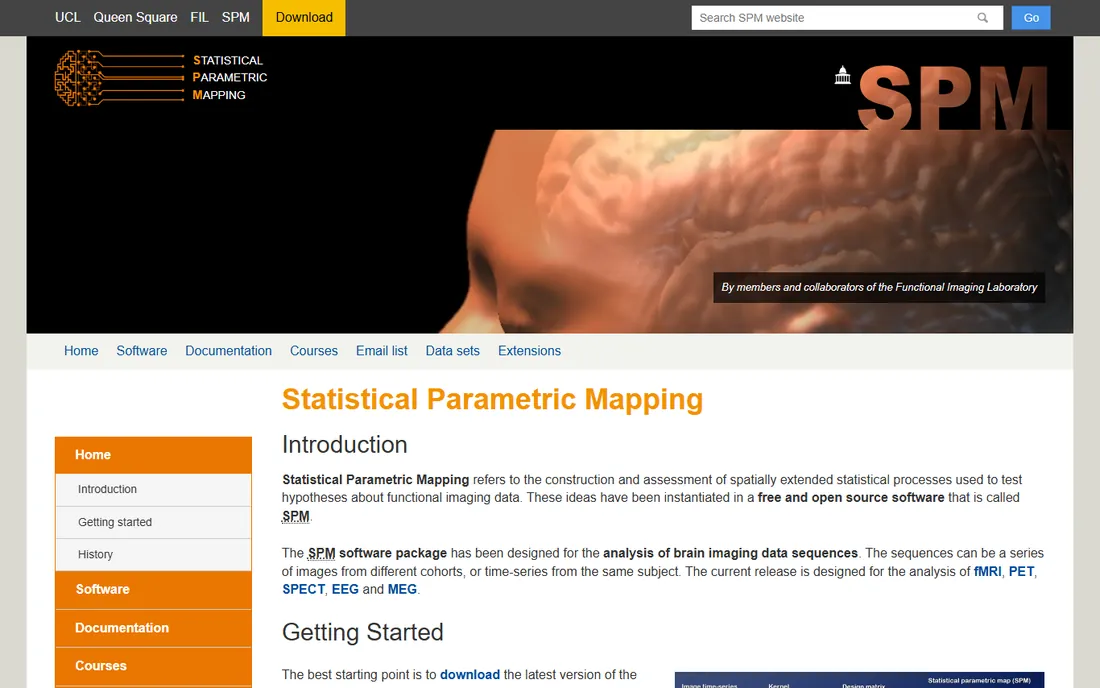
SPM, from University College London, defined how functional neuroimaging statistics are done. Its general linear model framework for fMRI and PET data, with correction for multiple comparisons and random field theory, underpins an enormous share of published brain mapping work. The batch system lets you build reproducible analysis pipelines, and the extensions cover everything from DTI to EEG-fMRI fusion.
It is a MATLAB toolbox, so a license is needed, and the learning curve is famously steep: SPM has its own vocabulary and its own way of organizing data. New users should budget weeks, not days, to become productive. For fMRI analysis in an academic setting, though, it remains the reference implementation that other tools are measured against.
What we like- Free
- The classic framework for voxel-based neuroimaging statistics
- Enormous literature and community
Watch out for- MATLAB required
- The interface and conventions take time to learn
Starting priceSee website
Free planYes
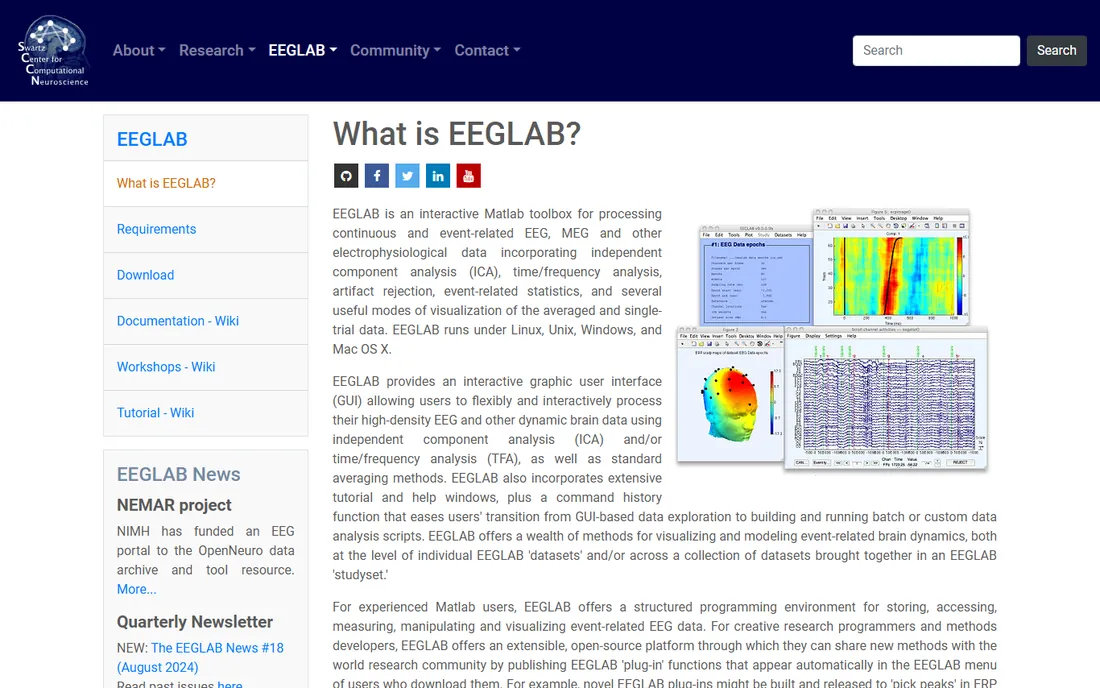
EEGLAB, from UC San Diego, is where many researchers first learn EEG analysis. The graphical interface makes it easy to scroll through data, reject artifacts and run independent component analysis, while the plugin system adds methods from dozens of labs, from advanced artifact correction to connectivity and source analysis. It is the standard teaching tool in EEG courses worldwide.
The plugin ecosystem is both the strength and the weakness: quality and documentation vary, and results from obscure plugins deserve scrutiny. Like SPM and Brainstorm it needs MATLAB. For scripted, large-scale pipelines, MNE-Python is cleaner. But for interactive exploration, teaching and trying new methods quickly, EEGLAB's combination of GUI and extensibility is unmatched.
What we like- Free
- Huge plugin ecosystem for every EEG method
- Excellent for teaching and exploratory analysis
Watch out for- MATLAB required
- Plugin quality varies
- Large-scale automation needs scripting
Starting priceSee website
Free planYes
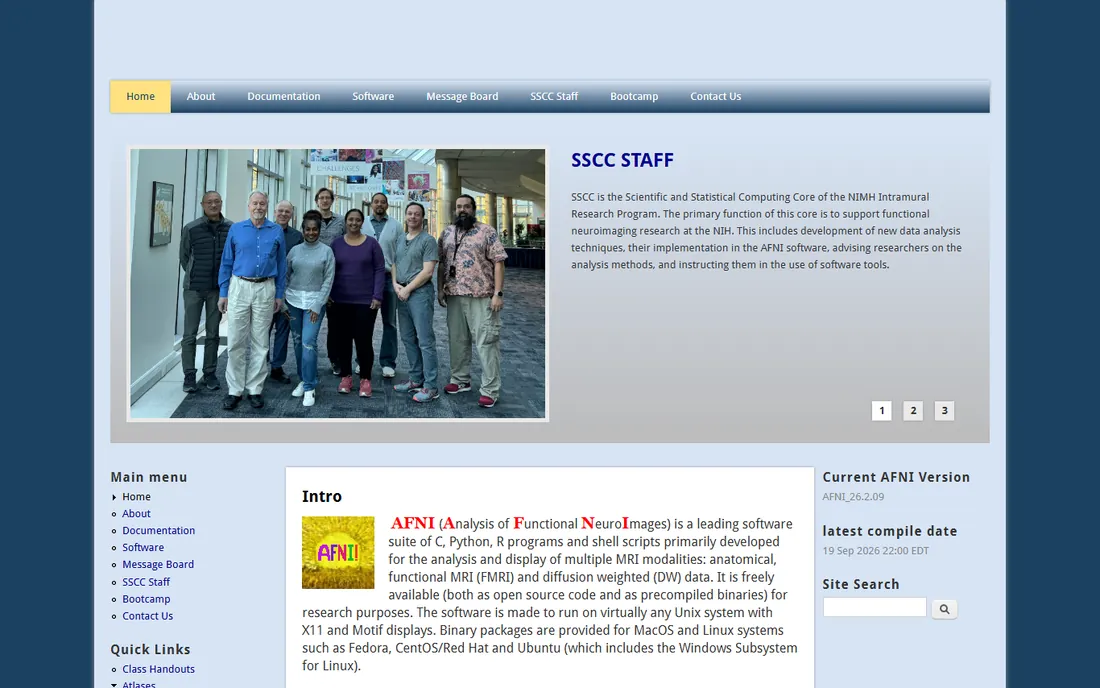
AFNI, from the US National Institute of Mental Health, is the power user's fMRI toolkit. Its command-line programs cover the full analysis chain with unusual flexibility, and its visualization tools are genuinely excellent for inspecting data quality and results. Advanced methods, from multi-echo fMRI to sophisticated alignment and statistics, often appear in AFNI first.
The learning curve is the steepest on this list. AFNI expects comfort with the terminal and rewards it; beginners can feel lost. Documentation is extensive but assumes background knowledge. Labs that invest the time get a toolkit with few limits, and the active user community and developer responsiveness are real assets. For fMRI researchers who outgrow GUI tools, AFNI is the natural next step.
What we like- Free
- Exceptionally flexible command-line tools
- Superb data visualization
- Strong for advanced fMRI methods
Watch out for- Steep learning curve
- Interface conventions feel dated to newcomers
How to choose brain mapping software for your lab
Match the tool to the data you actually collect. EEG and MEG labs choosing between commercial and open source should weigh CURRY or BESA against Brainstorm and MNE-Python: the commercial tools buy you validated clinical workflows and vendor support, while the free tools give you transparency and a larger research community. MRI labs split differently, with FreeSurfer owning structural analysis and SPM and AFNI dividing functional work largely by lab tradition and MATLAB availability.
Budget shapes the decision more than vendors admit. Commercial licenses in this space run to institutional purchase orders, while the open-source tools are free but demand staff time and programming skill. A lab with strong computational people often does better science with free tools; a clinical service that needs audit trails and support contracts needs the commercial ones. Hardware compatibility matters too: check that your amplifier, MEG system or scanner output is supported before committing, and confirm operating system requirements, since several tools here are Linux or Mac only.
Finally, think about reproducibility. Scripted pipelines in MNE-Python or AFNI can be version-controlled and shared exactly; GUI workflows need careful documentation to reach the same standard. Grant reviewers and journals increasingly expect shared code and data, which favors the scriptable tools.
What labs actually pay
Open-source tools on this list cost nothing to license, but they are not free to run. Budget for compute hardware or cluster time, MATLAB licenses where required, and above all staff time: a researcher spending three months learning MNE-Python or AFNI is a real cost. Commercial tools like CURRY, BESA and BrainVision Analyzer are priced by quote, typically as institutional licenses with annual maintenance; expect the conversation to start in the low five figures and scale with seats and modules. Training, often sold as multi-day courses by the vendors, shortens the ramp-up and is worth pricing into the first year. For grant budgeting, list the commercial license under equipment or software and the open-source route under personnel time; reviewers understand both.
We reviewed vendor documentation, feature lists and pricing pages, then checked published methods sections, lab usage reports, and community discussions to see which tools researchers actually rely on. We compared modality coverage, analysis methods, hardware compatibility, licensing terms and learning curve. We did not run analyses or process data in any of these products; the comparison reflects documented capabilities and reported user experience.
Frequently asked questions
Which brain mapping software is best for beginners?
Brainstorm is the easiest serious starting point: free, with a graphical interface and tutorials that walk through real datasets. EEGLAB is the classic choice for learning EEG specifically. Both let a student go from raw data to a publishable figure without programming.
Can free tools match commercial software for clinical work?
For research, yes; the methods are often identical and peer-reviewed. For clinical use, the difference is validation, documentation and support rather than raw capability. Hospitals and epilepsy centers usually need the audit trails and vendor backing that CURRY or BESA provide, along with regulatory clearance for diagnostic use.
Do I need MATLAB for brain mapping?
It depends on the tool. Brainstorm, SPM and EEGLAB require MATLAB. MNE-Python, FreeSurfer, AFNI and most commercial packages do not. If your institution already licenses MATLAB campus-wide, this is a non-issue; if not, the Python and standalone tools remove a significant cost.
EEG, MEG or MRI: which should our lab invest in?
They answer different questions. EEG is affordable and portable with millisecond timing but blurry spatial resolution. MEG adds far better source localization at a much higher equipment cost. MRI gives detailed anatomy and whole-brain functional maps but poor temporal resolution. Most cognitive neuroscience labs combine EEG or MEG with MRI anatomy from FreeSurfer.
How long does it take to learn tools like MNE-Python or AFNI?
Expect two to four weeks of part-time work to run standard pipelines confidently, and several months to customize analyses or troubleshoot novel data. GUI tools like Brainstorm or EEGLAB get you productive in days. Vendor training courses for the commercial tools typically run two to five days.
Can these tools share data with each other?
Largely yes. Open formats like FIF, BIDS and NIfTI let data move between tools, and most packages read each other's common formats. A typical pipeline might segment anatomy in FreeSurfer, analyze EEG in MNE-Python and run statistics informed by SPM conventions. BIDS, the Brain Imaging Data Structure, is the standard that makes this practical.
Sources we checked (9)
- https://www.neuroscan.com/
- https://besa.de/
- https://www.brainproducts.com/
- https://neuroimage.usc.edu/brainstorm/
- https://mne.tools/stable/index.html
- https://surfer.nmr.mgh.harvard.edu/
- https://www.fil.ion.ucl.ac.uk/spm/
- https://sccn.ucsd.edu/eeglab/
- https://afni.nimh.nih.gov/
Is your product missing or out of date?
We review this list regularly. Vendors can request a listing, send updated pricing or ask about featured placement.

Shihab Mia · Founder, Rankite
Shihab has spent more than a decade helping SaaS and e-commerce brands grow through search. He writes Rankite's software buying guides from pricing pages, documentation and public user reviews. More about Shihab.