How we make this list: we compare pricing pages, product documentation and public user reviews. Rankite is independent; if a vendor ever pays for a featured spot, that listing is clearly labeled Partner.
Key takeaways
- The biggest AR SDK story of 2026 is 8th Wall: Niantic retired the hosted platform and made the WebAR engine open source and free, including for commercial use.
- Native SDKs still win on quality: ARKit and ARCore are free and give the best tracking, LiDAR support, and geospatial features on their platforms.
- Unity AR Foundation remains the default for commercial AR apps that must work on both iPhone and Android from one codebase.
- Vuforia, EasyAR, and MAXST are the specialist tracking SDKs for industrial and object-recognition work, while Zappar and Onirix serve marketing teams with no-code WebAR.
Quick comparison
| Tool | Best for | Starting price | Free plan |
|---|
 Unity (AR Foundation) Unity (AR Foundation) | One codebase for iPhone and Android AR | Free (Personal tier); Pro $2,310/seat/year | Yes |
 Apple ARKit Apple ARKit | iOS apps with the best possible tracking | Free (Apple Developer Program $99/year to publish apps) | Yes |
 Google ARCore Google ARCore | Android AR and location-based experiences | Free | Yes |
 Vuforia Vuforia | Industrial AR with CAD and object recognition | $99/month (Basic) | Free trial |
 8th Wall 8th Wall | WebAR without an app download | Free (open source since February 2026) | Yes |
 Zappar Zappar | Marketing teams building AR without developers | $12.99/month (ZapWorks Developer) | Free trial |
 EasyAR EasyAR | Affordable cross-platform AR development | $39/month (Professional) | Yes |
 MAXST MAXST | Visual SLAM and AR smart glasses | $59/month (Pro subscription, per license) | Free trial |
 Onirix Onirix | Agencies shipping WebAR fast | See website | Yes |
Is your product missing or out of date?
We review this list regularly. Vendors can request a listing, send updated pricing or ask about featured placement.
The best augmented reality (AR) SDK software
#1
Unity (AR Foundation)
Best for: One codebase for iPhone and Android AR
Visit unity.com
Starting priceFree (Personal tier); Pro $2,310/seat/year
Free planYes
Unity with AR Foundation is the workhorse of commercial AR development. AR Foundation wraps ARKit and ARCore in one API, so your team writes most of the app once and gets native-grade tracking on both platforms. The Unity editor handles the full pipeline from prototyping to device testing, and the asset store has plugins for nearly every AR trick worth doing.
The honest math starts with Unity's own tiers: Personal is free under $200,000 in trailing revenue, and Pro is $2,310 per seat per year as of January 2026. For an agency building client AR apps, seats add up fast, and Unity's terms tie tier eligibility to the client's revenue on contract work. But when the project needs real performance on both mobile platforms, nothing else matches the reach of one Unity project targeting ARKit and ARCore together.
What we like- Write once, deploy to ARKit and ARCore
- Huge asset store and developer community
- Supports headsets like Quest and Vision Pro
Watch out for- Pro price rose to $2,310 per seat per year in January 2026
- App install required, so no reach like WebAR
Starting priceFree (Apple Developer Program $99/year to publish apps)
Free planYes
If your audience is on iPhone, ARKit is the quality ceiling. It ships with iOS, gives direct access to plane detection, image and object tracking, face tracking, location anchors, and LiDAR-powered scene reconstruction on Pro devices. The hardware-software pairing means tracking quality no cross-platform abstraction can quite match.
The trade is the platform wall. ARKit apps are iPhone and iPad only, and every user must install your app. For utility apps, games, and retail experiences where iPhone dominates the audience, that is a fair trade. For marketing campaigns chasing maximum reach, pair the decision with a WebAR option from this list. ARKit itself costs nothing beyond the standard $99 per year Apple Developer Program membership.
What we like- LiDAR scene reconstruction and face tracking
- Deep hardware integration on iPhone, iPad, and Vision Pro
- No SDK licensing cost
Watch out for- IOS only, so Android users are excluded
- Publishing to the App Store requires the $99 per year developer membership
Starting priceFree
Free planYes
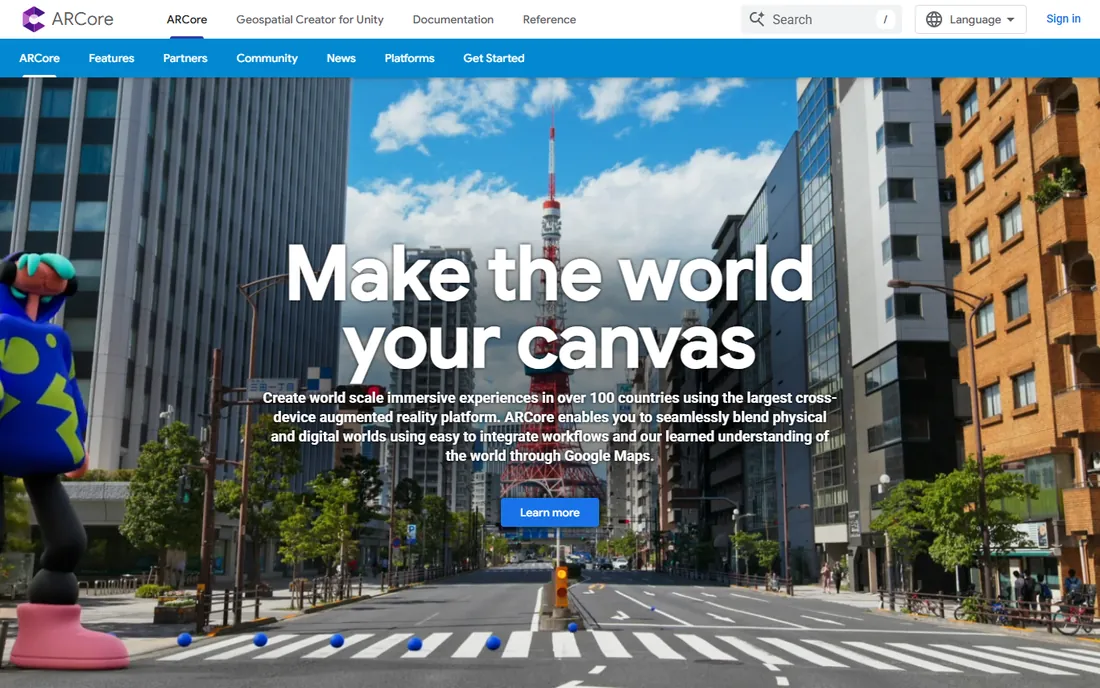
ARCore is Google's answer to ARKit and the only serious native option for Android. Its headline differentiator is the Geospatial API, which uses Google's visual positioning to anchor AR content to real-world locations at city scale, the tech behind games like SPACE INVADERS: World Defense. Cloud Anchors let multiple users see the same AR content in the same place.
Distribution is the usual Android caveat: ARCore works on a wide but not universal device list, and tracking quality varies by phone. For Android-first projects, tourism apps, and location-based games, ARCore is the obvious pick, and it costs nothing. It also plays well inside Unity through ARCore Extensions, which is how most teams actually ship with it.
What we like- Geospatial API for world-scale location AR
- Cloud Anchors for shared multi-user experiences
- Free with solid Unity and WebXR support
Watch out for- Android device support is fragmented across manufacturers
- IOS support exists but is secondary to ARKit
Starting price$99/month (Basic)
Free planFree trial
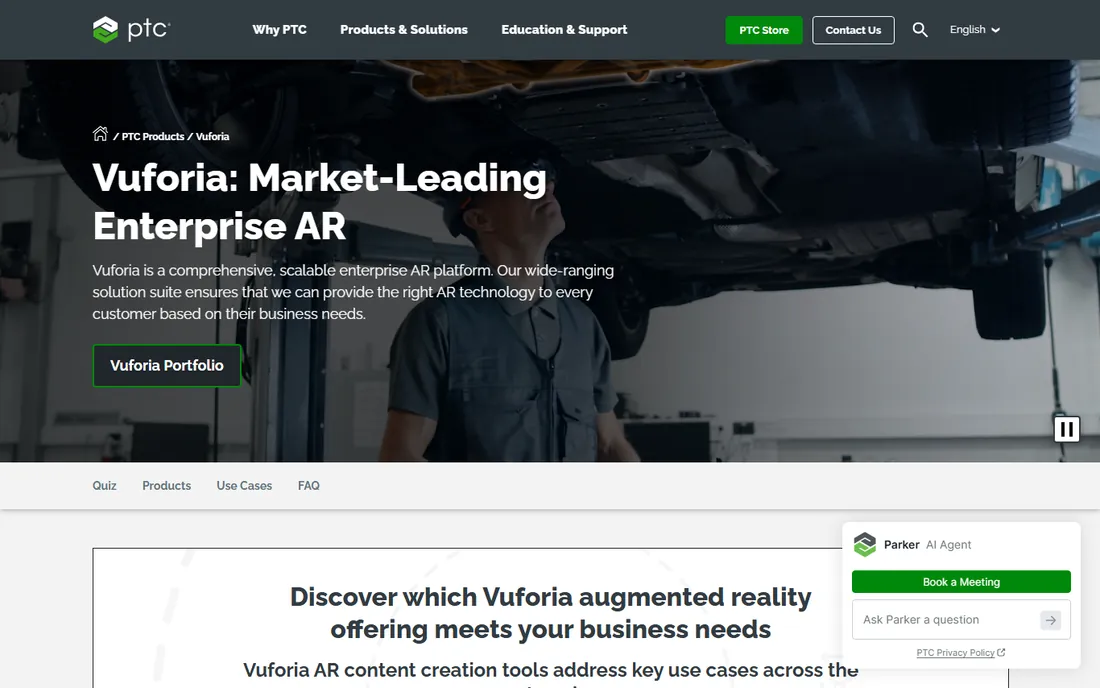
Vuforia, owned by PTC, is the enterprise AR SDK. Its signature trick is Model Targets: point a device at a machine and Vuforia recognizes it from the CAD model, no QR code or marker needed. Around the Engine sits a full suite for building work instructions (Studio), capturing expert procedures (Expert Capture), and remote assistance (Chalk), which is why it dominates manufacturing.
The Basic plan starts at $99 per month according to 2026 third-party pricing data, and PTC's pricing pages lean toward quote-based enterprise deals from there. Smaller developers should know the free options are limited and the platform's center of gravity is industrial use. If you are building AR for factory floors, field service, or training on complex equipment, Vuforia's object recognition justifies the cost.
What we like- Model Targets recognize machinery from CAD files with no markers
- Strong enterprise suite with Studio, Expert Capture, and Chalk
- Trusted by large manufacturers
Watch out for- Pricing scales aggressively toward enterprise budgets
- Surface tracking reviews are mixed compared with ARKit
Starting priceFree (open source since February 2026)
Free planYes
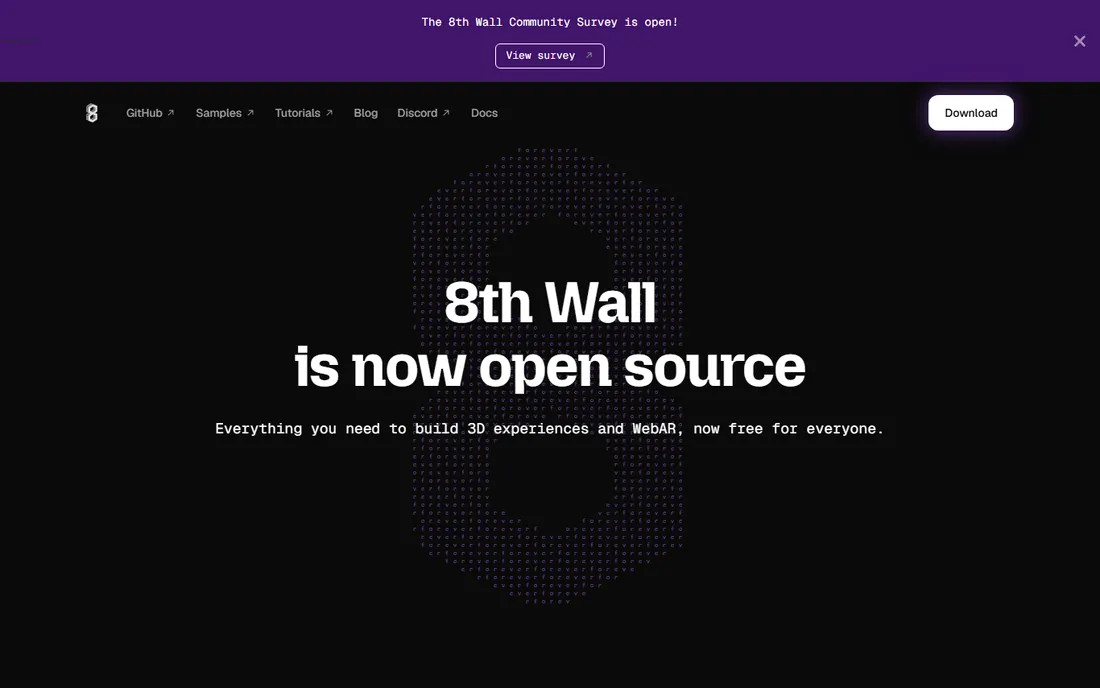
The 8th Wall story flipped in 2026: Niantic retired the hosted platform on February 28, ended all paid subscriptions, and released the XR engine as open source. The result is the most capable WebAR stack available at a price of zero, free even for branded campaigns and client projects. Download 8th Wall Desktop, build with the visual editor or the XR Engine, and host anywhere.
The catches are real but manageable. You now own hosting, source control, and deployment, and Apple's Safari still does not support WebXR AR on iPhone, so iPhone users get reduced experiences in some cases. For agencies and brands that previously paid $99 per month or thousands for commercial licenses, the open source pivot removed the biggest objection to WebAR entirely.
What we like- Now completely free, including for commercial projects
- Image targets, face effects, and sky effects in the browser
- Self-host projects anywhere
Watch out for- Hosted platform and cloud editor retired, so you manage your own infrastructure
- Safari on iPhone still lacks WebXR AR support
#6
Zappar
Best for: Marketing teams building AR without developers
Visit zappar.com
Starting price$12.99/month (ZapWorks Developer)
Free planFree trial
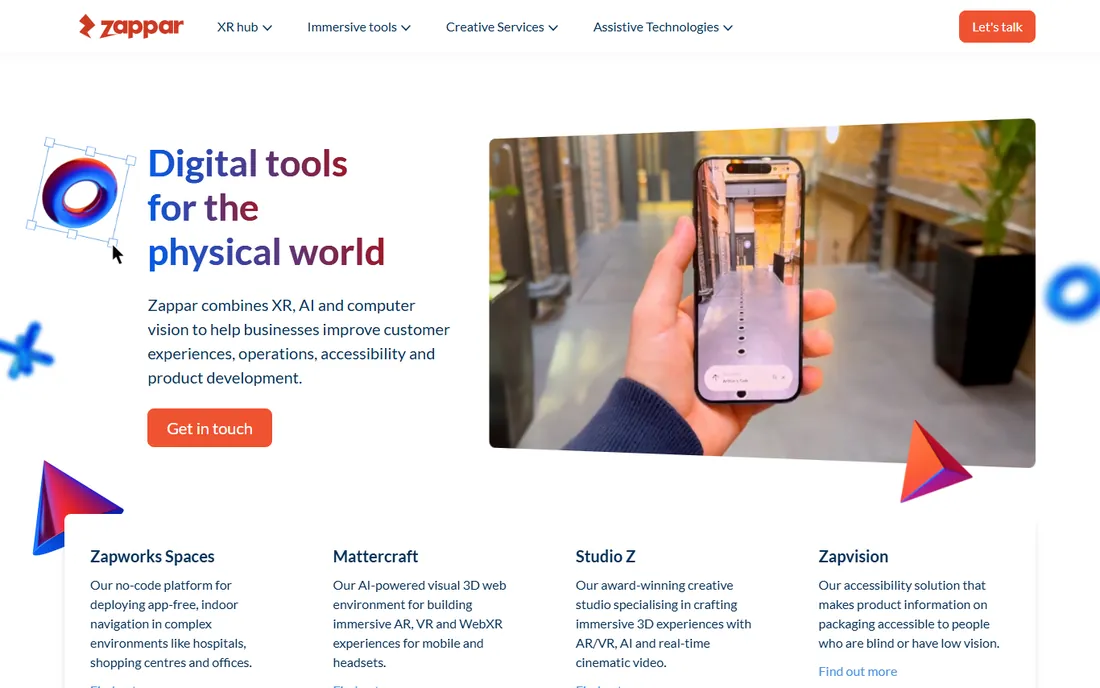
Zappar has been building branded AR since 2011, and its tooling reflects that heritage. Designer is a drag-and-drop no-code editor, Mattercraft is the full scriptable 3D environment for developers, and the Universal AR libraries bring Zappar's tracking into Three.js, Unity, A-Frame, and Babylon.js. Recent additions include WebXR support and Zapworks Spaces for indoor navigation.
G2's 2026 pricing data lists the ZapWorks Developer plan at $12.99 per month, but it is for non-commercial experimentation only, so commercial campaigns move to higher tiers. The platform also offers a free trial to test the tools. For marketing teams that want to ship AR campaigns without hiring an AR engineering team, Zappar's campaign experience and no-code path are the draw.
What we like- No-code Designer plus Mattercraft for developers
- Universal AR libraries for Three.js and Unity
- 15 years of brand campaign experience
Watch out for- The $12.99 plan is non-commercial
- Commercial publishing costs more
- Ecosystem is Zappar-centric
Starting price$39/month (Professional)
Free planYes
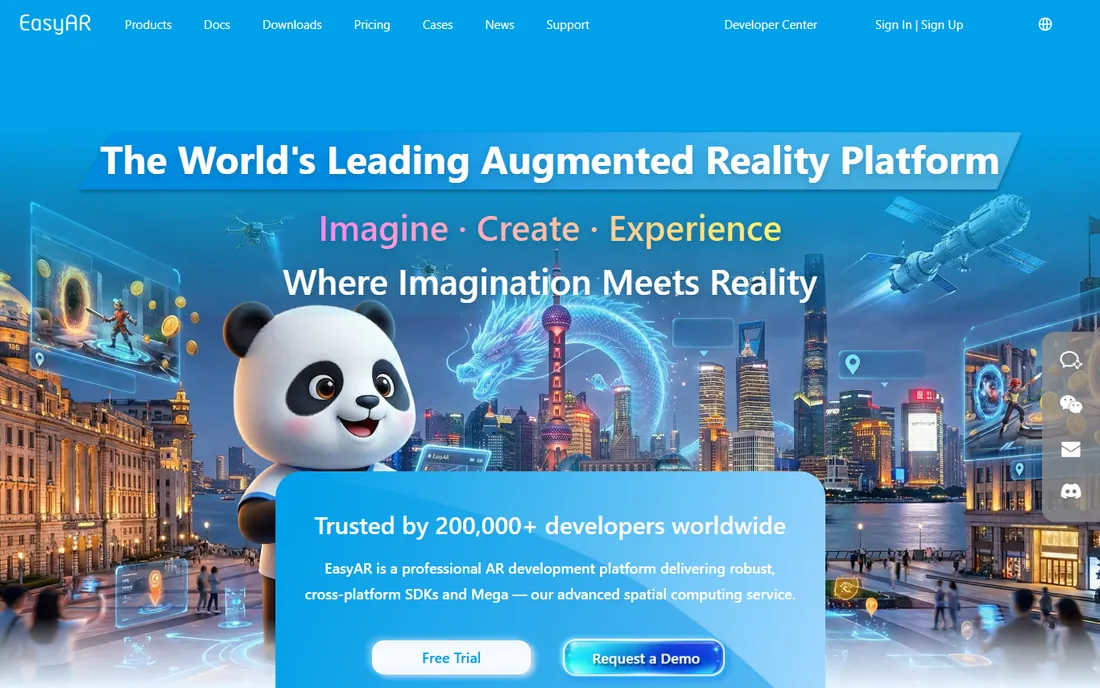
EasyAR, from Shanghai-based Visionstar, is the budget contender among full AR SDKs. The Sense 4.0 SDK covers motion tracking, image and object recognition, and an AR Cloud for persistent, shared spatial content, with a Unity plugin and support for headsets including Vision Pro. The Professional edition is $39 per month with no watermark and no session limits, and a one-time Classic license exists at $1,399.
The free Personal edition is genuinely usable for prototyping but shows a watermark and caps sessions at 100 seconds per run. More than 100,000 developers use the platform, and it has become the standard recommendation for teams that find Vuforia too expensive and Unity too heavy for their AR needs.
What we like- Professional plan at $39 per month undercuts most rivals
- Free Personal tier for learning
- AR Cloud with spatial mapping and multi-user sharing
Watch out for- Personal tier carries a watermark and a 100-second per-run limit
- Documentation and community are thinner than Unity's
Starting price$59/month (Pro subscription, per license)
Free planFree trial
MAXST is a South Korean AR SDK company whose calling card is visual SLAM: sensor-fusion tracking that keeps working where simpler trackers lose their place. The SDK spans image, object, and cloud recognition, supports external camera input and AR smart glasses, and MAXST's VPS service enables AR navigation and advertising with accurate indoor and outdoor positioning. Over 10,000 developers in more than 50 countries use it.
G2's April 2026 pricing data shows a free trial tier, a Pro subscription at $59 per license per month, a $899 one-time Pro license, and quote-based Enterprise. The one-time license is unusual in this category and appeals to teams that would rather buy than subscribe. MAXST deserves a look when your project involves glasses, navigation, or tracking scenarios where ARKit and ARCore fall short.
What we like- Sensor Fusion SLAM works without spatial limits
- Supports external cameras and smart glasses
- One-time $899 Pro license option
Watch out for- Smaller developer community than Vuforia or EasyAR
- Enterprise pricing requires direct consultation
Starting priceSee website
Free planYes
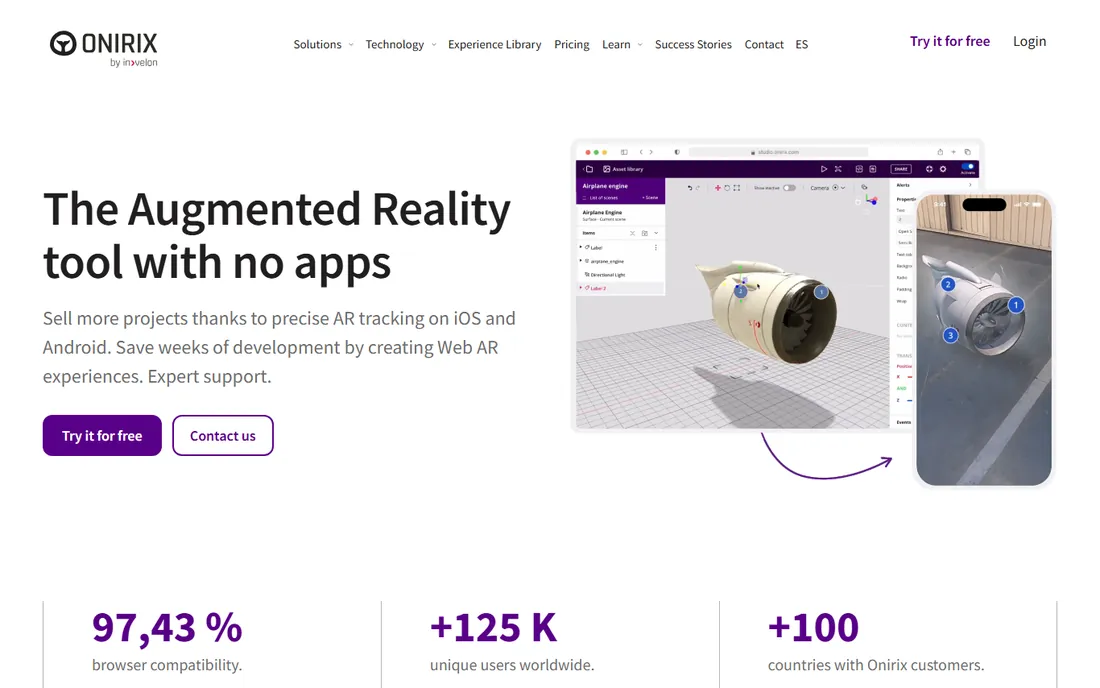
Onirix, from Spain, positions itself as the flexible WebAR platform for agencies. The Studio offers drag-and-drop experience building plus an online code editor with HTML, CSS, and JavaScript for developers who want full control, and its proprietary tracking is tuned for accurate browser-based AR on both iPhone and Android. The site claims 97.43 percent browser compatibility and customers in over 100 countries, including work for brands like LG and the Cleveland Cavaliers.
Pricing is the weak spot in the research: third-party sources variously report plans from 45 to 99 euros per month, so check the vendor's current pricing page. A free version exists for getting started. Onirix's own blog pitches it as the flexible alternative to 8th Wall, and with 8th Wall's hosted platform retired, agencies comparing WebAR vendors should put Onirix on the shortlist.
What we like- No-code Studio with online code editor for full control
- Proprietary tracking tuned for iOS and Android browsers
- Free version available
Watch out for- Pricing information is inconsistent across sources
- Smaller ecosystem than 8th Wall
How we chose
We started from the SDKs developers actually use in 2026: native frameworks from Apple and Google, the dominant cross-platform engine, the established tracking specialists, and the WebAR platforms agencies buy. We checked each product's current status, which mattered this year: Meta's Spark AR and AWS Sumerian were discontinued and are excluded, and 8th Wall's move to open source changed its pricing entirely. Prices come from vendor pages and 2026 third-party pricing data, with "See website" where sources conflicted. We weighed documentation quality, tracking accuracy, platform reach, and honest fit for small and mid-size teams rather than raw feature counts.
WebAR vs native: the decision that shapes everything
The first fork in every AR project is delivery: app or browser.
Go native when quality decides
ARKit, ARCore, and Unity AR Foundation deliver the best tracking, LiDAR depth, face tracking, and geospatial accuracy. Games, utility apps, industrial tools, and anything where precision matters belong here. The cost is the install: every user must download your app, and on iOS that means the App Store.
Go WebAR when reach decides
8th Wall, Zappar, and Onirix run AR from a link or QR code with no install. Marketing campaigns, retail try-ons, event activations, and tourism experiences live and die on friction, and WebAR removes it. The cost is capability: browser AR is weaker than native, and Safari on iPhone does not support WebXR AR as of 2026, which limits iPhone experiences.
The hybrid answer
Many teams ship both: a native app for the flagship experience and WebAR teasers for campaigns. Unity AR Foundation plus a WebAR platform covers both ends without two full engineering efforts.
What changed in AR development in 2026
Three shifts are worth knowing before you commit. First, 8th Wall went open source and free, which collapsed the cost of serious WebAR to hosting alone. Second, Unity raised Pro to $2,310 per seat per year in January 2026, so budget the engine alongside the SDK. Third, the platform duopoly hardened: Apple and Google keep the best sensors and APIs for their own native frameworks, and cross-platform tools are always one step behind the newest hardware features. Pick your SDK against the devices your audience actually carries, not the ones in the keynote.
Frequently asked questions
Which AR SDK is best for beginners?
For learning, ARKit and ARCore are free and have the best documentation from Apple and Google. For shipping a first commercial project cheaply, EasyAR's $39 per month Professional plan or 8th Wall's now-free open source engine are the friendliest onramps. Unity AR Foundation is the best beginner choice if you already know Unity.
Is there a completely free AR SDK?
Yes, several. ARKit and ARCore are free, Unity Personal is free under $200,000 in revenue, 8th Wall is now free and open source, and EasyAR has a free Personal tier. Publishing costs are separate: Apple charges $99 per year for the developer program, and app stores take their cut.
What happened to 8th Wall's pricing?
Niantic retired the hosted 8th Wall platform on February 28, 2026, ended all paid subscriptions, and released the XR engine as open source. It is now free to use, including for commercial projects, though you handle your own hosting and deployment.
ARKit or ARCore: which should I choose?
Choose based on your audience's phones. ARKit is iPhone only and ARCore is Android-first, though both support Unity. If you must serve both from one codebase, use Unity AR Foundation, which wraps both. For location-based experiences, ARCore's Geospatial API is the standout feature.
Can I build AR without coding?
Yes. Zappar's Designer and Onirix Studio are no-code editors for WebAR, and 8th Wall Desktop adds a visual editor to its open source engine. Vuforia also offers no-code SaaS options. No-code tools suit marketing and training content; custom apps still need developers.
What is the cheapest way to add AR to an existing app?
Use the native SDKs directly: ARKit on iOS and ARCore on Android cost nothing to integrate. If your app is already built in Unity, AR Foundation adds AR support with no SDK licensing fee, just your Unity seat costs.
Sources we checked (15)
- https://unity.com
- https://developer.apple.com
- https://developers.google.com/ar
- https://vuforia.com/
- https://8thwall.com/
- https://zappar.com/
- https://easyar.com/
- https://maxst.com/
- https://www.onirix.com
- https://www.g2.com/products/maxst-ar-sdk/pricing
- https://www.scmgalaxy.com/tutorials/top-10-augmented-reality-tools-in-2025-features-pros-cons-comparison/
- https://dev.to/aplusgamesstudio/arkit-vs-arcore-vs-webxr-choosing-your-ar-stack-2026-1nk9
- https://game-developers.org/unity-licensing-101-from-personal-to-pro
- https://appleinsider.com/articles/24/04/03/apple-vision-pro-gains-niantic-tech-to-open-up-more-ar-experiences
- https://www.onirix.com/pricing/?target=blank
Is your product missing or out of date?
We review this list regularly. Vendors can request a listing, send updated pricing or ask about featured placement.

Shihab Mia · Founder, Rankite
Shihab has spent more than a decade helping SaaS and e-commerce brands grow through search. He writes Rankite's software buying guides from pricing pages, documentation and public user reviews. More about Shihab.