How we make this list: we compare pricing pages, product documentation and public user reviews. Rankite is independent; if a vendor ever pays for a featured spot, that listing is clearly labeled Partner.
Key takeaways
- Start free: Siril, DeepSkyStacker, N.I.N.A. and PHD2 cover stacking, capture and guiding at zero cost.
- PixInsight (one-time license, 45-day trial on the vendor site) is the professional processing standard, with a learning curve to match.
- Capture and processing are separate jobs: N.I.N.A. runs the telescope, PixInsight or Siril develops the image.
- SharpCap's free version handles planetary and lunar capture well; its paid Pro tier adds the polar alignment and deep-sky tools.
Quick comparison
| Tool | Best for | Starting price | Free plan |
|---|
 PixInsight PixInsight | Deep-sky imagers who want the most capable processing platform available | See website (one-time commercial license) | Free trial (45 days, per vendor site) |
 Siril Siril | Imagers who want capable free processing without the PixInsight price | Free (open source) | Yes |
 DeepSkyStacker DeepSkyStacker | Beginners who want to stack their first light frames tonight | Free | Yes |
 N.I.N.A. N.I.N.A. | Automating capture sessions with a free, modern sequencer | Free (open source) | Yes |
 Astro Pixel Processor Astro Pixel Processor | Imagers who want guided, high-quality stacking without the PixInsight maze | See website (paid license with trial) | Free trial |
 SharpCap SharpCap | Planetary, lunar and electronically assisted astronomy capture | See website (free version; Pro license paid) | Yes (free version) |
 PHD2 PHD2 | Free, reliable autoguiding on any mount | Free (open source) | Yes |
 Sequence Generator Pro Sequence Generator Pro | Imagers who want a mature paid automation platform with support | See website (paid license) | Free trial |
Is your product missing or out of date?
We review this list regularly. Vendors can request a listing, send updated pricing or ask about featured placement.
The best astrophotography software
Nobody buys astrophotography software for fun. You buy it because you spent four hours in the cold collecting photons and now you have 200 noisy frames that need to become one clean image of a galaxy. The tools below do the three jobs that matter: running the camera and mount, stacking the frames, and processing the result. Half of them are free.
#1
PixInsight
Best for: Deep-sky imagers who want the most capable processing platform available
Visit pixinsight.com
Starting priceSee website (one-time commercial license)
Free planFree trial (45 days, per vendor site)
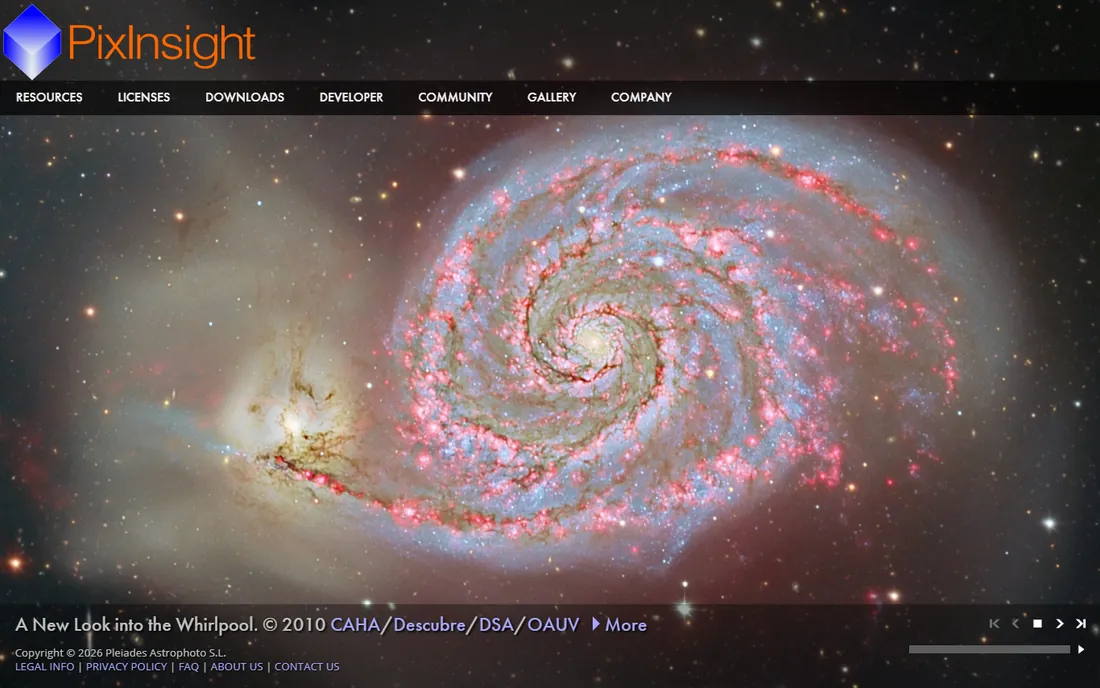
PixInsight is what most serious deep-sky imagers eventually land on. It handles calibration, registration, stacking, gradient removal, color calibration, stretching and finishing in one platform, and its scriptable, process-based workflow means you can re-run an entire pipeline when you learn a better technique. The vendor offers a fully functional 45-day trial, which is enough to process a real data set end to end.
The honest catch is the learning curve. PixInsight assumes you understand what calibration frames do and why background neutralization matters; beginners routinely produce worse results than Siril gives them in an afternoon. Budget a month of tutorials. If you stick with the hobby past your first year, though, this is the standard everything else is measured against.
What we like- The deepest processing toolkit in the category with a huge script and plugin ecosystem
- Non-destructive, repeatable workflows once you learn them
- Active development and a knowledgeable user community
Watch out for- The interface is famously intimidating, with a steep first month
- Paid third-party plugins (denoise, deconvolution) add cost on top of the license
#2
Siril
Best for: Imagers who want capable free processing without the PixInsight price
Visit siril.org
Starting priceFree (open source)
Free planYes
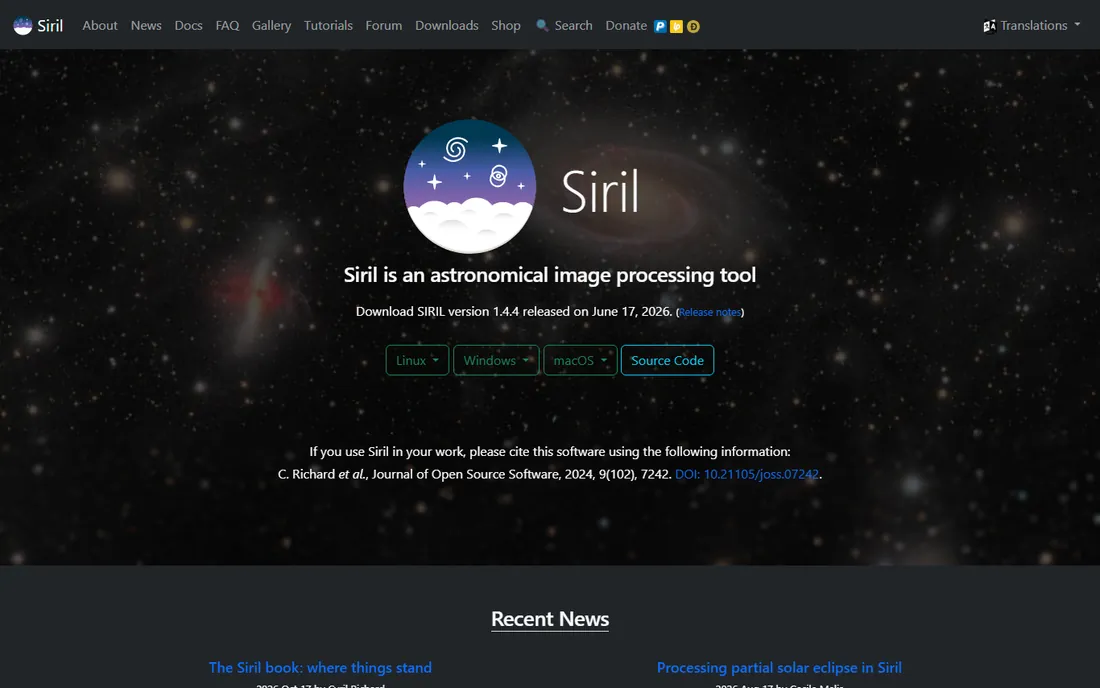
Siril is the free answer that embarrasses paid software. It stacks, calibrates, registers and processes deep-sky images with tools that genuinely compete with commercial packages, including photometric color calibration and background extraction. Being open source, it runs everywhere and costs nothing forever.
What it lacks is hand-holding. The workflow is powerful but sparse, and you will read the documentation. It also lacks the polished AI denoise and deconvolution plugins that PixInsight users buy. For beginners, Siril plus a few tutorials produces excellent first images. For the budget-conscious, it may be all you ever need.
What we like- Completely free with professional-grade stacking and processing
- Scriptable workflows for repeatable pipelines
- Runs on Windows, Mac and Linux
Watch out for- The interface is utilitarian and documentation assumes technical users
- Fewer one-click AI tools than the paid ecosystem
Starting priceFree
Free planYes
DeepSkyStacker does one thing: it takes your light, dark, flat and bias frames and produces a stacked image. The workflow is a short wizard, and an hour after downloading you can have your first stacked result. For a beginner with a DSLR and a tripod, that first stack is the moment the hobby clicks.
It is not a processing program. The stacked output still needs stretching, color work and noise handling in Siril or PixInsight. It is also Windows-only and looks it. But as a free first step into stacking, nothing is faster, and many imagers keep it in the toolkit for quick test stacks years later.
What we like- The simplest path from raw frames to a stacked image
- Free with no account or paywall
- Huge tutorial base since it has been around for years
Watch out for- Stacking only, with no real processing tools
- Windows-only and showing its age
Starting priceFree (open source)
Free planYes
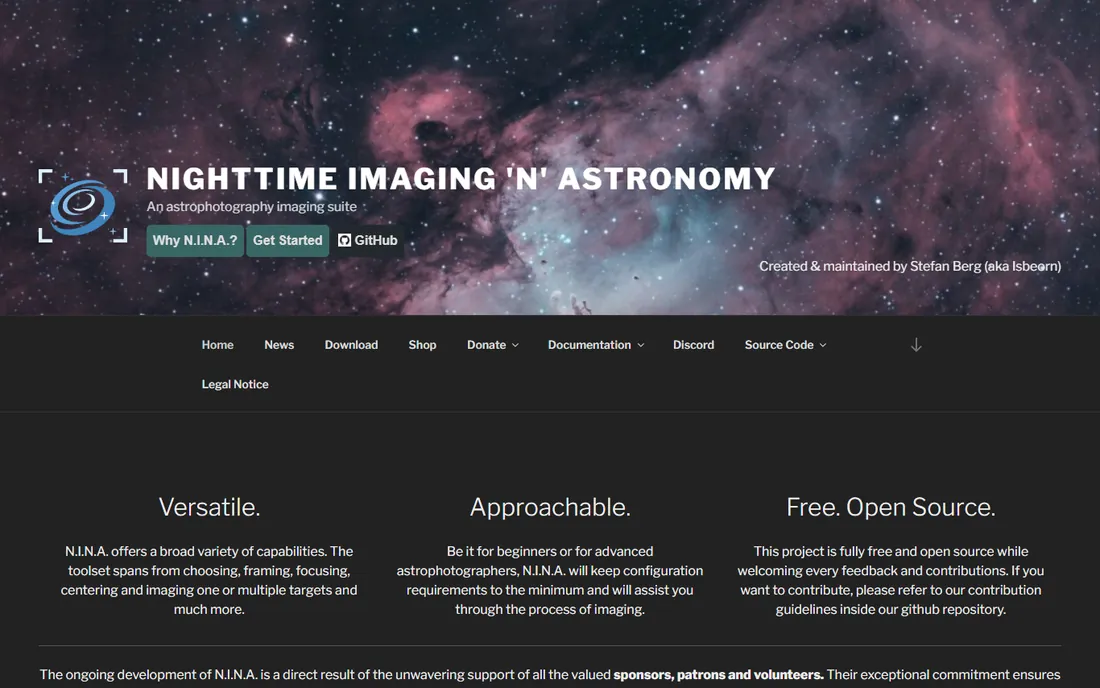
N.I.N.A. (Nighttime Imaging 'N' Astronomy) is the free sequencer that replaced paid capture software for most amateurs. It runs the camera, filter wheel, focuser and mount through automated imaging sequences: autofocus on temperature change, meridian flips, dithering, plate-solved framing. The plugin system extends it to weather monitoring, flat panels and more.
Setup is the price. With great plugins comes great configuration, and your first night will involve forums. It is also Windows-only, which matters for Mac-based imagers. But once configured, N.I.N.A. runs unattended sessions that used to require software costing hundreds of dollars.
What we like- Free advanced sequencing with autofocus, meridian flips and plate solving
- Plugin ecosystem for everything from flat panels to weather stations
- Modern interface that keeps improving
Watch out for- Windows-only
- The plugin sprawl means setup takes an evening of configuration
Starting priceSee website (paid license with trial)
Free planFree trial

Astro Pixel Processor sits between DeepSkyStacker and PixInsight. It walks you through calibration, registration, normalization and integration with sensible defaults, and its stacking quality is genuinely excellent, especially for mosaics and data collected over multiple nights. Intermediates who find PixInsight hostile often land here.
The question is the price. Siril does competent stacking for free, and PixInsight does everything for a one-time fee, which squeezes APP's middle position. Its case is workflow: if you want quality results with less study than PixInsight demands, the guided approach earns its keep. Trial it on your own data before deciding.
What we like- Excellent calibration and integration quality with a guided workflow
- Handles mosaics and multi-night data sets well
- Friendlier than PixInsight for intermediates
Watch out for- Paid license for what Siril does free at a basic level
- Processing tools are thinner than PixInsight's
#6
SharpCap
Best for: Planetary, lunar and electronically assisted astronomy capture
Visit sharpcap.co.uk
Starting priceSee website (free version; Pro license paid)
Free planYes (free version)
SharpCap owns planetary imaging. Its high-frame-rate capture, live histograms and seeing monitors are what lunar and planetary imagers use, and the live stacking feature lets deep-sky observers watch a target emerge on screen in real time, which makes it popular for electronically assisted astronomy. The free version covers a lot; Pro adds polar alignment, advanced sequencing helpers and more.
It is Windows-only, and for multi-hour automated deep-sky sessions N.I.N.A. sequences better. But for planets, the Moon and live outreach sessions, SharpCap is the tool. The free version is enough to learn on, and the Pro license is cheap by this category's standards.
What we like- The standard for planetary and lunar lucky imaging
- Live stacking shows deep-sky targets building in real time
- Polar alignment tools in the Pro version are excellent
Watch out for- Windows-only
- Deep-sky sequencing is basic next to N.I.N.A.
Starting priceFree (open source)
Free planYes
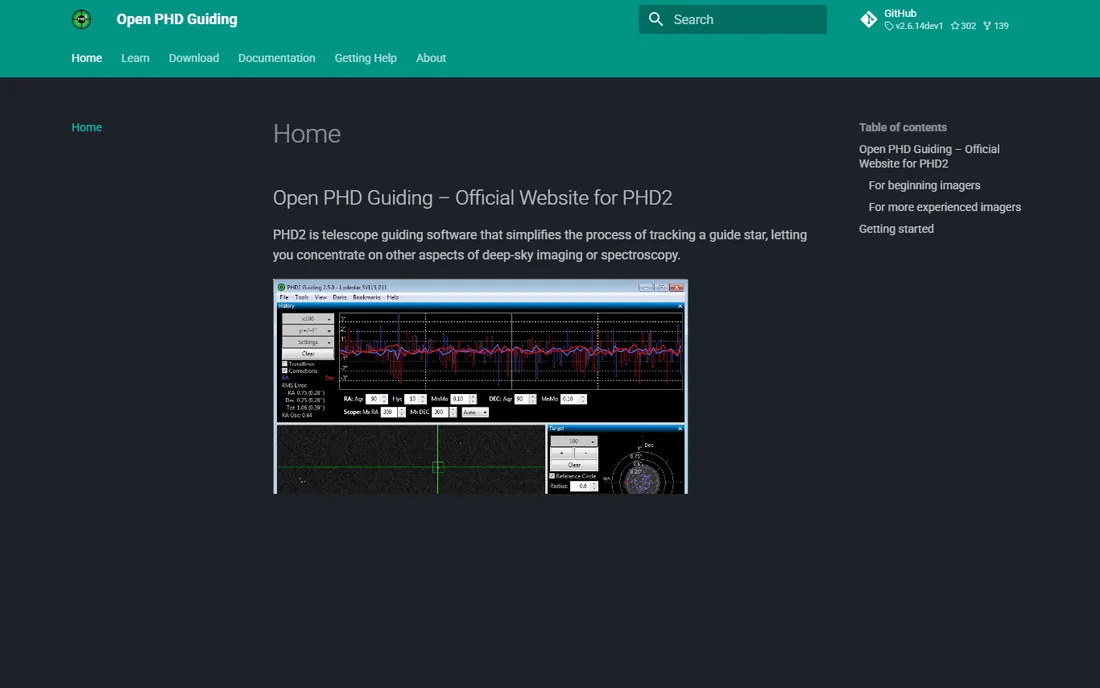
PHD2 is the reason long exposures work for amateurs. It watches a guide star through a small guide scope, sends corrections to the mount, and turns a shaky tracking mount into one that holds 5-minute subs. It is free, open source, and supported by virtually every capture program.
Every rig needs tuning: calibration, backlash compensation, and algorithm choice differ per mount. Expect one frustrating night and then years of reliable guiding. There is no paid alternative worth buying for most amateurs; PHD2 is simply the standard.
What we like- Free and the guiding standard for the hobby
- Multi-star guiding and predictive algorithms in recent versions
- Integrates with N.I.N.A., SGP and other sequencers
Watch out for- Guiding only, so you still need capture and processing software
- Tuning takes a night of experimentation per rig
Starting priceSee website (paid license)
Free planFree trial
Sequence Generator Pro was the advanced sequencer before N.I.N.A. existed, and it remains a polished, reliable choice. Equipment profiles, target planning, autofocus routines and meridian flip handling are all mature, and paying customers get actual support. For imagers who want software with a company behind it, SGP is the established pick.
The market shifted under it. N.I.N.A. does most of what SGP does for free, which makes the license a harder sell than it was five years ago. SGP's case now is maturity and support: fewer surprises, someone to email. Trial both on your rig; the right answer depends on how much you value a support channel.
What we like- Long-mature sequencing with excellent equipment profiles
- Strong autofocus and plate-solving integration
- Commercial support instead of forums
Watch out for- Paid license in a world where N.I.N.A. is free
- Windows-only
Frequently asked questions
What software do I need to start astrophotography?
Three jobs: capture (N.I.N.A. free), stacking (DeepSkyStacker or Siril, free) and processing (Siril free, PixInsight paid). Guiding adds PHD2 (free) once your exposures pass a minute or two. You can start the whole hobby on free software.
Is PixInsight worth the money?
If you process deep-sky images regularly, yes: it is the most capable platform and the one-time license covers years of use. If you are starting out, learn on Siril first. You will know when your processing has outgrown the free tools.
What is the best free astrophotography software?
Siril for processing, DeepSkyStacker for simple stacking, N.I.N.A. for capture automation and PHD2 for guiding. Together they cover the full workflow at zero cost, and many experienced imagers never pay for software.
Do I need a paid sequencer, or is N.I.N.A. enough?
N.I.N.A. is enough for the great majority of amateurs, including advanced multi-night automation. Sequence Generator Pro's case is commercial support and long maturity. Try N.I.N.A. first; pay only if you miss having someone to email.
Can I do astrophotography on a Mac?
Yes, with limits. Siril, PixInsight and Astro Pixel Processor run on macOS. N.I.N.A., DeepSkyStacker, SharpCap and PHD2's best-supported setups are Windows. Many Mac imagers capture with a small Windows mini-PC at the scope and process on the Mac.
How long does it take to learn PixInsight?
Expect a month of regular tutorial-following before your results beat what Siril gives you. The 45-day trial is sized for exactly this evaluation. Most users say the investment pays off within the first year of serious imaging.
How we chose
We started with the terms imagers search: astrophotography software, deep sky stacking software, astrophotography processing and autoguiding software. For each candidate we confirmed the product is current and maintained, checked pricing against the vendor's own pages, and compared capabilities across Cloudy Nights forums, Reddit's astrophotography community and practitioner reviews. Where a vendor price did not render as text on the vendor's page, we wrote "See website" rather than quoting a forum post. We weighted real workflow fit: capture, stacking, guiding and processing as separate jobs.
Capture vs. processing: buy for the job you have
Beginners conflate the software into one purchase, but capture and processing are different jobs with different tools. Capture software (N.I.N.A., SharpCap, SGP) runs the mount and camera during the night. Processing software (Siril, PixInsight, APP) develops the frames the next day. Guiding (PHD2) sits between them, keeping the mount on target.
Buy in that order of pain. If your stars are trailed, fix capture and guiding first; no processing software saves trailed subs. If your subs are sharp but your images look flat, the upgrade is processing skill and software. Most imagers should spend their first money, if any, on PixInsight, because capture and guiding are already free.
The free stack that covers everything
It is worth spelling out: N.I.N.A. sequences the night, PHD2 guides the mount, DeepSkyStacker or Siril stacks the frames, and Siril processes the result. Total cost: zero. This stack has produced competition-winning images. The paid tools buy convenience, depth and support, not access to the hobby.
Where the paid tools earn their price is time. PixInsight's gradient tools, color calibration and plugin ecosystem save hours per image once you know them. SGP's support saves a cloudy-night forum dive. SharpCap Pro's polar alignment saves twenty minutes every setup. None of these is necessary. All of them are pleasant. Start free, pay when a specific limitation costs you images.
Sources we checked (8)
- https://pixinsight.com/licenses/
- https://siril.org/
- https://deepskystacker.free.fr/
- https://nighttime-imaging.eu/
- https://www.astropixelprocessor.com/
- https://www.sharpcap.co.uk/
- https://openphdguiding.org/
- https://www.mainsequencesoftware.com/
Is your product missing or out of date?
We review this list regularly. Vendors can request a listing, send updated pricing or ask about featured placement.

Shihab Mia · Founder, Rankite
Shihab has spent more than a decade helping SaaS and e-commerce brands grow through search. He writes Rankite's software buying guides from pricing pages, documentation and public user reviews. More about Shihab.