How we make this list: we compare pricing pages, product documentation and public user reviews. Ratings come from G2, Capterra or Trustpilot, with the date we checked them.
Key takeaways
- Jira and Azure DevOps suit most software teams that need planning, code, and delivery tracking, while Jama Connect, IBM ELM, Polarion, Codebeamer, and Helix ALM suit regulated products that need strict traceability.
- Traceability is the deciding feature for medical, automotive, and aerospace teams: every requirement should link to design, code, tests, and release evidence without manual spreadsheets.
- Most enterprise ALM pricing is quote-based, so compare total cost by user type, hosting choice, modules, and support, not only a headline seat price.
- Teams that already use Atlassian or Microsoft tools will adopt Jira or Azure DevOps faster, while teams that need audit-ready baselines should prioritize dedicated ALM platforms.
- Pilot with a real project slice, including a requirement change, a failed test, and a release report, to see how traceability and reporting hold up under change.
Quick comparison
Is your product missing or out of date?
We review this list regularly. Vendors can request a listing, send updated pricing or ask about featured placement.
The best application lifecycle management software
Starting priceSee website
Free planYes
Jira is the default planning tool for many software teams, and for good reason. Teams can plan sprints, track issues, manage backlogs, and report progress in boards and timelines that most developers already know. The marketplace adds test management, requirements, and reporting apps, so a team can extend Jira toward ALM without replacing its core workflow. Confluence adds specs and context, which helps when requirements live near the work itself.
Jira is not a dedicated regulated ALM platform out of the box. Traceability from requirement to test to release can be built, but it needs consistent issue types, links, and workflows, plus discipline about how teams record changes. For a SaaS or internal software team that values speed and familiarity, that trade-off is fine. For a medical device team that must prove every requirement was tested under audit, a dedicated ALM tool may save effort in the long run.
What we like- Familiar agile planning, boards, and reporting
- Huge marketplace of integrations
- Free tier for small teams
Watch out for- Full ALM traceability needs add-ons or careful configuration
- Large instances need admin discipline
Starting priceSee website
Free planYes
Azure DevOps bundles planning, source control, build and release pipelines, and test plans, which makes it a complete ALM path for teams already in the Microsoft ecosystem. Azure Boards tracks work, Azure Repos holds code, Azure Pipelines automates builds and releases, and Azure Test Plans covers manual and exploratory testing. That breadth means fewer separate tools to integrate, and permissions and identity flow through Microsoft Entra ID for enterprise control.
The breadth can also confuse new teams, because each service has its own settings and limits. Pricing includes free tiers for small teams and paid plans for larger groups, plus pipeline minutes and test plan seats that buyers should price separately. For a .NET, Azure, or hybrid team that wants one vendor for planning through release, Azure DevOps is a strong, practical choice, provided the team invests in templates and process standards early.
What we like- Boards, repos, pipelines, and test plans in one suite
- Strong fit with Visual Studio, GitHub, and Azure
- Free tier for small teams
Watch out for- Interface spans many services and can feel complex
- Regulated traceability still needs process design

#3Jama Connect
Best for: Regulated product requirements4.3/5 on
G2 (225 reviews, checked Oct 2026)
Visit jamasoftware.com
Starting priceSee website
Free planNo
Jama Connect centers on requirements, which is exactly where regulated product teams struggle. It lets teams author, review, approve, and baseline requirements, then link them to design items, tests, and risks, so a change to one requirement shows its downstream impact. That live traceability helps automotive, medical, aerospace, and industrial teams prepare for audits without rebuilding trace matrices in spreadsheets at the end of a project.
Jama Connect works best as part of a wider toolchain, with code in Git, pipelines in CI tools, and test execution linked back to requirements. Buyers should ask about integrations, hosting, user roles, and how baselines and change control work in practice. Pricing comes through sales, so request a quote by user count and modules. For teams whose main risk is untested or changed requirements, Jama Connect is a focused, proven pick.
What we like- Requirements management built for regulated products
- Live traceability and impact analysis
- Strong support for standards work
Watch out for- Quote-based pricing
- Focused on requirements more than full code and pipeline management

#4
IBM Engineering Lifecycle Management
Best for: Complex systems engineering
Visit ibm.com
Starting priceSee website
Free planNo
IBM Engineering Lifecycle Management, often called IBM ELM, connects requirements, systems design, workflows, and tests for complex products. Teams can reuse requirements across product versions, model systems, manage change with impact analysis, and produce reports for compliance reviews. The digital thread idea runs through the suite: data stays linked across tools, so a design change, a test result, and a requirement update remain visible in one view.
That power suits aerospace, defense, automotive, finance, and medical device programs with long lifecycles and many variants. It also means implementation is a project in itself, with architecture, data migration, and training to plan. Small software teams will likely find Jira or Azure DevOps faster and cheaper. Large systems teams that need governance at scale should evaluate IBM ELM with a pilot that includes a real baseline, a change request, and an audit-style report.
What we like- Requirements, modeling, workflow, and test management in one family
- Digital thread traceability
- Strong compliance support
Watch out for- Enterprise pricing and implementation effort
- Needs skilled administrators for large deployments
Starting priceSee website
Free planFree trial

Polarion, from Siemens, is built for teams that must pass audits and regulatory inspections. Every requirement change is controlled, traceability is automatic, and teams can reuse or branch requirements, code, and tests across projects and product lines. LiveDocs, its structured document approach, lets teams author and approve specifications in a document-like view while keeping each item traceable underneath. That mix of documents and data helps teams that still review specs as documents but need item-level control.
Polarion offers both SaaS cloud and private hosting, which matters for firms with data residency or security rules. Extensions add integrations with many engineering tools, so buyers should map their toolchain before purchase. The platform rewards careful setup of workflows, permissions, and templates, so plan for admin time. For regulated teams that want a single ALM system for requirements, coding, testing, and release, Polarion is a strong contender.
What we like- Granular traceability with automatic change control
- Cloud or on-premises hosting
- Strong workflow and reuse features
Watch out for- Pricing is quote-based
- Configuration can be deep for teams new to ALM

#6
OpenText ALM Quality Center
Best for: Enterprise test and quality governance
Visit opentext.com
Starting priceSee website
Free planNo
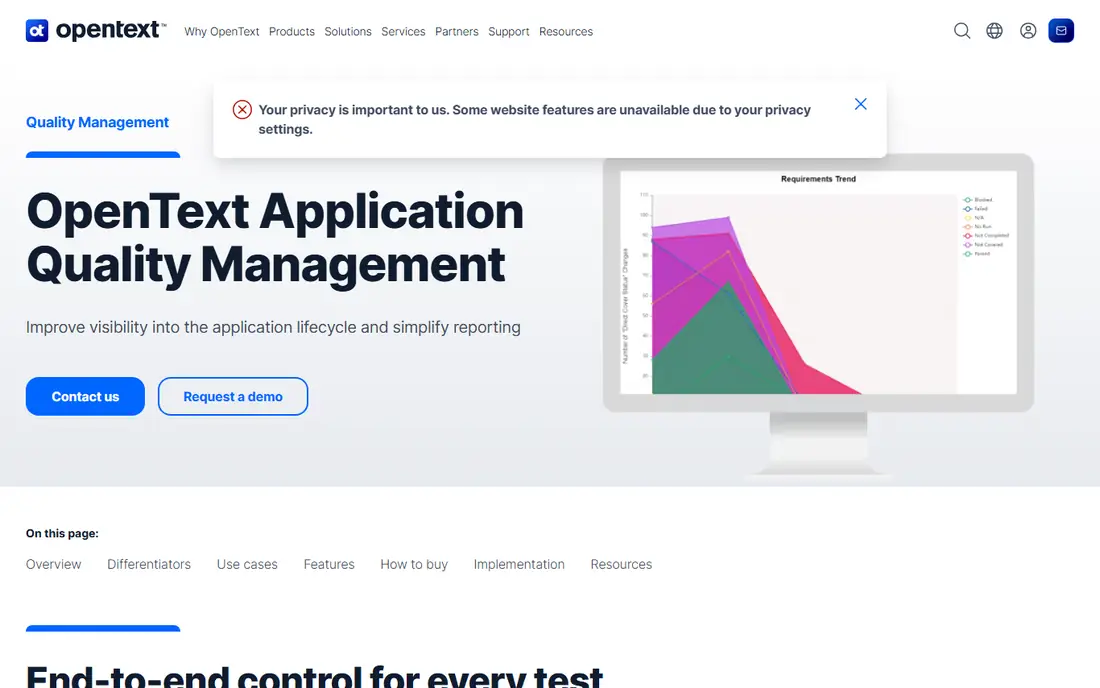
OpenText ALM Quality Center, formerly from Micro Focus and HP, has served enterprise quality teams for many years. It governs test planning, execution, defect tracking, and release quality in one place, with traceability that links requirements to tests and defects. Analytics give managers a view across releases, so they can see coverage gaps, defect trends, and readiness before a launch. Standardized processes, audit trails, and security controls support compliance work in large organizations.
The trade-off is modernity and fit. Teams used to fast, lightweight agile tools may find ALM Quality Center more formal and slower to configure, and it works best when quality governance is a central goal. It also pairs well with Jira in some firms, where Jira handles agile planning and ALM Quality Center governs testing and compliance. Buyers should confirm hosting, licensing by user type, and integration needs, and they should test the reporting views that managers will actually use each week.
What we like- Long-standing test management and governance
- Traceability across requirements, defects, and tests
- Analytics across releases
Watch out for- Interface feels older than newer ALM tools
- Enterprise deployment and licensing need planning

#7PTC Codebeamer
Best for: Product lines and safety-critical software4.3/5 on
G2 (141 reviews, checked Oct 2026)
Visit ptc.com
Starting priceSee website
Free planNo
Codebeamer, from PTC, targets complex, safety-critical products where variants matter. A car platform, a medical device family, or an industrial system may share most requirements and tests but differ by market, hardware, or regulation. Codebeamer manages those variants, risks, tests, and releases in one traceable system, with templates for standards such as ISO 26262, ASPICE, and IEC 62304. That product line focus sets it apart from general ALM tools that treat each project as separate.
Codebeamer also connects to DevOps pipelines and other PTC products for a wider digital thread, which helps hardware and software teams stay aligned. Small teams without variants may not need that depth, and they should weigh setup effort against benefit. For product line teams that must prove compliance across many variants, Codebeamer offers a coherent, audit-ready approach, and its SaaS option reduces infrastructure work compared with self-hosting.
What we like- End-to-end traceability with product line configuration
- Risk and compliance templates for automotive and medical work
- DevOps integrations
Watch out for- Quote-based pricing
- Depth can overwhelm small teams that do not need product line features

#8Perforce Helix ALM
Best for: Regulated teams that need clear traceability4.1/5 on
G2 (102 reviews, checked Oct 2026)
Visit perforce.com
Starting priceSee website
Free planFree trial
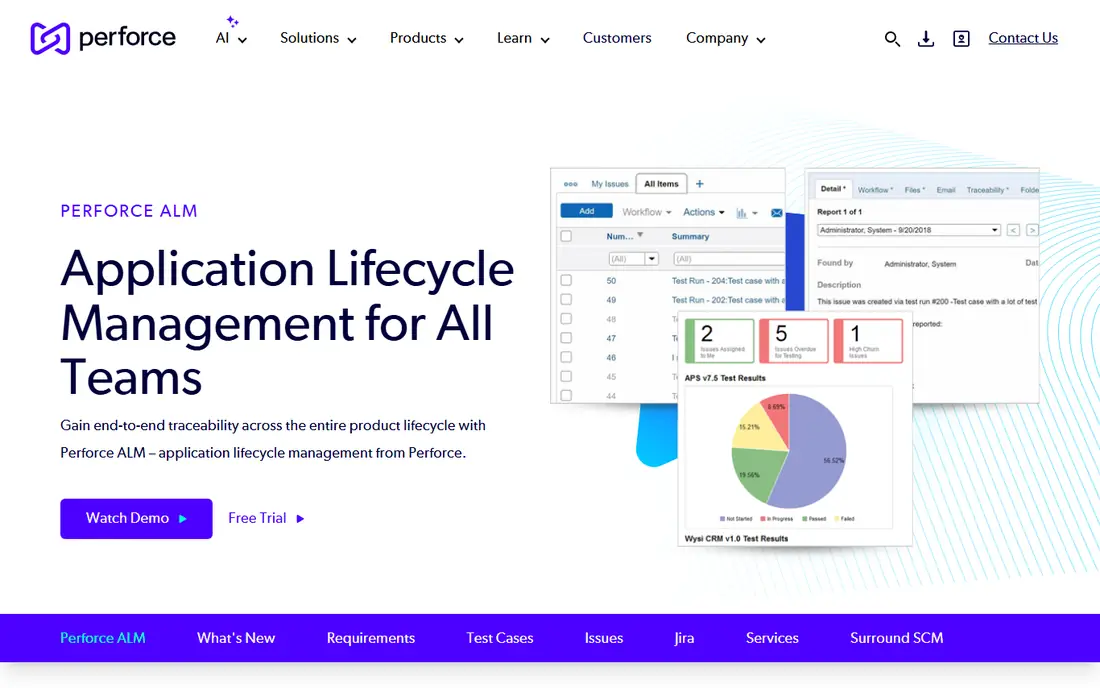
Helix ALM, from Perforce, covers requirements, test cases, issues, and workflows in a central platform, with a focus on regulated industries such as medical devices, aerospace, and automotive. Its traceability matrix links requirements to tests and issues, and built-in reports compare current data with baselines, which helps teams show auditors that every requirement was addressed. Workflows can be configured without coding, so quality teams can adapt processes to their own standards.
Helix ALM suits teams that want a dedicated ALM system without the scale of IBM ELM or Polarion, and it pairs with Perforce version control for teams already in that ecosystem. The ecosystem of third-party apps is smaller than Atlassian or Microsoft, so buyers should check integrations for their code, CI, and test tools early. For a mid-size regulated team that needs clear, auditable traceability at a manageable scale, Helix ALM is worth a trial.
What we like- Requirements, test cases, and issues in one central system
- Automatic traceability matrix
- Configurable workflows without coding
Watch out for- Smaller ecosystem than Jira or Azure DevOps
- Pricing needs a quote for larger teams
How we chose
We verified each vendor homepage, reviewed product documentation and pricing pages, and checked public reviews on G2, Capterra, and Reddit, plus vendor case material for regulated use. We favored tools that cover requirements, tests, traceability, and release evidence, and we distinguished general agile tools from dedicated ALM platforms. We did not claim hands-on testing, and we treated quote-based pricing as a signal to request a written proposal before budgeting.
Traceability models are hard to change after data is loaded, so choose based on audit needs first. If auditors will ask for a requirement-to-test matrix, baseline history, and change records, pick a tool that produces those artifacts natively. If speed and developer familiarity matter more, pick Jira or Azure DevOps and add test and requirements apps with clear link rules. Either path works, but mixing them without rules creates gaps.
Map the toolchain before you buy
List every tool that must connect: requirements, design, code repos, CI pipelines, test automation, defect tracking, and release management. Ask each ALM vendor which connections are native, which need plugins, and which need custom work. Test one full loop in a pilot, from a requirement change through code, test, and release notes, and check that links survive the change. A tool that looks complete in a demo can still fail if its Git or test integration is weak.
Plan roles, baselines, and change control
Decide who can author, approve, and change requirements, who can close tests, and who can create baselines. Write those rules before loading data, because retrofitting permissions after teams have worked in the system is messy. Also decide how often baselines are created, how variants are handled, and how reports will be used in reviews. A short governance document, agreed by engineering and quality teams, prevents most ALM failures.
Budget for migration and admin ownership
Migration from spreadsheets, old ALM tools, or Jira projects takes time for data cleanup, link repair, and history import. Assign an ALM owner who maintains templates, workflows, and integrations after go-live, and budget for training across engineering, test, and quality roles. Without an owner, even a strong tool drifts into inconsistent use, and traceability reports lose trust.
Frequently asked questions
What is the best application lifecycle management software?
Jira and Azure DevOps suit most agile software teams, while Jama Connect, IBM ELM, Polarion, Codebeamer, and Helix ALM suit regulated products that need strict traceability. OpenText ALM Quality Center suits enterprise teams focused on test governance. Pick by audit needs, toolchain, and team size, not by feature count alone.
What is the difference between ALM and project management?
Project management tracks tasks, dates, and resources, while ALM tracks the full product lifecycle from requirements through design, code, tests, and release, with links that show how each item relates. ALM adds traceability, baselines, change control, and compliance evidence that general project tools often lack or need add-ons to provide.
Do I need ALM software for a small software team?
A small team can often work well with Jira or Azure DevOps plus good link and test practices, without a dedicated ALM platform. A dedicated ALM tool becomes valuable when the team builds regulated products, manages many variants, or must prove coverage and change history to auditors or customers.
How much does ALM software cost?
Many enterprise ALM tools price by quote, based on users, modules, hosting, and support, so this guide lists See website for those tools. Jira and Azure DevOps offer free tiers for small teams, with paid plans for larger groups. Request a written quote that includes all user types and add-ons before budgeting.
Can ALM software integrate with Git and CI tools?
Yes, most tools in this list integrate with Git repos, CI pipelines, and test automation, though depth varies. Jira and Azure DevOps integrate deeply with their own ecosystems, while dedicated ALM tools often use plugins or standards-based links. Test the exact integrations your team uses during a pilot.
What should an ALM pilot include?
Include a real requirement set, a design change, a failed test, a defect fix, and a release report, so the team can see traceability, baselines, and reporting under change. Involve engineering, test, and quality staff, and check how long each task takes. A pilot that only creates new items will not show how the tool handles real project churn.
Sources we checked (8)
- https://www.atlassian.com/software/jira
- https://azure.microsoft.com/en-us/products/devops
- https://www.jamasoftware.com/
- https://www.ibm.com/products/engineering-lifecycle-management
- https://polarion.plm.automation.siemens.com/
- https://www.opentext.com/products/alm-quality-center
- https://www.ptc.com/en/products/codebeamer
- https://www.perforce.com/products/helix-alm
Is your product missing or out of date?
We review this list regularly. Vendors can request a listing, send updated pricing or ask about featured placement.

Shihab Mia · Founder, Rankite
Shihab has 5+ years in B2B and SaaS SEO. He writes Rankite's software buying guides from pricing pages, documentation and public user reviews. More about Shihab.
 Jira
 Azure DevOps
 Siemens Polarion