How we make this list: we compare pricing pages, product documentation and public user reviews. Rankite is independent; if a vendor ever pays for a featured spot, that listing is clearly labeled Partner.
Key takeaways
- Postman still has the largest ecosystem, but its free plan is now limited to a single user, so teams of two or more need a paid seat or a different tool.
- Apidog is the strongest all-in-one value pick at $9 per user per month, with a genuinely useful free tier for up to four collaborators.
- If your work must live in Git and never touch a vendor cloud, Bruno and Hoppscotch (self-hosted) are the two serious open-source answers.
- Stoplight is the most design-first of the commercial options, though it is being folded into the SmartBear API Hub, so check the current packaging before committing.
- For documentation quality alone, Scalar and ReadMe lead; Scalar is open source while ReadMe charges for analytics and interactive docs.
Quick comparison
| Tool | Best for | Starting price | Free plan |
|---|
 Postman Postman | Teams that want the biggest ecosystem | See website | Yes (Free plan, 1 user) |
 Apidog Apidog | Teams wanting design, test, mock and docs in one place | $9 per user/month (billed annually) | Yes (up to 4 users) |
 Stoplight Stoplight | Design-first teams with governance needs | See website | Yes (free for up to 3 users) |
 SwaggerHub SwaggerHub | OpenAPI standards work and large API portfolios | See website | Yes |
 Insomnia Insomnia | Developers who want a fast client with design chops | See website | Yes (free local Scratch Pad) |
 Bruno Bruno | Teams that keep everything in Git | See website | Yes (open-source edition) |
 Hoppscotch Hoppscotch | Lightweight browser-based API work | See website | Yes (self-hosted Community Edition) |
 Scalar Scalar | Open-source API references and docs | See website | Yes (client and reference are open source) |
 ReadMe ReadMe | Public APIs with a developer audience to grow | See website | Free trial |
Is your product missing or out of date?
We review this list regularly. Vendors can request a listing, send updated pricing or ask about featured placement.
Starting priceSee website
Free planYes (Free plan, 1 user)
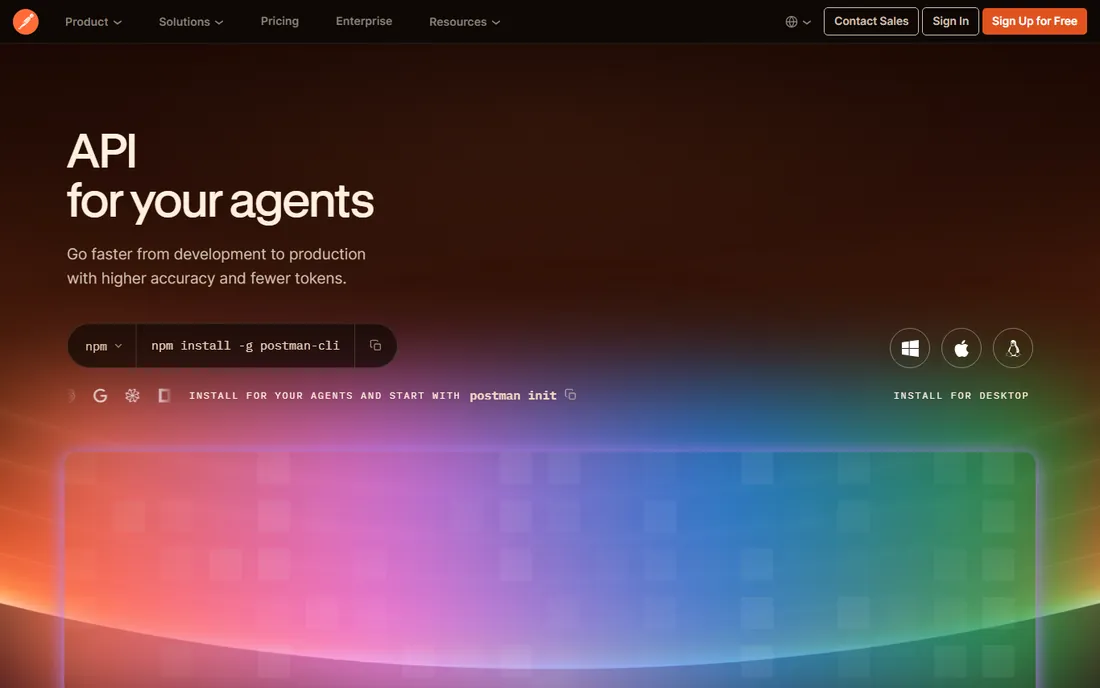
Postman remains the default choice because everyone already knows it and every CI system, gateway, and monitoring service plugs into it. For pure API design work, its Spec Hub lets you keep private and public specs next to your collections, and you can generate docs, mocks, and tests from the same source. The catch is the March 2026 pricing change: the free plan no longer supports teams at all. A two-person team now pays for two seats, and the per-seat cost climbs steeply at the Enterprise tier where SSO, governance, and audit controls live.
Postman makes sense when your API program needs the integrations more than it needs a tight budget. The workspace model suits organizations that already run dozens of APIs and want one pane of glass for design, testing, monitoring, and publishing. Solo developers get a very capable free client. Teams should price it against Apidog or Bruno before assuming Postman is the default, because the gap in cost for a five-person team is now hard to ignore.
What we like- Largest integration library and community
- Full lifecycle from design to monitoring
- Unlimited mock servers and collection runs on paid plans
Watch out for- Free plan shrank to one user, which prices out small teams
- The app keeps getting heavier with each release
#2
Apidog
Best for: Teams wanting design, test, mock and docs in one place
Visit apidog.com
Starting price$9 per user/month (billed annually)
Free planYes (up to 4 users)
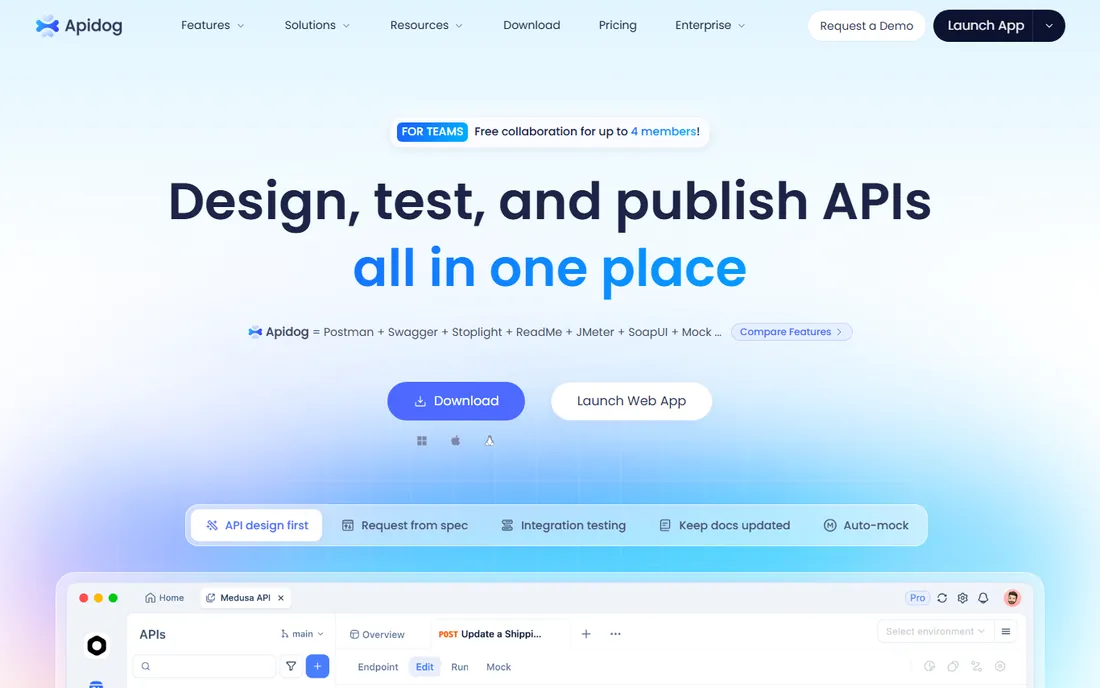
Apidog reads like a direct answer to Postman's 2026 pricing: the free tier covers four collaborating users with unlimited test runs and auto-generated docs, and paid seats start at $9 per user per month on annual billing. The design-first editor lets designers work visually while engineers drop into YAML, and both stay in sync with the same OpenAPI 3.1 source. Mock servers spin up with no configuration, which shortens the wait between spec approval and frontend integration.
Migration is deliberately easy: export any OpenAPI spec as JSON or YAML and import it, and endpoints, schemas, and parameters carry over. For teams, the interesting math is per-seat cost against SwaggerHub or Postman Team, where Apidog often comes in at half the price for comparable lifecycle coverage. The trade-off is lock-in. Your design, tests, mocks, and docs live in one proprietary workspace, so moving any one of them later means moving all of them. Teams comfortable with a single vendor will not mind; teams that insist on keeping specs in Git should look at Bruno instead.
What we like- Visual editor plus YAML for OpenAPI
- Zero-config cloud mock servers
- Full test orchestration without a second tool
Watch out for- Closed source, so you cannot self-host the full platform
- Younger company with a smaller community than Postman
Starting priceSee website
Free planYes (free for up to 3 users)
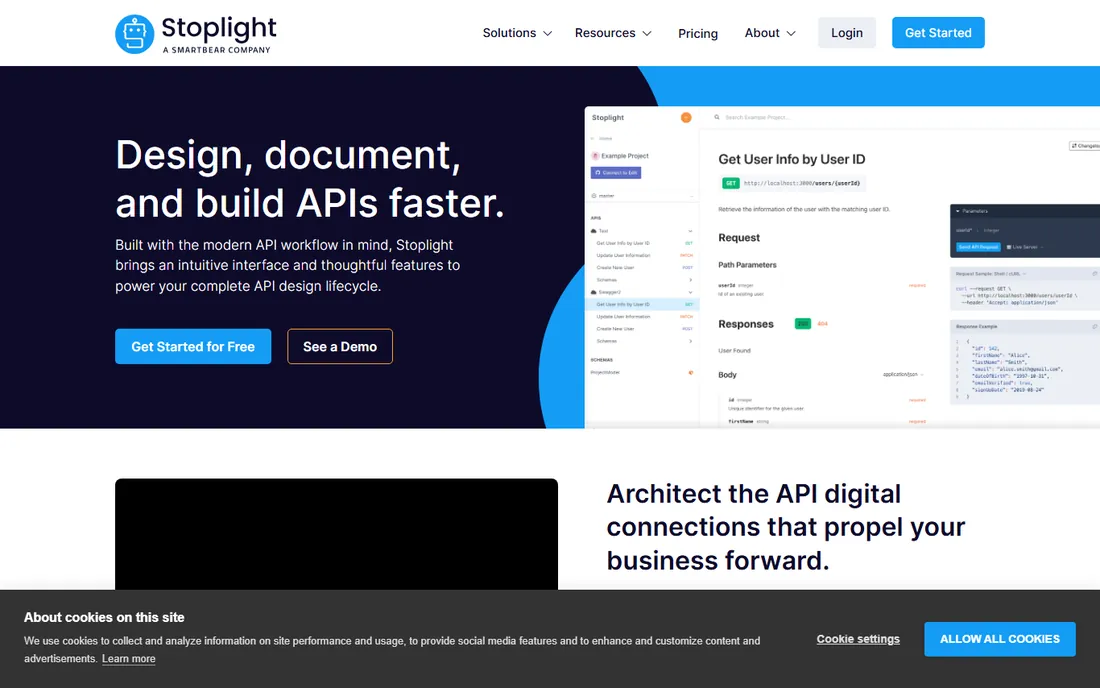
Stoplight built its name on doing one thing well: letting designers, PMs, and engineers shape an API contract together before anyone writes implementation code. The visual editor lowers the barrier for non-engineers, and governance features like spectral-based style guides enforce naming and structure rules across every spec in the organization. Prism, its HTTP mock server, generates realistic responses straight from the OpenAPI document.
The ownership story matters for buyers in 2026. SmartBear acquired Stoplight in 2023 and has been integrating it into the SmartBear API Hub, which includes SwaggerHub and PactFlow. That brings real advantages if you already use SmartBear testing tools, but it also means the standalone Stoplight packaging keeps changing. Before committing, confirm exactly which plan you are buying and what happens to your projects at renewal. For regulated teams that need design governance with an audit trail, Stoplight still has few equals; for everyone else, the price is harder to justify than it used to be.
What we like- Excellent visual OpenAPI editor
- Style guides and governance rules catch design drift early
- Prism mock server included
Watch out for- Product is being absorbed into SmartBear API Hub, so packaging and pricing keep shifting
- Paid tiers cost more than newer rivals
#4
SwaggerHub
Best for: OpenAPI standards work and large API portfolios
Visit swagger.io
Starting priceSee website
Free planYes
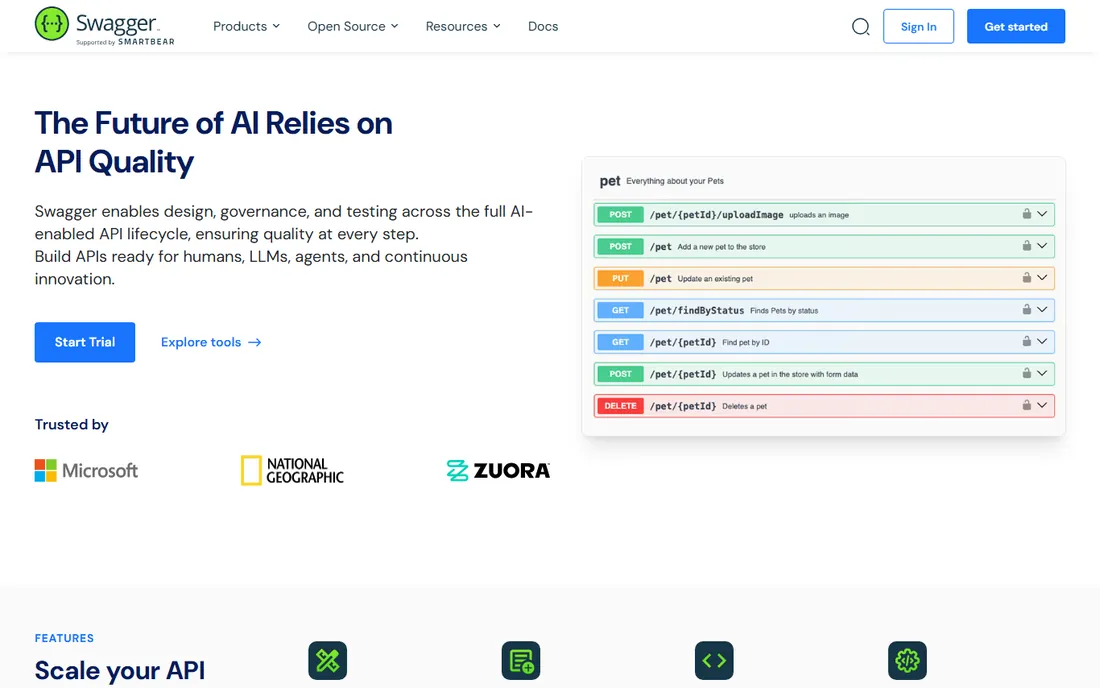
SwaggerHub is where the OpenAPI specification was born, and it shows in the tooling: strict spec validation, clean versioning, and collaboration workflows built around the contract rather than around requests. Enterprises that maintain hundreds of APIs use it as the system of record for their specs, with integrations into gateways and CI pipelines downstream. If your organization treats the OpenAPI document as the contract of record, SwaggerHub is the safest, most conservative choice.
The buying friction is real. Pricing is not published in a simple per-seat table, and the tiers that matter for teams sit well above Apidog or Bruno. The editor is YAML-first, which engineers tolerate and everyone else dreads, so design-first collaboration across roles is weaker than in Stoplight. Choose SwaggerHub when standards compliance, spec governance, and SmartBear ecosystem fit outweigh cost and modern UX. For a startup designing its first three APIs, it is almost always more tool than you need.
What we like- The reference implementation for OpenAPI design
- Strong versioning and collaboration on specs
- SmartBear ecosystem behind it
Watch out for- Pricing is opaque and sits at the premium end
- The editor experience feels dated next to Stoplight or Apidog
Starting priceSee website
Free planYes (free local Scratch Pad)
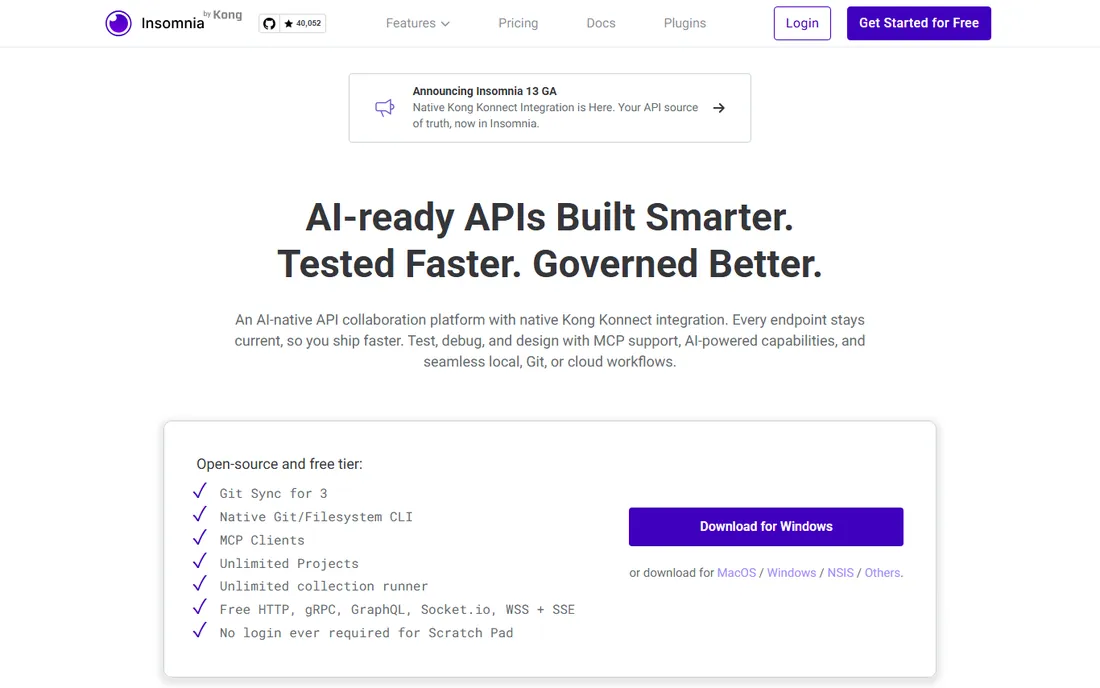
Insomnia started as the lighter alternative to Postman and keeps that identity even after the Kong acquisition. The desktop client is open source, fast to launch, and pleasant for day-to-day request work across REST, GraphQL, gRPC, and WebSockets. Its design mode lets you author and import OpenAPI specs, and Git sync gives teams a version-controlled workflow without a proprietary cloud database.
The free local Scratch Pad covers individual use without an account, which makes Insomnia an easy try. Paid plans are priced per user per month on annual billing and add the cloud collaboration, shared workspaces, and Kong gateway integration that teams need. That price undercuts Postman while keeping an open-source core, which is the pitch: pay for teamwork, keep the client free. The honest limitation is depth. Insomnia is a client with design features, not a design platform with governance, so teams that need style rules and review workflows will outgrow it.
What we like- Clean, fast interface
- Open-source client
- Git sync and Kong gateway ties for API teams
Watch out for- Full collaboration features sit behind the paid plan
- Design tooling is thinner than Stoplight or Apidog
Starting priceSee website
Free planYes (open-source edition)
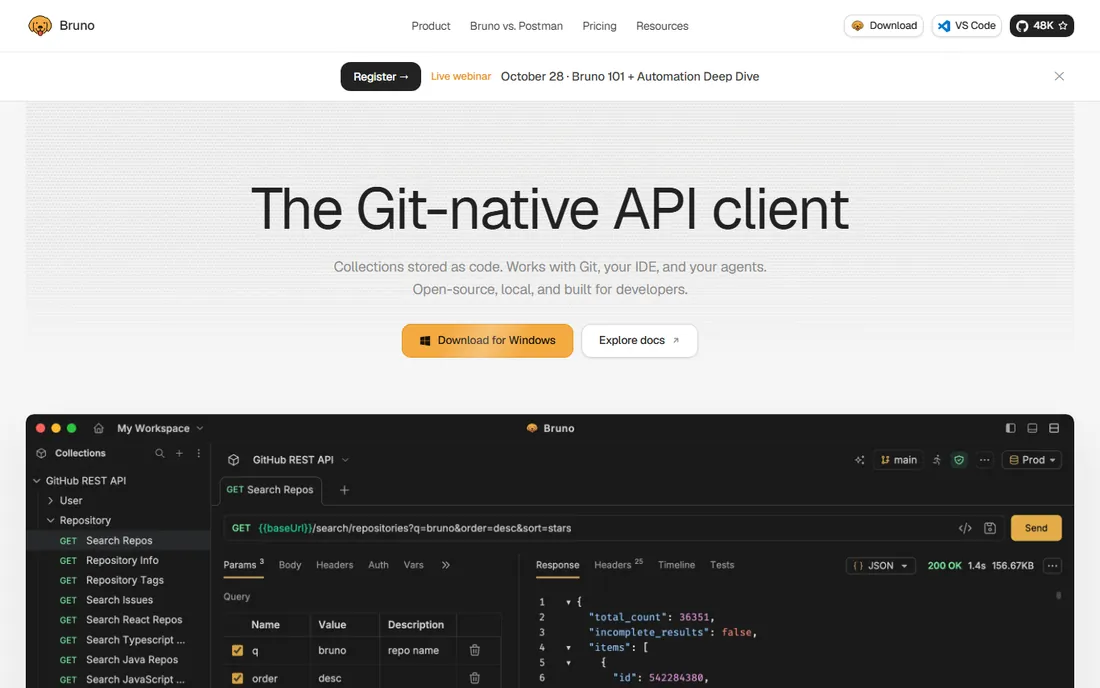
Bruno is the answer for developers who watched API clients turn into cloud platforms and wanted the opposite. Every collection lives as plain-text files in your repository, so branching, pull requests, and code review work exactly like the rest of your codebase. Nothing uploads to a vendor cloud unless you pay for the sync features, which makes security reviews short. The open-source edition is MIT licensed and genuinely complete for solo and small-team use.
Paid plans are priced per user per month on annual billing and add the Git UI, private repositories, and unlimited OpenAPI syncs, with an Ultimate tier for enterprise controls. Over 37,000 GitHub stars and 150,000-plus daily users give it real community momentum. The trade-off is that Bruno is deliberately not a platform. There is no hosted docs portal, no analytics, and no mock-server cloud, so teams that want the full lifecycle in one tab will pair it with something else or pick Apidog instead.
What we like- MIT-licensed and fully offline
- Collections stored as plain files that diff and merge
- No account required
Watch out for- Paid tiers needed for Git UI, private repos, and unlimited OpenAPI sync
- Smaller ecosystem than Postman
Starting priceSee website
Free planYes (self-hosted Community Edition)
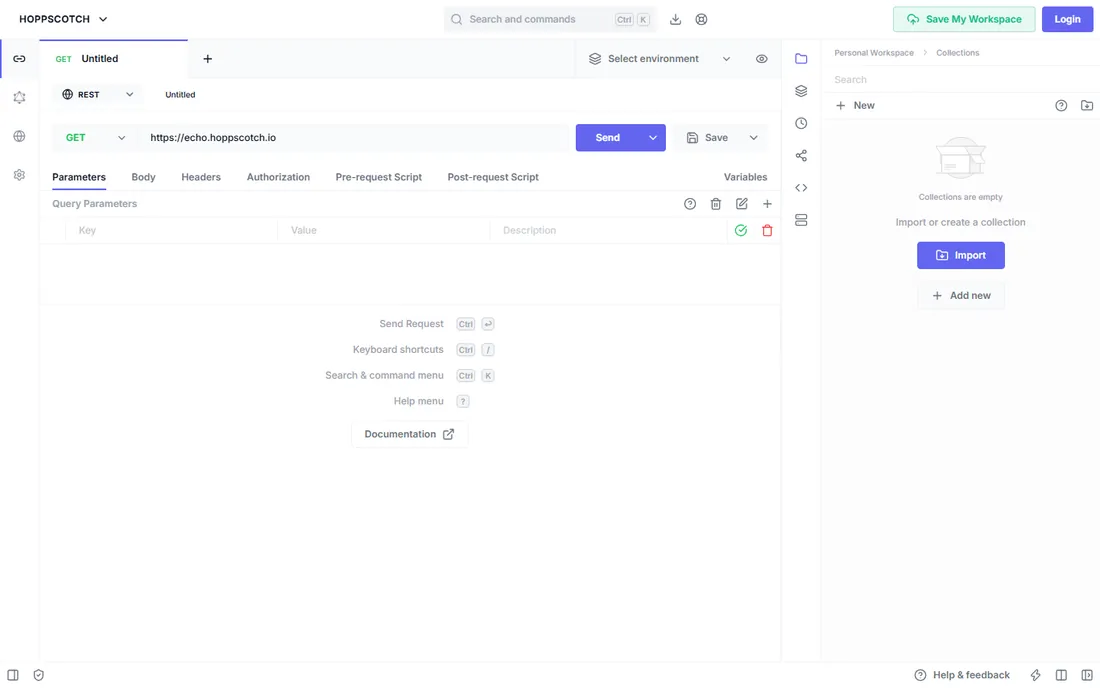
Hoppscotch is the fastest way to start poking at an API: open the site, send a request, share the result. The browser-first approach removes installation friction entirely, and the protocol support is unusually wide for a lightweight tool, covering REST, GraphQL, WebSockets, SSE, Socket.IO, and MQTT. Teams that need shared workspaces can self-host the Community Edition for free, which is the cheapest path to private team collaboration in this whole category.
Paid cloud plans are priced per user per month on annual billing and add managed workspaces, access controls, and SSO. The honest weakness is that Hoppscotch is a testing client with import features, not a design studio. It imports OpenAPI specs rather than authoring them beautifully, and there is no governance layer. Pick it when speed, browser access, and self-hosting matter more than design-first process; pair it with a docs tool like Scalar if your developers need more than request testing.
What we like- Runs in the browser with no install
- MIT-licensed and self-hostable
- Supports REST, GraphQL, WebSocket, MQTT and more
Watch out for- Cloud collaboration requires paid seats
- Design-first governance is minimal
Starting priceSee website
Free planYes (client and reference are open source)
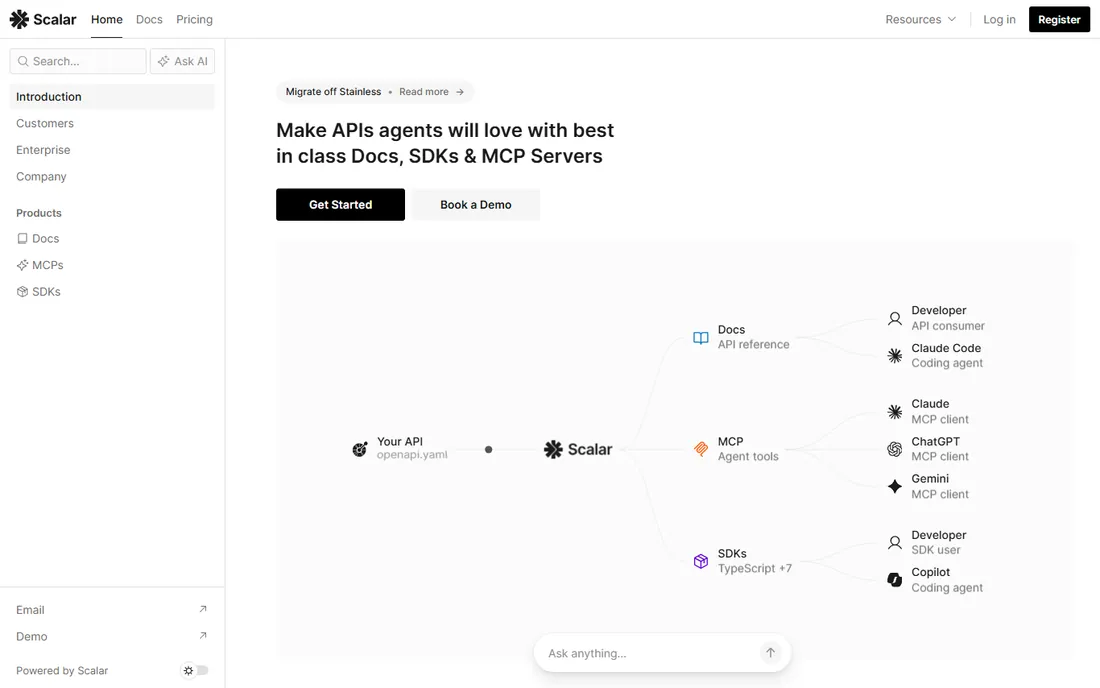
Scalar takes a different architectural bet: your OpenAPI document is the collection. There is no separate sync step because the spec itself is what you explore, test, and document against. The API client runs on desktop and in the browser, and the reference renderer produces genuinely beautiful three-panel documentation that has become a favorite for developer portals. Everything core is MIT licensed and free, with no account required.
Paid plans exist for hosted documentation, the registry, and team features, with the client free on every plan. That makes Scalar the cheapest way to get excellent docs and a solid client, and the open-source guarantee means your specs never get trapped. The catch is youth: the integration ecosystem is thinner than Postman's, and teams that want built-in testing orchestration or governance will need companion tools. For API-first companies that already live in OpenAPI, though, Scalar's model removes an entire class of sync headaches.
What we like- MIT-licensed client, reference, and mock server
- The OpenAPI document is the source of truth
- No account needed
Watch out for- Paid value sits in hosted docs and registry rather than the client
- Newer project with a thinner integration list
#9
ReadMe
Best for: Public APIs with a developer audience to grow
Visit readme.com
Starting priceSee website
Free planFree trial
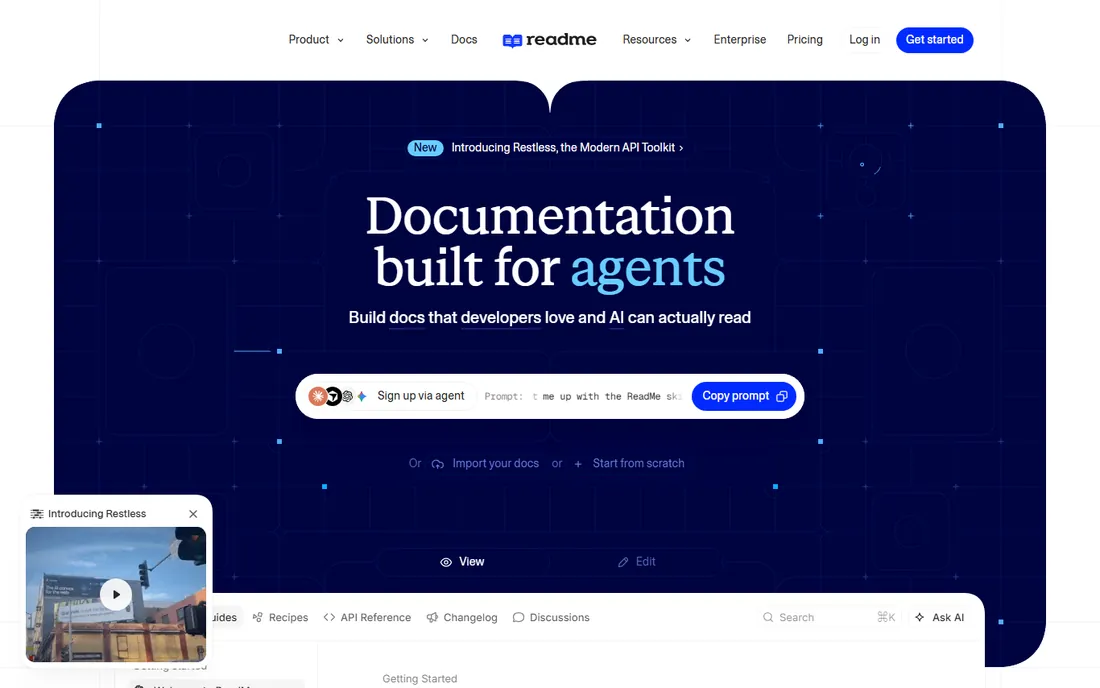
ReadMe is not really an API design tool; it is a documentation and developer-experience platform, and it earns its place here because the reference docs it produces are the best in the business. Interactive try-it consoles, guided recipes, changelogs, and a metrics dashboard that shows which endpoints developers actually call make it the choice for companies whose API is a product. If your goal is adoption rather than internal design process, ReadMe does more for you than any editor.
The price reflects that positioning. There is no free tier, only a trial, and the paid plans target companies with public APIs and revenue attached to them. Teams designing internal APIs should not pay ReadMe prices for a docs portal. But if your API has external developers, the analytics alone can justify the cost: you finally see which endpoints get adopted, which ones confuse people, and where to invest your design effort next.
What we like- Interactive documentation developers actually enjoy
- Built-in analytics show which endpoints get used
- Personalized hub pages
Watch out for- Premium pricing with no free tier
- Design features are thinner than dedicated design studios
How we chose
We compared pricing pages, product documentation, and public reviews on G2, Capterra, and Reddit threads from API developers, weighing feature depth for design-first workflows, OpenAPI support, collaboration models, integration breadth, and fit for company size from solo developers to enterprises. We did not run hands-on trials; this ranking reflects publicly documented capabilities and pricing as of October 2026.
How to pick without overpaying
Start with where your specs live. If the answer is Git and always will be, Bruno gives you the cleanest workflow and Hoppscotch self-hosted gives you browser access for free. If the answer is a vendor cloud, decide whether you need the full lifecycle or just great docs: Apidog covers the lifecycle at the lowest per-seat price, while Scalar plus your existing tooling covers docs beautifully for open-source budgets.
Match the tool to your team size
Solo developers can live happily on any of the free tiers here. The paid decision only bites at two to five people, which is exactly where Postman's 2026 pricing change hurts most. At that size, Apidog's free four-user tier or Bruno Pro usually wins on cost. Enterprises with governance, SSO, and audit requirements should shortlist Postman Enterprise, SwaggerHub, and Stoplight, and budget for the premium.
Check the lock-in before you commit
Ask three questions: can you export your specs as clean OpenAPI, can you leave without losing history, and does the vendor own the cloud your data sits in. Open-source tools like Bruno, Hoppscotch, and Scalar score perfectly here. Closed platforms score lower, so negotiate export guarantees and data-retention terms into any annual contract.
What design-first really means in 2026
Design-first stopped meaning "write YAML before code" years ago. In practice it means the contract gets reviewed like code: versioned, linted against style rules, mocked for frontend teams, and approved before implementation starts. Stoplight and SwaggerHub embody the governance-heavy version of this. Bruno and Scalar embody the Git-native version. Apidog tries to be both. The right choice depends on whether your bottleneck is cross-team review or developer velocity, and most teams overbuy governance they never use.
Frequently asked questions
Which API design tool is best for beginners?
Postman or Hoppscotch. Postman has the most tutorials and the largest community answering questions, while Hoppscotch needs no installation and lets a beginner send their first request in seconds. Both have free tiers, so the cost of trying is zero.
Is there a truly free API design tool for teams?
Yes, with caveats. Bruno's open-source edition is free for any team size if you keep collections in Git. Hoppscotch's self-hosted Community Edition is also free. Apidog's free tier covers up to four collaborators with no self-hosting required, which is the easiest free path for small teams.
What is the difference between Postman and SwaggerHub?
Postman is a full API lifecycle platform built around requests and collections, with design as one feature among many. SwaggerHub is built around the OpenAPI specification itself, with design, versioning, and governance as the core. Teams that think in collections choose Postman; teams that think in specs choose SwaggerHub.
Did Stoplight get acquired?
Yes. SmartBear acquired Stoplight in 2023 and has been integrating it into the SmartBear API Hub alongside SwaggerHub. The standalone product still exists, but buyers should confirm current packaging and pricing, since both have shifted during the integration.
Can I keep my API specs in Git with these tools?
Bruno is built for exactly this: collections are plain files in your repo. Hoppscotch and Insomnia both offer Git sync, and Scalar treats your OpenAPI document as the source of truth. Postman, Apidog, and SwaggerHub can export to Git but are cloud-first by design.
Which tool is cheapest for a five-person team?
Bruno Pro, priced per user per month on annual billing, or Apidog at $9 per user per month. Both undercut Postman's team pricing significantly. If your team can work from Git with no vendor cloud, Bruno's open-source edition costs nothing at all.
Sources we checked (5)
- https://apidog.com/blog/use-postman-free/
- https://apidog.com/blog/postman-free-vs-paid-comparison/
- https://github.com/scalar/scalar/blob/HEAD/documentation/alternatives/postman.md
- https://www.g2.com/products/postman/pricing
- https://slashdot.org/software/comparison/Apidog-vs-Stoplight/
Is your product missing or out of date?
We review this list regularly. Vendors can request a listing, send updated pricing or ask about featured placement.

Shihab Mia · Founder, Rankite
Shihab has spent more than a decade helping SaaS and e-commerce brands grow through search. He writes Rankite's software buying guides from pricing pages, documentation and public user reviews. More about Shihab.