How we make this list: we compare pricing pages, product documentation and public user reviews. Rankite is independent; if a vendor ever pays for a featured spot, that listing is clearly labeled Partner.
Key takeaways
- Shopify stores spending on paid ads should start with Triple Whale or Polar Analytics; both tie ad spend to real profit, not just ROAS.
- Google Analytics 4 remains the free baseline every store should run, but its sampling and learning curve push growing brands toward a dedicated ecommerce tool.
- If your problem is data accuracy across ad platforms, Littledata fixes the tracking layer; if your problem is understanding behavior, Mixpanel or Amplitude fits better.
- Pricing scales with GMV or order volume on most dedicated tools, so budget for growth rather than comparing entry prices alone.
Quick comparison
| Tool | Best for | Starting price | Free plan |
|---|
 Triple Whale Triple Whale | Shopify DTC brands that need attribution tied to profit | See website | Yes (limited Founders Dash) |
 Littledata Littledata | Stores whose GA and ad tracking cannot be trusted | See website | Free trial |
 Polar Analytics Polar Analytics | Larger DTC brands that outgrew single-app analytics | See website | No |
 Glew Glew | Multichannel retailers drowning in disconnected platforms | See website | No |
 Google Analytics 4 Google Analytics 4 | Every store as the free baseline | Free | Yes |
 Mixpanel Mixpanel | Teams obsessed with funnel and behavioral detail | See website | Yes |
 Klaviyo Klaviyo | Brands where email and SMS drive real revenue | See website | Yes |
 Amplitude Amplitude | Larger stores doing product analytics at scale | See website | Yes |
Is your product missing or out of date?
We review this list regularly. Vendors can request a listing, send updated pricing or ask about featured placement.
Your ad platforms each claim credit for the same sale. Your finance team defines profit differently from your media buyer. Somewhere between Meta Ads Manager, Shopify reports and a spreadsheet, the truth about your margins hides. Ecommerce analytics tools exist to end that argument: one place where spend, revenue, costs and customer behavior reconcile. Eight worth comparing, from free baselines to warehouse-grade BI.
Starting priceSee website
Free planYes (limited Founders Dash)
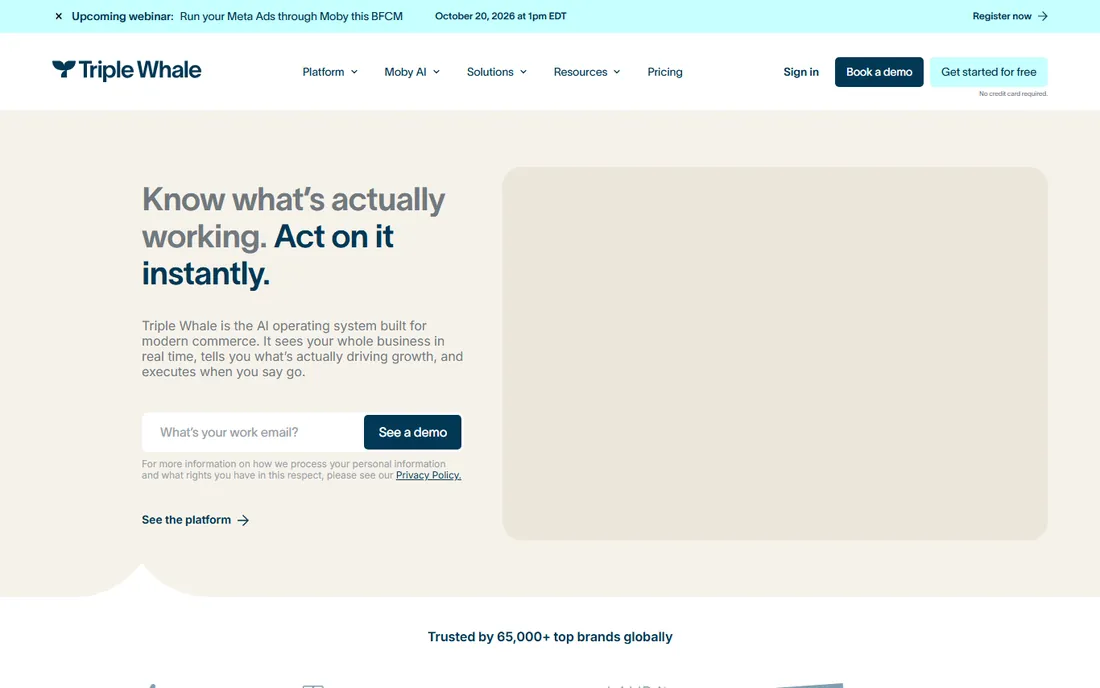
Triple Whale built its reputation inside the Shopify ecosystem, and it shows: setup is genuinely fast for Shopify stores because orders, product costs and ad spend flow in natively. The platform's real value is the profit layer. Where most tools stop at telling you a campaign generated revenue, Triple Whale subtracts ad spend, shipping, product costs and returns to show actual profit per channel, per campaign and per creative. That distinction matters enormously when a campaign looks profitable on ROAS and loses money after fulfillment.
The honest catch is scope and cost. Non-Shopify stores should look elsewhere, and the GMV-based pricing means your bill grows with your success. Some reviewers also note attribution numbers drifting from what ad platforms report, so validate the math against your own figures early. For Shopify brands spending real money on paid social, it remains the default shortlist pick.
What we like- First-party Triple Pixel captures purchase data ad-blockers miss
- Profit dashboards factor in COGS, shipping and returns, not just ROAS
- Moby AI surfaces budget and creative recommendations
Watch out for- Deeply Shopify-centric, a weak fit for WooCommerce or BigCommerce
- Pricing scales with GMV and climbs fast for high-revenue brands
Starting priceSee website
Free planFree trial
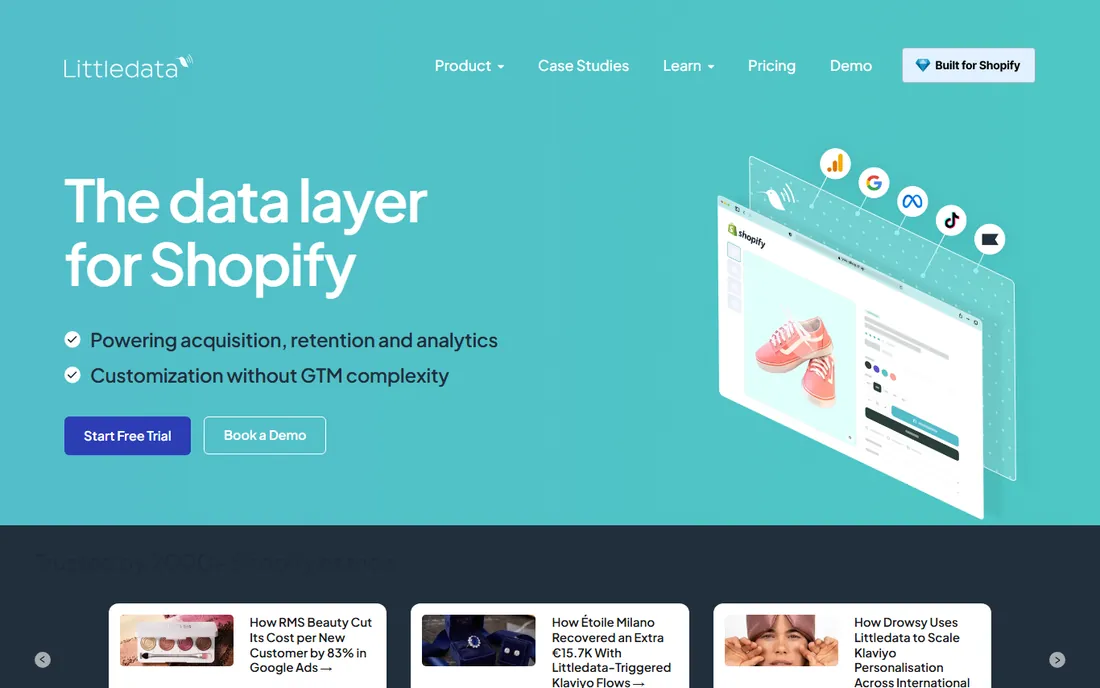
Littledata solves the problem upstream of every dashboard: bad data in. Ad blockers, iOS privacy changes and sloppy tag setups mean the numbers in GA4 and Meta often disagree with reality, and no visualization tool fixes that. Littledata rebuilds the tracking layer with server-side events, then keeps it audited so drift gets caught. If your team argues about which numbers to believe, this is usually the missing piece.
The trade-off is that Littledata does not replace your analytics tool; it feeds it. You buy Littledata plus GA4 or a BI tool, not instead of one. Stores with clean tracking already in place will see less value. But for brands whose attribution arguments start with "these numbers are wrong," fixing the pipeline beats buying another dashboard.
What we like- Server-side tracking fixes the data accuracy problem at the source
- Automatic audit flags broken events and mismatches
- Deep Shopify and Google Analytics integration
Watch out for- It is a data pipeline, not a dashboard, so you still need somewhere to look at the numbers
- Setup value depends on how broken your current tracking is
Starting priceSee website
Free planNo
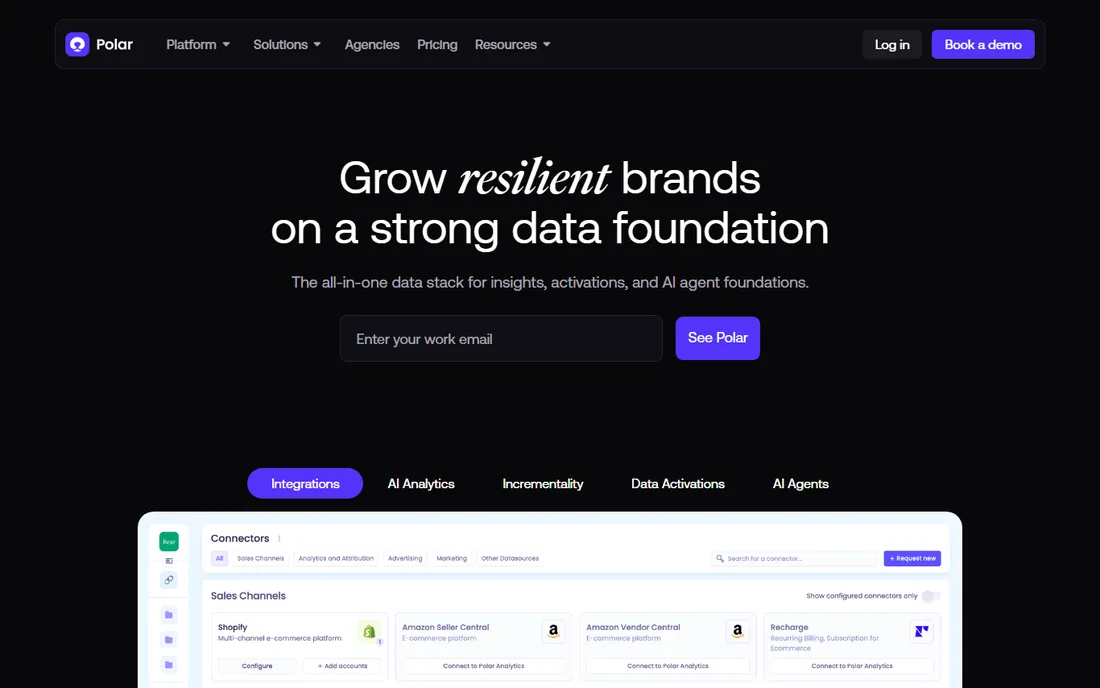
Polar Analytics is what brands graduate to when a simple dashboard stops answering their questions. It combines business intelligence with managed data infrastructure: your Shopify, ad, email and finance data land in a warehouse-backed model with consistent definitions, so marketing and finance finally argue from the same numbers. Reviewers point to the acquisition-cost and ROAS views as the reason they can adjust budgets weekly instead of waiting on manual reporting.
The cost is real, both in money and onboarding effort. This is not a plug-and-play app; expect a proper implementation. Smaller brands will find Triple Whale or even native reports sufficient. But for eight-figure brands where a misattributed million in spend actually matters, the governed-data approach pays for itself.
What we like- Warehouse-backed architecture unifies many sources into one governed view
- Acquisition-cost and ROAS dashboards built for weekly budget decisions
- Managed data infrastructure reduces engineering burden
Watch out for- Higher price and setup cost than app-store analytics tools
- Some users report slower support on custom data connections
#4
Glew
Best for: Multichannel retailers drowning in disconnected platforms
Visit glew.io
Starting priceSee website
Free planNo
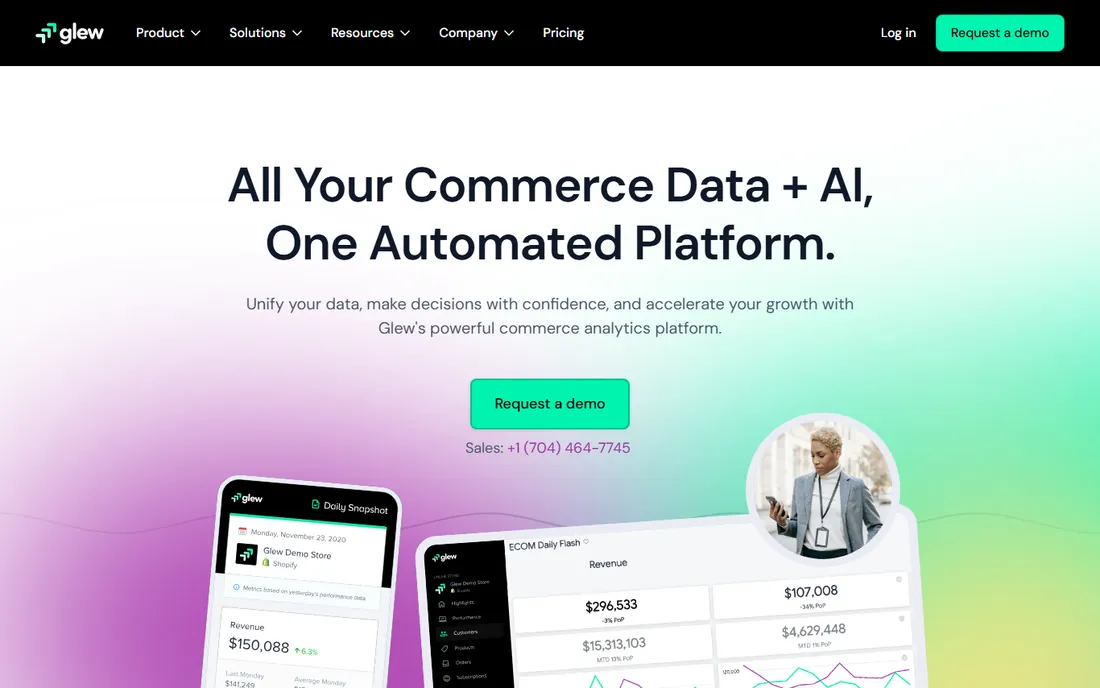
Glew's pitch is breadth: if you sell on Shopify, Amazon, eBay and your own site while running email, ads and a loyalty program, Glew pulls it into one reporting layer. The connector library is the product's core asset, and for multichannel retailers it replaces a small army of CSV exports. Product, customer and marketing analytics sit side by side, so you can see which products your best customers actually buy and which channels brought them.
The pricing opacity is the friction. Custom quotes mean a sales process before you can budget, and smaller single-channel stores will not need 170 connectors. Glew also reports on your data rather than cleaning it; pair it with solid tracking or the numbers inherit your mess. For multichannel operators, though, few tools match the coverage.
What we like- More than 170 native ecommerce connectors in one BI layer
- Covers sales, customers, products, marketing and profitability
- Built specifically for multichannel commerce reporting
Watch out for- Custom pricing with no self-serve transparency
- Reporting-first, so it will not fix bad source data by itself
Starting priceFree
Free planYes
GA4 is the default starting point for ecommerce tracking, and the price (free) makes it mandatory rather than optional. The event-based model tracks add_to_cart, begin_checkout, purchase and refund as discrete data points with rich parameters, which is exactly the granularity you need to find where carts die. The ML layer adds anomaly detection and predictive audiences that once required a data team.
The honest complaints are the interface and sampling. Building custom ecommerce reports still takes real effort, and high-traffic stores hit sampling in explorations that can skew results. GA4 is the foundation, not the finished house: run it always, and add a dedicated ecommerce tool when the questions get harder than its interface comfortably answers.
What we like- Completely free with deep ecommerce event tracking
- Machine-learning insights surface anomalies and churn predictions
- Cross-device journey stitching from mobile browse to desktop purchase
Watch out for- Steep learning curve after the Universal Analytics redesign
- Samples data on high-traffic properties, with unsampled Analytics 360 priced for enterprises
Starting priceSee website
Free planYes
Mixpanel answers the questions GA4 makes painful: where exactly does the checkout funnel break, which behaviors predict repeat purchase, which cohorts actually retain. Its event model is made for product and growth teams who think in user journeys rather than pageviews. Cart-level behavioral analysis (what did buyers do right before purchasing) is where it earns its keep for ecommerce.
It is not an attribution or profit tool out of the box. You will build those views yourself or pipe Mixpanel data into a warehouse. Event-volume pricing also means your bill tracks your traffic, so model it at scale, not at trial size. For behavior-led growth teams, it is one of the sharpest instruments available.
What we like- Event-based analytics built for funnel, cohort and retention analysis
- Generous free tier for getting started
- Real-time data without the sampling games
Watch out for- Ecommerce-specific profit and attribution views need custom work
- Pricing climbs with event volume as you scale
Starting priceSee website
Free planYes
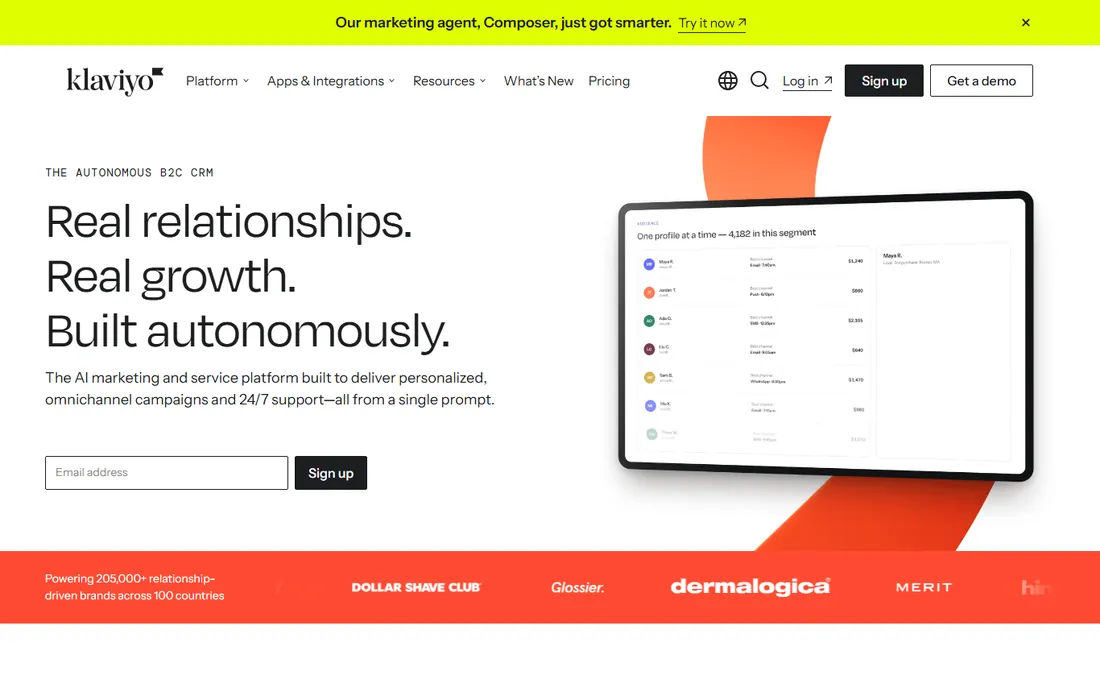
Klaviyo is a marketing platform first, but its analytics deserve a place here because for many DTC brands, email and SMS are the highest-margin channels. Its revenue attribution shows exactly what each flow and campaign earned, and the predictive models (expected CLV, churn risk) turn segments into revenue forecasts. The analytics live inside the tool that sends the messages, so insight-to-action has no handoff.
The boundary is channel scope. Klaviyo will not tell you about paid social profitability or site-wide behavior; it tells you about owned-channel revenue with unusual precision. Brands doing under six figures may find the free tier sufficient; larger lists pay real money. If email is 30 percent of your revenue, Klaviyo's analytics are not optional.
What we like- Revenue attribution ties every flow and campaign to dollars
- Predictive CLV and churn scoring built into segments
- Analytics live where the marketing happens, not in a separate tool
Watch out for- Analytics depth outside email and SMS is limited
- Costs scale with contact count, which punishes list growth
Starting priceSee website
Free planYes
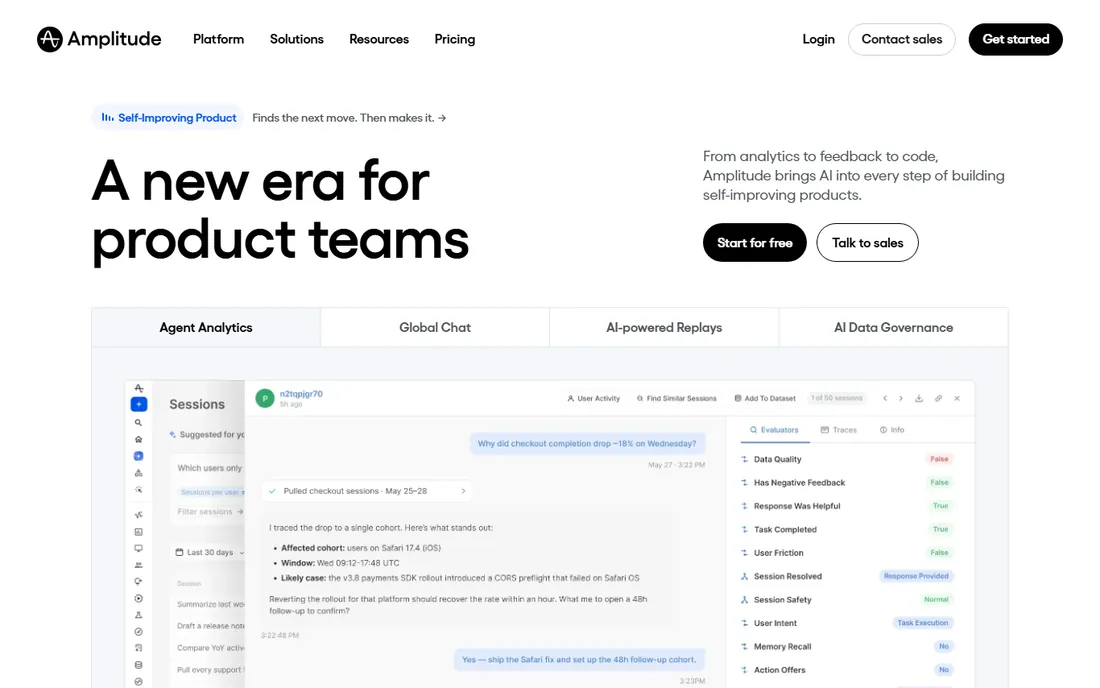
Amplitude is the heavyweight product-analytics option. Journey maps, behavioral cohorts and built-in experimentation let growth teams test hypotheses about the shopping experience with statistical rigor. For larger ecommerce operations with dedicated analysts, it handles the scale and complexity that simpler tools choke on, and the free tier is genuinely useful for evaluation.
The complexity is the price of admission. Amplitude assumes you have people who think in events and funnels; small teams without analysts will drown in it. And like Mixpanel, it is behavior-first: profit and ad attribution are things you build, not things it ships. Choose it when your bottleneck is understanding customer behavior, not when it is reconciling ad spend.
What we like- Best-in-class journey mapping, cohorts and experimentation
- Generous free tier for evaluation
- Scales to massive event volumes without breaking
Watch out for- Enterprise-grade power with enterprise-grade complexity
- Ecommerce attribution needs configuration rather than working out of the box
How we chose
We compared tools that ecommerce operators actually buy in 2026: DTC attribution platforms, tracking-accuracy pipelines, multichannel BI, behavioral analytics and the free baseline everything sits on. We weighed Shopify fit, connector breadth, pricing model transparency, free-tier usefulness and how each tool handles the profit question (not just revenue). Pricing comes from each vendor's own pricing page; where plans were not verifiable we used "See website." No hands-on testing was performed for this guide.
What to look for before you buy
Start with your actual question. If ad platforms disagree about credit, you need attribution (Triple Whale, Polar). If the numbers themselves are wrong, you need tracking accuracy (Littledata). If you cannot see behavior, you need product analytics (Mixpanel, Amplitude). Buying the wrong category is the most expensive mistake in this space.
Check the pricing model against your growth, not your current size. GMV-based, event-based and contact-based pricing all mean the bill rises with success. Ask each vendor what you pay at twice your current revenue and get it in writing.
Confirm platform fit before the demo. Shopify-native tools underdeliver on WooCommerce and BigCommerce; multichannel tools are overkill for a single store. The best tool is the one built for your stack.
Finally, insist on a data-accuracy conversation. Ask how the tool handles ad blockers, iOS privacy opt-outs and refunds. If the salesperson cannot explain it clearly, the product probably cannot handle it cleanly either.
Frequently asked questions
Do I still need Google Analytics if I buy Triple Whale?
Yes. GA4 is free and remains the baseline for traffic, content and SEO analysis. Dedicated tools add profit and attribution depth; they do not replace GA4's breadth.
What is the difference between attribution and analytics?
Analytics describes what happened (traffic, conversions, revenue). Attribution assigns credit for it across channels and campaigns. Ecommerce brands need both, which is why tools like Triple Whale bundle them.
How much should an ecommerce analytics tool cost?
Anywhere from free (GA4) to a few hundred dollars a month for DTC platforms, scaling with GMV, events or contacts. Enterprise BI and warehouse-backed tools run higher. Budget for your revenue in 12 months, not today.
Can these tools track profit, not just revenue?
The DTC-focused ones can. Triple Whale, Polar Analytics and Glew factor in ad spend, COGS, shipping and returns. Behavioral tools like Mixpanel and Amplitude generally do not; they track behavior, not margins.
Will these work with WooCommerce or BigCommerce?
Some will, some will not. Triple Whale is Shopify-first. Littledata, Glew, Mixpanel, Amplitude and GA4 all support other platforms. Confirm your exact stack on the sales call.
How do I know my tracking data is accurate?
Compare purchase counts in your analytics against your actual order records for the same period. Persistent gaps usually mean ad blockers or broken tags; that is the problem Littledata-style server-side tracking exists to fix.
Sources we checked (10)
- https://www.triplewhale.com
- https://www.littledata.io
- https://www.polaranalytics.com
- https://www.glew.io
- https://analytics.google.com
- https://www.mixpanel.com
- https://www.klaviyo.com
- https://www.amplitude.com
- https://www.omniconvert.com/blog/best-lifetimely-alternatives/
- https://albato.com/blog/publications/best-ecommerce-analytics-tools-track-sales-every-channel
Is your product missing or out of date?
We review this list regularly. Vendors can request a listing, send updated pricing or ask about featured placement.

Shihab Mia · Founder, Rankite
Shihab has spent more than a decade helping SaaS and e-commerce brands grow through search. He writes Rankite's software buying guides from pricing pages, documentation and public user reviews. More about Shihab.