How we make this list: we compare pricing pages, product documentation and public user reviews. Ratings come from G2, Capterra or Trustpilot, with the date we checked them.
Key takeaways
- Serval Mesh itself has stalled, so the practical move is to pick a live project with the same goal: messages that hop phone to phone without cell towers.
- Briar is the closest phone-only match, while Meshtastic wins on range but needs a LoRa radio in your pocket.
- Bridgefy is the easiest to hand to a crowd, yet it is closed source, so you cannot inspect what it does with your data.
- Every tool here trades range, speed, or ease of use, and none of them replaces a normal phone plan for everyday calls.
Quick comparison
| Tool | Best for | Starting price | Free plan |
|---|
 Briar | Private phone-only mesh messaging | Free | Yes |
 Meshtastic | Long-range off-grid text | Free | Yes |
 Bridgefy | Crowd alerts at events | Free | Yes |
 Berty | Open source peer-to-peer chat | Free | Yes |
 goTenna | Phone paired with a radio | See website | No |
 Reticulum | Builders of custom mesh networks | Free | Yes |
 Delta Chat | Chat over email when some link works | Free | Yes |
 Jami | Server-free calls and chat on local networks | Free | Yes |
Is your product missing or out of date?
We review this list regularly. Vendors can request a listing, send updated pricing or ask about featured placement.
The best Serval alternatives
Starting priceFree
Free planYes
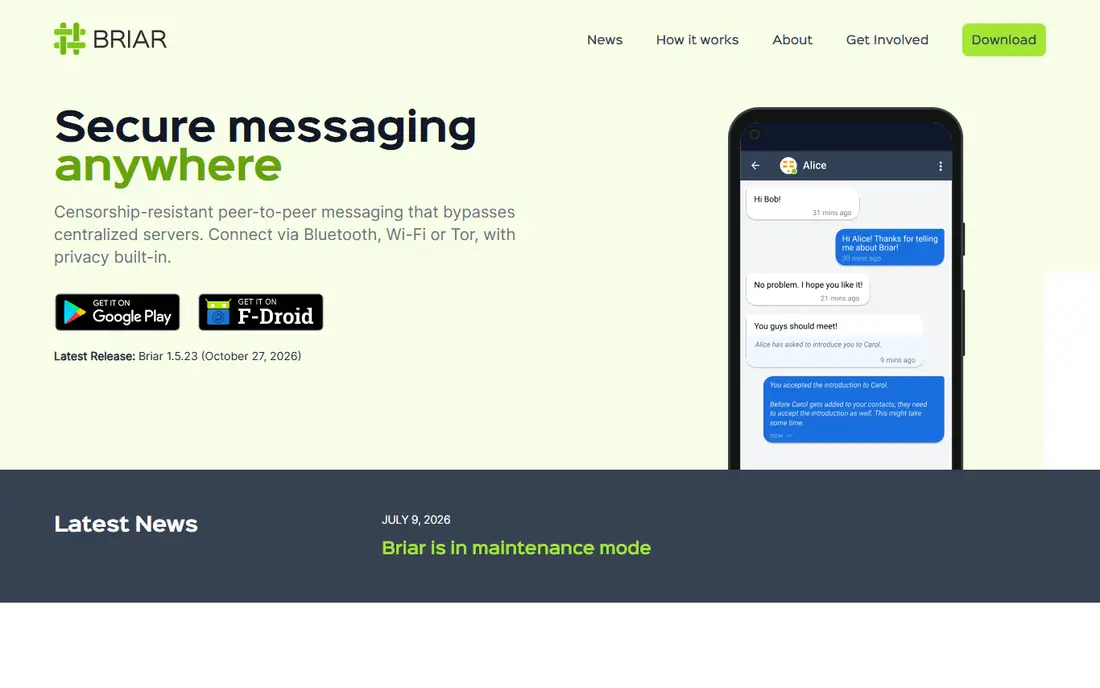
Briar is the tool most people mean when they ask for a Serval replacement. It was built for activists and journalists who need messages to move without a carrier, and it does that job with no account, no phone number, and no central server to seize or shut down. You add contacts by meeting in person or by sharing a link through another channel, then messages wait on your phone and hop across when two devices come into range.
The catch is reach. Each hop covers tens of meters, so Briar works best in a crowd, a building, or a camp where people pass each other often. In a thinly spread area with few users, messages sit unsent. Briar also runs on Android only, which rules out mixed phone groups. For a small team that meets face to face and wants strong privacy on phones they already own, it is still the simplest honest choice.
What we like- No servers in the middle
- Messages sync over Bluetooth or Wi-Fi
- Tor support when internet returns
Watch out for- Android only
- No sync across your own devices
- Lose the phone and you lose the history
Starting priceFree
Free planYes
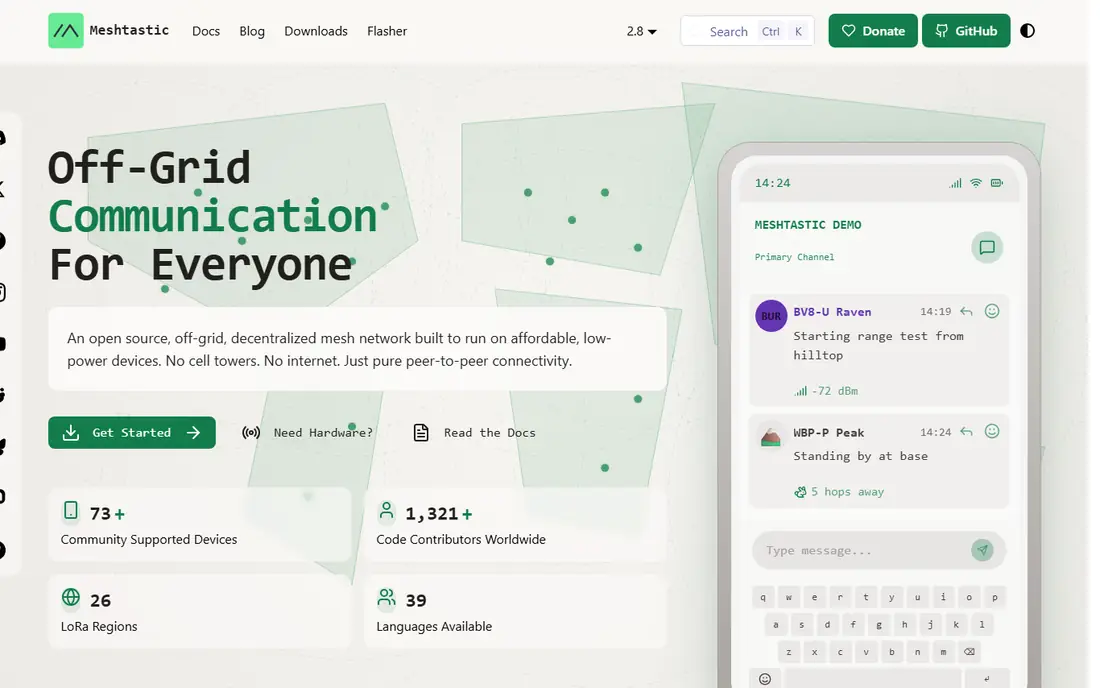
Meshtastic changes the range problem by moving the radio off the phone. A small LoRa board pairs with your phone over Bluetooth, and messages hop from board to board across open ground. A few well-placed nodes can cover a valley, a farm, or a festival site, and a node on a roof with a solar panel can relay while every phone is asleep.
The trade is hardware and speed. You need a compatible board, you need to flash firmware, and you need to pick the right radio region for your country. Messages are short text at roughly a few hundred bytes per second, so photos and voice are out. For rural teams, search groups, and prepared neighborhoods, that trade is worth it. For a casual user who will not buy extra gear, it is a nonstarter.
What we like- LoRa hops can span kilometers
- Nodes can relay day and night on solar
- Fully open source
Watch out for- You must buy and carry a radio board
- Text only, very slow
- Setup takes some patience
Starting priceFree
Free planYes
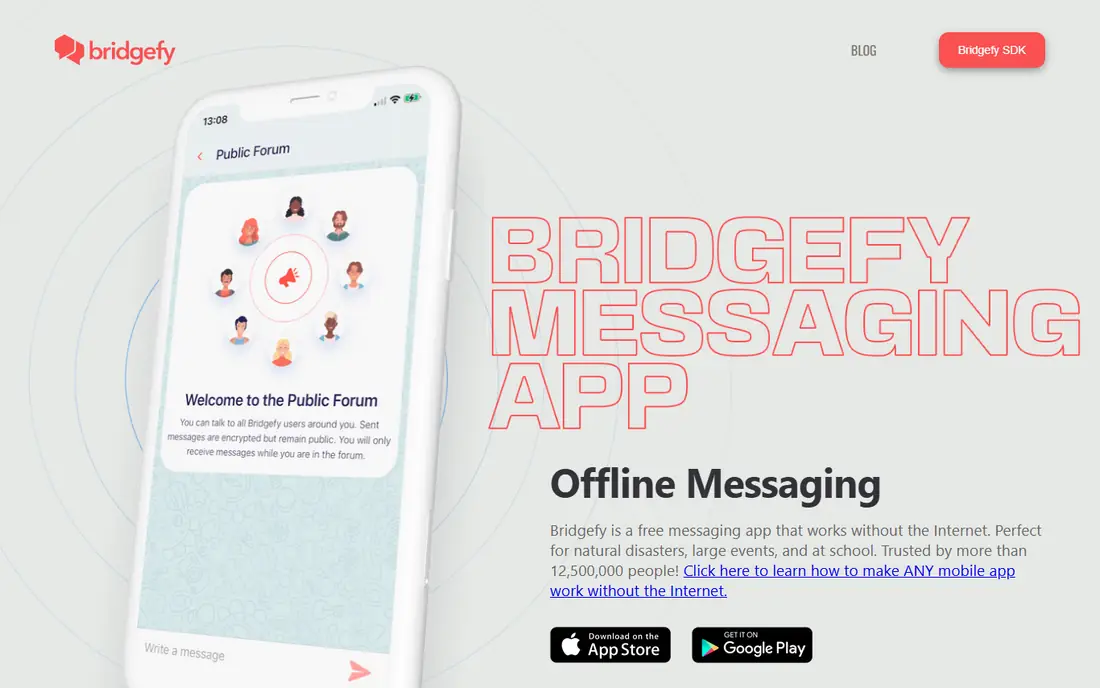
Bridgefy is the crowd-friendly option. Anyone can install it, turn on mesh mode, and send a message that hops across nearby phones over Bluetooth. Its broadcast mode is made for one message to many people at once, which suits event staff, protest marshals, and festival crews who need a fast alert without cell service.
The honest limit is trust. Bridgefy is closed source, so independent reviewers cannot check how it handles keys, metadata, or message storage. It also depends on density: a lone user in an empty area has nobody to hop through. Use it for public alerts and coordination, and keep sensitive one-to-one talk on an open source tool like Briar.
What we like- Very easy to install and use
- Broadcast mode reaches a crowd fast
- Proven at large gatherings
Watch out for- Closed source
- Mesh only works where other Bridgefy users are nearby
- Privacy claims cannot be audited
Starting priceFree
Free planYes
Berty is an open source messenger built on peer-to-peer networking, with no central server holding your contacts or messages. It finds peers directly and can pass messages over Bluetooth or a local network, which makes it a natural fit for groups that want Serval-style independence with a modern chat interface.
Berty is still maturing. Parts of the experience, such as relaying across several hops, work only in part, and some features fall back to internet links when they are present. The user base is small, so finding contacts takes effort. It suits open source fans who value inspectable code over polish, and who are willing to grow with the project.
What we like- Fully open source
- Peer-to-peer design with no central directory
- Works over Bluetooth and local Wi-Fi
Watch out for- Some features still need internet
- Smaller user base
- Multi-hop relay is partial
Starting priceSee website
Free planNo
goTenna pairs your phone with a small radio that sends texts and locations off-grid, with mapping in the app for field work. It is the closest thing to a finished product in this list: buy the device, pair it, and send messages without flashing firmware or joining a hobbyist forum.
The catch is cost and availability. You pay for hardware, and goTenna has shifted its focus across consumer and professional lines, so the exact model on sale today may differ from older guides. Confirm the current product and price on the vendor site before you plan around it. For a team with a budget that wants off-grid text without do-it-yourself radio work, it remains worth a look.
What we like- Purpose-built hardware with mapping
- Simple app pairing
- Made for field teams
Watch out for- Hardware purchase required
- Consumer mesh line has changed over time
- Check current availability before buying
Starting priceFree
Free planYes
Reticulum is not a chat app you hand to a friend. It is an open source networking stack that carries encrypted traffic over almost any link, from LoRa radios to packet radio to plain internet connections. Developers and radio clubs use it to build their own mesh systems, and a small set of apps already runs on top of it.
If you can read docs and run a node, Reticulum gives you more control than any finished app here. You choose the radios, the routes, and the rules. If you want to install one app and start chatting, look at Briar or Meshtastic instead. Reticulum belongs on the list because Serval itself was a platform as much as an app, and this is where that spirit now lives.
What we like- Open source and transport agnostic
- Runs over radio, packet radio, or the internet
- Strong cryptography
Watch out for- A toolkit, not a finished chat app
- Needs technical skill
- Setup is hands-on
Starting priceFree
Free planYes
Delta Chat looks like a chat app but runs on email. That sounds odd until the internet is half broken: in many shutdowns and outages, some email path survives even when social apps do not. With a chatmail account you get a fresh address in seconds, and contacts can reach you by scanning a code.
Delta Chat is not a mesh tool in the strict sense. It does not hop phone to phone over Bluetooth, and it cannot move a message with zero infrastructure. Include it as a fallback layer: when a sliver of connectivity exists, it keeps conversations going with tools everyone already understands. Pair it with Briar for the fully offline case.
What we like- Uses ordinary email, so it works wherever email gets through
- Encrypted chats
- No new account needed with chatmail
Watch out for- Not a true mesh
- Needs some email path to function
- Group chats depend on mail delivery
#8
Jami
Best for: Server-free calls and chat on local networks
Visit jami.net
Starting priceFree
Free planYes
Jami is a peer-to-peer communication app with no central server at all. Two devices can call, video chat, and message directly once they can reach each other, including over a local network with no internet beyond it. It runs on Android, iOS, and desktop systems, which makes it useful for mixed-device groups.
Jami does not create a multi-hop mesh by itself, so it fits best as the local-network layer of an off-grid kit: a building, a camp, or a vehicle convoy with its own Wi-Fi. Its strength is that the same app also works as a normal internet caller when service returns, so the group does not need two tools. Set expectations on call quality, since a weak local link shows up fast on voice and video.
What we like- Peer-to-peer audio, video, and chat
- No central server
- Runs on phones and desktops
Watch out for- Needs a network link between peers
- Call quality varies with the link
- Contact discovery takes setup
How we chose
We started from what Serval Mesh was: free, open source software that let phones pass messages without carriers or towers, built by a university research team. Since that project has stalled, we judged each alternative on whether it still works today, whether it moves messages with no central server, and whether a real group could run it without specialist help. We checked vendor sites, project docs, and public comparisons for range, platform support, and current status, and we left out tools that are dead, that only work with a paid central service, or that need a product category unrelated to mesh messaging.
Start with the distance problem, not the app store rating. If your group stays within one building or crowd, a phone-only tool like Briar or Bridgefy is enough. If you need kilometers, budget for LoRa hardware and pick Meshtastic, or buy purpose-built radios from goTenna. If your group is technical and wants to build its own network, Reticulum is the platform to study.
Match the tool to the group
A tool only works if everyone in the group can run it. Check phone platforms first: Briar is Android only, while Jami and Delta Chat cover more systems. Then check the density question. Mesh tools need neighbors, so a small team spread across a city will get more from Delta Chat over a surviving email path than from a Bluetooth mesh with nobody nearby.
Test before you depend on it
Run a drill with the exact phones, radios, and places you will use. Send messages across the real distance, with the real obstacles, and time how long delivery takes. Confirm battery life, since Bluetooth and LoRa radios drain phones, and agree on a fallback: a meeting point, a schedule for check-ins, and a second channel. An off-grid plan that has never been tested is a guess, not a plan.
Frequently asked questions
Is Serval Mesh still maintained?
Serval Mesh came from a university research project, and public comparisons now list it as stalled. The apps on its old download pages are out of date, and the community has moved to the projects in this guide. Treat Serval as a reference design, not a tool to deploy today.
Do these tools work with no cell service at all?
Briar, Meshtastic, Bridgefy, Berty, and goTenna can move messages with no carrier, as long as devices are within radio range of each other or of relay nodes. Delta Chat and Jami need some network path between peers, even if it is only a local Wi-Fi network. None of them can reach a phone that is out of range and offline.
Which option is best for a beginner?
Bridgefy is the easiest install, and Meshtastic is the easiest long-range option if you accept buying a radio board. Briar is the best phone-only pick for privacy, but its Android-only limit and contact setup take more effort. Start with the tool your whole group can install in one sitting.
Can I send photos or make calls off-grid?
Short text is the reliable off-grid payload. Photos crawl over LoRa and may fail, while voice needs a direct link of decent quality, which Jami can provide on a local network. Plan your off-grid messages as text first, and treat media as a bonus when a link proves fast enough.
Are mesh messages private?
Open source tools like Briar, Meshtastic, Berty, and Reticulum use encryption and let reviewers inspect the code, which is the strongest basis for trust. Closed source tools cannot offer that check, no matter what their marketing says. Even with encryption, metadata such as who is nearby and when they transmit can leak, so keep highly sensitive talk face to face.
Sources we checked (8)
- https://briarproject.org
- https://meshtastic.org
- https://bridgefy.me
- https://berty.tech
- https://gotenna.com
- https://reticulum.network
- https://delta.chat
- https://jami.net
Is your product missing or out of date?
We review this list regularly. Vendors can request a listing, send updated pricing or ask about featured placement.

Shihab Mia · Founder, Rankite
Shihab has 5+ years in B2B and SaaS SEO. He writes Rankite's software buying guides from pricing pages, documentation and public user reviews. More about Shihab.