How we make this list: we compare pricing pages, product documentation and public user reviews. Rankite is independent; if a vendor ever pays for a featured spot, that listing is clearly labeled Partner.
Key takeaways
- DeepL remains the quality pick for European languages, while Google and Microsoft win on language coverage and price at scale.
- Lara is the one to watch: free to use and built to replace ModernMT, which shuts down at the end of 2026.
- If you need human-quality output without managing translators, Unbabel blends AI with professional editors.
- For quick personal use, Google Translate costs nothing; for production APIs, compare per-character pricing before you commit.
Quick comparison
| Tool | Best for | Starting price | Free plan |
|---|
 DeepL DeepL | quality European language translation | $5.49/month + $25 per 1M characters (API Pro) | Yes |
 Google Cloud Translation Google Cloud Translation | scalable developer API | $20 per 1M characters | Yes |
 Microsoft Translator Microsoft Translator | Azure-based products | $10 per 1M characters | Yes |
 Amazon Translate Amazon Translate | AWS-based workflows | See website | See website |
 Lara Lara | adaptive, context-aware machine translation | Free | Yes |
 Unbabel Unbabel | AI translation with human editing | From $0.00020/word (pay as you go) | See website |
 Lilt Lilt | interactive enterprise machine translation | See website | See website |
 SYSTRAN SYSTRAN | regulated industries and private deployment | See website | Free trial (14 days) |
 Apertera Apertera | legal and financial translation | See website | See website |
 Google Translate Google Translate | free everyday translation | Free | Yes |
Is your product missing or out of date?
We review this list regularly. Vendors can request a listing, send updated pricing or ask about featured placement.
How to get real value from machine translation
Picture a support team answering tickets in twelve languages. Hiring native agents for each one is out of the question, so they route everything through machine translation. The first week goes fine. Then a customer in Japan receives a reply that is grammatically perfect and completely wrong about the refund policy. That is the reality of AI translation software: the engines are excellent at language and terrible at context, and picking the right one means matching the engine to the risk level of the content.
Ten AI translation engines, from APIs to apps
Starting price$5.49/month + $25 per 1M characters (API Pro)
Free planYes
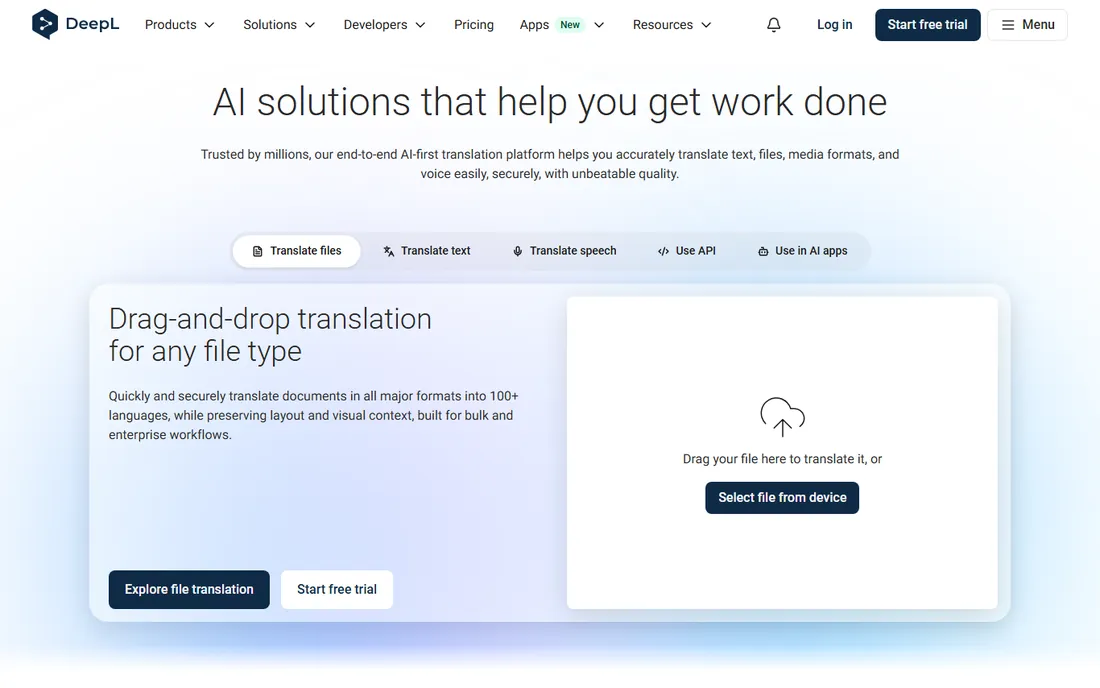
DeepL built its name on one thing: translations that read like a person wrote them, at least for French, German, Spanish, Italian, and Dutch. The difference against generic engines is most visible in longer sentences, where DeepL keeps the structure coherent instead of translating word by word. The API Pro tier starts at $5.49/month plus $25 per million characters, with a free Developer tier for small tests.
The honest weakness is coverage. For Japanese, Korean, Arabic, or less common languages, Google and Microsoft usually do better. The free tier also caps out quickly on real workloads. If your content is mostly European languages and quality matters more than cost, DeepL is the default choice. If you need 100+ languages, look at the cloud providers below.
What we like- Widely regarded as the most natural-sounding output for major European languages
- Clean API with a free Developer tier
- Formal/informal tone control
Watch out for- Weaker coverage outside European languages
- The free plan has character limits that run out fast
Starting price$20 per 1M characters
Free planYes
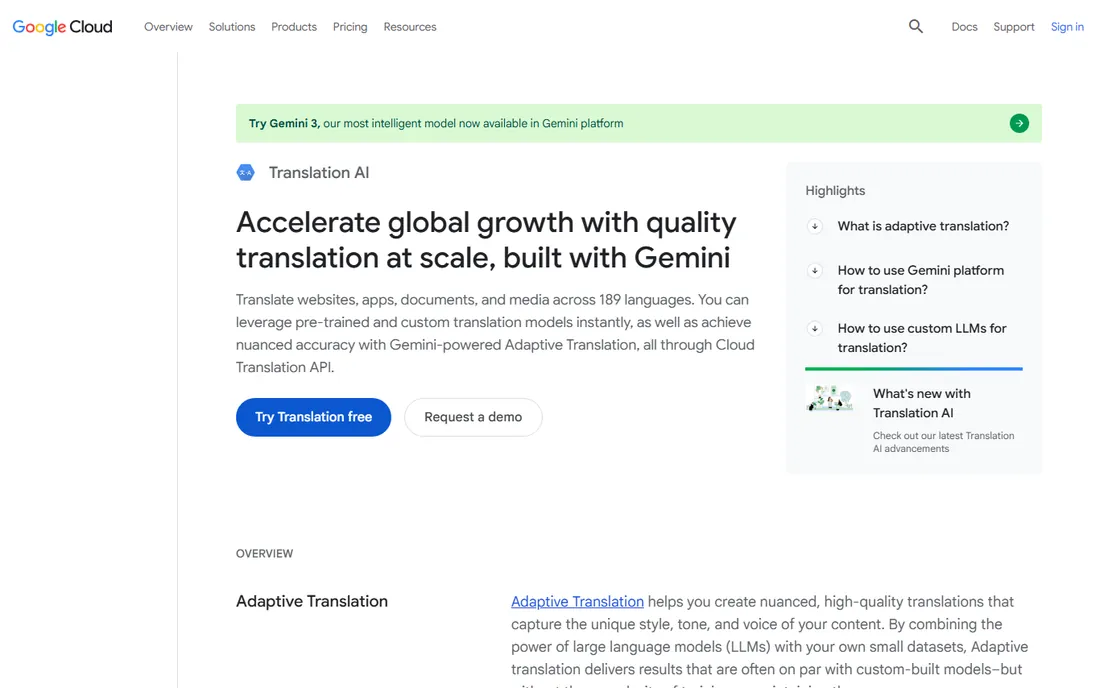
Google's Neural Machine Translation API supports well over 100 languages, which makes it the practical choice when you need to cover the long tail. Pricing is $20 per million characters for NMT, and the first 500,000 characters each month are free, which covers a lot of testing and small production loads. If your stack already runs on Google Cloud, the integration is trivial.
The catch is uneven quality. Major language pairs are strong, but some lower-resource languages produce output that needs heavy editing. At $20 per million characters, high-volume applications should also do the math carefully; it is not the cheapest option per character. For breadth of coverage and easy integration, though, it is hard to beat.
What we like- Broadest language coverage in the industry
- First 500,000 characters per month free
- Deep integration with Google Cloud services
Watch out for- Quality varies by language pair
- Costs can spike on high-volume workloads
Starting price$10 per 1M characters
Free planYes
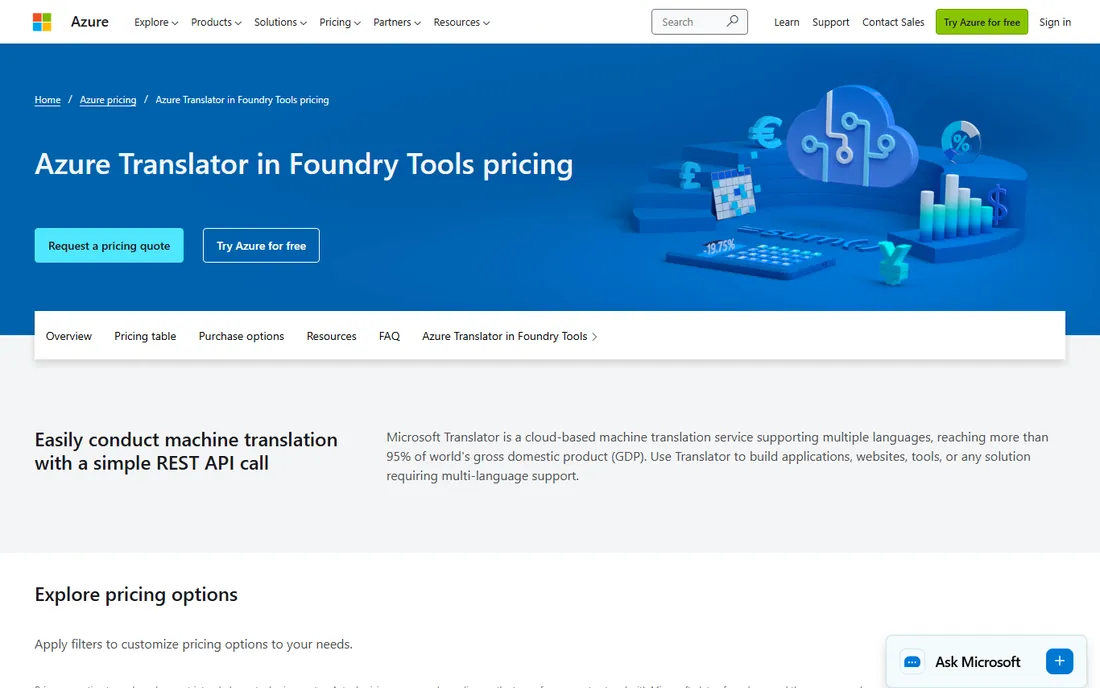
Microsoft's pricing is quietly one of the best deals in machine translation. The F0 tier includes 2 million characters per month free, and pay-as-you-go standard translation is $10 per million characters, half of Google's NMT rate. If your product lives in Azure or your users live in Office and Teams, the integration story is strong.
The weakness is that the best experience assumes Azure. Outside that ecosystem the API works fine, but you lose some of the bundled conveniences. Document translation and custom trained models also carry separate pricing that complicates the bill. For Azure shops and Microsoft-centric teams, it is usually the cheapest serious option.
What we like- F0 tier gives 2 million characters per month free
- $10 per million characters is competitive
- Strong Office and Teams integration
Watch out for- Tied to the Azure ecosystem for the best experience
- Document translation costs extra
Starting priceSee website
Free planSee website
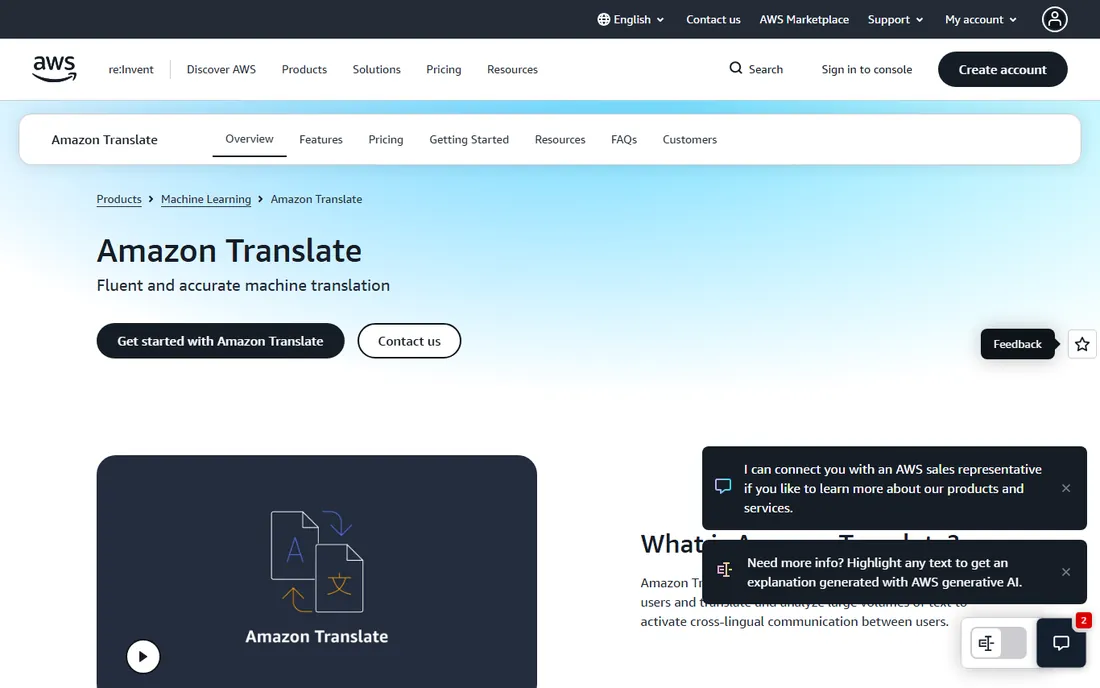
Amazon Translate fits naturally into AWS architectures: translate support tickets stored in S3, localize content in a Lambda function, plug into Connect for call centers. Custom terminology lets you pin down brand terms and product names so they translate consistently. There is no minimum commitment, which suits spiky workloads.
The honest catch is transparency. AWS pricing pages are dense, and the commonly cited rate of $15 per million characters should be confirmed on the current pricing page before you budget. Language coverage is also narrower than Google's. If AWS is your cloud, it is the path of least resistance. If not, the other providers offer more.
What we like- Real-time and batch translation inside AWS
- Custom terminology support
- Pay-per-use with no minimums
Watch out for- Pricing page needs a visit to confirm current rates
- Smaller language list than Google
Starting priceFree
Free planYes
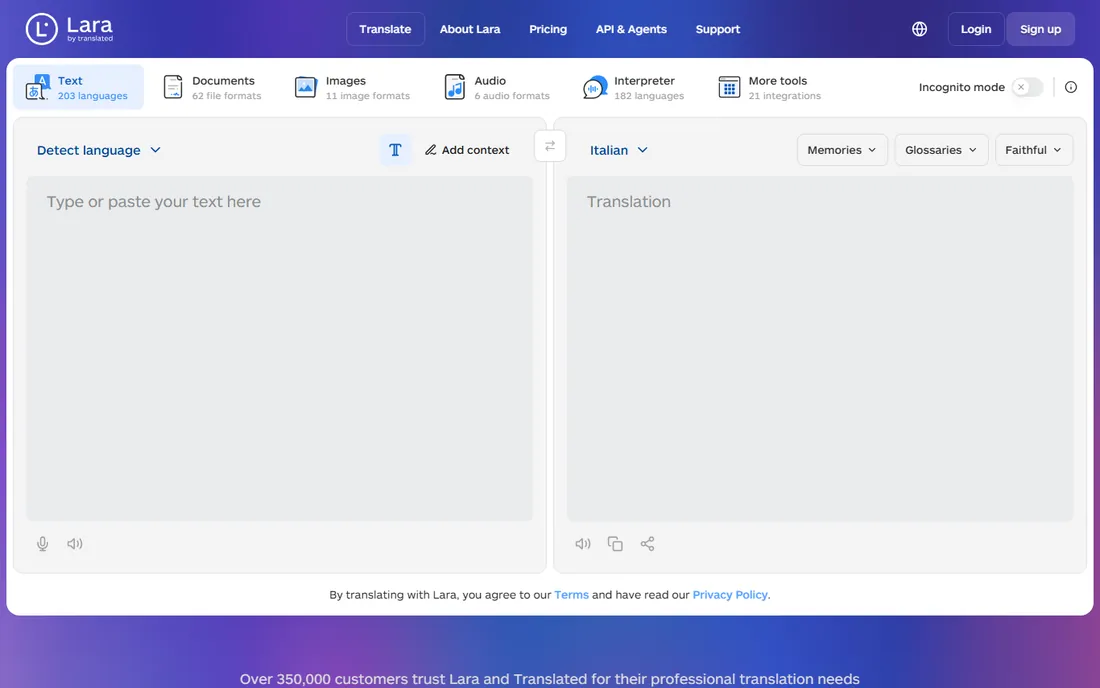
Lara is the new name to know: ModernMT announced it is evolving into Lara and will sunset at the end of 2026, with new registrations closed. Lara carries forward the adaptive approach, where the engine learns from your corrections and adapts to your domain over time. The homepage currently lists it as free to use.
Being new cuts both ways. The adaptive technology is genuinely interesting for teams that translate repetitive technical content, because the engine gets better the more you correct it. But the integration ecosystem is still growing, and long-term pricing is not yet established. If you were on ModernMT, start your migration planning now. Everyone else should trial it while it is free.
What we like- Free to use
- Built as the successor to ModernMT with adaptive learning
- Remembers corrections to improve over time
Watch out for- New product with a shorter track record
- Integration ecosystem still growing
Starting priceFrom $0.00020/word (pay as you go)
Free planSee website
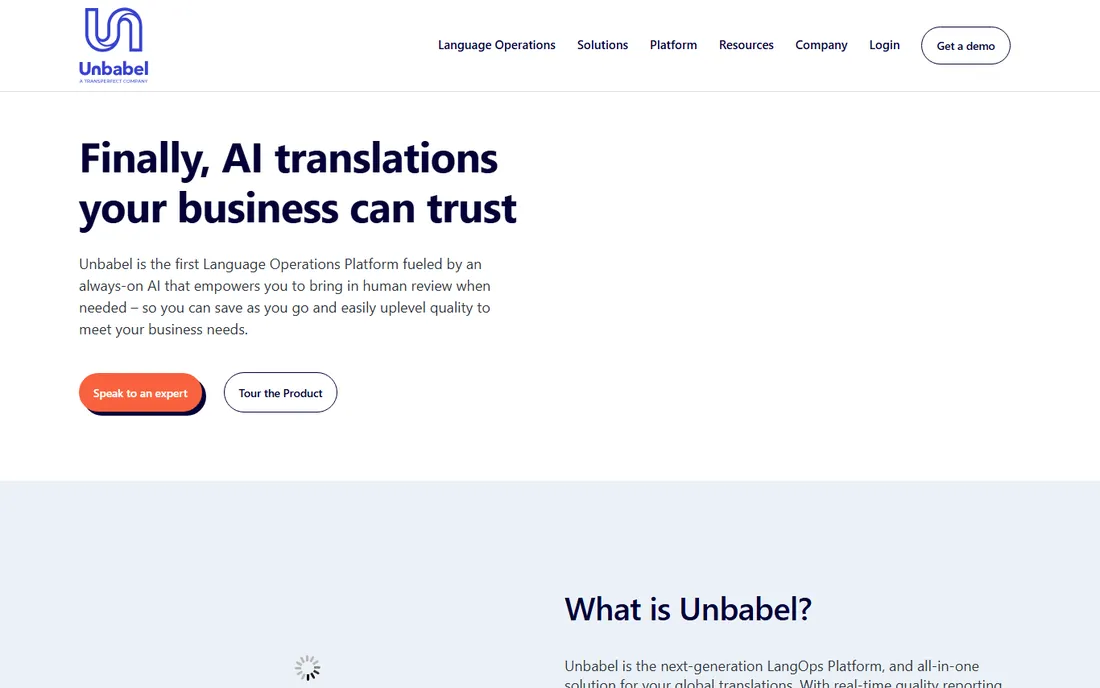
Unbabel occupies the middle ground between raw machine translation and traditional agencies. The pipeline runs your content through MT and then through human editors who fix what the machine got wrong, with pricing starting at $0.00020 per word on pay-as-you-go. For customer support teams, that combination delivers quality that pure MT cannot match at a price agencies cannot touch.
The tradeoff is time. Human editing means you do not get instant results, so it suits tickets and help articles better than live chat. It is also a service model more than a pure API, which some developers find constraining. If your translations face customers and errors cost you trust, Unbabel's hybrid approach is worth the premium over raw MT.
What we like- Combines machine translation with human editors for near-human quality
- Pay-as-you-go pricing from $0.00020/word
- Strong for customer support use cases
Watch out for- Human editing adds turnaround time
- Not a fit for instant real-time needs
#7
Lilt
Best for: interactive enterprise machine translation
Visit lilt.com
Starting priceSee website
Free planSee website
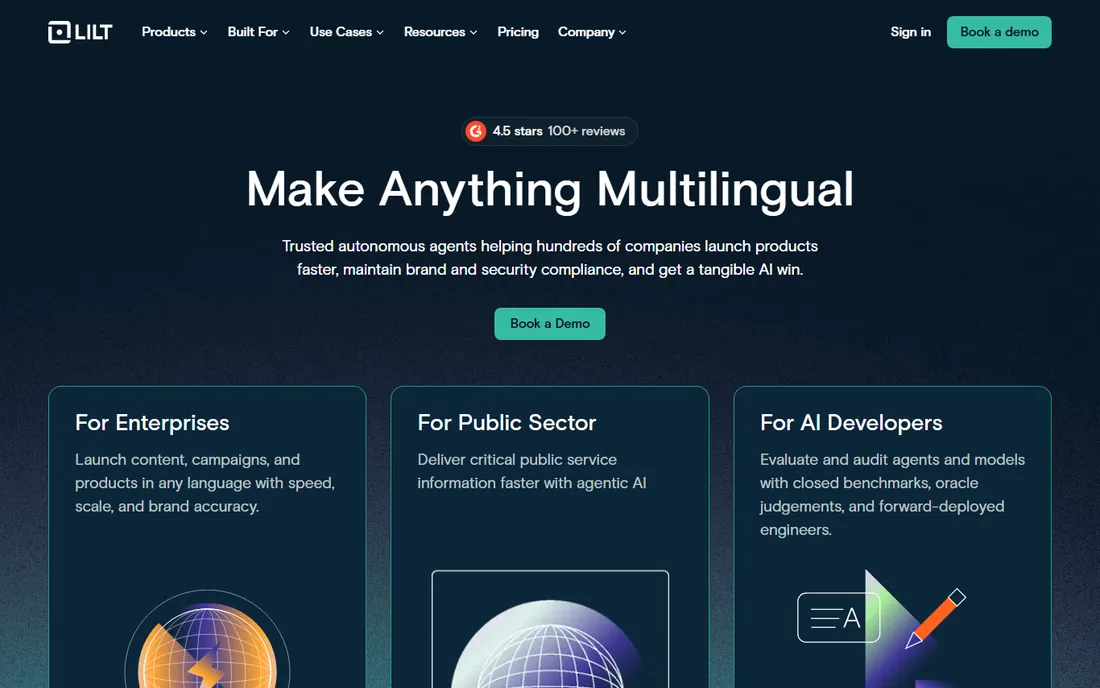
Lilt's differentiator is interactivity: as linguists work, the engine watches their corrections and adjusts its suggestions immediately, within the same session. Over a large program, that feedback loop compounds into real productivity gains. The company targets enterprises with serious volume and the security requirements that come with it.
Everything about the purchase says enterprise. Pricing is quote-based, onboarding involves a sales process, and small teams will find the attention of the sales team limited. If you are a large company running a continuous localization program and want MT that improves as your team works, Lilt belongs in the evaluation. Smaller buyers should start with DeepL or Google.
What we like- Adaptive MT that learns from linguist feedback in real time
- Strong enterprise security posture
- Good for large-scale content programs
Watch out for- Quote-based pricing only
- Aimed at large buyers, not individuals
Starting priceSee website
Free planFree trial (14 days)
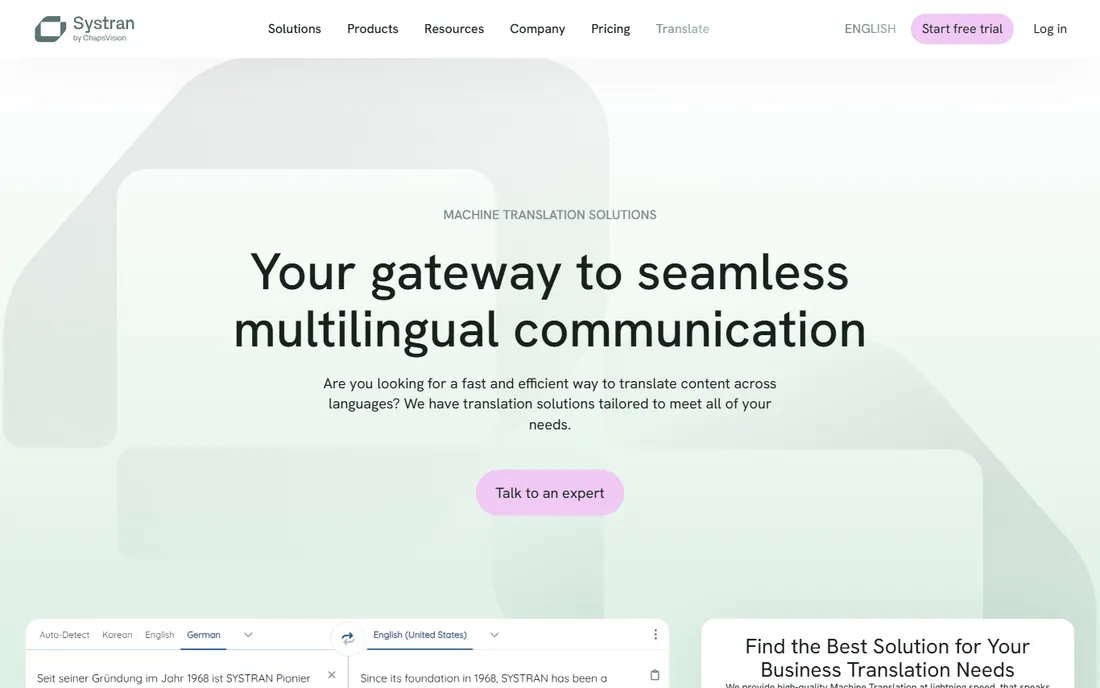
SYSTRAN has been in machine translation since before it was fashionable, and that history shows in specialized domains. Where the big cloud engines are generalists, SYSTRAN offers domain-adapted models and, critically, private deployment for organizations that cannot send data to a public cloud. Defense, legal, and government buyers have used it for years.
The buying experience reflects the enterprise focus. Pricing is not published in a simple table, and the range of products (Translate Pro, enterprise servers, OEM) takes effort to untangle. The 14-day trial helps, but expect a sales conversation for anything serious. If data privacy rules out public cloud MT, SYSTRAN is one of the few mature alternatives.
What we like- Decades of experience with specialized domains
- Private and on-premise deployment options
- Strong in defense, legal, and public sector
Watch out for- Pricing is not transparent
- The product line can confuse new buyers
Starting priceSee website
Free planSee website
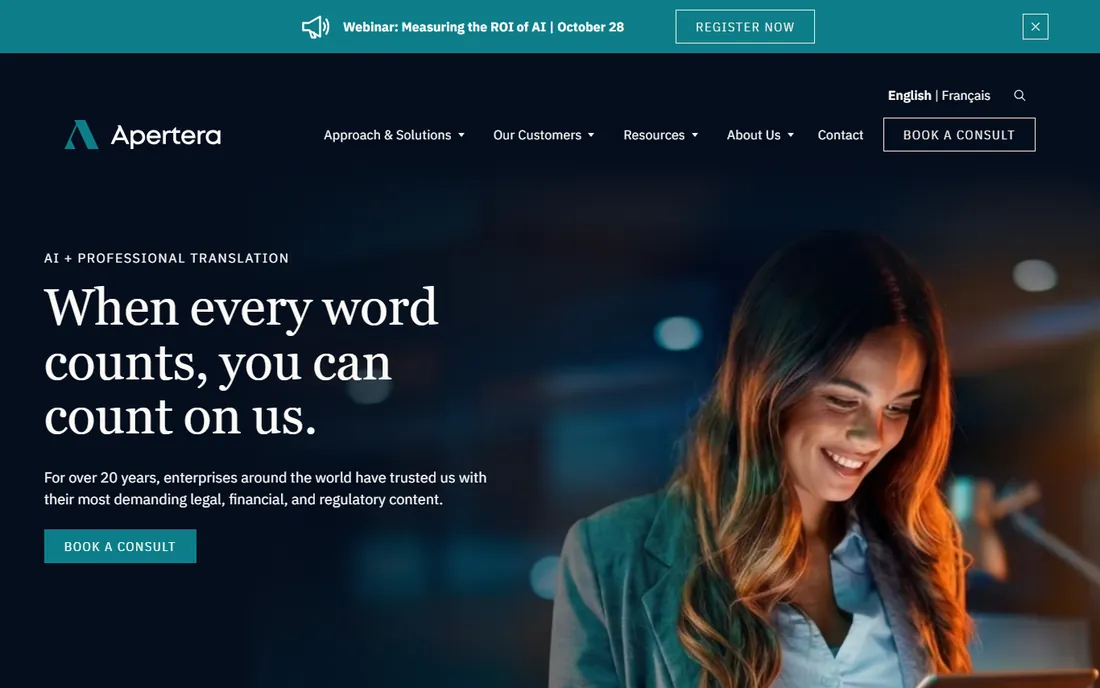
Apertera is the current name for Alexa Translations, which rebranded in mid-2026. The specialization is the point: legal contracts, financial disclosures, and regulatory filings, where a mistranslation carries real liability. Certified translation workflows and domain-trained engines serve a market that general MT engines treat as an afterthought.
That focus is also the limitation. This is not the tool for translating your marketing site into 30 languages; it is the tool for the ten documents a year where accuracy is non-negotiable. Pricing is quote-based, reflecting the professional-services character of the business. Law firms, banks, and compliance teams should know the name. Everyone else can pass.
What we like- Specialized in legal and financial content
- Certified translation workflows
- Rebrand of the established Alexa Translations
Watch out for- Niche focus limits general use
- Pricing requires a quote
Starting priceFree
Free planYes
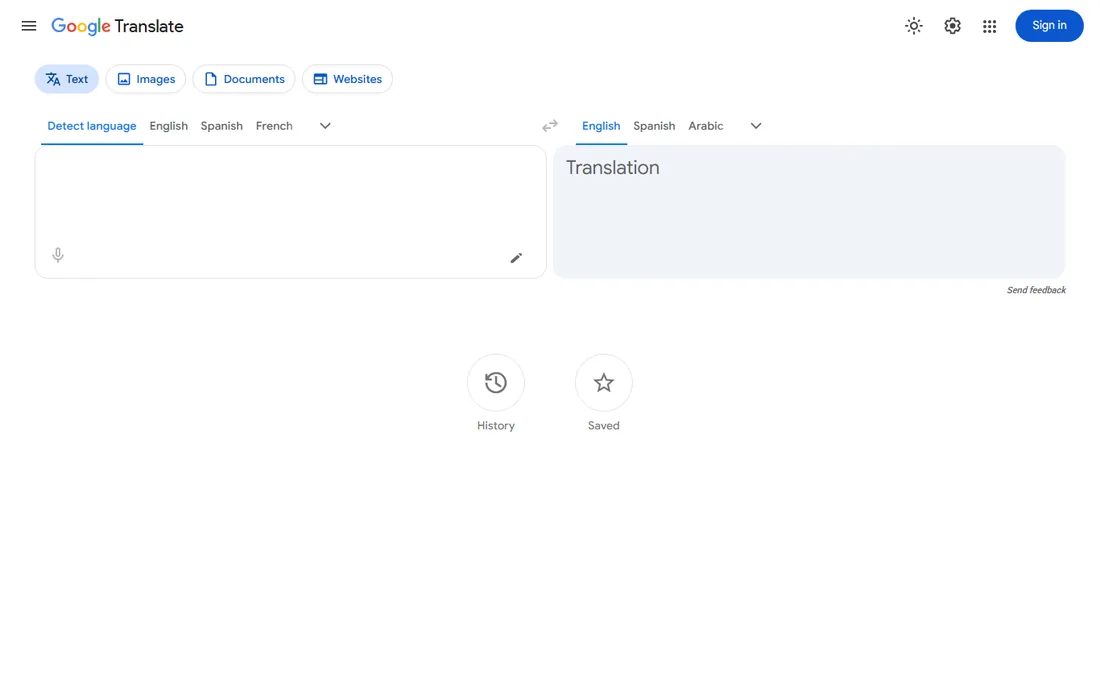
Google Translate remains the fastest way to understand a paragraph in a language you do not speak. It is free, instant, and covers an enormous range of languages, with mobile features like camera translation that the API products do not bother with. For travelers, students, and quick comprehension, nothing beats it on convenience.
The limits matter for business use. This is the consumer product, not the Cloud Translation API; there is no SLA, no support, and the terms are not appropriate for confidential documents. Quality is also a step below DeepL for European languages. Use it for understanding, not for publishing. When the translation matters, move up to one of the paid engines above.
What we like- Completely free with no account needed
- Huge language coverage
- Camera and conversation modes on mobile
Watch out for- No API for production use at this tier
- Privacy terms unsuitable for confidential content
Getting the most from machine translation engines
Match the engine to the risk. Internal drafts and gist translation can run on the cheapest option; customer-facing content deserves DeepL or a human-edited service like Unbabel. For APIs, compare the free tiers first: Microsoft's 2 million free characters per month and Google's 500,000 free characters cover a surprising amount of real usage.
Then test with your actual content, not sample sentences. Engines differ wildly by domain. Run a few hundred of your real segments through two or three candidates and have a native speaker score them. That afternoon of testing tells you more than any benchmark. Finally, plan for post-editing from the start: even the best engine needs a human pass on anything that carries legal, medical, or brand risk.
How we chose
We verified that each engine is live and available today, including the ModernMT to Lara transition, which we confirmed on the vendor's own site. Pricing comes from vendor pricing pages wherever they publish figures; where they do not, we say so. We compared language coverage, API quality, free tier generosity, and specialization, and we checked public reviews on G2, Capterra, and developer forums for real-world reliability reports. We did not run hands-on tests.
Raw MT vs human-edited: picking your quality tier
Machine translation output falls into three practical tiers. Raw MT is fine for understanding content yourself. Post-edited MT, where a human reviews and fixes the output, suits most customer-facing content and costs a fraction of full human translation. Full human translation remains the choice for legal, medical, and high-stakes marketing copy.
Your engine choice should follow the tier. If you post-edit everything anyway, a cheaper engine with good API ergonomics may beat a premium one. If you publish raw output, pay for the best quality you can afford, which usually means DeepL for European languages. Unbabel and traditional LSPs sell the middle tier as a service if you do not want to manage editors yourself.
Frequently asked questions
Is DeepL better than Google Translate?
For major European languages, DeepL usually produces more natural output. Google Translate covers far more languages and is free for casual use. For production API work, compare DeepL's API against Google Cloud Translation on your specific language pairs and content type.
How much does machine translation cost at scale?
Published rates range from $10 per million characters (Microsoft) to $20 per million (Google NMT), with DeepL charging $25 per million plus a platform fee. Free tiers from Microsoft (2M characters/month) and Google (500K/month) cover small workloads entirely. Always test with real volume before committing.
Can I use free machine translation for business content?
You can, but check the terms first. Consumer tools like Google Translate are not designed for confidential or customer-facing content. Paid API tiers come with data processing terms and SLAs that businesses need. When in doubt, use the paid tier.
What happened to ModernMT?
ModernMT announced it is evolving into Lara, with the ModernMT service sunsetting at the end of 2026 and new registrations closed. Existing users should plan migration to Lara or another engine. Lara is currently free to use at laratranslate.com.
Do I still need human translators if I use AI translation?
For high-stakes content, yes. Machine translation handles volume and speed; humans handle nuance, liability, and brand voice. Most professional workflows now combine both: MT for the first draft, human linguists for review and refinement.
Which engine is best for Asian languages?
Google Cloud Translation and Microsoft Translator generally have the broadest and most mature coverage for Japanese, Korean, and Chinese. DeepL has improved here but remains stronger in European pairs. Test your specific pairs, since quality varies by domain as well as language.
Sources we checked (12)
- https://www.deepl.com/
- https://www.deepl.com/pro-api
- https://cloud.google.com/translate
- https://aws.amazon.com/translate/
- https://azure.microsoft.com/en-us/pricing/details/cognitive-services/translator/
- https://laratranslate.com/
- https://unbabel.com/
- https://unbabel.com/pricing
- https://lilt.com/
- https://www.systran.net/
- https://www.apertera.com/
- https://translate.google.com/
Is your product missing or out of date?
We review this list regularly. Vendors can request a listing, send updated pricing or ask about featured placement.

Shihab Mia · Founder, Rankite
Shihab has spent more than a decade helping SaaS and e-commerce brands grow through search. He writes Rankite's software buying guides from pricing pages, documentation and public user reviews. More about Shihab.