How we make this list: we compare pricing pages, product documentation and public user reviews. Rankite is independent; if a vendor ever pays for a featured spot, that listing is clearly labeled Partner.
Key takeaways
- General-purpose chatbots hallucinate citations; legal research AI grounds answers in real case law with checkable citations.
- Most leading platforms publish no prices, so expect quoted, enterprise-style deals except at the low end.
- Spellbook, Fastcase, and Paxton AI are the realistic picks for solo and small-firm budgets.
- CoCounsel pairs AI with Westlaw content, while vLex adds one of the largest global legal databases plus court records.
- Always verify AI output against primary sources; no tool removes the attorney's duty to check citations.
Quick comparison
| Tool | Best for | Starting price | Free plan |
|---|
 Harvey Harvey | large firms and in-house teams | See website | No |
 CoCounsel CoCounsel | Westlaw-backed AI research | See website | No |
 Westlaw Westlaw | AI-assisted research on trusted content | See website | No |
 vLex vLex | global database plus court records | See website | Free trial |
 Paxton AI Paxton AI | litigation-focused AI for smaller firms | See website | Free trial |
 Spellbook Spellbook | contract drafting and review in Word | See website | No |
 Fastcase Fastcase | affordable research for solos and small firms | Free with bar membership | Yes (free for members of 80+ partner bar associations) |
 Everlaw Everlaw | litigation document review at scale | See website | No |
Is your product missing or out of date?
We review this list regularly. Vendors can request a listing, send updated pricing or ask about featured placement.
The best AI software for legal research
The cost of getting legal research AI wrong is not a wasted subscription. It is a hallucinated case citation in a filed brief, a missed overruled authority, or a client-confidential matter leaked into a model that trains on user data. Courts have already sanctioned lawyers for AI-invented citations. The right tool here is not the cleverest chatbot; it is the one whose answers trace back to real, verifiable authority and whose vendor contract actually protects your data.
Starting priceSee website
Free planNo
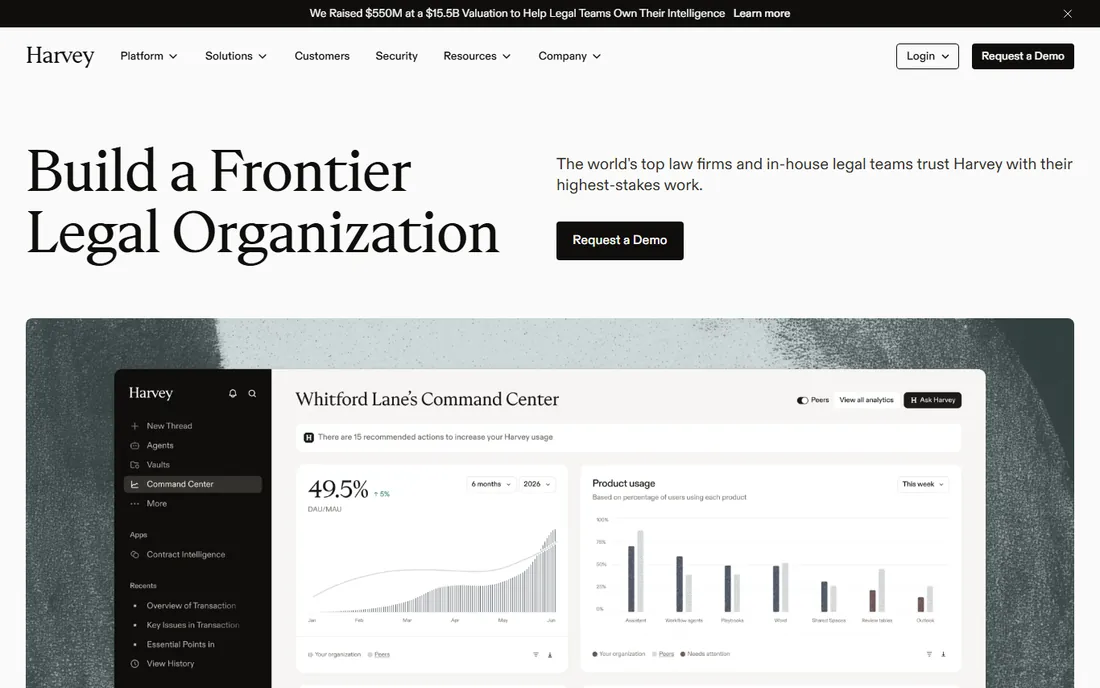
Harvey is the best-known name in legal AI, and its homepage reports 200,000+ professionals and 3,500+ legal organizations on the platform. It offers custom AI models trained on a firm's own work, agentic workflows that carry tasks through multiple steps, and a platform approach that covers research, drafting, and review in one place. The company raised its profile with an $11 billion valuation in 2026, making it the momentum leader in the space.
The honest catch is who it is for. Harvey is an enterprise platform: quote-only pricing, reported seat minimums in the twenties, and per-seat figures circulating in the four figures per month. Small and mid-size firms will get more value elsewhere. For BigLaw and large in-house teams, it is the category's flagship for a reason.
What we like- Built specifically for legal workflows with custom firm models
- Used by 3,500+ legal organizations per the vendor
- Agentic workflows that handle multi-step legal tasks
Watch out for- Enterprise pricing puts it out of reach for solos
- Quote-only pricing with no public figures
Starting priceSee website
Free planNo
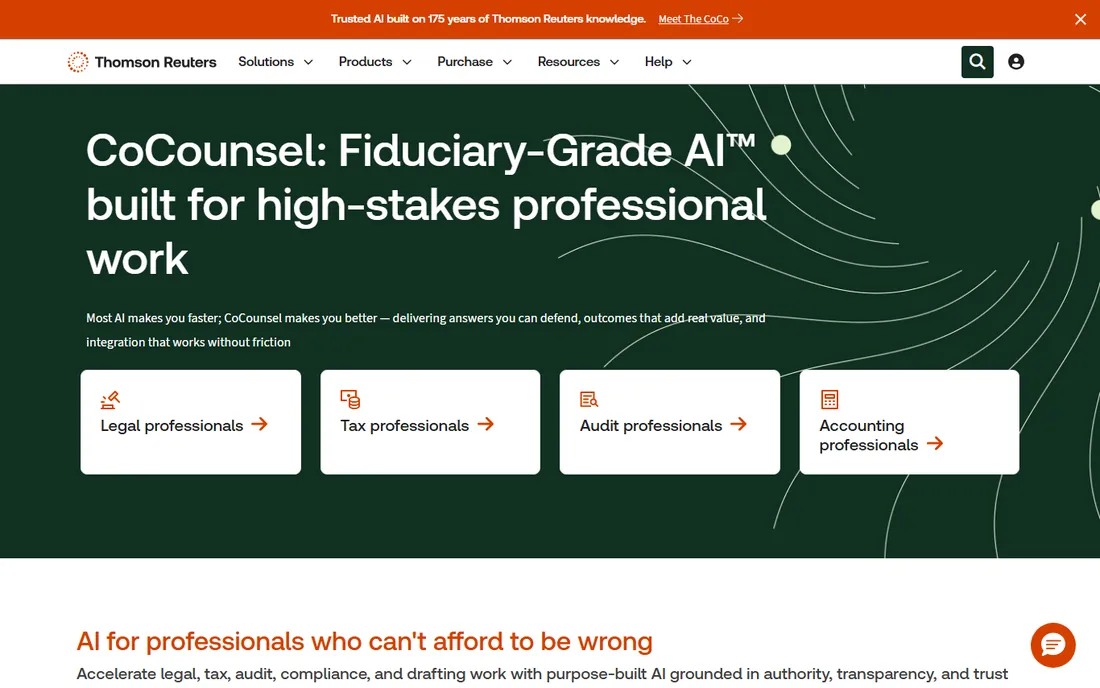
CoCounsel began as Casetext's GPT-4-based assistant and became Thomson Reuters' flagship AI product after the $650 million acquisition in 2023. Its advantage is grounding: answers draw on Westlaw's primary law, Practical Law's practice guides, and Checkpoint's tax content, with sources surfaced so attorneys can verify. The product page emphasizes professional-grade accuracy, and it connects to Microsoft 365 and major document management systems.
The honest catch is pricing opacity. Thomson Reuters publishes no price, and third-party figures suggest it sits in the mid hundreds per user per month depending on configuration, with Westlaw often required underneath. Firms already invested in Westlaw get the most from it; everyone else should weigh the total stack cost.
What we like- Grounded in Westlaw, Practical Law, and Checkpoint content
- Transparent, verifiable outputs with sources
- Enterprise-grade security and privacy
Watch out for- No public pricing
- Works best within the Thomson Reuters ecosystem
Starting priceSee website
Free planNo
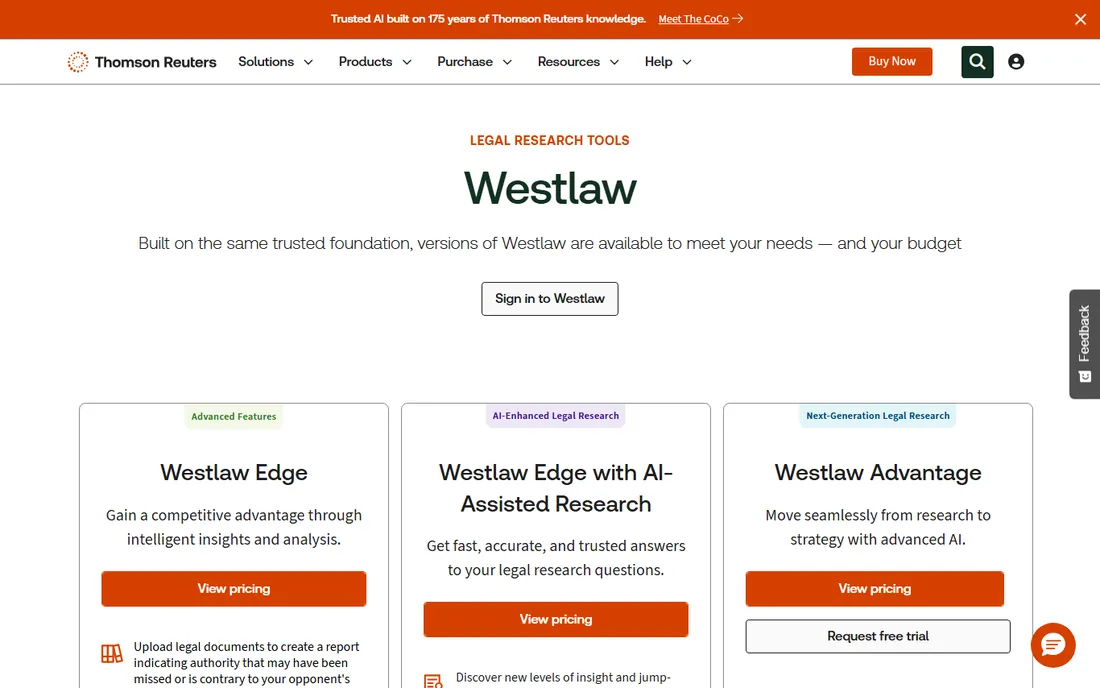
Westlaw remains the research database everything else is measured against, and it now has AI woven through it: AI-assisted research answers natural-language questions, AI jurisdictional surveys compile 50-state surveys, and AI-enhanced Quick Check flags missing or contrary authority in uploaded documents. KeyCite's overruling-risk flags give it a verification layer no startup can match.
The honest catch is cost. Westlaw has never been cheap, and the AI editions sit on top of traditional seat pricing. For firms that need the deepest US primary law with verified citations, it is still the gold standard; for firms that need AI drafting and workflow automation beyond research, pair it with or choose a platform like Harvey or CoCounsel.
What we like- The industry-standard research database with KeyCite validation
- AI-assisted research and jurisdictional surveys built in
- AI-enhanced Quick Check finds gaps in briefs
Watch out for- Premium pricing with no public figures
- Still a traditional research platform, not a general AI workspace
Starting priceSee website
Free planFree trial
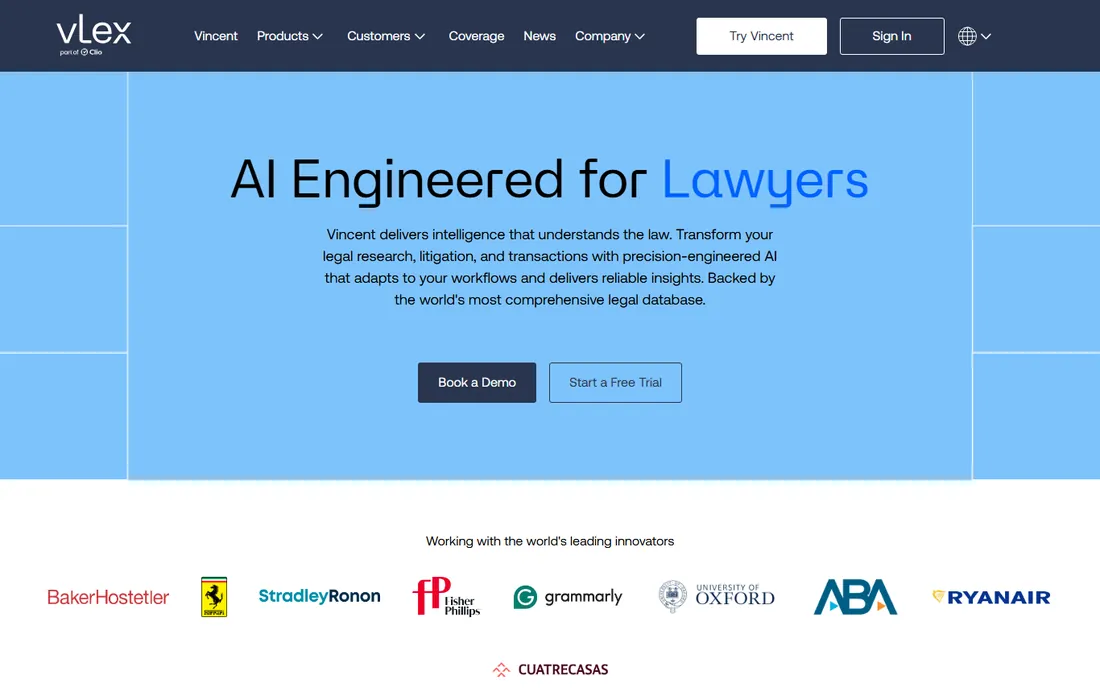
vLex, now part of Clio, combines one of the largest global legal databases with the Vincent AI assistant engineered for lawyers. Its scope is genuinely international: comprehensive US federal and state content, the UK's largest online collection, Spain's largest with over 7 million judgments, plus coverage across 100+ countries. Docket Alarm adds 850+ million court records with judge and opposing-counsel analytics.
The honest catch is fit. A firm practicing in one or two US states pays for global depth it may never use, and pricing is quote-based. For firms with international matters, or those wanting Clio-integrated practice management with research, it is the broadest platform on this list.
What we like- Over one billion legal documents from 100+ countries
- Docket Alarm adds 850+ million court records with litigation analytics
- Vincent AI assistant for research and drafting
Watch out for- No public pricing
- Sheer scope can be more than a domestic practice needs
#5
Paxton AI
Best for: litigation-focused AI for smaller firms
Visit paxton.ai
Starting priceSee website
Free planFree trial
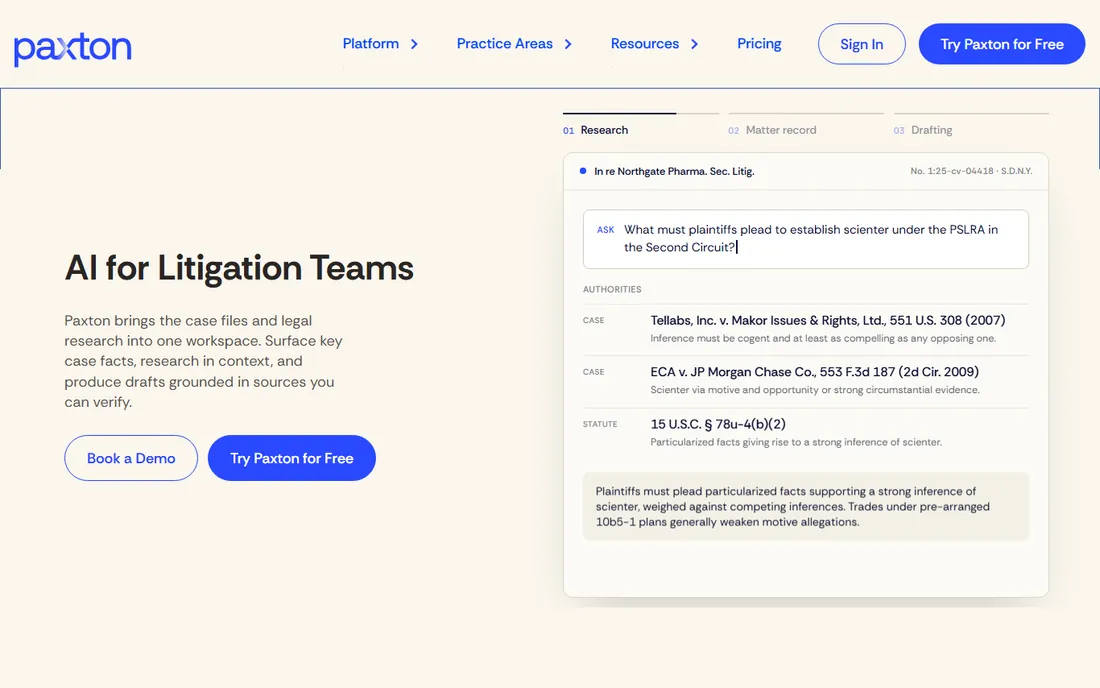
Paxton AI is built for litigators, and it shows in the design: every matter keeps its own record at the center, so research and drafting stay grounded in the case's facts, deadlines, and procedural posture. It handles file-ready drafting of motions, briefs, discovery responses, and deposition outlines, with research against 150 million-plus legal documents. The vendor reports 30,000+ attorneys using it.
The honest catch is scope. The litigation-first design is a strength for firms that litigate and a mismatch for purely transactional practices. It is the most approachable of the serious research platforms for smaller firms, but expect a sales conversation rather than a buy button.
What we like- Matter-centered workflow connecting research, drafting, and case files
- Research grounded in primary law with jurisdiction awareness
- SOC 2 compliant with a secure closed model
Watch out for- Litigation focus means less for transactional work
- No public pricing on the homepage
Starting priceSee website
Free planNo
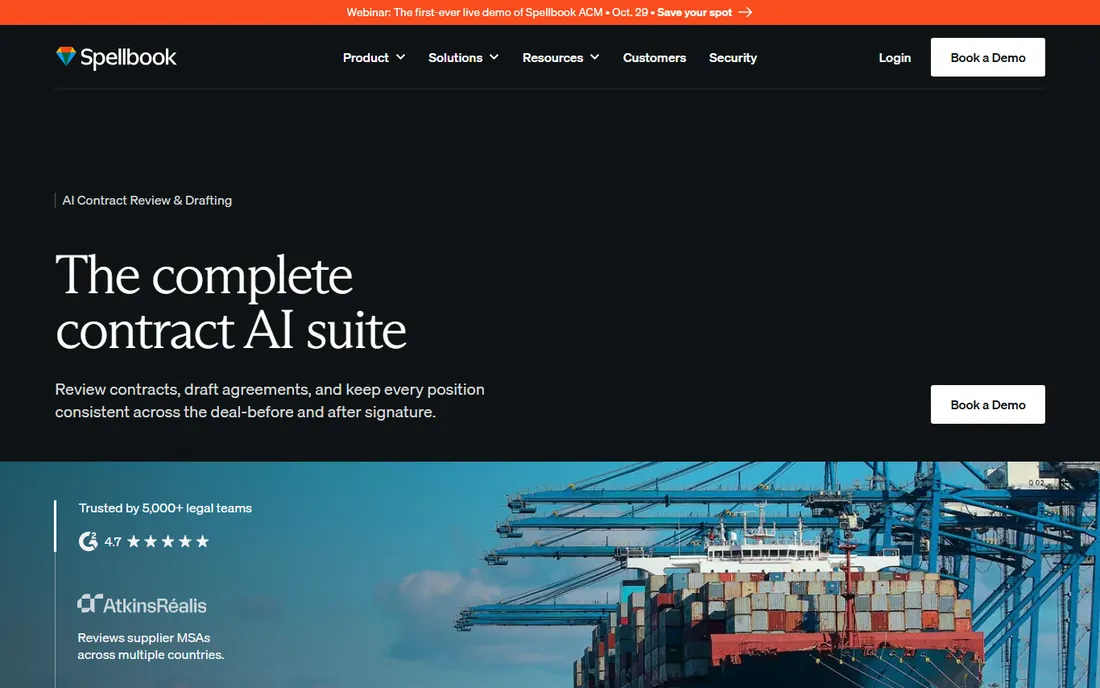
Spellbook takes a different angle on legal AI: instead of a research portal, it puts AI directly in Microsoft Word, where lawyers already draft. The platform now covers the full contract lifecycle: intake from email and Slack, AI drafting, surgical redlining, team playbooks enforced on every review, and a searchable repository of signed contracts. The vendor claims 5,000+ legal teams and a zero-data-retention policy.
The honest catch is that it is not a case-law research tool. If the job is finding and validating authority, look elsewhere on this list. But for transactional lawyers and in-house teams drowning in contracts, the in-Word design means adoption without training, and the pricing is reachable for small firms and legal departments.
What we like- Lives inside Microsoft Word with zero learning curve
- End-to-end contract workflow from intake to repository
- Zero data retention policy for confidentiality
Watch out for- Contract-focused rather than case-law research
- No free tier
Starting priceFree with bar membership
Free planYes (free for members of 80+ partner bar associations)
Fastcase is the budget answer to legal research, and for many solos it is free: over 80 national, state, and county bar associations include it as a member benefit. It covers cases, statutes, regulations, court rules, and constitutions, with visualization tools and AI-assisted features that punch above the price. For a solo practitioner, it can genuinely replace a Westlaw subscription.
The honest catch is depth. It does not match Westlaw or Lexis on secondary materials, analytics, or the sophistication of its AI. But when the alternative is no research platform at all, Fastcase's price, free for many bar members, makes it the best value in legal research.
What we like- Free member benefit through 80+ bar associations
- Visual tools like interactive timelines and the Bad Law Bot
- AI features layered onto affordable research
Watch out for- Database and features are thinner than Westlaw or Lexis
- AI capabilities lag the premium platforms
Starting priceSee website
Free planNo
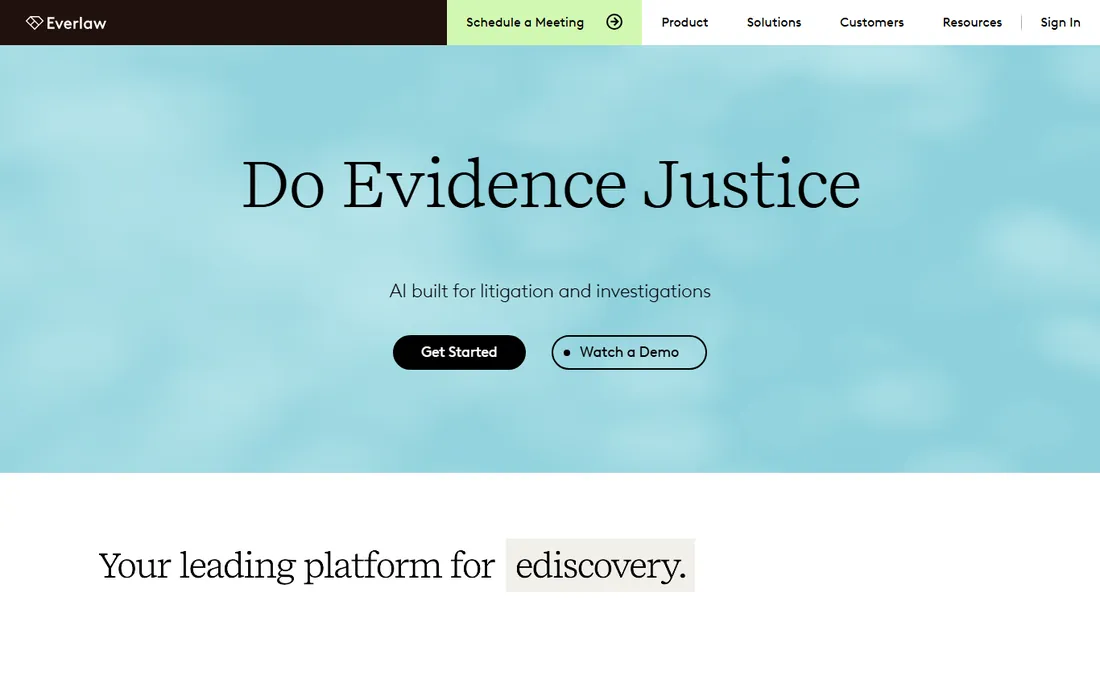
Everlaw is the litigation specialist: an e-discovery and investigation platform with AI built in, designed to handle massive document sets for complex cases. Its pitch is a single evidentiary system of record that the team's AI tools can plug into, keeping workflows grounded in evidence rather than scattered across platforms. It dominates the e-discovery shortlist alongside Relativity and DISCO.
The honest catch is specialization. This is not a tool for researching case law or drafting contracts; it is for reviewing, analyzing, and preparing evidence in litigation. For firms with heavy discovery loads, it is essential; for general research, the other tools here fit better.
What we like- Purpose-built for e-discovery and litigation with AI review
- Open platform connects to the AI tools a team already uses
- One evidentiary system of record
Watch out for- E-discovery focus, not general legal research
- Enterprise pricing with no public figures
How we chose
We compared eight AI legal research tools in October 2026 using vendor homepages and documentation, plus pricing analyses and buyer discussions from legal-tech publications and practitioner forums. We prioritized AI grounded in verifiable legal authority, citation transparency, data privacy terms, published or reported pricing, and fit for firm size from solo to enterprise. No vendor paid for placement, and nothing here is based on hands-on product testing.
What to demand before buying legal AI
Start with the citation test. Ask the vendor to show, in a live demo, how every AI answer links to the primary source it relied on, and what happens when authority has been overruled. A tool that summarizes confidently but cannot show its sources is a liability, not an assistant.
Then read the data terms. Ask whether your matters train the vendor's models, where data is stored, and what happens on cancellation. Zero-retention policies and SOC 2 compliance are the floor for client-confidential work. Finally, match the tool to the practice: research platforms for litigators, contract AI for transactional work, e-discovery for document-heavy cases. The market moves fast, so renegotiate annually rather than locking in.
General AI vs. legal research AI
A general chatbot can draft a memo, but it cannot be trusted with legal authority. It invents citations, misses jurisdictional nuances, and its training data has no concept of whether a case is still good law. Legal research AI exists precisely to close those gaps: grounded retrieval from real databases, citation validation like KeyCite and Shepard's, and workflows built around attorney review.
That does not make the lawyer optional. Every serious vendor frames its AI as assistive, and professional responsibility stays with the attorney. Use AI to accelerate research, then verify the sources yourself. The tools on this list make verification easy; generic AI makes it impossible.
Frequently asked questions
What is the best AI software for legal research?
For large firms, Harvey and CoCounsel lead. For solo and small firms, Spellbook, Fastcase, and Paxton AI offer reachable pricing. For the deepest traditional research with AI built in, Westlaw remains the standard. The right pick depends on firm size, practice area, and budget.
Can AI do legal research reliably?
It can accelerate research significantly, but reliability depends on the tool. Platforms grounded in real legal databases with citation validation, like CoCounsel, Westlaw, and vLex, are far more trustworthy than general chatbots. Attorneys must still verify every citation against primary sources.
How much does legal AI software cost?
Most leading platforms publish no prices; reported figures range from roughly $100 per user per month for smaller-firm tools to four figures per seat for enterprise platforms like Harvey. Fastcase is free for members of 80+ bar associations. Expect quoted, negotiated pricing.
Will AI replace lawyers?
No. AI handles research, drafting, and document review faster, but professional judgment, client counseling, courtroom advocacy, and ultimate responsibility for the work stay with the lawyer. Courts and ethics rules are clear that attorneys must supervise AI-assisted work.
Is my client data safe with legal AI tools?
It depends on the vendor's terms. Look for SOC 2 compliance, encryption, and zero-data-retention policies like Spellbook's. Never enter client-confidential information into a general consumer chatbot, which may use inputs for training.
What is the difference between CoCounsel and Westlaw?
Westlaw is the traditional legal research database with AI features added. CoCounsel is Thomson Reuters' AI assistant, built by Casetext, that works across research, drafting, and document analysis, drawing on Westlaw, Practical Law, and Checkpoint content. Many firms use both.
Sources we checked (10)
- https://harvey.ai/
- https://www.thomsonreuters.com/en/cocounsel
- https://legal.thomsonreuters.com/en/products/westlaw
- https://vlex.com/
- https://paxton.ai/
- https://spellbook.legal/
- https://www.fastcase.com/
- https://everlaw.com/
- https://www.codebridge.tech/articles/ai-legal-assistants
- https://scored.tools/downloads/best-ai-tools-for-legal-professionals-2026.pdf
Is your product missing or out of date?
We review this list regularly. Vendors can request a listing, send updated pricing or ask about featured placement.

Shihab Mia · Founder, Rankite
Shihab has spent more than a decade helping SaaS and e-commerce brands grow through search. He writes Rankite's software buying guides from pricing pages, documentation and public user reviews. More about Shihab.