How we make this list: we compare pricing pages, product documentation and public user reviews. Rankite is independent; if a vendor ever pays for a featured spot, that listing is clearly labeled Partner.
Key takeaways
- Responsive and Loopio are the enterprise standards, with deep content libraries, workflow controls, and the integrations large proposal teams need.
- AutoRFP.ai is the strongest fit for teams that want fast AI drafting with a clear $899/month price and a free two-week proof of concept.
- 1up, Arphie, and Inventive.ai represent the AI-native wave: quicker to deploy, with knowledge bases that update from sources like your help center and Slack.
- Ombud and Qvidian suit teams where RFPs are only part of the job, since they also cover sales content management and broader proposal automation.
Quick comparison
| Tool | Best for | Starting price | Free plan |
|---|
 Responsive Responsive | Enterprise teams running high-volume responses | See website | No (demo available) |
 Loopio Loopio | Mature proposal teams needing workflow control | See website | No (demo available) |
 AutoRFP.ai AutoRFP.ai | Fast AI drafting with transparent pricing | $899/month | Free trial (2-week proof of concept) |
 1up 1up | Teams wanting AI answers from live company knowledge | See website | Yes (free plan) |
 Arphie Arphie | Startups and lean teams automating RFPs quickly | See website | No (demo available) |
 Ombud Ombud | Content-centric teams managing sales knowledge | See website | No (demo available) |
 Qvidian Qvidian | Large sales orgs with proposal and content needs | See website | No (demo available) |
 Inventive.ai Inventive.ai | Sales teams automating RFPs and security reviews | See website | No (demo available) |
Is your product missing or out of date?
We review this list regularly. Vendors can request a listing, send updated pricing or ask about featured placement.
The best AI RFP software
Starting priceSee website
Free planNo (demo available)
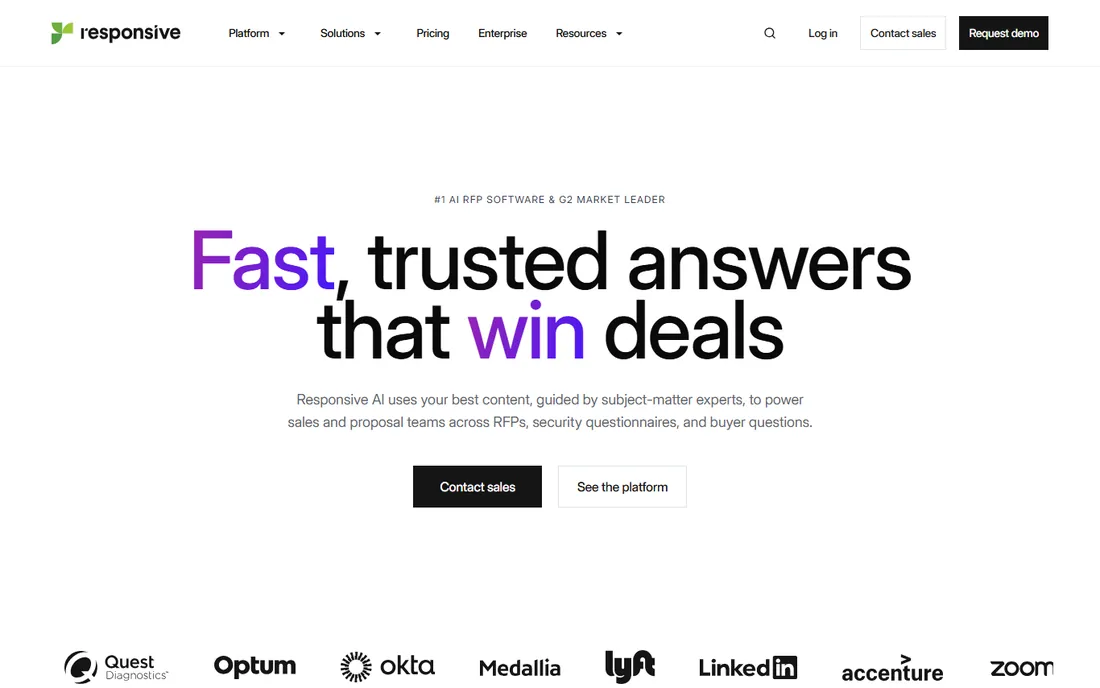
Responsive, formerly RFPIO, is the category-defining enterprise platform. It manages the entire response process: intake and triage, AI-assisted drafting from an approved content library, collaboration and approval workflows, and analytics on what wins. The AI layer drafts answers, flags content that needs review, and helps keep the library current as products change.
The platform earns its place at companies running dozens of complex responses a year, where workflow control and audit trails matter as much as drafting speed. The cost of that depth is a genuine implementation project: migrating content, configuring workflows, and training a team of contributors takes weeks. Smaller teams that just need faster drafting will find the newer AI-native tools lighter to adopt.
What we like- Purpose-built for RFP, RFI, DDQ, and security questionnaires
- AI agents plus automation across the response lifecycle
- Deep integrations with Salesforce, Slack, and Teams
Watch out for- Quote-based enterprise pricing with no public numbers
- Implementation and content migration take real effort
#2
Loopio
Best for: Mature proposal teams needing workflow control
Visit loopio.com
Starting priceSee website
Free planNo (demo available)
Loopio has been the other enterprise anchor of this category for years, and its strength is operational control over the response process. The content library keeps approved answers with owners, review dates, and expiry, so nothing stale slips into a proposal. AI features help draft from the library, import questions from any format, and route work to the right contributors.
Loopio fits organizations with a real proposal function: dedicated staff, recurring RFP volume, and stakeholders across departments. Pricing is custom and generally described as accessible relative to Responsive, but you will need a sales conversation to get numbers. Companies that answer a handful of RFPs a year will not use enough of the workflow machinery to justify it.
What we like- Strong content library with review and expiry controls
- Magic and AI features assist drafting and importing
- Project management built for multi-contributor RFPs
Watch out for- No public pricing, plans scale with team size
- Best suited to teams with dedicated proposal staff
#3
AutoRFP.ai
Best for: Fast AI drafting with transparent pricing
Visit autorfp.ai
Starting price$899/month
Free planFree trial (2-week proof of concept)
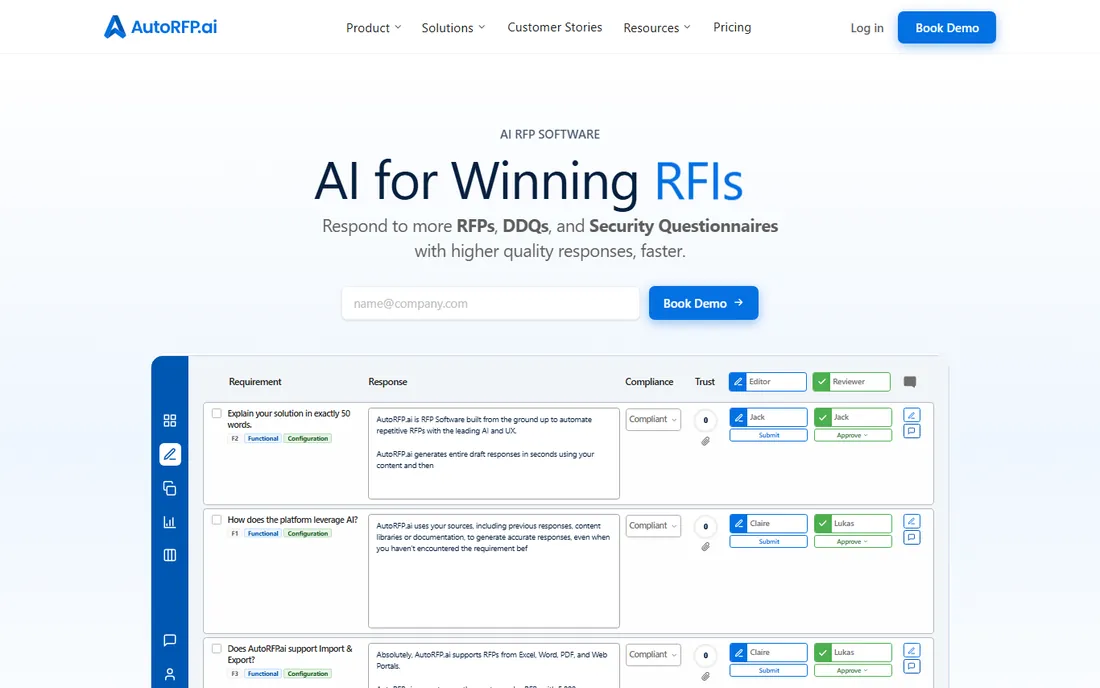
AutoRFP.ai takes the opposite approach to the enterprise incumbents: one product, one published price, and a free two-week proof of concept so teams can test it on a real RFP before paying. The AI drafts answers from your content, supports multiple languages, and plugs into the questionnaire formats teams actually receive.
The transparency is the story here. In a category where almost every vendor hides pricing behind a demo request, knowing the cost is $899 a month before you talk to anyone is genuinely useful for budgeting. The trade-off is maturity: the content governance, integrations, and reference customer depth do not yet match Responsive or Loopio. For mid-market teams that want AI drafting without an enterprise sales cycle, that trade is easy to accept.
What we like- Published pricing at $899/month, rare in this category
- Free two-week proof of concept before committing
- Multi-language support for global RFP responses
Watch out for- Single published price point with less plan flexibility
- Newer vendor with a smaller customer base than the incumbents
#4
1up
Best for: Teams wanting AI answers from live company knowledge
Visit 1up.ai
Starting priceSee website
Free planYes (free plan)
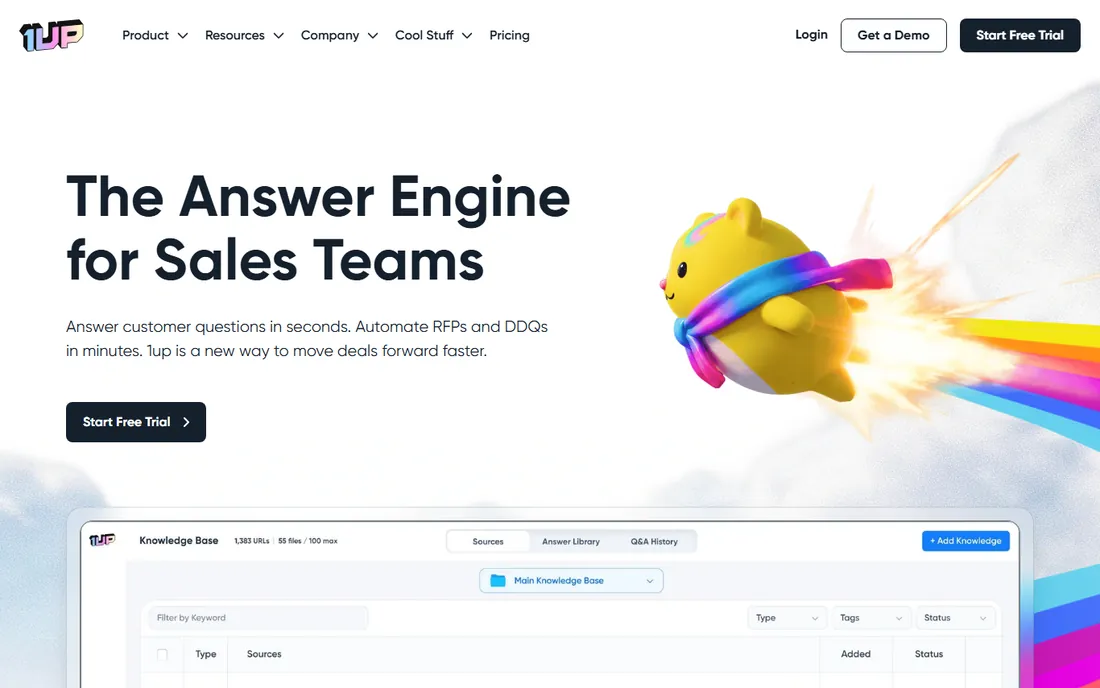
1up positions itself as an AI knowledge platform rather than just an RFP tool, which turns out to be a sensible design. It connects to your documentation, help center, website, and Slack, keeps the knowledge base fresh automatically, and then answers RFPs, security questionnaires, and internal questions from that same source of truth. A free plan with real usage limits makes it easy to test.
The practical benefit is maintenance. Traditional RFP libraries decay because updating them is manual work; a system that re-syncs from live sources stays current with less effort. The thing to check in a trial is accuracy on your hardest questions: connect your actual sources, run a real questionnaire through it, and review every answer. AI that cites its sources earns trust fast, and 1up's model is built around that verification loop.
What we like- Free plan lets teams test real AI answers
- Knowledge base syncs from docs, help center, and Slack
- Handles RFPs, security questionnaires, and internal Q&A
Watch out for- Public pricing details are thin beyond the free tier
- Answer quality depends on the sources you connect
#5
Arphie
Best for: Startups and lean teams automating RFPs quickly
Visit arphie.ai
Starting priceSee website
Free planNo (demo available)
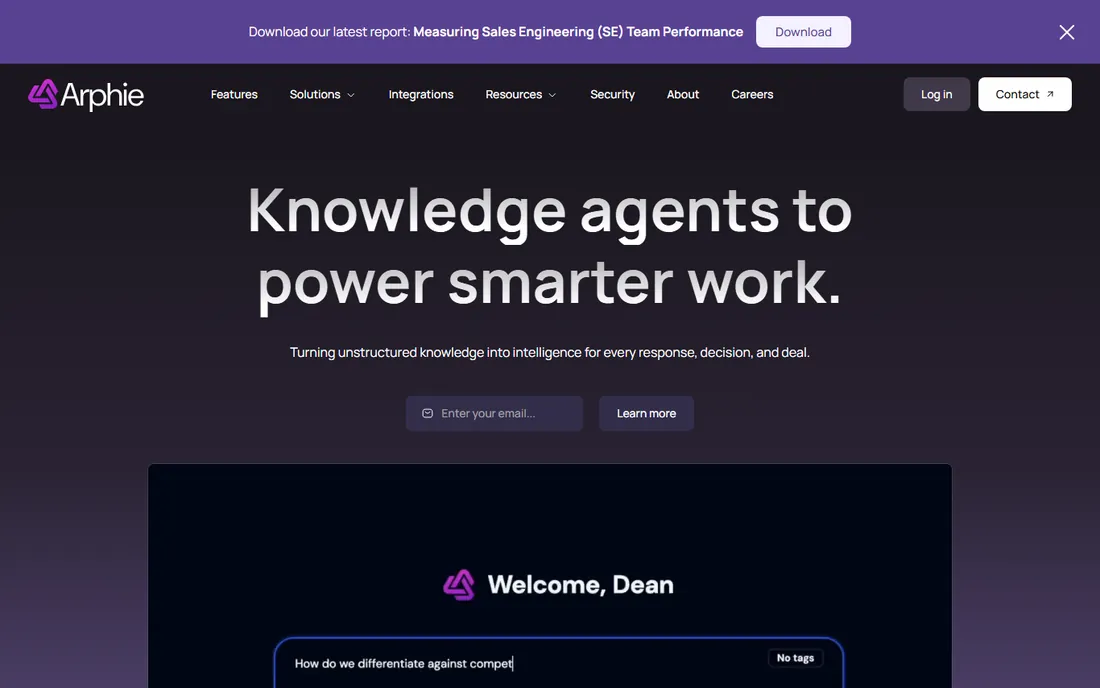
Arphie is built for the company that just started losing deals to RFP requirements it cannot staff. Setup is fast: connect your documents and website, and the AI starts drafting answers to incoming questionnaires. It covers the core document types, RFPs, RFIs, and security questionnaires, without asking a five-person team to run an enterprise workflow.
Set expectations accordingly. Arphie gets you from zero to drafted answers quickly, which is exactly what a lean team needs. It does not provide the approval chains, content expiry management, and deep CRM integrations that a 50-person proposal operation relies on. If your RFP volume grows into that territory later, plan for a migration; if it stays at a few a month, Arphie may be all you ever need.
What we like- Quick setup aimed at teams without proposal staff
- AI drafts from your existing documents and website
- Covers RFPs, RFIs, and security questionnaires
Watch out for- Lighter content governance than enterprise platforms
- Smaller integration catalog than the incumbents
#6
Ombud
Best for: Content-centric teams managing sales knowledge
Visit ombud.com
Starting priceSee website
Free planNo (demo available)
Ombud comes at the problem from the knowledge side: it is a content collaboration platform where technical teams create, approve, and maintain the answers that sales needs, and AI assists in drafting and reusing that content across RFPs and proposals. Solutions engineers and technical sellers are the core users, and the approval workflows reflect how technical content actually gets vetted.
This orientation suits organizations where the bottleneck is content quality rather than drafting speed. If your answers are outdated, inconsistent, or stuck in engineers' heads, Ombud's authoring and governance model addresses the root cause. If your library is already solid and you mainly need faster questionnaire completion, the AI-native drafting tools will feel more direct.
What we like- Strong content management with approval workflows
- AI-assisted authoring for technical responses
- Used by technical sales and solutions teams
Watch out for- Positioned more as content platform than pure RFP tool
- Pricing is quote-based with no public figures
#7
Qvidian
Best for: Large sales orgs with proposal and content needs
Visit qvidian.com
Starting priceSee website
Free planNo (demo available)
Qvidian is one of the oldest names in proposal automation, now part of Upland Software, and it covers the full arc from content management to proposal creation to analytics. Large sales organizations use it to standardize proposals, manage approved content, and measure what works. The feature depth built over decades is real.
The honest assessment is that Qvidian reads as a mature enterprise suite in a market being reshaped by AI-native startups. If your organization already runs Upland products, needs proven proposal workflows at scale, and values stability over novelty, it remains a credible choice. If your priority is AI drafting quality and fast deployment, the newer tools on this list will feel like they were built for a different era, because they were.
What we like- Long-established proposal automation with deep features
- Content library plus guided selling and analytics
- Backed by Upland's enterprise software portfolio
Watch out for- Interface reflects its long history more than modern AI tools
- Enterprise sales process with custom pricing
#8
Inventive.ai
Best for: Sales teams automating RFPs and security reviews
Visit inventive.ai
Starting priceSee website
Free planNo (demo available)
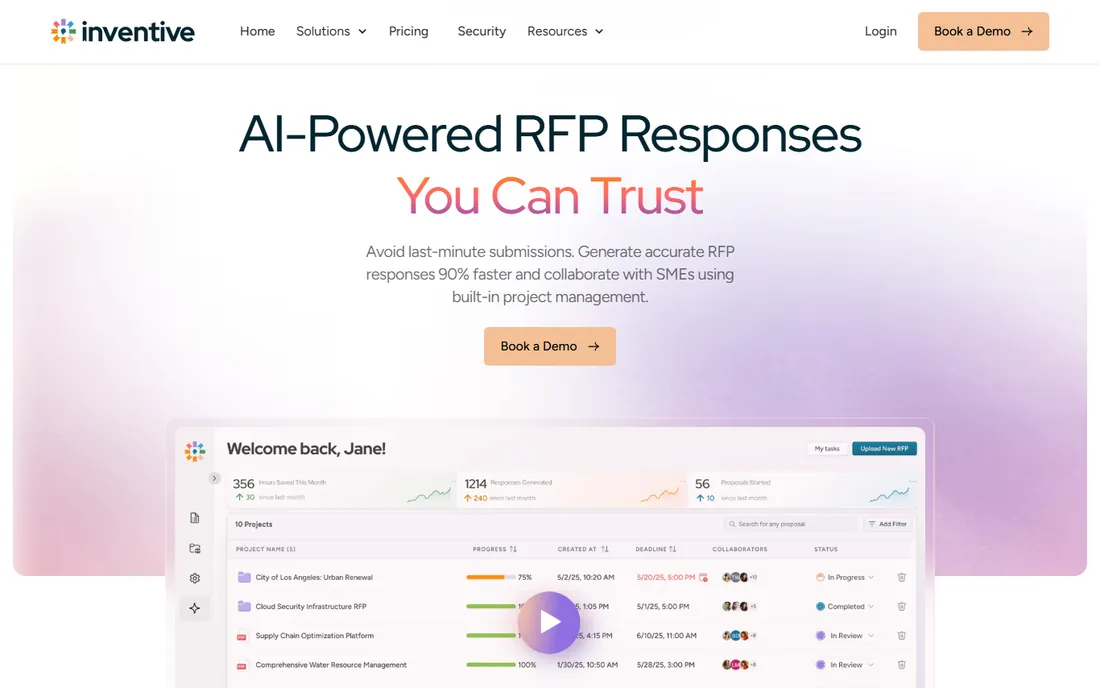
Inventive.ai fields AI agents that work across the questionnaire types sales teams face: RFPs, due diligence questionnaires, and security reviews. The pitch is end-to-end automation of the manual work around questionnaires, from parsing incoming documents to drafting answers to routing for approval, integrated with the tools sales and security already use.
As a newer entrant, it competes on AI capability and focus rather than installed base. That makes the evaluation straightforward: run your ugliest recent questionnaire through it, compare the draft quality and review effort against your current process, and talk to reference customers in your size band. The category is moving fast enough that a strong product from a young company can be the right bet, as long as you verify rather than assume.
What we like- AI agents handle RFPs, DDQs, and security questionnaires
- Integrates with the sales and security stack
- Aimed at reducing manual questionnaire work broadly
Watch out for- Newer entrant with less public customer proof
- Pricing requires a sales conversation
How pricing works in this category
Almost nobody publishes prices, which tells you something about how these tools are sold. Enterprise platforms price per user or per workspace, scaled by team size and modules, and the annual contract for a mid-size proposal team typically lands in the tens of thousands. Implementation and content migration are often quoted separately.
The exceptions are worth noting. AutoRFP.ai publishes $899 a month. 1up offers a genuinely usable free plan. These transparent options put pressure on the rest of the market and give smaller teams a way in without a procurement cycle. When you do talk to enterprise sales, ask what is included: AI drafting features, security questionnaire modules, and advanced analytics are sometimes separate line items.
How we chose
We started with the vendors that appear most often in buyer evaluations, G2 and Capterra rankings, and sales community discussions about RFP automation, then verified each product is actively sold and maintained in 2026. Pricing details come from vendor pages where published; AutoRFP.ai's $899/month figure is from its own site, which is unusual enough in this category to be worth calling out. Where vendors keep pricing behind sales conversations, we say so rather than repeating third-party estimates.
What to check before you buy
Start with a real questionnaire, not a demo script. Every vendor's AI looks good on a clean sample RFP. Bring your last painful one: the 200-question spreadsheet with merged cells, the security questionnaire with questions your product team dreads, the DDQ with financial tables. Run it through the trial and measure two things: how many answers needed no edits, and how long review took versus your current process.
Next, examine the content maintenance story. An RFP tool is only as good as its library six months after launch. Ask how content gets updated when products change, who gets notified when an approved answer expires, and whether the system flags answers that contradict newer sources. Tools that sync from live documentation have a structural advantage here over tools that depend on manual library upkeep.
Finally, check the approval and audit trail. Regulated buyers and enterprise customers expect to see who approved each answer and when. Confirm the workflow supports your actual review chain, that exports preserve the audit record, and that permissions keep draft answers away from people who should not see them. Security review of the vendor itself is standard at this point: ask for their SOC 2 report early, because your infosec team will ask you for it.
Frequently asked questions
What does AI RFP software actually do?
It stores your approved answers in a content library, then uses AI to draft responses to new RFPs, RFIs, DDQs, and security questionnaires automatically. Your team reviews, edits, and approves the drafts. Over time the system improves as it learns from your corrections and as the library stays current.
How much does AI RFP software cost?
Most enterprise vendors use quote-based pricing that scales with team size, typically reaching tens of thousands per year for mid-size teams. AutoRFP.ai publishes $899/month, and 1up offers a free plan. Always ask whether AI features, security questionnaire modules, and implementation are included in the quoted price.
Can it handle security questionnaires too?
Yes, most tools on this list cover security questionnaires alongside RFPs, and several market it as a core use case. Security questionnaires have their own quirks, such as evidence attachments and recurring formats like SIG and CAIQ, so confirm the tool supports the specific formats your customers send.
How long does implementation take?
AI-native tools can be productive within days of connecting your documents. Enterprise platforms typically take several weeks to a few months, mostly spent migrating and cleaning the content library. The content work is the long pole; the software itself is rarely the bottleneck.
Will AI answers be accurate enough to send to customers?
They are accurate enough to accelerate your process, not to skip review. Treat AI drafts as a strong first pass: expect your team to verify technical claims, pricing, and anything legally sensitive. Accuracy improves markedly when the knowledge base is current and well-organized, which is why content maintenance matters more than model choice.
Sources we checked (8)
- https://responsive.io/
- https://loopio.com/
- https://autorfp.ai/
- https://1up.ai/
- https://arphie.ai/
- https://ombud.com/
- https://www.qvidian.com
- https://inventive.ai/
Is your product missing or out of date?
We review this list regularly. Vendors can request a listing, send updated pricing or ask about featured placement.

Shihab Mia · Founder, Rankite
Shihab has spent more than a decade helping SaaS and e-commerce brands grow through search. He writes Rankite's software buying guides from pricing pages, documentation and public user reviews. More about Shihab.