How we make this list: we compare pricing pages, product documentation and public user reviews. Rankite is independent; if a vendor ever pays for a featured spot, that listing is clearly labeled Partner.
Key takeaways
- mabl and Tricentis Testim lead on AI self-healing, but both are quote-only, so budget a sales cycle and ask for written pricing against the same run volume.
- Functionize is the transparency outlier: published plans start at $20 per month with a free tier, while most AI testing vendors hide prices entirely.
- Katalon publishes per-seat pricing from $70 per seat per month and covers web, mobile, API and desktop in one platform, which suits mixed QA teams.
- If you need a real-device grid plus AI test authoring, LambdaTest (now TestMu AI) undercuts BrowserStack and Sauce Labs on entry price at $15 per month.
Quick comparison
| Tool | Best for | Starting price | Free plan |
|---|
 mabl mabl | Teams with frequently changing UIs and heavy test maintenance | See website | Free trial |
 Tricentis Testim Tricentis Testim | Enterprises already invested in the Tricentis suite | See website | Yes (Community) |
 Functionize Functionize | Teams that want agentic testing without an enterprise sales call | $20 per month (Growth) | Yes |
 Applitools Applitools | Teams drowning in false-positive visual diffs | $667 per month (Starter, billed annually) | Free trial (14 days) |
 LambdaTest (TestMu AI) LambdaTest (TestMu AI) | Budget-conscious teams that want a grid plus AI authoring | $15 per month (Live) | Yes |
 Katalon Katalon | Mixed QA and engineering teams testing everything | $70 per seat/month (True Platform, billed annually) | Free trial |
 BrowserStack BrowserStack | Teams that need the widest device and browser coverage | $29 per month (Live) | Free trial |
 Sauce Labs Sauce Labs | Regulated enterprises that need compliance and analytics | $39 per month (Live, billed annually) | Free trial |
 Autify Autify | Non-technical QA teams that want no-code automation fast | See website | Yes |
Is your product missing or out of date?
We review this list regularly. Vendors can request a listing, send updated pricing or ask about featured placement.
#1
mabl
Best for: Teams with frequently changing UIs and heavy test maintenance
Visit mabl.com
Starting priceSee website
Free planFree trial
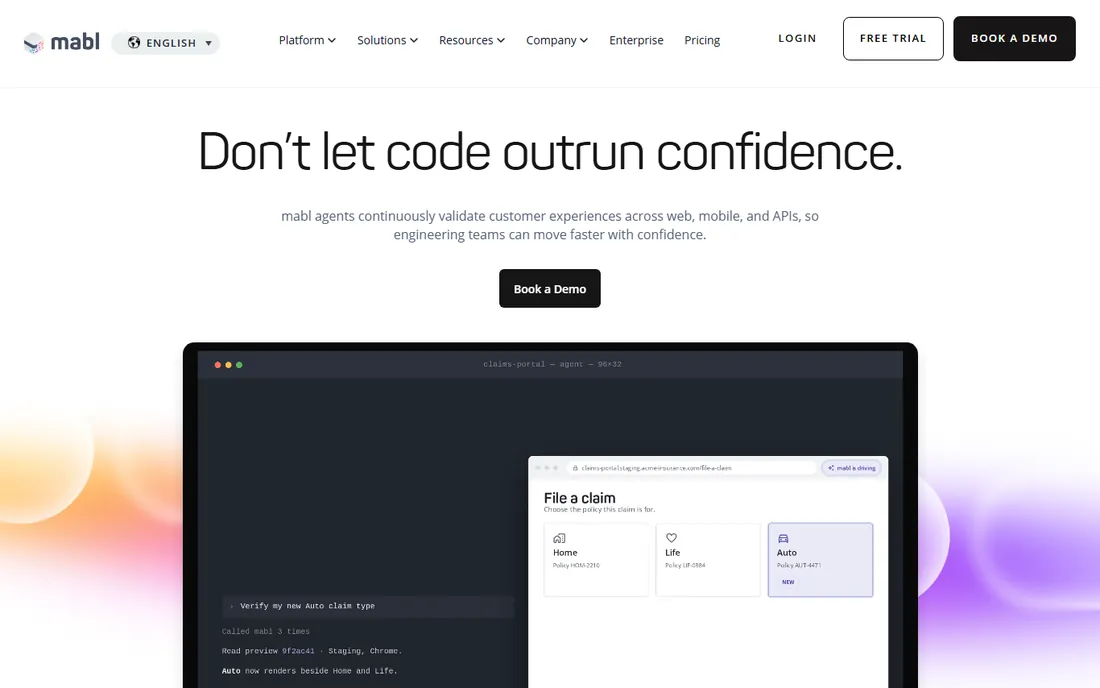
mabl is the reference point for AI-first test automation. Its machine-learning engine heals broken locators automatically, and its agentic runtime recovery can adapt mid-run when a flow goes sideways, then produce failure summaries with root-cause insights. Local and CI runs are unlimited and free, and cloud runs consume credits starting at 500 per month.
The commercial model is the friction. mabl publishes no prices, and you cannot try it against your real application before a sales conversation. Mobile testing costs extra, which matters if your roadmap includes native apps. For teams where UI churn eats QA hours every sprint, the self-healing alone can justify the quote. Everyone else should compare against a published-price rival first.
What we like- AI auto-healing repairs tests when the UI changes
- Unified web, API, accessibility and performance testing
- Unlimited local and CI runs plus unlimited viewer licenses
Watch out for- No published pricing, every plan is a custom quote
- Native mobile testing is a paid add-on
#2
Tricentis Testim
Best for: Enterprises already invested in the Tricentis suite
Visit testim.io
Starting priceSee website
Free planYes (Community)
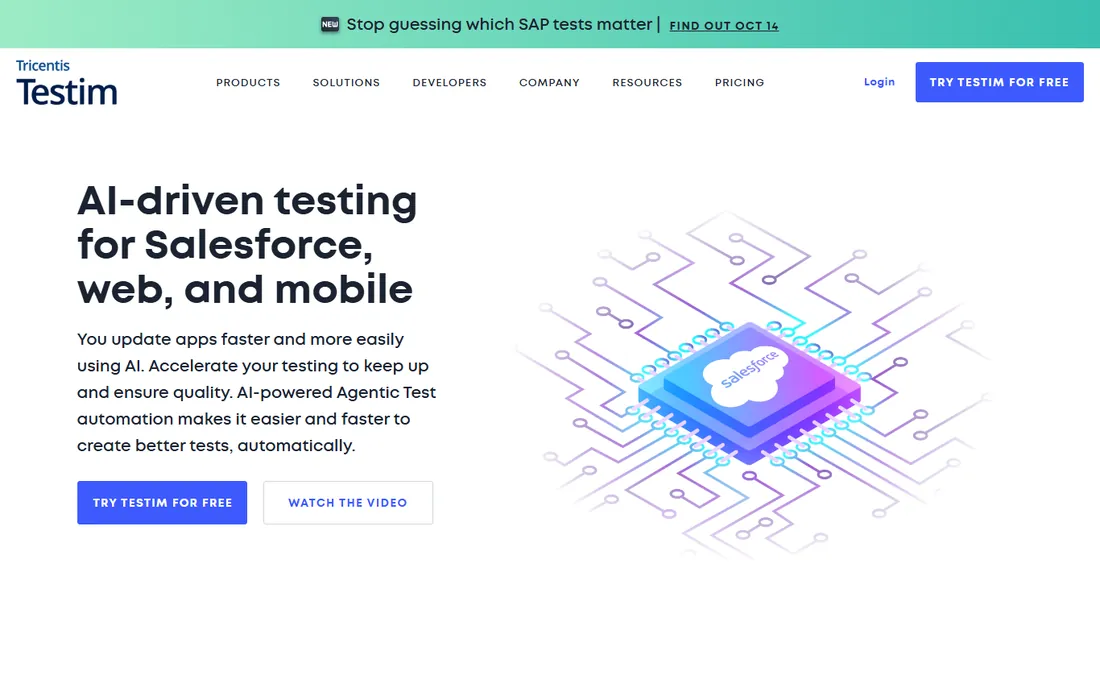
Testim takes a different route to the same problem. Its smart locators learn from every execution, so tests stay stable when element attributes change, and the visual canvas lets QA teams record and edit tests without writing code. Since the Tricentis acquisition, the product has split into Web, Mobile and Salesforce editions, with the Salesforce tier aimed squarely at admins managing customizations.
The honest catch is opacity and price. Paid pricing is quote-only, with reported enterprise contracts running $30,000 to $50,000 a year, and several reviewers note that AI-generated locators make it difficult to explain why a test failed. The free Community plan is real, though limited to one per organization. Testim makes most sense where Tosca or qTest already anchor the QA stack.
What we like- Smart Locators combine DOM metadata, ML and visual context for stability
- Free Community plan for one organization
- Deep integration with Tosca and qTest
Watch out for- All paid tiers are quote-only
- AI-based locators can make failures hard to explain
#3
Functionize
Best for: Teams that want agentic testing without an enterprise sales call
Visit functionize.com
Starting price$20 per month (Growth)
Free planYes
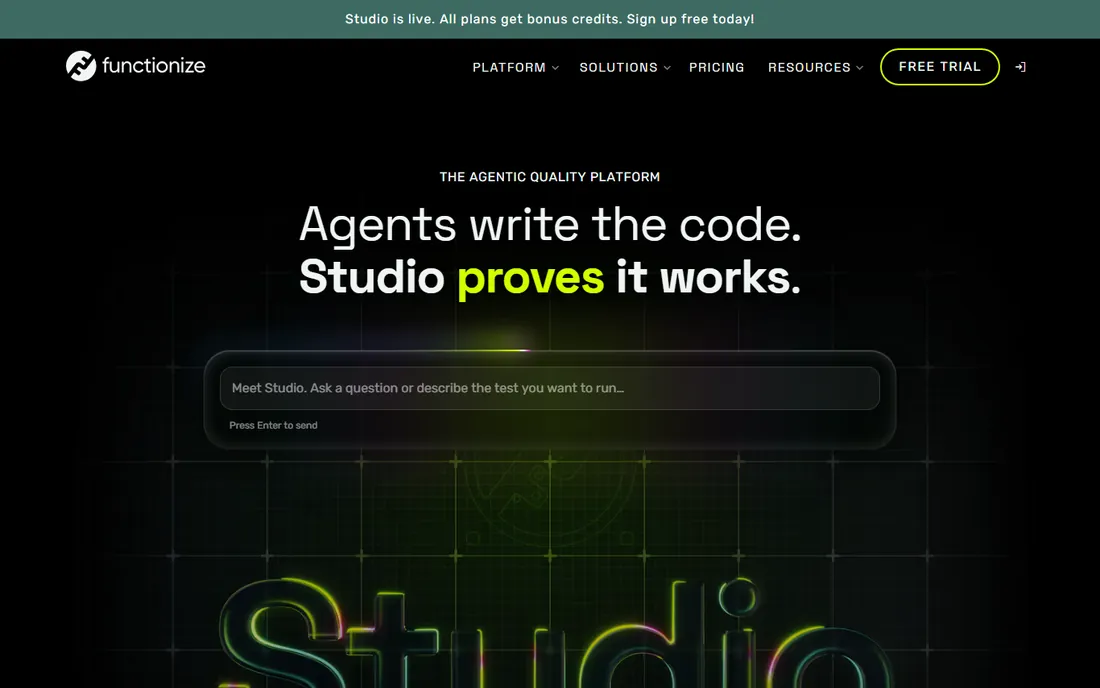
Functionize publishes what its competitors hide: the price. Its pricing page lists a free plan, Growth at $20 per month, Scale at $100 per month, and a custom Enterprise tier. The product describes itself as an independent testing agent: you describe what to test in plain language, and it builds, runs and keeps the tests green, with agentic actions such as creating, executing, diagnosing and fixing tests consuming credits.
The catch is the meter. Credits are not a universal number-of-tests metric, so you need to map your run volume and parallel-run needs against the credit pools before comparing with seat-based tools. For a team that wants to evaluate AI testing self-serve this week, Functionize is the easiest entry point in this list.
What we like- Published pricing with a free tier
- Plain-language test creation that builds and maintains tests
- Pay only for the agent actions you use
Watch out for- Credit metering requires mapping agentic actions to your workload
- Smaller vendor with a narrower integration footprint
Starting price$667 per month (Starter, billed annually)
Free planFree trial (14 days)
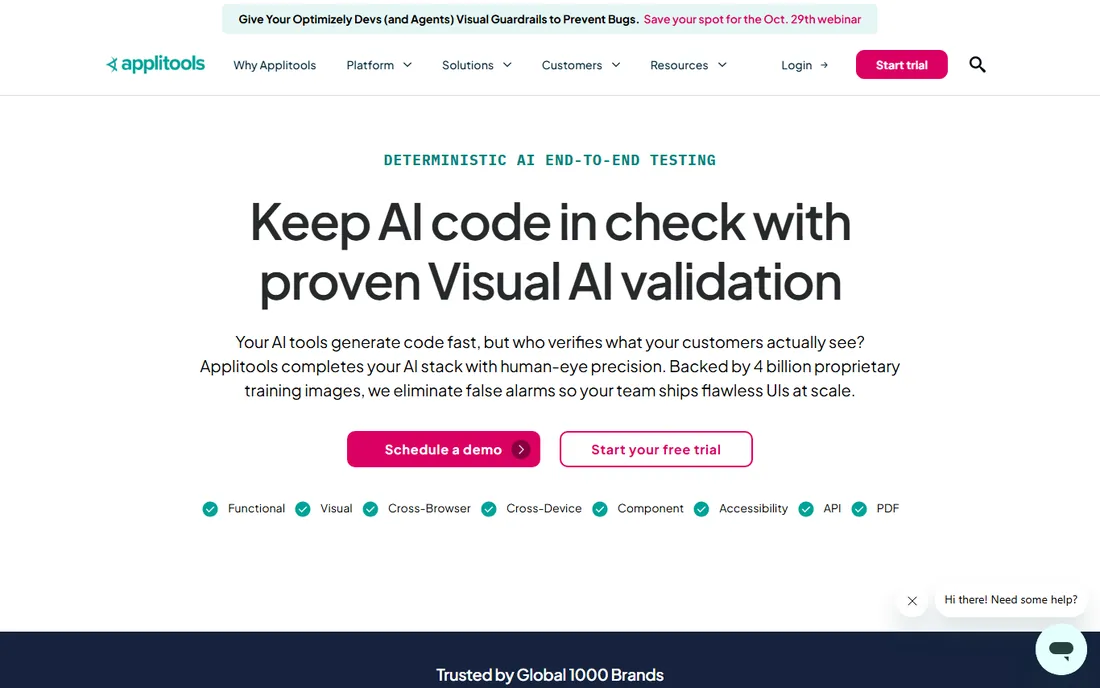
Applitools does not run your tests; it watches them. Its Visual AI compares screenshots with match levels for strict, layout, content and exact comparison, filtering out anti-aliasing and rendering noise that drown reviewers in false positives. The Ultrafast Grid renders checks across browsers in parallel, and the platform bolts onto whatever framework you already use.
The Starter plan is published at $667 per month billed annually, covering 100,000 component checkpoints or 1,000 page checkpoints with unlimited users. Everything above Starter is quoted. There is no free plan, only a 14-day trial capped for evaluation. Applitools earns its cost for large suites across many browsers; for a small suite, a cheaper diff engine usually suffices.
What we like- Visual AI ignores rendering noise that pixel diffs flag
- Ultrafast Grid runs cross-browser checks in parallel
- One published price, no guessing on the entry tier
Watch out for- No free plan
- Professional and Enterprise tiers are quote-only
- Real-device testing is an Enterprise add-on
#5
LambdaTest (TestMu AI)
Best for: Budget-conscious teams that want a grid plus AI authoring
Visit lambdatest.com
Starting price$15 per month (Live)
Free planYes
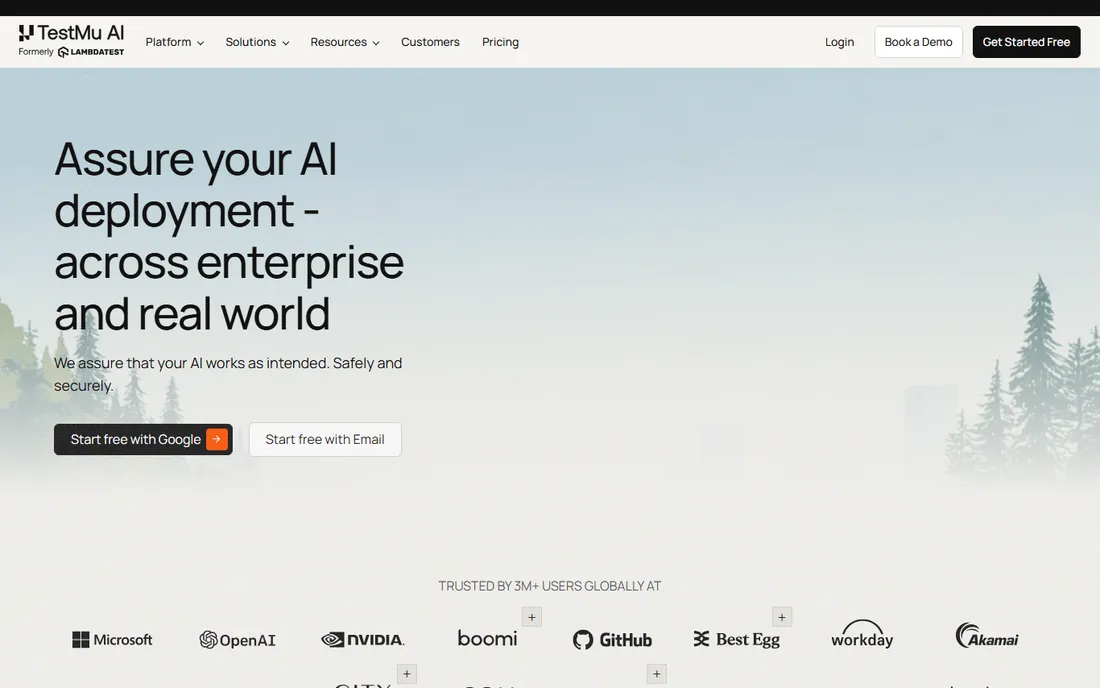
LambdaTest rebranded to TestMu AI in 2026, but the pitch is unchanged: the most aggressive pricing in cloud testing plus fast feature velocity. The classic Live plan starts at $15 per month, and KaneAI, the GenAI-native QA agent, plans tests from plain-language prompts and exports them to Selenium, Playwright or Appium. A permanent free tier covers limited live sessions and automation minutes.
The honest catch is that the headline price covers the basics. Automation-focused plans, parallel sessions and HyperExecute execution minutes push the real bill higher, and heavy teams end up nearer the team-tier rates. Still, for lean QA teams that need 3,000-plus browser and OS combinations without an enterprise contract, the pricing-to-performance ratio is hard to beat.
What we like- Lowest entry price in the cloud-grid category
- KaneAI generates tests from plain-English prompts
- HyperExecute speeds up large suites
Watch out for- Rebrand to TestMu AI in 2026 may confuse procurement
- Advanced concurrency costs rise fast with team size
#6
Katalon
Best for: Mixed QA and engineering teams testing everything
Visit katalon.com
Starting price$70 per seat/month (True Platform, billed annually)
Free planFree trial
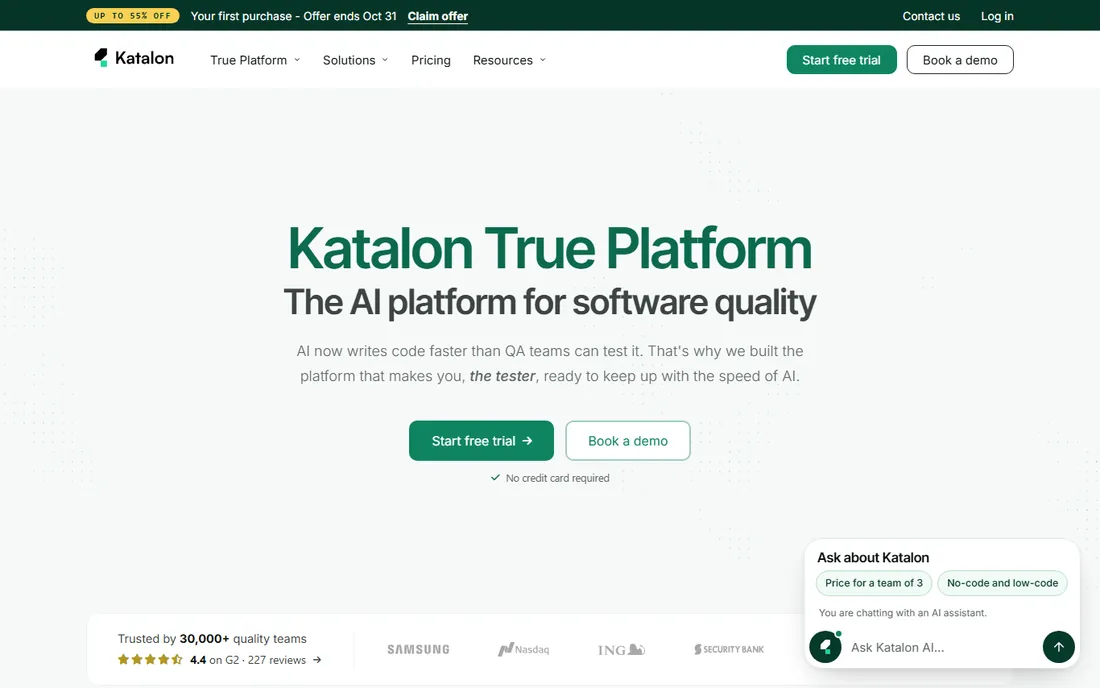
Katalon is the all-rounder for teams that test web, mobile, API and desktop without buying four tools. Studio offers no-code recording with low-code extensibility, the AI assistant converts natural-language descriptions into executable test cases, and True Production Insights maps real user journeys against regression coverage. Pricing is published: True Platform from $70 per seat per month online, True Automation higher, with a discounted Starter bundle for first purchases.
The catch is the seat math. Per-seat pricing compounds fast as the team grows, and reviewers note performance strain on very large suites. Advanced AI features, including the production-insights add-on, are gated behind higher tiers. Katalon suits organizations standardizing on one platform; teams that only need web testing will find lighter and cheaper options.
What we like- Covers web, mobile, API and desktop in one platform
- Gentle path from no-code recording to full scripting
- AI assistant turns descriptions into test cases
Watch out for- Cost climbs quickly with seat count
- Large suites can feel heavy
- Advanced AI features sit on higher tiers
Starting price$29 per month (Live)
Free planFree trial
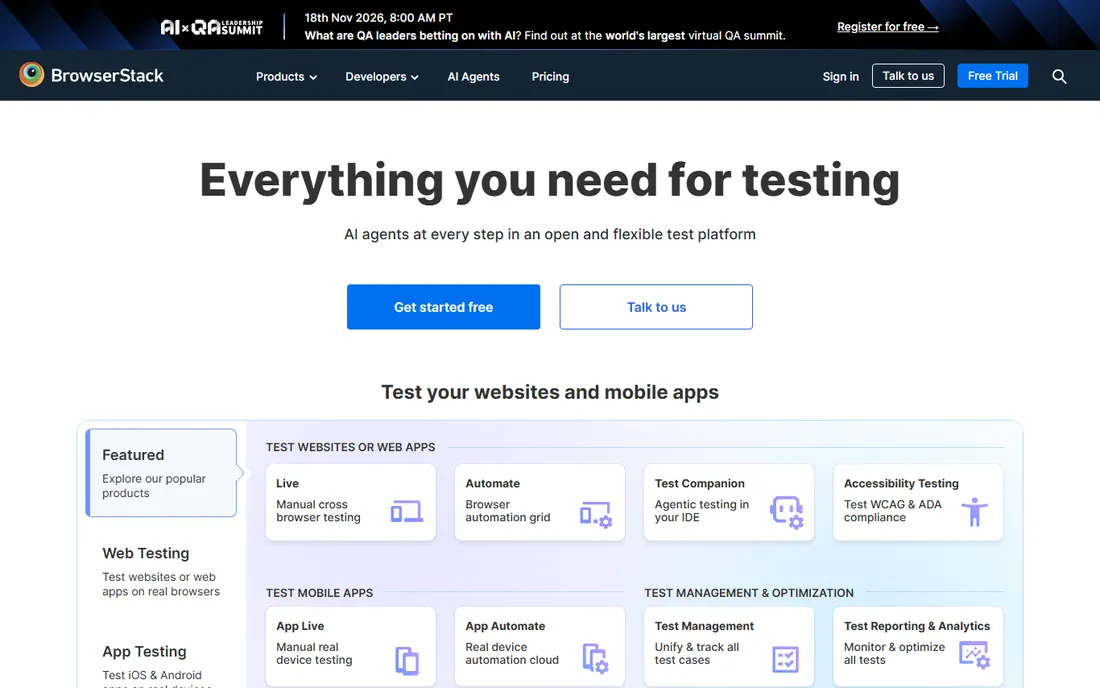
BrowserStack sells the grid, not the tests. Live starts at $29 per month for manual cross-browser testing, and Automate starts at $129 per month per parallel session for automated runs. The catalog is the industry's largest: thousands of browser and OS combinations, 30,000-plus real mobile devices, and every major CI integration. Percy contributes visual testing with a free tier of 5,000 screenshots a month.
The catch is cost at scale. Parallelism is the key price driver, and teams running many concurrent sessions face enterprise quotes that reviewers call prohibitive. BrowserStack's AI angle is thinner than the pure AI vendors here, though Percy now includes a visual review agent that filters false positives. Choose it for infrastructure breadth, not for AI authoring.
What we like- 3,000-plus browser and OS combinations plus tens of thousands of real devices
- Strong Playwright support
- Percy and Test Management have permanent free tiers
Watch out for- Pricing rises steeply with parallel sessions
- Consistently cited as expensive by smaller teams
#8
Sauce Labs
Best for: Regulated enterprises that need compliance and analytics
Visit saucelabs.com
Starting price$39 per month (Live, billed annually)
Free planFree trial
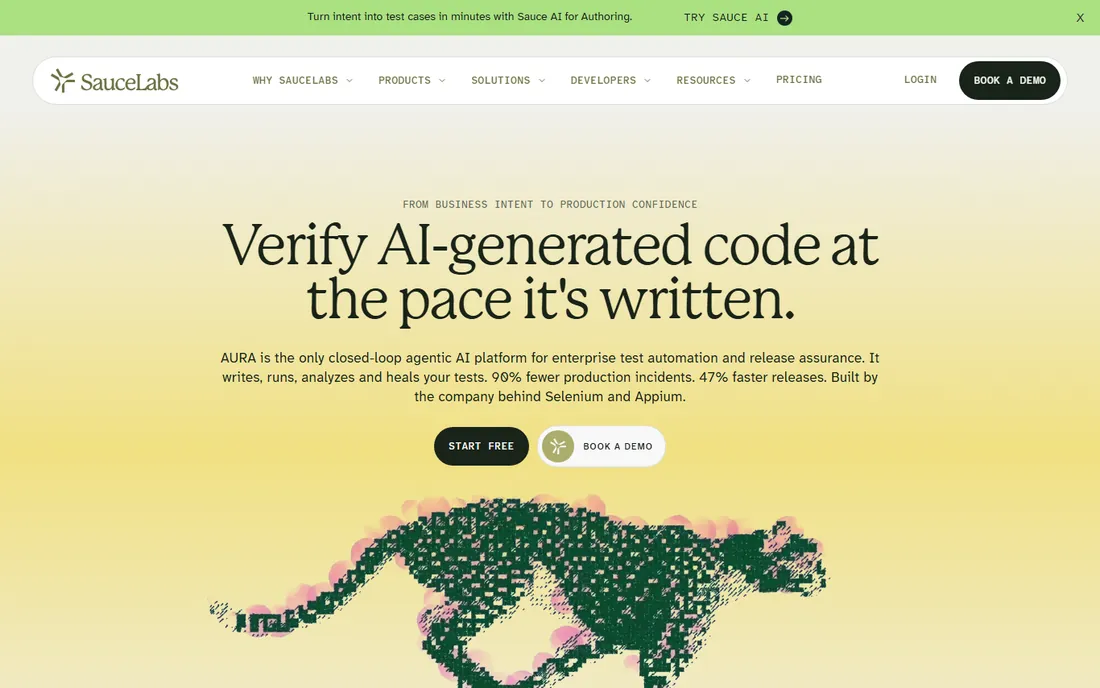
Sauce Labs is the enterprise answer to the same question BrowserStack answers. Live Testing starts at $39 per month billed annually for manual testing, Virtual Cloud at $149 for automation on browsers and emulators, and Real Device Cloud at $199 for physical devices. Every plan allows unlimited users and testing minutes, with cost tracking the number of parallel tests instead.
The analytics and error reporting are genuinely deeper than rivals, which is why regulated industries stay. The catch is the tier maze. The advertised $39 plan covers manual testing only with no automation at all, real devices require the separate $199 tier, and the AI features sit behind Enterprise. For compliance-heavy teams the premium is defensible; for startups it is usually overkill.
What we like- Deep analytics and error reporting
- Unlimited minutes and users on every plan
- Strong compliance posture with SOC 2 and ISO certifications
Watch out for- Automation starts at $149 per month for Virtual Cloud
- AI agents are gated to Enterprise
- Real devices need the separate $199 per month tier
#9
Autify
Best for: Non-technical QA teams that want no-code automation fast
Visit autify.com
Starting priceSee website
Free planYes
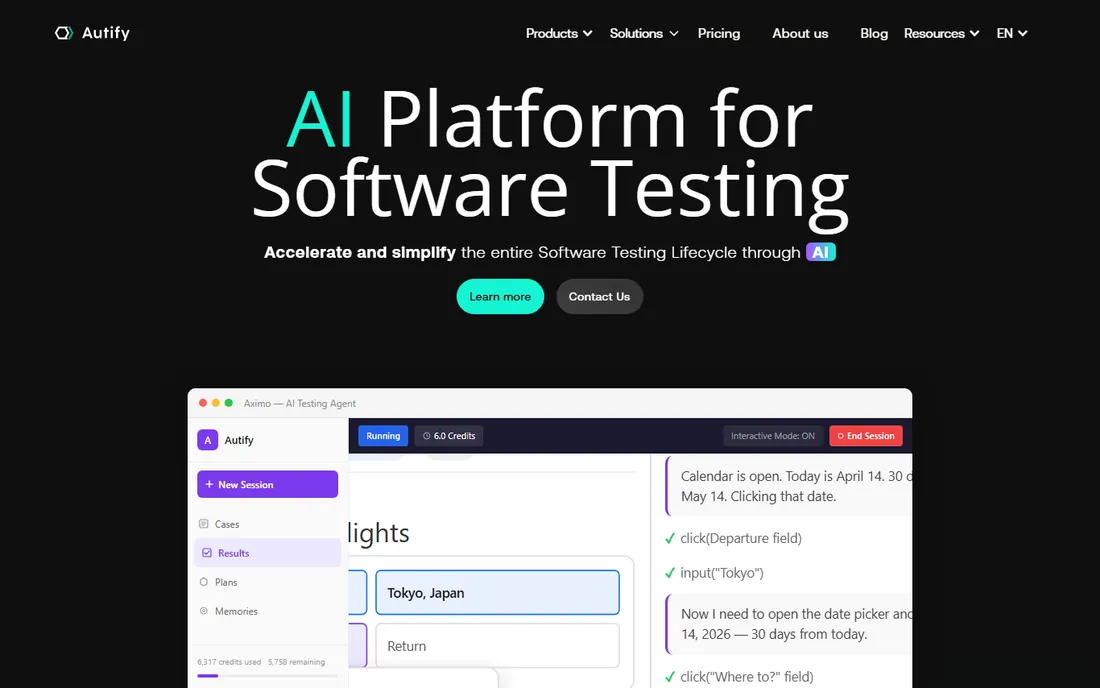
Autify is the friendliest on-ramp for non-technical QA teams. You record tests by clicking through your app in a browser extension, and the platform captures every click and text input without selectors. AI maintains the tests as the UI changes. The free plan includes 1,000 monthly credits, and paid tiers scale with credits and concurrency.
The catch is pricing transparency. Published figures vary across sources, with paid tiers reported from around $120 to $550 per month, so treat the vendor's pricing page as the only source of truth. Autify was founded in Japan and keeps strong momentum in APAC markets. For teams where the QA staff are not engineers, the recording workflow removes the biggest adoption barrier.
What we like- Record tests by clicking in a browser extension, no code needed
- Free tier with 1,000 monthly credits
- Covers web, mobile and desktop apps
Watch out for- Paid tiers are credit-based and poorly documented publicly
- Advanced features like unlimited runs require higher plans
How we chose
We reviewed vendor pricing pages, public documentation and 2026 buyer guides, focusing on tools with genuine AI capabilities: self-healing locators, AI test generation, visual AI or agentic authoring. We checked whether pricing is published or quote-only, verified free tiers and trial terms, and read user reviews on G2, Capterra and TrustRadius for maintenance burden and failure-explainability complaints. We did not claim hands-on testing. Only tools that exist today and fit AI-powered test automation made the list.
How the AI features actually differ
Not all AI testing is the same technology, and the label hides real differences.
Self-healing locators
mabl, Testim and Katalon use ML to repair tests when the UI changes. mabl heals at runtime with agentic recovery, while Testim combines DOM metadata, ML and visual context. The shared risk: silently healed tests can mask real regressions, so review what the AI changed.
AI test generation
Functionize and LambdaTest's KaneAI generate tests from plain-language descriptions. This helps teams with no automation engineers, but the output still needs review against your app's actual behavior before it joins the pipeline.
Visual AI
Applitools and BrowserStack's Percy use AI to decide which visual differences matter, cutting false positives. These are diff engines, not test runners, so budget them as an add-on to your existing framework.
Credit metering
mabl, Functionize and Autify meter cloud execution with credits rather than seats. That model fits bursty CI workloads, but you must map the vendor's metered actions to your run volume before signing.
What to budget beyond the subscription
The subscription is rarely the whole bill. Quote-only vendors such as mabl, Testim and Sauce Labs typically land in five figures annually at team scale, and parallel sessions multiply the cost on every grid vendor. Add implementation time: AI tools reduce maintenance, but the initial setup, training the AI on your app and integrating with CI still takes weeks. Finally, check what the free tier or trial actually covers. A trial that excludes your real application tells you nothing about the maintenance savings that justify the price.
Frequently asked questions
Do AI test automation tools replace QA engineers?
No. They reduce the maintenance burden, which surveys put as QA teams' top complaint, but someone still designs test strategy, reviews AI-generated tests and investigates real failures. The tools change what QA staff spend time on, not whether you need them.
What is self-healing test automation?
It is ML that repairs test locators when the UI changes, so tests keep passing after a redesign instead of failing on renamed elements. mabl, Testim and Katalon all offer it. The tradeoff is explainability: when a healed test fails, diagnosing the cause can be harder.
Which is cheaper for a small team, mabl or Katalon?
Katalon publishes its prices, starting from $70 per seat per month, so you can budget it directly. mabl is quote-only, and industry reporting puts entry around $499 per month. Functionize, at $20 per month with published plans, is cheaper than both for small teams.
Can these tools test mobile apps?
Most can. Katalon, LambdaTest, BrowserStack and Sauce Labs cover native mobile testing. mabl charges extra for native mobile as a paid add-on. Autify supports mobile apps on its platform. Confirm whether mobile is included or an add-on before you sign.
Do I need coding skills to use AI test automation tools?
Not for the no-code options. Autify, mabl and Testim let you record or describe tests without code. Katalon and Functionize offer a path from no-code to full scripting. Applitools assumes you already have a test framework it can watch.
How does credit-based pricing work?
Vendors meter cloud test runs with credits instead of seats. mabl starts plans at 500 credits per month, Functionize meters agentic actions like creating and fixing tests, and Autify's free tier includes 1,000 monthly credits. Unlimited local and CI runs are typically free; you pay when the vendor's cloud executes.
Sources we checked (11)
- https://qodex.ai/blog/mabl-vs-testrigor
- https://github.com/arjun0606/smolanalytics/blob/HEAD/research/FIELD_INCUMBENTS_AND_FREE.md
- https://www.functionize.com/pricing
- https://www.testmuai.com/applitools-alternative/
- https://costbench.com/software/browser-testing/lambdatest/
- http://katalon.com/pricing
- https://www.g2.com/products/katalon/pricing
- https://bug0.com/knowledge-base/browserstack-pricing
- https://qodex.ai/blog/sauce-labs-alternatives
- https://www.getapp.com/it-management-software/a/autify/
- https://robonito.com/blog/post/mabl-alternatives/
Is your product missing or out of date?
We review this list regularly. Vendors can request a listing, send updated pricing or ask about featured placement.

Shihab Mia · Founder, Rankite
Shihab has spent more than a decade helping SaaS and e-commerce brands grow through search. He writes Rankite's software buying guides from pricing pages, documentation and public user reviews. More about Shihab.