How we make this list: we compare pricing pages, product documentation and public user reviews. Ratings come from G2, Capterra or Trustpilot, with the date we checked them.
Key takeaways
- AI image detectors estimate whether an image was AI generated, but no detector is fully reliable, so treat scores as signals, not proof.
- Hive Moderation and Sightengine lead on API and moderation use, while Is It AI and AI or Not suit quick manual checks.
- Accuracy drops on edited, compressed, or cropped images, since edits remove the traces detectors look for.
- Combine detectors with metadata checks, reverse image search, and source verification for important decisions.
- Never accuse a creator based on one detector score alone, since false positives happen, especially with heavily edited photos.
Quick comparison
Is your product missing or out of date?
We review this list regularly. Vendors can request a listing, send updated pricing or ask about featured placement.
Starting priceSee website
Free planFree trial

Hive Moderation, from Hive AI, offers machine learning models that classify AI generated images, deepfakes, and other content through an API. Platforms use Hive to moderate uploads at scale, with scores for AI generation alongside NSFW, violence, and other classifiers. The API suits apps, marketplaces, and social platforms that check many images daily.
Pricing is quote based and setup needs developers, so casual users may prefer a free web checker. For a platform that needs programmatic AI image detection at scale, Hive offers strong models and moderation depth.
What we like- API first
- Image and video models
- Moderation suite
Watch out for- Pricing by quote
- Setup needs developers
Starting priceFree
Free planFree

Illuminarty provides a free web tool that estimates whether an uploaded image was AI generated, with a simple upload and a quick probability score. The tool suits journalists, teachers, and curious users who want a fast check without signing up. Results arrive in seconds for common image formats.
Accuracy varies by image type, and edited or compressed images fool it more often, as with all detectors. No API serves casual users, though the web tool covers manual checks. For a quick free check on a suspicious image, Illuminarty gives a useful first signal.
What we like- Free web checks
- Simple upload
- Fast results
Watch out for- Accuracy varies
- No API for casual users
Starting priceFree
Free planFree
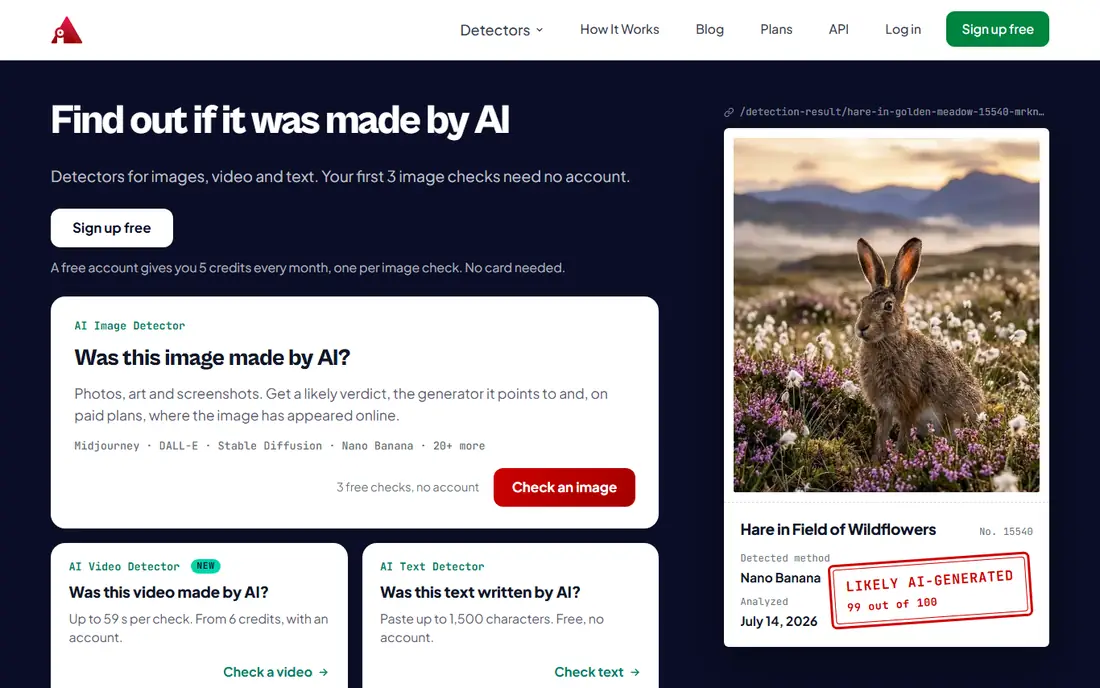
Is It AI offers free AI generated image detection through a simple web upload, returning a score for whether an image looks AI generated. The interface needs no signup for basic checks, which suits quick verification of a single image. The tool also covers text and other content types in related checkers.
Detail is limited compared with API platforms, and accuracy limits apply, especially for edited photos and newer generators. For a fast, free, no signup check, Is It AI covers the basics well.
What we like- Free checks
- Simple interface
- No signup for basics
Watch out for- Limited detail
- Accuracy limits apply
Starting priceSee website
Free planFree trial
Sightengine provides a content moderation API with an AI generated image model alongside NSFW, violence, and other classifiers. Platforms integrate Sightengine to screen uploads, with scores and thresholds they tune to their risk level. The API handles images and video, with documentation for common languages.
Pricing is quote based and setup needs developers, so it suits platforms rather than casual users. For a moderation pipeline that needs AI generation detection beside other safety checks, Sightengine offers a broad, API first solution.
What we like- Moderation API
- AI generation model
- Image and video
Watch out for- Pricing by quote
- Setup needs developers
Starting priceFree
Free planFree
AI or Not offers a free web checker that estimates whether an image was AI generated, with a simple upload and a quick verdict. The tool suits users who want a fast answer on one image, such as a profile photo or a viral picture. Results include a confidence style score rather than a bare yes or no.
Accuracy varies, and bulk checking is limited compared with API tools. For a quick manual check without cost or signup friction, AI or Not gives a handy first pass.
What we like- Free checks
- Fast results
- Simple upload
Watch out for- Accuracy varies
- Limited bulk options
Starting priceFree
Free planFree
Deepware Scanner, from Deepware, scans videos and images for deepfake signs, using models trained on manipulation traces. The free web scanner suits journalists and researchers checking a suspicious video or image, with results that explain detection signals where possible. The research background gives the tool credibility in deepfake work.
Video is the main focus, so image detail is thinner than dedicated image detectors. For a suspicious video or a face swap image, Deepware Scanner offers a free, research backed check.
What we like- Free deepfake scanning
- Video focus
- Research backed
Watch out for- Video first
- Image detail is thinner
Starting priceSee website
Free planFree trial
Sensity AI provides deepfake detection for images, video, and audio, with enterprise tools for monitoring and threat intelligence. Organizations use Sensity to track manipulated media across platforms, with dashboards and alerts for impersonation and fraud attempts. The platform suits security teams and media orgs facing organized manipulation.
Enterprise pricing and setup effort put Sensity beyond casual use, though trials let teams test detection. For an organization that needs deepfake monitoring at scale, Sensity offers depth that free checkers cannot match.
What we like- Deepfake focus
- Enterprise tools
- Monitoring
Watch out for- Enterprise pricing
- Setup effort
Starting priceSee website
Free planFree trial
Content at Scale, known for AI text detection, also offers AI image detection alongside its content tools, with bulk checking and reports for publishers and educators. The platform suits teams that check both text and images, such as editors verifying submissions. Reports give scores per item for review workflows.
Text detection leads the product, so image accuracy varies and should be cross checked with a dedicated image detector for important cases. For a team that already checks AI text and wants image checks in the same workflow, Content at Scale adds convenience.
What we like- Text plus image detection
- Bulk checks
- Reports
Watch out for- Text first
- Image accuracy varies
How we chose
We compared detection scope, API access, bulk checking, pricing, ease of use, and public accuracy discussion. We favored tools that state limits honestly, offer free checks for casual use, and provide API access for platform use. No hands on testing is claimed, and prices are shown as Free where free checks exist, or See website where pricing is quote based. Detector scores are estimates, not proof of origin.
Using detectors without false accusations
Run the same image through two or three detectors, since agreement raises confidence and disagreement warns you to dig deeper. Check metadata, reverse image search, and the source account before you judge, since a real photo with heavy editing can score as AI, and a new generator can fool a detector entirely. For high stakes decisions, such as news publication or academic discipline, use human review and source verification, not a detector score alone.
Limits, edits, and new generators
Detectors learn traces from known generators, so new models, heavy compression, cropping, and filters all reduce accuracy. A low score does not prove a photo is real, and a high score does not prove it is fake, since both errors happen regularly. Treat detector output as one clue among several, and state uncertainty honestly when you report findings. The field moves fast, so a detector that worked last year may lag the newest generators today.
Workflows for teams and publishers
Set a review threshold, such as flagging images above a score for human review, rather than auto rejecting on score alone. Log detector scores with the image and the reviewer decision, so appeals and audits have a record. Train reviewers on detector limits, so they know when to seek source confirmation. A workflow that pairs detectors with human judgment protects both accuracy and fairness.
Before you decide
Save the original file before you run any check, since social platforms strip metadata and compress images, and the original carries far more evidence than a downloaded copy. Note the detector name, score, and date for every check you rely on, so a later reviewer can see exactly what evidence supported the decision. When two detectors disagree, treat the image as unverified rather than picking the answer you prefer, since cherry picking detector results is worse than admitting uncertainty. Check the account that posted the image for past behavior, since a source with a history of manipulated media deserves more scrutiny than a trusted photographer. For newsroom use, keep a written policy on detector thresholds and human review, so every staffer handles flagged images the same way and appeals get a fair hearing. Test detectors on known real and known AI images from your own collection each quarter, so you learn their current strengths and blind spots instead of trusting old claims. Share those test results with your team, since a detector that fails on your own test images should not be trusted on public submissions either. Honest test results build team trust.
Frequently asked questions
Are AI image detectors accurate?
Detectors give useful signals but are not fully reliable, with accuracy that varies by generator, edits, compression, and image type. New generators often fool older detectors, and edited real photos sometimes score as AI. Use detectors as one clue, not proof, and cross check important images.
Can detectors spot every AI image?
No, since new generators, heavy editing, and compression remove or hide the traces detectors look for. A low score does not prove an image is real. Source verification, metadata, and reverse image search add evidence that detectors alone cannot provide.
Should I accuse someone based on a detector score?
No, since false positives happen and accusations harm reputations unfairly. Use a detector score as a reason to investigate further, with source checks and human review, before you make any claim. State uncertainty clearly when you share findings.
Do free detectors work as well as paid APIs?
Free web checkers suit single image checks, while paid APIs suit bulk and platform use with more models and tuning. Accuracy overlaps, since both face the same limits on new generators and edits. Pick based on volume and workflow, not on an assumption that paid always means more accurate.
What else helps verify an image?
Reverse image search shows where an image appeared before, metadata may reveal camera or software details, and source account history shows whether the poster is credible. Ask the source for the original file when it matters, since originals carry more evidence than compressed social copies. Combine these with detector scores for a stronger verdict.
Sources we checked (8)
- https://thehive.ai
- https://illuminarty.ai
- https://isitai.com
- https://sightengine.com
- https://www.aiornot.com
- https://scanner.deepware.ai
- https://sensity.ai
- https://contentatscale.ai
Is your product missing or out of date?
We review this list regularly. Vendors can request a listing, send updated pricing or ask about featured placement.

Shihab Mia · Founder, Rankite
Shihab has 5+ years in B2B and SaaS SEO. He writes Rankite's software buying guides from pricing pages, documentation and public user reviews. More about Shihab.
 Hive Moderation
 Illuminarty
 Is It AI
 Sightengine
 AI or Not
 Deepware Scanner
 Sensity AI
 Content at Scale