How we make this list: we compare pricing pages, product documentation and public user reviews. Rankite is independent; if a vendor ever pays for a featured spot, that listing is clearly labeled Partner.
Key takeaways
- Two architectures dominate: autonomous AI voice agents (Bland, Retell, Synthflow, Vapi) that hold the calls themselves, and AI dialing platforms (Orum, Nooks) that make human reps dramatically more productive.
- Retell AI ($0.07-$0.31/min with $10 free credits) and Synthflow (free to build, pay-as-you-go) are the easiest ways to test voice agents without an enterprise contract.
- Bland's single per-minute rate covers model, voice and telephony with no per-token charges; enterprise plans are volume-based.
- Goodcall (from $79/month, no per-minute charges) is the SMB-friendly outlier: flat monthly pricing for an AI phone agent.
Two architectures: AI agents vs. AI dialers
Every tool below falls into one of two camps, and buying the wrong one is the classic mistake. AI voice agents make the calls themselves: the software dials, holds a natural conversation, qualifies the prospect and books the meeting, with humans handling only edge cases. Bland, Retell AI, Synthflow and Vapi live here. AI dialing platforms keep humans on the calls but use AI to multiply their output: parallel dialing that skips voicemails and phone trees, AI that finds the right number, and coaching that improves every rep. Orum and Nooks live here. Regie.ai and Goodcall straddle the line: Regie wraps AI around the whole prospecting motion including dialing, while Goodcall gives small businesses an AI phone agent on flat monthly pricing.
Neither architecture is better in the abstract. If your bottleneck is rep capacity and you trust humans to close, the dialers win. If your bottleneck is covering volume your team cannot touch (after-hours, inbound overflow, reactivation campaigns), the autonomous agents win. Many teams end up with both. Know which problem you are solving before you demo.
Quick comparison
| Tool | Best for | Starting price | Free plan |
|---|
 Bland AI Bland AI | Enterprises running high-stakes, regulated voice AI at scale | Per-minute pricing (see website); enterprise plans by volume | No (book a demo) |
 Vapi Vapi | Developers and product teams building custom voice agents | See website (usage-based) | Developer credits to start |
 Retell AI Retell AI | Teams that want production-quality voice agents with minimal friction | $0.07-$0.31/min (depending on models, voice and add-ons) | $10 in free credits at signup, no contract |
 Synthflow Synthflow | Businesses that want to build agents free and pay only for calls | Pay-as-you-go (see website) | Free to build agents (pay when you launch calls) |
 Nooks Nooks | SDR teams that want AI across the whole revenue motion, not just dialing | See website (custom quote) | No (book a demo) |
 Regie.ai Regie.ai | Sellers who want an agentic workspace covering sourcing through follow-up | See website | Trial available |
 Orum Orum | SDR and BDR teams that want AI agents multiplying human calling output | See website (per user, billed annually; Launch and Ascend plans) | No (demo) |
 Goodcall Goodcall | Small businesses that want an AI phone agent on predictable flat pricing | From $79/month | No (demo) |
Is your product missing or out of date?
We review this list regularly. Vendors can request a listing, send updated pricing or ask about featured placement.
The best AI cold calling software
Cold calling math is brutal: most dials reach voicemail, most conversations end in objections, and the best reps spend most of their day not talking to buyers. AI attacks both sides of the equation. Voice agents take the calls nobody has time for. Dialing AI makes the calls your reps do take far more productive. The eight tools below are the ones sales teams are actually deploying in 2026, split across both approaches.
#1
Bland AI
Best for: Enterprises running high-stakes, regulated voice AI at scale
Visit bland.ai
Starting pricePer-minute pricing (see website); enterprise plans by volume
Free planNo (book a demo)
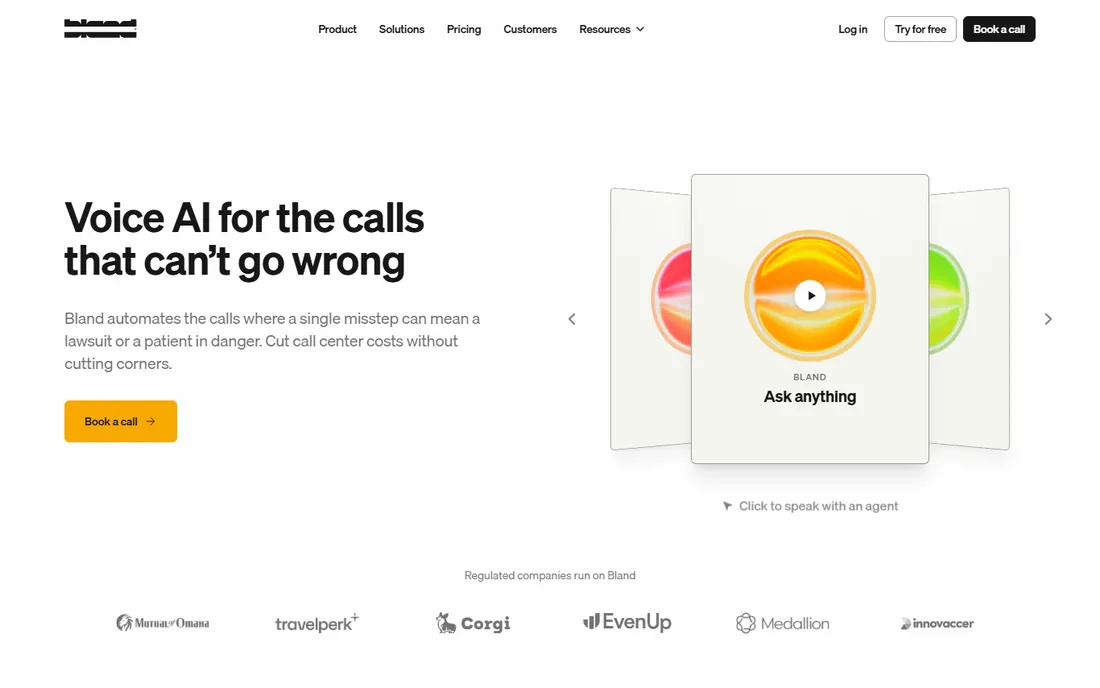
Bland pitches itself as the voice AI platform for "the calls that can't go wrong": regulated, complex conversations where a mistake means a lawsuit or a patient in danger. The technical differentiator is vertical integration: Bland built its own speech-to-text, language model and text-to-speech layers rather than assembling third-party vendors, which it argues removes outside points of failure and unexpected model changes.
The pricing model is refreshingly simple for the category: one per-minute rate covering the language model, speech-to-text, text-to-speech and telephony, with no per-token charges, no per-feature surcharges and no separate vendor invoices. Enterprise plans contract on volume, dedicated infrastructure and compliance needs. For a company automating thousands of calls in healthcare, finance or collections, the compliance stack (SOC 2 Type I and II, HIPAA, PCI, self-hosted options) is the real buying reason. Smaller teams should start with the trial-friendly options below.
What we like- Runs entirely on its own models (no third-party STT/LLM/TTS stitching)
- SOC 2, HIPAA and PCI certified
- One per-minute rate covers model, voice and telephony with no per-token charges
Watch out for- Enterprise-focused: pricing and deployment are built for scale, not for a three-person sales team testing the waters
#2
Vapi
Best for: Developers and product teams building custom voice agents
Visit vapi.ai
Starting priceSee website (usage-based)
Free planDeveloper credits to start
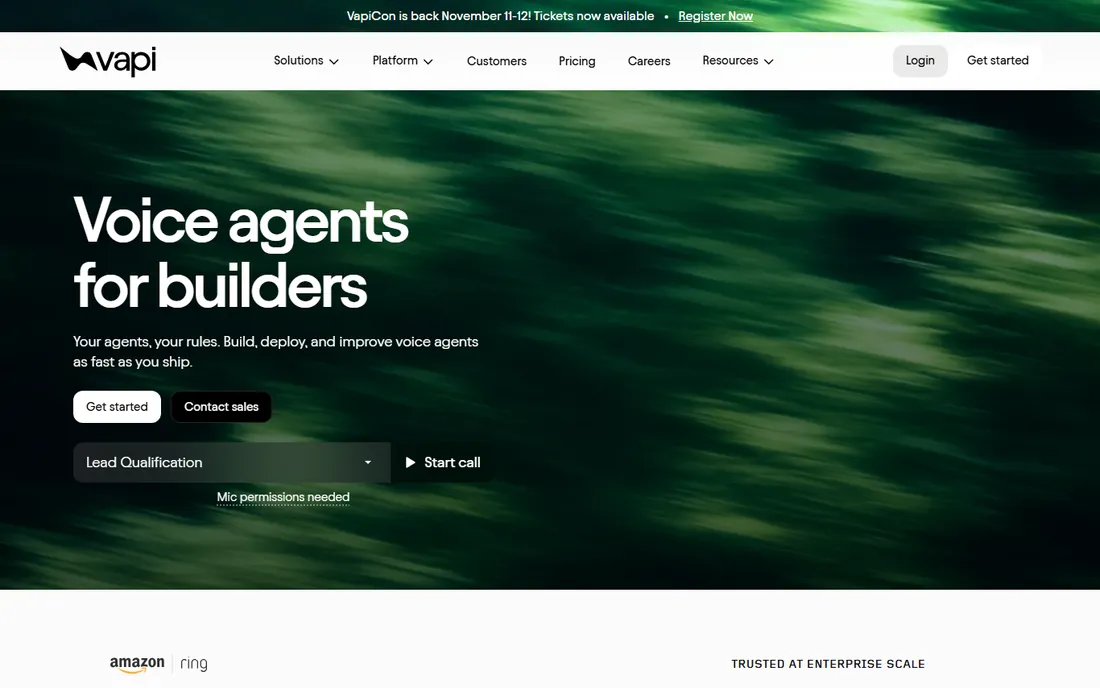
Vapi is the platform developers reach for when they want to build voice agents as a product feature rather than buy a finished calling tool. You configure everything from the voice and conversation flow to telephony and integrations, and Vapi handles the real-time infrastructure at sub-500ms latency. The vendor reports 1 billion calls supported, 2.5 million-plus agents launched and 1 million-plus developers.
The tradeoff is the one every developer platform carries: maximum control, maximum responsibility. If you have engineering resources and a specific call flow in mind, Vapi is the fastest path from prompt to production. If you want to log in and start dialing this week, pick one of the managed platforms instead. Pricing is usage-based; check the vendor's current rates.
What we like- The builder's platform: configure voice, conversation flow, telephony and integrations with APIs and SDKs
- 1 billion calls supported and 2.5M+ agents launched per the vendor
- Enterprise features (SSO, guardrails, HIPAA/SOC 2)
Watch out for- It is infrastructure, not a finished product: you build the agent, the prompts and the integrations yourself
#3
Retell AI
Best for: Teams that want production-quality voice agents with minimal friction
Visit retellai.com
Starting price$0.07-$0.31/min (depending on models, voice and add-ons)
Free plan$10 in free credits at signup, no contract
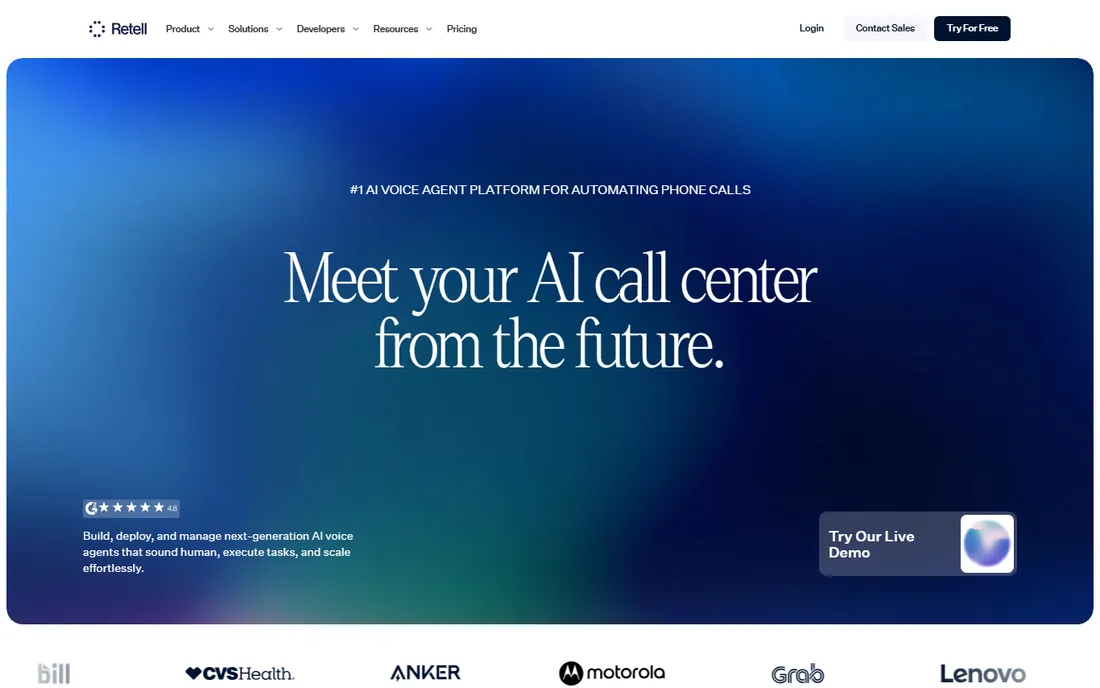
Retell AI is the low-friction entry point into serious voice agents. Sign up, get $10 in free credits with full platform access, build an agent, run simulation tests and make live test calls, all without a contract. After the credits, you pay per minute with no commitment. The vendor's own pricing guidance puts voice agents at $0.07 to $0.31 per minute depending on the models, voice and add-ons selected.
The product substance is solid: a no-code studio with visual call-flow design, ~600ms latency, interruption handling, outbound campaigns with pacing and retry logic, live call monitoring with human takeover, and CRM writeback. The FAQ is unusually honest about compliance: AI voice is legal in the U.S. but regulated, with TCPA consent requirements and state disclosure rules. For a team that wants to test AI cold calling this month, Retell is the easiest credible start.
What we like- Transparent per-minute pricing with a real free tier
- ~600ms latency with natural turn-taking
- Outbound campaign tooling (pacing, retries, voicemail handling) built in
- HIPAA, SOC 2, GDPR, ISO 27001 compliant
Watch out for- The per-minute range is wide: your actual cost depends heavily on model and voice choices
- Enterprise features require the higher plans
#4
Synthflow
Best for: Businesses that want to build agents free and pay only for calls
Visit synthflow.ai
Starting pricePay-as-you-go (see website)
Free planFree to build agents (pay when you launch calls)
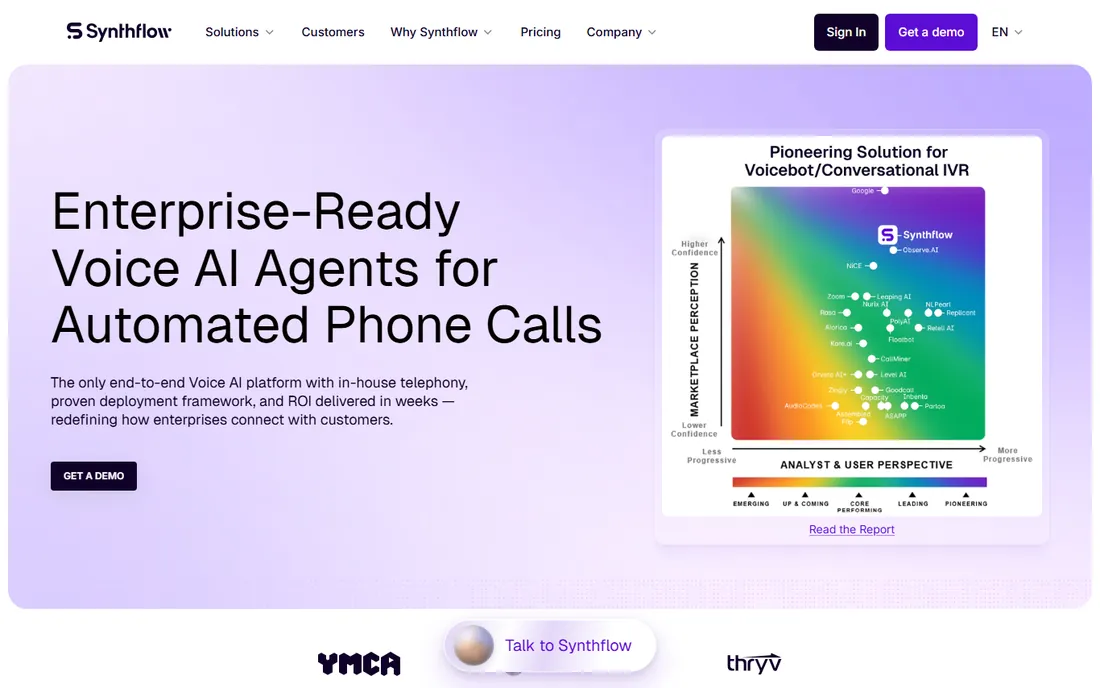
Synthflow's model is the friendliest in the category for experimentation: build your AI agent free using templates or the visual flow designer, configure voicemail detection and integrations, and only start paying when you launch real calls on pay-as-you-go. The vendor runs its own telephony network rather than relying on third-party carriers, claiming sub-100ms latency and 99.99% uptime, with 500 million-plus customer calls handled.
The platform covers inbound and outbound across industries, with enterprise features (SOC 2, HIPAA, PCI, GDPR) and 200-plus integrations. The BELL framework (Build, Evaluate, Launch, Learn) structures the agent lifecycle from testing through continuous improvement. For teams that want to prototype without a credit card conversation, Synthflow and Retell are the two to compare.
What we like- Build agents free with industry templates and a visual flow designer
- Own telephony network with sub-100ms latency claimed
- Pay-as-you-go at launch
- 500M+ customer calls per the vendor
Watch out for- Pay-as-you-go pricing details require the pricing page
- The enterprise positioning means smaller teams should confirm the fit
#5
Nooks
Best for: SDR teams that want AI across the whole revenue motion, not just dialing
Visit nooks.ai
Starting priceSee website (custom quote)
Free planNo (book a demo)
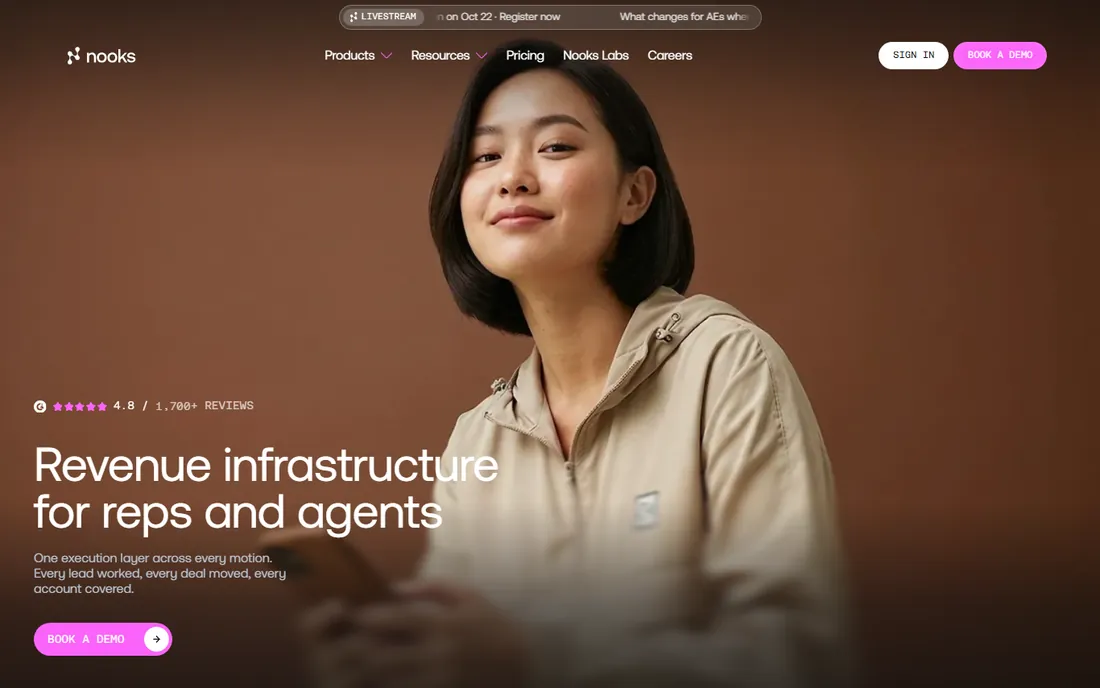
Nooks started as the AI parallel dialer SDR teams loved and grew into a revenue agent platform: prospecting, dialing, sequencing, enrichment, signals and coaching across the full revenue lifecycle. The AI dialing heritage shows: infrastructure built to make calls connect, with the coaching layer (what top reps do differently, AI practice sessions) turning call volume into rep improvement.
The vendor displays a 4.8 out of 5 rating from 1,700-plus reviews on its homepage, which is unusually strong social proof for the category. For an SDR organization that wants one platform for the phone motion end to end, Nooks is the category leader. For a team that only wants autonomous agents making calls, the voice-agent tools above fit better. Pricing is quote-based.
What we like- The broadest platform here: AI prospecting, AI dialing, AI sequencing, enrichment and coaching in one execution layer
- The vendor shows 4.8/5 from 1,700+ reviews on its site
- Strong parallel-dialing heritage
Watch out for- Enterprise sales process
- The breadth means teams that only need a dialer may pay for more platform than they use
#6
Regie.ai
Best for: Sellers who want an agentic workspace covering sourcing through follow-up
Visit regie.ai
Starting priceSee website
Free planTrial available
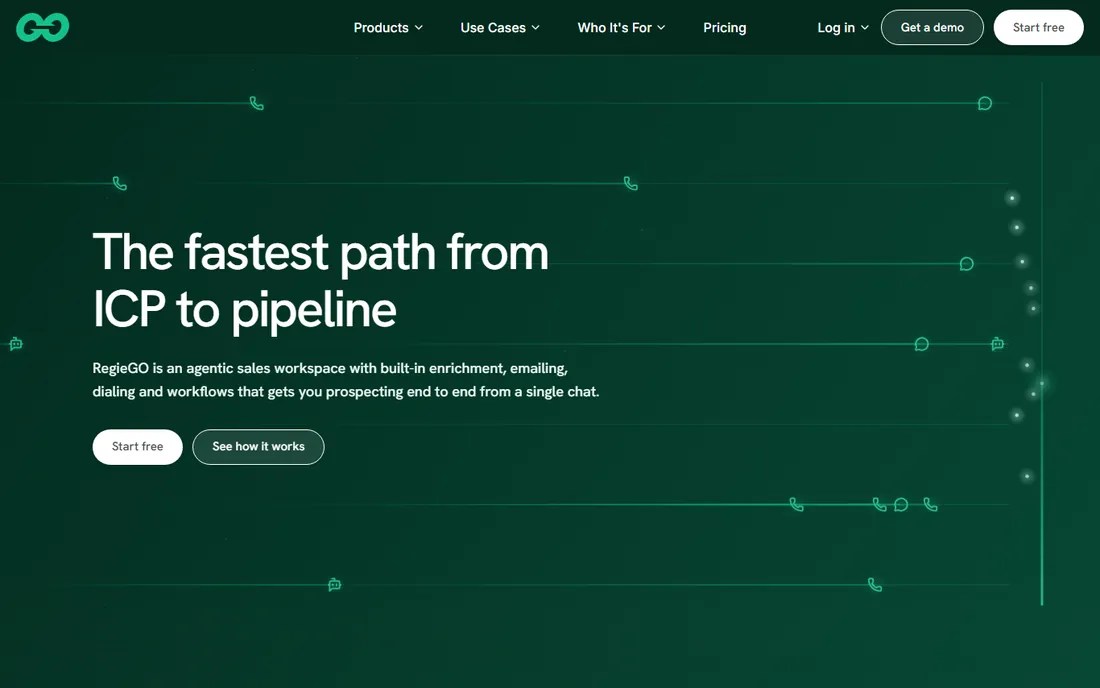
Regie.ai calls itself an agentic sales workspace, and the pitch is delegation: prompt the AI once and it handles sourcing, contact ranking, call preparation and follow-ups while the seller spends the day talking to active prospects. The platform weaves phone, email and social touches into coordinated plays, with messaging trained on what the vendor describes as billions of analyzed sales messages.
For the "best AI cold calling software" question, Regie fits buyers who want calling embedded in a full prospecting workflow rather than a standalone dialer or agent. If your team lives in sequences and multi-channel plays, the workspace model reduces tool sprawl. If you want maximum dials per hour or fully autonomous calls, the specialists above go deeper. Pricing is not published; a trial is available.
What we like- Agentic approach: prompt once and it handles sourcing, ranking, call prep and follow-ups
- Multi-channel plays across phone, email and social
- Built on billions of analyzed sales messages per the vendor
Watch out for- The broad prospecting scope means pure dialing depth should be validated against Nooks and Orum
- Pricing not published
#7
Orum
Best for: SDR and BDR teams that want AI agents multiplying human calling output
Visit orum.com
Starting priceSee website (per user, billed annually; Launch and Ascend plans)
Free planNo (demo)
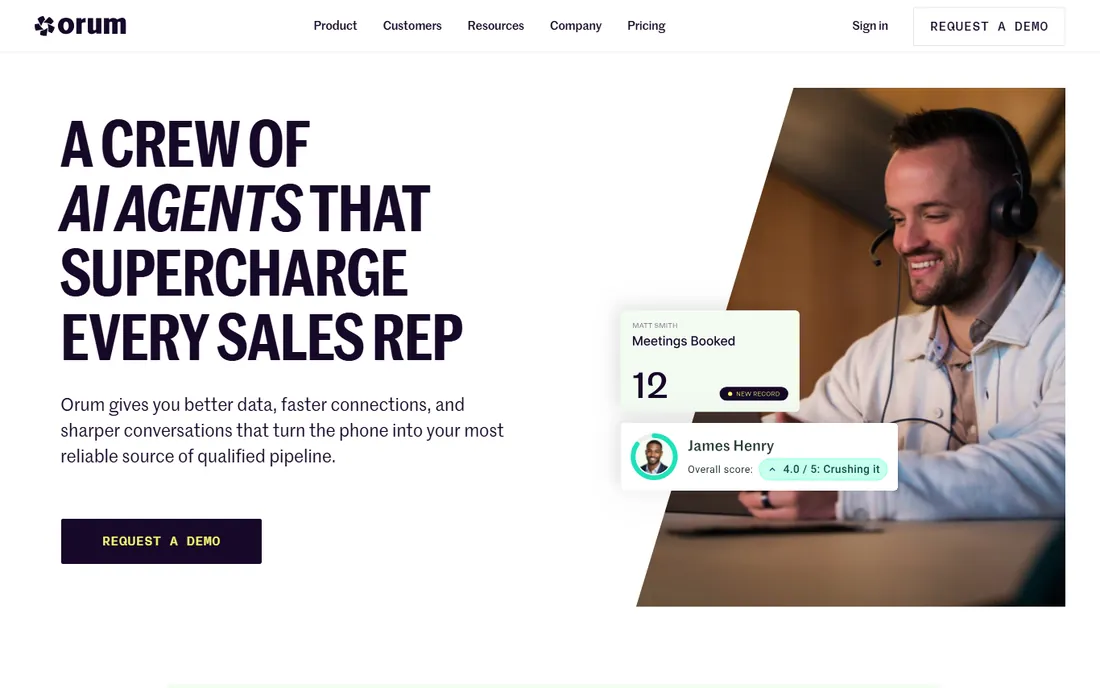
Orum's 2026 positioning is "a crew of AI agents that supercharge every sales rep," and the three-agent model is concrete: Scout finds the right number from your dialing history, Operator handles phone trees and voicemails and connects the rep only when a live person answers, and Coach listens to every call for objection handling, battlecards and practice sessions. The vendor says the agents are built on over 2 billion real sales calls.
The honest framing matters: Orum makes human cold calling dramatically more productive; it does not make the calls itself. For SDR teams whose model is humans closing, that is the right architecture: more live conversations per hour, integrated coaching, and number reputation management to protect connect rates. Pricing is per user billed annually across Launch and Ascend plans; get the quote from the vendor.
What we like- Three AI agents (Scout for phone data, Operator for connections, Coach for conversations) built on 2 billion-plus real sales calls per the vendor
- Owned telephony stack
- International dialing across 160+ countries
Watch out for- It supercharges human reps rather than replacing them: teams wanting fully autonomous agents should look elsewhere
- Pricing not published
#8
Goodcall
Best for: Small businesses that want an AI phone agent on predictable flat pricing
Visit goodcall.com
Starting priceFrom $79/month
Free planNo (demo)
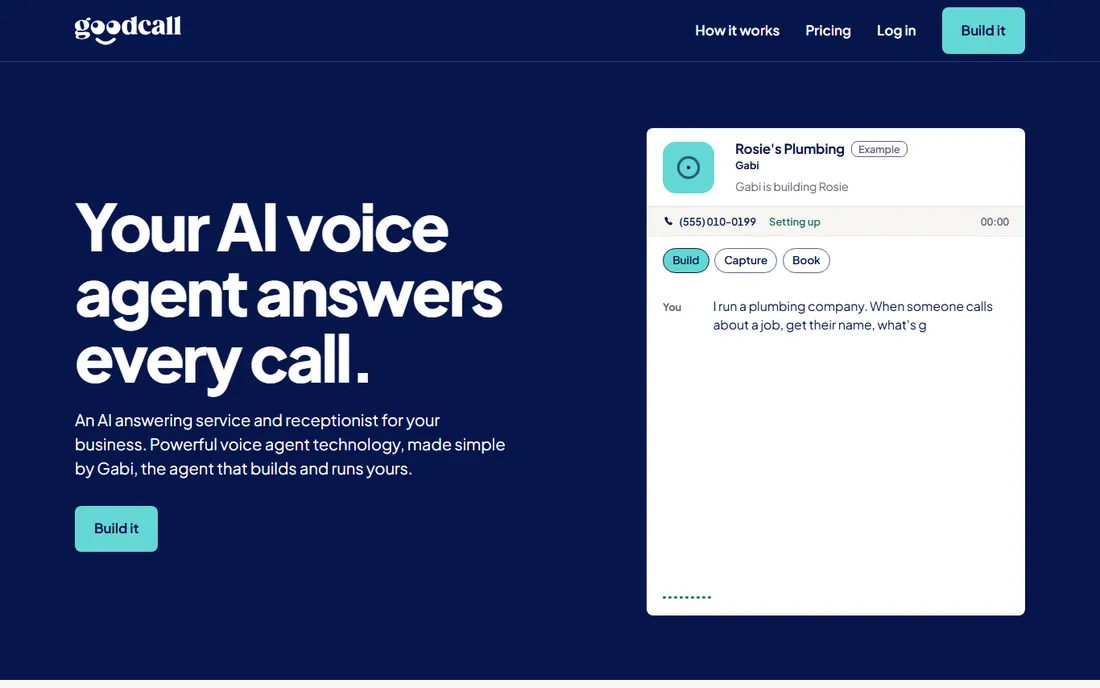
Goodcall is the outlier that small businesses should know about. Instead of per-minute pricing, it charges a flat monthly rate (plans start at $79) based on the customers your phone agent helps: a long call or a callback never changes the bill. Setup is conversational: describe the business (or hand over the website) and the agent builds its greeting, questions and workflows, with practice calls to test tricky scenarios before going live.
The use case is inbound-heavy: answering every call 24/7, triaging and qualifying callers, booking appointments and pushing leads to the CRM by text and email. For a small business missing calls today, that is the whole problem. For an SDR team running outbound campaigns, the voice-agent and dialer tools above are the right comparison. The predictable bill is the differentiator in a category priced by the minute.
What we like- No per-minute charges: flat monthly pricing by customers helped, so long calls never change the bill
- Dead-simple setup (describe the business, the agent builds itself)
- Every call recorded and transcribed
Watch out for- Built for small-business answering and lead capture, not high-volume outbound SDR campaigns
- The flat price covers a defined tier of usage
How to buy AI cold calling software
Start with the architecture decision above: autonomous agents or AI dialing for humans. Then budget honestly. Per-minute pricing ($0.07-$0.31/min at Retell, similar ranges elsewhere) looks cheap until you multiply by thousands of minutes: model a month of expected call volume and compare against Goodcall-style flat pricing or Orum-style per-seat pricing for your volume.
Then test before you commit. This category has the best trial story in sales software: Retell's $10 free credits, Synthflow's free agent building, and live demos where you can hear an actual agent call. Run your real call flows, not the vendor's demo script: your objection handling, your CRM integration, your compliance requirements.
Then handle compliance like it matters, because it does. Outbound AI calling sits under the TCPA: prior consent requirements, state-level automated-caller disclosure rules, and the FCC's treatment of AI-generated voices in robocalls. Recording consent varies by state. The platforms provide the tools (consent management, disclosure scripts, redaction); your calling practices determine compliance. Get legal review on the calling program before scaling, not after.
Frequently asked questions
How much does AI cold calling software cost?
Three pricing models dominate. Per-minute voice agents run roughly $0.07-$0.31 per minute (Retell publishes this range; others are similar). Per-seat dialing platforms (Orum, Nooks) price per user annually by quote. Flat monthly plans (Goodcall from $79/month) cover defined usage with no per-minute charges. Model your monthly call volume before choosing: high volume favors flat or per-seat pricing.
Is AI cold calling legal?
Using AI voice agents is legal in the United States but regulated. Outbound calling requires prior consent under the TCPA, some states require disclosing that the caller is automated, the FCC treats AI-generated voices in robocalls under existing TCPA restrictions, and call recording consent rules vary by state. Compliance depends on how you use the platform. Review your calling program with legal counsel.
Do AI voice agents sound human?
On short calls, most people cannot tell. Quality comes down to the speech model, response latency and interruption handling. The leading platforms run at 500-600ms latency with natural turn-taking and mid-sentence interruption support. The fastest evaluation is to hear one: take the live demo call every serious vendor offers and judge it against your own standards.
Will AI replace SDRs?
It is replacing the SDR's worst hours, not the SDR. Autonomous agents absorb volume humans cannot cover: after-hours, inbound overflow, reactivation and qualification. Dialing AI multiplies human output on live conversations. The teams getting the best results run hybrid models: agents handle the routine volume and hand off to people with full context when judgment or empathy is needed.
What should I test in a trial?
Your real flows, not the demo script. Test your objection handling, your CRM read/write integration, voicemail and phone-tree navigation, handoff to humans, and call quality on your actual call volume. Measure connect-to-conversation rates and cost per conversation, not just cost per minute. And test compliance features: consent capture, disclosure scripts and recording controls.
How we chose
We started with the categories buyers search: AI cold calling software, AI voice agents and AI sales dialers. For each candidate we opened the vendor's own site, checked product documentation and pricing pages, compared features against public reviews on G2, Capterra and TrustRadius and practitioner discussion on Reddit, and weighed company-size fit from solo founders to enterprise SDR organizations. Where a price could not be verified on the vendor's own page we wrote "See website" rather than guessing.
Sources we checked (10)
- https://bland.ai
- https://vapi.ai
- https://retellai.com
- https://synthflow.ai
- https://nooks.ai
- https://regie.ai
- https://www.orum.com
- https://goodcall.com
- https://www.g2.com/categories/ai-sales-assistant
- https://www.capterra.com/sales-software/
Is your product missing or out of date?
We review this list regularly. Vendors can request a listing, send updated pricing or ask about featured placement.

Shihab Mia · Founder, Rankite
Shihab has spent more than a decade helping SaaS and e-commerce brands grow through search. He writes Rankite's software buying guides from pricing pages, documentation and public user reviews. More about Shihab.