How we make this list: we compare pricing pages, product documentation and public user reviews. Rankite is independent; if a vendor ever pays for a featured spot, that listing is clearly labeled Partner.
Key takeaways
- The best AI cloud platform is usually the cloud where your data already lives; matching infrastructure beats chasing the newest model.
- AWS Bedrock wins on model breadth with 30-plus foundation models under one API, while Azure is the only cloud with both GPT and Claude frontier models.
- Google Vertex AI is the cost leader for high-volume inference, with Gemini Flash pricing dramatically below competitors.
- GPU neoclouds (CoreWeave, Lambda, Nebius) undercut hyperscalers by 2 to 3 times on raw compute for training workloads.
- Databricks is the pick when your AI needs to run directly on governed enterprise data rather than on a separate model platform.
Quick comparison
| Tool | Best for | Starting price | Free plan |
|---|
 AWS AWS | broadest model choice and ecosystem | See website | Yes |
 Google Cloud Google Cloud | cost-efficient inference and data integration | See website | Yes |
 Microsoft Azure Microsoft Azure | Microsoft-first enterprises | See website | Yes |
 Oracle Cloud Oracle Cloud | high-performance AI infrastructure value | See website | Yes |
 Databricks Databricks | AI on governed enterprise data | See website | Yes |
 CoreWeave CoreWeave | large-scale training reliability | See website | No |
 Lambda Lambda | affordable self-serve GPU compute | See website | No |
 Nebius Nebius | flexible GPU cloud with strong support | See website | No |
Is your product missing or out of date?
We review this list regularly. Vendors can request a listing, send updated pricing or ask about featured placement.
AI cloud platforms split into two species in 2026. The hyperscalers (AWS, Google, Azure, Oracle) sell managed model access plus the full cloud stack. The AI-native clouds (CoreWeave, Lambda, Nebius) and data platforms (Databricks) sell specialized compute and data infrastructure for AI workloads. Which species you need depends on whether you are building with models or training them.
Starting priceSee website
Free planYes
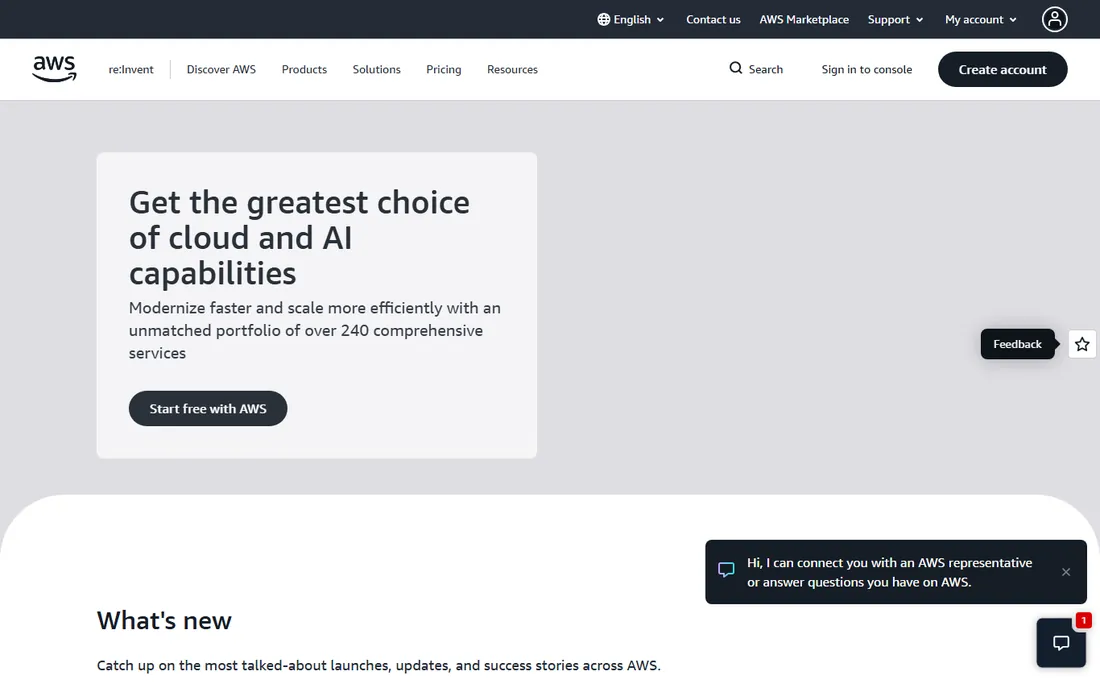
AWS remains the default AI cloud for one reason: choice. Bedrock puts Claude, Llama, Mistral, Cohere, Stability, and Amazon's own Nova models behind a single provider-neutral API, so you can swap models without re-architecting. SageMaker handles serious fine-tuning and custom training, and the Trainium and Inferentia chips offer a lower-cost alternative to NVIDIA for the right workloads. With 28 percent of global cloud infrastructure spend, the capacity is there when you need it.
The free tier lets you experiment before committing real budget. The honest catch is cost and complexity. On-demand H100 pricing around $55 per hour for an 8-GPU node is roughly double the neoclouds, and the sheer number of overlapping AI services means teams waste months picking wrong before they pick right. AWS is the platform for organizations that value breadth and already run on AWS.
What we like- Bedrock offers 30-plus foundation models under one API
- Deepest ecosystem of AI services from SageMaker to Trainium
- 124 availability zones of global capacity
Watch out for- GPU pricing is the highest among major options
- The service catalog's breadth creates real complexity
Starting priceSee website
Free planYes
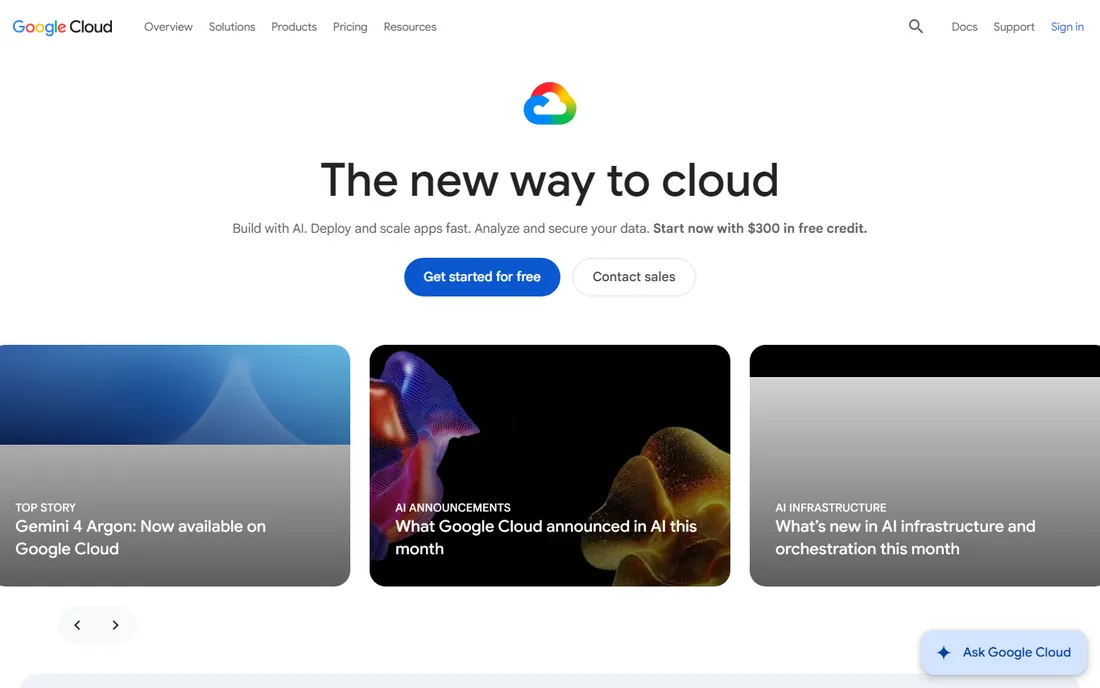
Google Cloud is the value play in AI cloud. Vertex AI gives you Gemini models with industry-leading context windows, and Gemini Flash pricing makes high-volume inference dramatically cheaper than the alternatives, sometimes by an order of magnitude. The custom TPU infrastructure means Google runs AI workloads 5 to 10 percent cheaper than competitors can, and some of that flows to you. BigQuery ML lets you run models directly on warehouse data without moving it.
New customers get $300 in free credits plus free usage of over 20 products, which is the most generous trial in the category. The honest catch is enterprise gravity. Google Cloud is growing fastest at 63 percent year over year, but it is still third in market share, and teams deeply embedded in Microsoft or AWS ecosystems face migration friction. For data-heavy AI workloads, especially on BigQuery, it is the natural home.
What we like- Gemini models with massive context windows
- BigQuery-native AI workflows
- $300 in free credits for new customers
Watch out for- Smaller enterprise AI footprint than AWS or Azure
- GPU quota can be hard to secure
Starting priceSee website
Free planYes
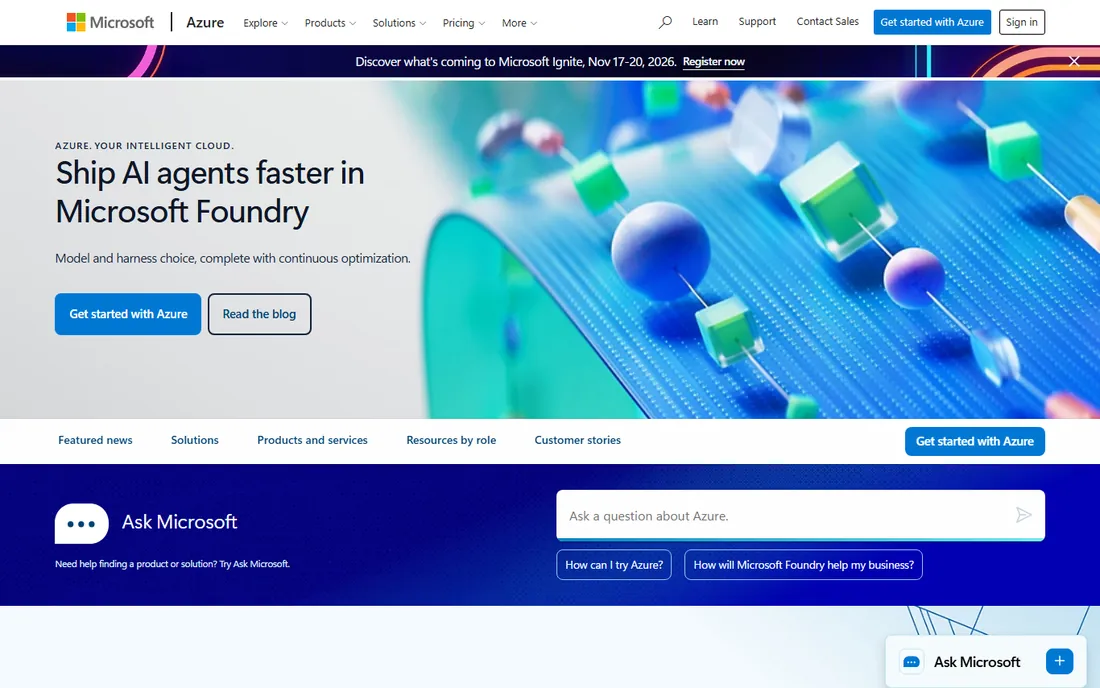
Azure's AI strategy is simple: be where the enterprises already are. With Microsoft 365, Entra ID, and the Azure footprint in most large companies, Azure AI Foundry slots AI into existing identity, governance, and procurement. The 2026 headline is model access: Azure is the only cloud offering both OpenAI's GPT frontier models and Anthropic's Claude on one platform, which removes the most common reason to go multi-cloud.
The compliance story is the deepest here, with FedRAMP High and the full Microsoft trust apparatus, and the AI-103 certification path gives teams a structured way to build skills. A free trial covers the first 30 days. The honest catch is capacity. Microsoft's own CFO has said Azure expects to be capacity constrained, with demand exceeding build-out, which means GPU quota is the hardest to secure here. Microsoft shops should still default to Azure; everyone else should weigh the constraint.
What we like- Only cloud with both GPT and Claude frontier models
- Deepest OpenAI integration
- Strongest enterprise compliance story
Watch out for- GPU capacity is the most constrained of the hyperscalers
- AI services sprawl across Foundry, OpenAI Service, and legacy names
#4
Oracle Cloud
Best for: high-performance AI infrastructure value
Visit oracle.com
Starting priceSee website
Free planYes
Oracle has quietly become the AI infrastructure contrarian. While competitors ration GPU capacity, Oracle is building it as fast as possible, and the customer list shows it: OpenAI, xAI, Meta, NVIDIA, and TikTok all run AI infrastructure on OCI. The pitch is straightforward: the highest-performing cloud services at the lowest cost, with bare-metal H100 pricing around $10 per GPU-hour that undercuts the other hyperscalers.
The multicloud AI database story is genuinely differentiated: Oracle's Autonomous AI Database runs inside AWS, Google, and Azure data centers, so your AI workloads can stay near your data regardless of cloud. The honest catch is ecosystem. Oracle's developer tooling and AI platform mindshare trail the big three, and the marketing leans infrastructure rather than the model-access experience developers expect. For training and inference at scale where unit economics matter, OCI deserves a quote.
What we like- Aggressive AI infrastructure pricing
- OpenAI, xAI, and Meta run AI workloads on OCI
- Multicloud database story is unique
Watch out for- Smaller AI developer ecosystem
- The platform's AI narrative is infrastructure-first, not developer-first
Starting priceSee website
Free planYes
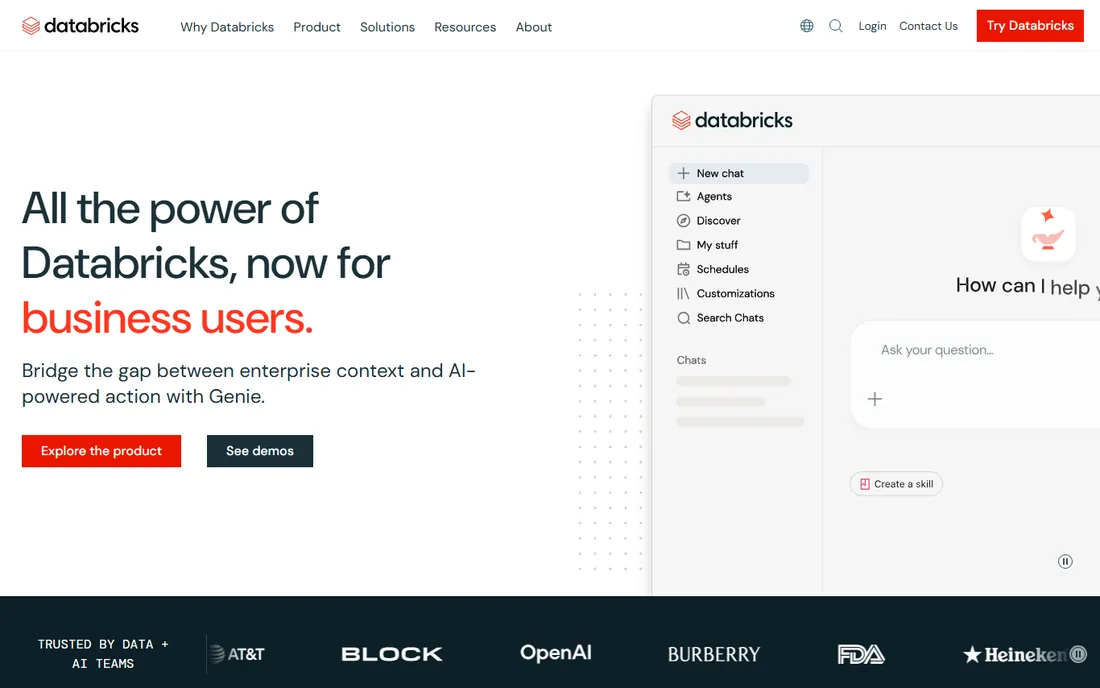
Databricks answers a different question from the model platforms: what if your AI could run where your data already lives? The Data Intelligence Platform unifies data engineering, analytics, and AI on the lakehouse, with Mosaic AI handling model training, fine-tuning, deployment, and governance. Unity Catalog governs data and models under one roof, which is what regulated enterprises actually need.
With over 60 percent of the Fortune 500 as customers and a five-time Gartner Magic Quadrant leadership position, the enterprise credibility is unmatched in the data-AI space. DBRX and the open-model work keep it honest about lock-in. The honest catch is the bill. Databricks Units pricing is famously difficult to forecast, and costs surprise teams that do not govern usage. It is the platform for data teams building AI on enterprise data, not for developers who just need a model API.
What we like- AI runs directly on your governed lakehouse data
- Mosaic AI covers the full model lifecycle
- Used by over 60 percent of the Fortune 500
Watch out for- Usage-based Databricks Units pricing is notoriously hard to forecast
- Strongest for data teams, less so for pure app developers
Starting priceSee website
Free planNo
CoreWeave is the AI cloud the AI labs themselves use. Nine of ten leading foundation model providers run on it, and it holds the industry's only Platinum ClusterMAX rating, earned three times. That reliability is the product: when a training run costs millions, the infrastructure that does not fail is worth more than the cheapest hourly rate. The company went public and now operates at massive scale with NVIDIA partnership depth nobody else matches.
The platform has expanded beyond raw compute into managed software for the AI lifecycle, with agents for research iteration and operational intelligence. The honest catch is the pricing structure. The headline $6.16 per GPU-hour for H100s is node-locked to 8-GPU minimums with no single-GPU self-serve option, so small workloads pay an effective premium. CoreWeave is for serious training at scale, not for experimenting with one GPU.
What we like- Only Platinum-rated AI cloud on SemiAnalysis ClusterMAX
- Trusted by 9 of 10 leading AI labs
- Purpose-built for massive training runs
Watch out for- Node-locked pricing penalizes small workloads
- Premium pricing versus other neoclouds
Starting priceSee website
Free planNo
Lambda is the developer's GPU cloud: straightforward on-demand pricing, single-GPU provisioning, and some of the lowest published rates in the industry. H100s at $3.99 per GPU-hour on-demand undercut CoreWeave's effective rate by nearly half for small workloads, and the absence of node minimums means you pay for exactly what you use. For fine-tuning, experimentation, and inference serving, that simplicity wins.
The company has grown from its ML-workstation roots into a serious cloud with managed clusters and the team behind infrastructure for major AI labs. The honest catch is the missing spot tier. With no interruptible pricing, batch and checkpointed workloads cannot capture the deep discounts CoreWeave and Nebius offer on spare capacity. For steady on-demand GPU needs at the best self-serve price, Lambda is the default.
What we like- Cheapest self-serve H100 pricing among neoclouds
- Single-GPU provisioning with no minimums
- Simple on-demand model
Watch out for- No spot or interruptible tier
- Smaller scale than CoreWeave or the hyperscalers
Starting priceSee website
Free planNo
Nebius has emerged as the neocloud that combines competitive pricing with genuine service. H100s at $3.85 per GPU-hour on-demand sit at the low end of the market, and the company claims meaningfully better total cost of ownership than AWS for both fine-tuning and inference. The SemiAnalysis Platinum rating puts its infrastructure quality in the top tier, and customers like Revolut and Shopify run serious production AI on it.
What users consistently praise is the support: 500-plus AI experts, 24/7 support by default, and free white-glove proof-of-concept engagements. For teams that need GPU capacity without the hyperscaler quota battles, Nebius delivers availability with a human touch. The honest catch is maturity. It is younger than CoreWeave with less enterprise procurement polish, though the Microsoft and Meta anchor deals signal that is changing fast.
What we like- Competitive $3.85 per GPU-hour H100 pricing
- Platinum ClusterMAX rating
- White-glove support with real AI experts
Watch out for- Younger platform than CoreWeave
- Enterprise procurement processes less mature
We split the category deliberately: four hyperscalers with managed model platforms, two AI-native GPU clouds for training economics, one data platform for AI on enterprise data, and one value neocloud. We drew on 2026 practitioner comparisons, GPU pricing trackers, and production deployment reports. We verified every vendor homepage to confirm the platform exists today and serves AI workloads. We did not claim hands-on testing. Pricing in this category is usage-based per token or per GPU-hour and changes frequently, so we use "See website" throughout and cite the pricing snapshots as directional rather than quotable.
Model access vs raw compute: know which you are buying
Most buyers confuse two different purchases. If you are building applications on foundation models, you need model access: managed APIs with the models you want, guardrails, RAG tooling, and agent frameworks. That is Bedrock, Vertex AI, Azure AI Foundry, and Databricks. Compare them on model selection, data residency, and per-token pricing for your specific models.
If you are training or fine-tuning models, you need raw compute: GPUs by the hour with fast networking and reliable infrastructure. That is CoreWeave, Lambda, Nebius, and the hyperscalers' GPU instances. Compare them on per-GPU-hour pricing, minimum commitments, spot availability, and reliability ratings. Buying model access when you need compute, or vice versa, is the most expensive mistake in this category.
Frequently asked questions
What is the best AI cloud platform in 2026?
It depends on your workload. AWS Bedrock offers the broadest model selection, Azure is the only cloud with both GPT and Claude, Google Vertex AI is cheapest for high-volume inference, and Databricks is best for AI on governed enterprise data. For raw GPU training, CoreWeave leads on reliability while Lambda and Nebius lead on price.
How much does AI cloud computing cost?
Model API pricing is per token and varies enormously: budget models cost cents per million tokens while frontier models cost dollars. GPU compute ranges from around $3.85 per H100 GPU-hour at neoclouds to $12-plus at hyperscalers. Always benchmark with your actual workload; published rates are directional.
Should I use AWS, Azure, or Google Cloud for AI?
Choose the cloud where your data and team already live. That removes most deployment friction. AWS wins on model breadth, Azure on Microsoft ecosystem integration and dual GPT-plus-Claude access, Google on cost-efficient inference and BigQuery integration. Multi-cloud routing tools can abstract the differences when you need the best of each.
What is the difference between Bedrock and SageMaker?
Bedrock is AWS's managed API for third-party and Amazon foundation models: pick a model, call the API, pay per token. SageMaker is the machine learning platform for training, fine-tuning, and deploying your own models on managed infrastructure. Most teams use Bedrock for applications and SageMaker for customization.
Are GPU neoclouds reliable for production training?
The top tier is. CoreWeave holds the industry's only Platinum ClusterMAX reliability rating, and Nebius earned Platinum as well. These platforms now run production training for the world's leading AI labs. The reliability gap that once favored hyperscalers has largely closed at the top end.
Can I try these platforms for free?
Yes, mostly. Google Cloud offers $300 in free credits, Azure has a 30-day free trial, AWS has a free tier, and Databricks offers a free trial. The GPU neoclouds (CoreWeave, Lambda, Nebius) generally do not offer self-serve free tiers, though Nebius provides white-glove proof-of-concept engagements.
Sources we checked (10)
- https://aws.amazon.com
- https://cloud.google.com
- https://azure.microsoft.com
- https://www.oracle.com
- https://www.databricks.com
- https://lambda.ai
- https://coreweave.com/
- https://nebius.com/
- https://www.swfte.com/blog/aws-bedrock-guide-2026
- https://www.marktechpost.com/2026/08/23/best-gpu-neoclouds-2026/
Is your product missing or out of date?
We review this list regularly. Vendors can request a listing, send updated pricing or ask about featured placement.

Shihab Mia · Founder, Rankite
Shihab has spent more than a decade helping SaaS and e-commerce brands grow through search. He writes Rankite's software buying guides from pricing pages, documentation and public user reviews. More about Shihab.