How we make this list: we compare pricing pages, product documentation and public user reviews. Rankite is independent; if a vendor ever pays for a featured spot, that listing is clearly labeled Partner.
Key takeaways
- Dify, n8n, Flowise and Langflow all self-host free via Docker, so the platform costs you only server time and model tokens.
- n8n is the best all-rounder for teams that want visual agent building with code escape hatches on their own infrastructure.
- LangGraph, CrewAI and Haystack are frameworks for engineering teams that want agents as versioned code.
- On-premises does not mean offline: most teams self-host the agent runtime and still call a hosted model API, keeping documents inside their own network.
The reason to run agents on your own infrastructure is not nostalgia; it is data. Every agent touches your documents, your tickets, your customer data, and in regulated industries that data cannot leave your network. The good news is that the agentic AI category grew up open-source: the best platforms here run in a Docker container on your own server, free, with cloud plans only if you want someone else to host. These eight are the platforms worth evaluating when the agents have to live on your side of the firewall.

#1
Dify
Best for: teams building LLM apps with a visual builder
Visit dify.ai
Starting priceFree (self-hosted); cloud from $59/workspace/month
Free planYes
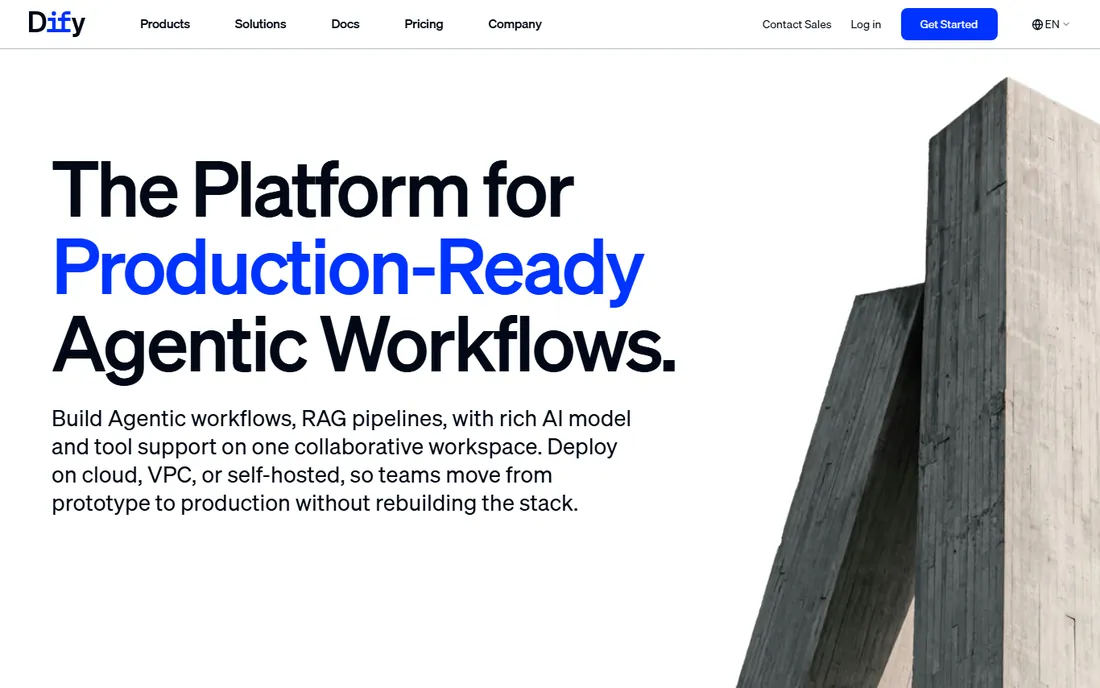
Dify is the closest thing to a complete self-hosted agent platform: a visual builder for agents, RAG pipelines and workflows, plus model management and API serving, all in one open-source package. Deploy it with Docker on your own server and the platform itself costs nothing; you pay for the server and the model tokens you consume. Cloud plans start at $59 per workspace per month if you would rather not manage infrastructure.
For a team standardizing agent development on-premises, Dify covers the most ground with the least assembly. It needs a modest server, 4 GB of RAM and a couple of CPU cores for comfortable use, and production RAG pipelines want more. If you want one platform decision instead of five framework decisions, start here.
What we like- Full platform for agents, RAG and workflows
- Self-hosts free with Docker
- Turns workflows into REST APIs with one click
Watch out for- Needs at least 4 GB RAM for comfortable self-hosting
- Cloud pricing is per workspace
- Heavier than single-purpose tools

#2
n8n
Best for: visual agent and automation building on your own server
Visit n8n.io
Starting priceFree (self-hosted); cloud from 24 euros/month
Free planYes

n8n is the pragmatic pick: a visual canvas for workflows and AI agents that you can self-host completely free, with 1,500+ integrations and code nodes for JavaScript and Python when the canvas runs out. It runs in Docker, supports queue mode for scale, and the fair-code license keeps the self-hosted edition free for most internal use. Cloud plans start at 24 euros a month if you want it managed.
What sets n8n apart for on-premises teams is maturity: years of production use, thousands of workflow templates, and observability built in. Agents built here are monitored workflows, not black boxes. For most teams, n8n is the shortest path from idea to a running agent that is not metered per thought.
What we like- Genuinely free self-hosted edition
- 1,500+ integrations
- Combines visual building with JavaScript and Python
Watch out for- Fair-code license, not fully open source
- Self-hosting needs maintenance
- Cloud bills in euros
Starting priceFree (self-hosted); cloud from $35/month
Free planYes
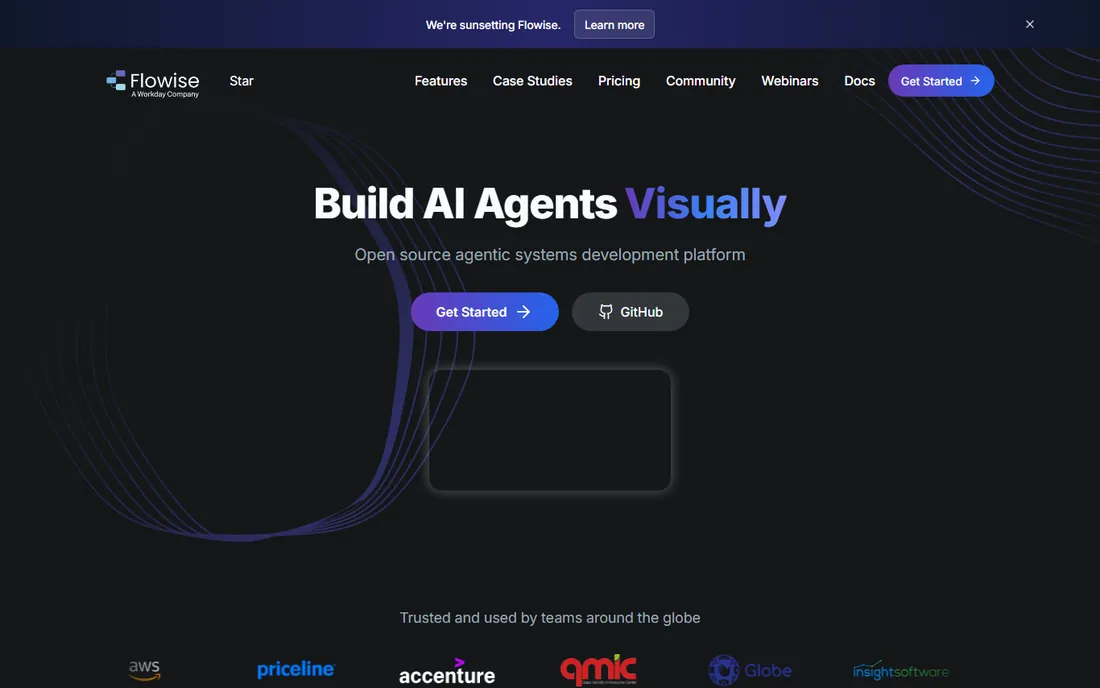
Flowise is the lightest way to build LangChain agents visually and run them on your own hardware. A single Docker container gets you a drag-and-drop canvas, a marketplace of templates for RAG and conversational agents, and connections to models from OpenAI, Anthropic or a local Ollama instance. Self-hosting is free; the cloud plan runs $35 a month.
It is less of a complete platform than Dify and less of an automation engine than n8n, but that is the point: Flowise does one thing, visual agent building, with minimal overhead. For prototypes, internal chatbots and RAG experiments on your own server, it is the fastest option here.
What we like- Free self-hosting with a simple Docker setup
- Drag-and-drop LangChain agents
- Template marketplace for RAG and chatbots
Watch out for- Smaller team and ecosystem than Dify or n8n
- Advanced features need code
- Cloud plan is basic

#4
Langflow
Best for: Python teams wanting visual orchestration without lock-in
Visit langflow.org
Starting priceFree
Free planYes
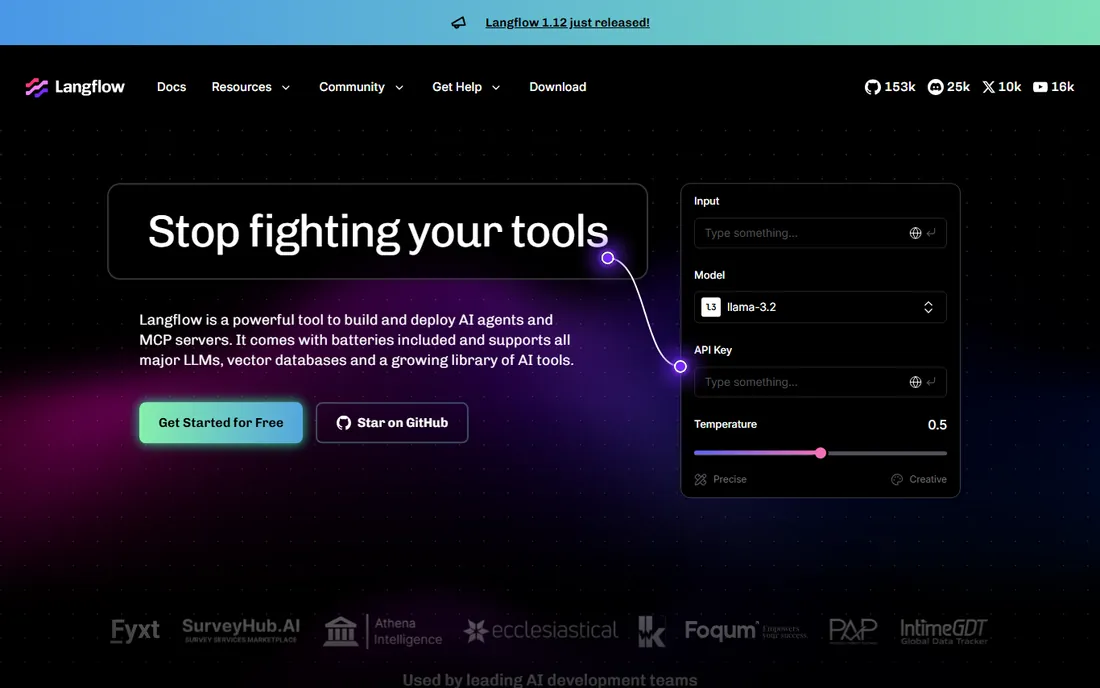
Langflow gives Python teams the visual builder experience without the platform lock-in: connect LLMs, tools and data sources on a canvas, then run the pipeline or version it as code. It is MIT-licensed, enterprise-minded about security and scalability, and ships new releases roughly weekly. Self-hosting is a Docker image away.
The trade is ownership. There is no managed cloud to fall back on and no non-technical builder experience; this is a developer tool. For engineering teams that want agents as part of their codebase, with visual speed and code-level control, Langflow is the right shape.
What we like- MIT-licensed open source
- Visual builder with code versioning
- Strong community and frequent releases
Watch out for- Developer-oriented, not for business users
- You own the hosting and maintenance
- Python ecosystem assumed
Starting priceSee website
Free planYes
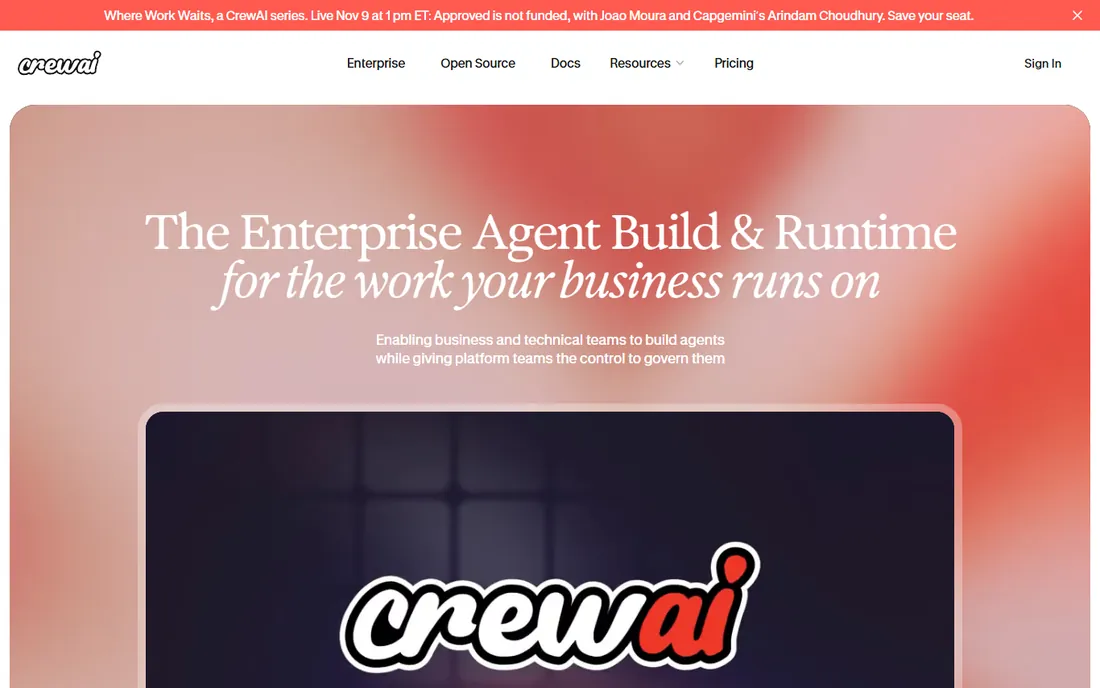
CrewAI's idea is simple: define agents by roles, give them tools, and let them collaborate. That mental model, closer to job titles than to graphs, makes multi-agent systems easier to design for teams that think in roles. The framework is free and open source, and it runs wherever your Python runs, including fully on-premises.
What you do not get is a platform: no hosted builder, no managed runtime, no monitoring dashboard out of the box. CrewAI is the engine, and your team builds the car. For experiments and for teams with the engineering to productionize, it is one of the most productive frameworks available.
What we like- Intuitive role-based mental model for agents
- Free open-source framework
- Good for research-style multi-agent experiments
Watch out for- Framework only, you build the platform around it
- Python-focused
- Production hardening is your job
Starting priceFree
Free planYes
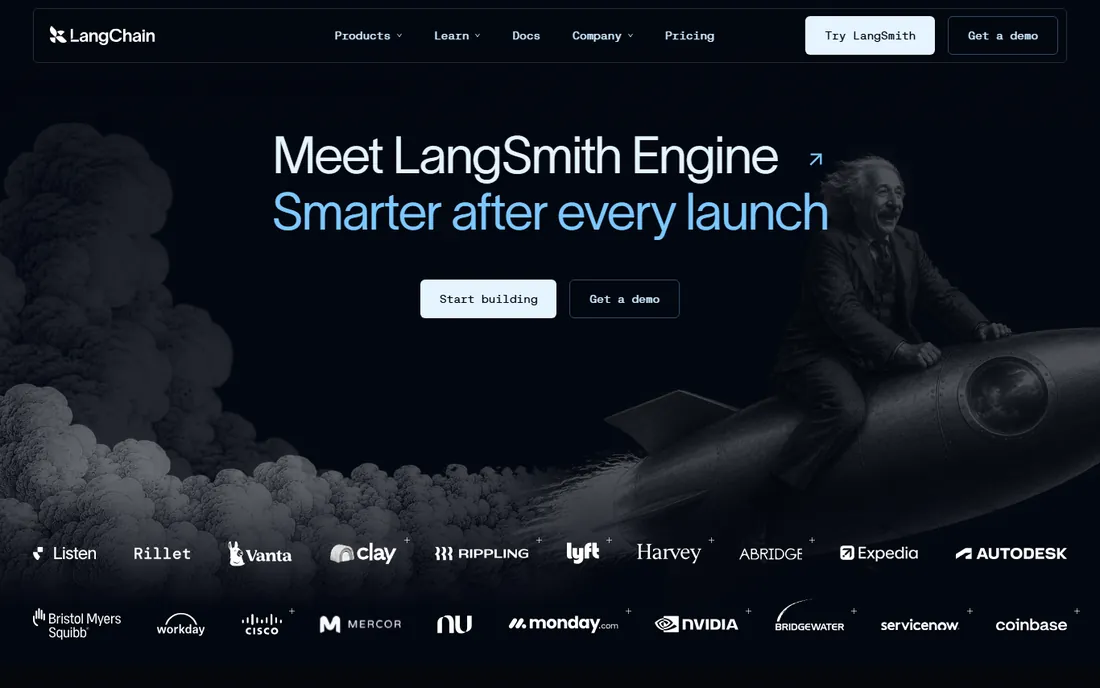
LangGraph, from the LangChain team, treats agents as graphs of code: stateful, testable, versioned and debuggable. Paired with LangSmith for tracing, it is the stack engineering teams choose when agents become production software rather than experiments. The framework is free and runs anywhere, including your own data center.
This is the opposite end of the spectrum from Flowise's canvas. If your team writes Python, LangGraph gives you the most control and the best debugging story in the category. LangSmith's paid plans start around $39 per seat, which is the only cost beyond your infrastructure and tokens.
What we like- Agents as versioned, testable code
- LangSmith tracing for debugging
- The standard for serious agent engineering
Watch out for- Developer-only
- LangSmith's paid tiers add cost
- Steeper learning curve than visual builders
Starting priceFree
Free planYes
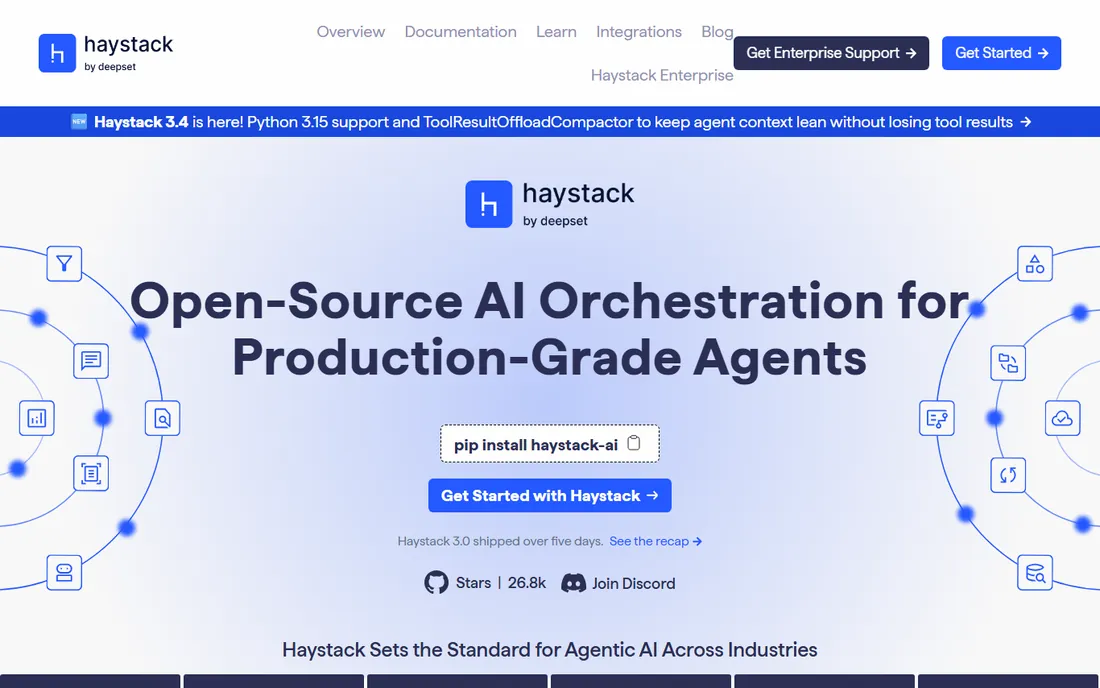
Haystack is the infrastructure pick: an open-source framework for building search, RAG and agent pipelines over your own documents, running entirely on your hardware. It predates the agent hype and shows it in maturity, with well-tested components for retrieval, ranking and generation that newer tools are still catching up to.
You will not get a drag-and-drop canvas or a managed dashboard. What you get is a solid foundation for document-grounded agents that never send your data anywhere. Teams with ML knowledge building serious RAG systems on-premises should evaluate Haystack before assembling the same pieces from scratch.
What we like- Mature open-source NLP framework
- Strong RAG and document-search pipelines
- Runs fully on your infrastructure
Watch out for- Framework, not a visual platform
- Narrower than full agent platforms
- Python and ML knowledge needed
Starting priceFree
Free planYes
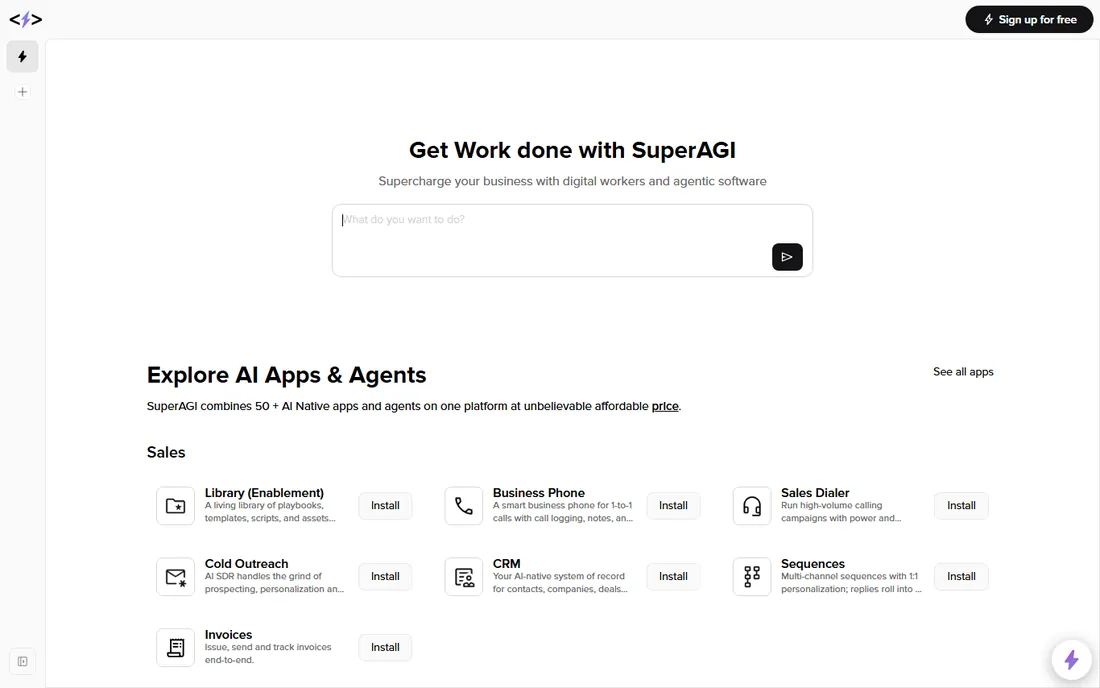
SuperAGI offers open-source autonomous agents with a GUI and a marketplace of agent templates, all runnable on your own servers. It sits between the frameworks and the visual platforms: more guided than CrewAI, more agent-focused than n8n's workflow canvas.
The community is smaller than Dify's or LangChain's, so expect to solve more problems yourself, and autonomous agents deserve careful sandboxing wherever they run. For teams that want to experiment with autonomous agent behavior on-premises without building everything from scratch, SuperAGI is a credible starting point.
What we like- Open source with a graphical interface
- Agent marketplace
- Runs on your own infrastructure
Watch out for- Smaller community than the leaders
- Autonomous agents need careful supervision
- Documentation is thinner
Decide who builds. Non-technical teams need Dify or Flowise; automation-minded teams need n8n; Python engineers need LangGraph, Langflow, CrewAI or Haystack. The platform decision follows the team, not the feature list, because the best on-premises tool is the one your people will actually maintain.
Separate the two bills. On-premises platforms are mostly free; your costs are the server and the model tokens. Compare that against cloud agent platforms that meter every run. At prototype scale the difference is small; at tens of thousands of runs a month, self-hosting wins by a wide margin. Run your own numbers before committing either way.
Plan for the model too. Self-hosting the agent runtime is the easy part; the language model is the bigger decision. Most on-premises teams start by calling a hosted model API while keeping documents and orchestration inside their network, then evaluate self-hosted models later. That hybrid is the practical default, and every platform here supports it.
Frequently asked questions
Can I really run AI agents fully on-premises?
Yes. Dify, n8n, Flowise and Langflow all deploy via Docker on your own servers with no cloud dependency for the platform itself. The language model is the remaining question: you can call a hosted API or self-host an open model, depending on your data requirements and hardware.
Do I need a GPU to self-host an agent platform?
No. The agent runtime is ordinary code, a loop with tools and memory, that runs fine on a CPU-only server. A GPU only matters if you also self-host the language model itself. Dify wants about 4 GB of RAM for comfortable use; lighter tools run on far less.
What does self-hosting an agent platform cost?
The software is free for most tools here. A small VPS or on-premises VM handles the runtime; the real variable cost is model tokens, whether from a hosted API or your own GPU servers. Compared with per-run cloud agent pricing, self-hosting usually wins once volume grows.
Are self-hosted agents safe?
They are as safe as your setup. Agents run commands and code, so harden them like any production service: unprivileged users, loopback-only interfaces reached over SSH or VPN, a default-deny firewall, file permissions on secrets, and prompt updates. Never expose an agent's control interface raw on a public port.
Which is better for on-premises: Dify or n8n?
Dify is the better complete agent platform with RAG and model management built in; n8n is the better automation engine with deeper integrations and workflow maturity. Teams building LLM applications usually pick Dify; teams automating business processes with AI steps usually pick n8n. Many run both.
Quick comparison
| Tool | Best for | Starting price | Free plan |
|---|
| Dify | teams building LLM apps with a visual builder | Free (self-hosted); cloud from $59/workspace/month | Yes |
| n8n | visual agent and automation building on your own server | Free (self-hosted); cloud from 24 euros/month | Yes |
 Flowise Flowise | cheapest visual agent prototyping | Free (self-hosted); cloud from $35/month | Yes |
| Langflow | Python teams wanting visual orchestration without lock-in | Free | Yes |
 CrewAI CrewAI | multi-agent teams with role-based design | See website | Yes |
 LangGraph LangGraph | code-first agents with tracing and versioning | Free | Yes |
 Haystack Haystack | search and RAG pipelines as agent infrastructure | Free | Yes |
 SuperAGI SuperAGI | open-source autonomous agents with a GUI | Free | Yes |
Is your product missing or out of date?
We review this list regularly. Vendors can request a listing, send updated pricing or ask about featured placement.
Sources we checked (11)
- https://dify.ai
- https://n8n.io/
- https://flowiseai.com/
- https://www.langflow.org
- https://www.crewai.com/
- https://www.langchain.com/
- https://haystack.deepset.ai
- https://superagi.com
- https://dev.to/stimlau/best-ai-agent-builder-in-2026-7-tools-tested-1lj7
- https://www.ssdnodes.com/learn/best-self-hosted-ai-agents
- https://www.itechguides.com/best/ai-agent-platforms/
Is your product missing or out of date?
We review this list regularly. Vendors can request a listing, send updated pricing or ask about featured placement.

Shihab Mia · Founder, Rankite
Shihab has spent more than a decade helping SaaS and e-commerce brands grow through search. He writes Rankite's software buying guides from pricing pages, documentation and public user reviews. More about Shihab.