How we make this list: we compare pricing pages, product documentation and public user reviews. Rankite is independent; if a vendor ever pays for a featured spot, that listing is clearly labeled Partner.
Key takeaways
- Oracle NetSuite, Sage Intacct and Acumatica are the serious multi-entity platforms, but all three are quote-based with implementation costs that dwarf the license.
- QuickBooks Enterprise (from $1,873/year) is the pragmatic step up for businesses outgrowing QuickBooks Online, though true consolidation still needs workarounds.
- Odoo ($31.10/user/month) and AccountingSuite (from $19/month) are the only options here with published pricing, making them the easiest to evaluate.
- The deciding features are intercompany transaction automation and one-click consolidation; if a platform makes you export to Excel for that, it is not multi-entity software.
Quick comparison
| Tool | Best for | Starting price | Free plan |
|---|
 Oracle NetSuite Oracle NetSuite | Mid-market and enterprise multi-subsidiary operations | See website (custom quote) | No |
 Sage Intacct Sage Intacct | Finance-led companies needing deep reporting | See website (custom quote) | No |
 Acumatica Acumatica | Mid-market ERP without per-user pricing | See website (custom quote) | No |
 QuickBooks Enterprise QuickBooks Enterprise | Growing businesses outgrowing QuickBooks Online | $1,873/year (Silver plan, 1 user) | No |
 Odoo Odoo | Small teams wanting modular ERP on a budget | $31.10/user/month (Standard plan) | Yes |
 AccountingSuite AccountingSuite | Inventory-heavy businesses running several companies | $19/month (Start-Up plan) | Free trial |
 Multiview Multiview | Mid-market companies wanting guided implementation | See website (custom quote) | No |
 Gravity Software Gravity Software | Microsoft-centric firms wanting multi-entity on Dynamics | See website (custom quote) | No |
Is your product missing or out of date?
We review this list regularly. Vendors can request a listing, send updated pricing or ask about featured placement.
The best accounting software for multiple entities
A business owner just bought her second company, a small distribution business across town. Month-end arrives and the reality sets in: two separate QuickBooks files, intercompany loans tracked in a spreadsheet, and a consolidation that takes her bookkeeper three days of copy-paste to produce numbers she half trusts. The businesses are growing, but the accounting is held together with formulas and hope.
That is the moment multi-entity accounting software earns its keep. These platforms run several companies, subsidiaries or locations in one system, automate the transactions between them, and consolidate the books into one set of reports with eliminations handled properly. The eight below cover the realistic 2026 shortlist, from enterprise ERP down to affordable options for businesses running two or three entities.
#1
Oracle NetSuite
Best for: Mid-market and enterprise multi-subsidiary operations
Visit netsuite.com
Starting priceSee website (custom quote)
Free planNo
NetSuite is the default answer when a finance team says "we need real multi-entity accounting." Its OneWorld module runs subsidiaries across countries and currencies in one database, automates intercompany transactions and eliminations, and consolidates in real time instead of at month-end. For companies with inventory, warehouses or manufacturing alongside the entities, the operational modules make it a full ERP rather than just an accounting system.
The honest catch is total cost. Oracle publishes no prices; industry estimates put the base around $999 a month plus $99 to $199 per user per month, with implementation commonly running $25,000 to well over $100,000. Renewal increases of 15 to 30% are widely reported. NetSuite is the most capable platform here by a distance. It is also the one most likely to cost triple what you first estimated.
What we like- OneWorld multi-subsidiary management is the deepest in the category
- Handles multi-currency, multi-language and global tax natively
- Huge module ecosystem for inventory, manufacturing and commerce
Watch out for- No public pricing and every quote is negotiated
- Implementation typically costs as much as the license
- Renewal increases are a known pain point
Starting priceSee website (custom quote)
Free planNo
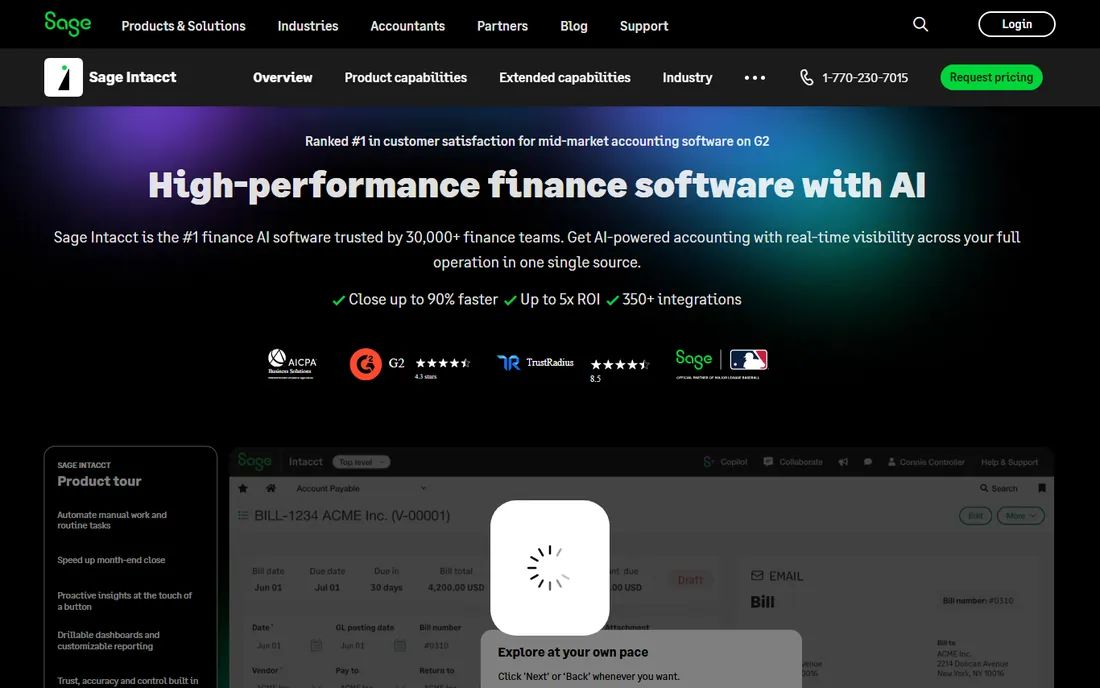
Sage Intacct is the finance team's ERP. Where NetSuite leads on operational depth, Intacct leads on the books themselves: a dimensional general ledger that tags every transaction by entity, department, location and project, consolidation that handles currency translation and eliminations cleanly, and reporting that lets a CFO slice the whole group any way they want without a spreadsheet. Professional services firms, nonprofits and SaaS companies choose it for exactly this.
The tradeoffs are scope and price. Intacct is weaker on inventory, warehousing and manufacturing, so product companies often need NetSuite or Acumatica instead. Pricing is quote-based and modular, with typical mid-market contracts landing in the tens of thousands per year before implementation. If your pain is financial reporting across entities rather than operations, Intacct is the sharper tool.
What we like- Dimensional chart of accounts makes multi-entity reporting genuinely flexible
- Strong financial consolidation and close management
- Favored by CFOs in professional services and nonprofits
Watch out for- Quote-based pricing with modular costs
- Weaker on inventory and manufacturing than NetSuite
- Implementation still needs a partner
Starting priceSee website (custom quote)
Free planNo
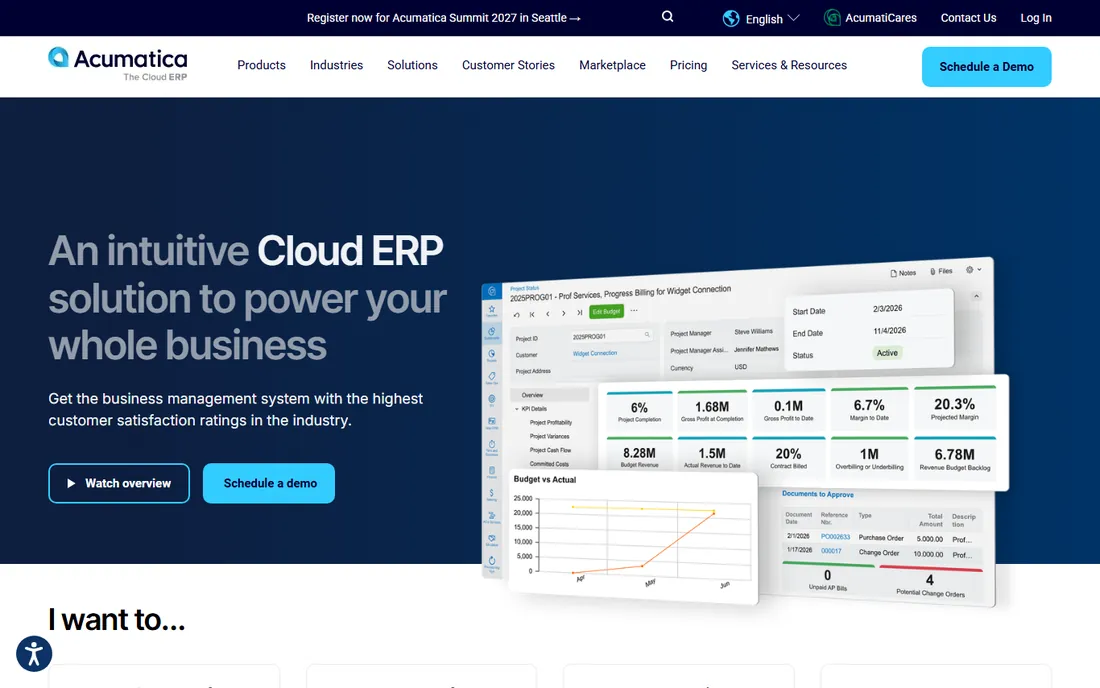
Acumatica's pitch is simple: stop paying per user. Its consumption-based pricing charges for transaction volume and resources instead of seats, so a 200-person company does not pay 200 seat licenses. Underneath that model is a real cloud ERP with multi-company accounting, automated intercompany transactions, multi-currency consolidation and solid distribution and manufacturing modules.
The honest catch is that "no per-user pricing" does not mean cheap. Quotes are custom, typical mid-market deals land in the $25,000 to $75,000 per year range, and implementation is a separate project. Partner quality matters enormously with Acumatica, so vet the implementer as hard as the software. For mid-market companies that hate seat licenses, it is the most credible NetSuite alternative.
What we like- Unlimited users with consumption-based pricing, which breaks the per-seat model
- True multi-company accounting with intercompany automation
- Strong manufacturing and distribution modules
Watch out for- Quote-based pricing makes comparison shopping slow
- Implementation partner quality varies
- Smaller ecosystem than NetSuite
Starting price$1,873/year (Silver plan, 1 user)
Free planNo
QuickBooks Enterprise is the bridge for businesses that have outgrown QuickBooks Online but are not ready for NetSuite. It is the desktop powerhouse: up to 40 users, advanced inventory with barcode and multi-location tracking, custom reporting, and editions from Silver at $1,873 a year through Gold ($2,210) and Platinum ($2,717) to custom-quoted Diamond. Your staff already knows how to use it.
The honest catch is in the category name. Enterprise handles multiple companies as separate files better than it consolidates them; true multi-entity accounting with automated intercompany eliminations is not its strength. It is also desktop software at heart, with cloud hosting as a paid add-on. For a growing single business with complex inventory, it is excellent. For real multi-entity consolidation, the ERPs above do the actual job.
What we like- Familiar QuickBooks interface your team already knows
- Published pricing from $1,873/year for Silver
- Advanced inventory, pricing and job costing on higher tiers
Watch out for- Multi-entity support is limited compared to true ERPs
- Desktop-based with hosting as an add-on
- Per-user licensing scales costs with headcount
#5
Odoo
Best for: Small teams wanting modular ERP on a budget
Visit odoo.com
Starting price$31.10/user/month (Standard plan)
Free planYes
Odoo is the only platform here that publishes its prices and means it. Standard at $31.10 per user per month gets you all apps on Odoo's cloud, and the Custom plan at $61 adds multi-company accounting, Odoo Studio customization, the external API and self-hosting options. There is even a genuinely free Community edition and a one-app-free cloud tier. For a small business running two or three entities, the price is a fraction of NetSuite.
The catch is that cheap licenses do not mean a cheap project. Multi-company lives on the Custom tier, implementation partners charge real money, and heavy customization can spiral. Odoo rewards teams willing to configure it themselves and punishes those expecting NetSuite-level hand-holding at Odoo prices. For the technically comfortable small business, it is unmatched value.
What we like- Published pricing with a free one-app tier
- Multi-company accounting on the Custom plan
- Modular apps let you add inventory, CRM and more as you grow
Watch out for- Multi-company requires the Custom plan ($61/user/month)
- Implementation and customization costs add up
- Support quality depends on the partner
Starting price$19/month (Start-Up plan)
Free planFree trial
AccountingSuite is built for product businesses that outgrow QuickBooks: distributors, manufacturers and multi-location retailers. It combines accounting with serious inventory management, order processing and multi-company support, starting at $19 a month for the Start-Up plan and scaling through Business and Professional tiers. For a business running two or three related companies with real inventory, the feature-to-price ratio is strong.
The honest catch is scale. AccountingSuite is a smaller vendor, the integration ecosystem is thin compared to the ERPs, and the interface prioritizes function over beauty. It will not replace NetSuite for a 50-entity global group. But for the distributor running three companies who needs multi-entity books and inventory in one affordable system, it is one of the few options that does both without an enterprise quote.
What we like- Published pricing from $19 a month
- Strong inventory and order management for the price
- Multi-company support aimed at distributors and manufacturers
Watch out for- Smaller vendor with a narrower integration list
- Interface is functional rather than polished
- Advanced features need the higher tiers
Starting priceSee website (custom quote)
Free planNo
Multiview has spent decades doing one thing: accounting for organizations with many entities. Hospitals with dozens of locations, nonprofits with many funds, service companies with many branches. The platform handles intercompany transactions, allocations and consolidated reporting natively, and the company is known for hands-on implementation rather than handing you software and a manual.
The tradeoff is breadth. Multiview is a financial system, not a full operational ERP, so manufacturers needing shop-floor modules should look at NetSuite or Acumatica. Pricing is quote-based and mid-market in practice. For the multi-location service business or nonprofit whose problem is purely financial consolidation across many entities, Multiview's specialization is exactly the point.
What we like- Purpose-built multi-entity and intercompany accounting
- Guided implementation with a named team
- Strong in healthcare, nonprofits and multi-location services
Watch out for- Quote-based pricing
- Smaller market presence than the big ERPs
- Less operational depth for manufacturing
Starting priceSee website (custom quote)
Free planNo
Gravity Software is accounting built natively on Microsoft Dynamics 365 Business Central, which makes it the natural pick for companies already living in the Microsoft world. Multi-entity accounting, intercompany transactions and consolidated reporting run inside the Dynamics framework, with Power BI, Office 365 and Teams integrations coming along for free. For a Microsoft shop, the "one throat to choke" argument is real.
The honest catch is the stack commitment. Gravity makes most sense when you are already on Microsoft 365 and plan to stay there; outside that ecosystem, its advantages shrink. Pricing is quote-based through partners. If your company runs on Microsoft and needs multi-entity books without leaving the fold, Gravity is the path of least resistance.
What we like- Built on Microsoft Dynamics 365, so it inherits the Microsoft ecosystem
- True multi-entity accounting with intercompany automation
- Familiar Office 365 integration
Watch out for- Quote-based pricing
- Requires commitment to the Microsoft stack
- Smaller partner network than NetSuite or Intacct
What multi-entity accounting actually requires
Strip away the marketing and three capabilities decide whether software is really multi-entity. First, it must run multiple companies in one database with a shared chart of accounts, not as separate files you reconcile by hand. Second, it must automate intercompany transactions: when Company A bills Company B, both sides should post automatically with eliminations handled at consolidation. Third, it must consolidate in one click, with currency translation and minority interests done properly.
Then check the practicalities. User permissions must work across entities, so a warehouse clerk sees one company and the CFO sees all. The close process should be trackable per entity with a group-level view. And audit trails must survive consolidation, because the first thing an auditor asks is how the group numbers tie to the entity books. Demo all three with your actual structure, not the vendor's sample data.
Finally, count entities the way the vendor counts them. Some licenses include unlimited entities, others charge per company, and a few price "subsidiaries" as separate modules. A five-entity group can be quoted very differently depending on that definition, so settle it before comparing numbers.
How this shortlist was built
This list was built from vendor documentation, published pricing research and procurement data, and practitioner discussions, with figures verified in October 2026. Prices appear only where vendors publish them; NetSuite, Sage Intacct, Acumatica, Multiview and Gravity Software do not publish prices on their own sites, so they are listed as custom quote. Every platform here genuinely supports multi-entity accounting and is actively sold today.
No hands-on testing was involved and no vendor paid for placement. The selection weights true multi-entity capability, consolidation quality, intercompany automation and fit for different company sizes. Affordable options with published pricing (Odoo, AccountingSuite, QuickBooks Enterprise) sit alongside the enterprise ERPs because not every multi-entity business is a mid-market company.
The implementation bill nobody puts on the pricing page
The license quote is the smaller half of an ERP purchase. NetSuite implementations commonly run $25,000 to $150,000 or more depending on entities, countries and modules. Sage Intacct and Acumatica projects are smaller but still routinely five figures. Even Odoo, with its cheap licenses, regularly sees $10,000 to $40,000 in partner implementation costs.
Budget the full picture before you sign: licenses for year one, implementation, data migration, integrations, training and the internal time your finance team will spend on the project for months. Then budget year two, because renewal increases are standard across this category. The vendors who quote only the license are not lying; they are just answering a narrower question than the one you should be asking.
Frequently asked questions
What is multi-entity accounting software?
It is accounting software that manages the books of several related companies, subsidiaries, branches or locations in one system. It automates transactions between the entities, handles currency translation, and produces consolidated financial statements with intercompany eliminations, instead of requiring spreadsheets to combine separate books.
When does a business need multi-entity accounting?
When running two or more QuickBooks files (or equivalent) becomes painful: month-end consolidation takes days, intercompany balances never reconcile, or auditors start asking hard questions. Common triggers are acquiring another company, opening a second location with separate books, or operating in multiple states or countries.
Can QuickBooks handle multiple entities?
QuickBooks Online handles multiple companies as separate subscriptions with no real consolidation. QuickBooks Enterprise manages multiple company files better and has some intercompany features on higher tiers, but it is not a true multi-entity ERP. Businesses with serious consolidation needs usually move to NetSuite, Sage Intacct, Acumatica or a similar platform.
How much does multi-entity accounting software cost?
It ranges enormously. Odoo starts at $31.10 per user per month and AccountingSuite at $19 a month, while NetSuite, Sage Intacct and Acumatica are quote-based with typical mid-market contracts from tens of thousands to hundreds of thousands per year including implementation. QuickBooks Enterprise sits in the middle at $1,873+ per year per user.
What is intercompany accounting?
It is the accounting for transactions between related companies in the same group: loans, shared services, inventory transfers and management fees. Good multi-entity software posts both sides automatically and eliminates these transactions when consolidating, so the group financials do not double-count internal activity.
How long does implementation take?
Expect one to three months for QuickBooks Enterprise or AccountingSuite, three to six months for Odoo or Acumatica with a partner, and four to nine months for NetSuite or Sage Intacct depending on entities, countries and modules. Data migration and chart-of-accounts design, not the software itself, usually set the timeline.
Sources we checked (12)
- https://www.oneupnetworks.com/post/quickbooks-enterprise-pricing/
- https://cpawarehouse.com/quickbooks-enterprise-pricing/
- https://verito.com/blog/quickbooks-enterprise-pricing/
- https://www.brokenrubik.com/blog/netsuite-pricing-the-definitive-guide
- https://theledgerlabs.com/how-much-does-netsuite-cost/
- https://www.houseblend.io/articles/netsuite-pricing-2026-license-costs
- https://www.erpresearch.com/pricing/oracle-netsuite
- https://prospeo.io/s/oracle-netsuite-alternatives
- https://www.appther.com/blogs/gohighlevel-vs-odoo-crm
- https://news.desaglawan.id/odoo-erp/
- http://www.skysize.io/blog/guides-5/how-much-does-odoo-cost-in-2026-the-complete-breakdown-31
- https://www.softwareworld.co/software/accountingsuite-reviews/
Is your product missing or out of date?
We review this list regularly. Vendors can request a listing, send updated pricing or ask about featured placement.

Shihab Mia · Founder, Rankite
Shihab has spent more than a decade helping SaaS and e-commerce brands grow through search. He writes Rankite's software buying guides from pricing pages, documentation and public user reviews. More about Shihab.