How we make this list: we compare pricing pages, product documentation and public user reviews. Rankite is independent; if a vendor ever pays for a featured spot, that listing is clearly labeled Partner.
Key takeaways
- Beeminder and stickK put real money behind your goals, using loss aversion as the motivator.
- Focusmate and Supporti use a human being as the accountability mechanism, through live sessions or daily buddy check-ins.
- Most tools here have a genuinely free tier, so you can test the approach before paying.
- The right choice depends on what stops you: pick money stakes if you ignore reminders, pick a human partner if you need social pressure.
- Habitica and Routinery work best for daily routines rather than one-off goals.
Quick comparison
| Tool | Best for | Starting price | Free plan |
|---|
 Beeminder Beeminder | measurable goals with escalating stakes | $0 (free for 3 active goals; Premium from $8/month) | Yes |
 stickK stickK | formal commitment contracts with social pressure | $0 (free; stakes are set by you) | Yes |
 Focusmate Focusmate | beating procrastination with live coworking | $0 (free for 3 sessions per week; Plus from $8/month billed annually) | Yes |
 Forfeit Forfeit | proof-based habit contracts with AI verification | $0 (free; stakes are set by you) | Yes |
 Supporti Supporti | a real human accountability partner | $15.99 per month | Free trial (14 days) |
 Habitica Habitica | turning habits into a game you play with friends | $0 (free; subscription $4.99/month or $47.99/year) | Yes |
 Routinery Routinery | timed morning and evening routines | $0 (free for 2 routines; Pro $5/month or $36/year) | Yes |
Is your product missing or out of date?
We review this list regularly. Vendors can request a listing, send updated pricing or ask about featured placement.
The best accountability software
Starting price$0 (free for 3 active goals; Premium from $8/month)
Free planYes
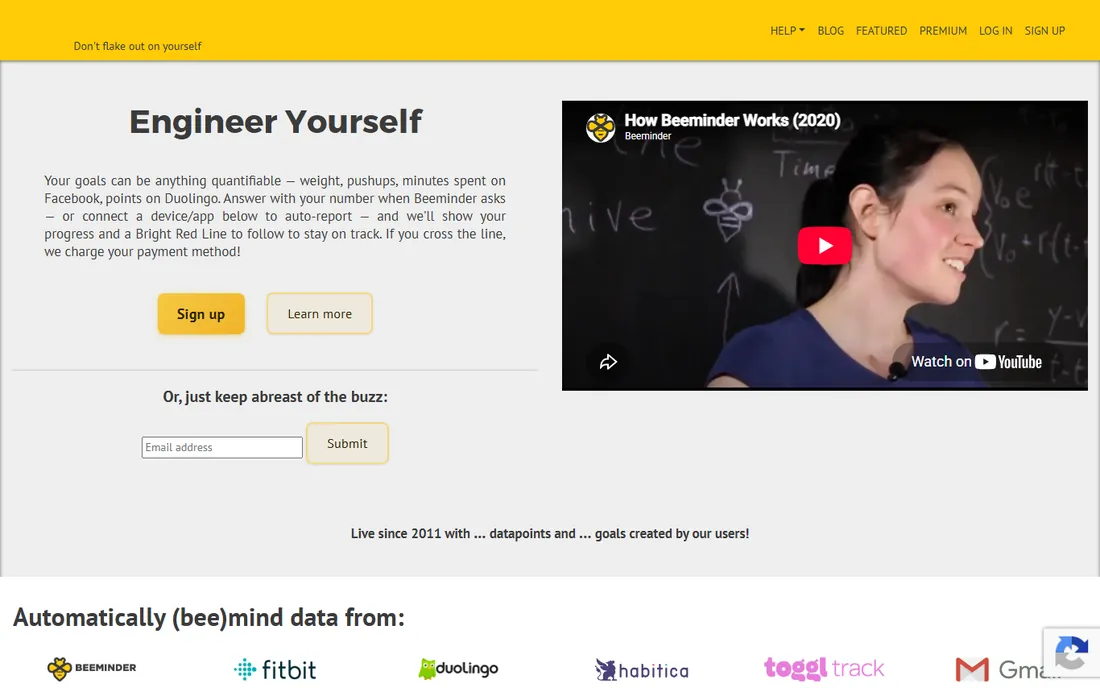
Beeminder is the veteran of money-based accountability. You set a goal with a measurable target, and Beeminder plots your progress on a graph with a bright line you must stay above. Fall behind the line and you pay, starting at $5 and climbing a fixed ladder ($10, $30, $90) with each derailment. The free tier covers 3 active goals, and Premium starts at $8 a month.
What separates Beeminder is automation. It pulls data from Fitbit, Toggl, Duolingo, RescueTime, and dozens of other services, so your graph updates without manual logging. Email, Slack, SMS, and webhook reminders start when you drift into the red and come faster as the deadline approaches. If you respond to data and deadlines, nothing here is more thorough.
The catch is emotional. Real money leaving your account is stressful by design, and the pledge ladder means repeated failures get expensive fast. You can cap your pledge, and you should. Beeminder suits people who trust systems more than motivation and want the harshest honest feedback loop available.
What we like- Automatic data tracking through dozens of integrations
- Free if you stay on track
- Escalating pledges make each failure cost more
Watch out for- The interface feels technical
- Money stakes create genuine anxiety for some users
- Quantified goals only, not open-ended habits
#2
stickK
Best for: formal commitment contracts with social pressure
Visit stickk.com
Starting price$0 (free; stakes are set by you)
Free planYes
stickK is the original commitment contract platform, founded in 2008 by Yale economists Dean Karlan and Ian Ayres. You create a contract with a goal and timeline, optionally add financial stakes, invite a referee to verify your progress reports, and recruit supporters who follow your commitment journal. If you fail, your pledged money goes to a charity, a friend, a foe, or an "anti-charity" you dislike.
The research behind it is real: Karlan's work found that adding a referee roughly doubles the chance of success, and adding financial stakes roughly triples it. Users have put over $51 million on the line across more than half a million commitments. The platform itself is free; the only money involved is the stakes you choose.
The downside is execution. The site and apps feel dated, and progress reporting is manual, so it relies on your honesty and your referee's attention. But the concept is the purest form of accountability software here: a signed commitment, witnesses, and consequences. For big one-off goals like quitting smoking or finishing a thesis, the formality helps.
What we like- Created by Yale behavioral economists with research behind it
- Referee and supporter roles add human accountability
- Anti-charity stakes are a strong motivator
Watch out for- The website feels dated
- Mobile app ratings are mediocre
- No automatic tracking, everything is self-reported
Starting price$0 (free for 3 sessions per week; Plus from $8/month billed annually)
Free planYes
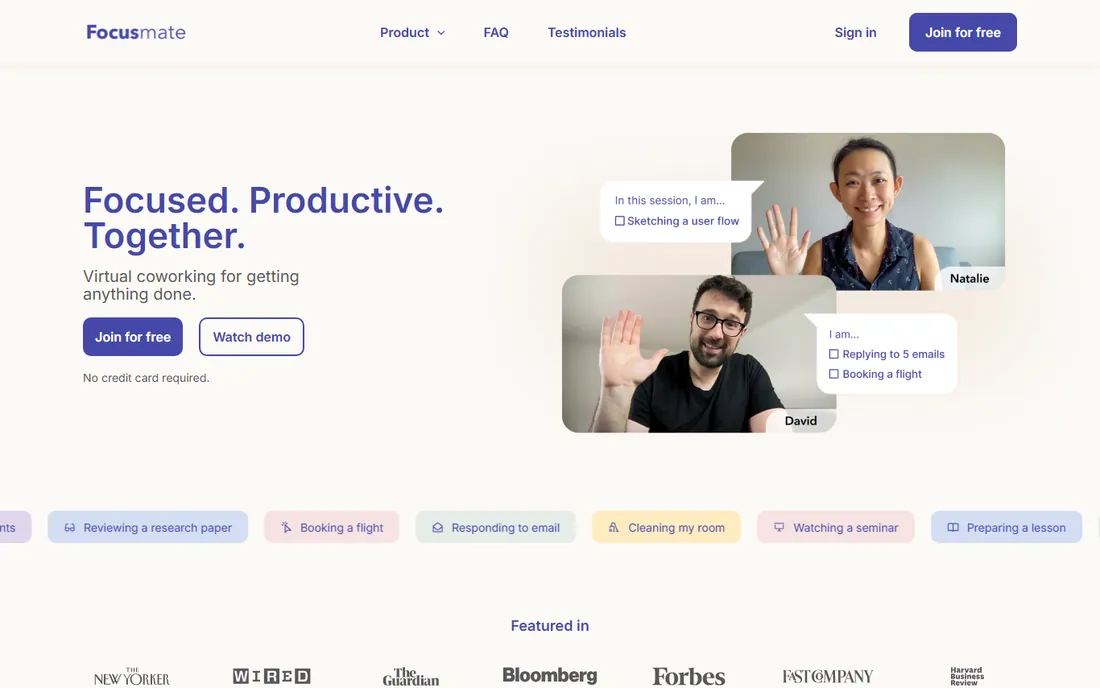
Focusmate solves the hardest part of any task: starting. You book a session, get matched with another person somewhere in the world, declare your task in the first minute, then work silently on camera while they do the same. A check-in at the end closes the loop. The concept is body doubling, and for procrastinators it works shockingly well.
The free plan covers 3 sessions a week, and Focusmate Plus at $8 a month billed annually ($12 month-to-month) opens up unlimited sessions. Sessions run 25, 50, or 75 minutes, join from the browser on desktop or mobile, and sync with your calendar. The company reports over 12 million completed sessions.
The limitation is scope. Focusmate is a focus tool, not a goal tracker: it helps you do the thing, but it does not remember your goals or penalize misses. If your problem is avoidance rather than follow-through, it is the best tool here. If your problem is remembering commitments at all, pair it with one of the trackers below.
What we like- A real person on camera makes starting dramatically easier
- Sessions book in 25, 50, or 75-minute blocks
- Browser-based, no software to install
Watch out for- Free tier caps at 3 sessions a week
- Always-on camera is uncomfortable for some
- No goal tracking beyond the session itself
#4
Forfeit
Best for: proof-based habit contracts with AI verification
Visit forfeit.app
Starting price$0 (free; stakes are set by you)
Free planYes
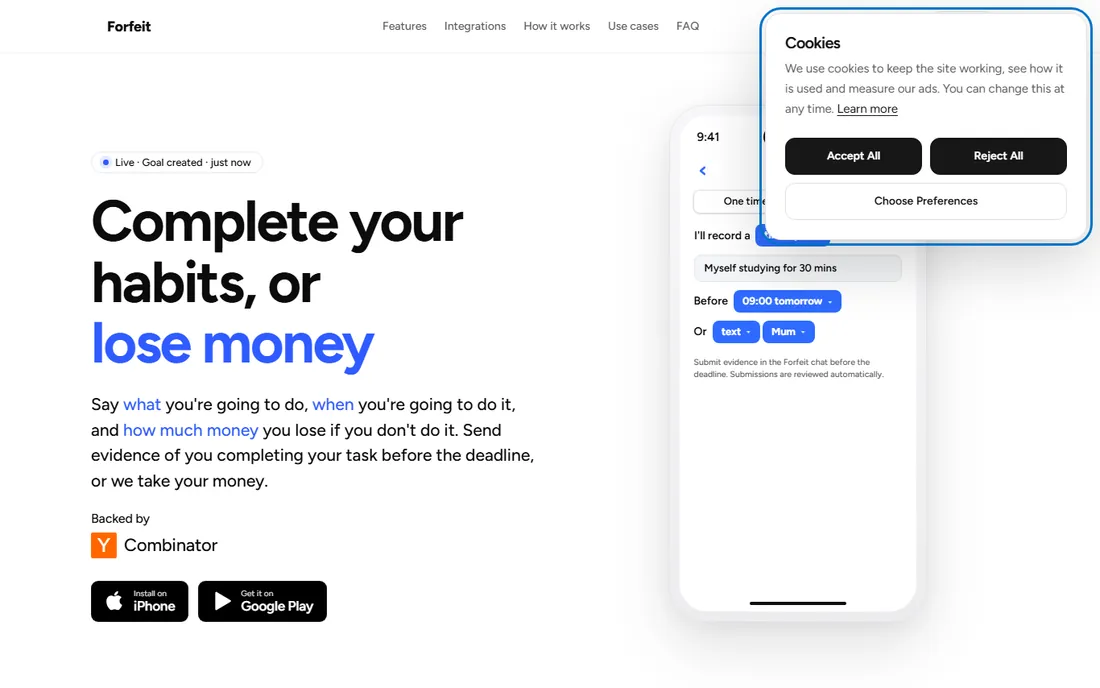
Forfeit modernizes the money-on-the-line model with proof. You set a rule ("up by 6:30am, $15 on the line"), choose how to prove it (live photo, GPS check-in, Apple Health sync, timelapse), and submit evidence before the deadline. AI verifies the submission is fresh and real, with human reviewers handling edge cases. Miss the window and the card gets charged.
The verification options are the standout. A photo forfeit for waking up, a GPS forfeit for getting to the gym, a health-data forfeit for 10,000 steps with automatic syncing and nothing to submit. The app also blocks distracting apps during goal windows and offers an AI coach that calls and texts you with reminders. The company reports a 94% success rate across 75,000+ goals.
The risks are the same as any stakes app: set forfeits you can actually hit, because the charges are automatic. The appeals process exists for genuine emergencies. For people who liked the stickK concept but want modern verification instead of self-reporting, Forfeit is the upgrade.
What we like- Multiple verification methods including photo, GPS, and health data
- AI checks your proof, with human review for edge cases
- Appeals process if life gets in the way
Watch out for- Money stakes can add up if you overcommit
- Screen blocking features are limited on some platforms
- A newer company than Beeminder or stickK
Starting price$15.99 per month
Free planFree trial (14 days)
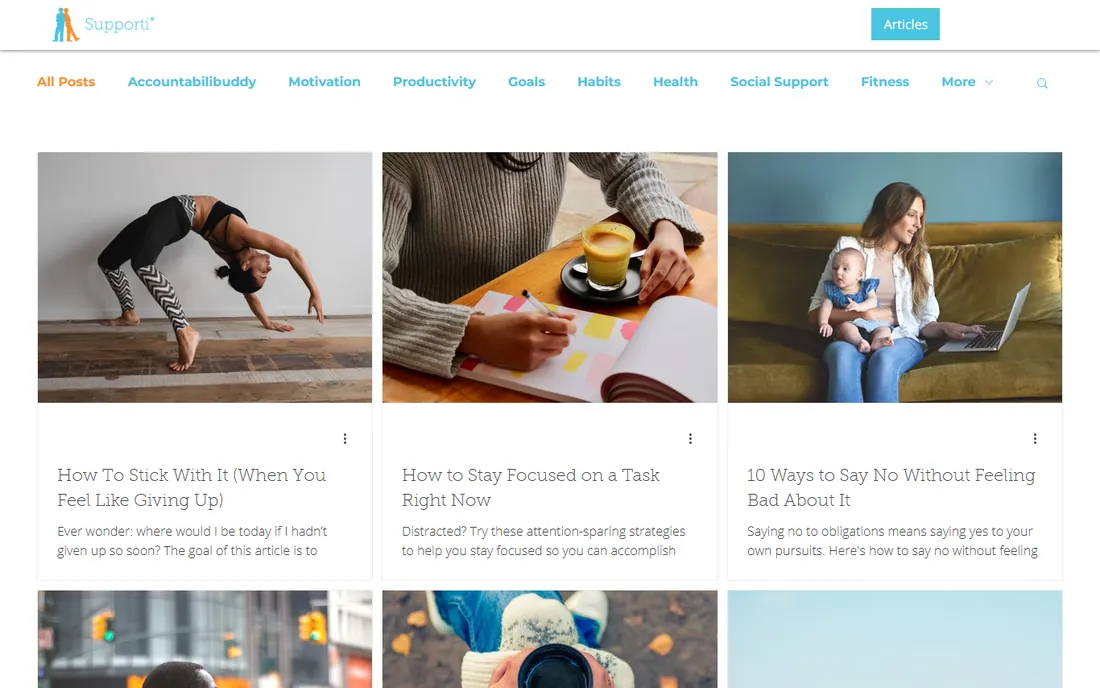
Supporti pairs you with a real person as your accountability partner. You pick a daily action through a goal-setting wizard, get matched with a buddy for 7 days, and check in with each other every day by chat. At the end of the session you rate each other on encouragement, then continue together or get rematched. The mutual design means you are accountable for being a good partner too.
The pricing is $15.99 a month or $129.99 a year, with a 2-week free trial for new users. That subscription filters for serious users, which is the point: a buddy system only works if both people show up. The company also runs a Superbuddy program and referral rewards for free access.
The trade-off is dependence on strangers. A great buddy is transformative; a flaky one is frustrating, though rematching is painless. Supporti suits people who respond to social obligation rather than financial stakes, and who want encouragement alongside accountability. If you have ever kept a promise only because someone else was counting on you, this is your format.
What we like- Matched with a real buddy for 7-day sessions
- Daily mutual check-ins build a genuine relationship
- Goal-setting wizard breaks goals into daily actions
Watch out for- No free tier beyond the trial
- Quality depends on your matched buddy
- Mobile only, no web app
Starting price$0 (free; subscription $4.99/month or $47.99/year)
Free planYes
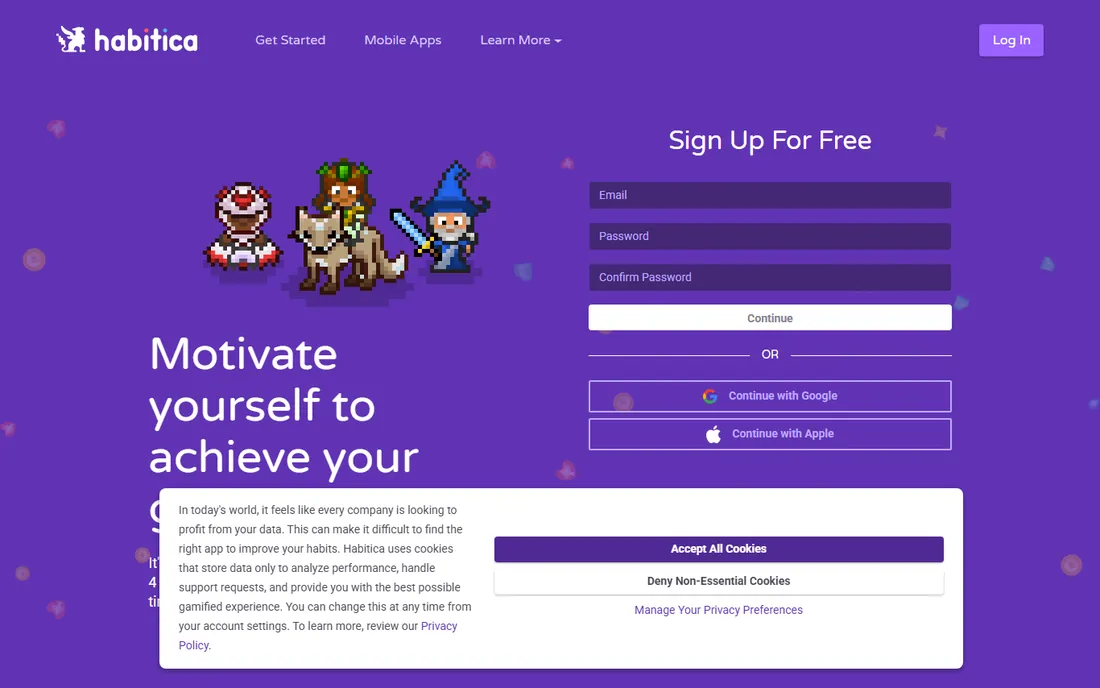
Habitica turns your to-do list into a role-playing game. Habits, dailies, and to-dos become quests that earn your avatar experience, gold, gear, and pets. Miss a daily and your character takes damage; at zero health you lose a level, your gold, and a piece of equipment. Parties of up to 30 friends battle bosses together, where everyone's missed dailies hurt the whole party.
That party mechanic is genuine accountability: your friends feel it when you skip. Guilds and challenges add community layers, and the app is open source with a volunteer community contributing art and translations. The core is free, with an optional subscription at $4.99 a month or $47.99 a year.
The honest catch is that the game can become the point. Some users optimize their avatar instead of their habits. And the HP penalty for missed days feels punishing rather than motivating if you are going through a rough week. Habitica fits gamers and social players who want accountability to feel like play, not pressure.
What we like- Full RPG with avatar, quests, and parties makes consistency fun
- Open source with a decade-long community
- Parties create real social accountability
Watch out for- The game layer can distract from the habits
- Missed dailies damage your character, which some find demoralizing
- Dated visual style
Starting price$0 (free for 2 routines; Pro $5/month or $36/year)
Free planYes
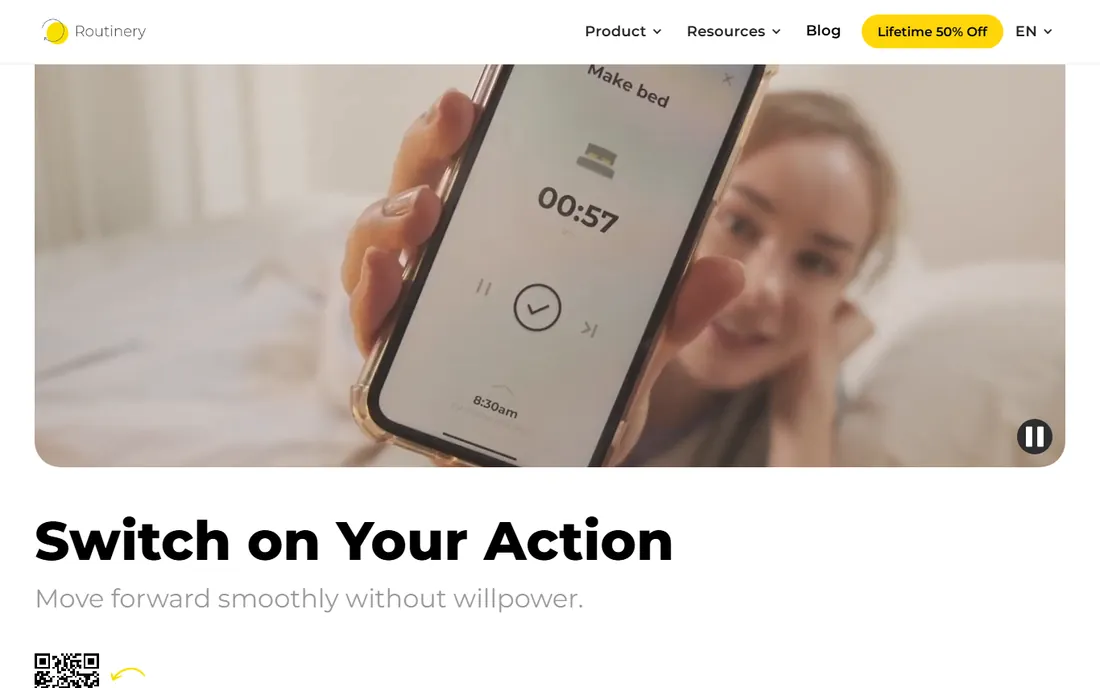
Routinery is built for people who stall between the steps of a routine. Instead of a checklist, it runs your morning, evening, or focus routine as a timed sequence: each step gets its own timer and a voice that announces what to do next. You stop deciding what comes next and just follow the voice.
The free tier covers 2 routines, and Pro at $5 a month or $36 a year opens up unlimited routines. Reminders fire by weekday and time, with location alerts and an iOS alarm option. If you skip, the streak can lapse, but Rest Mode covers planned breaks and a Streak Recovery Pass can restore one. Routinery's own blog publishes detailed, honest comparisons of competing apps, which is a good sign.
Routinery is narrower than the other tools here: it will not hold you accountable for quarterly business goals. But for the daily routines that structure a productive life, the timed, voice-guided format solves the exact failure mode of static checklists. If your mornings keep falling apart, start here.
What we like- Step-by-step timers with a voice that calls out each step
- Reminders by weekday, time, location, and iOS alarm
- Strong following among ADHD and neurodivergent users
Watch out for- Focused on routines, not one-off goals
- No web version
- Free tier limited to 2 routines
How we chose
We focused on tools whose core mechanism is accountability itself, not general habit tracking. Pricing comes from vendor pages, official help centers, and each company's own published comparisons, checked against 2026 listings. We verified each tool is still operating and available. We looked at what the consequence of a miss is, whether a human is involved, and how each tool fits different motivation styles. We did not test any software hands-on.
Pick the accountability style that matches your failure mode
Money stakes work if your problem is follow-through. Beeminder, stickK, and Forfeit all convert a broken promise into a financial loss, which behavioral economics says is the strongest single motivator. Choose Beeminder for quantified, data-tracked goals; stickK for formal contracts with a referee; Forfeit for modern proof-based verification.
Human accountability works if your problem is isolation. Focusmate gives you a stranger watching you work for an hour. Supporti gives you a buddy checking in daily for a week. Both exploit the same psychology: we keep promises to other people that we break to ourselves. These are the right pick if you have ever done something only because someone was watching.
Game and routine mechanics work if your problem is boredom or executive dysfunction. Habitica makes consistency fun through social gaming. Routinery removes the decision-making from routines with timed, voice-guided steps. Neither punishes you financially, which makes them gentler on-ramps.
Start free, escalate only when you plateau
Every tool on this list except Supporti has a free tier worth using. Run the free version for two weeks and measure honestly: did your completion rate change? If the gentle version works, you do not need the paid one. Escalate only when you plateau: move from Routinery's free routines to a stakes app when gentle reminders stop working, or from Beeminder's free goals to a human coach when money stops scaring you.
The most expensive failure in accountability software is buying the harshest tool first, flaming out, and concluding that nothing works. The research suggests graduated commitment beats maximal commitment. Start with the lightest mechanism that might work, and let your own data tell you when to add teeth.
When accountability apps are not enough
Software handles the mechanics of commitment, but it cannot fix a goal you do not actually want. If you keep paying Beeminder derailments or ghosting your Supporti buddy, the problem may be the goal, not the system. Shrink the commitment until it is embarrassingly small, or admit the goal belongs to someone else's expectations and drop it.
There is also a line between accountability and self-punishment. Money stakes should sting, not cause financial stress; a missed day should cost you HP in a game, not your self-respect. The best tools here include escape hatches: appeals in Forfeit, pledge caps in Beeminder, Rest Mode in Routinery. Use them. An accountability system you abandon after a bad week is worse than no system at all.
Frequently asked questions
What is accountability software?
Software designed to keep you committed to goals through external pressure: financial stakes, a human partner, reminders, or game mechanics. Unlike a simple to-do list, it adds a consequence for not following through, whether that is losing money, disappointing a buddy, or breaking a streak.
Which accountability app is best for losing weight?
Beeminder and Forfeit both work well for weight goals. Beeminder can auto-sync scale data and charges escalating pledges when you drift off your weight line. Forfeit lets you stake money on daily actions like workouts or step counts, verified by health data. stickK's commitment contracts with a referee are a strong free alternative.
Are free accountability apps effective?
They can be. Focusmate's free 3 sessions a week, Beeminder's free 3 goals, and Routinery's free 2 routines are all genuinely useful without paying. The paid tiers mostly remove limits or add harsher consequences. Start with the free tier and pay only when you hit a limit that matters.
Is putting money on the line safe?
The apps charge only the stakes you set, and reputable ones use standard payment processing. The real risk is overcommitting: set stakes high enough to sting but low enough that a bad week does not cause financial stress. Beeminder lets you cap pledges, and Forfeit offers appeals for genuine emergencies.
Can accountability software help with ADHD?
Many people with ADHD report that body doubling (Focusmate) and timed, voice-guided routines (Routinery) help with task initiation, which is a common ADHD challenge. These tools provide external structure rather than relying on internal motivation. They are productivity aids, not medical treatment, so pair them with professional guidance where needed.
What is the difference between stickK and Beeminder?
Both use money stakes, but stickK is built around formal commitment contracts with a human referee and supporters, best for one-off goals with a deadline. Beeminder is built around continuous quantified tracking with automatic data sync and escalating pledges, best for ongoing numeric goals. stickK is fully free; Beeminder is free for 3 goals with paid tiers.
Sources we checked (8)
- https://www.fastcompany.com/91618954/16-tools-for-a-more-focused-workday
- https://www.routinery.app/blog/apps-that-nudge-you-when-you-skip-goal
- https://www.routinery.app/blog/gamified-routine-builders-ranked
- https://play.google.com/store/apps/details?id=com.summit.stickk&gl=za&hl=en
- https://www.getsupporti.com/help
- https://www.themuse.com/advice/accountability-partner
- https://play.google.com/store/apps/details?id=app.forfeit.forfeit&hl=en_AU
- https://www.dailyhabits.xyz/habit-tracker-app/coach-me-vs-stickk
Is your product missing or out of date?
We review this list regularly. Vendors can request a listing, send updated pricing or ask about featured placement.

Shihab Mia · Founder, Rankite
Shihab has spent more than a decade helping SaaS and e-commerce brands grow through search. He writes Rankite's software buying guides from pricing pages, documentation and public user reviews. More about Shihab.