How we make this list: we compare pricing pages, product documentation and public user reviews. Ratings come from G2, Capterra or Trustpilot, with the date we checked them.
Key takeaways
- Backstage is a free, open source framework from Spotify, under CNCF incubation, but the real cost is the team running it: 3 to 12 dedicated engineers and over $2 million total cost of ownership over three years for a full build.
- Port is the catalog-first SaaS alternative, with a free tier for 15 seats and paid tiers from $30 per seat per month.
- Cortex is the scorecard-first alternative, with quote-only per-seat pricing near $65 per user per month in third-party comparisons.
- OpsLevel is the governance-first alternative, with a read-only reporting model that makes it the lowest-risk portal to trial and the cheapest to leave.
- Humanitec, Roadie, Compass, and Red Hat Developer Hub cover orchestration, managed Backstage, Atlassian ecosystems, and enterprise Red Hat support.
Quick comparison
| Tool | Best for | Starting price | Free plan |
|---|
 Port | Catalog plus self-service without headcount | Free | Yes |
 Cortex | Scorecards and standards enforcement | See website | No |
 OpsLevel | Governance-first visibility | See website | No |
 Humanitec | Environment orchestration | $1,979 per month | No |
 Roadie | Managed Backstage without the platform tax | $24 per user per month | No |
 Atlassian Compass | Atlassian ecosystem teams | $7.67 per user per month | Yes |
 Red Hat Developer Hub | Enterprise supported Backstage | See website | No |
 Spotify Portal for Backstage | Official managed Backstage | See website | No |
Is your product missing or out of date?
We review this list regularly. Vendors can request a listing, send updated pricing or ask about featured placement.
The best Backstage.io alternatives
Starting priceFree
Free planYes
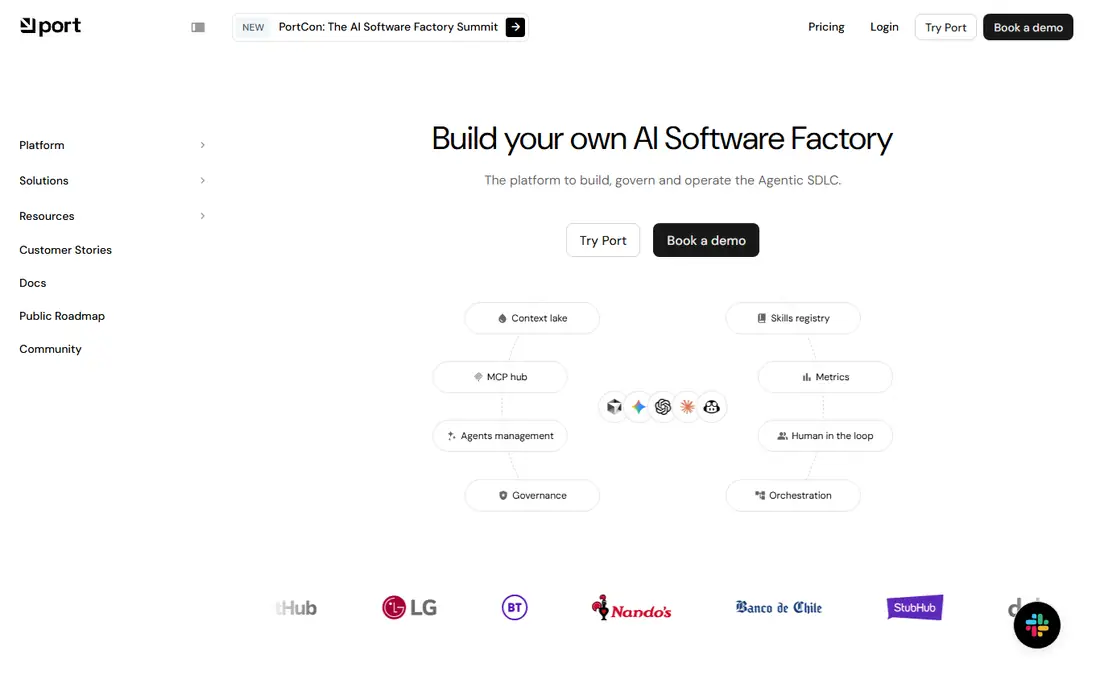
Port is the catalog-first alternative for mid-size teams that want a rich catalog without running infrastructure. Its blueprint catalog, self-service actions, and AI Builder workflows cover the core portal jobs: what exists, who owns it, and how to request it. The free tier covers 15 seats with no time limit, and paid tiers run $30 per seat per month on Basic and $40 on Standard billed annually, with Enterprise custom.
Port does not provision infrastructure, so teams whose bottleneck is environment provisioning need Humanitec instead. Lock-in risk is medium: blueprints and schemas are yours but SaaS-shaped. For a team whose bottleneck is visibility and self-service without platform-team headcount, Port is the leading Backstage alternative.
What we like- Catalog-first agentic SDLC platform with blueprint catalog, self-service actions, and AI Builder workflows
- Free tier for 15 seats with no time limit
- Basic from $30 per seat per month billed annually
- Standard from $40
Watch out for- SaaS only, no self-hosted option
- Catalog and actions, not infrastructure provisioning
- Lock-in risk is medium, since blueprints are yours but SaaS-shaped
Starting priceSee website
Free planNo
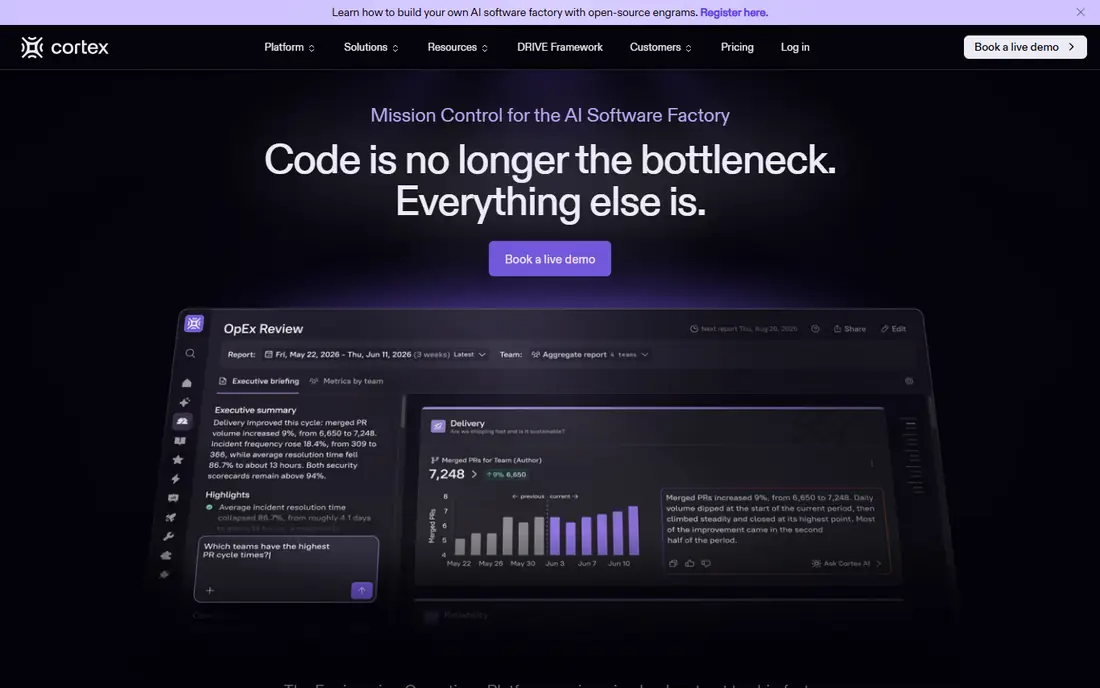
Cortex pitches itself as the most aggressive Backstage replacement, repositioned as an EngOps suite with OpEx Review, AI Impact, a Context Graph, and Cortex MCP for agents. Its strength is that scorecards and standards enforcement are the core product, not a plugin, with 50 plus integrations out of the box and a Forrester TEI study to support the business case.
Pricing is quote-only and custom per seat, with third-party comparisons near $65 per user per month, which becomes prohibitive for companies with large engineering organizations. The EngOps repositioning mid-purchase means buyers should pin down in writing which product surface they are actually buying. For engineering-leadership buyers who want audit-ready standards enforcement and adoption reporting more than customization, Cortex is the scorecard-first pick.
What we like- Scorecards and engineering-standards enforcement are the core product, not a plugin
- 50 plus integrations out of the box
- SOC 2 Type 2 and ISO 27001
- EngOps suite with OpEx Review, AI Impact, and a Context Graph
Watch out for- Quote-only pricing, with third-party comparisons near $65 per user per month, which becomes prohibitive at large engineering headcounts
- Marketing volume exceeds the category's signal tolerance
- EngOps repositioning means pinning down the exact product surface in writing
Starting priceSee website
Free planNo
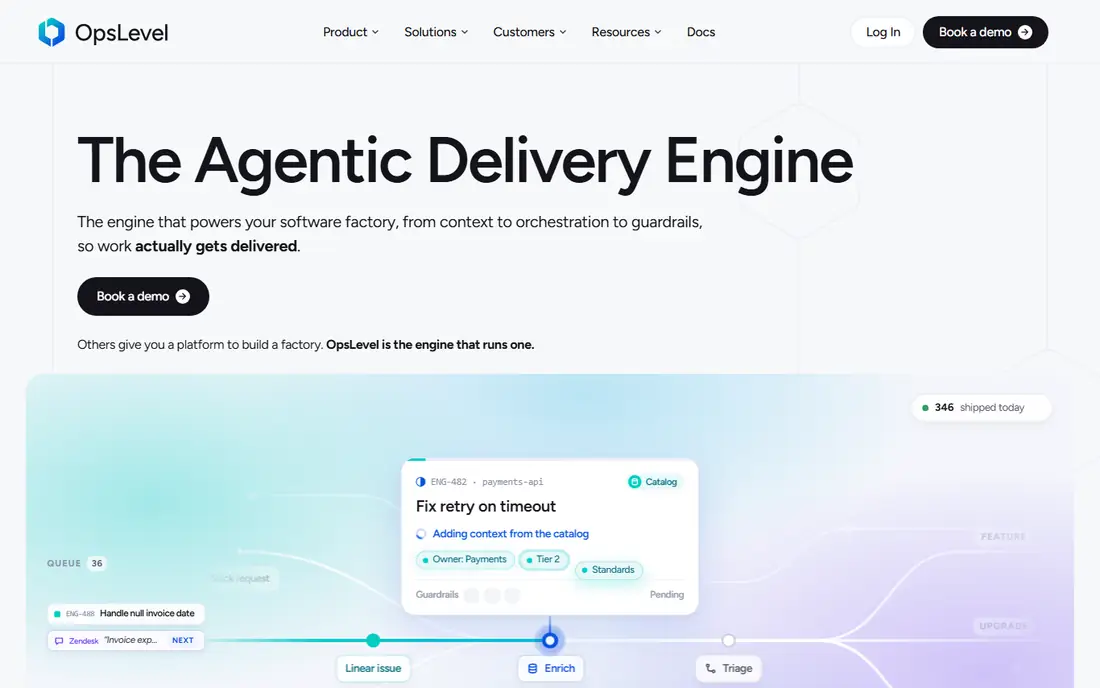
OpsLevel is the governance-first, quietly opinionated alternative. Its catalog plus scorecards plus self-service actions cover visibility and standards, with a growing AI-agent story: a Context Layer built on MCP and an agent that ships merge-ready PRs across a service fleet. The lowest-risk model in the category is its key trait: it observes and reports against standards rather than mutating infrastructure, which makes it the easiest to trial and the cheapest to leave.
Pricing is quote-only, with Standard up to 50 users and Enterprise unlimited, and per-developer pricing with volume discounts. The read-only reporting model that makes it safe also means it will not solve a provisioning problem. For a team buying its first portal whose primary goal is visibility and standards, not orchestration, OpsLevel is the governance pick.
What we like- Lowest-risk model in the category: observes and reports against standards rather than mutating infrastructure
- Catalog plus scorecards plus self-service actions
- AI Context Layer on MCP and an agent shipping merge-ready PRs
- SOC 2 Type 2
- Per-developer pricing with volume discounts
Watch out for- Quote-only pricing
- Standard tier up to 50 users with Enterprise unlimited
- Read-only reporting model will not solve provisioning problems
Starting price$1,979 per month
Free planNo
Humanitec is the execution alternative: a Platform Orchestrator rather than a portal. Its Score specs and Resource Definitions compile to per-environment infrastructure, with a Portal as an optional frontend and Backstage, Port, and Cortex supported as frontends. That makes it the choice for teams whose bottleneck is environment provisioning rather than catalog visibility.
Pricing runs Teams from $1,979 a month billed annually for 5 users, with monthly listings near $2,199, Pro near $4,950 a month for 50 users, and Enterprise and self-hosted custom. Lock-in risk is high, since orchestration logic lives in the tool. For a small platform team with budget whose bottleneck is provisioning, Humanitec is the orchestration pick.
What we like- Platform Orchestrator that compiles Score specs and Resource Definitions into per-environment infrastructure
- Portal optional
- Backstage, Port, and Cortex supported as frontends
- Free trial with no credit card plus an MVP program
Watch out for- Teams from $1,979 a month billed annually for 5 users, with monthly listings near $2,199
- Pro near $4,950 a month for 50 users
- Orchestration logic lives in the tool, so lock-in risk is high
- Enterprise and self-hosted tiers are custom
#5
Roadie
Best for: Managed Backstage without the platform tax
Visit roadie.io
Starting price$24 per user per month
Free planNo
Roadie is managed Backstage. It offers the industry-standard Backstage framework with its entire ecosystem and community support, but without the infrastructure maintenance that makes self-hosted Backstage expensive. At $24 per user per month, it is the golden path for enterprises that want modern platform capabilities without the platform tax or the $2 million plus cost of building from scratch.
There is no free plan, and customization depth depends on the managed service rather than full self-hosting control. For an enterprise that wants Backstage itself but values its engineers' time too much to spend it on infrastructure, Roadie is the managed pick.
What we like- Industry-standard Backstage with its full ecosystem and community support, without infrastructure maintenance
- $24 per user per month entry
- Golden path for enterprises that want Backstage without building from scratch
Watch out for- No free plan
- Still Backstage under the hood, so customization depth depends on the managed service
- Per-user pricing scales with headcount
Starting price$7.67 per user per month
Free planYes
Atlassian Compass suits teams that live entirely in the Atlassian ecosystem. Its component catalog with ownership and health tracking integrates natively with Jira and Confluence, and its free plan plus $7.67 per user per month entry make it the cheapest paid portal here. For an Atlassian shop, the integration efficiency can outweigh the platform's constraints.
The limits are ecosystem-bound: value drops outside Atlassian tools, and scaffolding and templates were deprecated on December 1, 2025, which removes a core portal workflow. For a team deep in Atlassian already, Compass is the natural, cheap extension. For a heterogeneous toolchain, Port or OpsLevel fits better.
What we like- Free plan available
- $7.67 per user per month entry
- Native Jira and Confluence integration
- Component catalog with ownership and health tracking
Watch out for- Best value only inside the Atlassian ecosystem
- Scaffolding and templates were deprecated on December 1, 2025
- Limitations with non-Atlassian tools
Starting priceSee website
Free planNo
Red Hat Developer Hub is the enterprise-supported Backstage distribution. It packages upstream Backstage with Red Hat support, lifecycle management, and enterprise hardening, which suits regulated enterprises that need a vendor behind their portal rather than a community project alone. The plugin ecosystem from upstream Backstage carries over.
Pricing is quote-only, and the platform still requires platform-team effort, since it is Backstage under the hood rather than a fully managed SaaS. For an enterprise that wants Backstage with a support contract and Red Hat alignment, Developer Hub is the supported pick.
What we like- Enterprise-supported Backstage distribution with Red Hat support and lifecycle
- Suits regulated enterprises that need a vendor behind their portal
- Plugin ecosystem from upstream Backstage
Watch out for- Quote-only pricing with no published figures
- Still Backstage under the hood, so platform-team effort remains
- Red Hat ecosystem alignment matters
#8
Spotify Portal for Backstage
Best for: Official managed Backstage
Visit spotify.com
Starting priceSee website
Free planNo
Spotify Portal for Backstage is the official managed offering from Backstage's originator. It gives teams the closest thing to upstream Backstage with managed operations, which suits organizations that want Spotify's own product direction and ecosystem compatibility without self-hosting.
Pricing is quote-only with no free plan, and managed scope depends on Spotify's roadmap. For a team that wants the official Backstage experience as a service, Spotify Portal is the originator's pick. For a team that wants the cheapest managed Backstage, Roadie at $24 per user per month is more transparent.
What we like- Official managed offering from Backstage's originator, Spotify
- Closest to upstream Backstage with managed operations
- Ecosystem compatibility
Watch out for- Quote-only pricing
- No free plan
- Managed scope and roadmap depend on Spotify's product direction
How we chose
We compared each tool against what Backstage.io actually offers: an open source framework, under CNCF incubation and originated at Spotify, for building an internal developer portal from plugins, with a software catalog, templates, documentation, and TechDocs. Pricing figures come from vendor pages and published comparisons captured in September and October 2026, and anything we could not confirm is written as "See website". We favored tools that serve US engineering organizations, and we flagged where a tool is a portal, an orchestrator, or a managed Backstage, since that decides whether it replaces Backstage or only hosts it.
What to check before you pick
Start with the bottleneck. If it is visibility and self-service, shortlist Port. If it is standards enforcement, shortlist Cortex and OpsLevel. If it is environment provisioning, shortlist Humanitec. If it is Backstage itself without the maintenance burden, shortlist Roadie, Red Hat Developer Hub, and Spotify Portal. Then check four things before buying: whether the pricing model is per seat, per tier, or quote-only, and what it costs at your real developer count; whether the tool provisions infrastructure or only reports on it; what lock-in looks like, since Humanitec's orchestration logic and Port's SaaS-shaped blueprints carry different risks than OpsLevel's read-mostly rules; and whether your platform team has the headcount for self-hosted Backstage, since a funded team of 4 plus engineers with strong opinions is the minimum for a full-control build. Treat published prices as a negotiation baseline, not a quote, and pilot on a subset of services before migrating the whole catalog.
Frequently asked questions
Is Backstage free?
Yes, the Backstage framework itself is free and open source under Apache 2.0. The real cost is the team running it: 3 to 12 dedicated engineers and over $2 million total cost of ownership over three years for a full build.
What is the cheapest Backstage alternative?
Port's free tier for 15 seats is cheapest for small teams. Among paid portals, Atlassian Compass at $7.67 per user per month is cheapest, and Roadie at $24 per user per month is the cheapest managed Backstage.
Port vs Cortex: which is better?
Port is better for catalog visibility and self-service without platform-team headcount. Cortex is better for scorecard-driven standards enforcement and audit-ready reporting for engineering leadership.
Does OpsLevel provision infrastructure?
No. OpsLevel observes and reports against standards rather than mutating infrastructure. Teams needing provisioning should shortlist Humanitec, which compiles Score specs into per-environment infrastructure.
Can I keep using Backstage plugins with a managed alternative?
Roadie, Red Hat Developer Hub, and Spotify Portal all build on upstream Backstage, so plugin compatibility is strongest there. Port, Cortex, and OpsLevel are separate platforms with their own integration models.
What is an internal developer portal?
An internal developer portal is a single place where developers find services, owners, documentation, and self-service actions. Backstage popularized the model with its software catalog, templates, and TechDocs.
Sources we checked (8)
- https://www.getport.io/
- https://www.cortex.io/
- https://www.opslevel.com/
- https://humanitec.com/
- https://roadie.io/
- https://www.atlassian.com/software/compass
- https://developers.redhat.com/products/red-hat-developer-hub
- https://spotify.com/backstage
Is your product missing or out of date?
We review this list regularly. Vendors can request a listing, send updated pricing or ask about featured placement.

Shihab Mia · Founder, Rankite
Shihab has 5+ years in B2B and SaaS SEO. He writes Rankite's software buying guides from pricing pages, documentation and public user reviews. More about Shihab.