How we make this list: we compare pricing pages, product documentation and public user reviews. Ratings come from G2, Capterra or Trustpilot, with the date we checked them.
Key takeaways
- Port is the most flexible managed portal, with blueprints, scorecards, and self-service actions on a data model you define.
- Cortex leads for engineering standards, with scorecards, initiatives, and production readiness for the AI software factory.
- OpsLevel is the pick for service maturity and ownership, with a catalog that builds itself from your tools.
- Atlassian Compass suits Jira and Bitbucket teams, but its scorecards and catalog are transitioning into Atlassian DX, so check migration plans.
- Harness IDP is the best Backstage migration path, keeping existing catalogs and plugins inside the Harness delivery platform.
- Humanitec and Qovery solve the execution half: orchestrating environments and deployments behind a portal, not just showing a catalog.
- Roadie is excluded from this list because it is closed to new portal customers and pivoting to AI context tooling.
Quick comparison
| Tool | Best for | Starting price | Free plan |
|---|
 Port | Flexible managed portal | See website | Free trial |
 Cortex | Engineering standards | See website | Free trial |
 OpsLevel | Service maturity | See website | Free trial |
 Atlassian Compass | Atlassian shops | See website | Free trial |
 Harness IDP | Backstage migration | See website | Free trial |
 Humanitec | Platform orchestration | See website | Free trial |
 Qovery | Deployments in your cloud | See website | Free trial |
Is your product missing or out of date?
We review this list regularly. Vendors can request a listing, send updated pricing or ask about featured placement.
The best Spotify Backstage alternatives
Starting priceSee website
Free planFree trial
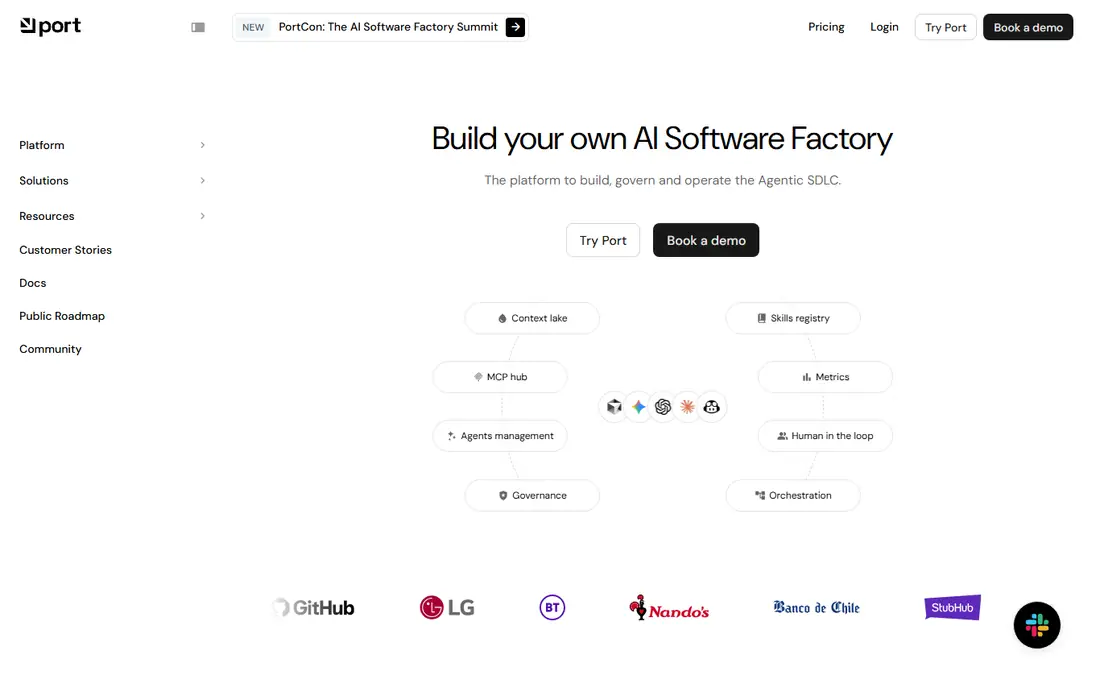
Port is a platform to build, govern, and operate the agentic software development lifecycle. Its homepage covers a marketplace of skills, plugins, and agents, governance of agents across the lifecycle, infrastructure provisioning with agents, autonomous ticket resolution, self-healing incidents, auto-fixing pipeline failures, and AI root cause analysis. Comparison sources describe Port as offering a flexible data model and low-code blueprints, which is its core advantage over Backstage's more rigid catalog model.
The trade-off is that Port is a portal, not a runtime. Actions send payloads to your existing systems, which do the work, so you still need pipelines and infrastructure behind each self-service action. For teams that already have runtimes and want a governed self-service layer with maximum modeling flexibility, Port is the strongest managed portal on this list.
What we like- Flexible data model with low-code blueprints
- Scorecards, self-service actions, and automations
- Agentic SDLC governance
Watch out for- Pricing is quote based
- Portal only, so you still need runtimes behind each action
Starting priceSee website
Free planFree trial
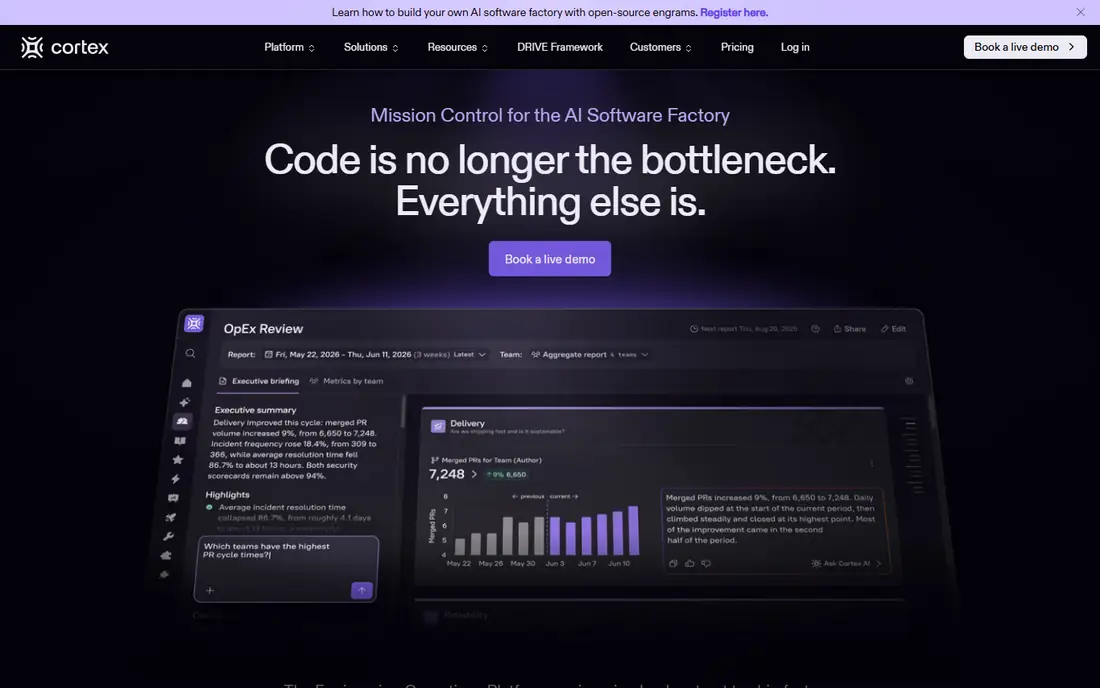
Cortex describes itself as mission control for the AI software factory, an engineering operations platform trusted to ship faster as AI multiplies output without risk to reliability and security. Its homepage covers production readiness, AI enablement with security and testing standards, and self-service scaffolding, migrations, and infrastructure provisioning through golden paths, plus a DRIVE framework for measuring organizational effectiveness with human-in-the-loop governance.
The catch is scope. Cortex measures and enforces standards across your engineering org, but it does not deploy or run applications itself. For engineering leaders who want to drive standards, production readiness, and AI adoption across many teams, Cortex is the best Backstage alternative.
What we like- Engineering operations platform with scorecards and initiatives
- Production readiness checks
- Self-service golden paths
- DRIVE framework for AI era governance
Watch out for- Pricing is quote based
- Reports on tooling rather than deploying or running applications
Starting priceSee website
Free planFree trial
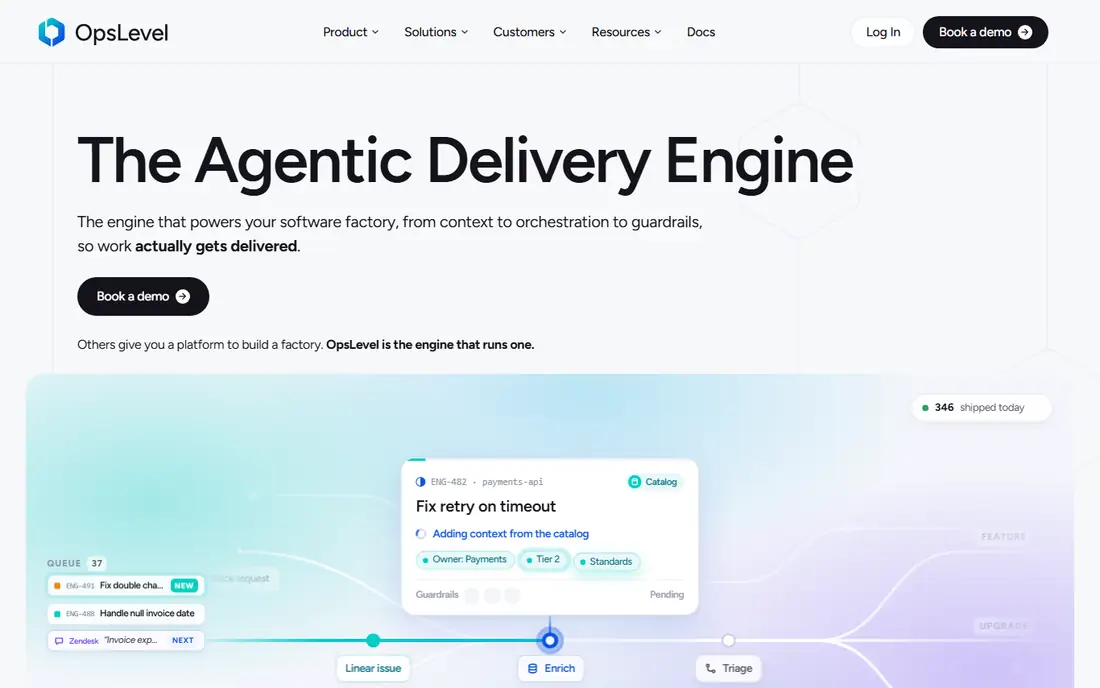
OpsLevel is an internal developer portal for high-performing teams, described as the single pane of glass for engineering teams and agents. Its homepage covers cataloging your entire software ecosystem in minutes with AI powered enrichment and auto-detected service owners, team-specific and global software health measurement, checks against predefined standards, custom workflows for repeated work, and a Software Factory model where agents handle triage and maintenance under approvals. Customer quotes praise OpsLevel for replacing spreadsheets, Backstage, and custom scorecard tools.
The trade-off is pricing model and scope. OpsLevel is priced per developer with custom quotes, and like Port it is a portal layer rather than a runtime. For teams whose main problem is not knowing what services exist, who owns them, or which meet standards, OpsLevel is the best pick.
What we like- Catalog builds itself from GitHub, Datadog, AWS, and more
- Service maturity checks and standards
- Self-service workflows
- Agent aware context
Watch out for- Pricing is quote based per developer
- Portal focus means runtimes stay separate
Starting priceSee website
Free planFree trial
Atlassian Compass is the internal developer platform from Atlassian, built to catalog services and improve software health for teams already living in Jira and Bitbucket. Its homepage covers maintaining services with a central source for operating and building software, untangling architecture with a comprehensive component catalog, and extensibility with internal and third-party tools, plus case studies from Boden and OVO Energy.
The caveat is important: the Compass homepage itself states that as Atlassian focuses on a next-generation solution for tracking developer productivity and experience, Compass scorecards and catalog functionality will transition into DX, and customers should discuss migration options with their account manager. For Atlassian shops that accept that transition, Compass remains the cheapest credible entry, but new buyers should confirm the DX roadmap first.
What we like- Native Jira and Bitbucket integration
- Component catalog with scorecards
- Cheapest credible entry for Atlassian teams
Watch out for- Scorecards and catalog functionality are transitioning into Atlassian DX, so roadmap needs checking before committing
Starting priceSee website
Free planFree trial
Harness IDP is a managed Backstage fork bundled with the Harness software delivery platform, and the easiest migration path off self-hosted Backstage. Its homepage describes one portal for every service and standard, with self-service infrastructure provisioning, AI powered discovery and setup, unified docs and data, golden path repeatability, and automated scorecards for compliance. Migration support explicitly retains existing catalogs and plugins while adding RBAC, SSO, Policy as Code, and managed SaaS reliability.
The trade-off is ecosystem fit. Harness IDP shines brightest for teams already using or planning to use Harness CI/CD, though it works standalone. For Backstage users tired of operating the portal themselves, Harness IDP is the lowest friction move.
What we like- Keeps existing Backstage catalogs and plugins
- Self-service golden paths
- Automated scorecards
- 200 plus integrations
- Free trial with no credit card
Watch out for- Quote based enterprise pricing
- Best value inside the wider Harness delivery platform
Starting priceSee website
Free planFree trial
Humanitec is a platform orchestrator, not a pure developer portal, and that distinction matters. Its homepage positions Humanitec as the missing layer between who requests infrastructure and what gets provisioned, letting AI agents and developers provision within rules the platform team defines, with progressive rollouts, impact analysis, rollback, drift detection, and ephemeral environments. It plugs into existing Terraform or OpenTofu modules and enforces standards from that point on.
The catch is that Humanitec solves execution, not discovery. It does not replace a service catalog on its own, but it pairs well with a portal like Port or Backstage. For platform teams whose bottleneck is governed provisioning rather than catalog visibility, Humanitec is the right layer.
What we like- Orchestration and governance layer for AI and human deployments
- Progressive rollouts, impact analysis, rollback, and drift detection
- Works with existing Terraform modules
Watch out for- Not a pure portal
- Catalog and developer experience features are thinner than Port or Cortex
Starting priceSee website
Free planFree trial
Qovery is an agentic infrastructure platform that runs, scales, and governs projects on any cloud. Its homepage covers migrating workloads, spinning up multi-cloud environments, and letting AI agents deploy safely, with blueprint templates, preview environments per pull request, built-in guardrails, and deployment from any git or container registry, all inside your own AWS, GCP, Azure, or Kubernetes account. A 14 day free trial with no credit card is offered.
The trade-off is category. Qovery is an orchestration platform with a blueprint catalog, not a pure developer portal, so teams needing deep scorecards or service maturity tracking should pair it with a portal. For teams that want self-service deploys in their own cloud without building the pipeline layer, Qovery is the best execution focused alternative.
What we like- Deploys into your own cloud account or existing Kubernetes cluster
- Blueprint catalog with preview environments
- 14 day free trial with no credit card
Watch out for- Orchestration platform with portal capabilities, not a pure portal
- Enterprise pricing for large estates
How we chose
We compared tools that replace Spotify Backstage for internal developer portals: a software catalog, self-service actions, scorecards, and docs in one place. Each vendor homepage was opened to confirm the product exists today and matches its category, except Configure8, whose homepage failed with a DNS error and was dropped rather than listed on search evidence. Roadie was excluded because comparison sources report it is closed to new portal customers. We kept a mix of managed portals, a Backstage migration path, and orchestration platforms, since Backstage buyers split into two groups: those who need a better portal, and those who need something that actually runs workloads.
Migrating from Backstage without losing your catalog
Start by exporting your Backstage catalog: entities, ownership, docs, templates, and plugins. That inventory decides the replacement, since a team with heavy custom plugins needs Harness IDP or a managed Backstage distribution, while a team with a simple catalog can move to Port, Cortex, or OpsLevel. Map each template to a self-service action in the new tool, and test golden paths with one team before migrating the rest.
Keep Backstage running until the new portal proves itself on real services, and rebuild scorecards early, since standards tracking is where migrations most often stall. Finally, decide whether you need execution too: if developers still file tickets for environments after the portal migration, add an orchestration layer like Humanitec or Qovery rather than blaming the portal.
Frequently asked questions
Is Backstage itself still available?
Yes, Backstage remains an open source framework from Spotify under the CNCF, and Spotify also offers a managed Portal for Backstage. Teams switch to avoid operating the portal themselves, or for stronger scorecards, governance, and self-service.
Which Backstage alternative is cheapest?
Atlassian Compass is the cheapest credible entry for Atlassian shops, with published per user rates, but check the DX transition first. Port offers a free tier, and Harness IDP and Qovery offer free trials. Most others are quote based.
Do I need a portal, an orchestrator, or both?
Portals show what exists and let developers self-serve. Orchestrators actually provision environments and deployments. Many teams need both: a portal like Port or Cortex for visibility and standards, plus Humanitec or Qovery for governed execution.
Can I migrate my Backstage catalog and plugins?
Harness IDP explicitly supports retaining existing catalogs and plugins. Other portals support importing catalog data from Git and APIs, but custom plugins usually need rebuilding, so audit plugin usage before committing.
What is the difference between a service catalog and scorecards?
A catalog lists what exists: services, APIs, owners, and docs. Scorecards measure whether each service meets standards like security, reliability, and documentation. Backstage offers both, and so do Port, Cortex, OpsLevel, and Harness IDP.
Why is Roadie not on this list?
Roadie was a popular managed Backstage option, but comparison sources report it is closed to new portal customers and pivoting to AI context tooling. Existing subscribers may still use it, but new buyers should choose another option here.
Sources we checked (7)
- https://www.getport.io
- https://www.cortex.io
- https://www.opslevel.com
- https://www.atlassian.com/software/compass
- https://www.harness.io/products/internal-developer-portal
- https://humanitec.com
- https://www.qovery.com
Is your product missing or out of date?
We review this list regularly. Vendors can request a listing, send updated pricing or ask about featured placement.

Shihab Mia · Founder, Rankite
Shihab has 5+ years in B2B and SaaS SEO. He writes Rankite's software buying guides from pricing pages, documentation and public user reviews. More about Shihab.