How we make this list: we compare pricing pages, product documentation and public user reviews. Ratings come from G2, Capterra or Trustpilot, with the date we checked them.

Key takeaways
- TestNG is the closest full replacement for JUnit, with groups, dependencies, parallel execution, and data providers built in.
- Spock and Kotest suit teams that want more readable, expressive tests, in Groovy and Kotlin respectively, with data driven testing as a first class feature.
- Cucumber, Selenide, and Serenity BDD suit acceptance and UI testing, where readable scenarios and clear reports matter more than pure unit test speed.
- Mockito and AssertJ are not full test runners on their own. They replace the mocking and assertion parts of a JUnit workflow, and they usually run inside JUnit, TestNG, or another runner.
- All eight tools here are free and open source as libraries, so the real cost is learning time, build setup, and maintenance, not a license fee.
Quick comparison
| Tool | Best for | Starting price | Free plan |
|---|
 TestNG | Large Java suites needing groups and parallel runs | Free | Yes |
 Spock | Readable Groovy specifications with built in mocking | Free | Yes |
 Kotest | Kotlin first testing with many test styles | Free | Yes |
 Cucumber | Plain language acceptance tests for mixed teams | Free | Yes |
 Mockito | Mocking dependencies in Java unit tests | Free | Yes |
 AssertJ | Fluent, readable assertions for Java and Kotlin | Free | Yes |
 Selenide | Concise browser UI tests in Java | Free | Yes |
 Serenity BDD | Living documentation and reports for acceptance tests | Free | Yes |
Is your product missing or out of date?
We review this list regularly. Vendors can request a listing, send updated pricing or ask about featured placement.
The best alternatives to JUnit
#1
TestNG
Best for: Large Java suites needing groups and parallel runs
Visit testng.org
Starting priceFree
Free planYes
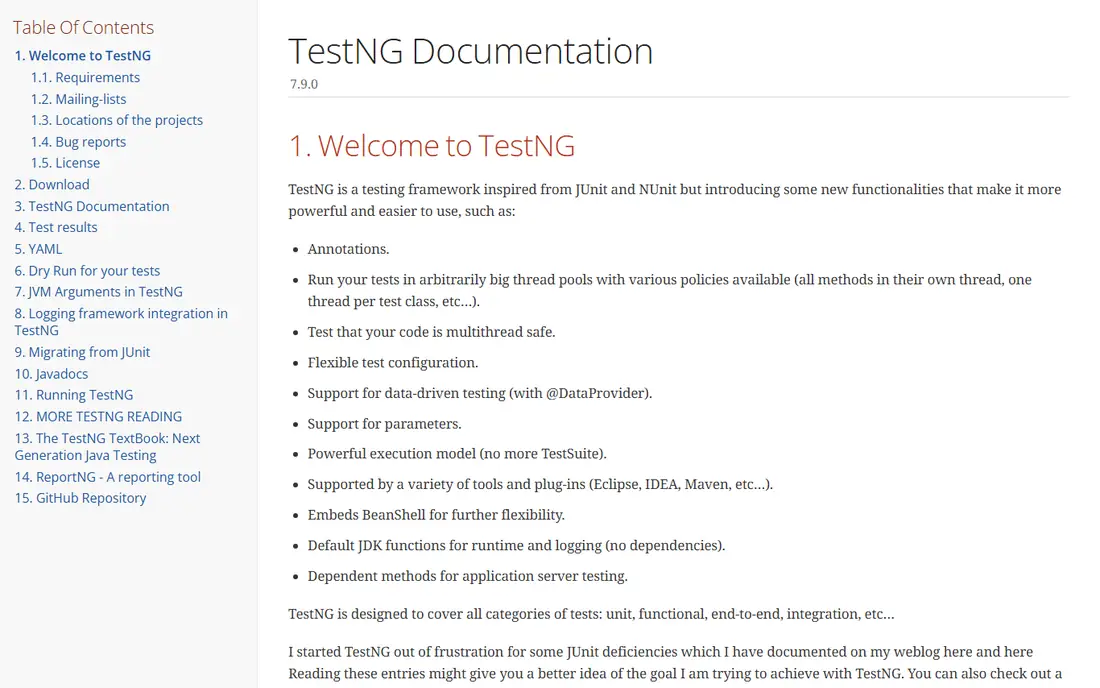
TestNG suits a Java team whose test suite has outgrown simple unit tests. It was inspired by JUnit and NUnit, but adds features that large suites need: you can group tests as fast, slow, integration, or smoke, run only one group in CI, declare that one test depends on another, and feed many data rows into a single test method through a data provider. Parallel execution is also built in, with policies for running methods, classes, or instances in their own threads, which helps when a suite takes too long on a single thread.
That power comes with a learning curve. A small project with a few dozen tests will not feel the benefit, and the XML suite file can seem like extra ceremony compared with JUnit annotations alone. TestNG is also less common in tutorials and starter projects, so new team members may need time to learn its model. For a large, long lived Java codebase with integration tests, flaky test management, and a need for flexible runs, TestNG is the most direct and capable JUnit replacement on this list.
What we like- Groups, dependencies, and priorities for ordering tests
- Data providers for data driven tests
- Parallel execution in configurable thread pools
- XML suite configuration and strong Maven, Gradle, and IDE support
Watch out for- Smaller community than JUnit, so answers and examples are fewer
- XML configuration can feel heavy for small projects
- Migration from JUnit needs annotation and setup changes
Starting priceFree
Free planYes
Spock suits a team that values test readability above all else. Tests are written in Groovy as specifications, with given, when, then, expect, and where blocks that make the setup, action, and expected result obvious at a glance. A data table in a where block can run the same test across many inputs, and failure output shows the values involved, which makes debugging faster than a plain assertion failure.
Spock also includes mocking, so a team does not need a separate mocking library for many cases, and it runs on the JUnit Platform, which means it works with common build tools and IDEs. The main cost is Groovy itself. A Java only team must accept Groovy in the test codebase, and must manage Groovy version compatibility with Spock and the JDK. If your team already uses Groovy, or is willing to learn it for tests, Spock produces some of the clearest tests in the JVM world. If not, TestNG or Kotest may be an easier switch.
What we like- Given, when, then blocks that read like a specification
- Data tables for data driven tests
- Built in mocking and stubbing
- Runs on the JUnit Platform, so IDE and build tool support is good
Watch out for- Requires Groovy, which is an extra language for a pure Java team
- Groovy and Spock version pairing needs care
- Fewer resources than JUnit for very large Java only teams
#3
Kotest
Best for: Kotlin first testing with many test styles
Visit kotest.io
Starting priceFree
Free planYes
Kotest suits a Kotlin team that wants a testing framework written for Kotlin, not adapted from Java. It supports many styles, so a team can write behavior specs that read like user stories, feature specs grouped by feature, or simple string based tests, all with natural language names and unlimited nesting. Its assertions library is fluent and Kotlin idiomatic, and its property testing module can generate many inputs, shrink a failing case to a small example, and check coverage.
Kotest also supports Kotlin Multiplatform, which matters if the same code targets JVM, JavaScript, Native, or Android. The limit is language fit: a Java team should not adopt Kotest just for its features, since the Kotlin advantage disappears. A Kotlin team should pick one style early and document it, because Kotest flexibility can lead to five different test styles in one codebase. With that discipline, Kotest is the best JUnit alternative for modern Kotlin work.
What we like- Many test styles, from behavior and feature specs to simple string specs
- Strong assertions library with hundreds of matchers
- Property based testing with generators and shrinking
- Multiplatform support for JVM, JS, Native, and Android
Watch out for- Kotlin only focus, so Java teams gain little
- Many styles can confuse a team without a style guide
- Community is smaller than JUnit, especially outside Kotlin projects
#4
Cucumber
Best for: Plain language acceptance tests for mixed teams
Visit cucumber.io
Starting priceFree
Free planYes
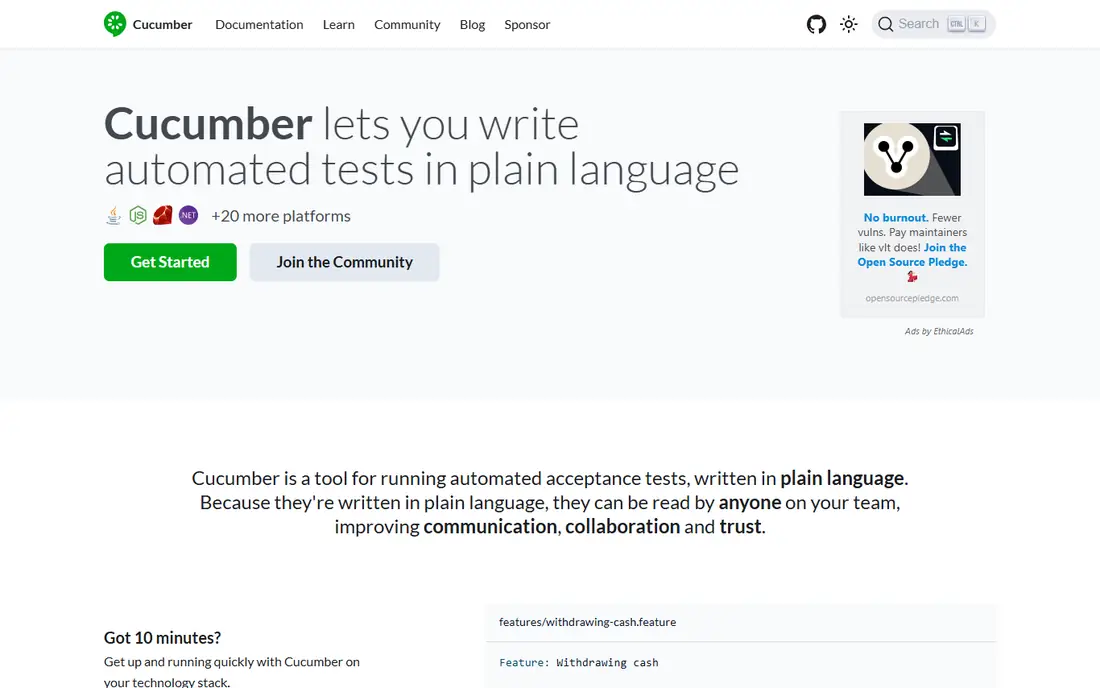
Cucumber suits a team that needs non developers to read and trust automated tests. A scenario such as a customer withdrawing cash within their balance is written in plain language, then linked to code that performs each step. Product managers can review the scenarios, QA can add edge cases, and developers can implement the steps, which improves shared understanding of what the software should do.
Cucumber is not a drop in JUnit replacement for unit tests. It is slower to write and run than a unit test, and it needs a runner and step definitions behind the plain language. A team that adopts Cucumber for every test will end up with a slow, brittle suite. Used well, Cucumber covers acceptance tests at the top of the testing pyramid, while JUnit, TestNG, Spock, or Kotest cover unit and integration tests below. That split, with clear rules about what belongs in a scenario, is where Cucumber earns its place.
What we like- Scenarios written in plain language that product, QA, and developers can all read
- Gherkin syntax for Given, When, Then steps
- Implementations in Java, Kotlin, and many other languages
- Strong fit for acceptance and regression testing
Watch out for- Not a unit test framework, so it does not replace JUnit for class level tests
- Step definition maintenance grows with the scenario count
- Plain language scenarios can become vague without discipline
Starting priceFree
Free planYes
Mockito suits almost any Java team that tests classes with dependencies, because it removes the need to write fake classes by hand. You create a mock of a repository or service, stub its methods to return test data, run the code under test, and verify that the expected methods were called with the expected arguments. That pattern makes unit tests fast and focused, since a database or web service is not needed to test business logic.
Mockito is best understood as a companion to a runner, not a runner itself. Most teams use it inside JUnit or TestNG, and many starter projects include it by default. The main risk is misuse: mocking everything, including value objects and types owned by other libraries, produces tests that pass while the real system fails. Follow the Mockito guidance on its own site: do not mock types you do not own, do not mock value objects, and do not mock everything. Used with restraint, Mockito is the standard mocking choice for Java, and a key reason some teams stay with JUnit while changing only the mocking layer.
What we like- Clean API for creating mocks, stubbing methods, and verifying interactions
- Works with JUnit and TestNG
- Supports spies, argument captors, and behavior driven syntax
- Huge community and many examples
Watch out for- Not a test runner, so it needs JUnit, TestNG, or another framework
- Over mocking can hide real integration problems
- Mocking types you do not own can make tests brittle
Starting priceFree
Free planYes
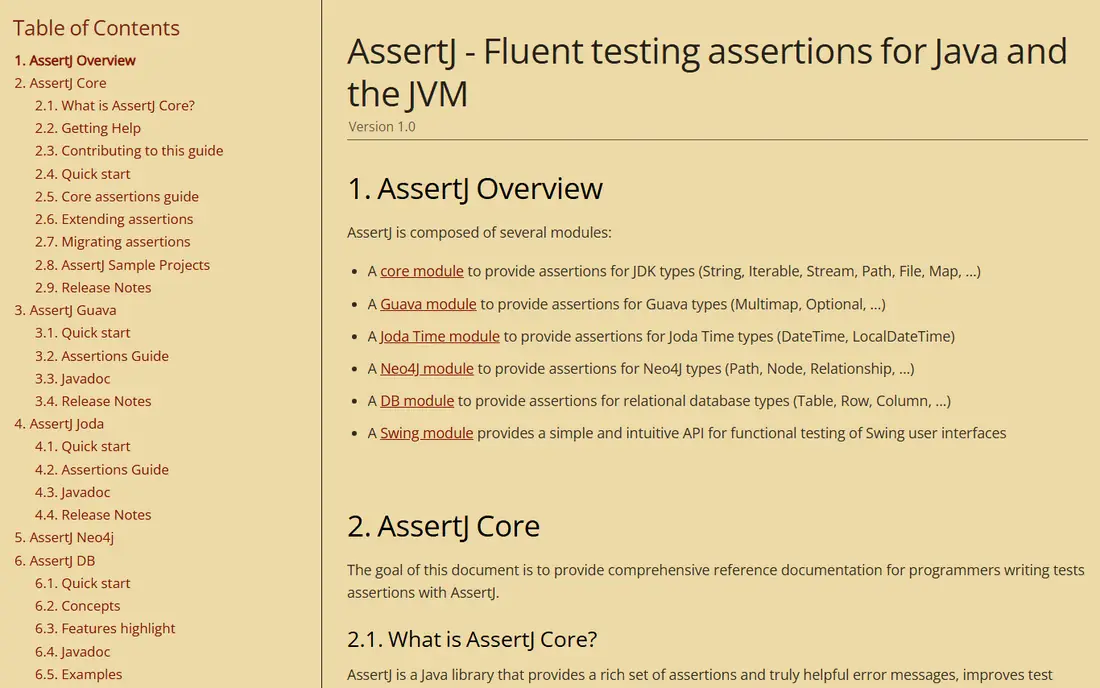
AssertJ suits a team that finds standard assertions hard to read or hard to debug. Instead of a generic assertEquals call, AssertJ lets you chain type specific checks, such as checking that a list has a certain size, contains certain items, and does not contain others, in one readable statement. When a test fails, the error message describes the actual value in detail, which often removes a round of debugging.
AssertJ also offers soft assertions, which collect several failures and report them together, instead of stopping at the first failure. That helps when a test checks many fields of one object. Like Mockito, AssertJ is a library that runs inside a test framework, not a replacement for one, and it is often bundled with Spring Boot starter test dependencies alongside JUnit and Mockito. If your complaint about JUnit is assertion readability rather than test structure, adding AssertJ may solve the problem without a migration at all.
What we like- Fluent assertions for strings, collections, maps, files, dates, optionals, and many other types
- Clear failure messages that show what was expected and found
- Soft assertions that collect several failures
- BDD style entry point alongside the standard style
Watch out for- Assertion library only, not a test runner
- Large API takes time to learn fully
- Fluent chains can become long if a team does not keep assertions focused
Starting priceFree
Free planYes
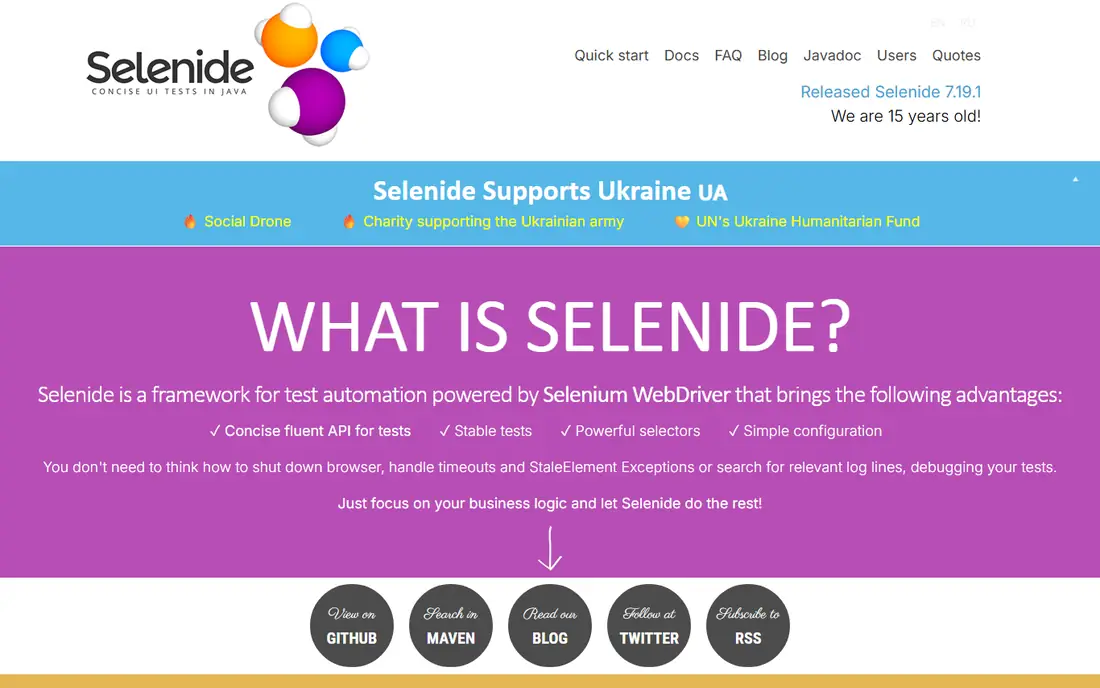
Selenide suits a Java team that needs browser UI tests without the boilerplate of raw Selenium. It wraps WebDriver with a short API, handles waiting for elements automatically, and deals with common problems such as stale element errors, so tests focus on business logic: open a page, fill a form, check a result. Automatic screenshots on failure also help, since a UI failure is much easier to diagnose with a picture of the page at that moment.
Selenide does not replace JUnit for unit tests. It still needs a runner, usually JUnit or TestNG, and it runs much slower than unit tests because it drives a real browser. Use it for a focused set of UI tests that cover critical user journeys, and keep unit and API tests in a faster framework. Teams that already know Selenium will learn Selenide quickly, and teams new to UI testing will find its concise API a gentler start than raw WebDriver code.
What we like- Concise API on top of Selenium WebDriver
- Automatic handling of waits, timeouts, and stale elements
- Automatic screenshots on failure
- Simple setup with a single dependency
Watch out for- Browser UI testing only, so it does not replace unit tests
- Selenium based, so browser and driver setup still matters
- Customization beyond the concise API can be harder than with raw Selenium
Starting priceFree
Free planYes
Serenity BDD suits a team that needs test results to serve as documentation for stakeholders. It takes tests written with Cucumber, JUnit, or Selenium and produces reports that show features, scenarios, steps, screenshots, and outcomes in a form a product owner can read. That living documentation answers a question unit test reports cannot: which requirements were tested, and what happened, in business terms.
Serenity also supports the Screenplay pattern, which models user interactions as tasks performed by actors, and that can make large UI suites easier to maintain than traditional page objects. The cost is setup and build complexity: Serenity adds dependencies, configuration, and report generation to a project, and a small team with only unit tests will not need it. For a larger team with acceptance tests, regulatory reporting needs, or a demand for clear stakeholder reports, Serenity BDD is the strongest reporting focused alternative on this list.
What we like- Rich living documentation that shows which requirements were tested
- Narrative reports with screenshots and step detail
- Works with Cucumber, JUnit, and Selenium
- Screenplay pattern support for maintainable UI tests
Watch out for- Heavier setup than a plain runner
- Report generation adds build time
- Best value comes with acceptance tests, not simple unit tests
- Training material is partly paid, though the tool itself is free
How we chose
We compared vendor documentation, project homepages, and public reviews and discussions on GitHub, Stack Overflow, and Reddit, and we checked each project homepage to confirm it loads and belongs to the named tool. We favored tools that are actively maintained and that cover a real JUnit job: running tests, mocking, asserting, or reporting, and we included both full runners and focused libraries, with their limits stated plainly. We did not claim hands-on testing. All eight tools are free and open source as libraries, so prices here reflect that, not a paid plan, and any paid training or support around a tool is separate from the tool itself.
What to check before you switch from JUnit
Start with the reason for switching. If the problem is parallel execution, grouping, or data driven tests at scale, TestNG is the direct answer. If the problem is readability, Spock or Kotest may help, depending on language. If the problem is acceptance testing or reporting, Cucumber or Serenity BDD may help. If the problem is only mocking or assertions, adding Mockito or AssertJ to your existing JUnit setup may be enough, with far less migration risk.
Next, check build and IDE support for your stack. Confirm that your Maven or Gradle setup, your IDE, and your CI system run the new framework, report results, and handle parallel tests correctly. Confirm JDK compatibility, especially for TestNG versions that require JDK 11 or higher, and for Groovy and Spock version pairings. Run a pilot on one module, not the whole codebase, and compare run time, flakiness, and failure output with your current JUnit suite.
Then check team skills and maintenance. A framework that one person loves and no one else understands will become a burden when that person leaves. Agree on a test style, a naming convention, and rules for mocking, and document them in the project. Also check plugin and library compatibility: some tools assume JUnit Platform, some assume their own runner, and mixing runners in one module can complicate reporting.
Finally, plan migration in stages. Keep existing JUnit tests running while new tests use the new framework, and migrate old tests only when they change or when a module is rewritten. A big bang rewrite of a test suite rarely pays off, and it risks losing coverage while the team learns a new tool. A staged migration, with a pilot, a style guide, and a clear reason for each module moved, gives you the benefits of a new framework without losing the safety net your tests provide.
Frequently asked questions
Is TestNG a complete replacement for JUnit?
Yes, for most Java projects. TestNG runs unit, integration, and end to end tests, with groups, dependencies, data providers, and parallel execution built in. Migration still needs work on annotations, configuration, and build setup, so pilot it on one module first.
Do I need Groovy to use Spock?
Yes, Spock tests are written in Groovy, even when the code under test is Java. That is the main adoption cost for a pure Java team, and it should be weighed against the readability benefit before switching.
Can I use Mockito or AssertJ without JUnit?
You still need a test runner, but it does not have to be JUnit. Both libraries work with TestNG and other runners, and both are commonly used alongside JUnit rather than instead of it. Think of them as parts of a test stack, not standalone frameworks.
Is Kotest only for Kotlin?
Kotest is designed for Kotlin and Kotlin Multiplatform, and that is where it shines. Java teams should choose TestNG or Spock instead, since Kotest offers little advantage without Kotlin.
When should I use Cucumber instead of a unit test framework?
Use Cucumber for acceptance tests that product, QA, and developers should all read, such as user journeys and business rules. Keep unit and integration tests in JUnit, TestNG, Spock, or Kotest, since Cucumber scenarios are slower and need more maintenance per test.
Are all of these tools really free?
Yes, as libraries, all eight are free and open source. Costs come from learning time, setup, and maintenance, and in the case of Serenity BDD, optional paid training material, not from a license fee for the tool itself.
Sources we checked (8)
- https://testng.org/
- https://spockframework.org/
- https://kotest.io/
- https://cucumber.io/
- https://site.mockito.org/
- https://assertj.github.io/doc/
- https://selenide.org/
- https://serenity-bdd.info/
Is your product missing or out of date?
We review this list regularly. Vendors can request a listing, send updated pricing or ask about featured placement.

Shihab Mia · Founder, Rankite
Shihab has 5+ years in B2B and SaaS SEO. He writes Rankite's software buying guides from pricing pages, documentation and public user reviews. More about Shihab.