How we make this list: we compare pricing pages, product documentation and public user reviews. Ratings come from G2, Capterra or Trustpilot, with the date we checked them.
Key takeaways
- Zapier is the easiest replacement for simple app to app workflows, with the widest app catalog.
- Make gives the most visual power per dollar for multi step scenarios on a budget.
- n8n is the pick for technical teams that want to self host and own their workflows.
- Workato, Boomi, Celigo, and MuleSoft are the enterprise grade replacements for complex, governed integrations.
- Microsoft Power Automate is the natural choice for Microsoft 365 shops, with desktop RPA included.
- Note that Tray itself now presents as Tray.ai, with AI agents added to its automation platform.
Quick comparison
| Tool | Best for | Starting price | Free plan |
|---|
 Workato | Enterprise governed automation | See website | Free trial |
 Zapier | Simple no code workflows | See website | Yes |
 Make | Visual scenarios on a budget | See website | Yes |
 n8n | Self hosted workflows | See website | Yes, self hosted |
 Boomi | Hybrid enterprise integration | See website | Free trial |
 Celigo | Mid market governed automation | See website | Free trial |
 Microsoft Power Automate | Microsoft 365 shops | See website | Free trial |
 MuleSoft | API led enterprise integration | See website | Free trial |
Is your product missing or out of date?
We review this list regularly. Vendors can request a listing, send updated pricing or ask about featured placement.
The best Tray.io alternatives
#1Workato
Best for: Enterprise governed automation4.7/5 on
G2 (843 reviews, checked Oct 2026)
Visit workato.com
Starting priceSee website
Free planFree trial
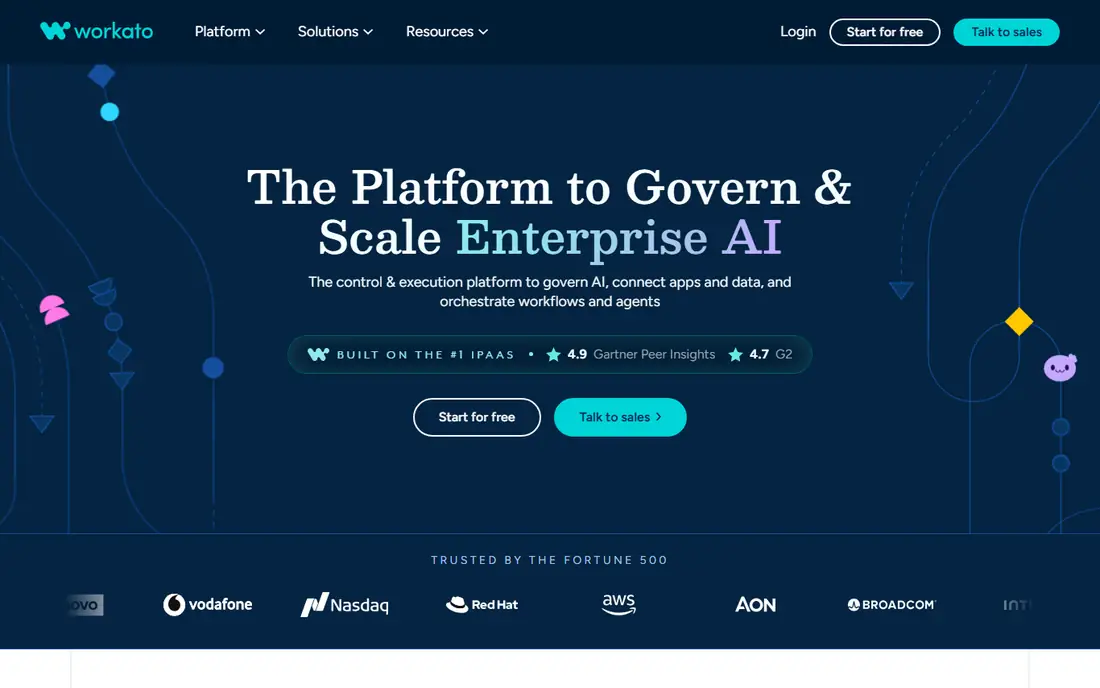
Workato is the closest enterprise grade replacement for Tray. Its homepage describes one unified AI platform for building, running, and governing agents, models, MCPs, workflows, and integrations at scale, powered by what it calls the number one iPaaS. Connectivity spans 17,000 plus apps, APIs, databases, files, and MCP servers, with centralized identity, policy, approvals, security, observability, and cost controls.
The trade-offs are cost predictability and on premises reach. Usage based metering can make costs hard to forecast as adoption spreads, and the platform is cloud only. Workato fits large organizations that want business users building automations under IT governance, across many systems, with agent and API management in the same platform.
What we like- One platform for agents, workflows, integrations, APIs, and MCP
- 17,000 plus apps and APIs
- Strong governance and cost controls
Watch out for- Enterprise pricing is quote based
- Cloud only, so on premises systems need a separate answer
#2Zapier
Best for: Simple no code workflows4.5/5 on
G2 (2,088 reviews, checked Oct 2026)
Visit zapier.com
Starting priceSee website
Free planYes
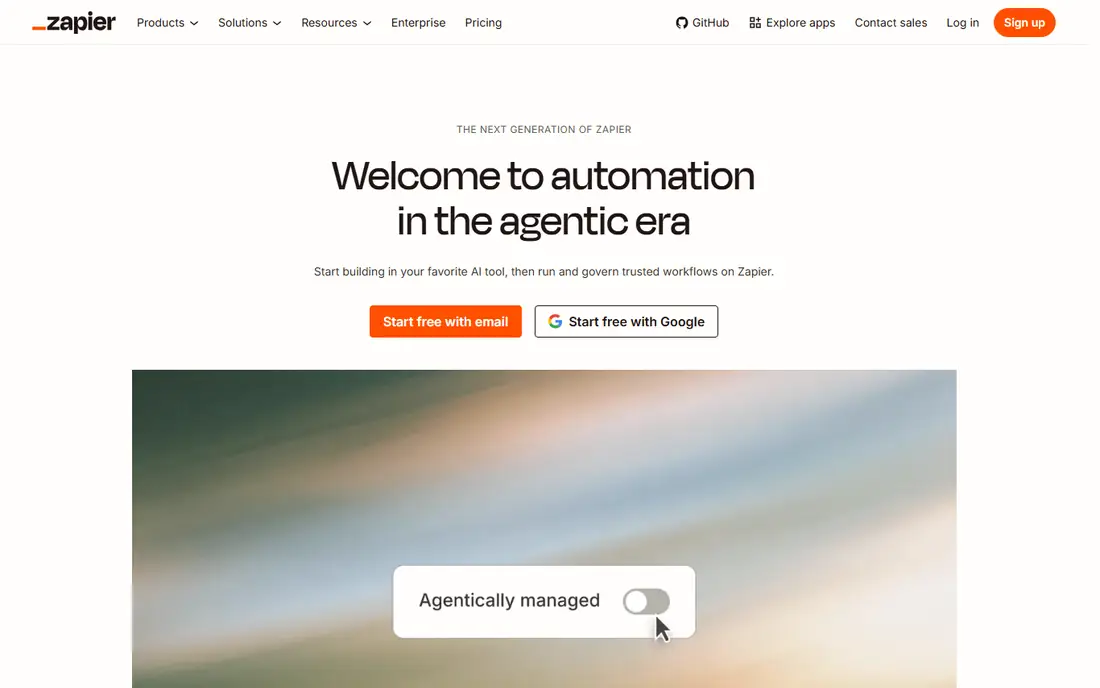
Zapier is the easiest Tray alternative to start with. Its homepage describes automation in the agentic era: build in Claude, ChatGPT, Cursor, or another AI tool, then run and govern trusted workflows on Zapier, with 9,000 plus apps and 66,000 plus triggers and actions. Governance features include SOC 2 Type II and SOC 3 compliance, app and action level controls, and full visibility into every agent action and workflow run.
The catch is scale. Task based pricing can climb quickly for high volume workflows, and Zapier is less suited to heavy data transformation or on premises integration than Boomi or MuleSoft. For business teams connecting SaaS apps with simple to moderately complex workflows, Zapier remains the fastest replacement.
What we like- 9,000 plus app integrations
- MCP support for AI tools
- Governance controls for IT
- Easy for non technical teams
Watch out for- Task based pricing can grow fast at scale
- Less suited to complex data transformation than iPaaS tools
#3Make
Best for: Visual scenarios on a budget4.6/5 on
G2 (347 reviews, checked Oct 2026)
Visit make.com
Starting priceSee website
Free planYes

Make is the value pick for visual workflow building. Its homepage stresses building and managing AI agents and automations in one visual canvas, connecting any app, data source, or AI model by prompt, drag and drop, or from an AI chat. It connects 3,500 plus apps out of the box, with custom integrations for anything with an API, and the free plan requires no credit card and has no time limit.
The trade-off is catalog size and enterprise polish. Make covers fewer apps than Zapier, and its governance features are strongest on higher tiers. For teams that want complex visual scenarios with branching and data handling at a lower price, Make is the strongest budget alternative to Tray.
What we like- Visual multi step scenarios with branching
- 3,500 plus apps out of the box
- Free plan with no credit card and no time limit
Watch out for- Smaller app catalog than Zapier
- Enterprise governance features need higher tiers
#4n8n
Best for: Self hosted workflows4.7/5 on
G2 (319 reviews, checked Oct 2026)
Visit n8n.io
Starting priceSee website
Free planYes, self hosted
n8n is the platform for technical teams that want to own their automation. Its homepage describes agents and workflows you can follow, with full on premises options, SSO and LDAP, encrypted secret stores, version control, role based permissions, audit logs, and log streaming to a SIEM. Git based control, isolated environments, and workflow diffs suit developer led teams, and human in the loop controls and guardrails support AI governance.
The catch is operational responsibility. Self hosting gives control but means your team maintains the platform, updates, and scaling. n8n fits technical teams that want open source flexibility, code where it helps, and data staying inside their own infrastructure.
What we like- Self host on your own infrastructure
- Code plus low code building
- Strong security and observability controls
Watch out for- Self hosting means you own maintenance
- Smaller prebuilt catalog than Zapier
#5Boomi
Best for: Hybrid enterprise integration4.4/5 on
G2 (505 reviews, checked Oct 2026)
Visit boomi.com
Starting priceSee website
Free planFree trial
Boomi is the enterprise iPaaS with the longest track record on this list. Its homepage describes a trusted platform for AI driven automation that connects systems, prepares data, and governs AI, running anywhere including behind your firewall. Integration and automation, AI agent management, API management, and data management share one platform, and Boomi cites 12 consecutive years as a Leader in the Gartner Magic Quadrant for iPaaS.
The trade-off is complexity and cost. Boomi is built for enterprises with many systems and high throughput, so smaller teams may find it heavier than Zapier or Make. For hybrid estates mixing cloud SaaS with on premises ERP and databases, Boomi is the most proven Tray replacement.
What we like- Hybrid cloud and on premises integration
- API and data management in one platform
- Long analyst recognition
Watch out for- Enterprise pricing is quote based for most plans
- Platform breadth takes time to learn
#6Celigo
Best for: Mid market governed automation4.6/5 on
G2 (1,105 reviews, checked Oct 2026)
Visit celigo.com
Starting priceSee website
Free planFree trial
Celigo describes itself as the number one rated iPaaS for enterprise automation, with one platform to connect apps, automate work, and scale AI with the right access. Its homepage covers integrations, data ingestion, EDI, APIs, MCP, and agents sharing one business context, with a marketplace of prebuilt connectors, integration apps, AI agents, MCP servers, and templates. Celigo cites G2 top ratings for iPaaS, EDI, and API management, plus Gartner Peer Insights Customers Choice for 2026 and 2025.
The catch is that Celigo sits between point tools and the largest iPaaS platforms: more governed than Zapier, less sprawling than Boomi or MuleSoft. That middle ground is exactly right for mid market and growing companies that need governed automation without enterprise iPaaS complexity. Celigo offers a 30 day free trial with full platform access.
What we like- Integrations, EDI, APIs, MCP, and agents on one platform
- Prebuilt integration apps and templates
- Strong customer ratings
Watch out for- Pricing is quote based
- Mid market focus means less scale than Boomi or MuleSoft for the largest estates
#7Microsoft Power Automate
Best for: Microsoft 365 shops4.4/5 on
G2 (1,092 reviews, checked Oct 2026)
Visit microsoft.com
Starting priceSee website
Free planFree trial
Microsoft Power Automate is the natural Tray alternative for Microsoft shops. Its homepage describes business process workflow automation that needs only a browser and an email address to start, with more than 1,400 prebuilt certified connectors including Dynamics 365, SAP, and Salesforce, plus custom connectors and desktop flows for RPA on systems without APIs. An on premises data gateway securely connects cloud flows to on premises services.
The trade-off is ecosystem fit. Power Automate is strongest inside Microsoft 365, and its licensing flexibility can confuse buyers comparing per user and per flow plans. For organizations already paying for Microsoft 365, Power Automate is often the cheapest and simplest replacement, since much of the stack is already licensed.
What we like- Deep Microsoft 365 and Dynamics integration
- Desktop RPA for non API systems
- 1,400 plus prebuilt connectors
Watch out for- Licensing can confuse buyers
- Strongest inside Microsoft ecosystems
Starting priceSee website
Free planFree trial
MuleSoft, part of Salesforce, is the API led enterprise alternative. Its homepage now leads with Agent Fabric, an AI control plane that finds, governs, connects, and controls the cost of every agent across a business, but the core platform remains API led connectivity: reusable APIs in layers so integrations get faster to maintain over time, with full API management from design and security to monitoring and discovery. Mule apps can run on CloudHub or on your own servers.
The catch is scale and cost. MuleSoft is built for enterprises that design and govern their own APIs, and its pricing and implementation effort reflect that. For Salesforce estates and large organizations with API strategy at the center, MuleSoft is the most structured Tray replacement.
What we like- API led connectivity with reusable APIs
- Full API lifecycle management
- Agent Fabric for AI agent governance
Watch out for- Enterprise pricing and implementation effort
- Overkill for simple app to app workflows
How we chose
We compared tools that replace Tray for integration and automation: connecting apps, moving data, and running workflows with governance. Each vendor homepage was opened to confirm the product exists today and matches its category. Pricing in this category varies by metering model, tasks, operations, credits, or quote, so we wrote See website where the vendor does not publish a clear entry price, and flagged free plans and trials from vendor pages. We kept a mix of no code tools, visual builders, self hosted platforms, and enterprise iPaaS, since Tray buyers range from small teams to large enterprises.
Migrating from Tray without breaking workflows
Start by inventorying your Tray workflows: triggers, connectors, data transformations, error handling, and owners. That inventory decides the replacement, since simple app to app flows and complex data pipelines need different tools. Map each workflow to the new platform before building, and test error handling and retries explicitly, since silent failures are the most common migration problem.
Run old and new workflows in parallel for critical processes, and compare outputs before cutover. Pay attention to metering: a workflow that was cheap on Tray may cost more on a task based platform, and vice versa. Finally, rebuild governance from day one, with named owners, access controls, and monitoring, so the new platform does not become the same sprawl you just left.
Frequently asked questions
Is Tray.io still available?
Tray now presents as Tray.ai, with AI agents added to its automation platform. Existing customers should check current Tray.ai plans and features, since the product has evolved beyond its original iPaaS positioning.
What is the cheapest Tray alternative?
Make and Zapier both offer free plans, and n8n can be self hosted without a subscription. For paid plans, Make is usually the cheapest visual builder, but compare metering models, since task, operation, and credit pricing behave differently at scale.
Which Tray alternative is best for enterprises?
Workato, Boomi, Celigo, and MuleSoft are the enterprise grade options, with governance, API management, and hybrid or on premises reach. Workato suits governed business user automation, Boomi suits hybrid estates, MuleSoft suits API led Salesforce shops, and Celigo suits mid market governed automation.
Can I self host an integration platform?
Yes. n8n offers a fully on premises option, and Boomi and MuleSoft can run behind your firewall or on your own servers. Zapier, Make, Workato, and Celigo are primarily cloud platforms.
What is the difference between iPaaS and workflow automation?
Workflow automation connects apps with triggers and actions, usually for simpler flows. iPaaS adds data transformation, API management, governance, and hybrid connectivity for complex enterprise integrations. Zapier and Make lean toward workflow automation, while Boomi, MuleSoft, Workato, and Celigo are full iPaaS platforms.
How do I estimate costs when switching?
Compare metering models carefully. Task based, operation based, credit based, and quote based pricing behave differently as volume grows. Inventory your current workflow volume, test the new platform on real workloads, and ask vendors for cost projections at your actual scale before committing.
Sources we checked (8)
- https://www.workato.com
- https://zapier.com
- https://www.make.com
- https://n8n.io
- https://www.boomi.com
- https://www.celigo.com
- https://www.microsoft.com/en-us/power-platform/products/power-automate
- https://www.mulesoft.com
Is your product missing or out of date?
We review this list regularly. Vendors can request a listing, send updated pricing or ask about featured placement.

Shihab Mia · Founder, Rankite
Shihab has 5+ years in B2B and SaaS SEO. He writes Rankite's software buying guides from pricing pages, documentation and public user reviews. More about Shihab.