How we make this list: we compare pricing pages, product documentation and public user reviews. Ratings come from G2, Capterra or Trustpilot, with the date we checked them.

Key takeaways
- Most Vite alternatives here are free and open source, so the real cost is setup time and maintenance, not a licence fee.
- Webpack still suits large, complex apps with unusual build requirements, while esbuild suits teams that prize raw build speed above all else.
- Rspack is the closest option for teams that want Webpack-style configuration with Rust-level speed.
- Turbopack only makes sense inside a Next.js project, since it does not ship as a standalone bundler.
- If you need a dev server with hot reloading out of the box, Parcel and Rsbuild need far less configuration than Rollup or esbuild alone.
Quick comparison
| Tool | Best for | Starting price | Free plan |
|---|
 Webpack | large apps with complex build needs | Free | Yes |
 Parcel | zero-config web projects | Free | Yes |
 esbuild | extremely fast builds and minification | Free | Yes |
 Rollup | libraries and lean production bundles | Free | Yes |
 Turbopack | Next.js apps that need fast refresh | Free | Yes |
 Rspack | Webpack migration with faster builds | Free | Yes |
 Rsbuild | Rspack-based projects with sensible defaults | Free | Yes |
 Bun | JavaScript runtime plus fast bundling | Free | Yes |
Is your product missing or out of date?
We review this list regularly. Vendors can request a listing, send updated pricing or ask about featured placement.
The best alternatives to Vite
Starting priceFree
Free planYes
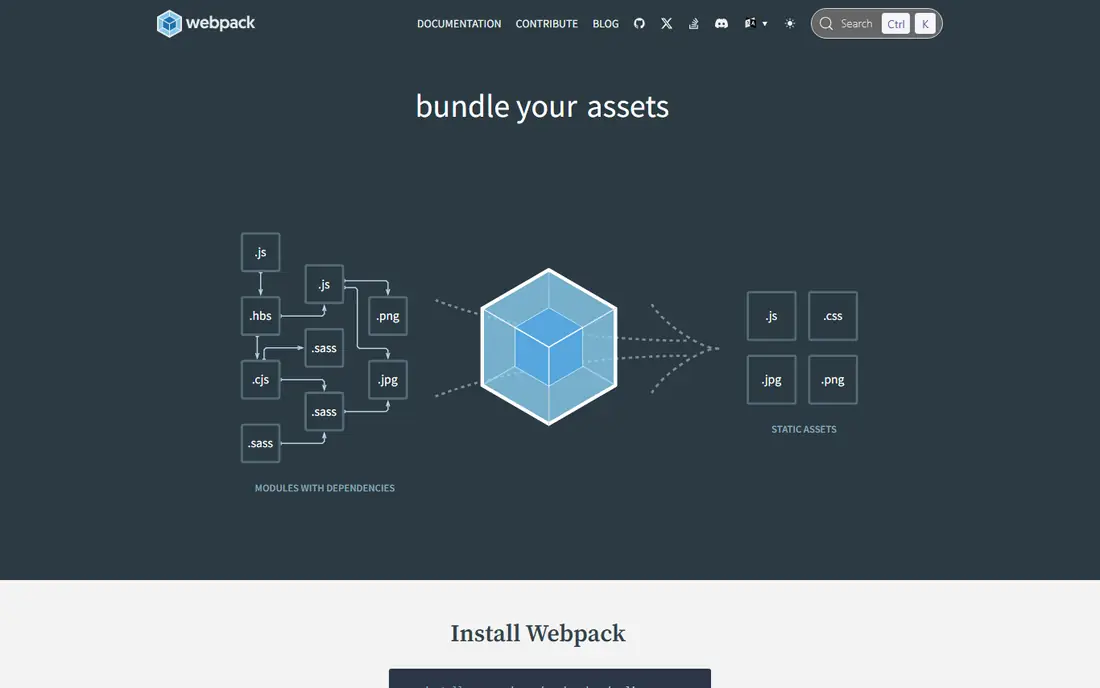
Webpack remains the default answer when a project has build requirements that simpler tools do not cover. Its loader and plugin system handles almost any asset type, and its code splitting controls let teams shape exactly how chunks are shared between routes. That depth is why so many enterprise apps, design systems, and legacy codebases still run on it.
The catch is time. A Webpack setup can take days to tune, and new team members face a steeper learning curve than they do with Vite. Build speed also lags behind esbuild, Rspack, and Turbopack on large projects. Pick Webpack when control and ecosystem matter more than startup speed, and when the team already knows its configuration model.
What we like- Huge plugin and loader ecosystem
- Fine-grained control over code splitting
- Long track record on large codebases
Watch out for- Configuration can grow large
- Slower cold builds than Rust-based tools
Starting priceFree
Free planYes
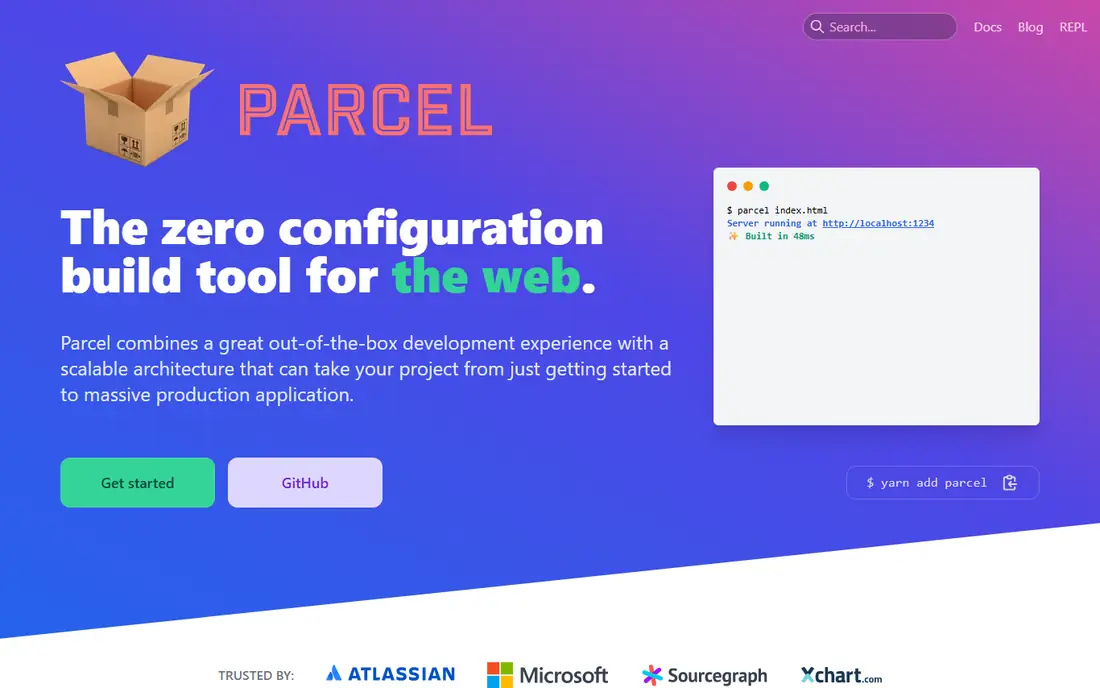
Parcel takes the opposite approach to Webpack. Point it at an entry file and it resolves dependencies, transforms assets, and starts a dev server with almost no setup. For small sites, prototypes, and teams that do not want to maintain a build config, that simplicity is a real advantage.
The trade-off shows up on unusual projects. When you need custom transforms, exotic code splitting, or deep integration with a framework toolchain, Parcel gives you fewer levers than Webpack or Rollup. It is also less common in large monorepos. Choose Parcel when the project is straightforward and speed of setup beats fine control.
What we like- Works with little or no configuration
- Built-in dev server and hot reloading
- Handles many asset types automatically
Watch out for- Less control over advanced bundling
- Smaller plugin ecosystem than Webpack
Starting priceFree
Free planYes
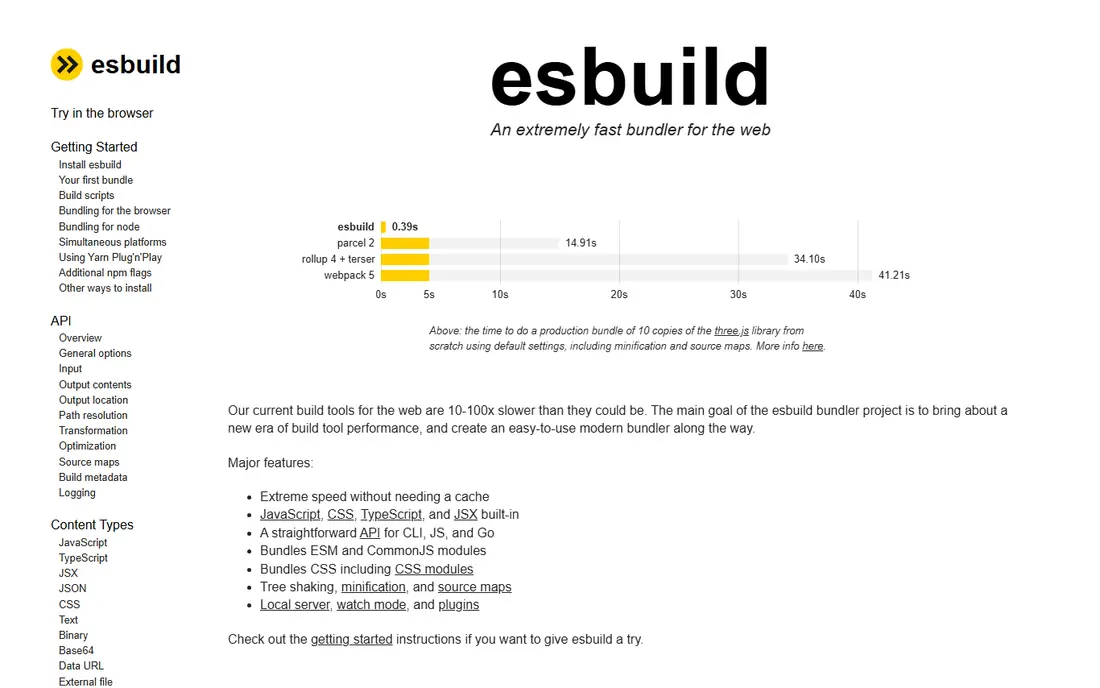
esbuild is a bundler and minifier written in Go, and its speed is the whole point. Projects that took tens of seconds to build can finish in under a second, which changes how often developers run full builds and how long continuous integration jobs take. It handles JavaScript, TypeScript, JSX, and CSS with a small, clear set of options.
What it does not do is replace a full development environment. There is no dev server, no hot module replacement, and no type checking, so teams usually pair it with another tool or add those pieces themselves. Its plugin API is also narrower than Rollup or Webpack. Use esbuild as a fast build step, or as the engine inside another tool, rather than as a complete Vite replacement on its own.
What we like- Very fast builds and minification
- Simple command-line use
- Easy to drop into existing pipelines
Watch out for- No built-in dev server or hot reloading
- Limited plugin system
- Does not type-check TypeScript
Starting priceFree
Free planYes
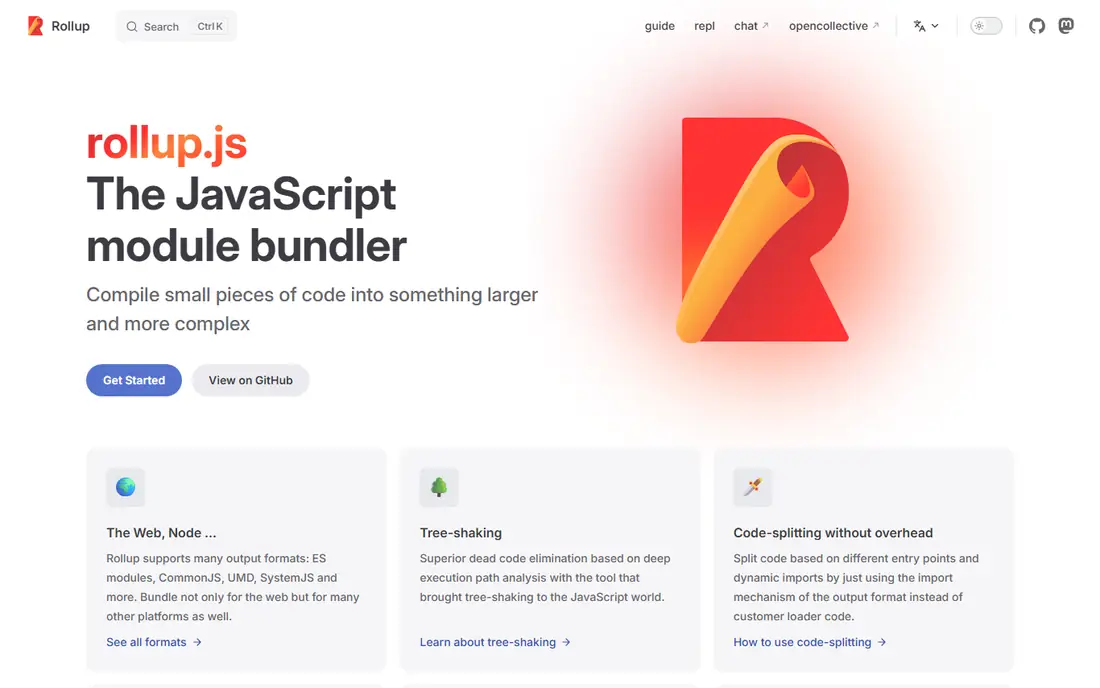
Rollup has long been the bundler of choice for JavaScript libraries, and Vite itself uses Rollup for production builds. Its tree-shaking is strong, its output is easy to read, and its plugin ecosystem covers most library needs, from TypeScript to CSS handling. If you ship a package that other developers will bundle, Rollup gives you precise control over module formats and external dependencies.
As an app bundler, Rollup needs more assembly. You add a dev server, watch mode, and hot reloading yourself, which is work that Vite does for you. Large apps also build more slowly than they do with Rspack or esbuild. Pick Rollup when bundle quality and library output matter most, and accept the extra setup for app development.
What we like- Excellent tree-shaking
- Clean output for libraries
- Mature plugin ecosystem
Watch out for- Dev server and hot reloading need extra setup
- Slower than Rust-based bundlers on huge apps
Starting priceFree
Free planYes
Turbopack is the bundler built into Next.js, written in Rust and designed around incremental compilation. It caches work down to a fine grain and reuses it between runs, which makes repeated refreshes feel instant on large Next.js apps. For teams already committed to Next.js, it is the natural Vite alternative because it comes with the framework.
The limit is hard: there is no standalone Turbopack to point at a Vue, Svelte, or vanilla project. If you are not on Next.js, this entry is informational only, and you should look at Rspack or Rsbuild instead. Even inside Next.js, projects with unusual Webpack customisations may need to keep Webpack for a time. Choose Turbopack when Next.js is already the stack.
What we like- Fast refresh and incremental builds inside Next.js
- Rust-based performance
- Maintained by the Next.js team
Watch out for- Only available inside Next.js
- No standalone use for Vue, Svelte, or plain projects
Starting priceFree
Free planYes
Rspack is a Rust-based bundler built to be compatible with much of the Webpack ecosystem, including its configuration shape and many of its plugins and loaders. That compatibility is its main selling point: teams can keep most of their existing setup and still get a large speed improvement. It is used in large production apps, which gives it credibility beyond a demo.
Compatibility is not total. Some plugins, loaders, and edge-case behaviours still differ from Webpack, so a migration needs a test pass over the full build, including code splitting and asset handling. The community is also smaller than Webpack, so obscure problems may take longer to resolve. Pick Rspack when you like Webpack but want faster builds without a full rewrite.
What we like- Largely compatible with Webpack configuration
- Rust-based speed
- Good fit for large apps
Watch out for- Some Webpack plugins and loaders need changes
- Newer ecosystem than Webpack
#7
Rsbuild
Best for: Rspack-based projects with sensible defaults
Visit rsbuild.rs
Starting priceFree
Free planYes
Rsbuild is the opinionated build tool built on Rspack, in the same way Vite wraps Rollup and esbuild. It supplies the dev server, hot reloading, and production defaults that raw Rspack does not, so a new project can start quickly. It supports the major frameworks and handles TypeScript, CSS, and static assets without a long configuration file.
Because it is younger, its guide library and template range are thinner than Vite, and teams moving from Vite will need to relearn some defaults. It also inherits the Rspack compatibility limits described above. Choose Rsbuild when you want Rspack speed with a Vite-like starting experience, and you are comfortable with a newer tool.
What we like- Sensible defaults on top of Rspack
- Fast dev server and builds
- Supports React, Vue, and Svelte
Watch out for- Younger tool than Webpack or Vite
- Fewer community templates and guides
#8
Bun
Best for: JavaScript runtime plus fast bundling
Visit bun.sh
Starting priceFree
Free planYes
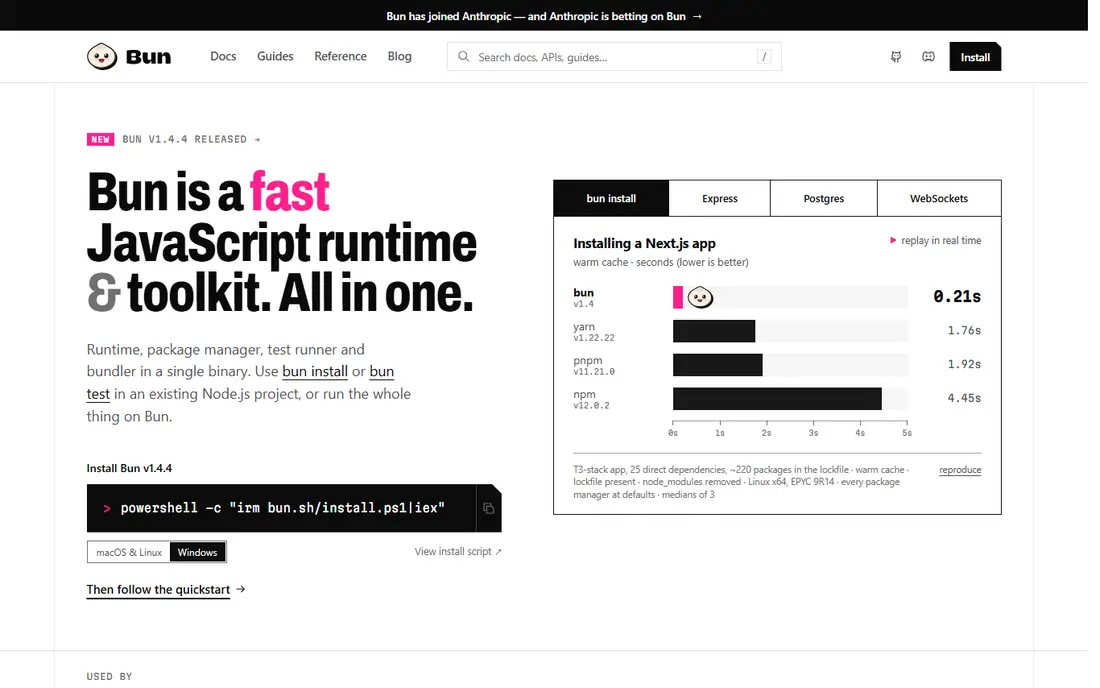
Bun is primarily a JavaScript runtime, but it also includes a bundler, a test runner, and a package manager, which makes it a different kind of Vite alternative. For teams that want one tool to run, bundle, and test code, Bun reduces the number of moving parts. Its startup speed and built-in TypeScript handling also remove steps that other setups need.
The risk is compatibility. Bun aims for Node.js compatibility, but gaps remain in some APIs and packages, so existing projects need a test pass before switching. Its bundler is also simpler than Webpack, with fewer controls for complex splitting. Pick Bun when you want an all-in-one runtime and bundler for a new project, and you can verify your dependencies run on it.
What we like- Runtime, bundler, test runner, and package manager in one tool
- Very fast startup
- Built-in TypeScript support
Watch out for- Newer runtime with some Node.js compatibility gaps
- Bundler is less configurable than Webpack
How we chose
We compared pricing pages, documentation, and public reviews on G2, Capterra, and Reddit, and we checked which tools are actively maintained and fit the category of a Vite alternative for web development. A tool made this list only when it can bundle a real web project today, either on its own or, in the case of Turbopack, inside its host framework. We favoured tools with a clear audience, a documented migration path, and honest limits, and we left out discontinued bundlers and tools that only handle one narrow job, such as minification alone.
What to check before you switch
Start from the job, not the benchmark. A bundler that wins a cold-build race may still be the wrong pick when your project needs a specific plugin, a particular module format, or a dev server behaviour your framework expects. List those hard requirements first, then shortlist two tools and run them against your real codebase.
Migration cost deserves a line in the plan. Check whether your plugins and loaders have equivalents, whether code splitting behaves the same way, and whether your continuous integration setup needs new steps. Run the production build, inspect the output size, and test the app in a staging environment before changing the default toolchain.
Speed, control, and support
Speed matters most on large codebases and in continuous integration, where minutes add up across a team. Control matters most when the app has unusual assets, multiple entry points, or strict output requirements. Support matters when something breaks at release time: a larger community and longer history usually mean faster answers.
A practical shortlist
For a new React, Vue, or Svelte app that needs a Vite-like experience, try Rsbuild or Parcel first. For a Webpack project that is slow but otherwise sound, try Rspack. For a library, start with Rollup. For a Next.js app, Turbopack is already there. For a fresh project where one tool for runtime and bundling appeals, test Bun against your dependencies.
Frequently asked questions
Is there a free alternative to Vite?
Yes. Every tool in this guide is free and open source, including Webpack, Parcel, esbuild, Rollup, Rspack, Rsbuild, and Bun. The cost to budget is developer time for setup, migration, and maintenance, plus any continuous integration minutes your builds consume.
Which Vite alternative is fastest?
esbuild usually wins raw build and minification speed, while Turbopack and Rspack win on incremental rebuilds and refresh in large apps. The honest answer depends on project size, asset mix, and whether you measure cold builds or repeated edits during development.
Can I migrate from Vite to Webpack or Rspack easily?
Migration effort varies. Rspack is designed for Webpack-style configuration, so Webpack knowledge transfers well. Moving to Webpack itself takes more work, since its configuration is more detailed. In both cases, test plugins, code splitting, and asset output before switching a production app.
Does Turbopack work outside Next.js?
No. Turbopack ships inside Next.js and is not available as a standalone bundler for other frameworks. Teams on Vue, Svelte, or vanilla JavaScript should consider Rsbuild, Parcel, or Rspack instead.
Is esbuild a full replacement for Vite?
Not on its own. esbuild builds and minifies very fast, but it has no dev server or hot reloading, and it does not type-check TypeScript. It works well as a build step or as an engine inside another tool, but most teams pair it with additional tooling for development.
Should a new project still start with Vite?
Vite remains a strong default for many web projects, and this guide is for teams with a specific reason to move, such as a framework requirement, a Webpack codebase, or a need for a different runtime. When none of those apply, staying with Vite avoids migration cost for no clear gain.
Sources we checked (8)
- https://webpack.js.org
- https://parceljs.org
- https://esbuild.github.io
- https://rollupjs.org
- https://nextjs.org
- https://rspack.rs
- https://rsbuild.rs
- https://bun.sh
Is your product missing or out of date?
We review this list regularly. Vendors can request a listing, send updated pricing or ask about featured placement.

Shihab Mia · Founder, Rankite
Shihab has 5+ years in B2B and SaaS SEO. He writes Rankite's software buying guides from pricing pages, documentation and public user reviews. More about Shihab.