How we make this list: we compare pricing pages, product documentation and public user reviews. Ratings come from G2, Capterra or Trustpilot, with the date we checked them.
Pick Xero if you run a small or growing business and want unlimited users, clean multi-currency accounting and a low monthly price. Pick NetSuite if you run a mid-size company with several entities, warehouses or sales channels and need one system for finance, inventory and orders. NetSuite costs far more and takes months to set up, so skip it for a simple ledger.
Key takeaways
- Xero costs 27 dollars per month for Early, 59 for Growing and 97 for Established after an October 2026 price rise, with unlimited users on every plan.
- NetSuite publishes no prices. Every quote is custom, and third-party ranges put a typical mid-market subscription in the tens of thousands of dollars per year.
- Xero fits businesses with one entity and a team of any size. NetSuite fits businesses with several entities, warehouses and sales channels.
- QuickBooks Online is the main alternative to Xero, with deeper US payroll and inventory, while Sage Intacct and Business Central sit between Xero and NetSuite.
How do Xero and NetSuite compare on price
Xero raised US prices on 1 October 2026. Early now costs 27 dollars per month, Growing 59 dollars and Established 97 dollars, billed monthly with no published annual discount. New US customers are offered a deep introductory discount for the first three to six months, but the list price is what you pay after that. Older reads of 25, 55 and 90 dollars are from before the October rise and should not be used. Xero charges no per-user fees, so adding staff does not change the subscription price. On a straight monthly comparison, Xero is cheaper than every ERP in this list, and the gap widens for teams, because the ERP vendors charge per user or per module.
NetSuite publishes no list prices. Oracle quotes every NetSuite subscription individually, based on modules, users, entities and contract length, so you cannot budget for it without a sales conversation. Implementation is a separate cost, and it is usually quoted as a one-time fee. For a small business, the gap alone decides the question: Xero Established at 97 dollars per month costs 1,164 dollars per year, while a NetSuite subscription for a small team is commonly quoted in five figures per year before implementation.
Xero covers the core ledger for a small business: invoicing, quotes, bank reconciliation, expenses, sales tax, reporting and a cash flow forecast, with budgets on Growing and multi-currency, projects and KPI reporting on Established. It connects to most banks and to more than 1,000 apps. It does not handle multi-entity consolidation, warehouse management or manufacturing. If your business is one company with one set of books, Xero covers what you need.
NetSuite covers far more. It combines accounting, inventory, order management, CRM and e-commerce in one cloud ERP, with multi-subsidiary and multi-currency accounting built in. It handles intercompany transactions, consolidated reporting, warehouse management, demand planning and revenue recognition. That depth is why mid-size companies buy it, and why it is too much for a small business.
The answer depends on what growing means for your business. If growth means more customers, more invoices and a few more staff, Xero grows with you, because every plan includes unlimited users and you only pay more when you need the features of the next tier. Established at 97 dollars per month adds multi-currency, project time and costs, expense and mileage claims and a 180-day forecast. Most small businesses never outgrow Xero, and the ones that do usually move because they added a second entity or a warehouse, not because they added staff.
If growth means more entities, more warehouses or more sales channels, NetSuite is the better fit. It consolidates several subsidiaries into one set of books, tracks stock across warehouses, and ties orders from a website, a store and a sales team into one flow. Sage Intacct is the other common step up, handling multi-entity accounting and revenue recognition without the full ERP scope of NetSuite. Business Central is the third option, and the only one of the three with a published per-user price.
What does implementation and support look like
Xero can be set up in a day: connect a bank account, import a chart of accounts, set up sales tax and start invoicing. Support is by email and chat, and a large network of accountants knows the product. The trade-off is no phone support on standard plans, and US payroll is powered by Gusto rather than built in.
NetSuite implementation takes weeks or months, usually run by Oracle or a partner: scope modules, map your chart of accounts, migrate data, train staff and test before you go live. Support is tiered, and the help you get depends on the support package in your contract. Sage Intacct is similar, with implementation typically taking three to six months with a partner. Business Central is also partner-led in most cases, although its published price makes the software line easier to budget. If you need to be live next week, Xero is the only option in this comparison that can do it.
Check your entity count first: one entity points to Xero, several point to NetSuite, Sage Intacct or Business Central. Check your user count next: Xero includes unlimited users on every plan, while NetSuite, Intacct and Business Central price per user or per module. Check invoicing: Xero Early caps invoices at 20 per month and bills at five, so budget for Growing at 59 dollars if you invoice often. Check payroll: Xero Payroll in the US is powered by Gusto at 36 dollars per month plus 6 dollars per employee or contractor. Finally, check the renewal price after any introductory discount: Xero offers a deep discount for new US customers for the first three to six months, and the list price is what you pay after that.
Quick comparison
| Tool | Best for | Starting price | Free plan |
|---|
 Xero | Growing teams that want unlimited users and clean multi-currency accounting | 27 dollars per month for Early; Growing 59 dollars, Established 97 dollars | No free plan; introductory discount for new US customers for the first three to six months |
 NetSuite | Mid-size businesses that need accounting, inventory, CRM and e-commerce in one system | Quote only; Oracle does not publish NetSuite list prices | No free plan; demo available on request |
 QuickBooks Online | US small businesses that want the deepest feature set and a large accountant network | 38 dollars per month for Simple Start; Essentials 85 dollars, Plus 140 dollars, Advanced 340 dollars; Solopreneur 20 dollars | No free plan; 30-day trial on paid plans; 70 percent off for three months until 29 November 2026 |
 Sage Intacct | Mid-size finance teams that need multi-entity accounting and revenue recognition | Quote only; Sage does not publish Sage Intacct prices | No free plan; no free trial, only a guided demo on request |
 FreshBooks | Freelancers and service businesses that live on invoicing and time tracking | 23 dollars per month for Lite; Plus 43 dollars, Premium 70 dollars | No free plan; 30-day trial |
 Zoho Books | Small businesses that want a free plan with room to grow into a full suite | 0 dollars for Free; Standard 20 dollars per month, 15 dollars when billed annually | Free for businesses with under 50,000 dollars in annual revenue, up to 1,000 invoices per year |
 Wave | Sole proprietors and freelancers who want a genuinely free ledger | 0 dollars for Starter; Pro is 19 dollars per month or 190 dollars per year | Starter is free with unlimited invoices, estimates, bills and bookkeeping records |
 FreeAgent | Freelancers and small businesses that want simple bookkeeping with a clear tax view | 10 dollars per month for the first six months, then 20 dollars per month, for US customers | No free plan; 30-day trial; free with some UK business bank accounts |
Is your product missing or out of date?
We review this list regularly. Vendors can request a listing, send updated pricing or ask about featured placement.
#1Xero
Best for: Growing teams that want unlimited users and clean multi-currency accounting4.4/5 on
G2 (1,832 reviews, checked Oct 2026)
Visit xero.com
Starting price27 dollars per month for Early; Growing 59 dollars, Established 97 dollars
Free planNo free plan; introductory discount for new US customers for the first three to six months
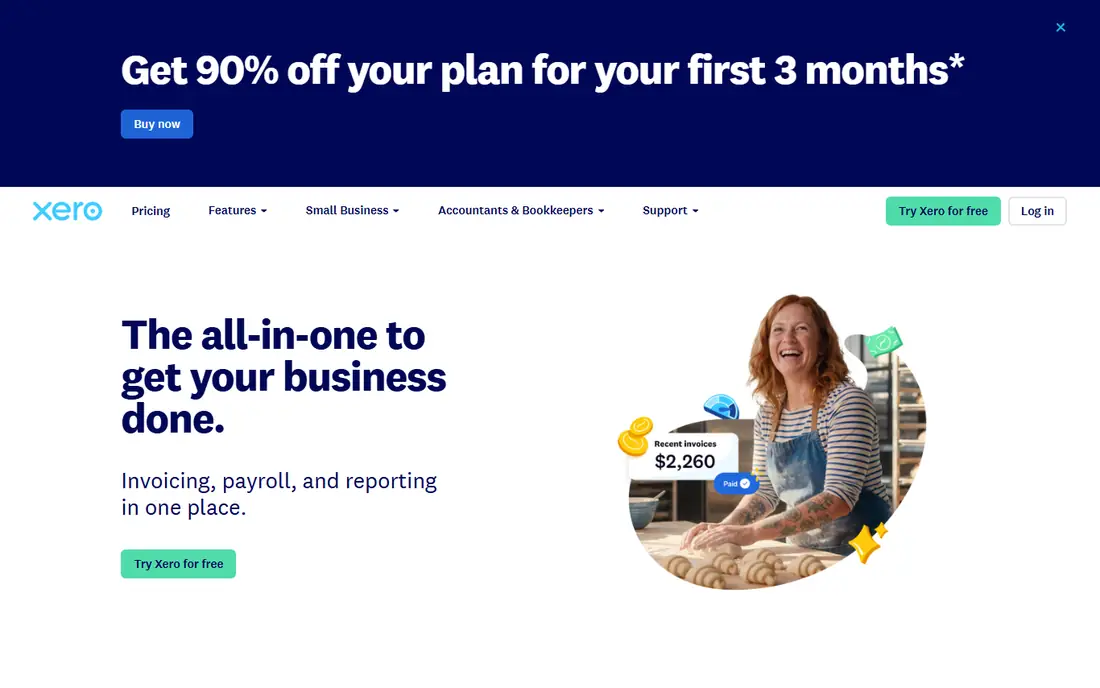
Xero is the best choice for a business where several people touch the books. Early costs 27 dollars per month and includes quotes, 20 invoices and five bills a month, bank reconciliation, document capture, reports, sales tax and a 30-day forecast. Growing at 59 dollars removes the invoice cap and adds bill entry, dashboards, budgets and a 60-day forecast. Established at 97 dollars adds multi-currency, project time and costs, expense and mileage claims, KPI analysis and a 180-day forecast. None of the plans charge per user, a real saving for a team of five or more. The trade-offs are the invoice cap on Early, the lack of native US payroll, and the October 2026 price rise from 25, 55 and 90 dollars.
What we like- Unlimited users on every plan
- No per-user fees
- Strong multi-currency and project tools on Established
- Clean interface
Watch out for- Early caps invoices at 20 per month and bills at five
- No native payroll in the US, it is powered by Gusto
- Prices rose in October 2026
#2NetSuite
Best for: Mid-size businesses that need accounting, inventory, CRM and e-commerce in one system4.1/5 on
G2 (4,963 reviews, checked Oct 2026)
Visit netsuite.com
Starting priceQuote only; Oracle does not publish NetSuite list prices
Free planNo free plan; demo available on request
NetSuite is the enterprise option in this list: it combines accounting, inventory, order management, CRM and e-commerce in one cloud ERP, with multi-subsidiary and multi-currency support built in. Oracle does not publish list prices, so every quote is custom and depends on modules, users and contract length. That alone rules it out for most small businesses. NetSuite is the ceiling here: if Xero Established starts to feel small, and you need one system for finance, stock and sales across multiple entities, NetSuite is the next step.
What we like- Full ERP in one system
- Strong inventory, order management and multi-subsidiary accounting
- Scales well past small business size
Watch out for- Quote-only pricing means a sales process before you know the cost
- Implementation is slow and expensive
- Far more than a small business needs
#3QuickBooks Online
Best for: US small businesses that want the deepest feature set and a large accountant network4.0/5 on
G2 (3,871 reviews, checked Oct 2026)
Visit quickbooks.intuit.com
Starting price38 dollars per month for Simple Start; Essentials 85 dollars, Plus 140 dollars, Advanced 340 dollars; Solopreneur 20 dollars
Free planNo free plan; 30-day trial on paid plans; 70 percent off for three months until 29 November 2026
QuickBooks Online is the default accounting choice for US small businesses: almost every US accountant knows it, most banks connect to it, and most industry tools integrate with it. Plans run from Simple Start at 38 dollars per month for one user through Essentials at 85 dollars for three users, Plus at 140 dollars for five users and Advanced at 340 dollars for 25 users, with Solopreneur at 20 dollars for one-person businesses. Plus adds inventory, project profitability and budgeting, while Advanced adds batch workflows, custom permissions and revenue recognition. The weakness is price: a five-person team pays for Plus even if it only needs invoicing.
What we like- Largest US accountant network
- Strong inventory and project tools on Plus
- Built-in payroll
- Deep sales tax and 1099 handling
Watch out for- Most expensive small business option in this comparison at the top tiers
- Per-user limits force upgrades as the team grows
- Prices rose in August 2026
#4Sage Intacct
Best for: Mid-size finance teams that need multi-entity accounting and revenue recognition4.3/5 on
G2 (4,521 reviews, checked Oct 2026)
Visit sage.com
Starting priceQuote only; Sage does not publish Sage Intacct prices
Free planNo free plan; no free trial, only a guided demo on request
Sage Intacct is a cloud financial system for growing and mid-size organisations, typically with more than 20 employees or more than 4 million dollars in annual revenue. It covers core financials, multi-entity consolidation, project accounting, revenue recognition, planning and subscription billing, with AI agents that help with the close, AP matching, anomaly checks and timesheets. Sage does not publish prices, so every subscription is quoted through Sage or a partner, and third-party planning ranges put a typical mid-market subscription at 10,000 to 35,000 dollars per year. Intacct is the step up from Xero for a finance team that needs real consolidation without the full ERP scope of NetSuite.
What we like- Deep multi-entity and consolidation tools
- Strong revenue recognition and project accounting
- AI agents for close, AP and anomaly checks
Watch out for- Quote-only pricing with no public rate card
- Implementation typically takes three to six months
- Built for finance teams, not owners who do their own books
#5FreshBooks
Best for: Freelancers and service businesses that live on invoicing and time tracking4.5/5 on
G2 (981 reviews, checked Oct 2026)
Visit freshbooks.com
Starting price23 dollars per month for Lite; Plus 43 dollars, Premium 70 dollars
Free planNo free plan; 30-day trial
FreshBooks is built for people who send invoices for their time. Lite costs 23 dollars per month and includes unlimited invoices, estimates, time tracking, expenses, recurring invoices and automatic bank import. Plus at 43 dollars and Premium at 70 dollars add more clients, team members and automation, while Select is custom priced for larger teams. The vendor pricing FAQ confirms these figures from 5 March 2026, with annual billing at 248.40 dollars for Lite, 464.40 dollars for Plus and 756 dollars for Premium.
What we like- Best invoicing experience in this list
- Strong time tracking and expense capture
- Simple interface that clients understand
Watch out for- Weaker double-entry accounting than QuickBooks or Xero
- No free plan
- Prices rose in March 2026
#6Zoho Books
Best for: Small businesses that want a free plan with room to grow into a full suite4.4/5 on
G2 (329 reviews, checked Oct 2026)
Visit zoho.com
Starting price0 dollars for Free; Standard 20 dollars per month, 15 dollars when billed annually
Free planFree for businesses with under 50,000 dollars in annual revenue, up to 1,000 invoices per year
Zoho Books is the best value paid option in this comparison. The free plan costs nothing for businesses under 50,000 dollars in annual revenue and allows 1,000 invoices per year. Standard costs 20 dollars per month, or 15 dollars annually, and adds three users, 5,000 invoices per year, bank feeds and sales tax tracking. Professional costs 50 dollars per month, or 40 dollars annually, and adds five users, 10,000 invoices, multi-currency, inventory and project tracking. Premium costs 70 dollars per month, or 60 dollars annually, Elite 150 dollars, or 120 dollars annually, and Ultimate 275 dollars, or 240 dollars annually.
What we like- Useful free plan
- Cheap paid tiers
- Strong fit with the rest of the Zoho suite
- 14-day free trial of Premium
Watch out for- Free plan is limited to one user plus an accountant
- Invoicing caps rise only with paid tiers
- Support is better on paid plans
#7Wave
Best for: Sole proprietors and freelancers who want a genuinely free ledger4.3/5 on
G2 (328 reviews, checked Oct 2026)
Visit waveapps.com
Starting price0 dollars for Starter; Pro is 19 dollars per month or 190 dollars per year
Free planStarter is free with unlimited invoices, estimates, bills and bookkeeping records
Wave is the only tool in this list with a free plan that has no cap on invoices. Starter costs nothing and includes unlimited estimates, invoices, bills and bookkeeping records, with online payments at 2.9 percent plus 60 cents. Pro costs 19 dollars per month or 190 dollars per year and adds automatic bank import, auto-merge and categorisation, late payment reminders, branding removal, extra user roles, integrations and live human support. Payroll costs 40 dollars per month plus 6 dollars per person, and bookkeeping help starts at 149 dollars per month.
What we like- Free plan with no invoice cap
- Simple to set up
- Payroll available in all 50 states
- Pro adds bank import and extra user roles
Watch out for- Automatic bank import and receipt scanning moved behind Pro
- No phone support on the free plan
- Limited reporting depth
#8FreeAgent
Best for: Freelancers and small businesses that want simple bookkeeping with a clear tax view4.3/5 on
G2 (45 reviews, checked Oct 2026)
Visit freeagent.com
Starting price10 dollars per month for the first six months, then 20 dollars per month, for US customers
Free planNo free plan; 30-day trial; free with some UK business bank accounts
FreeAgent is built for freelancers and small businesses that want bookkeeping without a learning curve. In the US it costs 10 dollars per month for the first six months, then 20 dollars per month, and it covers invoicing, expenses, time tracking, bank reconciliation and a tax timeline that shows what you owe and when. In the UK it is free with a NatWest, Royal Bank of Scotland, Ulster Bank or Mettle business account, which is why so many UK freelancers use it. The trade-offs are the price rise after six months, fewer integrations than QuickBooks or Xero, and UK tax features that matter less to a US buyer.
What we like- Very simple interface
- Clear tax timeline and Self Assessment view
- Invoicing, expenses and time tracking in one place
Watch out for- US price rises after six months
- Fewer integrations than QuickBooks or Xero
- UK tax features matter less to a US buyer
Frequently asked questions
Is NetSuite worth it for a small business
No, for most small businesses it is not. NetSuite is built for mid-size companies with several entities, warehouses or sales channels, and it is priced and implemented for that size. A small business with one entity will pay far more and wait far longer to go live than with Xero, QuickBooks Online or Zoho Books, and it will use only a small part of what NetSuite offers.
How much does NetSuite cost per month
Oracle does not publish NetSuite prices, so there is no list price to quote. Every subscription is quoted individually based on modules, users, entities and contract length, and implementation is quoted separately. Third-party planning ranges put a typical mid-market subscription in the tens of thousands of dollars per year.
Can Xero handle multiple companies
Xero handles one organisation per subscription. If you run several entities, you need a separate subscription for each one, or you move to a system built for consolidation, such as NetSuite, Sage Intacct or Business Central. Xero Established adds multi-currency, projects and KPI reporting, but it does not consolidate multiple entities into one set of books.
Which tool is cheaper, Xero or NetSuite
Xero is far cheaper. Xero Established costs 97 dollars per month, or 1,164 dollars per year, and Early costs 27 dollars per month. NetSuite is quoted in five figures per year for most mid-market buyers before implementation. The two products are not priced for the same buyer.
When should a business move from Xero to NetSuite
Move when Xero starts to limit you, not before. The usual triggers are a second legal entity, a warehouse that needs real stock control, multi-currency consolidation across subsidiaries, or revenue recognition rules that Xero cannot handle. Until one of those applies, Xero Established will do the job at a small fraction of the cost and effort.
Sources we checked (8)
- https://www.xero.com/us/pricing/
- https://www.netsuite.com/portal/products/netsuite-pricing.shtml
- https://quickbooks.intuit.com/pricing/
- https://www.sage.com/en-us/products/sage-intacct/
- https://www.freshbooks.com/2026-faq-price-change
- https://www.zoho.com/us/books/pricing/
- https://www.waveapps.com/pricing/
- https://www.freeagent.com/
Is your product missing or out of date?
We review this list regularly. Vendors can request a listing, send updated pricing or ask about featured placement.

Shihab Mia · Founder, Rankite
Shihab has 5+ years in B2B and SaaS SEO. He writes Rankite's software buying guides from pricing pages, documentation and public user reviews. More about Shihab.