How we make this list: we compare pricing pages, product documentation and public user reviews. Ratings come from G2, Capterra or Trustpilot, with the date we checked them.
Key takeaways
- Big data workloads punish the wrong pricing model first: usage based billing can grow faster than row counts, while flat or capacity pricing stays predictable.
- Fivetran and Airbyte cover the widest managed connector needs, but they solve different problems: Fivetran reduces operations, Airbyte gives more deployment control.
- Real time needs change the shortlist completely. Estuary Flow and Apache Kafka belong in streaming conversations, while batch tools should not be forced into sub second work.
- Apache Spark and Apache Airflow remain the open source backbone for very large, custom workloads, but they need engineering time that managed tools replace.
- For most buyers, the deciding test is a real high volume source with change data capture, backfills, and schema changes, not a small demo sync.
Quick comparison
| Tool | Best for | Starting price | Free plan |
|---|
 Fivetran | Teams that want managed ingestion with minimal pipeline maintenance | See website | Yes |
 Airbyte | Teams that want open source control plus a managed cloud option | $20 per user/month | Yes |
 Estuary Flow | Streaming pipelines that need low latency change data capture | See website | Yes |
 Apache Spark | Very large batch and streaming jobs that need distributed processing | See website | Yes |
 Apache Airflow | Orchestrating complex multi step data pipelines | See website | Yes |
 dbt Cloud | Transforming data inside the warehouse with version controlled SQL | See website | Yes |
 Matillion | Push down transformation inside cloud data warehouses | See website | Free trial |
 Azure Data Factory | Microsoft shops moving data across Azure and on premises systems | See website | Free trial |
 Informatica | Large enterprises with governance, legacy sources, and complex estates | See website | Free trial |
Is your product missing or out of date?
We review this list regularly. Vendors can request a listing, send updated pricing or ask about featured placement.
#1Fivetran
Best for: Teams that want managed ingestion with minimal pipeline maintenance4.3/5 on
G2 (841 reviews, checked Oct 2026)
Visit fivetran.com
Starting priceSee website
Free planYes
Fivetran is the default answer when a data team wants pipelines that mostly run themselves. Connect a source, choose a destination warehouse, and Fivetran handles extraction, loading, schema drift, and retries. That low operations burden is valuable at big data scale, where a small team can otherwise spend its week maintaining connectors instead of modeling data.
The cost conversation needs care. Fivetran bills by Monthly Active Rows per connection, with a free tier up to 500,000 Monthly Active Rows in recent listings, plus a small per connection base charge. At millions of rows, the per row rate falls with volume tiers, but history mode changes and frequent updates still count. Model a full month of real source activity, including deletes and updates, before signing, and ask how a backfill or a schema change will affect the bill.
What we like- More than 700 connectors with automated schema handling
- Log based change data capture for supported databases
- Managed scaling without running pipeline servers
Watch out for- Usage based Monthly Active Rows billing can be hard to forecast at very high volume
- Annual contract minimums apply on paid contracts in recent listings
#2Airbyte
Best for: Teams that want open source control plus a managed cloud option4.4/5 on
G2 (78 reviews, checked Oct 2026)
Visit airbyte.com
Starting price$20 per user/month
Free planYes
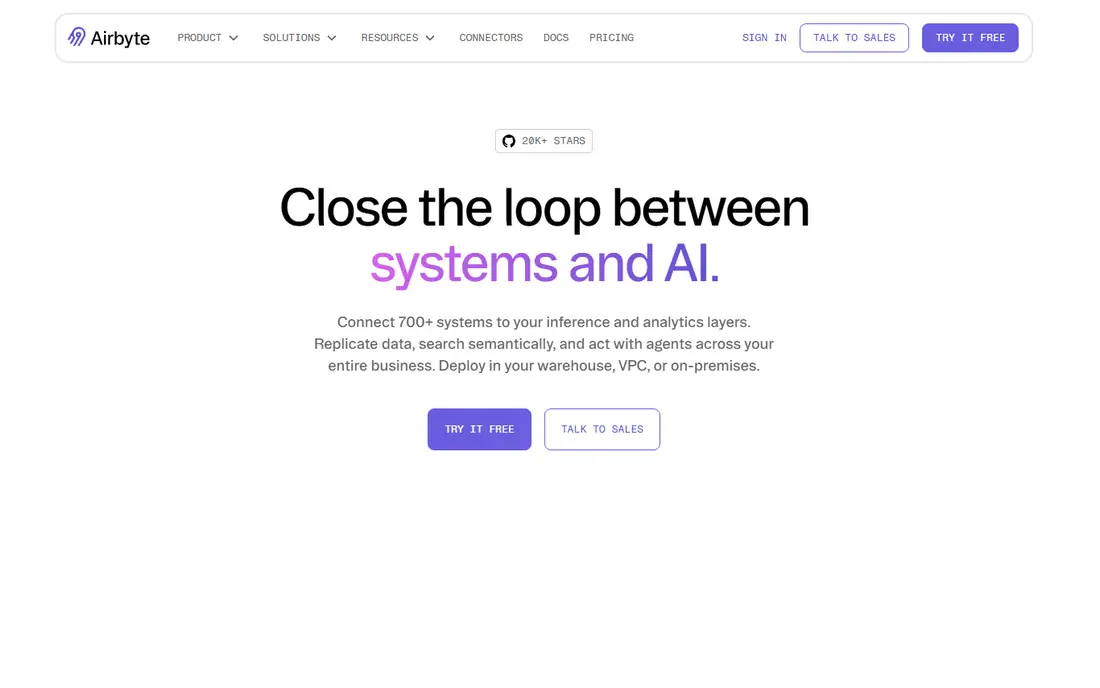
Airbyte gives buyers a choice that Fivetran does not: run the open source core yourself, use managed cloud, or mix the two. That flexibility matters for teams with strict data residency rules, custom sources, or a preference for open code they can inspect. The connector builder, with AI assistance, also shortens the time to add a niche API source that a managed vendor might not prioritize.
Pricing starts with free open source use, and Airbyte Cloud Standard starts at $20 per month in recent comparisons. Higher tiers move to volume or capacity based Data Workers, which suit steady high volume better than per row surprises. The honest cost is engineering time on self hosted setups: upgrades, monitoring, and connector maintenance still belong to your team. For big data work, test a high volume database source first, since sync speed and cost differ sharply between database, file, and API sources.
What we like- Large connector library and a no code connector builder
- Self hosted, cloud, and hybrid deployment on one codebase
- Volume based and capacity based pricing options
Watch out for- Self hosted deployments need DevOps time
- Cloud sync intervals and credit burn vary by source type and plan
#3
Estuary Flow
Best for: Streaming pipelines that need low latency change data capture
Visit estuary.dev
Starting priceSee website
Free planYes
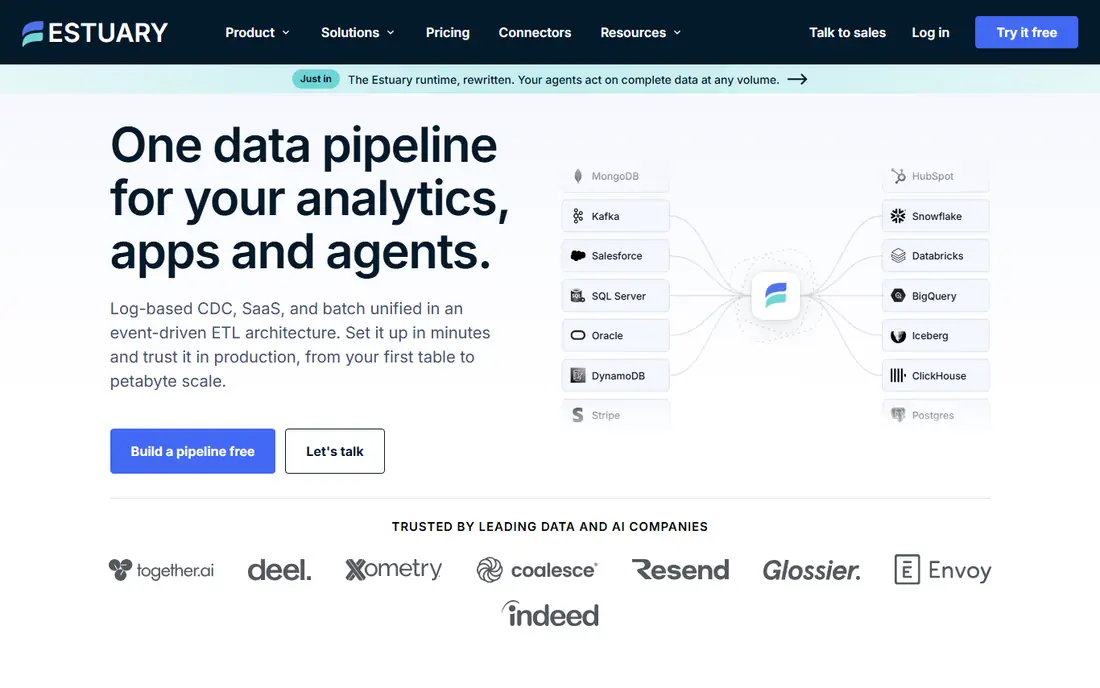
Estuary Flow is built for a different clock speed from batch ETL. Instead of syncing every hour, it streams database changes continuously, which suits fraud checks, live dashboards, and operational systems that cannot wait for the next batch. Its exactly once style delivery and replay from stored collections also help when a destination needs a backfill without re-reading the source.
That power comes with design work. Teams need to think about ordering, late data, and schema evolution in a streaming model, not just schedule a nightly job. Pricing in recent listings includes $0.50 per gigabyte moved plus a per connector charge, with a free developer tier up to 10 gigabytes per month. For big data workloads, the win is clearest when latency is a business requirement. If an hourly batch already meets the need, a simpler batch tool may be cheaper and easier to run.
What we like- Streaming change data capture with very low latency
- One capture can feed several destinations
- In pipeline SQL, Python, and TypeScript transformations
Watch out for- Streaming design takes more thought than batch syncs
- Pricing combines data volume and connector instances, so model both
#4Apache Spark
Best for: Very large batch and streaming jobs that need distributed processing4.3/5 on
G2 (54 reviews, checked Oct 2026)
Visit spark.apache.org
Starting priceSee website
Free planYes
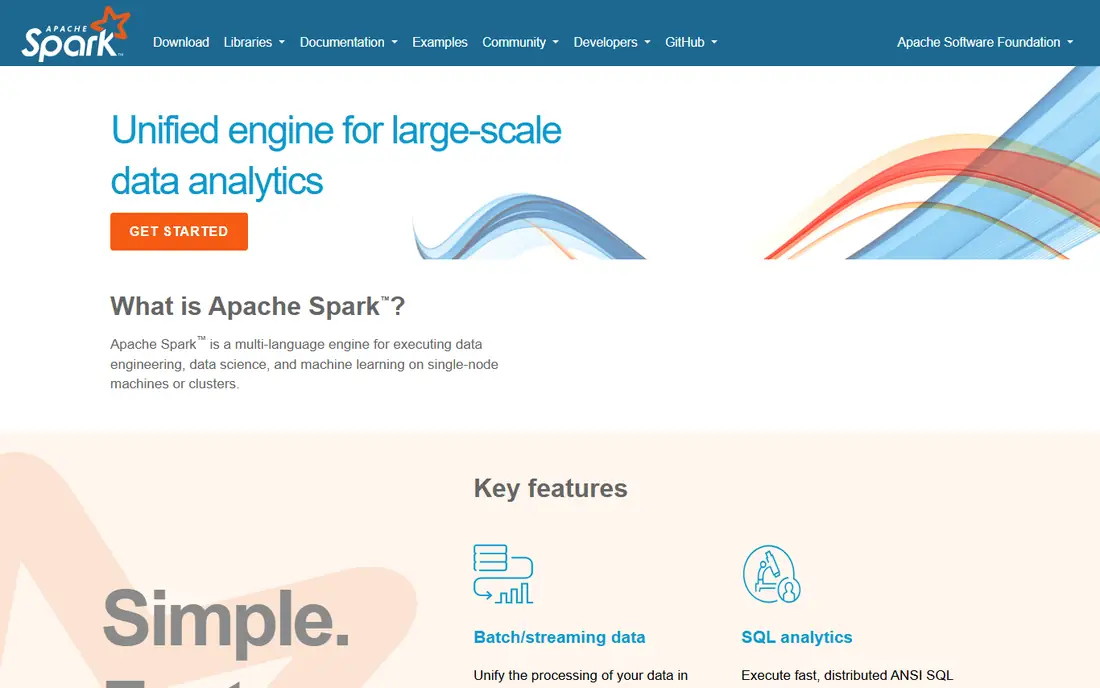
Apache Spark is not a plug and play ETL product. It is a processing engine that can handle datasets far larger than a single server, split work across nodes, and run both batch and streaming jobs. That makes it the right core for teams building custom transformations, machine learning features, or complex joins that a visual ETL tool would struggle to express.
Buyers should budget for people, not just software. Spark itself is open source and free to download, but clusters, storage, monitoring, and tuning cost money and time. Managed Spark services from cloud providers reduce some of that burden, but they add their own pricing. Choose Spark when volume, custom logic, or latency requirements exceed what a managed connector tool can do cleanly. For standard SaaS to warehouse syncs, it is usually more engineering than the job needs.
What we like- Distributed processing across clusters for huge datasets
- Strong batch and streaming APIs
- Wide ecosystem of connectors and libraries
Watch out for- Needs cluster management and skilled engineers
- Costs shift to cloud compute and operations rather than disappearing
#5Apache Airflow
Best for: Orchestrating complex multi step data pipelines4.4/5 on
G2 (130 reviews, checked Oct 2026)
Visit airflow.apache.org
Starting priceSee website
Free planYes
Airflow is often confused with an ETL tool, but its job is orchestration: it decides what runs, in what order, when to retry, and what to do when a step fails. That matters at big data scale, where a pipeline may involve ingestion, Spark jobs, dbt models, quality checks, and warehouse loads in a strict sequence. Airflow gives that sequence a visible, version controlled home.
The limit is that Airflow needs other tools to do the actual extraction and transformation. Teams usually pair it with Airbyte, Fivetran, Spark, or dbt, which means the total stack has several parts to maintain. Managed Airflow services start around a few hundred dollars per month in third party listings, and they remove much of the server work. If your pipelines are simple and linear, a managed ETL tool with built in scheduling may be enough. If they are branching, conditional, and business critical, Airflow earns its place.
What we like- Python based scheduling with clear dependencies and retries
- Large community and provider ecosystem
- Full control over pipeline code
Watch out for- Airflow orchestrates work, it does not move data by itself
- Self hosting needs ongoing maintenance and monitoring
#6
dbt Cloud
Best for: Transforming data inside the warehouse with version controlled SQL
Visit getdbt.com
Starting priceSee website
Free planYes
dbt belongs in a big data stack even though it is not an ingestion tool. Once Fivetran, Airbyte, or Estuary loads raw data into Snowflake, BigQuery, or Databricks, dbt turns that raw data into clean, tested models that analysts can trust. Because models are SQL in version control, changes are reviewable, testable, and reversible in a way that point and click transformations often are not.
The buying question is team shape. dbt Core is open source and free, while dbt Cloud adds scheduling, a development environment, and collaboration features on a per seat basis. Small analyst teams may find Cloud worthwhile for scheduling alone. Large teams should model seat growth carefully, since every analyst who needs Cloud access adds cost even if warehouse compute is billed separately. Pair dbt with an ingestion tool, not instead of one, and the combined stack is usually the cleanest path to governed analytics at scale.
What we like- SQL based modeling that analysts can own
- Testing, documentation, and lineage built into the workflow
- Strong integration with major warehouses
Watch out for- Dbt transforms data after loading, it does not ingest sources
- Cloud pricing is per seat, which grows with team size
#7Matillion
Best for: Push down transformation inside cloud data warehouses4.4/5 on
G2 (83 reviews, checked Oct 2026)
Visit matillion.com
Starting priceSee website
Free planFree trial
Matillion is designed for teams that want their warehouse to do the heavy lifting. Instead of moving large datasets through a separate ETL server, Matillion builds jobs that run inside the warehouse itself, which keeps large transformations close to the data and avoids extra data movement. Visual design helps data engineers build pipelines faster than hand coding every job, while still allowing SQL and Python where needed.
The trade-off is skill and cost modeling. Simple pipelines are quick to build, but complex business logic still needs engineering judgment, and credit based pricing can vary with job frequency and data size. Matillion also fits best when the team has already committed to a major cloud warehouse. If the stack is still undecided, a warehouse neutral ingestion tool plus dbt may keep more options open. Trial Matillion with a real warehouse workload, including a large join and a daily incremental load, before committing.
What we like- Visual pipelines that push work into the warehouse
- Strong fit for Snowflake, BigQuery, and Databricks
- Built in orchestration and data quality features
Watch out for- Requires SQL or Python skill for complex logic
- Usage based credit pricing needs careful modeling at high volume
#8Azure Data Factory
Best for: Microsoft shops moving data across Azure and on premises systems4.6/5 on
G2 (101 reviews, checked Oct 2026)
Visit azure.microsoft.com
Starting priceSee website
Free planFree trial
Azure Data Factory is the natural choice when the data estate already lives in Azure. It connects to Azure SQL, Synapse, Data Lake, and Databricks, and it can reach on premises sources through a self hosted integration runtime. For teams that already use Azure Active Directory, monitoring, and security controls, that native fit reduces integration work and keeps governance in one place.
Outside Azure, the advantage fades. Pricing is also harder to compare at a glance, since it combines orchestration, data movement, and compute meters. Teams should build a cost model from a real pipeline, not from a single unit price, and watch data egress and integration runtime costs on hybrid jobs. For a Microsoft centered big data workload, Data Factory is often the lowest friction option. For a multi cloud estate, a neutral tool such as Airbyte or Fivetran may avoid locking pipelines to one cloud.
What we like- Native integration with Azure Synapse, Databricks, and Microsoft 365 data
- Visual and code based pipeline design
- Hybrid connectivity for on premises sources
Watch out for- Pricing spans several meters, including pipeline runs and data movement
- Less natural outside the Azure ecosystem
#9
Informatica
Best for: Large enterprises with governance, legacy sources, and complex estates
Visit informatica.com
Starting priceSee website
Free planFree trial
Informatica remains relevant for big data precisely because many big data problems are not new. Large enterprises still run legacy databases, mainframes, and heavily governed data domains where lineage, masking, and audit trails matter as much as speed. Informatica Cloud Data Integration and its wider Intelligent Data Management Cloud cover ingestion, transformation, quality, and governance in one vendor stack.
Smaller teams should be cautious. Implementation, training, and licensing costs are enterprise scale, and a lean team may get faster value from Fivetran plus dbt. The right buyer is an organization with many sources, strict compliance needs, and a data platform team that can run the product properly. Ask for a scoped proof of concept on the hardest sources first: legacy systems, high volume change data capture, and governed domains. If those pass, Informatica can consolidate tools that would otherwise need several vendors.
What we like- Deep connector library including legacy and mainframe sources
- Strong data quality, lineage, and governance features
- Proven at very large enterprise volume
Watch out for- Enterprise pricing and implementation effort are substantial
- Learning curve is steep for smaller teams
How we chose
We compared vendor pricing pages, documentation, and public reviews on G2, Capterra, and Reddit, focusing on factors that decide big data success: connector breadth, change data capture, streaming latency, warehouse push down, orchestration, and pricing units. We also weighed team fit, since a two person analytics team and a platform engineering team should not buy the same stack. No hands-on load test is claimed here. The shortlist reflects documented capabilities and the patterns that recur across independent buyer reviews.
A practical way to pick for big data
Start with volume, latency, and team skill, in that order. Volume decides whether per row pricing is safe. Latency decides whether batch tools are even eligible. Team skill decides whether open source power is an asset or a maintenance burden.
Model cost on real data, not on a demo
Run a one week test with a production sized source. Include inserts, updates, deletes, schema changes, and at least one full backfill. Record rows, gigabytes, connector counts, and warehouse compute separately. That test often overturns a pricing comparison made from headline rates alone, especially for usage based tools.
Separate ingestion, transformation, and orchestration
Many buyers look for one tool to do everything, then discover that the best ingestion tool is a weak transformation tool, or the best orchestrator needs other tools to move data. A common strong stack is Fivetran or Airbyte for ingestion, dbt for transformation, and Airflow or a managed scheduler for orchestration. Buying the stack in parts, with clear contracts between them, is usually more durable than forcing one product into all three roles.
Plan for schema change and failure
Big data pipelines fail in predictable ways: a source adds a column, a key changes, a job runs twice, or a destination fills up. Check how each tool handles schema drift, deduplication, retries, and alerting before you commit. A tool that syncs fast but silently drops changed records will cost more in bad decisions than a slower tool with clear error handling.
Frequently asked questions
Which ETL tool is best for very large batch workloads?
Apache Spark is the strongest engine for custom very large batch work, while Fivetran and Airbyte are stronger for standard managed ingestion. Many large teams use both: a managed tool for source syncs, and Spark for heavy custom processing.
Is Fivetran or Airbyte better for big data?
Fivetran usually wins on low operations and managed reliability, while Airbyte wins on deployment flexibility and open source control. The better choice depends on whether your team values hands off operation or control over hosting and custom connectors.
Do I need a streaming tool for big data?
Only if latency is a business requirement. Hourly or daily batch syncs meet most analytics needs. Streaming tools such as Estuary Flow or Kafka become necessary when dashboards, fraud checks, or operational systems need data in seconds rather than hours.
What is the difference between ETL and ELT?
In ETL, data is transformed before loading into the destination. In ELT, data is loaded raw first, then transformed inside the warehouse, often with dbt. Most modern big data stacks use ELT, since cloud warehouses can transform large data efficiently after loading.
How do ETL tools handle schema changes?
Managed tools usually detect new columns and adapt, but behavior varies for type changes, renames, and dropped columns. Test schema changes explicitly during a trial, and confirm whether the tool pauses, alerts, or silently alters the destination table.
Can open source ETL tools handle enterprise scale?
Yes, with engineering investment. Apache Spark and Airflow run some of the largest pipelines in production, but they need cluster management, monitoring, and skilled staff. Managed tools trade some control for lower operations cost, which is often the right trade for smaller teams.
Sources we checked (9)
- https://www.fivetran.com
- https://www.airbyte.com
- https://www.estuary.dev
- https://spark.apache.org
- https://airflow.apache.org
- https://www.getdbt.com
- https://www.matillion.com
- https://www.azure.microsoft.com
- https://www.informatica.com
Is your product missing or out of date?
We review this list regularly. Vendors can request a listing, send updated pricing or ask about featured placement.

Shihab Mia · Founder, Rankite
Shihab has 5+ years in B2B and SaaS SEO. He writes Rankite's software buying guides from pricing pages, documentation and public user reviews. More about Shihab.