How we make this list: we compare pricing pages, product documentation and public user reviews. Ratings come from G2, Capterra or Trustpilot, with the date we checked them.
Key takeaways
- Unity is still the default engine for most XR teams. A company with more than $200K in annual revenue or funding has to pay for Unity Pro at $2,310 per seat per year, and Apple Vision Pro builds require a paid plan.
- If you need headset apps and have no budget for licenses, Godot 4.6 now supports OpenXR 1.1 and builds one universal APK for OpenXR headsets at no cost.
- For browser-based AR with no app download, Onirix, Needle and PlayCanvas are the strongest options on this list. 8th Wall shut down its hosted platform on February 28, 2026, and Blippar has paused new subscriptions.
- Pricing models vary a lot. Unity, Needle and PlayCanvas Organization charge per seat. Onirix uses flat monthly tiers with view limits. Unreal is tied to revenue, and Vuforia Premium and ShapesXR teams are quote-only.
- Before you sign anything, check which plans allow commercial use. Several free tiers (Needle Hobby, Onirix Starter) are limited to personal projects, testing or demos.
Quick comparison
| Tool | Best for | Starting price | Free plan |
|---|
 Unity | Cross-platform headset and mobile XR apps | $210 per seat/month, or $2,310 per seat/year for Unity Pro | Yes (Unity Personal, for businesses under $200K revenue or funding) |
 Unreal Engine | High-fidelity VR, simulation and visualization | See website | Yes (free to use below Epic's revenue thresholds) |
 Godot Engine | License-free OpenXR headset development | Free (open source) | Yes |
 Vuforia Engine | Industrial AR with image and model targets | See website (Premium and Enterprise are quote-based) | Yes (Basic plan) |
 Onirix | No-code WebAR and spatial AR for brands | €45/month (Starter, billed annually; €90 billed monthly) | Free trial (15 days) |
 Needle | Web-based 3D and XR from Unity or Blender | €49 per seat/month (billed annually at €588) | Yes (Hobby, non-commercial) |
 PlayCanvas | Collaborative WebXR built in the browser | $15/month (Personal); $50 per seat/month (Organization) | Yes |
 ShapesXR | Prototyping XR interfaces inside a headset | See website | Yes (1 editable space) |
 ZapWorks | WebAR marketing campaigns | See website | See website |
 Lens Studio | AR Lenses for Snapchat and Spectacles | Free | Yes |
Is your product missing or out of date?
We review this list regularly. Vendors can request a listing, send updated pricing or ask about featured placement.
The best XR development software
#1Unity
Best for: Cross-platform headset and mobile XR apps4.5/5 on
G2 (364 reviews, checked Oct 2026)
Visit unity.com
Starting price$210 per seat/month, or $2,310 per seat/year for Unity Pro
Free planYes (Unity Personal, for businesses under $200K revenue or funding)
Most XR agencies and in-house teams in the US build on Unity, so hiring is easier here than with any other engine on this list. If you hire an outside studio to build a training sim or a Quest app, there is a good chance they will hand you a Unity project.
Unity Personal is free for organizations below $200K in annual revenue or funding. Above that, Unity Pro lists at $210 per seat per month or $2,310 per seat per year. Unity Enterprise becomes mandatory above $25M in annual revenue. Unity Industry, the tier aimed at non-game uses like manufacturing and automotive, is custom priced.
The catch is that costs add up. Pro is priced per seat, Apple Vision Pro publishing is only on paid tiers, and add-ons such as Unity AI and extra Asset Manager storage are billed separately. Budget for the full team, not just your lead developer.
What we like- Largest pool of XR developers and tutorials
- Builds for Quest, Android XR, iOS, Android and Apple Vision Pro
- Huge asset store and plug-in support from hardware makers
Watch out for- Pro is required once revenue or funding passes $200K
- Vision Pro and console builds need a paid plan
#2Unreal Engine
Best for: High-fidelity VR, simulation and visualization4.5/5 on
G2 (151 reviews, checked Oct 2026)
Visit unrealengine.com
Starting priceSee website
Free planYes (free to use below Epic's revenue thresholds)
Unreal is the engine to look at when visual quality sells the project. Typical examples are architectural walkthroughs, automotive configurators, and defense and medical simulation.
Licensing has two tracks. Game developers pay nothing until a product passes $1M in lifetime gross revenue, then Epic takes a 5% royalty on revenue above that line. Since Unreal Engine 5.4, companies with more than $1M in annual revenue that use the engine for non-game work (training, visualization, enterprise apps) need paid seat subscriptions. Check Epic's license page for the current seat price before you budget.
The honest weakness is weight. Unreal projects are large, standalone headset performance takes real optimization skill, and there are fewer Unreal XR specialists to hire than Unity ones.
What we like- Best-in-class visual quality for VR and virtual production
- Full C++ source access
- Blueprints visual scripting for non-programmers
Watch out for- Heavier hardware demands and steeper learning curve
- Non-game companies above $1M in revenue must buy seats
Starting priceFree (open source)
Free planYes
Godot used to be a hobbyist choice for XR. That changed with version 4.6, which added OpenXR 1.1, frame synthesis, full spatial entities support and a single universal APK that runs on any OpenXR headset. Meta has also helped fund the engine's XR work, and Google documents Godot as a supported path for Android XR.
For a mid-size company, the appeal is simple. There is no per-seat bill, no revenue audit, and you own the full source.
The downside is a thinner ecosystem. Many hardware vendors and enterprise SDKs ship for Unity first, and it takes longer to find a contractor who has shipped Godot XR projects. There is no paid support desk to call when a build breaks before a deadline.
What we like- No license fees, royalties or seat counts
- OpenXR 1.1 support and a universal APK for OpenXR headsets
- Supported by Google's Android XR documentation
Watch out for- Smaller XR talent pool and fewer third-party SDKs
- No vendor support contract by default
Starting priceSee website (Premium and Enterprise are quote-based)
Free planYes (Basic plan)
Vuforia is an AR SDK rather than a full engine, and it is strongest when AR has to lock onto real equipment. Manufacturers use it to overlay service steps on a machine, and its model targets track physical objects from CAD data. PTC says more than one million developers have chosen the platform.
The free Basic plan lets you generate licenses and build prototypes. Premium and Enterprise plans are contact-for-pricing, and Cloud Image Recognition is sold as an add-on to any plan.
Expect a sales process. If you are a small agency that wants to know your annual cost on day one, the lack of public pricing is frustrating. You will also need a Unity (or native) developer to build around the SDK.
What we like- Mature tracking for images, objects and CAD-based model targets
- Works inside Unity for mobile and headset apps
- Part of PTC, a large industrial software vendor
Watch out for- Paid plan prices are not published
- Cloud image recognition is an extra add-on
#5Onirix
Best for: No-code WebAR and spatial AR for brands4.3/5 on
G2 (5 reviews, checked Oct 2026)
Visit onirix.com
Starting price€45/month (Starter, billed annually; €90 billed monthly)
Free planFree trial (15 days)
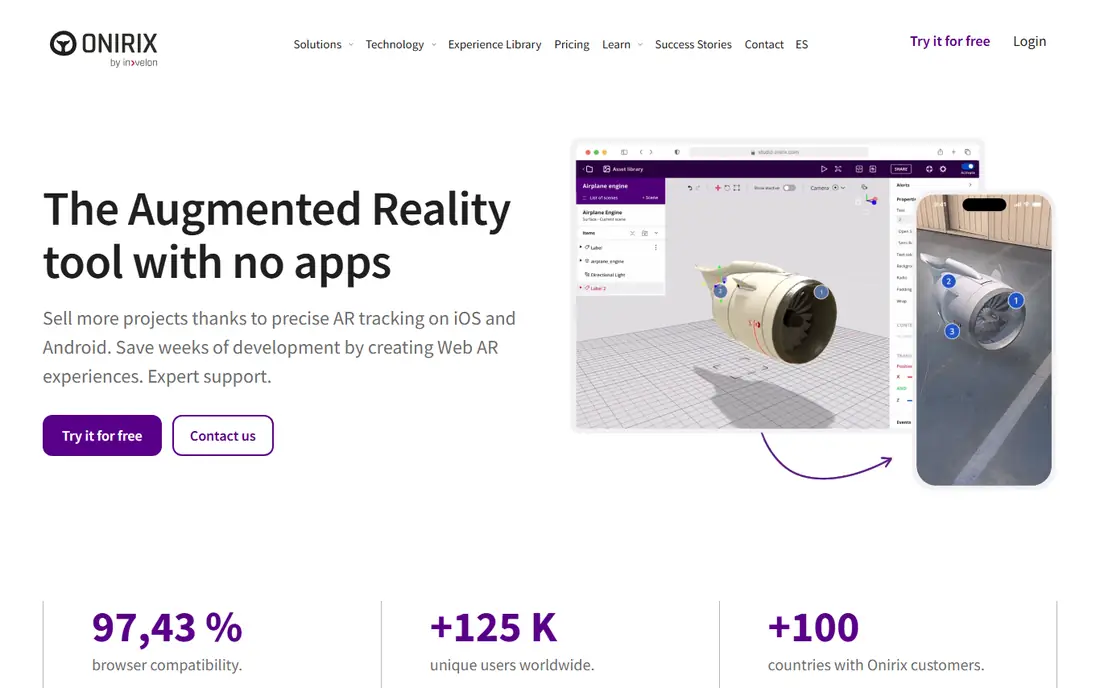
Onirix fills the gap that 8th Wall's hosted platform left behind. Marketers and small agencies can build WebAR scenes in Onirix Studio and share them through a link or QR code. Developers can drop down to the Web AR SDK for custom work.
Its spatial features are unusual for a WebAR tool. You can scan a space, anchor content precisely and build wayfinding routes. Industrial teams can bring in BIM models with their metadata or E57 point cloud files.
Read the license terms closely. Starter is meant for testing, internal development and pre-sales demos, with 5 scenes per project. Commercial deployment to end customers starts at Professional, which costs €299 per month billed annually or €598 billed monthly. Industry plans are annual only.
What we like- Browser-based editor with no app download for end users
- Spatial AR with visual positioning and wayfinding
- Imports BIM models and E57 point clouds
Watch out for- Starter plan cannot be used for commercial client work
- Professional jumps to €299/month on annual billing
Starting price€49 per seat/month (billed annually at €588)
Free planYes (Hobby, non-commercial)
Needle suits teams that already build in Unity or Blender but want the result to run in a browser, including WebXR on headsets and phones.
The Pro plan is the reason to shortlist it. At €49 per seat per month on annual billing, you get commercial use, no watermark, unlimited projects, 250 GB of storage and no per-view fees. That last point matters for campaigns: if traffic suddenly spikes, flat pricing is easier to defend than metered views.
Hobby is free but limited to personal projects. It carries Needle branding and allows one cloud project.
What we like- Exports Unity and Blender scenes to the web
- Unlimited viewers with no per-view fees on Pro
- Works with three.js for custom code
Watch out for- Hobby tier is non-commercial and shows Needle branding
- Pricing is in euros, so US costs move with exchange rates
Starting price$15/month (Personal); $50 per seat/month (Organization)
Free planYes
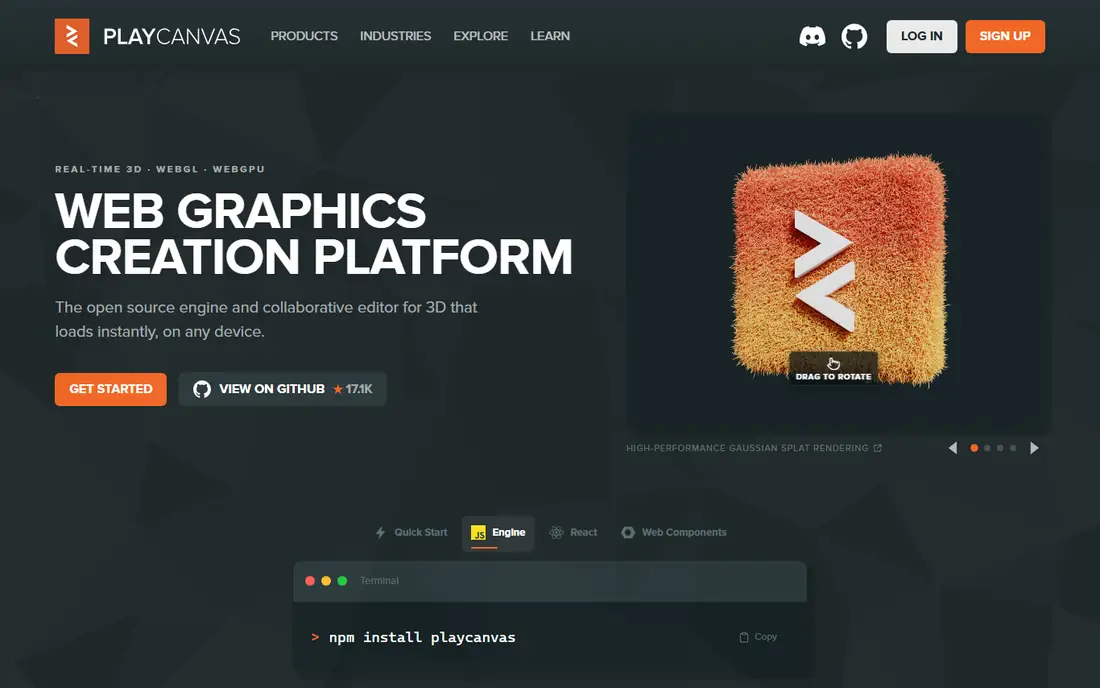
PlayCanvas is a WebGL and WebXR engine whose editor runs entirely in the browser. Designers and developers can work on the same scene at once without installing anything.
The pricing is easy to follow. The engine is open source, and the free Editor plan includes unlimited public projects and 1 GB of storage. Personal is $15 per month for private projects. Organization is $50 per seat per month with team management and 50 GB. Plans bill monthly, and annual invoices are available for Organization subscriptions.
Watch the cancellation rule. Published apps keep running if you stop paying, but private projects become locked until you resubscribe or make them public.
What we like- Open-source engine with a browser-based, real-time collaborative editor
- Free app hosting on every plan
- Low monthly cost with no annual lock-in
Watch out for- Free projects are public
- Private projects lock if you cancel a paid plan
Starting priceSee website
Free planYes (1 editable space)
ShapesXR is for the step before development. Product designers and UX teams build spatial layouts, menus and flows directly in a headset, review them with stakeholders, and hand them to developers.
Collaboration is the strong point. Several people can work in the same space, and the company says it does not limit collaboration on the free plan. Indie and freelance creators can apply for a Community License that grants some paid features for six months.
The limit is scope. You will still need one of the engines above to ship an app. Since November 2024, free users get only one editable space, and any extra spaces switch to view-only.
What we like- No-code design and prototyping in VR and mixed reality
- Real-time multi-user collaboration, even on the free plan
- Team plan adds presentation and scene sync modes
Watch out for- It is a design tool, not a production engine
- Free plan was cut to a single editable space in late 2024
#9ZapWorks
Best for: WebAR marketing campaigns4.5/5 on
G2 (30 reviews, checked Oct 2026)
Visit zap.works
Starting priceSee website
Free planSee website
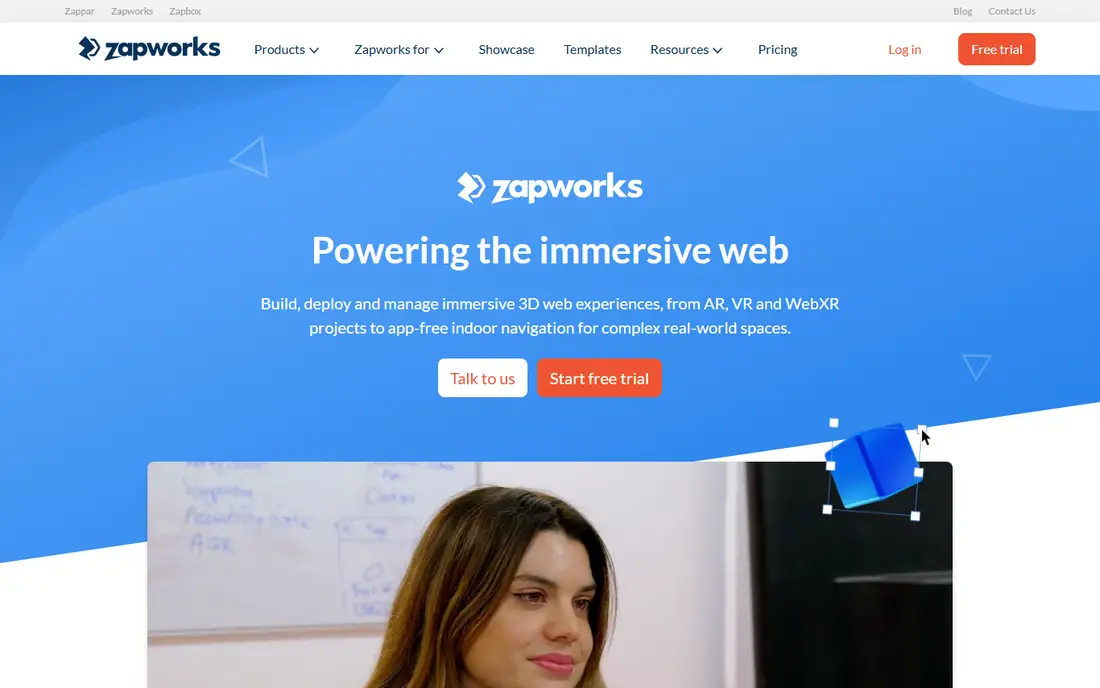
ZapWorks, from Zappar, has been building AR for packaging, print, retail and events for years. It offers a visual workflow for designers and coding tools for developers, plus integrations such as Sketchfab for 3D assets.
For a consumer brand running QR-triggered AR on product packaging, it is a natural fit.
Confirm current plan names, view limits and commercial terms directly with the vendor, since third-party listings show different figures. If your roadmap is about Quest or Vision Pro apps rather than phone-based AR, an engine will serve you better.
What we like- Covers world tracking, face tracking and image tracking
- Tools for both designers and developers
- Integrates with Sketchfab for 3D assets
Watch out for- Pricing is easier to confirm with sales than from public listings
- Less suited to headset apps
Starting priceFree
Free planYes
Lens Studio is Snap's free AR development platform for selfie effects, try-on Lenses and world-facing experiences. For a retail or consumer brand, the draw is reach, because a good Lens can be shared inside Snapchat without anyone installing a new app.
It also works beyond the Snapchat app. The same tool builds for Spectacles, Snap's AR glasses, and Camera Kit lets you bring Lenses into your own mobile or web app.
The weakness is lock-in. Your work lives in Snap's format and depends on Snap's platform decisions. Use it for audience reach, not as the foundation of a long-term product.
What we like- Free desktop app with Snap's tracking and rendering engine
- Built-in distribution to a very large Snapchat audience
- Same tool targets Spectacles and Camera Kit apps
Watch out for- Tied closely to the Snap ecosystem
- Not a general-purpose engine for enterprise headset apps
How we chose
We started with the tools XR developers actually ship with, then kept only products you can buy or download as of October 2026. That meant dropping platforms that have shut down or paused sign-ups. For every tool, we read the vendor's own pricing page and documentation, checked plan limits, commercial-use rules and contract terms, and noted where prices are quote-only.
We then compared public feedback on G2, Capterra and Reddit. We also looked at platform support (OpenXR, WebXR, Android XR, Apple Vision Pro), integrations with Unity, Blender and CAD tools, and fit for small and mid-size companies. We did not run lab tests. Where a vendor does not publish a price, we say so rather than estimate.
Decide where the experience will run
Start here, because the choice splits early. Headset apps for Quest, Android XR or Vision Pro point you to Unity, Unreal or Godot. Phone AR that opens from a QR code points you to WebAR tools like Onirix, Needle, PlayCanvas or ZapWorks. Social AR for consumer reach points to Lens Studio.
Read the commercial-use rules, not just the price
Free tiers on this list often exclude client or commercial work. Needle Hobby is non-commercial, Onirix Starter is for testing and demos, and Unity Personal ends at $200K in revenue or funding. Whether Unreal is free for you depends on your revenue and on whether you make games.
Compare per-seat and per-view costs
Per-seat pricing (Unity Pro, Needle Pro, PlayCanvas Organization) grows with team size. View-based or tiered pricing (Onirix) grows with audience size. A three-person team running a viral campaign should prefer flat seat pricing with unlimited views. A large team with a small internal audience may prefer the opposite.
Plan for platform risk
XR tools disappear. 8th Wall retired its hosted platform on February 28, 2026, and released its engine as open source. Experiences already published on it will run only until February 28, 2027. Blippar has suspended new subscriptions while it rebuilds its platform. Before committing, confirm you can export projects and self-host, and keep source assets (3D models, textures, scripts) in your own storage.
Budget for people, not just licenses
License fees are usually the smallest line in an XR budget. Developer time, 3D asset creation, device testing and app store or headset deployment cost far more. Choosing the engine your team already knows often saves more than choosing the cheapest license.
Frequently asked questions
What is the most popular software for XR development?
Unity is the most widely used engine among XR developers, with Unreal Engine in second place. Both support the major headsets and mobile platforms. Godot is growing quickly thanks to its OpenXR work but still has a much smaller developer base.
Is there free XR development software for commercial projects?
Yes. Godot is free and open source with no royalties, PlayCanvas's engine is open source, and Lens Studio is free for building Snap Lenses. Unity Personal is free for businesses under $200K in revenue or funding. Always check the license before shipping client work on a free tier.
What happened to 8th Wall?
Niantic retired the hosted 8th Wall platform on February 28, 2026 and released the engine as open source. Experiences already published keep running until February 28, 2027. Teams still on 8th Wall should export their projects now and either self-host or move to another WebAR tool.
Do I need Unity Pro to build for Apple Vision Pro?
Yes. Unity's plans page lists building and publishing for Apple Vision Pro as a Pro-level feature. That means a paid seat at $210 per month or $2,310 per year for each developer who needs it.
WebAR or a native app: which should a small business choose?
WebAR runs in a phone browser, so customers do not need to install anything. That makes it the usual choice for marketing and packaging campaigns. Native apps give better tracking, offline use and headset support, which matter more for training and field service. Many companies start with WebAR and move to native only when usage justifies it.
How long does it take to build a basic XR experience?
A simple WebAR scene in a no-code tool like Onirix can be built in days. A custom headset training app in Unity or Unreal usually takes weeks to months, depending on the 3D content and how complex the interactions are. Prototyping the flow first in a tool like ShapesXR can shorten the build phase.
Sources we checked (19)
- https://unity.com/products
- https://enterprise.unrealengine.com/en-US/license
- https://www.unrealengine.com/blog/we-are-updating-unreal-engine-twinmotion-and-realitycapture-pricing-in-late-april
- https://en.wikipedia.org/wiki/Unreal_Engine_5
- https://developer.android.com/develop/xr/godot
- https://www.uploadvr.com/godot-now-supports-more-xr-features-builds-a-universal-openxr-apk/
- https://vr.org/articles/godot-46-xr-engine-meta-funding
- https://www.ptc.com/en/products/vuforia/vuforia-engine/pricing
- https://developer.vuforia.com/library/vuforia-engine/FAQ/pricing-and-licensing-options/
- https://www.onirix.com/pricing/
- https://cloud.needle.tools/pricing
- https://playcanvas.com/plans
- https://learn.shapesxr.com/pricing-limitations-faq
- https://vr-expert.com/software/shapesxr/
- https://www.capterra.com/p/163574/ZapWorks/
- https://developers.snap.com/lens-studio/overview/getting-started/what-is-lens-studio
- https://developers.snap.com/camera-kit/ar-content/build-lenses
- https://www.8thwall.com/blog/post/200208966730/next-chapter
- https://www.blippar.com/webar-vs-native-ar-performance-cost-and-deployment/
Is your product missing or out of date?
We review this list regularly. Vendors can request a listing, send updated pricing or ask about featured placement.

Shihab Mia · Founder, Rankite
Shihab has 5+ years in B2B and SaaS SEO. He writes Rankite's software buying guides from pricing pages, documentation and public user reviews. More about Shihab.