How we make this list: we compare pricing pages, product documentation and public user reviews. Rankite is independent; if a vendor ever pays for a featured spot, that listing is clearly labeled Partner.
Key takeaways
- TransUnion TLOxp (now under the TruLookup brand) is the enterprise benchmark, but it is quote-only, costly, and credential-heavy. Small teams should start elsewhere.
- Tracers offers the most generous on-ramp: your first $100 in searches free, with batch and API options that scale.
- IDI idiCORE gives a 30-day trial with no monthly minimums, which is rare in this market and worth using before you commit anywhere.
- BatchData absorbed BatchSkipTracing in August 2025. If you were a BatchSkipTracing user, the product you want now is BatchData.
- None of these tools are for tenant or employee screening. FCRA rules bar using skip-trace data for credit, insurance, or employment eligibility decisions.
Quick comparison
| Tool | Best for | Starting price | Free plan |
|---|
 TransUnion TLOxp TransUnion TLOxp | Enterprise and high-volume US investigations | See website | Free trial |
 Tracers Tracers | Small to mid-size investigative teams | See website | Free trial ($100 free searches) |
 LexisNexis Accurint LexisNexis Accurint | Legal teams needing court and asset depth | See website | No |
 BatchData BatchData | Real estate investors and proptech teams | See website | No |
 Thomson Reuters CLEAR Thomson Reuters CLEAR | Law enforcement and fraud teams | See website | No |
 IRB Search IRB Search | Budget-conscious investigators | See website | No |
 IDI idiCORE IDI idiCORE | Repossession and collections teams | See website | Free trial (30 days) |
 Enformion Enformion | High-volume API and dialer integrations | See website | No |
Is your product missing or out of date?
We review this list regularly. Vendors can request a listing, send updated pricing or ask about featured placement.
Starting priceSee website
Free planFree trial
TLOxp is the name investigators cite when match quality matters most. TransUnion now positions it under its TruLookup solution line, but the product is the same idea: person and business linking across a massive identity graph, with batch tools for running whole lists and risk indicators that help collectors prioritize accounts. When a list is difficult and the cost of a wrong number is high, this is the database serious shops reach for.
The price of that quality is process. Pricing is quote-only and sits at the high end of the market, and access requires credentialing that can include a site visit. If you run a few dozen searches a month, you will pay enterprise overhead for capacity you never use. TLOxp earns its keep at volume: collections operations, legal teams with heavy caseloads, and investigators who need defensible, documented results.
What we like- More than 100 billion public and proprietary data points
- Strong batch processing and person-business linking
- Risk indicators built in
Watch out for- Enterprise quotes and higher cost
- Strict credentialing and compliance process
- Overkill for occasional searches
Starting priceSee website
Free planFree trial ($100 free searches)
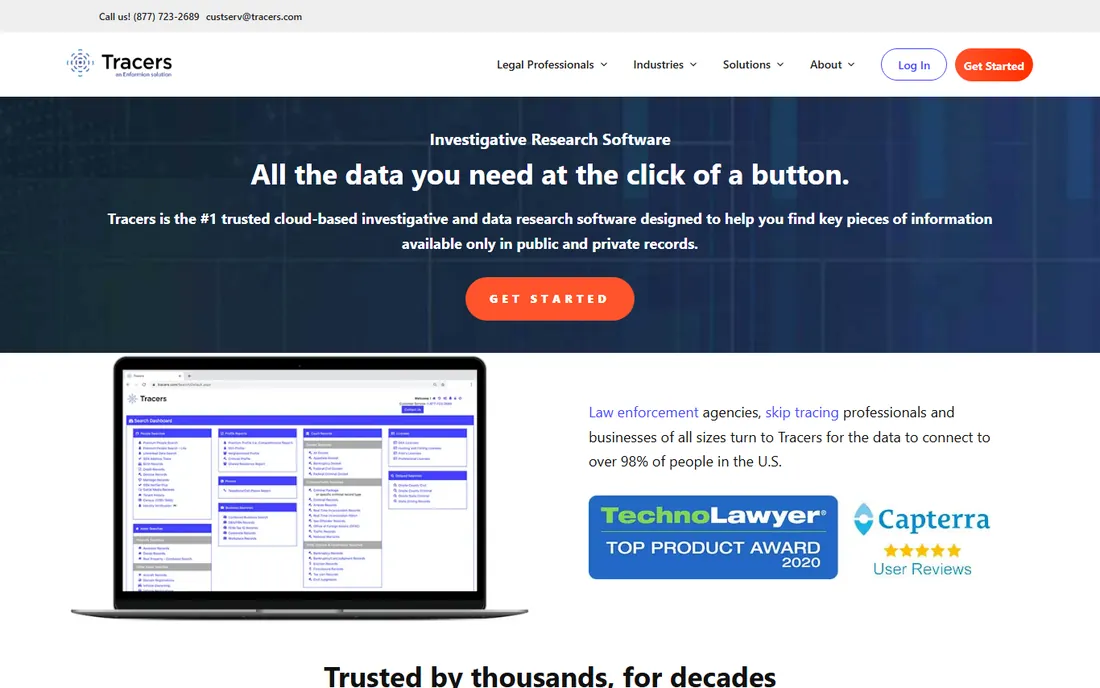
Tracers wins the on-ramp. Your first $100 in skip tracing searches are free, which is enough to run real cases and judge the data before spending anything. The platform covers 98 percent of US adults across 42 billion data points, with people, business, social media, and UCC filing searches, plus bulk batch processing for high-volume work.
The company has been in this business since 1996 and positions itself as the mid-market alternative to the enterprise databases: strong data, simpler setup, actual human support. Reviewers consistently call it good value for law firms and process servers. The honest catch is that pricing is not published, so you will talk to sales, and the seat model means costs climb as you add staff. For one to five investigators, though, it is the easiest yes in the category.
What we like- First $100 in searches free, no card games
- More than 42 billion data points
- Batch processing and a real API
Watch out for- Exact pricing is not published
- Seat-based costs add up as teams grow
- Lighter on court-record depth than Accurint
Starting priceSee website
Free planNo
Accurint is the legal industry's default for a reason: when a case needs court records, assets, liens, judgments, and business affiliations, few databases go deeper. The "Deep Skip" searches are built for subjects who have gone quiet, and monitoring alerts flag new address or asset activity without you re-running searches. There is also a mobile app, so investigators can pull records in the field.
The billing model is the thing to watch. Accurint charges per search type in a menu format, which is flexible but makes budgeting harder than a flat subscription; heavy users report the costs stacking up. And the FCRA boundary matters: Accurint data may not be used as a factor in credit, insurance, or employment eligibility decisions. If your use case is collections, legal, or investigation with a permissible purpose, it is excellent. If it is screening, it is the wrong tool entirely.
What we like- Deepest court, asset, and lien records
- "Deep Skip" for hard-to-find subjects
- Alerts when subject data changes
Watch out for- Menu-style per-search pricing can add up fast
- Subscription plus ID verification required
- Cannot be used for FCRA eligibility decisions
Starting priceSee website
Free planNo
If you used BatchSkipTracing, stop looking for it: in August 2025 the company consolidated everything into BatchData, and the old brand is gone. The current platform is a developer-focused data stack for real estate: 155 million properties, more than 700 data points per property, skip tracing, phone verification, and DNC scrubbing through REST APIs and bulk delivery.
The pricing logic is modern and fair. You pay per matched person record returned, not per API call, so probing a list of unknown-quality numbers does not punish you. The company claims a 76 percent right-party contact rate, roughly triple the industry average, by validating numbers against carrier data. The catch is fit: this is built for proptech teams and high-volume investors, not for a private investigator running one-off searches. Solo operators will find Tracers or IRB Search more approachable.
What we like- BatchSkipTracing merged into the platform in August 2025
- Claims a 76 percent right-party contact rate
- Pay per matched record, not per API call
Watch out for- Pricing skews toward high-volume plans
- Developer-focused, less hand-holding
- The rebrand confused legacy BatchSkipTracing users
Starting priceSee website
Free planNo
CLEAR is the investigative platform behind a long list of government contracts, including a long-term deal putting it in front of more than 25,000 Department of Justice users across the FBI, DEA, US Marshals, and ATF. That pedigree shows in the product: associative analytics that map relationships between people, businesses, assets, and vehicles, plus license plate recognition data for vehicle location history.
For corporate fraud, risk, and investigations teams, CLEAR's strength is auditability. Searches are documented, data is near-real-time, and the training resources are serious. The tradeoff is that this is unambiguously an enterprise sale with plan-based pricing and no self-serve path. Small firms will find the process heavy; large organizations with compliance requirements will find it exactly right.
What we like- Associative analytics that surface non-obvious connections
- Near-real-time data
- Trusted by DOJ agencies including the FBI and DEA
Watch out for- Plan-based enterprise pricing
- Designed for trained investigators
- Onboarding takes time
Starting priceSee website
Free planNo
IRB Search has a loyal following among private investigators for one practical reason: it delivers serious data without the enterprise onboarding gauntlet. Investigators on professional forums note that competing databases can require a $60 site visit before you run your first search; IRB gets you working faster. The database spans criminal records, bankruptcies, property, businesses, licenses, and reverse phone lookup.
It is not the prettiest tool here, and the lack of published pricing means a sales conversation. But for solos and small agencies watching every dollar, the value equation is strong: deep records, low friction, reasonable per-search costs. If you want a polished modern UI and white-glove onboarding, pay more for Tracers. If you want data per dollar, IRB belongs on the shortlist.
What we like- Access to more than 85 billion records
- No site visit required for signup
- Competitive per-search pricing
Watch out for- Pricing is not published on the site
- Interface feels dated next to newer tools
- Support is thinner than Tracers
Starting priceSee website
Free planFree trial (30 days)
IDI's pitch is refreshingly simple: no monthly minimums, and a 30-day trial that lets you run real work before committing. The idiCORE platform draws on credit-header, proprietary, public record, and public data covering nearly 100 percent of US adults, refreshed daily, with batch and API options alongside the online portal. Collections teams get scrubbing for deceased and bankruptcy records built in.
The standout use case is repossession. One Texas repo company in IDI's case studies moved all its data work to idiCORE and credited it with a 30 percent improvement in recovery rates, citing the vehicle data linking as the difference. Pricing is negotiated, so the trial is doing real work here: run your hardest lists through it for 30 days, compare hit rates against whatever you use now, and then negotiate from evidence.
What we like- 30-day trial with no commitment
- No monthly minimums
- Identity graph covering nearly all US adults
Watch out for- Pricing is negotiated, not published
- Best pricing requires volume commitments
- Interface takes a session to learn
Starting priceSee website
Free planNo
Enformion is the pick when skip tracing is a pipeline, not a search box. The EnformionGO API and batch append products are designed to enrich thousands of records and feed them straight into dialers and CRMs, with per-match pricing and low monthly minimums that suit high-volume operations. For collections and marketing operations running serious volume, the automation story is the whole point.
Two caveats. First, the vendor does not publish pricing, so budget for a sales cycle. Second, the product line has absorbed several smaller competitors over the years, which means you should confirm exactly which platform and data set you are being quoted on rather than assuming. Used correctly, it is one of the most cost-effective options at scale.
What we like- EnformionGO API built for automation
- Per-match pricing with low monthly minimums
- Batch append that feeds dialers directly
Watch out for- No pricing published by the vendor
- Sales-led process
- The product line has absorbed several competitors, so confirm which platform you are buying
We worked from vendor product pages, documentation, and pricing pages, then cross-checked against public reviews on G2, Capterra, TrustRadius, and investigator discussions on Reddit. Pricing and trial details above come from the vendors' own published pages where they exist; where vendors do not publish pricing, we say so instead of repeating third-party guesses. We weighted data coverage, batch and API capability, fit for different buyer types from solo PIs to enterprise collections, and pricing transparency. We did not run hands-on tests; this is a research comparison, not a lab review.
Choosing a skip trace vendor without getting burned
Start with your volume and your use case, because those two facts eliminate most of the list. If you run fewer than a few hundred searches a month, the enterprise databases will cost you more in process than they return in data; Tracers or IRB Search will serve you better. If you run thousands of records in batches, BatchData or Enformion's batch products are built for exactly that, and per-search web tools will slow you down.
Use the trials properly. IDI's 30-day trial and Tracers' $100 in free searches are not marketing; they are your evaluation plan. Run the same hard list through two vendors and compare right-party contact rates, not record counts. A database that returns more records with lower accuracy costs you more in wasted calls.
Ask about pricing mechanics before you sign. Menu-style per-search pricing (Accurint) rewards careful users and punishes heavy ones. Seat pricing (Tracers) rewards small teams. Per-match pricing (BatchData, Enformion) rewards high-volume pipelines. And ask what credentialing involves: site visits, license verification, and permissible-purpose documentation are normal in this industry, but you should know the timeline before you need the data.
Every legitimate skip tracing vendor will ask about your permissible purpose, and that is a feature, not friction. Under the Fair Credit Reporting Act, skip-trace data from these databases may not be used to determine eligibility for credit, insurance, or employment. Tenant screening and hiring decisions need FCRA-compliant consumer reports from a different category of provider entirely.
Outbound calling brings its own rules. Scrub every list against the National Do Not Call Registry, honor state-level lists, and keep records of consent for automated calls under the TCPA. Several tools here build DNC scrubbing into the workflow; use it. And keep your own compliance process around data handling: these databases contain sensitive personal information, and your access agreement makes you responsible for who on your team can see it.
Frequently asked questions
What is skip tracing software?
Skip tracing software searches linked public records, credit-header data, and proprietary databases to locate people and their current contact information. Investigators, collectors, process servers, and real estate investors use it to find current addresses, phone numbers, relatives, associates, assets, and vehicles when a subject cannot be reached at their last known details.
Do I need a license or special permission to use these tools?
You do not need a private investigator license in most states, but every vendor requires a permissible purpose under laws like the GLB Act and DPPA, and will verify your business before granting access. Expect to document who you are, what industry you are in, and what you will use the data for. Some vendors also require an on-site inspection before activation.
How much does skip tracing software cost?
It varies widely. Per-search tools can cost cents to a few dollars per search, seat-based platforms run tens of dollars per user per month plus usage, and enterprise databases like TLOxp, Accurint, and CLEAR are quote-only with annual commitments. Real estate batch tracing historically ran around 9 to 20 cents per matched record; confirm current pricing with the vendor, since the market reprices often.
Which skip tracing tool is best for real estate investors?
BatchData is the natural choice now that it absorbed BatchSkipTracing: it combines property data, skip tracing, and DNC scrubbing in one platform with per-match pricing. Tracers is a strong alternative for investors who also need people-search depth beyond property records. Pick based on whether property data or people data is your primary need.
Can I use skip tracing software for tenant or employee screening?
No. Skip tracing databases are not consumer reporting agencies under the FCRA, and their data may not be used to determine eligibility for credit, insurance, employment, or tenancy. Using them for screening exposes you to serious legal liability. Use an FCRA-compliant background check provider for those decisions.
What happened to BatchSkipTracing?
BatchData consolidated its products in August 2025, merging BatchSkipTracing into the main BatchData platform at batchdata.io. Existing functionality continues under the BatchData brand with API, bulk, and pay-as-you-go options. If you have old bookmarks or logins for batchskiptracing.com, go to batchdata.io instead.
Sources we checked (8)
- https://www.transunion.com/solution/trulookup
- https://www.tracers.com/skiptracing/
- https://risk.lexisnexis.com
- https://batchdata.io/reverse-skip-trace-api
- https://clear.thomsonreuters.com
- https://www.ididata.com/skip-tracing/
- https://www.enformion.com
- https://irbsearch.com
Is your product missing or out of date?
We review this list regularly. Vendors can request a listing, send updated pricing or ask about featured placement.

Shihab Mia · Founder, Rankite
Shihab has spent more than a decade helping SaaS and e-commerce brands grow through search. He writes Rankite's software buying guides from pricing pages, documentation and public user reviews. More about Shihab.