How we make this list: we compare pricing pages, product documentation and public user reviews. Ratings come from G2, Capterra or Trustpilot, with the date we checked them.
Key takeaways
- Seismic (merged with Highspot) and Showpad (merged with Bigtincan) are the two enterprise platforms left standing, so most large buyers end up choosing between them.
- Allego and Mindtickle suit teams that want coaching and content in one place rather than a pure content repository.
- Guru and Spekit fit companies where reps live in Slack, Salesforce or their browser and will not open another portal.
- Qwilr is the value pick with published per-user pricing, starting at $35 per user per month on annual billing, while Paperflite prices its tiers by quote.
Quick comparison
| Tool | Best for | Starting price | Free plan |
|---|
 Seismic Seismic | Enterprise sales enablement at scale | See website | No |
 Showpad Showpad | Content-driven buyer engagement | See website | No |
 Allego Allego | Video coaching plus content libraries | See website | No |
 Mindtickle Mindtickle | AI coaching tied to revenue outcomes | See website | No |
 Mediafly Mediafly | Enterprise enablement with services included | See website | No |
 Spekit Spekit | Enablement inside the tools reps already use | See website | No |
 Guru Guru | Governed knowledge for AI-powered teams | See website | No |
 Paperflite Paperflite | Content engagement analytics on a budget | See website | No |
 Enablix Enablix | Job-oriented enablement with usage-based pricing | See website | No |
 Qwilr Qwilr | Interactive proposals and buyer-facing content | $35/user/month (billed annually) | Free trial (14 days) |
Is your product missing or out of date?
We review this list regularly. Vendors can request a listing, send updated pricing or ask about featured placement.
The best sales content management software
Starting priceSee website
Free planNo
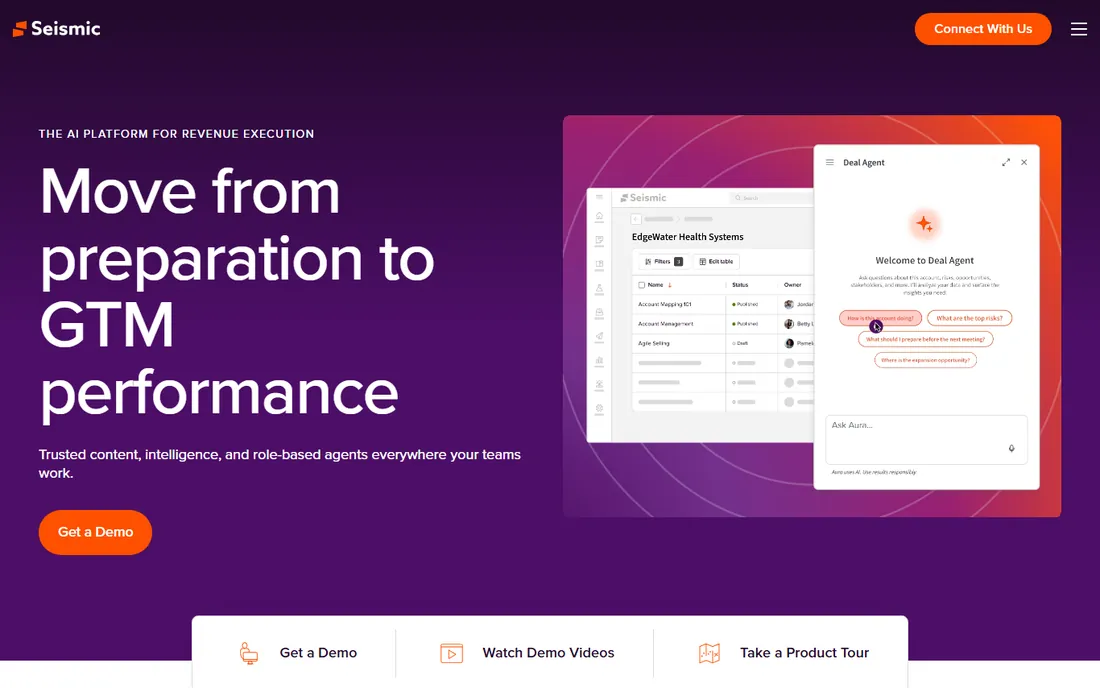
Seismic is the company that survived the biggest consolidation this category has seen. In August 2026 it completed its merger with Highspot, and the combined business operates as Seismic, with the product line branded "Highspot by Seismic". The result is a platform with 2,500 customers and 3.5 million users covering content management, sales coaching, analytics and buyer engagement in one contract.
That scale is the pitch and the warning. Large sales organizations get a single vendor for content, training and analytics with deep Salesforce and Microsoft integrations. Smaller teams get enterprise sales cycles, implementation projects and pricing to match. If you have hundreds of reps and a dedicated enablement team, Seismic is the default shortlist entry. If you have twenty reps, keep reading.
What we like- Combined Seismic-Highspot platform with 2,500 customers and 3.5M users
- Content management plus coaching, analytics and digital sales rooms
- Deep CRM integrations
Watch out for- Enterprise pricing and implementation
- Overkill for small teams
Starting priceSee website
Free planNo
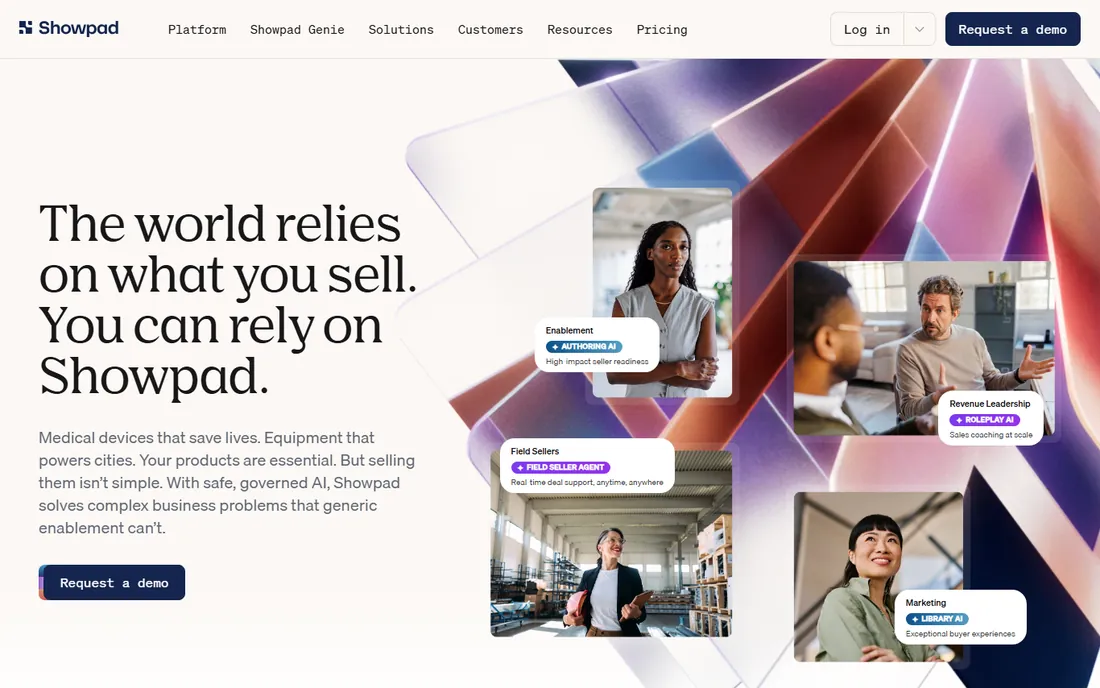
Showpad is the other enterprise anchor, and it got there through its own merger. Vector Capital combined Bigtincan with Showpad in late 2025, and the combined company kept the Showpad name. With more than 2,000 customers across 50 countries, the platform pairs content management with sales coaching and shared spaces for buyer collaboration. Its mobile apps have long been a strong point for field sales teams who live on their phones.
The merger means the product line is still settling, so ask direct questions about the roadmap during evaluation. Pricing is quote-based. For mid-market and enterprise teams that want reps sharing content from the field and managers coaching from the same platform, Showpad remains a strong pick.
What we like- Combined Showpad-Bigtincan company with 2,000+ customers in 50 countries
- Strong content sharing and coaching
- Good mobile experience for field teams
Watch out for- Quote-based pricing
- Broad platform can feel complex for simple content sharing
Starting priceSee website
Free planNo
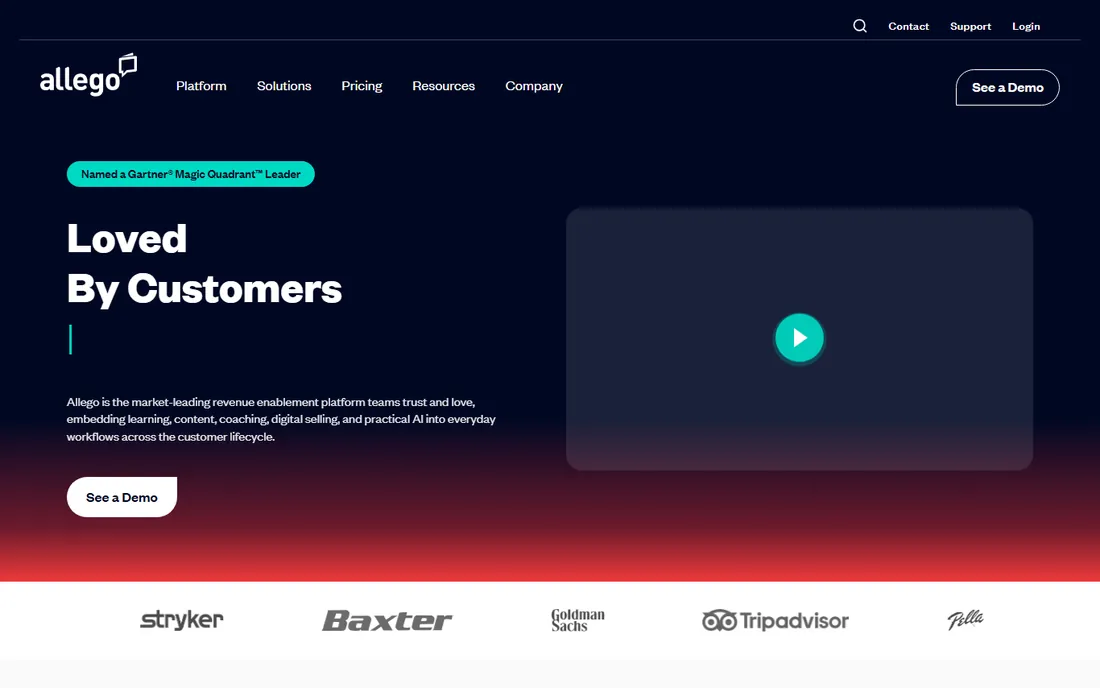
Allego approaches sales content management from the coaching side. The platform combines content libraries and digital sales rooms with video-based practice, AI roleplays and conversation intelligence, so the same system that stores your battlecards also trains reps to use them. The company was founded by Yuchun Lee and Mark Magnacca and is frequently named a leader in analyst evaluations of revenue enablement.
Implementation is lighter than the enterprise suites, with go-live commonly measured in weeks rather than quarters. Pricing is not published. The fit is sales leaders who care as much about rep skill as rep content. If you only need a content repository, simpler tools below cost less.
What we like- Content libraries, digital sales rooms and conversation intelligence in one platform
- Video-based practice and AI roleplays
- Typical go-live measured in weeks
Watch out for- Coaching-heavy approach
- Pricing not published
Starting priceSee website
Free planNo
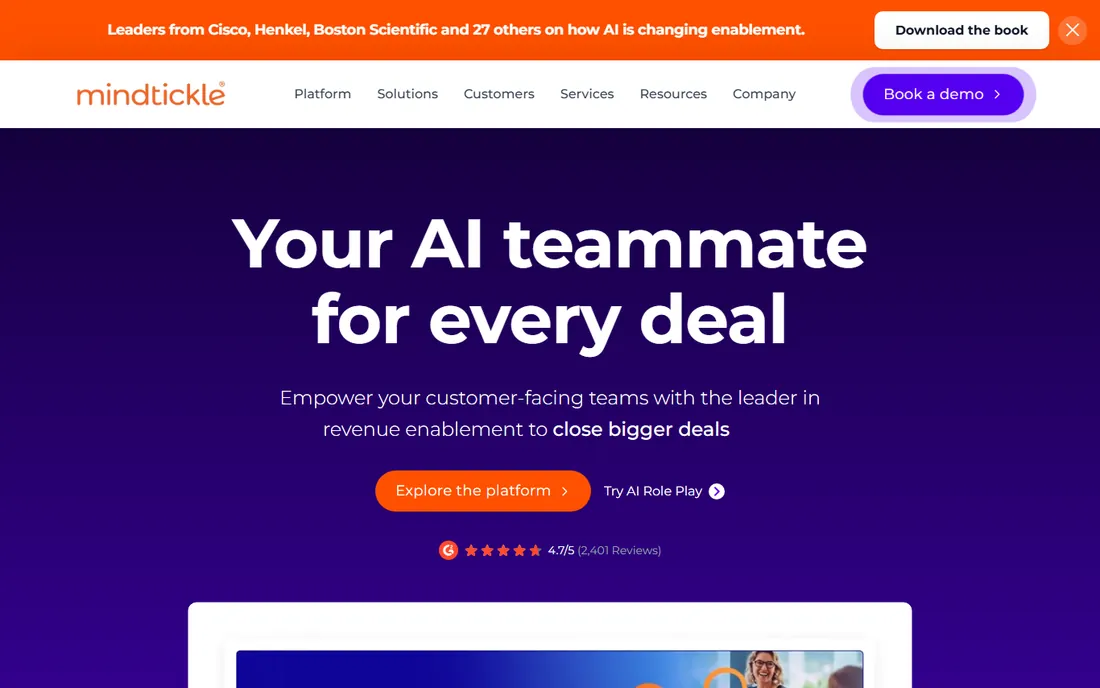
Mindtickle has spent a decade collecting data on how sales reps behave, and its current pitch is an agentic operating system that coaches, guides and acts on deals using that history. The platform covers onboarding, personalized training, AI coaching and field performance insights, with content management as part of a wider revenue enablement suite.
The company publishes bold outcome numbers (31% larger deal sizes, 40% more revenue per rep, 50% faster onboarding). Treat vendor statistics as marketing, but they signal where the product aims: measurable rep improvement, not just organized files. Pricing is quote-based and the product is built for larger revenue teams. Smaller companies will find the commitment steep.
What we like- Agentic AI coaching layered over every deal
- Personalized training at scale
- Detailed analytics on rep behavior
Watch out for- Enterprise focus with quote-based pricing
- Heavier than a pure content tool
Starting priceSee website
Free planNo
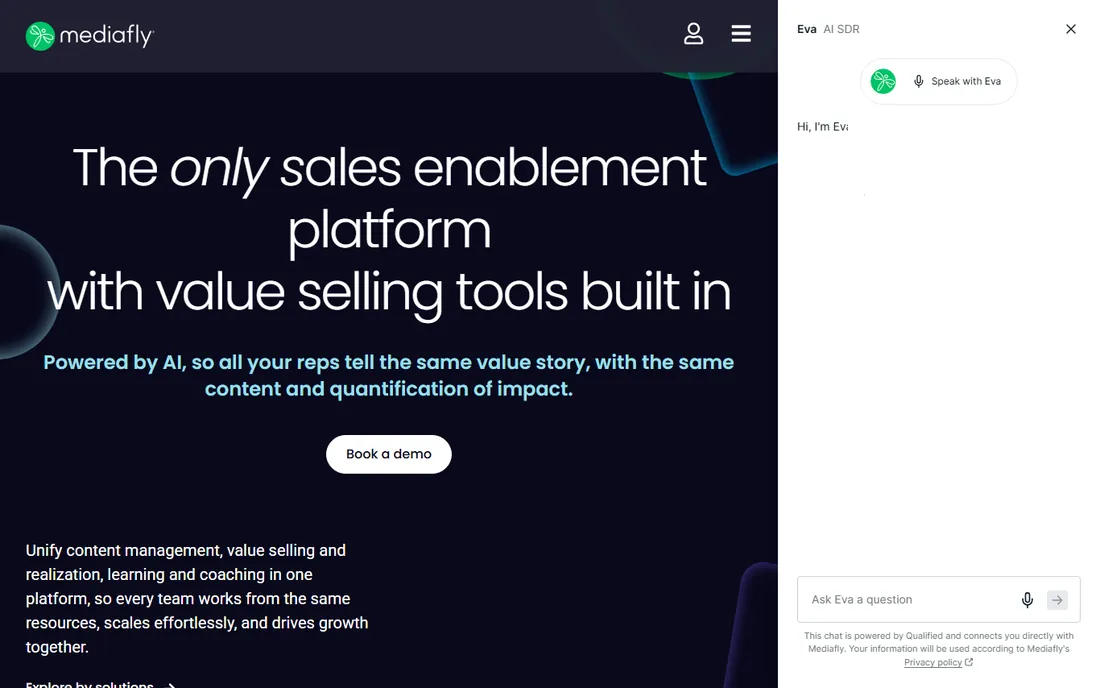
Mediafly sells revenue enablement as a platform plus a services team. The software covers content management, training and value tools such as ROI calculators, with an AI layer it calls Command Center that automates routine work and surfaces insights. What distinguishes it from pure software vendors is the services arm: in-house teams for implementation, change management and creative work who build custom workspaces and branded content for you.
That is genuinely useful for enterprises without a big internal enablement staff, and it is genuinely expensive. Pricing is quote-based. If your team can self-implement, you may be paying for services you do not need. If it cannot, Mediafly's model can be the difference between software that ships and software that sits.
What we like- Unified platform for content, training and value selling tools
- In-house professional and creative services
- AI "Command Center" automation
Watch out for- Services-led model adds cost
- Pricing not published
#6
Spekit
Best for: Enablement inside the tools reps already use
Visit spekit.com
Starting priceSee website
Free planNo
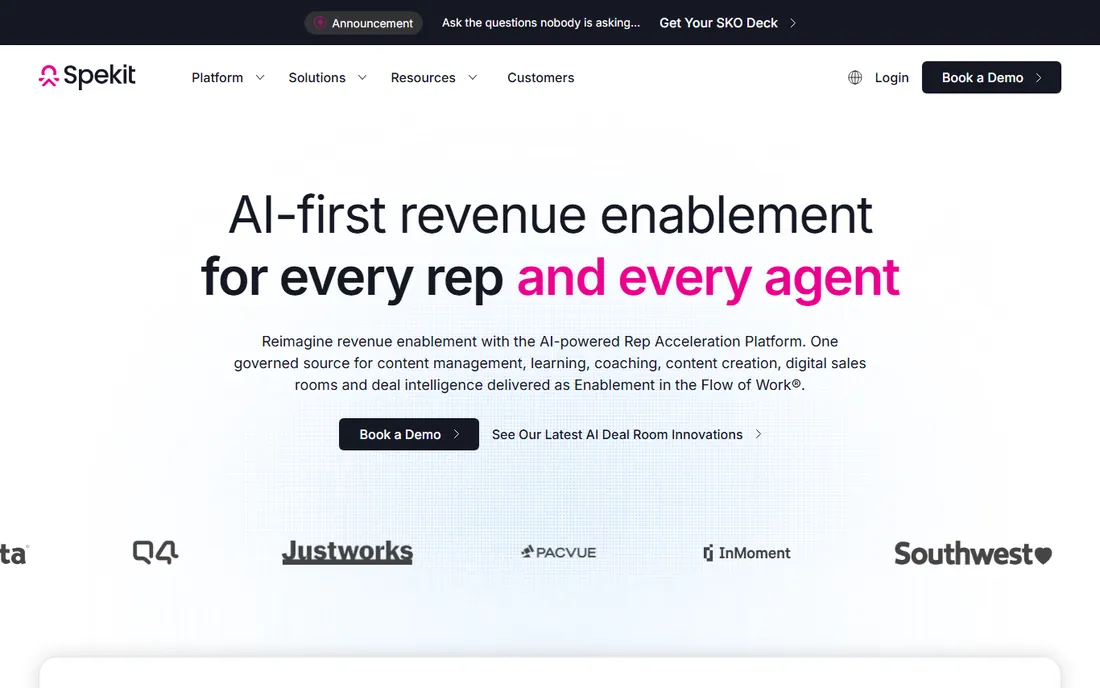
Spekit bets that reps will never open another portal, so it brings enablement to them. Playbooks, battlecards, talk tracks and training appear inside Salesforce, Slack, Gmail and the browser, exactly where the selling happens. For adoption, this is the strongest argument in the category: there is nothing new to log into and nothing new to learn.
The tradeoff is depth. Spekit is thinner on content analytics and buyer-facing engagement than the suite vendors. Pricing is not published and runs on custom quotes. It fits revenue teams whose last enablement tool died from neglect. If your reps already use a portal happily, you do not need this.
What we like- Surfaces playbooks and content in Salesforce, Slack and the browser
- Near-zero adoption risk
- Quick to deploy
Watch out for- No published pricing
- Lighter on deep content analytics
Starting priceSee website
Free planNo
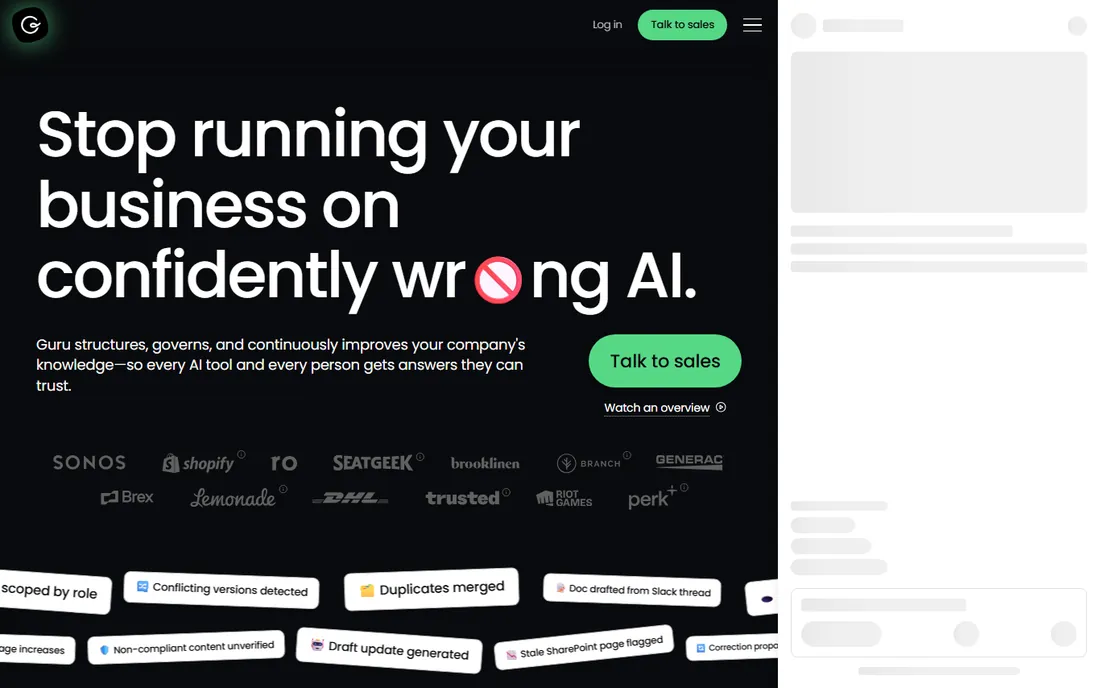
Guru started as a team knowledge base and now describes itself as a governed knowledge layer for enterprise AI. The pitch for sales teams: product knowledge, battlecards and process docs stay verified through workflows and usage signals, then get delivered wherever reps work, including inside AI agents through MCP. With 100+ integrations covering Slack, Teams, Salesforce and Zendesk, it meets reps in their flow instead of dragging them to a portal.
Note the pricing change. Guru's pricing page no longer lists per-seat prices; it now sells platform-plus-expertise engagements scoped to your organization, so expect a custom quote. That moves it upmarket from its self-serve roots. It fits companies standardizing knowledge for both humans and AI agents. Teams that only need sales content may find it broader than necessary.
What we like- Verification workflows keep content accurate
- 100+ integrations with MCP delivery to AI agents
- Strong governance and permissions
Watch out for- Pricing moved to custom quotes
- Broader than pure sales content
Starting priceSee website
Free planNo
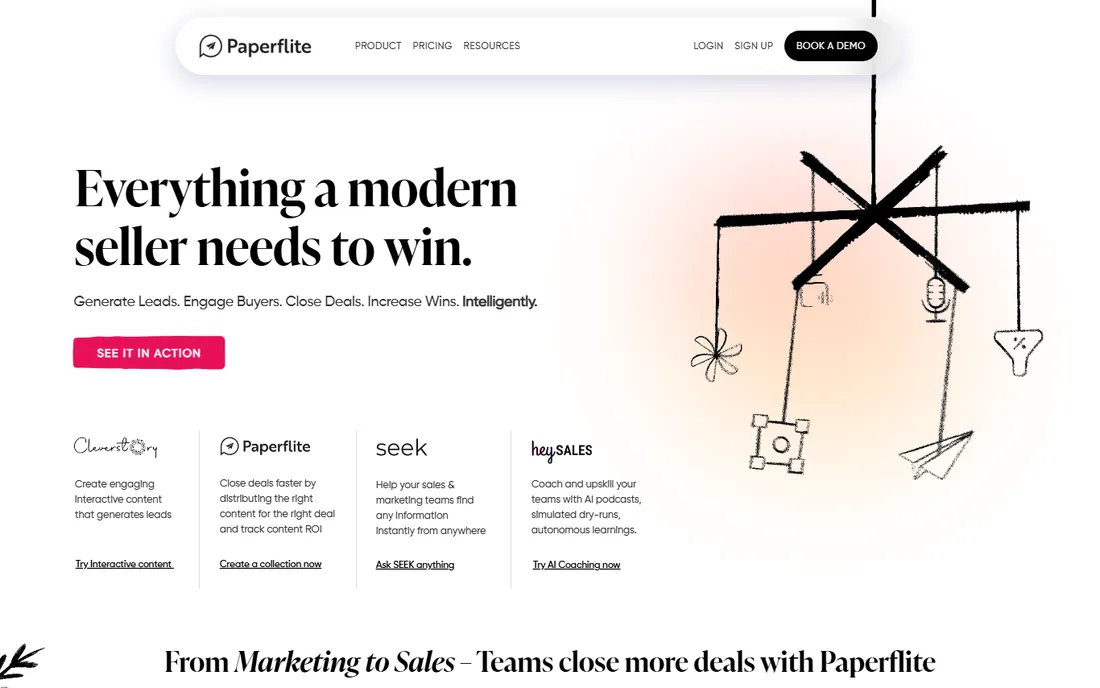
Paperflite is an AI-native revenue enablement platform built around a content hub the company describes as Netflix-like: reps browse collections, microsites and interactive experiences instead of folders. Underneath sits SEEK, a language-model layer that answers questions from your content repository, plus AI coaching, buyer simulations and predictive deal insights on higher plans. The company also runs Cleverstory for interactive content and heysales for AI coaching under one roof.
Paperflite sells tiered plans from Starter through Professional and Advanced up to Enterprise, with digital deal rooms and AI recommendations on the higher tiers. Pricing is quote-based, so expect a sales conversation before you see numbers. The platform is SOC 2 Type II certified. The tradeoff is vendor size: Paperflite cannot match Seismic or Showpad on enterprise install base, but for mid-market teams it delivers most of the functionality at a friendlier price point.
What we like- Netflix-style content hub with AI discovery
- Engagement analytics and digital deal rooms on higher plans
- AI coaching and buyer simulations included
Watch out for- Smaller vendor footprint than the enterprise suites
- Pricing only available by quote
#9
Enablix
Best for: Job-oriented enablement with usage-based pricing
Visit enablix.com
Starting priceSee website
Free planNo
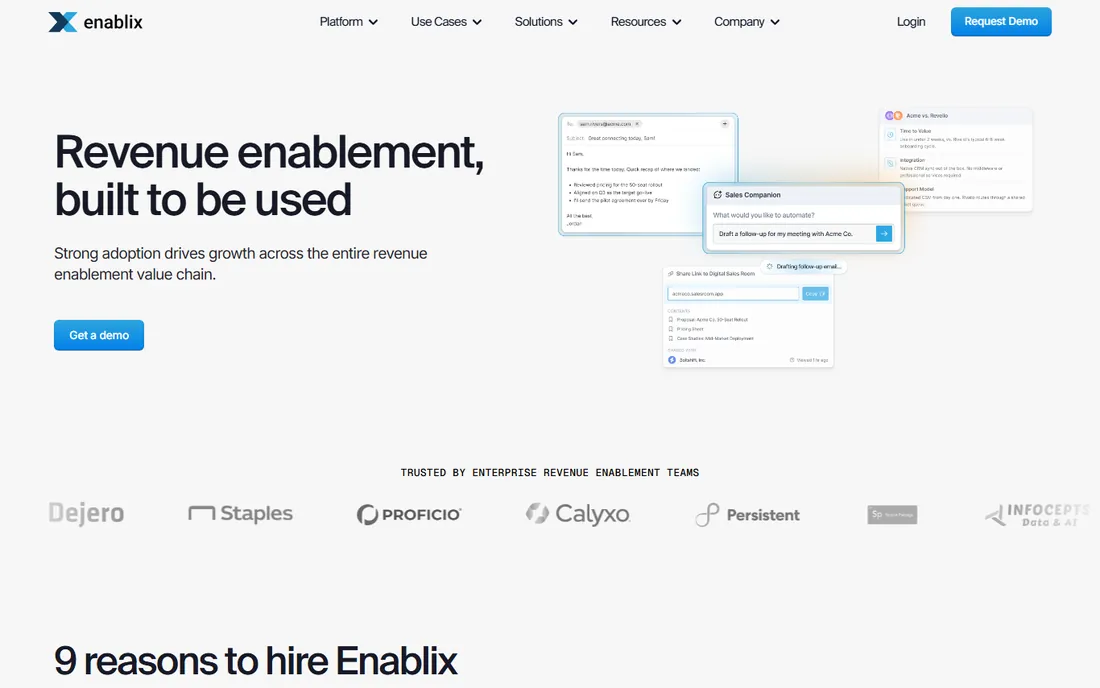
Enablix argues that enablement fails on adoption rather than features, so it prices on usage with unlimited users instead of per-seat licenses. The platform runs content management, digital sales rooms, roleplay practice and partner enablement on one content and governance layer, and its AI answers link back to the source content they came from. Integrations reach into CRMs, content management systems, call recording tools and general language models, plus MCP for AI agents.
The company is small, founded in 2017 in Ashburn, Virginia, which cuts both ways. You get attention and flexibility, but less analyst coverage and a thinner customer proof base than the giants. Pricing is usage-based and unpublished, so you will need a conversation to get numbers. It fits teams allergic to seat licenses and shelfware.
What we like- Usage-based pricing with unlimited users
- AI answers traceable to source content
- Works inside CRM and other tools via integrations and MCP
Watch out for- Smaller vendor founded in 2017
- No published price points
#10
Qwilr
Best for: Interactive proposals and buyer-facing content
Visit qwilr.com
Starting price$35/user/month (billed annually)
Free planFree trial (14 days)
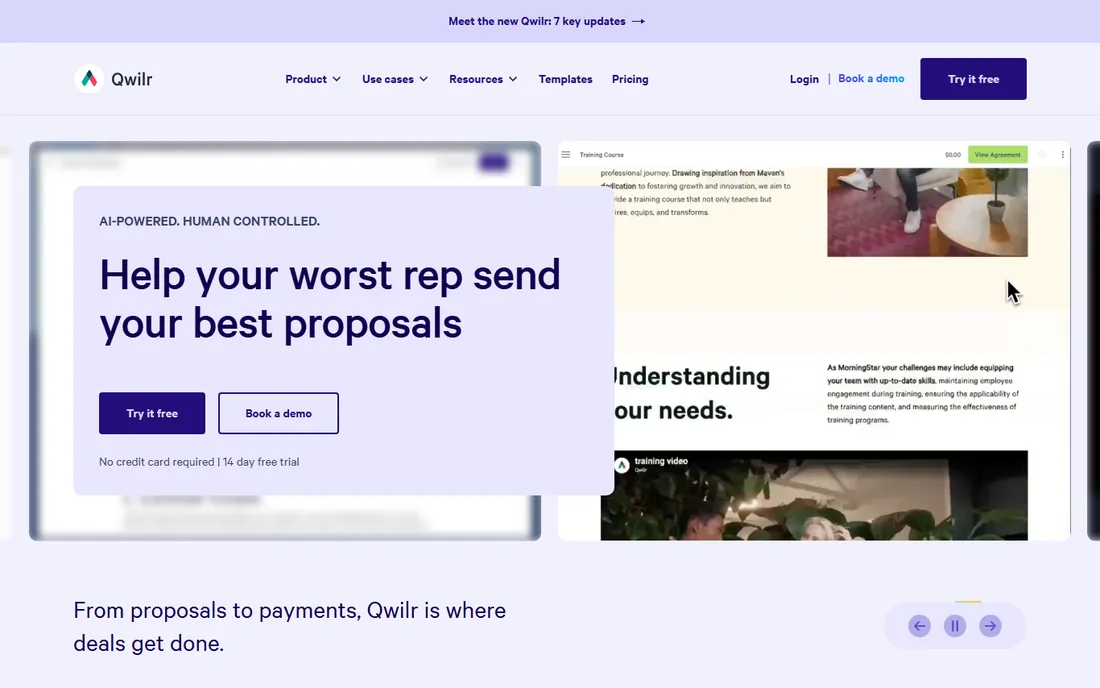
Qwilr is the specialist at the end of the sales content chain: turning collateral into interactive web proposals. Reps build pages from templates with interactive pricing, embedded video and calendars. Buyers open them in a browser, sign, and even pay through QwilrPay powered by Stripe. Block-level analytics show which sections each stakeholder read, which is genuinely useful for enterprise deals with large buying groups.
Pricing is published and straightforward. Starter is $35 per user per month on annual billing ($49 monthly). Growth is $55 with a five-user minimum and Scale is $75 with a ten-user minimum, both annual only. Every signup starts with a 14-day free trial and no credit card. The limitation is scope: Qwilr manages proposals and buyer-facing pages, not your whole content library or rep coaching. Pair it with a repository tool, or use it standalone if proposals are the whole job.
What we like- Web-based interactive proposals with e-sign and payments
- Block-level engagement analytics
- 14-day free trial with no credit card
Watch out for- Proposal-centric, not a full content library
- Growth and Scale plans need annual billing with seat minimums
Where sales content management usually breaks down
The technology is rarely the problem. Content management fails in three familiar ways, and the fix is organizational before it is technical.
First, nobody owns the library. Marketing uploads, nobody archives, and reps stop trusting search results because half the content is outdated. The tools with verification workflows (Guru) or automated quality checks (Enablix) help, but someone still has to own the calendar of reviews.
Second, content never reaches the moment of use. A perfect battlecard in a portal nobody opens is the same as no battlecard. This is why in-flow tools like Spekit win on adoption, and why every vendor now pushes CRM and Slack integrations. During evaluation, ask for a live demo inside your actual CRM, not a slide.
Third, nobody measures what works. If you cannot see which assets get used and which influence deals, you cannot improve the library. Prioritize tools with content engagement analytics (Paperflite, Seismic, Showpad, Qwilr) and plan a quarterly review of the numbers. A library that shrinks as bad content gets cut is a healthy one.
How to choose without overbuying
Start from team size and the real workflow, not the feature matrix. Under 30 reps, you probably need a content hub with analytics and a proposal tool, which Paperflite plus Qwilr covers at published prices. Between 30 and 200 reps, add coaching or in-flow delivery: Allego, Mindtickle or Spekit depending on whether your gap is skill or access. Above that, or in regulated industries, the enterprise suites (Seismic, Showpad, Mediafly) earn their keep through governance, permissions and services.
On pricing, treat "See website" as a signal. It usually means annual contracts and five-figure minimums. Ask every vendor the same questions: per-seat or flat fee, what counts as a user, overage charges, contract length and exit terms, data export format, and what happens to your content if you leave. Get the answers in writing before the pilot ends, because that is when your negotiating power is highest.
How we chose
We started from vendor pricing pages, product documentation and feature lists, then checked how each product is actually used through public reviews on G2 and Capterra and discussions on Reddit. We favored tools with a clear sales content management use case: organizing, delivering and measuring the content reps use to sell. We weighted fit for small and mid-size US businesses, which is why vendors with published pricing sit next to the enterprise suites. Two mergers shaped the list: Seismic completed its merger with Highspot in August 2026 and operates as Seismic, and Showpad combined with Bigtincan in late 2025 under the Showpad name, so each appears once. We did not test the products hands-on.
Frequently asked questions
What is sales content management software?
It is software that organizes, distributes and tracks the content sales teams use: pitch decks, case studies, battlecards, one-pagers, videos and proposals. Good tools also show which content gets used and which of it influences deals, so marketing can stop producing assets nobody opens.
How is it different from a CMS or a DAM?
A CMS manages website content and a DAM manages brand assets. Sales content management is built for the selling workflow: CRM integration, rep-facing search, buyer sharing links, engagement analytics and often coaching. The audience is the sales team, not the web team.
What does sales content management software cost?
Qwilr publishes its pricing, starting at $35 per user per month on annual billing. Most other vendors keep pricing behind a sales conversation, and enterprise platforms typically run into five figures per year. Enablix prices on usage with unlimited users instead of per-seat licenses.
Do small teams need a full enablement platform?
Usually not. A team under 30 reps gets most of the value from a content hub with analytics plus a proposal tool. Full platforms make sense when you need governance, multi-team permissions, coaching programs or dedicated services, which is typically a 100-plus rep problem.
What happened to Highspot and Bigtincan?
Both were acquired. Seismic completed its merger with Highspot in August 2026 and the combined company operates as Seismic. Vector Capital combined Bigtincan with Showpad in late 2025 and kept the Showpad brand. That is why this guide lists Seismic and Showpad once each instead of four separate products.
Can these tools replace proposal software?
Some can, partially. Qwilr is proposal software first and content management second. The suite vendors include proposal and document features, but teams that live on proposals often pair a content hub with a dedicated proposal tool for better templates, e-sign and payment collection.
Sources we checked (12)
- https://seismic.com/
- https://showpad.com/
- https://www.allego.com/
- https://www.mindtickle.com/
- https://mediafly.com/
- https://spekit.com/
- https://getguru.com/pricing
- https://paperflite.com/
- https://www.paperflite.com/pricing?product=cleverstory
- https://enablix.com/
- https://qwilr.com/
- https://qwilr.com/pricing/
Is your product missing or out of date?
We review this list regularly. Vendors can request a listing, send updated pricing or ask about featured placement.

Shihab Mia · Founder, Rankite
Shihab has 5+ years in B2B and SaaS SEO. He writes Rankite's software buying guides from pricing pages, documentation and public user reviews. More about Shihab.