How we make this list: we compare pricing pages, product documentation and public user reviews. Ratings come from G2, Capterra or Trustpilot, with the date we checked them.
Key takeaways
- Only three of the nine vendors here publish a full price list: eClinicalWorks ($499 per provider per month for EHR only), Practice Fusion ($199 per provider per month) and CharmHealth ($200 per provider per month, or $0.50 per encounter).
- CharmHealth is the only option with a permanent free plan. It's capped at 50 encounters a month, one provider, five users and 1,000 patient records.
- Practice Fusion bills monthly but requires an annual commitment. The low sticker price still locks you in for 12 months.
- athenahealth, Tebra, DrChrono, NextGen, ModMed and Elation all quote each practice separately. Expect a sales call, and get the contract term, implementation fee and data export terms in writing before you sign.
- Specialty matters more than brand. A dermatology or orthopedic group will often get more from ModMed than from a general-purpose EHR, while primary care clinics have more to choose from.
Quick comparison
| Tool | Best for | Starting price | Free plan |
|---|
 eClinicalWorks | Multi-specialty practices wanting published pricing | $499 per provider/month (EHR only) | No |
 athenahealth (athenaOne) | Practices that want billing and EHR from one vendor | See website | No |
 Practice Fusion | Budget-conscious independent practices | $199 per provider/month (annual commitment) | Free trial (14 days) |
 Tebra | Independent practices up to about 10 providers | See website | No |
 DrChrono | Mobile and iPad-friendly charting | See website | No |
 Elation Health | Primary care and direct primary care | See website | No |
 CharmHealth | Solo and very small practices on a tight budget | $0.50 per encounter ($25 monthly minimum) | Yes |
 NextGen Healthcare | Practices that may grow into an enterprise system | See website | No |
 ModMed | Specialty groups such as dermatology and orthopedics | See website | No |
Is your product missing or out of date?
We review this list regularly. Vendors can request a listing, send updated pricing or ask about featured placement.
The best EMR and EHR medical software
#1eClinicalWorks
Best for: Multi-specialty practices wanting published pricing3.7/5 on
G2 (158 reviews, checked Oct 2026)
Visit eclinicalworks.com
Starting price$499 per provider/month (EHR only)
Free planNo
eClinicalWorks is one of the few large ambulatory EHR vendors that puts real numbers on its pricing page. The EHR-only plan is $499 per provider per month and the EHR with practice management plan is $599. A revenue cycle service costs 2.9% of practice collections. All three tiers are listed with no start-up costs, and the vendor says more than 180,000 physicians use its software.
You get a lot for the price. The EHR plan includes the patient portal, mobile app, e-prescribing with formulary checks, document and referral management, registry reporting, and 24x7 support. Scanning and faxing software, an E&M coder and clinical templates are listed as included at no extra cost.
The catch is in the fine print. Initial training is included only for practices with one to nine providers. Larger groups pay extra implementation fees, and airfare for trainers is billed separately. Patient statements and eClinicalMessenger transactions carry per-use fees, so ask for an estimate based on your monthly volume.
What we like- Prices posted publicly with no start-up costs listed
- 24x7 support, cloud hosting and disaster recovery included
- Optional practice management and outsourced billing tiers
Watch out for- Per-statement and messaging transaction fees on top of the subscription
- Extra implementation fees for practices with more than nine providers
#2athenahealth (athenaOne)
Best for: Practices that want billing and EHR from one vendor3.4/5 on
G2 (114 reviews, checked Oct 2026)
Visit athenahealth.com
Starting priceSee website
Free planNo
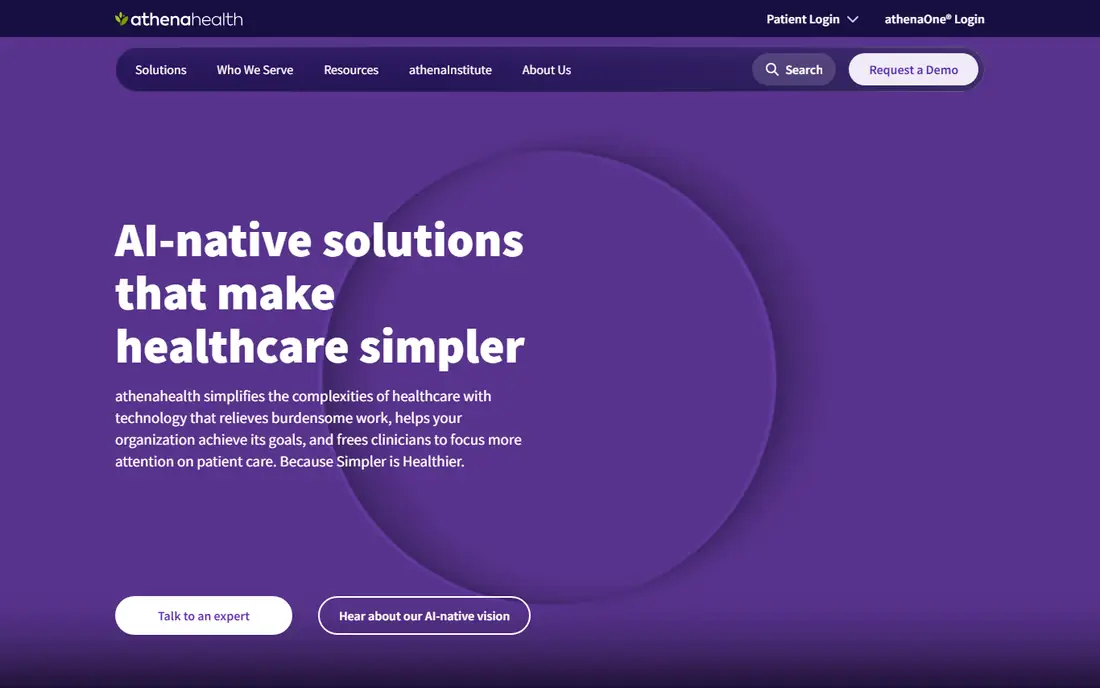
athenaOne suits a practice that wants one company to handle the EHR, scheduling, claims and patient engagement, rather than stitching tools together. Its main appeal is billing. Many practices buy athenahealth as much for claims follow-up and payer rules as for charting.
Pricing is quote-based. Third-party pricing guides report that athenaOne is usually sold as a percentage of monthly collections rather than a flat per-provider fee. That lowers the barrier for a new or small practice, because cost rises and falls with revenue.
The same model can work against you. A busy, well-paid practice can end up paying far more than it would on a flat subscription, and costs are harder to budget. Work out the fee at your current and projected collections before you compare it with a per-provider quote.
What we like- Clinical, practice management and revenue cycle tools in one cloud suite
- Collections-based pricing can tie cost to practice revenue
- Large network for sharing records with other organizations
Watch out for- No public price list
- Percentage-of-collections pricing gets expensive as revenue grows
#3Practice Fusion
Best for: Budget-conscious independent practices3.8/5 on
G2 (62 reviews, checked Oct 2026)
Visit practicefusion.com
Starting price$199 per provider/month (annual commitment)
Free planFree trial (14 days)

Practice Fusion has the most predictable price on this list. It fits a small independent practice that wants a cloud EHR without a large upfront bill. The pricing page lists $199 per provider per month, billed monthly, with a required annual commitment. Taxes are extra.
The licensing works well for small teams. Each provider subscription includes three signing staff licenses and unlimited non-signing staff licenses, so front desk staff and medical assistants don't add per-seat costs. You can also run a two-week trial before committing, which few EHR vendors offer.
Practice Fusion is owned by Veradigm and is mainly an EHR. If you need full billing, you add a billing product or service, which raises the total. Practices that want deep practice management in one system may outgrow it.
What we like- Clear published price
- Includes 3 signing staff licenses and unlimited non-signing staff
- Two-week free trial before you commit
Watch out for- Annual commitment required even though billing is monthly
- Billing services sold separately
#4Tebra
Best for: Independent practices up to about 10 providers4.1/5 on
G2 (263 reviews, checked Oct 2026)
Visit tebra.com
Starting priceSee website
Free planNo
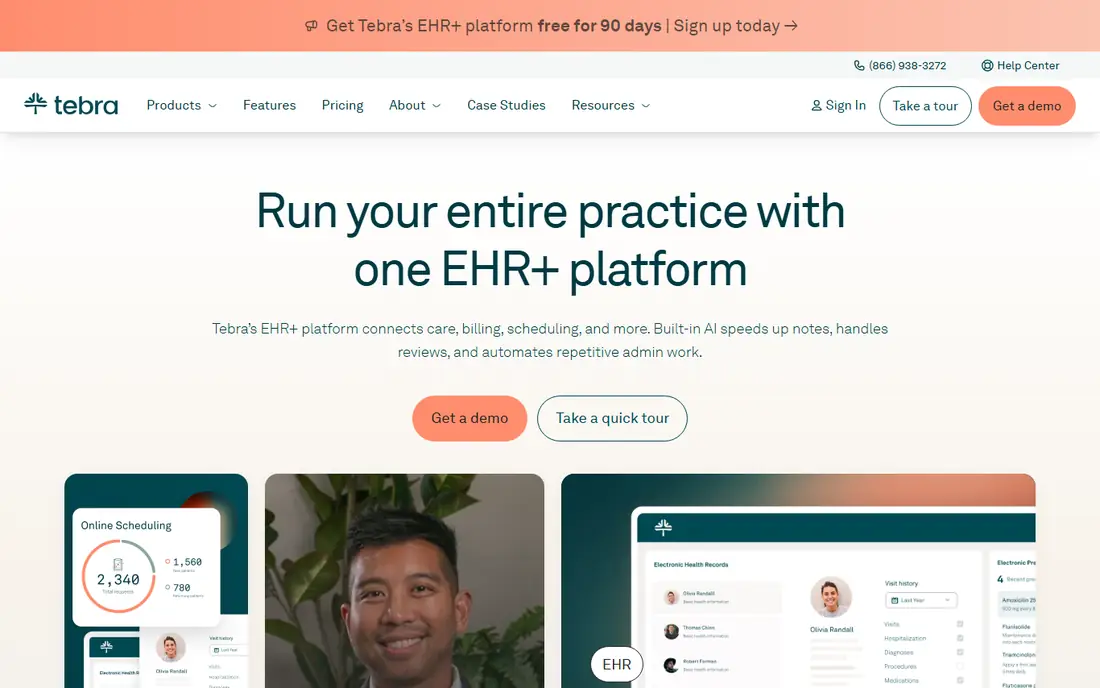
Tebra formed in 2021 when Kareo, a billing and EHR company, merged with PatientPop, a practice marketing company. That history shows in the product. It targets small to medium independent practices, typically up to about 10 providers, that want charting, billing and patient marketing tools in one account.
Payment processing is unusually transparent. Tebra's payment processing policy lists in-person card fees of 2.75% plus $0.30 per transaction, with no annual fee. The software subscription itself is quote-based and depends on which bundle you choose.
Read the pricing policy before signing. It says Tebra may move a customer from a subscription to a per-transaction plan with 30 days' notice if the practice goes over 500 claims per provider per month. Some users also report extra charges for AI note tools and data exports, so get those terms in writing.
What we like- EHR, billing and patient marketing tools from one vendor
- Built for private practices rather than health systems
- Integrated payment processing with published card rates
Watch out for- Quote-based pricing with add-on fees
- Pricing policy allows a switch to transactional pricing at high claim volumes
#5DrChrono
Best for: Mobile and iPad-friendly charting3.4/5 on
G2 (43 reviews, checked Oct 2026)
Visit drchrono.com
Starting priceSee website
Free planNo
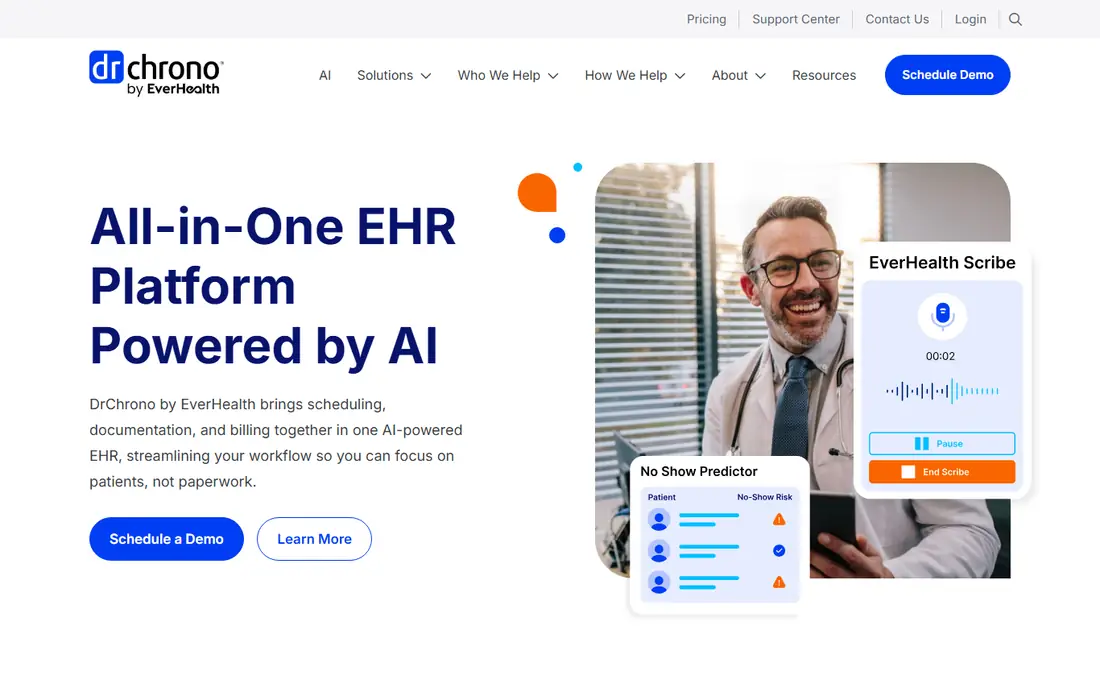
DrChrono, now part of EverHealth, has long appealed to clinicians who chart on an iPad or phone between rooms. It works well for small practices that want a modern interface and an all-in-one system without a hospital-style implementation.
Plans come in three tiers: Foundation, Growth and Premium. Foundation already bundles the EHR, patient engagement, practice management and billing tools. Premium adds advanced AI features and premium add-ons. DrChrono's support site lists its EverHealth Scribe add-on at $99 per provider per month.
The weakness is that you can't see prices up front. None of the tiers have a public price, and third-party reviewers mention usage overages such as per-text messaging fees. Ask for a full fee schedule, including overages, before you compare it with flat-priced options.
What we like- EHR, practice management and billing in every plan tier
- Strong mobile charting heritage
- Optional AI scribe priced at $99 per provider per month
Watch out for- No published base price
- Advanced AI and add-ons reserved for the top tier
#6Elation Health
Best for: Primary care and direct primary care4.4/5 on
G2 (16 reviews, checked Oct 2026)
Visit elationhealth.com
Starting priceSee website
Free planNo
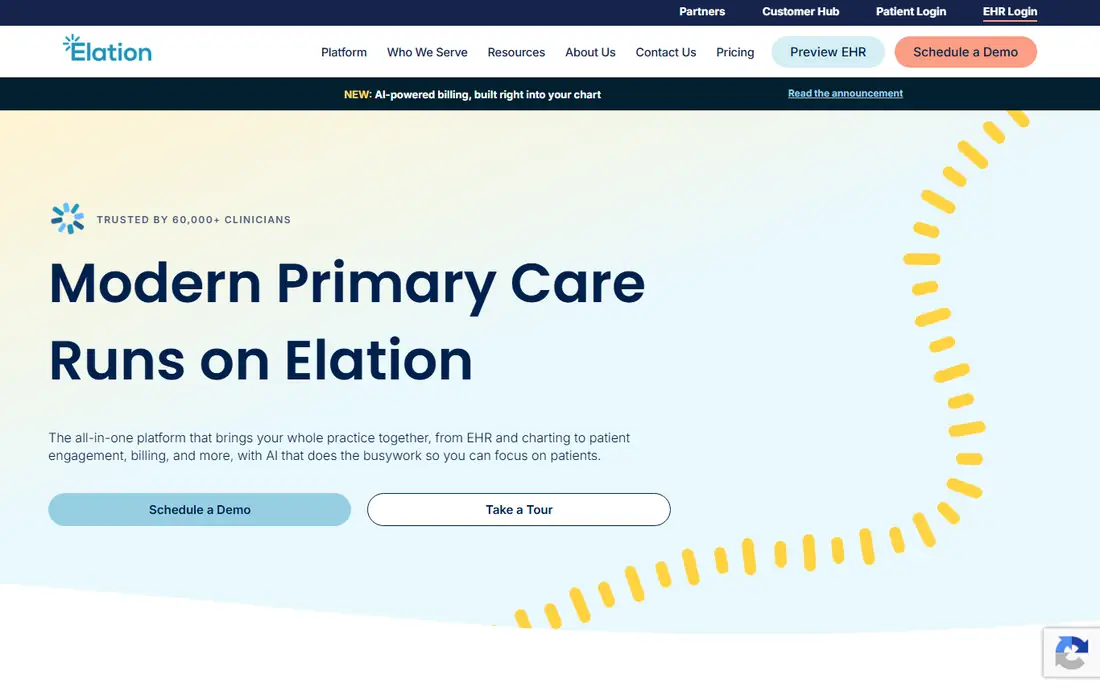
Elation is a focused choice. It's built for primary care physicians, including direct primary care practices that run on memberships instead of insurance billing. The clinical chart is the center of the product, and reviewers often praise how quickly physicians can read a patient's history.
The company offers separate plans for direct care and insurance-based practices, plus optional billing. Its patient payments product charges a flat 3.25% fee, which Elation presents as cheaper than typical processors. Third-party sites quote a wide range of subscription prices, so treat any number you see online as a starting point for a quote.
The limit is scope. Specialists, therapists and multi-specialty groups will find fewer templates and workflows built for them. Reviewers also say Elation moved to annual contracts, so you can't pay month to month.
What we like- Charting designed around primary care workflows
- Separate plans for direct care and insurance-based practices
- Flat 3.25% patient payment processing fee
Watch out for- Not built for behavioral health or surgical specialties
- Annual contracts reported by reviewers
Starting price$0.50 per encounter ($25 monthly minimum)
Free planYes

CharmHealth is the cheapest way into a certified EHR for a new or part-time practice. The free plan allows one provider, five users, up to 50 encounters a month and up to 1,000 patient records. Once you outgrow it, the encounter plan costs $0.50 per encounter with a $25 monthly minimum.
Busier practices can move to the provider plan at $200 per provider per month, with unlimited encounters and users. CharmHealth sells practice management and medical billing as part of the same platform, and its pricing page says there are no hidden costs.
The trade-off is size and support. CharmHealth is a smaller vendor than athenahealth or eClinicalWorks, so there are fewer third-party integrations and fewer consultants who know the system. For a solo integrative, functional medicine or cash-pay clinic, that's often an acceptable trade.
What we like- Free plan with no ads for low-volume practices
- Pay-per-encounter option for part-time clinicians
- Meaningful Use certified (2015 edition) and MIPS ready
Watch out for- Free plan caps at 50 encounters, 1 provider and 1,000 patients
- Smaller ecosystem than the market leaders
#8NextGen Healthcare
Best for: Practices that may grow into an enterprise system3.7/5 on
G2 (175 reviews, checked Oct 2026)
Visit nextgen.com
Starting priceSee website
Free planNo

NextGen sells two different products. NextGen Office is a cloud EHR and practice management system for smaller practices. NextGen Enterprise serves larger outpatient groups that need heavy customization. That split makes NextGen a reasonable pick for a group that expects to add providers and locations.
NextGen doesn't publish pricing. Third-party estimates for NextGen Office fall in the low hundreds of dollars per provider per month, and Enterprise is fully custom. Ask which product you're being quoted, because setup time and cost differ a lot between the two.
Reviews of NextGen Office mention a steeper learning curve for complex features and mixed support experiences. In the demo, use your own common visit types rather than the vendor's script, and see how many clicks a typical note takes.
What we like- NextGen Office for small practices and Enterprise for large groups
- Broad specialty content
- One vendor path from small clinic to large group
Watch out for- No public rate card
- Enterprise implementations are long and costly
#9ModMed
Best for: Specialty groups such as dermatology and orthopedics4.5/5 on
G2 (362 reviews, checked Oct 2026)
Visit modmed.com
Starting priceSee website
Free planNo
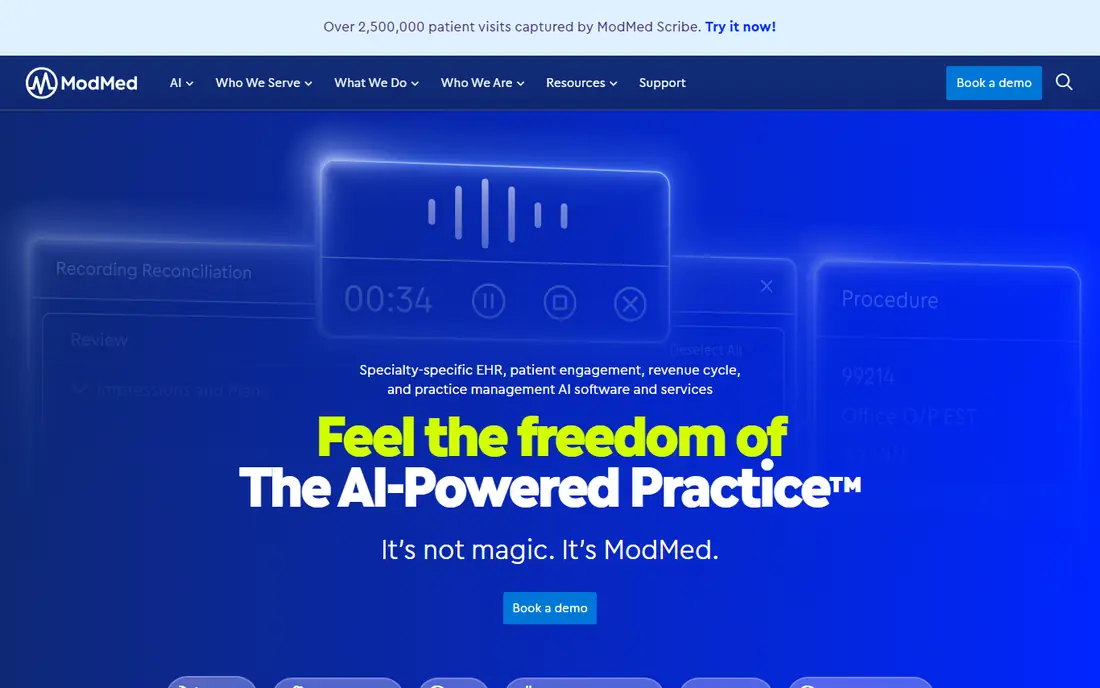
ModMed is built for specialists. Its EMA EHR comes with workflows for dermatology, orthopedics, ophthalmology, gastroenterology and other specialties, so a specialist practice spends less time building templates from scratch. For a busy dermatology group, that can mean faster notes from day one.
Pricing is quote-based. Third-party estimates put it at roughly $500 per provider per month or more, near the top of this list. You're paying for specialty content that general EHRs don't have.
The honest catch is cost and rigidity. Several Capterra reviewers describe high fees and less flexibility than they expected, especially after signing. If you run a primary care or behavioral health practice, a general-purpose EHR will likely serve you better for less.
What we like- Specialty-specific EHR (EMA) with prebuilt templates
- Adapts documentation to the provider's specialty
- Integrated practice management and billing options
Watch out for- Among the more expensive options
- Users report limited flexibility and admin overhead
How we chose
We started with the EHR systems that independent and mid-size US practices most often shortlist. Then we checked each vendor's own website for current plans, prices, contract terms and included features. Where a vendor publishes pricing (eClinicalWorks, Practice Fusion and CharmHealth), we used those figures. Where it doesn't, we marked the price "See website" rather than presenting third-party estimates as fact.
We also compared documentation and policy pages, public reviews on G2, Capterra and Reddit, specialty coverage, billing and practice management depth, and fit for practices with roughly 1 to 50 providers. We left out hospital-only systems because they aren't a realistic purchase for most readers.
What to check before you sign an EHR contract
Match the system to your specialty first
A family medicine practice, a dermatology group and a therapy practice need very different templates, order sets and billing codes. First, narrow your list to vendors that already serve your specialty, then compare prices. Adapting a general EHR for a niche specialty takes months of template work.
Compare total cost, not the headline rate
The per-provider price is only part of the bill. Add implementation and training fees, e-prescribing of controlled substances, patient statement and texting fees, lab and imaging connections, payment processing rates, and any AI scribe add-ons. If a vendor charges a percentage of collections, work out that fee at your current revenue and at your expected revenue in two years.
Read the contract term and exit clause
Many EHRs require an annual commitment, and some require multi-year terms. Ask what happens to your data when you leave: what format the export comes in, whether it includes full clinical notes and attachments, how long it takes, and whether there's a fee. A cheap system with an expensive exit isn't cheap.
Plan for setup time
A solo practice on a cloud EHR can often go live in a few weeks. A multi-location group switching from another system should plan for several months to cover data migration, lab and other connections, and staff training. Schedule go-live away from your busiest season, and see fewer patients for the first week or two.
Test with real workflows
In demos, ask the vendor to document your three most common visit types, send a prescription, order a lab and submit a claim. Count the clicks. Bring a front desk staff member, because scheduling and check-in are where staff frustration shows up first.
Frequently asked questions
What is the difference between an EMR and an EHR?
An EMR (electronic medical record) is a digital version of the chart inside one practice. An EHR (electronic health record) is designed to share records with other providers, labs, pharmacies and patients. Nearly every modern product, including all nine here, is sold as an EHR, and people use the terms interchangeably.
How much does EHR software cost for a small practice?
Published prices on this list range from free (CharmHealth's capped plan) to $599 per provider per month (eClinicalWorks with practice management). Most vendors quote privately, and the final bill depends on provider count, billing needs and add-ons. Budget for setup, lab and other connections, and transaction fees on top of the subscription.
Is there a good free EHR?
CharmHealth offers a free plan for one provider with up to 50 encounters a month and 1,000 patient records. That works for a new or part-time practice. Most full-time practices will outgrow it within months and move to a paid plan.
Should I buy an EHR with built-in billing?
If you bill insurance and don't already use a billing service, an EHR with built-in practice management and claims tools usually saves time and avoids entering data twice. Cash-pay and direct primary care practices need far less billing functionality. Outsourced billing is another option, often priced as a percentage of collections.
Can I move my patient data if I switch EHRs later?
Usually yes, but terms vary. Ask each vendor in writing how exports work, what data is included, how long it takes and what it costs. Some vendors charge for full database exports, and that fee belongs in your cost comparison.
Do I need a certified EHR?
If you take part in Medicare quality programs such as MIPS, you need certified EHR technology to report on Promoting Interoperability measures. Most mainstream vendors, including those listed here, sell certified products. Confirm current certification status with the vendor before signing.
Sources we checked (22)
- https://www.eclinicalworks.com/products-services/pricing/
- https://www.eclinicalworks.com/
- https://www.practicefusion.com/pricing/
- https://www.practicefusion.com/
- https://www.charmhealth.com/ehr/ehr-pricing-us.html
- https://www.elationhealth.com/
- https://www.elationhealth.com/payment-policy/
- https://www.elationhealth.com/practice-success/billing/patient-payments/
- https://www.drchrono.com/pricing/
- https://www.drchrono.com/small-practice/
- https://support.drchrono.com/home/may-2026
- https://www.tebra.com/pricing/overview
- https://www.tebra.com/tebra-pricing-policy
- https://www.tebra.com/tebra-payment-processing-pricing-policy
- https://en.wikipedia.org/wiki/Tebra
- https://softwarefinder.com/emr-software/athenahealth/pricing
- https://pabau.com/blog/nextgen-healthcare-pricing/
- https://www.selecthub.com/p/ehr-software/nextgen-office/
- https://www.selecthub.com/p/ehr-software/modmed/
- https://www.capterra.com/p/124590/EMA/
- https://ranksvs.com/review/elation-health/
- https://pabau.com/blog/drchrono-pricing/
Is your product missing or out of date?
We review this list regularly. Vendors can request a listing, send updated pricing or ask about featured placement.

Shihab Mia · Founder, Rankite
Shihab has 5+ years in B2B and SaaS SEO. He writes Rankite's software buying guides from pricing pages, documentation and public user reviews. More about Shihab.