How we make this list: we compare pricing pages, product documentation and public user reviews. Ratings come from G2, Capterra or Trustpilot, with the date we checked them.
Key takeaways
- This category splits sharply: enterprise platforms (o9, Blue Yonder, RELEX, ToolsGroup) are quote-only and implementation-heavy, while SMB tools like Netstock (from $900/month) and Prediko (from $49/month) publish entry prices.
- For Shopify and D2C brands, Prediko and GMDH Streamline deliver AI forecasting at a fraction of enterprise cost.
- Probabilistic forecasting (ToolsGroup, Lokad) beats point forecasts for intermittent, lumpy, or long-tail demand.
- Match the tool to your stack: retail/grocery favors RELEX, aftermarket and spare parts favor ToolsGroup, and Netstock works best on top of an existing ERP.
Quick comparison
| Tool | Best for | Starting price | Free plan |
|---|
 o9 Solutions o9 Solutions | Large global enterprises replacing fragmented planning systems with one AI-powered platform | See website (quote-based enterprise licensing) | No |
 Blue Yonder Blue Yonder | Retailers, FMCG and manufacturers that need forecasting tied into replenishment, fulfillment and returns | See website (quote-based enterprise platform licensing) | No |
 RELEX Solutions RELEX Solutions | Retailers, grocers, wholesalers and consumer-goods manufacturers planning from production to shelf | See website (quote-based SaaS licensing) | No |
 ToolsGroup ToolsGroup | Manufacturers, aftermarket/service-parts businesses and distributors with volatile or intermittent demand | See website (quote-based) | No |
 Netstock Netstock | SMBs and mid-market distributors/manufacturers already running an ERP | From $900/month (annual subscription) | No |
 Forecast Pro Forecast Pro | Individual forecasters and small planning teams that need a serious forecasting toolkit without enterprise software overhead | See website (vendor's 2021 order form listed $1,495-$9,995 licenses; confirm current prices) | Trial available |
 Lokad Lokad | Mid-market retailers, manufacturers and distributors with complex or lumpy demand that standard forecasting cannot handle | See website (monthly subscription aligned to network size, no per-user fees; no exact figures published) | No |
 GMDH Streamline GMDH Streamline | SMB distributors, wholesalers and ecommerce sellers that want real AI forecasting at a small-business price point | See website (paid plans quote-based; free version downloadable) | Yes (free version for macOS and Windows) |
 Prediko Prediko | D2C and Shopify brands that need AI demand forecasting tied to replenishment and purchase orders | From $49/month (per the Shopify app listing on the vendor's own homepage) | 14-day free trial |
Is your product missing or out of date?
We review this list regularly. Vendors can request a listing, send updated pricing or ask about featured placement.
How we chose
We started with the categories buyers search: AI demand forecasting software, demand forecasting tools and supply chain planning software. For each candidate we opened the vendor's official pages, checked analyst coverage (Gartner, Nucleus) and practitioner reviews on G2 and Capterra, and compared forecast approach, industry fit, implementation reality and pricing transparency. Prices come only from vendor-published pages; where the vendor publishes nothing, we say so instead of guessing.
The top AI demand forecasting software
The cost of a bad forecast shows up twice: stockouts lose sales, overstock ties up cash. Every tool below uses AI or machine learning for demand forecasting, but they serve very different businesses. Pick by company size, industry and existing tech stack.
#1
o9 Solutions
Best for: Large global enterprises replacing fragmented planning systems with one AI-powered platform
Visit o9solutions.com
Starting priceSee website (quote-based enterprise licensing)
Free planNo
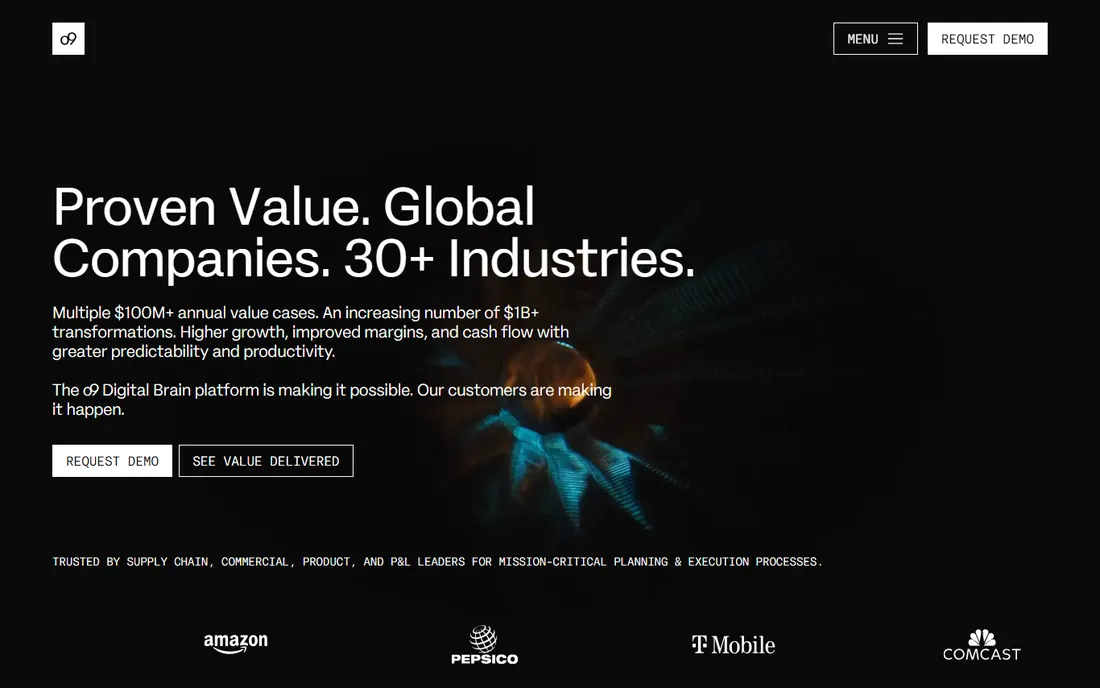
o9 is the heavyweight transformation play. Its knowledge-graph model lets demand, supply and finance plans react to the same signals in near real time, and the vendor was named a Leader in 2026 Gartner Magic Quadrant reports. Multiple $100M+ annual value cases back the pitch.
The honest catch is scale of commitment: this is a transformation program, not a software purchase, and pricing reflects that. Setup is a managed, consultant-supported implementation over several months on multi-year enterprise agreements. For global enterprises, it is the category leader; for everyone else, it is out of reach.
What we like- Digital Brain platform with Enterprise Knowledge Graph connects demand, supply, finance and commercial planning in one model
- Fast scenario planning and what-if analysis with generative/agentic AI
- Proven at very large scale across 30+ industries
Watch out for- Enterprise-only pricing and engagement, not viable for SMBs
- Implementations are multi-month, services-heavy programs requiring real change management
#2
Blue Yonder
Best for: Retailers, FMCG and manufacturers that need forecasting tied into replenishment, fulfillment and returns
Visit blueyonder.com
Starting priceSee website (quote-based enterprise platform licensing)
Free planNo
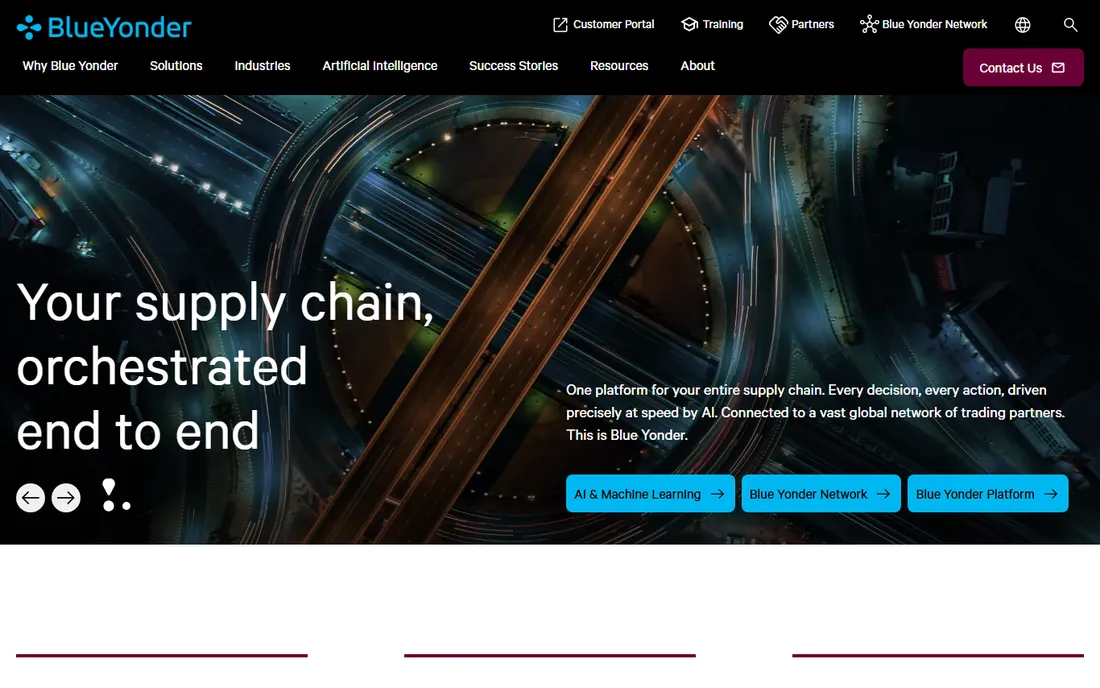
Blue Yonder is the retail-scale forecaster. Cognitive demand planning trained on retail-grade data delivers genuine short-term demand sensing, and the platform connects planning to execution on a multi-tier trading partner network. Analyst recognition spans Gartner and Nucleus.
The honest catch is that it is a platform sale: expect modules, services and a multi-year commitment. Setup is a managed implementation, typically months. For retailers and manufacturers with complex fulfillment, the end-to-end scope is the point; for pure forecasting needs, it is more than necessary.
What we like- End-to-end platform (plan through fulfillment, delivery, returns) on one data cloud
- AI/ML models produce over 20 billion predictions daily per the vendor
- Deep industry coverage: retail, grocery, consumer goods, manufacturing, logistics
Watch out for- Broad platform scope means buying complexity and long sales cycles
- Quote-only pricing with enterprise minimums, overkill below mid-market scale
#3
RELEX Solutions
Best for: Retailers, grocers, wholesalers and consumer-goods manufacturers planning from production to shelf
Visit relexsolutions.com
Starting priceSee website (quote-based SaaS licensing)
Free planNo
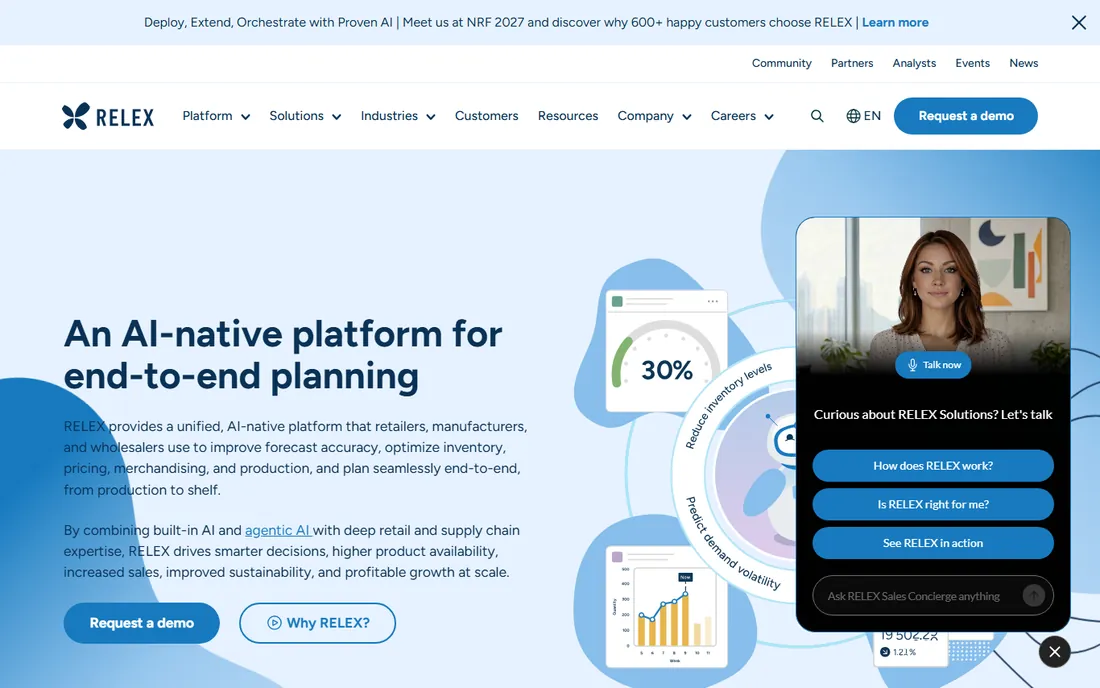
RELEX is the retail specialist. Granular AI forecasting feeds automated replenishment directly, so forecast accuracy converts into on-shelf availability and less waste. Every signal feeds a single model, which is why grocers with perishables favor it.
The honest catch is industry fit: it is built for retail-shaped problems, not general manufacturing. Setup is a vendor-supported implementation, usually months given store-network complexity. For retail and consumer goods, it is arguably the best-shaped tool here.
What we like- AI-native unified platform: forecasting, replenishment, pricing, promotions, space and supply chain on one model
- Especially strong in grocery/fresh with spoilage prediction and batch-level perishability handling
- Leader in the 2026 Nucleus Research Enterprise Supply Chain Planning Value Matrix, two years running
Watch out for- Retail/consumer-goods focused, weaker fit for discrete manufacturing or B2B distribution
- Quote-only pricing with no self-serve tiers
#4
ToolsGroup
Best for: Manufacturers, aftermarket/service-parts businesses and distributors with volatile or intermittent demand
Visit toolsgroup.com
Starting priceSee website (quote-based)
Free planNo
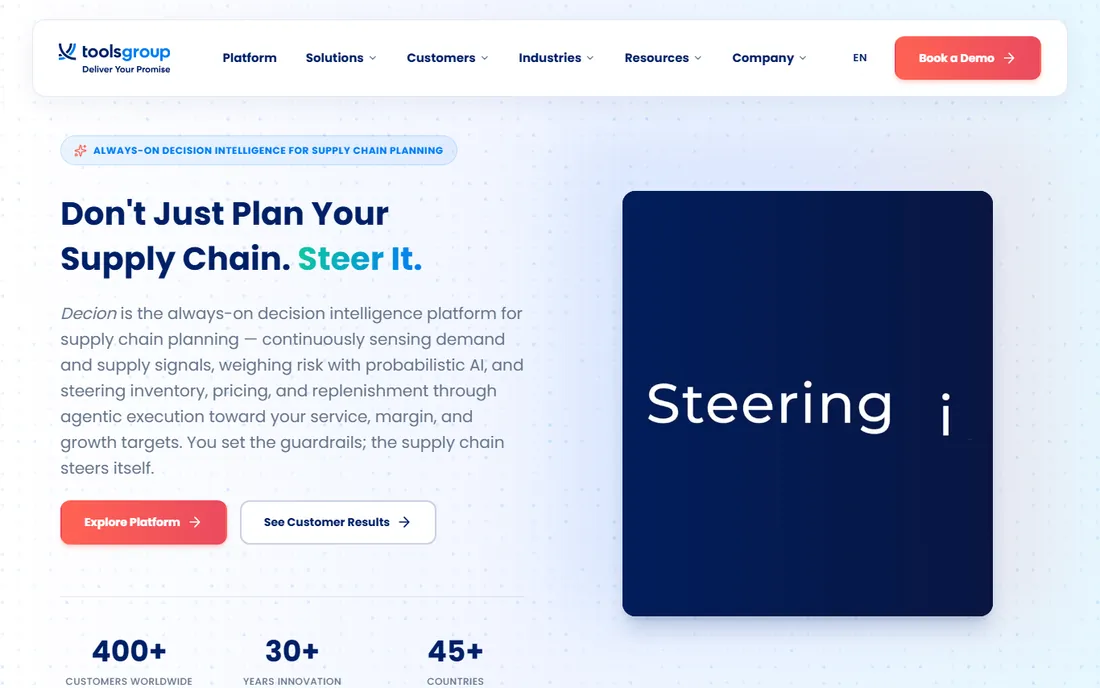
ToolsGroup is the long-tail expert. Where classic forecasting fails on slow movers and erratic demand, its probabilistic models output full distributions so planners can balance service against stock cost. The vendor's Decion platform now frames this as always-on decision intelligence.
The honest catch is conceptual: the team must adopt distribution-based thinking, and evaluation requires a sales process with no trial. Setup is a managed implementation with vendor support. For aftermarket and spare parts, nothing here beats it.
What we like- Probabilistic AI forecasting models full demand distributions, not single-point estimates, for better risk-adjusted inventory decisions
- Strong in intermittent and long-tail demand (spare parts, MRO, aftermarket)
- Multi-echelon inventory optimization built on the probabilistic forecasts
Watch out for- Quote-only pricing with no trial
- Probabilistic approach has a learning curve for planners used to point forecasts and safety stocks
#5
Netstock
Best for: SMBs and mid-market distributors/manufacturers already running an ERP
Visit netstock.com
Starting priceFrom $900/month (annual subscription)
Free planNo
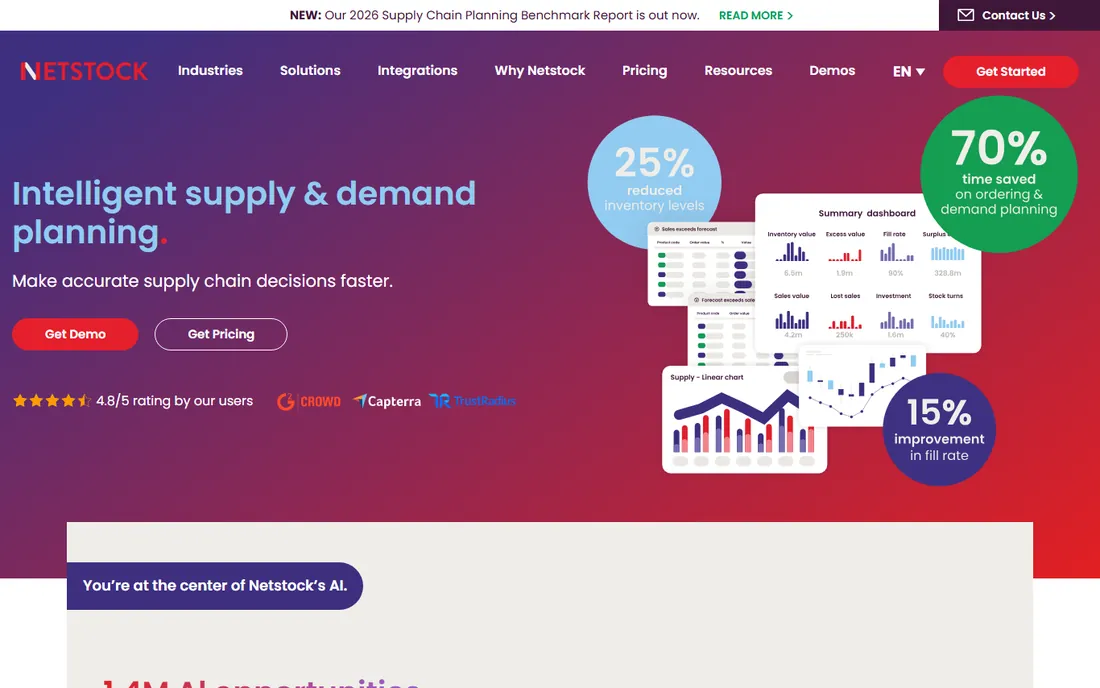
Netstock is the SMB-friendly forecasting layer. It pulls sales and stock data automatically from your ERP and turns it into forecasts and reorder recommendations, with the vendor's AI surfacing the critical issues most teams miss. Bundles run Essentials, Advanced and Commercial plus a Demand Planning add-on.
The honest catch is the ERP dependency and the inventory-value pricing model: get the quote tied to your actual inventory profile. For mid-market companies on SAP, Oracle or Microsoft Dynamics that want AI forecasting without an enterprise program, it is the most accessible option here.
What we like- Published starting price and clear bundle structure, rare transparency in this category
- Widest ERP integration range in its segment (60+ leading global ERPs)
- Fully operational in 90 days or less, with 6-10 week typical implementation
Watch out for- Requires an ERP to function
- It is a layer on top of ERP data, not a standalone planner
- Pricing scales by inventory value, so fast-growing businesses can see meaningful price steps
#6
Forecast Pro
Best for: Individual forecasters and small planning teams that need a serious forecasting toolkit without enterprise software overhead
Visit forecastpro.com
Starting priceSee website (vendor's 2021 order form listed $1,495-$9,995 licenses; confirm current prices)
Free planTrial available
Forecast Pro is the forecaster's workbench. The software picks the best statistical or ML method per item automatically, so a small team gets credible forecasts fast. Now at version 14 (Forecast Pro Extended), it remains the classic standalone forecasting package.
The honest catch is the delivery model: it is a forecasting workbench, not a collaborative planning suite, so enterprises will outgrow it. Setup is days to hours with a free trial offered. For a single forecaster who needs statistical rigor without a platform rollout, it delivers.
What we like- Off-the-shelf forecasting package that forecasters can run in days or hours, no IT project
- "best pick" algorithm combines AI, machine learning and statistical methods automatically
- Perpetual licenses with 12 months of maintenance included per the vendor's order form
Watch out for- Desktop-package model, not a modern multi-user SaaS planning platform
- Published price list is dated (2021 order form), so current pricing needs confirmation
#7
Lokad
Best for: Mid-market retailers, manufacturers and distributors with complex or lumpy demand that standard forecasting cannot handle
Visit lokad.com
Starting priceSee website (monthly subscription aligned to network size, no per-user fees; no exact figures published)
Free planNo
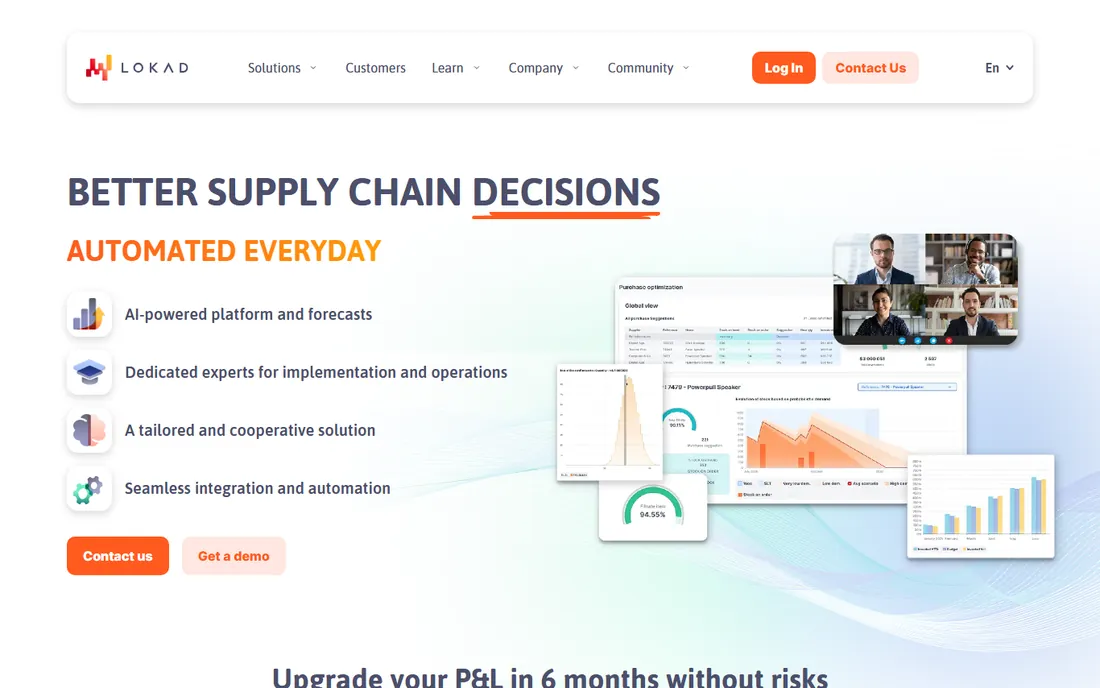
Lokad is the decision-first forecaster. It outputs concrete orders, allocations and pricing actions from full probability distributions, with recommendations tied explicitly to bottom-line financial impact. A dedicated Supply Chain Scientist supports each engagement.
The honest catch is the engagement model: expect to work closely with their team on data and modeling, which is a feature for some and a burden for others. Go-live is typically under 6 months. For mid-market companies with hard forecasting problems, it punches above its size.
What we like- Genuinely probabilistic forecasting with stochastic optimization for purchasing, allocation and pricing decisions
- Differentiable programming approach tunes forecasts to the business's actual economics
- Layers on top of existing ERP/WMS via flat files, APIs or EDI with no rip-and-replace
Watch out for- No published prices
- Subscription scoped to network size via a sales conversation
- Analytical depth demands engaged data and planning teams, not a hands-off tool
#8
GMDH Streamline
Best for: SMB distributors, wholesalers and ecommerce sellers that want real AI forecasting at a small-business price point
Visit gmdhsoftware.com
Starting priceSee website (paid plans quote-based; free version downloadable)
Free planYes (free version for macOS and Windows)
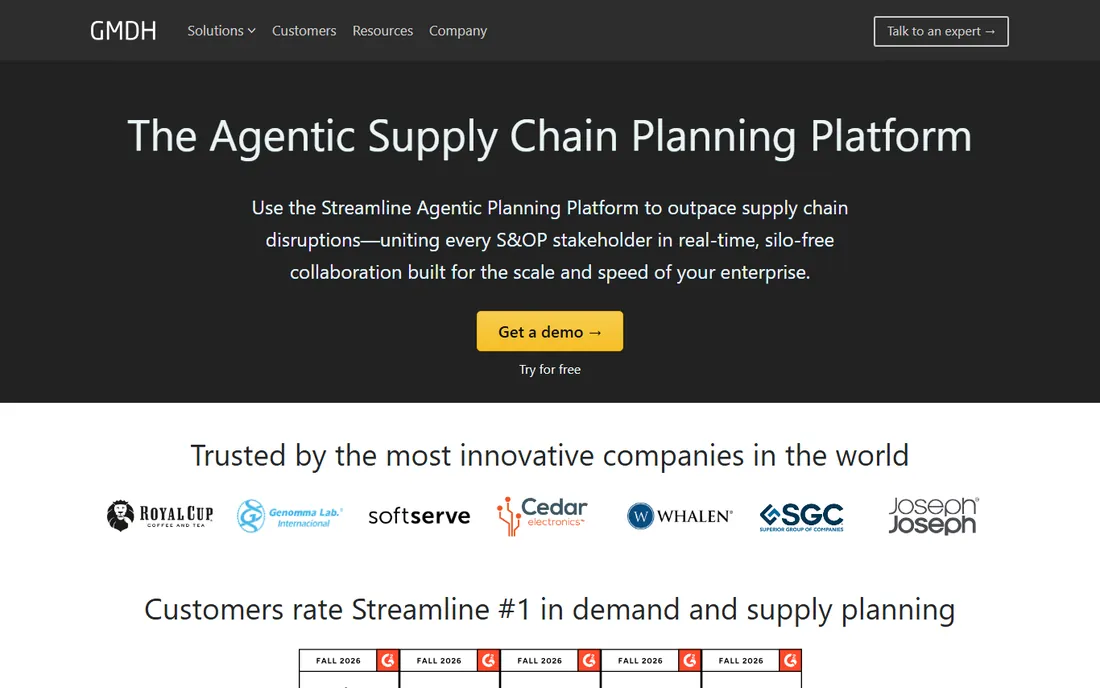
GMDH Streamline is the value play. Genuine statistical and AI forecasting with ERP integration where competitors charge enterprise rates, covering demand planning, inventory planning, replenishment and purchase orders in one tool. The free download for Windows and Mac lowers the evaluation barrier.
The honest catch is the desktop legacy and thinner collaboration story compared to cloud-native platforms. Setup is self-service with training docs and webinars. For SMB distributors and ecommerce sellers, the value equation is the strongest here.
What we like- Affordable entry point with a free version and trial, unusual in AI forecasting
- Bi-directional integrations with a long list of ERPs and data sources (SAP, NetSuite, Dynamics, QuickBooks, Shopify, ODBC, Excel)
- Covers demand planning plus inventory planning, replenishment and purchase orders in one tool
Watch out for- No published paid pricing, quotes via sales
- Desktop-oriented heritage (Windows/Mac downloads) versus pure cloud SaaS, less suited to very large multi-user teams
#9
Prediko
Best for: D2C and Shopify brands that need AI demand forecasting tied to replenishment and purchase orders
Visit prediko.io
Starting priceFrom $49/month (per the Shopify app listing on the vendor's own homepage)
Free plan14-day free trial
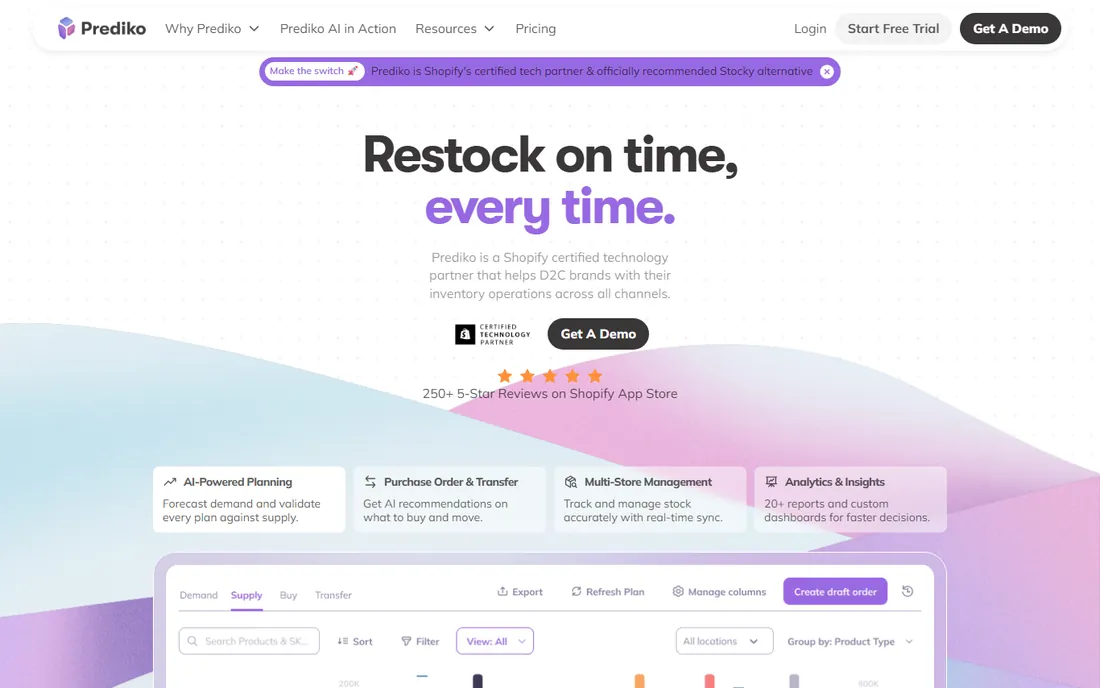
Prediko is the Shopify specialist. A Shopify-certified technology partner, it connects to the store, pulls sales history and generates AI forecasts that convert directly into buying plans and purchase orders. The vendor reports 2,500+ Shopify merchants using it.
The honest catch is the narrow market: outside Shopify, look elsewhere. Setup is connecting the store, essentially self-service. For D2C brands fighting stockouts and overstock on Shopify, it is the most tailored option in this list.
What we like- Shopify-native: pulls 12 months of sales data and generates AI forecasts without manual setup
- Unified forecasting plus purchase-order management with 1-click POs
- Unlimited users per account per the vendor's own FAQ
Watch out for- Built for Shopify/D2C brands, not a fit outside ecommerce inventory planning
- Full plan structure beyond the app listing is quote-based
Probabilistic vs. point forecasting: which do you need?
Two tools here (ToolsGroup, Lokad) sell probabilistic forecasting, and the distinction matters. A point forecast says "we expect 100 units." A probabilistic forecast says "there is a 90% chance demand falls between 70 and 140 units." For smooth, predictable demand, point forecasts work fine and every tool here delivers them. For intermittent, seasonal, or long-tail demand, the distribution is the valuable part: it tells you how much safety stock each decision actually needs.
The trade-off is organizational. Probabilistic forecasting asks planners to think in distributions and service levels instead of single numbers, and that takes training. ToolsGroup and Lokad build multi-echelon optimization on top of those distributions; if your team is not ready for the mindset shift, a simpler tool with good point forecasts (Netstock, Prediko, Forecast Pro) will serve you better.
This category has the sharpest price cliff of any in this series. The enterprise four (o9, Blue Yonder, RELEX, ToolsGroup) do not publish pricing, sell through sales teams, and implement over months with consultants. Annual contracts at that tier run into seven figures for large deployments. The SMB tools (Netstock from $900/month, Prediko from $49/month, GMDH Streamline's free version) are buyable this quarter with self-service or short implementations.
There is no wrong tier, only a wrong fit. A mid-market distributor buying o9 gets a transformation program it cannot staff; a retailer buying Prediko gets a tool that cannot handle its store network. The honest question is your demand complexity and your change appetite: complex networks with volatile demand justify the enterprise tier, while straightforward reorder logic does not.
Frequently asked questions
What is AI demand forecasting software?
AI demand forecasting software uses machine learning models, often combined with statistical methods, to predict future product demand from sales history, seasonality, promotions, market signals and external factors. Modern tools generate forecasts automatically per SKU or store and feed them into replenishment, pricing and inventory decisions.
How much does AI demand forecasting software cost?
Enterprise platforms (o9, Blue Yonder, RELEX, ToolsGroup) are quote-only and typically run into six or seven figures annually. Mid-market options publish entry prices: Netstock from $900/month and Prediko from $49/month. Forecast Pro historically sold perpetual licenses ($1,495-$9,995 per its 2021 order form); confirm current prices with the vendor.
What is the difference between probabilistic and traditional forecasting?
Traditional forecasting outputs a single number per item (a point forecast). Probabilistic forecasting outputs a full demand distribution, showing the probability of each outcome, which feeds risk-adjusted inventory decisions. ToolsGroup and Lokad lead here; it is most valuable for intermittent, lumpy or long-tail demand where point forecasts mislead.
Which demand forecasting software is best for small business?
Netstock (from $900/month, ERP-native) and GMDH Streamline (free version, broad ERP connectors) suit SMB distributors. Shopify brands should look at Prediko (from $49/month). Individual forecasters can use Forecast Pro's workbench approach without a platform purchase.
Which demand forecasting software is best for retail and grocery?
RELEX Solutions is built for retail-shaped problems, with grocery-specific strengths like spoilage prediction and batch-level perishability. Blue Yonder covers retail at larger scale with end-to-end planning. Both are quote-only enterprise platforms.
How long does implementation take?
SMB tools: hours to weeks (Prediko connects to Shopify in a session; Netstock quotes 6-10 weeks). Mid-market specialists: Lokad typically goes live under 6 months. Enterprise platforms: months of managed, consultant-supported implementation. The longer timelines buy deeper integration, not just software installation.
Sources we checked (11)
- https://o9solutions.com/
- https://blueyonder.com/
- https://relexsolutions.com/
- https://www.toolsgroup.com/
- https://netstock.com/
- https://forecastpro.com/
- https://lokad.com/
- https://gmdhsoftware.com/
- https://prediko.io/
- https://www.g2.com/categories/demand-forecasting
- https://www.capterra.com/demand-forecasting-software/
Is your product missing or out of date?
We review this list regularly. Vendors can request a listing, send updated pricing or ask about featured placement.

Shihab Mia · Founder, Rankite
Shihab has 5+ years in B2B and SaaS SEO. He writes Rankite's software buying guides from pricing pages, documentation and public user reviews. More about Shihab.