How we make this list: we compare pricing pages, product documentation and public user reviews. Rankite is independent; if a vendor ever pays for a featured spot, that listing is clearly labeled Partner.
Key takeaways
- Best overall: o9 Solutions, ideal for enterprises that want AI planning across the supply chain: integrated business planning on one platform.
- Blue Yonder suits retailers and manufacturers modernizing planning, while Kinaxis is the better fit for companies that need concurrent planning and scenario modeling.
- Buyers who want everything in one subscription should look at Coupa, which pairs strong procurement suite with broader platform features.
Quick comparison
| Tool | Best for | Starting price | Free plan |
|---|
 o9 Solutions o9 Solutions | Enterprises that want AI planning across the supply chain | See website | No |
 Blue Yonder Blue Yonder | Retailers and manufacturers modernizing planning | See website | No |
 Kinaxis Kinaxis | Companies that need concurrent planning and scenario modeling | See website | No |
 Coupa Coupa | Procurement teams that want AI spend management | See website | No |
 E2open E2open | Global firms that need multi-tier supply chain visibility | See website | No |
 FourKites FourKites | Shippers that need real-time freight tracking | See website | No |
 project44 project44 | High-velocity shippers tracking freight in real time | See website | No |
 Everstream Everstream | Teams that want AI risk monitoring for supply chains | See website | No |
 RELEX RELEX | Retailers optimizing forecasting and replenishment | See website | No |
Is your product missing or out of date?
We review this list regularly. Vendors can request a listing, send updated pricing or ask about featured placement.
The Top AI Supply Chain Software
Starting priceSee website
Free planNo
o9 Solutions offers AI-powered integrated business planning that connects demand, supply and finance on a single platform. Its forecasting models learn from internal and external signals, helping large enterprises plan with more confidence. The platform targets complexity that spreadsheets cannot handle.
The integrated approach is the pitch: one model, one plan, shared across functions. That alignment is where the ROI stories come from.
Implementations are long and demand executive commitment plus change management. This is not a tool you pilot casually. But for enterprises ready to modernize planning, o9 is a leader.
What we like- Integrated business planning on one platform
- Strong AI demand forecasting
- Enterprise scale
Watch out for- Long implementations
- Needs serious change management
Starting priceSee website
Free planNo
Blue Yonder, formerly JDA, brings decades of supply chain depth to AI-era planning. Its suite covers demand planning, fulfillment, warehousing and transportation, with machine learning woven through forecasting and optimization. Retailers and manufacturers form the core base.
The end-to-end coverage means fewer vendors to integrate. Planning through execution lives in one ecosystem, which simplifies the architecture.
Deployments are complex and licensing is enterprise-grade. Mid-size companies may find it heavy. But for large operations modernizing supply chain tech, Blue Yonder's experience shows.
What we like- Deep retail and manufacturing expertise
- End-to-end supply chain suite
- Strong partner network
Watch out for- Complex deployments
- Significant licensing costs
#3
Kinaxis
Best for: Companies that need concurrent planning and scenario modeling
Visit kinaxis.com
Starting priceSee website
Free planNo
Kinaxis built its name on concurrent planning: when a assumption changes, the entire plan recalculates in seconds. Its in-memory engine lets planners run scenarios live in meetings instead of waiting overnight for batch runs. Electronics and automotive supply chains swear by it.
That speed changes how planning works. Teams evaluate options collaboratively instead of debating static spreadsheets, which shortens decision cycles measurably.
The product is specialized and enterprise-oriented, with implementation effort to match. Smaller firms should look elsewhere. But for complex, fast-moving supply chains, Kinaxis is elite.
What we like- Fast what-if scenario planning
- In-memory planning engine
- Strong in electronics and automotive
Watch out for- Specialized, less for small firms
- Implementation takes effort
#4
Coupa
Best for: Procurement teams that want AI spend management
Visit coupa.com
Starting priceSee website
Free planNo
Coupa applies AI to the spending side of the supply chain: procurement, invoicing, expenses and supplier management. Its community data benchmarks your spend against peers, which gives negotiations a factual basis. The suite is broad and mature.
Adoption is the strength. Interfaces are consumer-simple, which drives the compliance that makes procurement software actually work. Savings follow usage.
Costs grow with modules and the value case fits larger spend volumes. Small companies will not feel the ROI. But for enterprises taming procurement spend, Coupa is proven.
What we like- Strong procurement suite
- AI spend analytics
- Large customer community
Watch out for- Modules add cost
- Best for larger organizations
#5
E2open
Best for: Global firms that need multi-tier supply chain visibility
Visit e2open.com
Starting priceSee website
Free planNo
E2open runs a multi-enterprise network connecting brands, suppliers and logistics partners on shared data. That network model gives visibility beyond tier one, which is where most disruptions hide. Trade compliance and global logistics round out the suite.
For global firms, the collaborative angle matters. Partners work from the same plan data instead of emailing spreadsheets, which cuts the latency that amplifies shocks.
The interface shows its age and onboarding is a project. But for multi-tier visibility across a global network, E2open's model is sound.
What we like- Network-based multi-enterprise platform
- Trade and compliance coverage
- Broad functional range
Watch out for- Interface feels dated
- Onboarding takes time
Starting priceSee website
Free planNo
FourKites tracks freight in real time across modes, turning carrier data into predictive ETAs and exception alerts. Shippers see where every load is and whether it will arrive on time, without chasing carriers by phone. The network effects grow with each participant.
Predictive accuracy is the product. Machine learning on billions of tracking events produces ETAs customers can plan around, and exception management focuses teams on the loads that need attention.
The scope is transportation, not end-to-end planning, and pricing is quote-based. But for real-time freight visibility, FourKites is the category reference.
What we like- Real-time visibility network
- Predictive ETAs
- Strong carrier coverage
Watch out for- Focused on transportation
- Pricing not published
Starting priceSee website
Free planNo
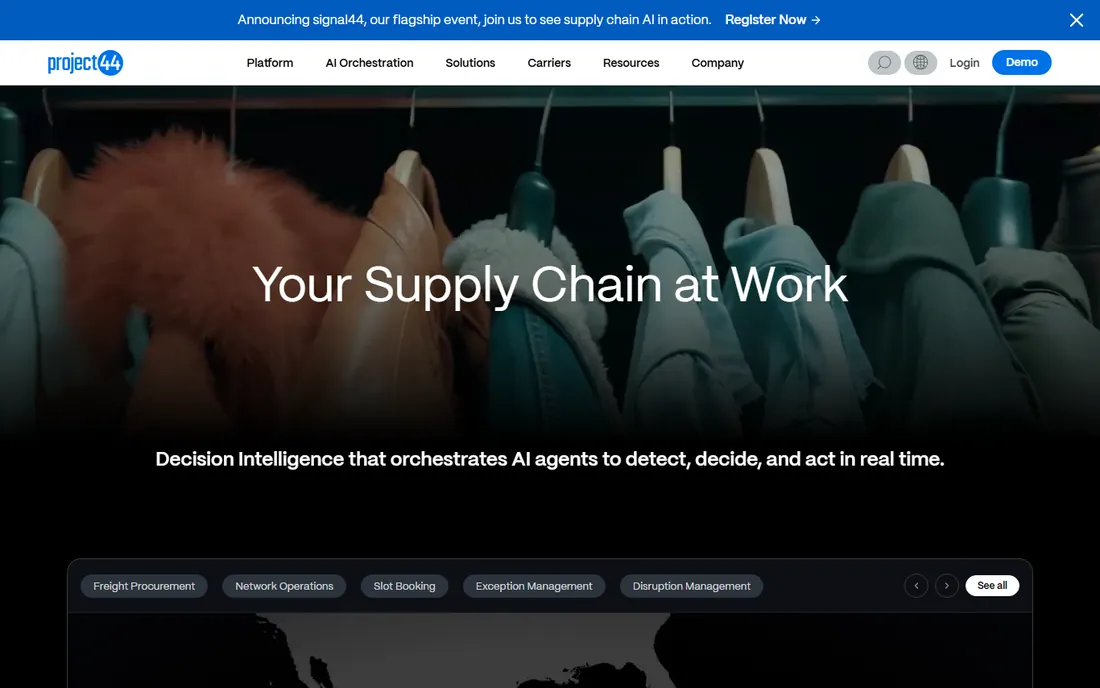
project44 provides real-time transportation visibility for high-velocity shippers, covering truckload, ocean, air and rail in one platform. Predictive ETAs and exception workflows help logistics teams manage by exception instead of by spreadsheet.
The analytics layer turns tracking data into carrier scorecards and network insights, which feeds procurement and planning decisions. Visibility becomes intelligence, not just dots on a map.
Getting carriers connected takes effort and pricing targets enterprise budgets. But for shippers where freight velocity is the business, project44 delivers.
What we like- Real-time visibility across modes
- Broad global coverage
- Strong analytics layer
Watch out for- Carrier onboarding takes work
- Enterprise pricing
#8
Everstream
Best for: Teams that want AI risk monitoring for supply chains
Visit everstream.ai
Starting priceSee website
Free planNo
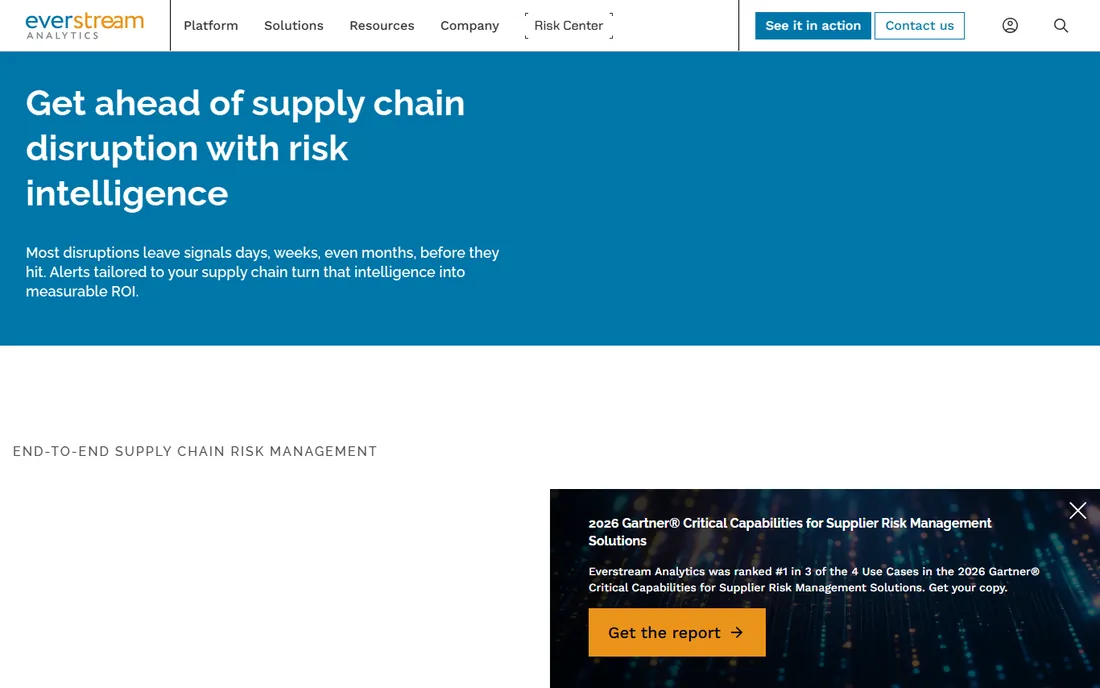
Everstream uses AI to monitor supply chain risk: weather, geopolitics, labor, cyber and supplier financial health, mapped against your supplier network including sub-tiers. When incidents threaten, alerts arrive with impact assessments attached.
The sub-tier visibility is the differentiator. Most companies cannot see past tier one; Everstream's data and models illuminate the deeper chain where surprises originate.
It monitors rather than plans, so pair it with planning software for the full picture. The category is still standardizing. But for proactive risk awareness, Everstream is purpose-built.
What we like- AI-driven risk detection
- Sub-tier supplier visibility
- Proactive incident alerts
Watch out for- Monitoring-focused, not a planning tool
- Newer category with evolving standards
Starting priceSee website
Free planNo
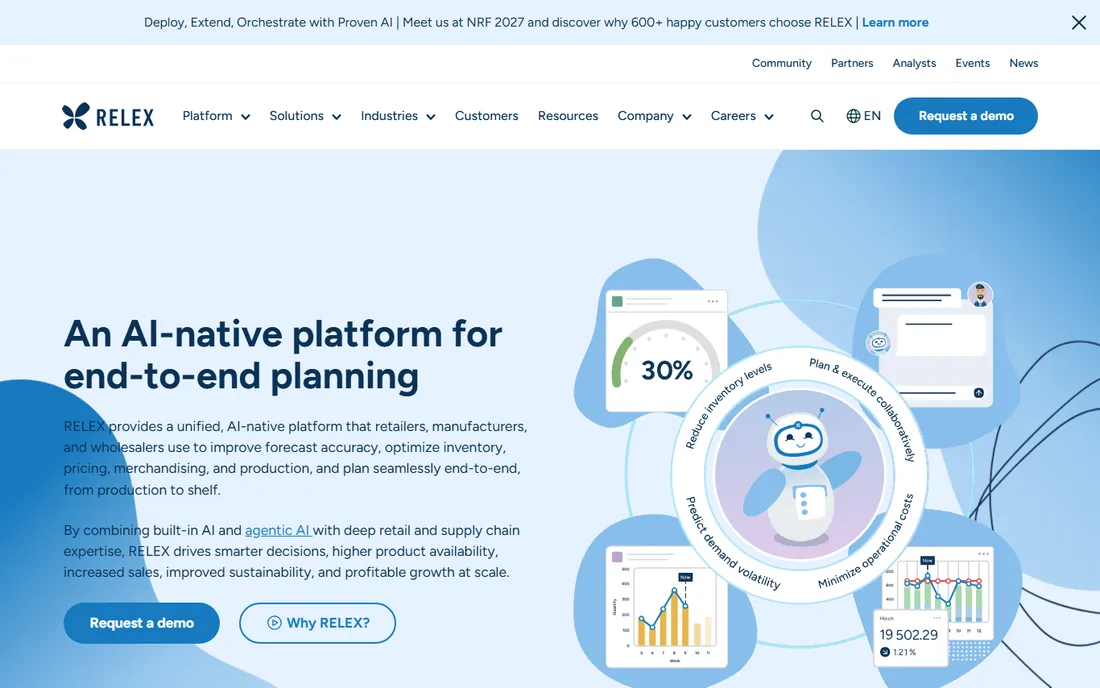
RELEX specializes in retail supply chains: demand forecasting, replenishment, promotions and fresh-food optimization in one planning platform. Grocery and FMCG retailers use it to cut waste while keeping shelves stocked, which is the industry's core tension.
The unified model means forecasts, inventory and replenishment stay consistent instead of drifting across tools. Fresh categories benefit most, where shelf-life math punishes errors.
Manufacturing-heavy operations should look elsewhere; this is a retail product. But for retailers, RELEX's focus shows in results.
What we like- Strong retail demand forecasting
- Unified supply chain planning
- Good fit for grocery and FMCG
Watch out for- Retail-centric focus
- Less for manufacturing
What to evaluate in AI supply chain software
Define the problem narrowly. Demand forecasting, freight visibility, procurement, and risk monitoring are different products; suites bundle them, but specialists do each better. Buy for your biggest pain first.
Verify the AI claims with references. Ask vendors for customers in your industry and comparable scale, and ask those references what the models actually improved. Supply chain AI is only as good as its data inputs.
Plan for implementation. These are not plug-and-play tools: data integration, change management, and process redesign determine success. Budget as much for implementation as for licenses in year one.
Involve IT early. Data integration is the longest pole in the tent, and IT needs to scope the ERP, warehouse, and TMS connections before you sign. A vendor's promised timeline means little without your IT team's validation.
Ask about data ownership and exit terms. Your planning data is strategic, so confirm you can export models, histories, and configurations if you leave. Vendor lock-in is expensive to discover after signing.
Finally, confirm reference customers in your industry. A vendor proven in retail may struggle in manufacturing, and references reveal the difference fast.
How we chose
We evaluated these tools using their public pricing pages, official documentation, and feature descriptions, supplemented by user reviews on G2, Capterra, and Reddit. We weighted coverage of the category's core job, clarity of reporting, honest pricing, and suitability for small versus large teams. This is desk research done carefully, not lab testing.
Making AI supply chain projects succeed
Data quality decides outcomes. AI forecasting on dirty, siloed data produces confident wrong answers. Audit and clean your master data before expecting model magic.
Start with one use case. Demand forecasting for a single category or visibility for one lane proves value faster than an enterprise-wide rollout. Expand from proven wins.
Keep humans in the loop. Planners with AI recommendations outperform both pure automation and pure intuition. Design workflows where the model suggests and the expert decides.
Measure results against a baseline. Record forecast accuracy, stockout rates, or freight costs before implementation so the ROI case rests on numbers, not enthusiasm. Review quarterly and adjust scope based on what the data shows.
Frequently asked questions
How much does supply chain software cost?
Enterprise platforms are quote-based and typically run into six or seven figures annually including implementation. Focused tools for visibility or risk monitoring cost less. Budget implementation separately; it often matches license costs in year one.
How long does implementation take?
Months to over a year for enterprise planning platforms. Data integration and change management dominate the timeline. Focused visibility tools can go live in weeks.
Can AI really predict supply chain disruptions?
It can flag higher risk earlier than manual monitoring by correlating news, weather, and supplier signals. Prediction is probabilistic, not certain. The value is earlier warning and faster response, not perfect foresight.
Do I need to replace my ERP?
No. Most AI supply chain tools integrate with existing ERPs rather than replacing them. They add intelligence and visibility layers on top of your system of record.
What data do these tools need?
Historical demand, inventory levels, supplier information, and logistics data at minimum. The models improve with external signals like weather, events, and market indicators. Cleaner inputs produce more reliable forecasts.
Sources we checked (9)
- https://o9solutions.com/
- https://blueyonder.com/
- https://kinaxis.com/
- https://www.coupa.com
- https://e2open.com/
- https://www.fourkites.com
- https://project44.com/
- https://everstream.ai/
- https://www.relexsolutions.com
Is your product missing or out of date?
We review this list regularly. Vendors can request a listing, send updated pricing or ask about featured placement.

Shihab Mia · Founder, Rankite
Shihab has spent more than a decade helping SaaS and e-commerce brands grow through search. He writes Rankite's software buying guides from pricing pages, documentation and public user reviews. More about Shihab.