How we make this list: we compare pricing pages, product documentation and public user reviews. Rankite is independent; if a vendor ever pays for a featured spot, that listing is clearly labeled Partner.
Key takeaways
- Netstock and EazyStock fit mid-size distributors that want forecasting live in weeks, not quarters.
- Anaplan, o9 and Kinaxis are the heavy hitters for large, complex supply chains with multi-plant or global networks.
- John Galt and Logility suit mid-market manufacturers that outgrew spreadsheets but do not need a full enterprise platform.
- None of these vendors publish list prices, so budget for a demo-led sales process and ask about implementation costs early.
- ToolsGroup's probabilistic forecasting stands out for companies with long-tail SKUs and intermittent demand.
Quick comparison
| Tool | Best for | Starting price | Free plan |
|---|
 Anaplan Anaplan | Enterprise connected planning | See website | No |
 o9 Solutions o9 Solutions | AI-driven integrated business planning | See website | No |
 Kinaxis Kinaxis | Concurrent supply chain planning | See website | No |
 Blue Yonder Blue Yonder | Large-scale demand and supply planning | See website | No |
 John Galt John Galt | Mid-market demand and inventory planning | See website | No |
 ToolsGroup ToolsGroup | Probabilistic forecasting for complex assortments | See website | No |
 Logility Logility | Demand and supply planning for manufacturers | See website | No |
 Netstock Netstock | Inventory-focused demand planning for SMBs | See website | No |
 EazyStock EazyStock | Cloud demand planning for distributors | See website | No |
Is your product missing or out of date?
We review this list regularly. Vendors can request a listing, send updated pricing or ask about featured placement.
The top demand planning software
Starting priceSee website
Free planNo
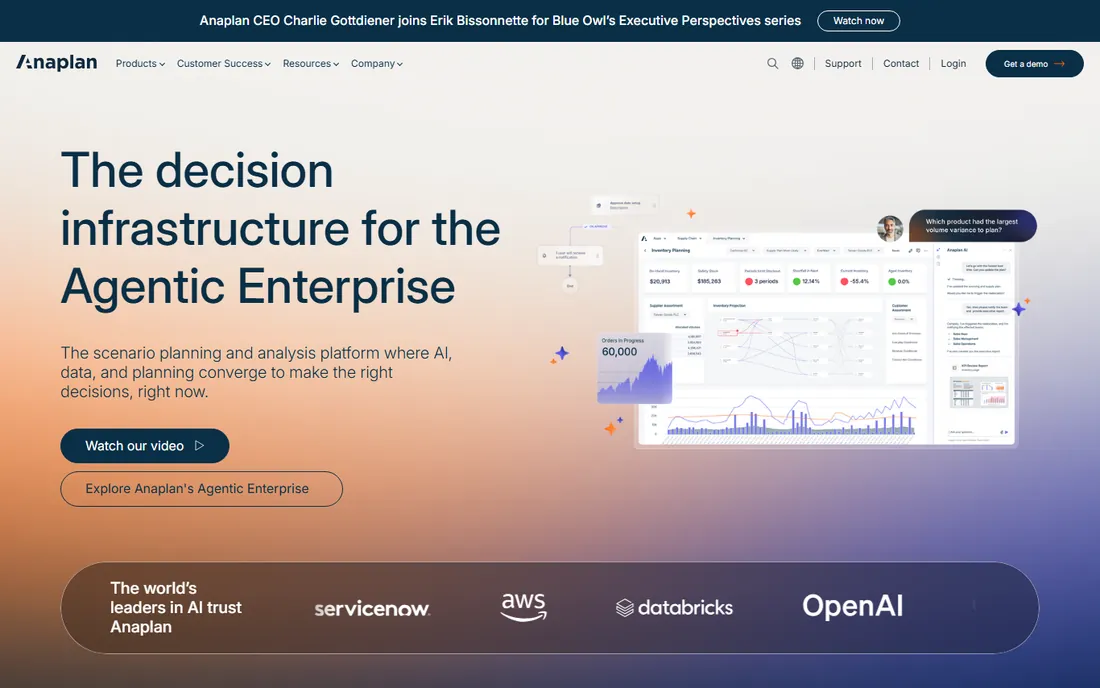
Anaplan is built for companies that want demand planning tied directly to financial and operational plans. Instead of forecasting in one system and budgeting in another, planners build models that connect both, so a change in a demand assumption flows through revenue and capacity views. That connected approach is why large consumer goods and retail companies choose it.
The tradeoff is complexity. Anaplan works best when a company has dedicated planning staff or partners who can build and maintain models. Implementation timelines run in months, and the licensing cost reflects the enterprise positioning. For a mid-size company with a small planning team, this is usually more platform than needed.
What we like- Real-time what-if scenario modeling
- Connects demand plans with finance and supply
- Large app marketplace with prebuilt planning models
Watch out for- Enterprise-level pricing and implementation effort
- Needs trained model builders to get full value
Starting priceSee website
Free planNo

The first thing that stands out about o9 is the depth of its forecasting engine. The platform combines statistical models, machine learning and external demand signals, then links the forecast to supply, inventory and commercial planning in one model. Companies dealing with promotions, seasonality and multi-tier distribution get a lot out of this.
o9 is firmly an enterprise product. Deals typically involve a multi-month evaluation and implementation with services help. Smaller businesses will find the cost and effort hard to justify. If you run a complex global network and forecast accuracy is a board-level metric, o9 belongs on the shortlist.
What we like- Strong AI and machine learning forecasting
- Graph-based modeling handles complex supply networks
- Proven at very large enterprises
Watch out for- Long sales and deployment cycles
- Overkill for companies under roughly $100M in revenue
Starting priceSee website
Free planNo
Kinaxis built its reputation on speed. Its in-memory engine recalculates the entire plan as you change assumptions, so planners see the ripple effects of a demand spike across supply and inventory immediately. That concurrent approach cuts the latency that makes traditional sequential planning so painful.
The platform is especially common in electronics, automotive and pharmaceutical supply chains, where product lifecycles are short and disruptions are frequent. Kinaxis does not publish pricing and typically sells through annual subscriptions sized by planning scope. Expect a serious implementation project, and budget for training.
What we like- Concurrent planning shows demand, supply and inventory impact of every change instantly
- Strong scenario comparison
- Deep roots in manufacturing and high tech
Watch out for- Pricing and licensing complexity
- Smaller companies may struggle with the learning curve
Starting priceSee website
Free planNo

Blue Yonder (formerly JDA) covers more of the supply chain than most names on this list, from demand forecasting through warehouse and transportation management. For retailers and distributors that want one vendor across planning and execution, that breadth is the selling point. Its demand planning module handles promotion forecasting and fresh-food replenishment particularly well.
The honest catch is that breadth adds weight. Deployments are enterprise projects with significant services components. Companies that only need demand planning may find the rest of the suite unnecessary. Blue Yonder fits organizations with the budget and internal resources to run a full-scale planning transformation.
What we like- Broad suite covering demand, fulfillment and logistics
- Strong retail and grocery footprint
- Mature machine learning demand models
Watch out for- Suite breadth can mean a heavy implementation
- Integration with legacy ERPs takes work
Starting priceSee website
Free planNo
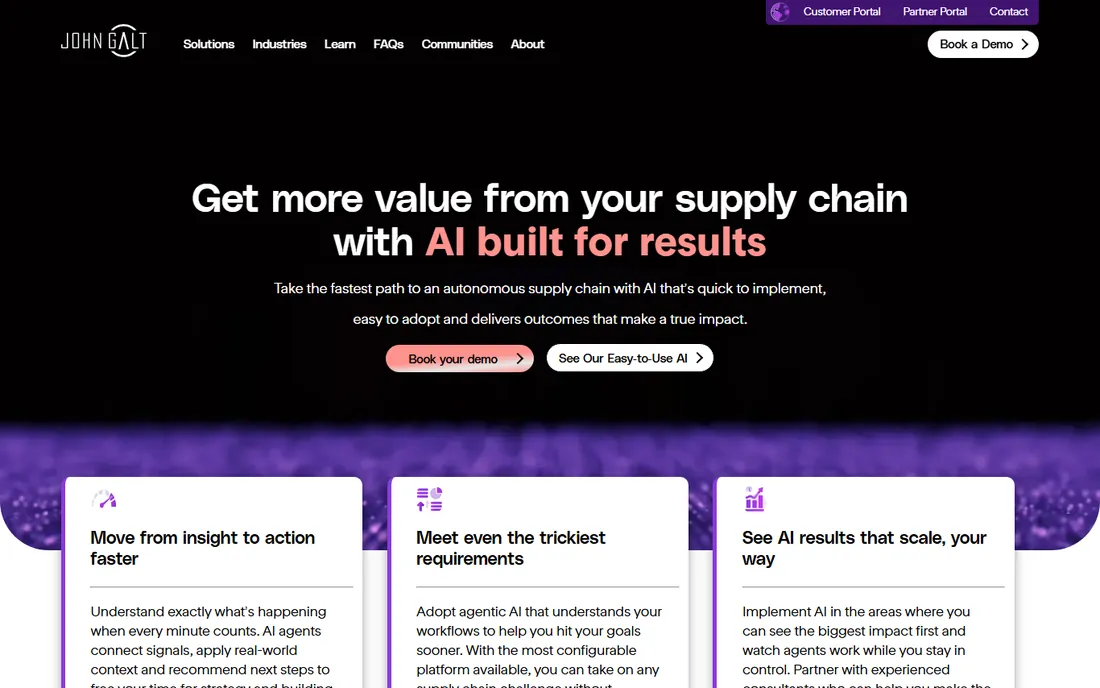
John Galt sits in a useful middle ground. The Atlas Planning Platform gives mid-market manufacturers and distributors real statistical forecasting, inventory optimization and S&OP workflows without the enterprise price tag or year-long implementation. Many customers come from spreadsheets and are running live in weeks.
It will not replace Kinaxis or o9 at a Fortune 500 company, and that is not the point. For a company with a few plants or distribution centers and a lean planning team, John Galt delivers most of the forecasting value that matters. Ask for customer references in your industry during the evaluation.
What we like- Purpose-built for mid-size companies
- Atlas Planning Platform covers demand, inventory and S&OP
- Faster deployments than enterprise suites
Watch out for- Less suited to highly complex global networks
- Smaller partner ecosystem than the big vendors
Starting priceSee website
Free planNo
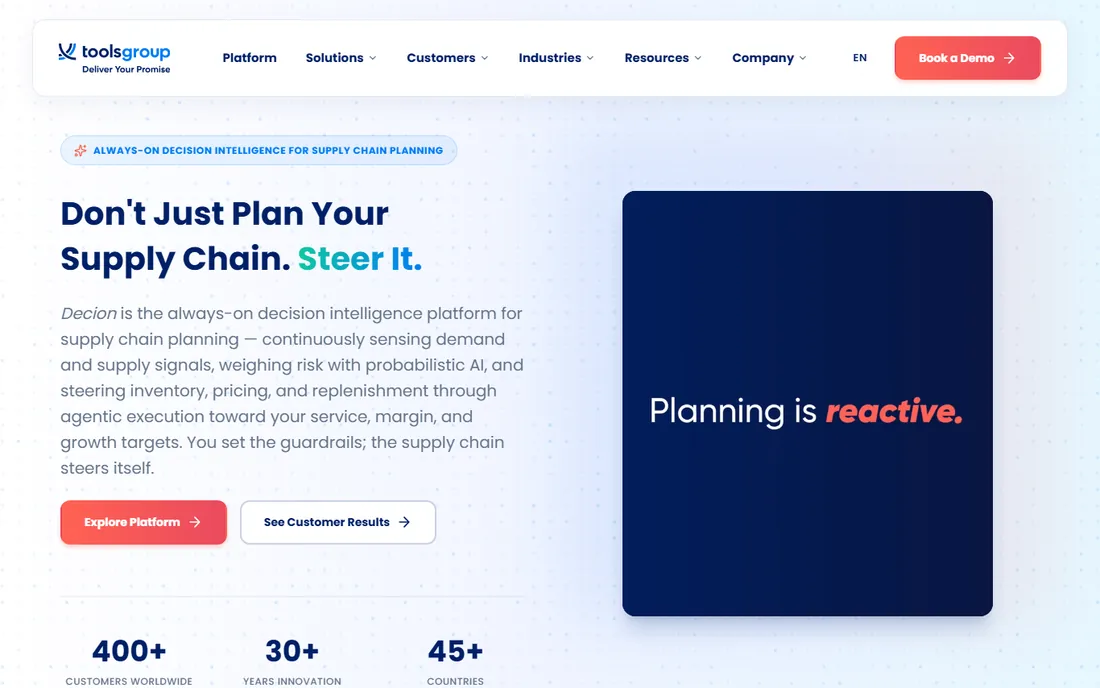
Most forecasting tools predict a single number. ToolsGroup predicts a probability distribution, which sounds academic until you manage thousands of slow-moving SKUs where a single-number forecast is always wrong. Its SO99+ platform was built for exactly this problem: distributors, spare parts and retailers with long-tail assortments.
The approach pays off in inventory: service levels go up while stock goes down, because the plan accounts for demand variability instead of ignoring it. The catch is data hunger. Probabilistic models need clean, granular sales history to work well, so companies with messy item masters should clean house before or during implementation.
What we like- Probabilistic models handle intermittent and lumpy demand well
- Strong in distribution and aftermarket parts
- Inventory optimization built in
Watch out for- Positioning can feel technical for non-specialists
- Implementation needs clean historical data
Starting priceSee website
Free planNo
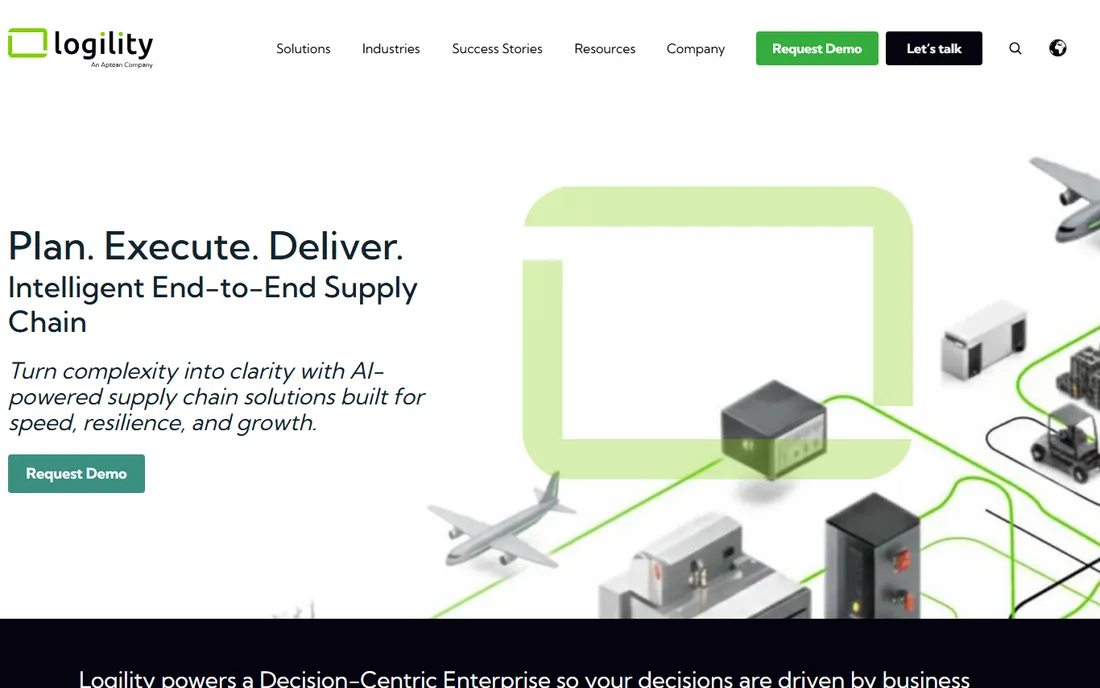
Logility has been in demand planning for decades, and it shows in the depth of the planning logic. The platform covers demand forecasting, inventory optimization, supply planning and S&OP, with particular strength in manufacturing verticals like food and beverage, apparel and consumer goods. Its acquisition by Aptean has tightened integration with mid-market and enterprise ERPs.
This is not a quick self-serve purchase. Logility sells through a consultative process with implementation services, and the interface reflects its long history rather than modern SaaS design trends. Manufacturers that value planning depth over interface polish will be comfortable here.
What we like- Integrated demand, supply and S&OP on one platform
- Solid fit for process and discrete manufacturing
- Now part of Aptean with deeper ERP ties
Watch out for- Enterprise-oriented sales motion
- User interface feels dated in places
Starting priceSee website
Free planNo
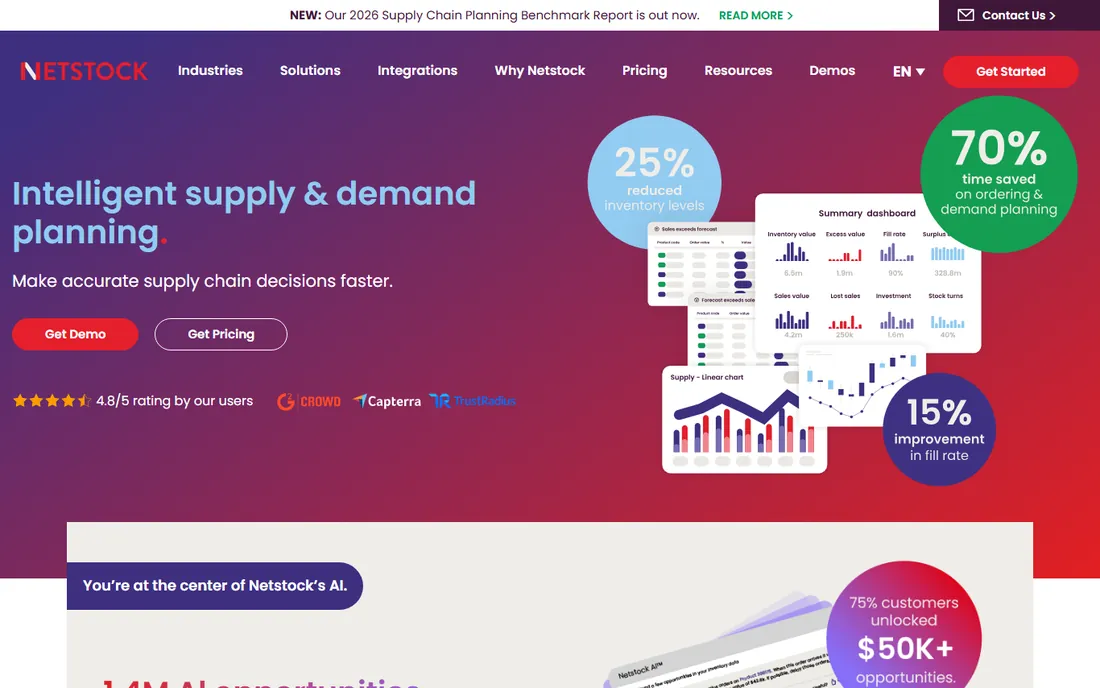
Netstock targets the companies the enterprise vendors ignore: distributors and manufacturers with $5M to $250M in revenue that still plan inventory in spreadsheets. The product connects to the ERP, classifies every SKU by demand pattern, and generates exception alerts so a small team manages by exception instead of reviewing thousands of items.
Deployment speed is the real differentiator. Most customers are live in a matter of weeks with a cloud setup and standard ERP connectors. The tradeoff is scope: Netstock is an inventory and demand planning tool, not a full supply chain suite. If you need multi-plant capacity planning or financial S&OP, look upmarket.
What we like- Fast implementation, often live in weeks
- Plugs into many ERPs
- Clear exception-based dashboards for small teams
Watch out for- Less depth for multi-echelon network optimization
- Best for inventory planning rather than full S&OP
Starting priceSee website
Free planNo
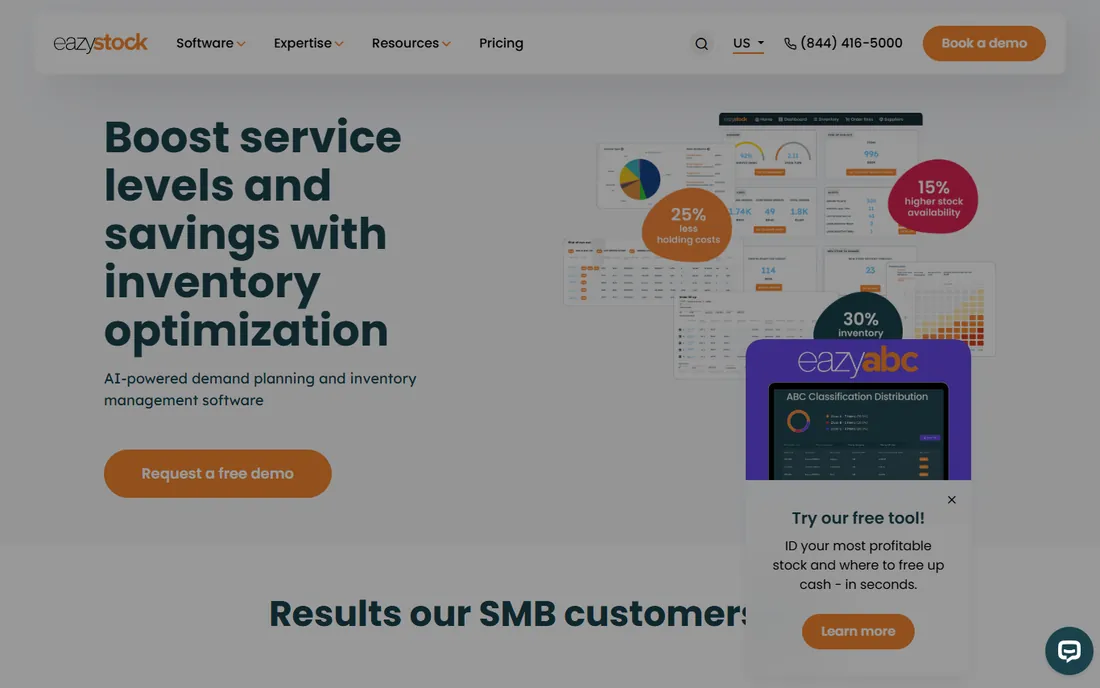
EazyStock competes in the same SMB space as Netstock, with a cloud-native product aimed at distributors and wholesalers. The interface is cleaner than many legacy planning tools, and the standard integrations cover the ERPs distributors actually run. Forecasting, inventory optimization and purchasing workflows come in one package.
As a smaller vendor, EazyStock cannot match the partner ecosystem or reference base of the big names. Support quality gets good marks from customers, which matters more at this size. For a distributor that wants modern software without an enterprise project, EazyStock is worth a demo alongside Netstock.
What we like- Cloud-native with a modern interface
- Strong ERP integrations for distributors
- Good value for the feature set
Watch out for- Smaller vendor with a narrower partner network
- Advanced customization options are limited
How we chose
We screened the demand planning market for products that are actively sold and supported today, then narrowed the list to vendors with real demand forecasting functionality, not just inventory reporting. Selection drew on vendor pricing pages and documentation, public product reviews on G2 and Capterra, analyst coverage and community discussion. We weighted forecast method transparency, fit for different company sizes, ERP integration breadth and realistic implementation effort. No vendor paid for placement, and we did not claim hands-on testing.
What to check before you sign a contract
Start with your data, not the demo. Every forecasting engine on this list performs better with clean, granular sales history at the SKU and location level. If your item master is messy or your sales history lives in three systems, budget for data cleanup as part of the project. Vendors rarely highlight this, but it determines whether the forecast is useful in month three.
Ask specifically about implementation scope and timeline. Enterprise platforms like Anaplan, o9 and Kinaxis usually involve services engagements measured in months, while Netstock and EazyStock aim for weeks. Get the implementation estimate in writing alongside the license quote, because services can exceed the software cost in the first year.
Check the ERP integration list before anything else. A planning tool that does not connect cleanly to your ERP becomes an expensive spreadsheet. Ask for reference customers running the same ERP you use, and ask those references how long the integration actually took.
Finally, clarify what "forecast accuracy" means in the vendor's claims. Ask how accuracy is measured (MAPE, bias, fill rate) and at what aggregation level. A vendor quoting 95 percent accuracy at the product-family level may deliver 60 percent at the SKU level, and the SKU level is where your planners live.
Common mistakes buyers make
The most common mistake is buying for the forecast instead of the workflow. A slightly less accurate forecast with exception-based planning that your team actually uses beats a perfect model that nobody opens. During demos, spend more time on the planner's daily workflow than on the algorithm slides.
Another mistake is underestimating change management. Demand planning software changes how purchasing and sales plan their week. If the planning team does not trust the system, they will keep their spreadsheets. Budget time for training and for a parallel run where the team validates the system against their old process.
Frequently asked questions
What is demand planning software?
Demand planning software forecasts future customer demand using historical sales data, statistical models and often machine learning. It helps companies decide how much inventory to hold, when to order and how to staff. Most tools also connect the forecast to purchasing and production plans.
What is the best demand planning software for small businesses?
Small distributors and manufacturers usually do best with Netstock or EazyStock. Both connect to common ERPs, deploy in weeks and are priced for mid-size budgets. Enterprise platforms like Anaplan or o9 are typically too expensive and complex for smaller teams.
What is the best demand and supply planning software for enterprises?
Anaplan, o9 Solutions, Kinaxis and Blue Yonder lead the enterprise segment. Anaplan excels at connecting demand plans to finance, o9 at AI-driven integrated planning, Kinaxis at fast concurrent scenario planning and Blue Yonder at broad planning plus execution coverage.
How much does demand planning software cost?
Most vendors do not publish prices. SMB tools like Netstock and EazyStock typically run in the low five figures per year, while enterprise platforms can reach six or seven figures including implementation. Always get the services estimate alongside the license quote.
How long does implementation take?
SMB-focused tools can go live in 4 to 8 weeks. Mid-market platforms like John Galt and Logility typically take 2 to 6 months. Enterprise deployments with Anaplan, o9 or Kinaxis often run 6 to 12 months or longer, depending on scope and data readiness.
Sources we checked (9)
- https://www.anaplan.com
- https://o9solutions.com
- https://www.kinaxis.com/en
- https://blueyonder.com
- https://johngalt.com
- https://www.toolsgroup.com
- https://www.logility.com
- https://www.netstock.com
- https://www.eazystock.com
Is your product missing or out of date?
We review this list regularly. Vendors can request a listing, send updated pricing or ask about featured placement.

Shihab Mia · Founder, Rankite
Shihab has spent more than a decade helping SaaS and e-commerce brands grow through search. He writes Rankite's software buying guides from pricing pages, documentation and public user reviews. More about Shihab.