How we make this list: we compare pricing pages, product documentation and public user reviews. Rankite is independent; if a vendor ever pays for a featured spot, that listing is clearly labeled Partner.
Key takeaways
- DotActiv at $70 per month is the best all-round planogram software for mid-size retail operations.
- RELEX and Blue Yonder serve enterprise chains with planogramming inside broader merchandising suites.
- Quant at 1,200 euros per user per year auto-generates planograms from sales data for large store networks.
- OPENCatman offers a genuinely free tier, and Nexgen POG costs just $400 per year for browser-based planogramming.
- SmartDraw at $7.95 per user per month is the cheapest way to draw shelf layouts without retail-specific features.
Quick comparison
| Tool | Best for | Starting price | Free plan |
|---|
 DotActiv DotActiv | retailers and suppliers doing category management | $70 per month | No |
 RELEX Solutions RELEX Solutions | retail chains wanting unified merchandising | See website | No |
 Blue Yonder Blue Yonder | enterprise category management | See website | No |
 Quant Quant | large store networks needing automation | €1,200 per user per year | No |
 LEAFIO LEAFIO | mid-size chains wanting AI planogramming | See website | No |
 GoPlanogram GoPlanogram | suppliers, brands, and retailers | $5,500 per year | No |
 Nexgen POG Nexgen POG | straightforward affordable planogramming | $400 per year | Free trial |
 Shelf Logic Shelf Logic | small teams and occasional planogram work | See website | No |
 SmartDraw SmartDraw | quick planogram diagrams on a budget | $7.95 per user per month | Free trial |
 OPENCatman OPENCatman | teams getting started with category management | Free | Yes |
Is your product missing or out of date?
We review this list regularly. Vendors can request a listing, send updated pricing or ask about featured placement.
The top 10 planogram software
Starting price$70 per month
Free planNo
DotActiv is the independent specialist that keeps winning retail planogram comparisons. Starting at $70 per month, the software handles planogramming, shelf planning, space management, and retail analytics, with support for standard 2D linear shelving through complex fashion and makeup fixtures. The vendor pairs software with category management services, so smaller retailers get expertise alongside the tool.
The automated optimization tools analyze integrated sales data and suggest product placement changes that lift category performance. Brand assets can be customized by market and store configuration, which matters for chains with different fixture sets.
DotActiv lacks the supply chain breadth of RELEX or Blue Yonder, and per-seat licensing gets expensive with big teams. For retailers and suppliers whose core need is planogramming done well, it remains the value benchmark.
What we like- Purpose-built for retail planogramming
- 2D and complex fixture support
- Paired with category services
Watch out for- Smaller vendor ecosystem
- Per-seat licensing adds up for large teams
Starting priceSee website
Free planNo
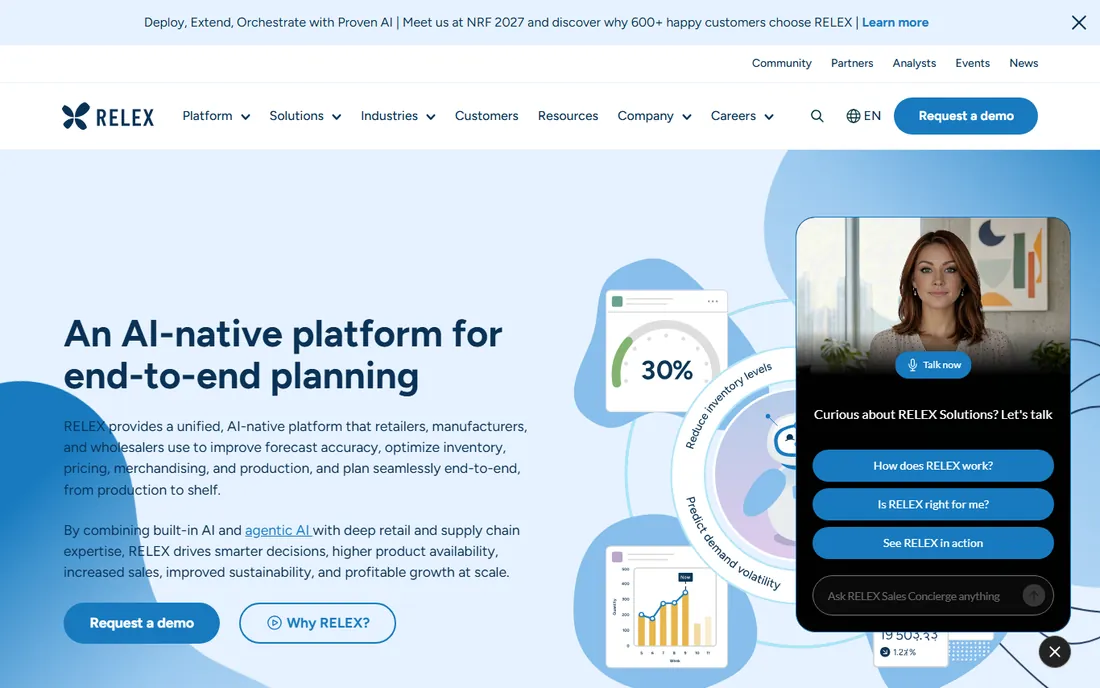
RELEX Solutions treats planograms as one module in a unified retail planning platform covering supply chain, merchandising, and space planning. Founded in 2005 in Finland, the company serves major retail chains where planograms must connect to replenishment, assortment, and forecasting. Pricing is quote-based and scoped to chain size.
The integration is the argument: planograms generated from the same demand forecasts that drive replenishment stay accurate as assortments change. For chains above 50 stores, this automation replaces the manual planogram maintenance that consumes category teams.
Smaller retailers will find RELEX overbuilt and overpriced; the platform assumes enterprise scale. For large chains standardizing merchandising and supply chain on one system, it is a leading choice.
What we like- Planogramming inside a unified supply chain suite
- Strong automation
- Used by major chains
Watch out for- Quote-only pricing
- Enterprise scale and cost
Starting priceSee website
Free planNo
Blue Yonder, formerly JDA and before that Intactix, carries decades of category management heritage. Its space planning tools serve large retailers running enterprise category management, with desktop roots and browser-based tiers inside a wider supply chain platform. Pricing is quote-only.
The depth is unmatched: floor planning, assortment, macro and micro space management, and planogram execution across thousands of stores. Retailers already on Blue Yonder for supply chain get planogramming as a natural extension.
The complexity and cost put it out of reach for everyone except large enterprises. Implementations are long and the pricing reflects it. For the biggest retail operations, it remains the standard.
What we like- Deep category management heritage (formerly JDA/Intactix)
- Full space planning suite
- Massive scale
Watch out for- Quote-only enterprise pricing
- Complex implementations
Starting price€1,200 per user per year
Free planNo
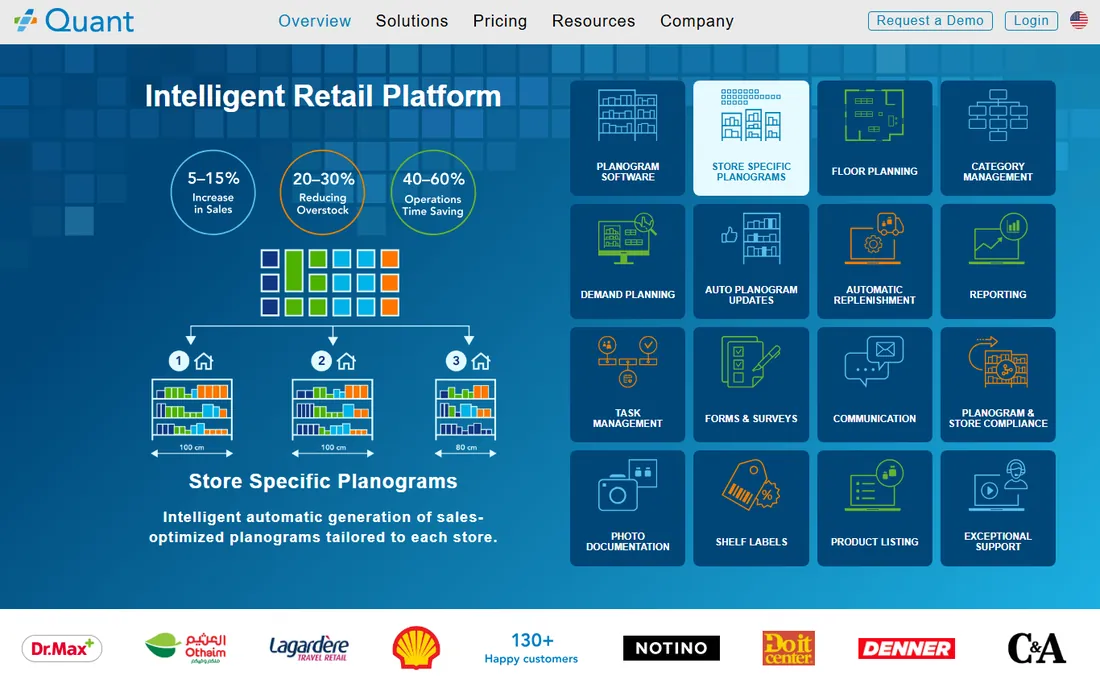
Quant from Quant Retail is the automation play: the cloud platform auto-generates planograms optimized by sales data using user-defined templates, keeping thousands of planograms current across diverse store networks without adding staff. Pricing starts at 1,200 euros per user per year.
The integrated scope goes beyond planograms to category management, ranging, shelf labels, POS printing, store communication, and in-store marketing. Cloud licensing with unlimited users suits retailers who want the whole team working from one database. Consultants help with data integration, with typical go-live under 12 weeks.
The per-user yearly cost is high for smaller operations, and the vendor's global presence is smaller than RELEX or Blue Yonder. For retail chains where manual planogram maintenance has become the bottleneck, Quant's automation is the point.
What we like- Smart auto-generation of planograms from sales data
- Unlimited users on cloud
- Shelf labels and POS printing included
Watch out for- 1,200 euros per user yearly is steep
- Czech vendor with smaller global footprint
#5
LEAFIO
Best for: mid-size chains wanting AI planogramming
Visit leafio.ai
Starting priceSee website
Free planNo
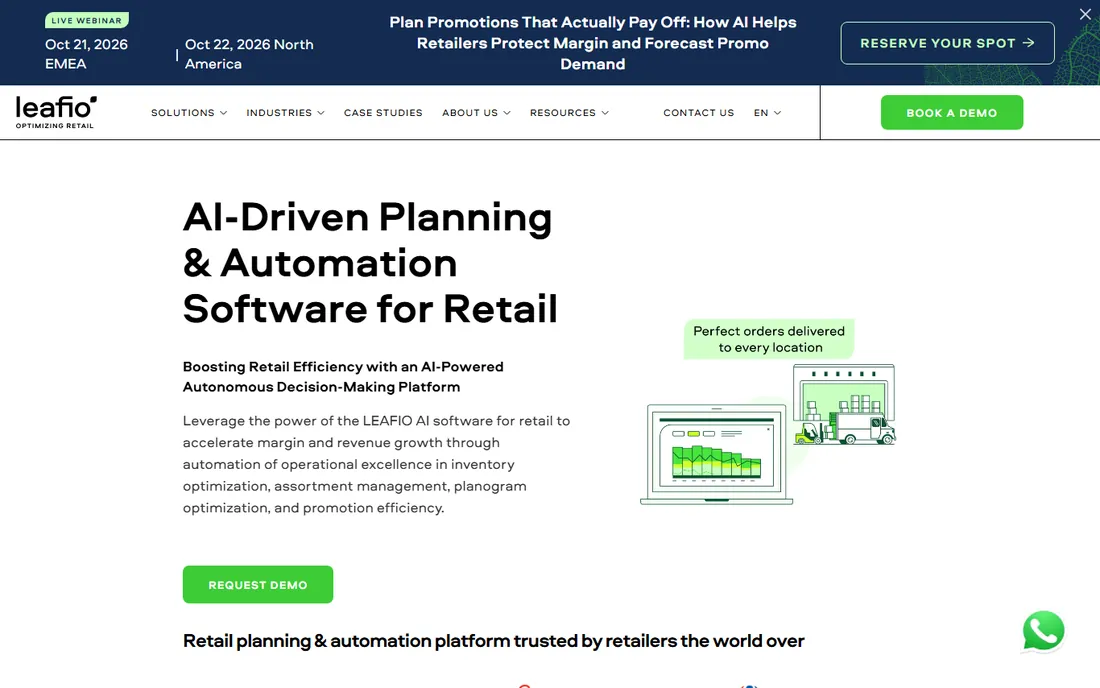
LEAFIO AI Retail Solutions offers a full-cycle macro and micro space management solution with automated planogram generation, execution control, and shelf space performance improvement. The platform is built for 10 to 50 store chains where planogramming automation starts delivering measurable ROI. Pricing is quote-based.
The AI angle is real: automated generation plus execution verification helps chains enforce planogram compliance in stores, which is where most planogram programs actually fail. Deployment is faster than the enterprise alternatives, and the retail-specific design shows.
As a younger vendor, LEAFIO lacks the decades of case history that RELEX and Blue Yonder carry. For mid-size chains that want AI planogramming without enterprise overhead, it is the strongest modern option.
What we like- AI-powered auto-generation
- Full-cycle macro and micro space management
- Faster to deploy than enterprise suites
Watch out for- Quote-only pricing
- Younger vendor than the incumbents
Starting price$5,500 per year
Free planNo
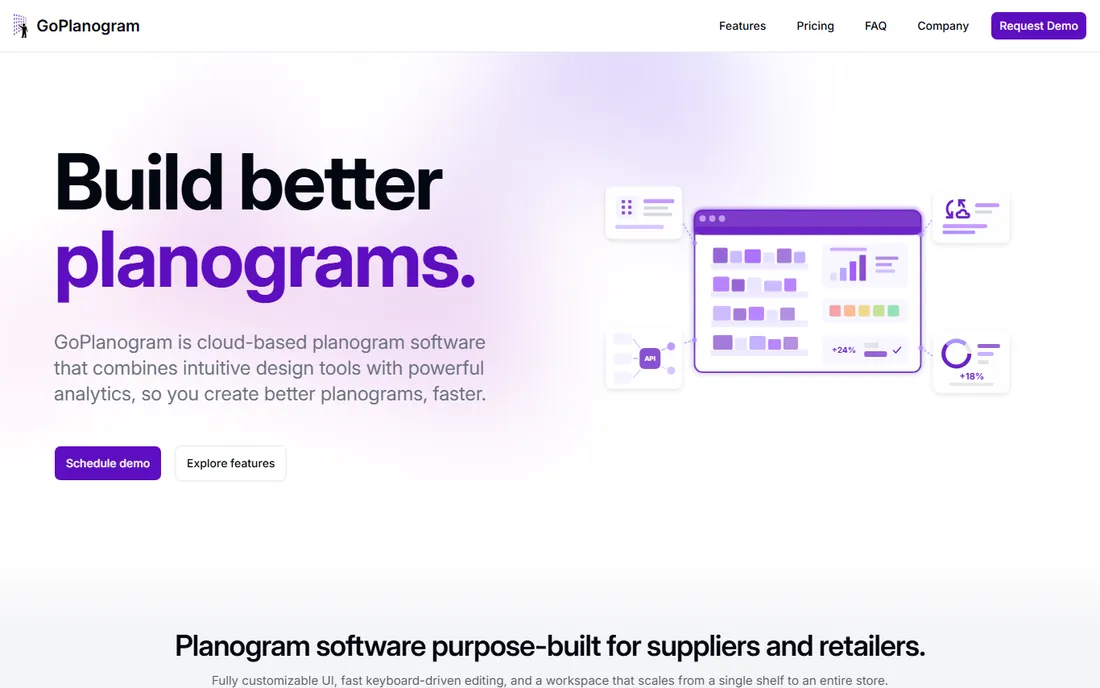
GoPlanogram is the browser-based planogram tool built for suppliers, brands, and retailers, starting at $5,500 per year with published pricing. Nothing installs or updates; the whole platform runs in the browser, which simplifies life for supplier teams sharing planograms with multiple retail partners.
The supplier focus shows in the workflow: brands build planograms for their categories and share them with retail buyers, a process that desktop tools handle awkwardly. Published pricing removes the sales-call dance that enterprise vendors require.
The $5,500 yearly entry is a real commitment for a single user, and the feature set is narrower than the full suites. For suppliers and brands whose planogram work centers on selling into retailers, the browser-first design fits.
What we like- Browser-based, nothing to install
- Published pricing from $5,500 yearly
- Supplier-friendly
Watch out for- Flat yearly pricing favors larger users
- Narrower feature set than suites
Starting price$400 per year
Free planFree trial
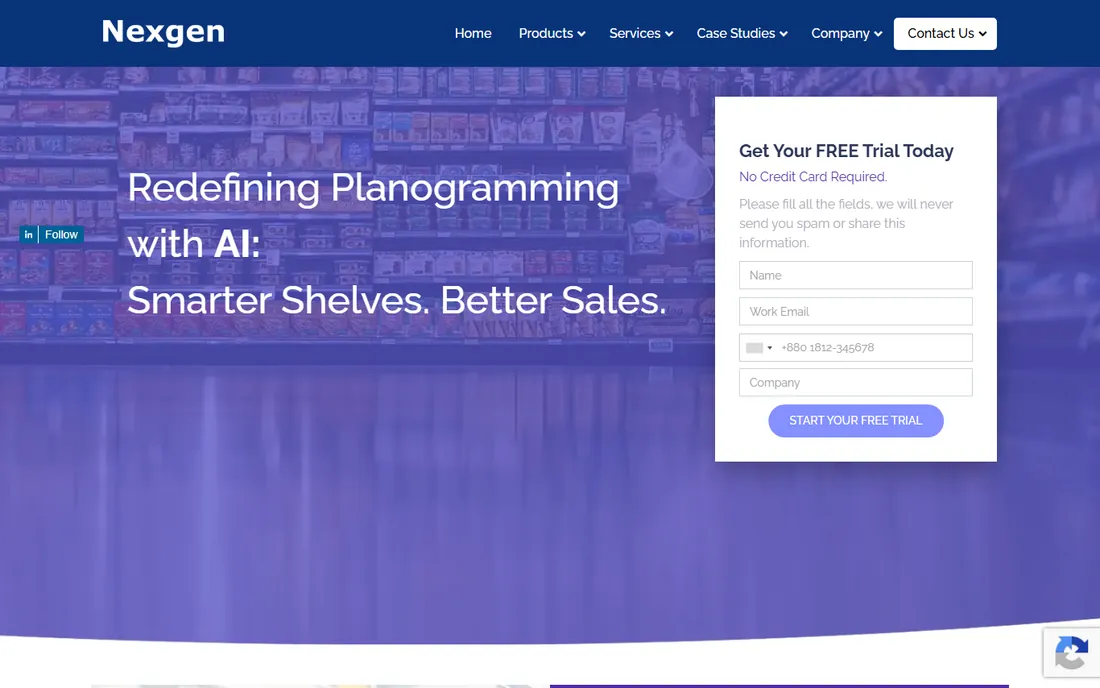
Nexgen POG is the affordable workhorse: $400 per year for browser-based planogram software that is easy to learn and use. It produces store-specific planograms that improve product visibility, with a free trial so teams can test before subscribing. Reviews consistently praise the simple interaction across the merchandising stages.
For under-10-store operations, Nexgen POG gives structured planogramming without enterprise overhead. The priority at this scale is moving shelf plans out of spreadsheets into a consistent format, and Nexgen does exactly that.
Multi-format chains will miss store clustering and advanced logic, and the automation lags the AI-driven tools. For suppliers and small retail teams wanting straightforward planogramming at a fair price, it is hard to beat.
What we like- Just $400 per year
- Browser-based
- Easy to learn
- Free trial available
Watch out for- Simpler than enterprise tools
- No store clustering for multi-format chains
Starting priceSee website
Free planNo
Shelf Logic serves small teams and occasional planogram work with Windows desktop editions plus low-cost cloud viewing plans. The published pricing is aimed at teams that do planogramming intermittently rather than as a daily discipline, and the desktop familiarity suits users upgrading from spreadsheets.
The cloud viewing plans let store teams see planograms without full licenses, a sensible model for small operations. For retailers with simple fixture sets and infrequent resets, the cost stays low.
Pricing details require a conversation, and the desktop roots mean collaboration lags the browser-native tools. For small teams with occasional planogram needs, Shelf Logic is the budget-friendly specialist.
What we like- Low-cost editions for small teams
- Windows desktop familiarity
- Cloud viewing plans
Watch out for- Pricing not published
- Desktop roots limit collaboration
Starting price$7.95 per user per month
Free planFree trial
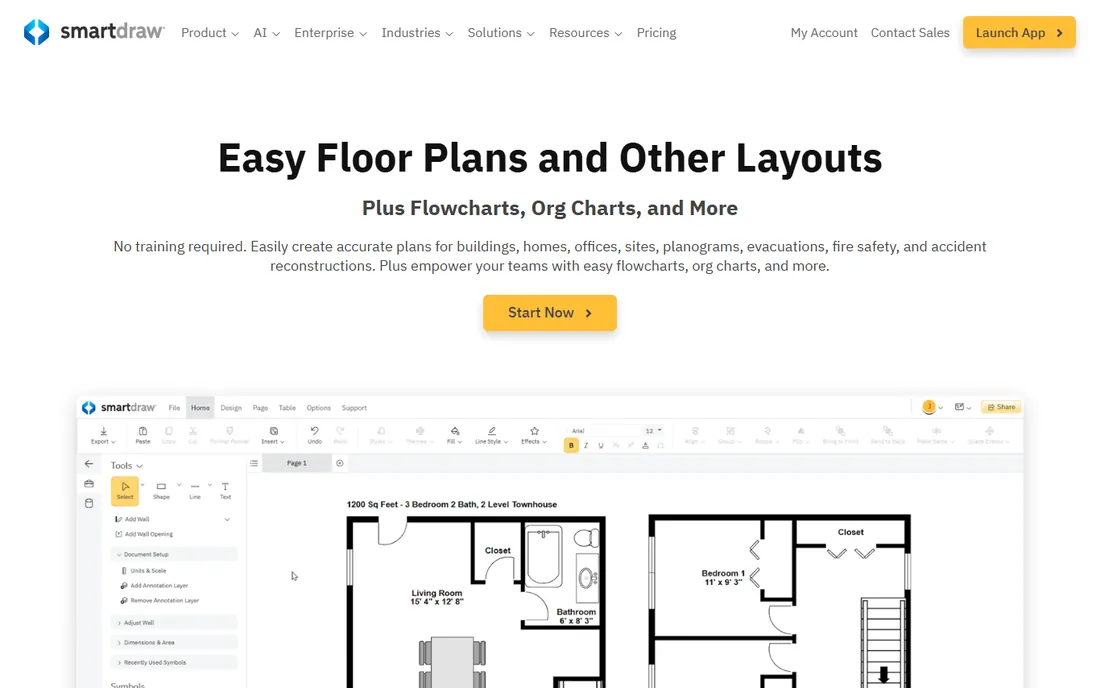
SmartDraw is general diagramming software with retail and planogram templates included, and at $7.95 per user per month it is the cheapest paid option in this roundup. The 4,500 templates and 34,000 symbols cover shelf layouts alongside floor plans and fixtures, with Visio import and export and integrations with Microsoft 365 and Google Workspace.
For a single store or a consultant who needs to draw a decent shelf plan quickly, SmartDraw works. The intelligent formatting keeps diagrams professional, and the price is trivial.
It is not planogram software in the retail sense: no sales-data optimization, no fixture libraries, no store clustering. For actual category management, choose a specialist. For drawing shelf layouts cheaply, SmartDraw suffices.
What we like- Cheapest paid option here
- 4,500 templates
- Visio import/export
- Google and Microsoft integrations
Watch out for- General diagramming, not retail-specific
- No sales-data optimization
Starting priceFree
Free planYes
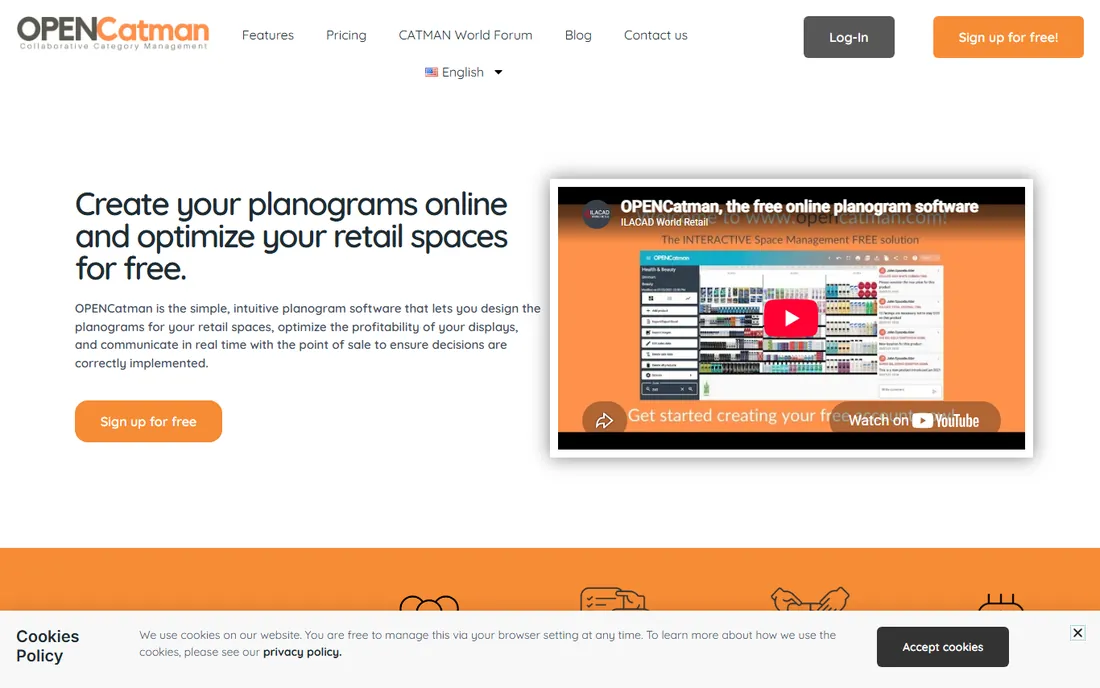
OPENCatman is the free entry point: a browser-based category management platform with a free tier and paid plans for growing teams. The shared product library across all users means small retailers and suppliers get real category management data without the enterprise price tag.
For teams getting started, the free tier teaches the discipline: product hierarchies, category reviews, and basic planogramming before committing budget. The browser design keeps collaboration simple.
Serious multi-store use needs the paid plans, and the feature set is smaller than the established vendors. As a free starting point for category management, nothing else in this roundup competes.
What we like- Free tier available
- Browser-based
- Shared product library across users
Watch out for- Paid tiers needed for serious use
- Smaller feature set
How we chose
We compared planogram software on planogram creation quality, auto-generation and AI features, store clustering, compliance verification, integrations with POS and supply chain systems, pricing transparency, and fit for different retail scales. We reviewed current 2026 roundups, vendor documentation, and user reviews on SourceForge and Slashdot, and checked published pricing where vendors disclose it. We did not operate retail stores; assessments reflect current documentation and reviewer consensus as of October 2026.
Matching planogram software to your store count
Under 10 stores, the priority is getting shelf plans out of spreadsheets into a consistent format. Nexgen POG at $400 yearly or SmartDraw at $7.95 monthly handle this without enterprise overhead. OPENCatman is free if you are starting from zero. Do not buy an enterprise suite at this scale; the implementation cost exceeds any benefit.
At 10 to 50 stores, automation starts paying for itself. Manual planogram updates across dozens of locations create errors and backlogs, and compliance verification becomes the real problem. LEAFIO is purpose-built for this range, and DotActiv at $70 monthly covers the essentials with room to grow.
Above 50 stores, auto-generation and AI compliance verification become the baseline. Quant and RELEX serve this segment with sales-data-driven planogram generation across diverse store networks. Blue Yonder fits the largest enterprises with full category management suites. Price these on total implementation and team training, not just license cost.
Suppliers and brands selling into retailers follow a different path: GoPlanogram's browser-based sharing or Nexgen POG for simple needs, since the workflow centers on presenting planograms to buyers rather than managing stores.
Why planograms fail in stores (and it is not the software)
The dirty secret of planogramming is that the software works and the stores do not comply. Category managers build perfect shelf plans; store teams shelve what is easy, what is available, or what the last delivery contained. Every planogram vendor knows this, which is why the AI tools now lead with compliance verification: photo-based shelf audits that check whether the shelf matches the plan.
Before buying software, decide how you will verify execution. Without store-level accountability, the most sophisticated auto-generated planogram is a PDF nobody reads. The tools with mobile execution apps and image-recognition checks, LEAFIO, DotActiv, and the enterprise suites, exist because compliance is the bottleneck.
The second failure mode is stale data. Planograms built on last year's sales rot quietly. The auto-generation tools solve this by refreshing plans from current POS data, but only if the data integration actually runs. Budget the integration work, not just the license.
Frequently asked questions
What is planogram software?
Planogram software creates visual shelf layouts showing exactly where each product sits on store shelves. Retailers and suppliers use it to optimize product placement for sales, manage space across store locations, and verify that stores execute the planned layouts.
How much does planogram software cost?
Prices range from free to enterprise quotes: OPENCatman is free, SmartDraw costs $7.95 per user per month, Nexgen POG is $400 per year, DotActiv starts at $70 per month, GoPlanogram starts at $5,500 per year, and Quant costs 1,200 euros per user per year. RELEX, Blue Yonder, LEAFIO, and Shelf Logic require custom quotes.
Is there free planogram software?
Yes. OPENCatman offers a free tier with browser-based category management and planogramming. SmartDraw and Nexgen POG offer free trials. General-purpose diagramming can sketch basic layouts, but free tools lack the sales-data optimization and compliance verification of paid platforms.
What is the difference between planogram software and space planning software?
Planogram software designs shelf-level product layouts. Space planning software works at a higher level: floor plans, department placement, and macro space allocation across the store. Most enterprise tools, RELEX, Blue Yonder, Quant, cover both; the affordable tools focus on planograms.
How long does planogram software take to implement?
Simple tools like Nexgen POG or SmartDraw are usable within days. Mid-range platforms like DotActiv take weeks with training. Enterprise suites like RELEX, Blue Yonder, or Quant typically need 8 to 12 weeks including data integration, with Quant's consultants targeting under 12 weeks for go-live.
Do I need AI planogram generation?
Chains above 50 stores benefit most: AI auto-generation keeps thousands of planograms current as assortments and sales data change, work that manual teams cannot sustain. Below that scale, manual planogramming with a tool like Nexgen POG or DotActiv is more cost-effective. The AI premium pays off in labor savings, not shelf aesthetics.
Sources we checked (6)
- https://smbtech.au/blog/the-best-planogram-software-for-retail-in-2026/
- https://goplanogram.com/planogram-software-alternatives
- https://slashdot.org/software/comparison/Quant-Retail-vs-RELEX/
- https://slashdot.org/software/comparison/RELEX-vs-leafio/
- https://slashdot.org/software/comparison/Nexgen-POG-vs-OPENCatman/
- https://www.saasworthy.com/product/smartdraw/pricing
Is your product missing or out of date?
We review this list regularly. Vendors can request a listing, send updated pricing or ask about featured placement.

Shihab Mia · Founder, Rankite
Shihab has spent more than a decade helping SaaS and e-commerce brands grow through search. He writes Rankite's software buying guides from pricing pages, documentation and public user reviews. More about Shihab.