How we make this list: we compare pricing pages, product documentation and public user reviews. Rankite is independent; if a vendor ever pays for a featured spot, that listing is clearly labeled Partner.
Key takeaways
- ConsignCloud at $89 per month offers the most modern interface with Shopify and Square integrations.
- ConsignPro at $129 per month is the long-standing all-in-one for resale and consignment accounting.
- Ricochet at $199 per month provides the deepest POS and inventory system for growing resale businesses.
- SimpleConsign at $129 per month suits stores wanting professional cloud software with strong support.
- Best Consignment Shop Software at $879 one-time appeals to owners who refuse subscriptions.
Quick comparison
| Tool | Best for | Starting price | Free plan |
|---|
 ConsignCloud ConsignCloud | stores wanting modern software with integrations | $89 per month | Free trial |
 ConsignPro ConsignPro | comprehensive resale and consignment accounting | $129 per month | Free trial |
 Ricochet Ricochet | growing resale businesses needing POS depth | $199 per month | Free trial |
 SimpleConsign SimpleConsign | professional cloud software with strong support | $129 per month | Free trial |
 Aravenda Aravenda | high-volume Shopify-integrated resale | See website | No |
 Best Consignment Shop Software Best Consignment Shop Software | owners who want to buy once, not subscribe | $879 one-time | Free trial |
 Liberty Consignment Liberty Consignment | large-scale consignment operations | See website | No |
 ThriftCart ThriftCart | thrift stores with donation-driven inventory | See website | No |
Is your product missing or out of date?
We review this list regularly. Vendors can request a listing, send updated pricing or ask about featured placement.
The best consignment shop software
Starting price$89 per month
Free planFree trial
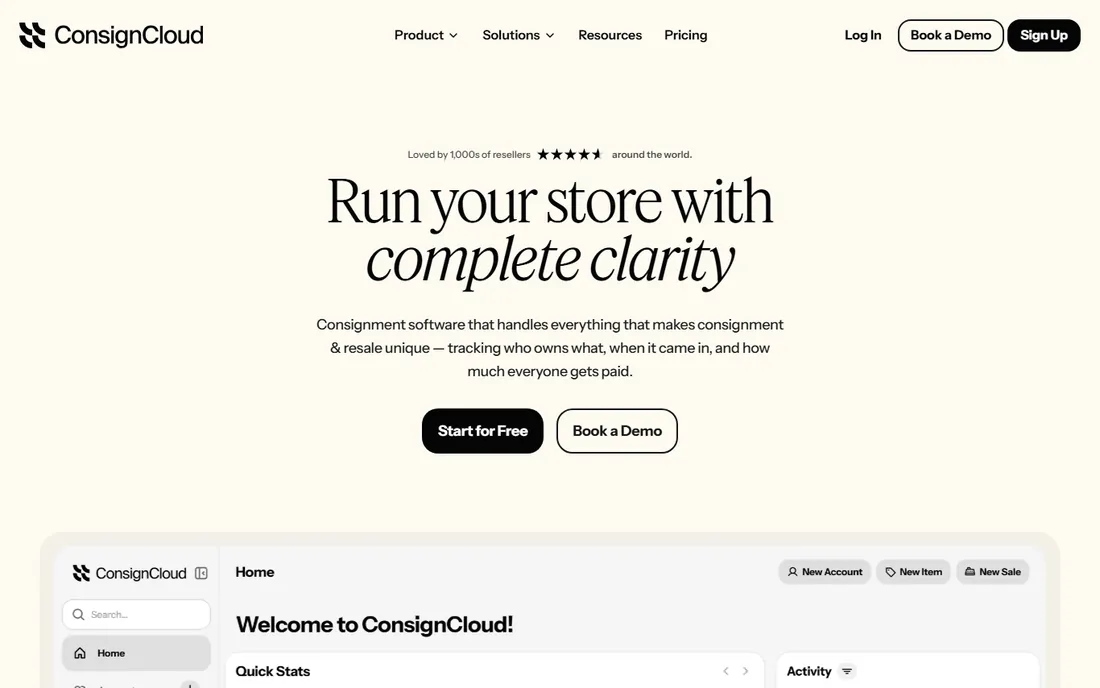
ConsignCloud is the modern choice for consignment stores. The interface is clean and easy to learn, especially compared to older competitors, and the platform covers POS, inventory, consignor management, and built-in ecommerce with credit card processing. The consignor portal with automated email notifications keeps consignors informed without staff effort.
Pricing starts at $89 per month for the basic plan, with integrated ecommerce and the consignor portal as $29 add-ons each. Transaction fees of 2.7% plus $0.05 apply through its payment processing. Support is frequently praised in reviews, which matters in a category where vendors vary widely.
The honest caveats come from user reviews: inventory sync issues with Shopify and Square integrations have been reported, and the platform is less proven at large multi-location scale. For single and small multi-store operations that value usability, ConsignCloud is the easiest recommendation.
What we like- Clean modern interface
- Shopify and Square integrations
- Consignor portal with automated notifications
- Strong support reviews
Watch out for- Reported sync issues with external integrations
- Less proven at large multi-location scale
Starting price$129 per month
Free planFree trial
ConsignPro from Visual Horizons has served resale and consignment shops since the 1990s, making it the veteran of this list. The all-in-one covers retail POS, inventory tracking, consignor management, ecommerce, and financial accounting with the depth that comes from decades of refinement. A free 30-day trial lets shops evaluate properly.
Pricing starts at $129 per month for one computer, with additional users extra. The accounting depth exceeds most competitors, which matters for shops where the books are complex: layaways, account credits, and detailed consignor statements.
The interface shows its age next to ConsignCloud, and per-user pricing penalizes larger staffs. But for shops that prioritize proven accounting and responsive support over modern design, ConsignPro's track record is unmatched.
What we like- Longest track record in the category
- Deep retail accounting
- Knowledgeable support team
Watch out for- Interface less modern than ConsignCloud
- Per-user pricing adds up
Starting price$199 per month
Free planFree trial
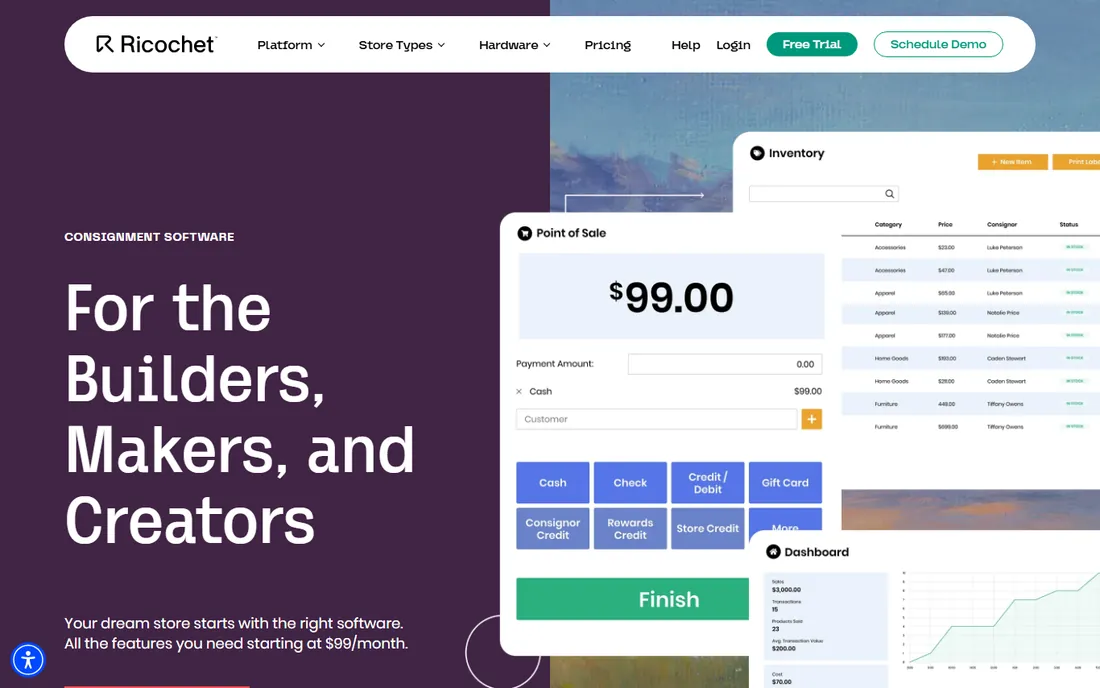
Ricochet is the growth platform for consignment, resale, and vendor-based stores. The POS runs across PC, Mac, and iPad for flexible in-store operations, with inventory management, reporting, and account tracking built for the category. Integrated merchant services and ACH payouts streamline the money movement that defines consignment.
Online selling comes through Ricochet Web or Shopify integration, extending the store's reach beyond foot traffic. At $199 per month, it is the priciest subscription on this list, reflecting the depth.
Ecommerce is a paid add-on rather than included, and some advanced features cost extra. For growing resale businesses that need serious POS and inventory depth, Ricochet's completeness justifies the premium over cheaper options.
What we like- Powerful POS across PC, Mac, and iPad
- Integrated payments and ACH payouts
- Online selling through Ricochet Web or Shopify
Watch out for- Highest subscription price here
- Some features are paid add-ons
Starting price$129 per month
Free planFree trial
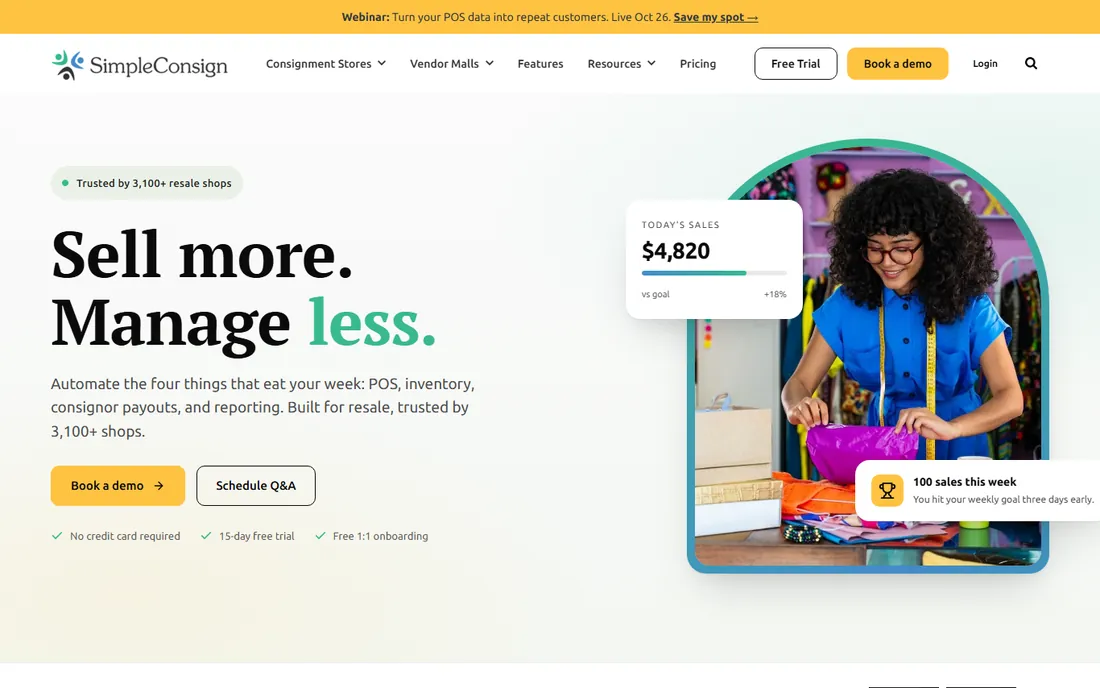
SimpleConsign, powered by Traxia, is the professional-grade cloud option proven at larger scale than most competitors. The web-based system manages POS, customer tracking, consignor relationships, and ecommerce, with integrations to QuickBooks, Shopify, and major payment processors. Multi-location operators use it successfully.
Pricing starts at $129 per month per location for the Basic plan, rising to $279 for Professional. The per-location model is fair for chains but adds up for operators with many small stores.
The interface is functional rather than modern, trailing ConsignCloud on design. But for operators who need proven multi-location consignment software with real accounting integrations, SimpleConsign's maturity shows.
What we like- Web-based with POS, consignor, and ecommerce management
- QuickBooks and Shopify integrations
- Proven at multi-location scale
Watch out for- Less modern interface than ConsignCloud
- Pricing per location adds up
Starting priceSee website
Free planNo
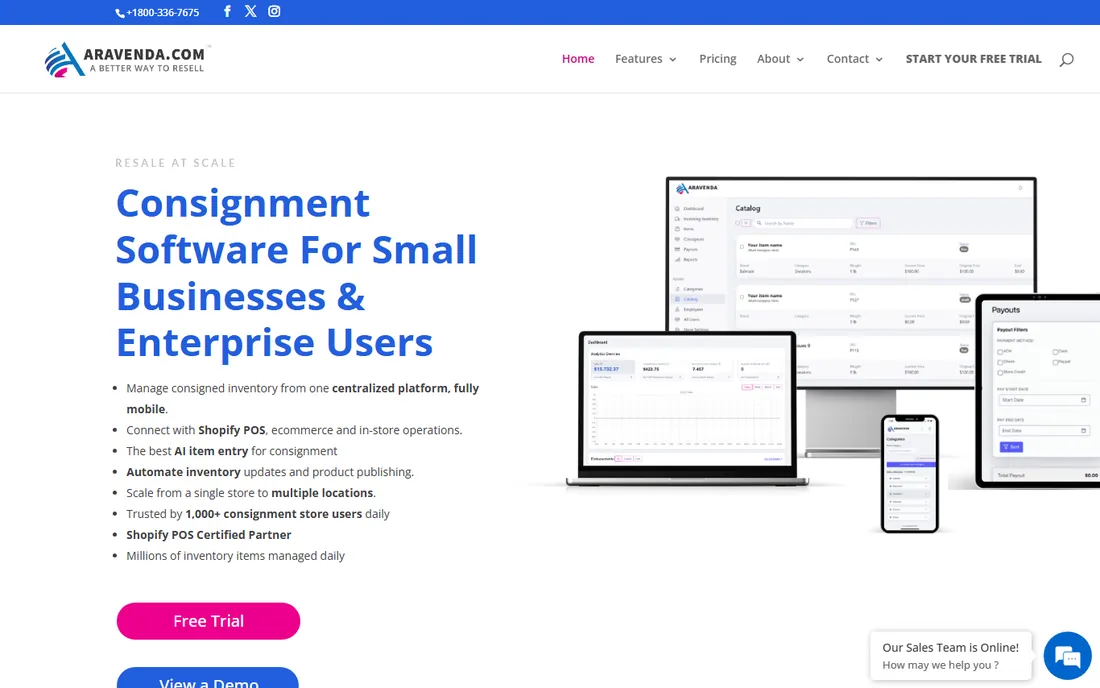
Aravenda is the choice for high-volume resale operations deeply integrated with Shopify. Founded in 2018, it was built for the modern resale economy where online and in-store inventory must stay synchronized and transaction volumes run high.
The architecture handles the complexity of serious resale: large SKU counts, frequent price changes, and omnichannel inventory. For operations where Shopify is the system of record and the consignment software must keep pace, Aravenda's integration depth stands out.
Pricing is quote-based, which suits its target of larger operations but frustrates smaller shops. The company is younger than the incumbents, so directors valuing decades of history may hesitate. For high-volume Shopify resale, it is purpose-built.
What we like- Built for Shopify-integrated resale
- Handles high transaction volumes
- Modern architecture
Watch out for- Pricing not published
- Newer company founded in 2018
Starting price$879 one-time
Free planFree trial
Best Consignment Shop Software, from SBSSolutions, takes the increasingly rare one-time purchase approach: $879 once, no monthly subscription. In business since 2001, it covers consignor management, customer database, inventory, POS, and pricing optimization with the completeness of a mature product.
For owners who have watched subscription costs compound over the years, the math is appealing: the purchase pays for itself in under a year versus $89-plus monthly alternatives. The feature set handles the standard consignment workflow competently.
The tradeoff of the purchase model is pace: feature updates arrive slower than on subscription platforms, and the interface reflects its era. But for shops that want software as an asset rather than a bill, it is the only option of its kind.
What we like- One-time $879 purchase, no subscription
- Serving shops since 2001
- Full consignor and POS features
Watch out for- One-time model means slower feature updates
- Less modern than cloud competitors
Starting priceSee website
Free planNo
Liberty Consignment from ResaleWorld serves the large end of the market: operations with the scale and complexity that overwhelm simpler tools. The feature set is deep, handling complex consignor arrangements, high transaction volumes, and the reporting that multi-store management demands.
ResaleWorld's focus on the resale industry means the software understands consignment specifics rather than adapting generic retail tools. Large operators get the configurability their varied business models require.
Small shops should look elsewhere; the complexity and quote-based pricing assume serious operations. For large-scale consignment businesses, Liberty's depth makes it worth the evaluation.
What we like- Feature-rich for large operations
- Handles complex consignor structures
- Established resale software vendor
Watch out for- Pricing not published
- Complexity exceeds small-shop needs
Starting priceSee website
Free planNo
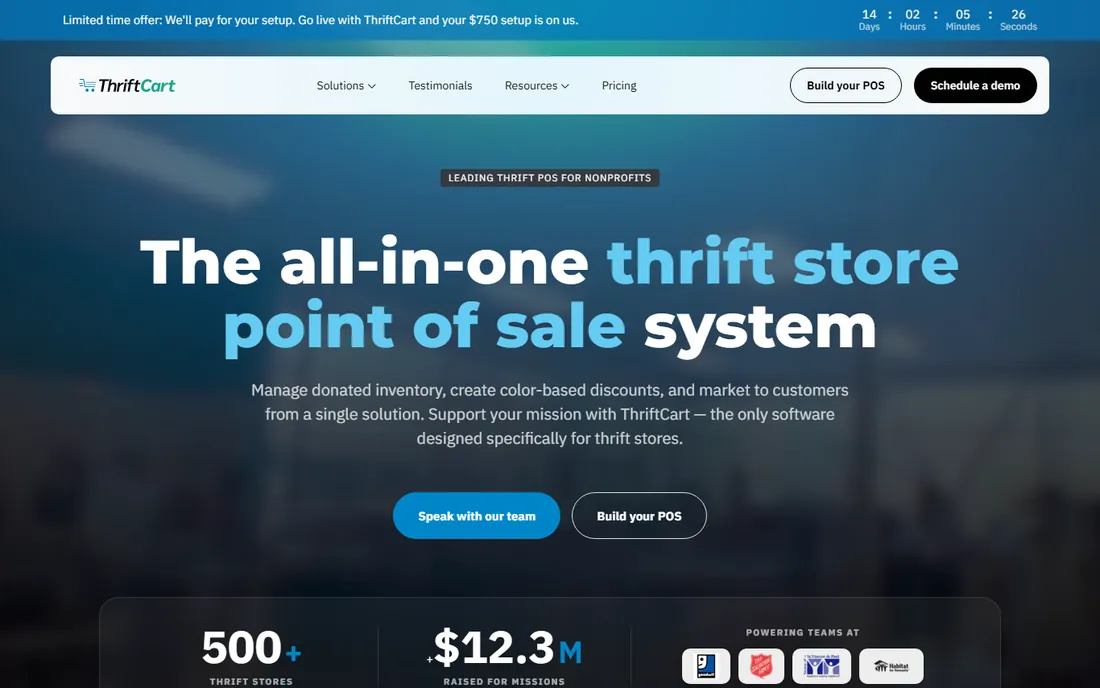
ThriftCart serves the thrift store segment specifically, where inventory comes from donations rather than consignors. The workflows reflect that reality: donation intake, donor tracking, and the rapid inventory turnover that defines thrift operations, alongside POS and inventory management.
For nonprofit thrift stores and charity shops, the donation-centric design fits better than consignment-first tools adapted to the job. The reporting serves the accountability needs of charitable organizations.
Traditional consignment shops with consignor splits will find the general-purpose tools more fitting. But for thrift operations, ThriftCart's specialized workflows make it the natural choice.
What we like- Built for thrift store workflows
- Handles donation intake
- POS and inventory for resale
Watch out for- Pricing not published
- Narrower focus than general consignment tools
How we chose
We compared consignment and resale software on consignor management, split and payout handling, POS quality, inventory tracking, ecommerce integration, and pricing fairness. We checked each vendor's pricing page and current 2026 comparisons, read shop owner reviews on Capterra and Reddit, and weighed ease of use for staff, consignor portal quality, and fit for US shops of different sizes. We did not run live store trials; prices were verified against vendor pages or comparisons current as of October 2026.
The feature that keeps consignors is not your POS or your accounting. It is the portal where they check their sales in real time. Consignors who can see their items selling, watch their balance grow, and receive automatic notifications bring you better inventory. Consignors who have to call the shop for a statement take their good stuff to your competitor.
When evaluating software, log into the consignor portal as a consignor would. Is it clean? Does it work on a phone? Are the statements clear? The portal is your consignors' entire experience of your business between visits. Every platform here offers one, but the quality varies enormously, and it is the feature most directly tied to inventory quality.
How to choose consignment software that handles your split structure
Start with your splits, not the feature list. Consignment splits vary: 50/50, sliding scales by price, tiered by volume, different rates for different categories. Map your actual split structure, including every exception, and verify the software handles each one natively. Workarounds for splits create accounting errors and consignor disputes.
Then check the payout workflow end to end: how consignors get paid, by check, ACH, or store credit, how often, and what the fees are. Confirm the ecommerce story if you sell online: does inventory sync in real time, or will you oversell? Finally, trial with your real data for two weeks, including a full payout cycle. The software that survives your actual month-end is the right one.
Frequently asked questions
What is consignment shop software?
Consignment shop software manages the consignment business model: tracking inventory owned by consignors, calculating split commissions on sales, processing consignor payouts, and running point of sale. It replaces the spreadsheets and manual accounting that consignor splits otherwise require.
How much does consignment software cost?
Monthly plans run $89 to $199: ConsignCloud from $89, ConsignPro and SimpleConsign at $129, Ricochet at $199. Best Consignment Shop Software costs $879 one-time with no subscription. Several vendors use quote-based pricing. Factor in transaction fees and add-ons like ecommerce, which some vendors charge extra for.
Should I choose ConsignPro or ConsignCloud?
Choose ConsignCloud for the most modern interface, easier staff training, and Shopify and Square integrations. Choose ConsignPro for deeper retail accounting and the longest track record in the category. Both offer free trials; run each with your real inventory for two weeks before deciding.
Do I need ecommerce integration?
If you sell online, yes, and it must sync inventory in real time to avoid overselling. ConsignCloud includes built-in ecommerce; Ricochet offers it as an add-on or through Shopify. If you are in-store only, skip the ecommerce tier and save the money. Do not pay for online selling you will not use.
How do consignor payouts work?
The software tracks each consignor's sales, applies your split structure, and generates payouts by check, ACH direct deposit, or store credit on your schedule. Most platforms automate the calculation; you approve and release. Verify the payout fees and timing during the trial, since these vary and directly affect consignor satisfaction.
What about multi-location consignment stores?
SimpleConsign and Liberty Consignment are the most proven for multi-location operations, with per-location pricing and centralized reporting. ConsignCloud handles smaller multi-store setups. Confirm that inventory transfers between locations, consolidated consignor accounts, and location-level reporting all work before committing a chain to any platform.
Sources we checked (5)
- https://www.circle-hand.com/blog_en/best-pos-software-and-systems-for-consignment-shops
- https://slashdot.org/software/comparison/ConsignCloud-vs-ConsignPro/
- https://www.softwaresuggest.com/simpleconsign/alternatives
- https://sourceForge.net/software/consignment/canada/
- https://slashdot.org/software/comparison/Ricochet-Consignment-Software-vs-The-Consignment-Shop/
Is your product missing or out of date?
We review this list regularly. Vendors can request a listing, send updated pricing or ask about featured placement.

Shihab Mia · Founder, Rankite
Shihab has spent more than a decade helping SaaS and e-commerce brands grow through search. He writes Rankite's software buying guides from pricing pages, documentation and public user reviews. More about Shihab.