How we make this list: we compare pricing pages, product documentation and public user reviews. Ratings come from G2, Capterra or Trustpilot, with the date we checked them.
Key takeaways
- Qualys VMDR is the closest enterprise replacement, with hybrid scanning and a connected vulnerability-to-patch workflow.
- Rapid7 InsightVM offers the most transparent published pricing, from $1.62 per asset per month at the 500-asset tier.
- Wiz leads for cloud exposure prioritization, with a security graph and attack paths from $24,000 per year for 100 workloads.
- Orca Security suits agentless cloud assessment, with SideScanning and contextual risk scoring.
- Greenbone OpenVAS is the free path for teams willing to run their own scanner.
- Snyk suits developer-led teams that want fixes inside code, dependencies and images.
Quick comparison
Is your product missing or out of date?
We review this list regularly. Vendors can request a listing, send updated pricing or ask about featured placement.
The best Tenable alternatives

#1Qualys VMDR
Best for: Enterprise hybrid scanning4.4/5 on
G2 (168 reviews, checked Oct 2026)
Visit qualys.com
Starting priceFrom $596 per month
Free planFree trial
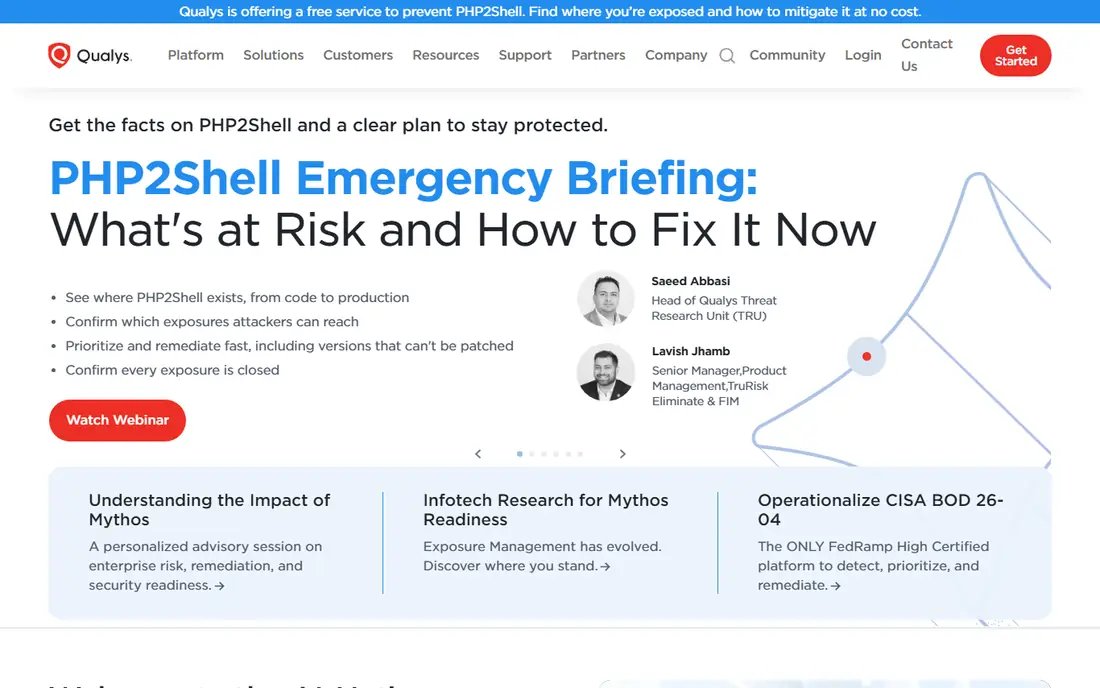
Qualys VMDR is the closest enterprise replacement for Tenable, with hybrid scanning across cloud and on-premises infrastructure and a connected vulnerability-to-patch workflow that moves findings toward fixes without switching tools. Third-party listings cite entry tiers near $2,195 per year and AWS Marketplace listings from $596 per month for 128 hosts, though enterprise pricing is quote-based and no complete public list price exists. Compliance reporting is built in, which suits regulated industries.
Pricing opacity is the main drawback: procurement teams need a sales call before they can model total cost of ownership, unlike Rapid7's published per-asset rates. The console experience also feels dated to some reviewers. For an enterprise that wants a full vulnerability-to-patch platform, Qualys is the strongest Tenable alternative.
What we like- Connected vulnerability-to-patch workflow
- Hybrid cloud and on-prem coverage
- Compliance built in
Watch out for- Quote-based enterprise pricing
- Console experience feels dated to some reviewers

#2Rapid7 InsightVM
Best for: Transparent per-asset pricing4.4/5 on
G2 (81 reviews, checked Oct 2026)
Visit rapid7.com
Starting price$1.62 per asset per month
Free planFree trial
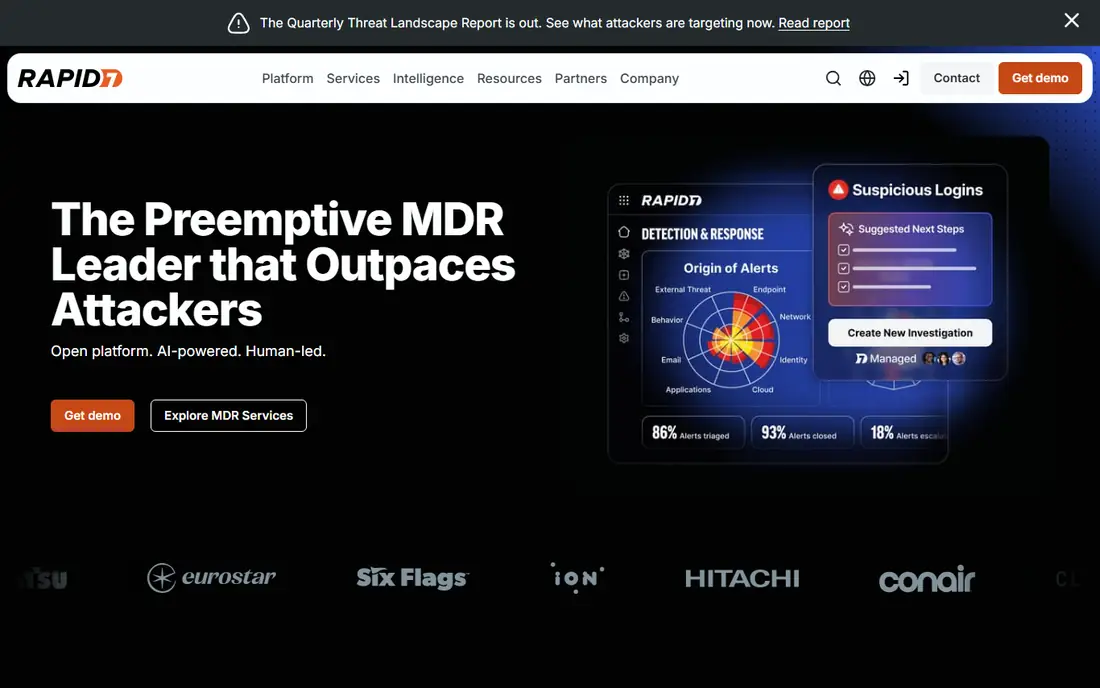
Rapid7 InsightVM offers the most transparent published pricing of the three enterprise platforms, from $1.62 per asset per month at the 500-asset tier, roughly $19.44 per asset annually before discounts or add-ons. Active Risk prioritization ranks findings by exploitability and business context, and remediation tracking follows fixes across teams. Gartner named Tenable, Qualys and Rapid7 all Leaders in its first Magic Quadrant for exposure assessment, so none of the three is a laggard.
Costs scale per asset, so large estates pay more, and cloud-only coverage needs pairing for on-prem depth. For a mid-size team that wants to model total cost before a sales call, Rapid7's published rates make it the easiest buy to justify.
What we like- Most transparent published pricing
- Active Risk prioritization
- Strong remediation tracking
Watch out for- Costs scale per asset
- Cloud-only coverage needs pairing for on-prem depth

#3Wiz
Best for: Cloud exposure prioritization4.7/5 on
G2 (863 reviews, checked Oct 2026)
Visit wiz.io
Starting price$24,000 per year
Free planFree trial
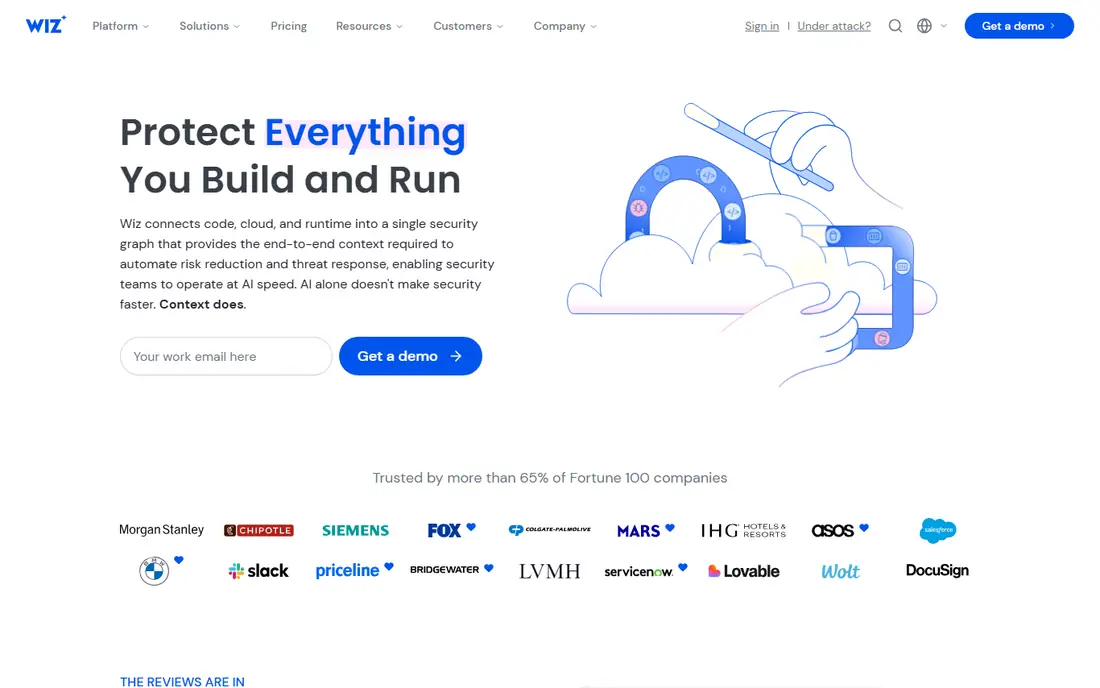
Wiz leads for cloud exposure prioritization, with a security graph that maps attack paths across cloud resources and ranks the exposures attackers can actually reach. Essential pricing starts at $24,000 per year for 100 workloads, and agentless deployment means teams see cloud risk within days rather than after a long agent rollout. That graph-based prioritization is why cloud-native teams choose Wiz over infrastructure scanners.
Wiz is cloud-only with no on-prem network scanning, so hybrid estates need a second tool for internal networks. The entry price is high for small teams. For a cloud-first organization, Wiz is the best exposure management platform.
What we like- Security graph and attack paths
- Cloud exposure prioritization
- Fast agentless deployment
Watch out for- Cloud-only, no on-prem network scanning
- Entry price high for small teams
Starting priceFrom $7,000 per month
Free planFree trial
Orca Security suits agentless cloud assessment, with SideScanning that reads workload disks from outside the workload, avoiding agent installation and performance impact. Contextual risk scoring combines vulnerabilities with misconfigurations, identity exposure and data sensitivity, so teams fix the risks that matter rather than every finding. EC2 packs start from $7,000 per month, reflecting its enterprise positioning.
The entry price excludes small teams, and the scope is cloud-only, so on-prem networks need another scanner. For an enterprise cloud team that wants agentless assessment with context, Orca is a strong Wiz alternative.
What we like- Agentless SideScanning
- Contextual risk scoring
- Full cloud workload coverage
Watch out for- High entry price
- Cloud-only scope
Starting priceSee website
Free planFree trial
CrowdStrike Falcon Exposure Management suits teams already running Falcon, since the existing agent powers exposure management without new deployment. Adversary intelligence and asset context drive threat-led prioritization, ranking the exposures attackers are actually exploiting. That threat lens distinguishes it from scanners that rank by severity alone.
Pricing is custom quote, and vulnerability management is an add-on module to an EDR-first platform, so buyers should confirm what the module adds over Falcon's core. For a CrowdStrike shop, adding exposure management is the lowest-friction path to vulnerability visibility.
What we like- Adversary intelligence and asset context
- Existing Falcon agent
- Threat-led prioritization
Watch out for- Custom quote pricing
- VM is an add-on module to an EDR-first platform
#6
Microsoft Defender Vulnerability Management
Best for: Microsoft endpoint programs
Visit microsoft.com
Starting priceSee website
Free planNo
Microsoft Defender Vulnerability Management suits Microsoft-centric shops, since core capabilities sit inside Endpoint P2 and remediation flows through Defender and Intune. Teams already running Defender get vulnerability visibility without a new agent, and Intune closes the loop on patching. That integration is why Microsoft shops often skip a standalone scanner.
Coverage is weaker outside the Microsoft ecosystem, and premium features cost extra beyond the core. For a Microsoft 365 and Defender organization, this is the most integrated vulnerability management option.
What we like- Core in Endpoint P2
- Defender and Intune remediation workflow
- No new agent for Defender shops
Watch out for- Weaker outside the Microsoft ecosystem
- Premium features cost extra
Starting price$0
Free planYes
Snyk suits developer-led teams that want vulnerability fixes inside code, dependencies and container images rather than network scans. A free tier covers individual developers, with Team plans from $25 per developer per month adding collaboration and policy features. Scanning runs in CI and in the IDE, so developers fix issues where they work instead of receiving tickets from a separate security team.
Snyk is not a network scanner, so infrastructure coverage needs a separate tool such as Qualys, Rapid7 or OpenVAS. For a team whose main risk sits in code and open-source dependencies, Snyk is the best developer-first option.
What we like- Free tier
- Dependency, code and image scanning
- Fixes inside developer workflows
Watch out for- Not a network scanner
- Infrastructure coverage needs a separate tool
Starting price$0
Free planYes
Greenbone OpenVAS suits teams willing to run their own scanner, with a free Community Edition license for self-hosted network vulnerability scanning and no per-asset fees. That zero license cost makes it the budget path for small teams, labs and organizations that cannot justify commercial per-asset pricing. Paid appliances are available through sales for teams that want support.
The community feed runs slower than commercial feeds, integrations are fewer, and there is no managed service, so the team runs and tunes the scanner itself. For a skilled team on a zero budget, OpenVAS is the best free network scanner.
What we like- Free Community Edition
- Self-hosted network scanning
- No per-asset fees
Watch out for- Slower feed and fewer integrations than commercial tools
- You run and tune it
How we chose
We compared vulnerability management tools on scanning coverage, prioritization quality, remediation workflow, cloud versus on-prem fit and pricing transparency. We used vendor pages and recent comparison guides for rates, and we favored tools with published prices or free tiers. We did not claim hands-on testing. Instead we weighed what each tool scans, how it ranks findings, whether it helps fix them, and what it costs, so security teams can match a tool to their estate and budget.
Pricing transparency matters
Pricing transparency varies sharply across these tools, and that itself is a selection factor worth weighing before a procurement cycle starts. Tenable and Rapid7 both publish per-asset numbers a buyer can plug into a spreadsheet: Tenable One Vulnerability Management at $3,500 per year for 100 assets, and Rapid7 from $1.62 per asset per month at 500 assets. Qualys does not publish a complete list price, which pushes procurement teams toward a sales call before they can model total cost of ownership.
Treat third-party estimates as directional, not as quotes: Qualys estimates range from $2,195 entry tiers to $596 per month for 128 hosts on marketplace listings, and Tenable's full platform estimates range far above its entry tier once modules and asset counts grow. Get a written quote scoped to your asset count, modules and contract term before comparing totals, and rebaseline remediation SLAs when migrating, since a Critical label does not mean the same thing across platforms. Run a proof of concept on your own estate before signing, since scan accuracy and console usability vary more in practice than datasheets suggest, and a tool that misses assets is worse than no tool at all. Measure asset discovery coverage first, since every scanner claims full coverage and few deliver it on segmented networks. Then measure remediation time, since a scanner that finds problems without helping fix them only grows the backlog. Track mean time to remediate for critical findings during the trial, and compare it with your current baseline, since that single metric reveals whether the new tool actually improves security outcomes. If remediation time does not fall, the tool is reporting, not protecting. Choose the platform that shortens the path from finding to fix, not the one with the longest finding list. Outcomes matter more than counts in every security program, always.
Frequently asked questions
What is the best Tenable alternative?
Qualys VMDR is the closest enterprise replacement, Rapid7 InsightVM offers the most transparent pricing, and Wiz leads for cloud exposure. The right pick depends on whether your estate is hybrid, cloud-only or Microsoft-centric.
How much does Tenable cost?
Tenable One Vulnerability Management is displayed at $3,500 per year for 100 assets, and Nessus Professional costs $4,790 per year for a single scanner. Full platform pricing scales with asset count and modules and is quote-based.
Is there a free Tenable alternative?
Yes. Greenbone OpenVAS is free for self-hosted network scanning, and Snyk offers a free tier for code and dependency scanning. Both need more hands-on work than commercial platforms.
What is the difference between vulnerability scanning and exposure management?
Scanning finds vulnerabilities, while exposure management ranks them by real-world exploitability, attack paths and business context. Wiz, Orca and CrowdStrike lead on exposure prioritization, while Qualys and Rapid7 cover scanning plus remediation.
Should I run two vulnerability tools?
Running two tools during a migration or acquisition is common, but rebaseline remediation SLAs first, since severity labels differ across platforms. Long term, one platform with a clear remediation workflow beats two tools that disagree.
Sources we checked (8)
- https://www.qualys.com
- https://www.rapid7.com
- https://www.wiz.io
- https://orca.security
- https://www.crowdstrike.com
- https://www.microsoft.com/security/business/threat-protection/microsoft-defender-vulnerability-management
- https://snyk.io
- https://www.greenbone.github.io/docs/latest/
Is your product missing or out of date?
We review this list regularly. Vendors can request a listing, send updated pricing or ask about featured placement.

Shihab Mia · Founder, Rankite
Shihab has 5+ years in B2B and SaaS SEO. He writes Rankite's software buying guides from pricing pages, documentation and public user reviews. More about Shihab.
 Orca Security
 CrowdStrike Falcon Exposure Management
 Snyk
 Greenbone OpenVAS