How we make this list: we compare pricing pages, product documentation and public user reviews. Ratings come from G2, Capterra or Trustpilot, with the date we checked them.
Key takeaways
- Regular Telegram chats are not end-to-end encrypted by default; only opt-in Secret Chats are, and they do not sync across devices or work for groups.
- Signal is the best default replacement for most people, with encryption on by default, an open source protocol, and minimal data collection.
- Discord and Element best replace Telegram large groups and channels, with structured channels, roles, and voice rooms that Signal groups cannot match.
- Session and Threema suit users who want no phone number at signup, while WhatsApp suits users who need the largest existing network.
Quick comparison
| Tool | Best for | Starting price | Free plan |
|---|
 Signal | Private messaging by default | Free | Yes |
 WhatsApp | Largest everyday network | Free | Yes |
 Discord | Large communities and channels | Free | Yes |
 Element | Self-hosted federated communities | Free | Yes |
 Session | No phone number messaging | Free | Yes |
 Threema | Anonymous ID messaging | $2.99 one-time | No |
 SimpleX Chat | No account or stable ID | Free | Yes |
 Wire | Business teams and enterprises | Free | Yes |
Is your product missing or out of date?
We review this list regularly. Vendors can request a listing, send updated pricing or ask about featured placement.
The best Telegram alternatives
#1Signal
Best for: Private messaging by default4.4/5 on
G2 (453 reviews, checked Oct 2026)
Visit signal.org
Starting priceFree
Free planYes
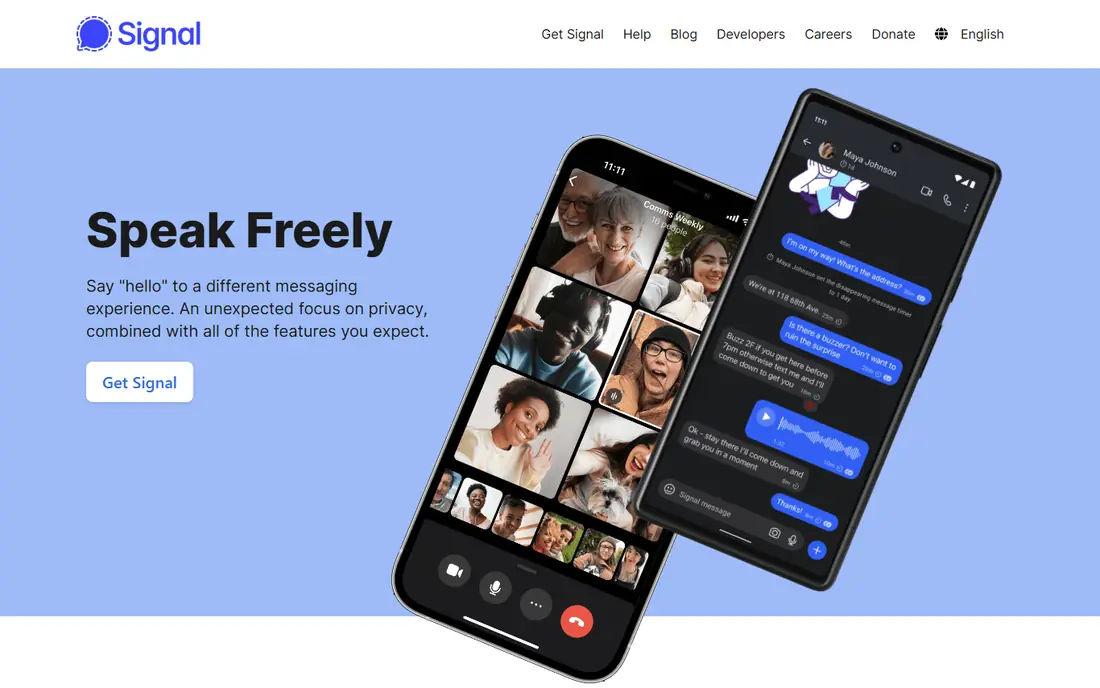
Signal is the best default Telegram alternative for most people, and the reason is simple: everything is end-to-end encrypted by default, with no setting to enable and no exception for groups. Its protocol is open source and widely reviewed, data collection is minimal with sealed sender hiding who messages whom, and disappearing messages, usernames, and registration lock add practical protections. Signal covers private texts, calls, media, and smaller groups without extra setup.
The trade-offs are a phone number requirement and the absence of Telegram-style public channels, so large broadcast communities need Discord or Element instead. One US nonprofit also runs the central servers, which matters to users who want full decentralization. For private messaging, Signal remains the gold standard in 2026 guides.
What we like- End-to-end encryption on by default
- Open source protocol
- Minimal metadata collection
Watch out for- Needs a phone number
- One US nonprofit runs the servers
- No channels like Telegram
#2WhatsApp
Best for: Largest everyday network4.6/5 on
G2 (250 reviews, checked Oct 2026)
Visit whatsapp.com
Starting priceFree
Free planYes
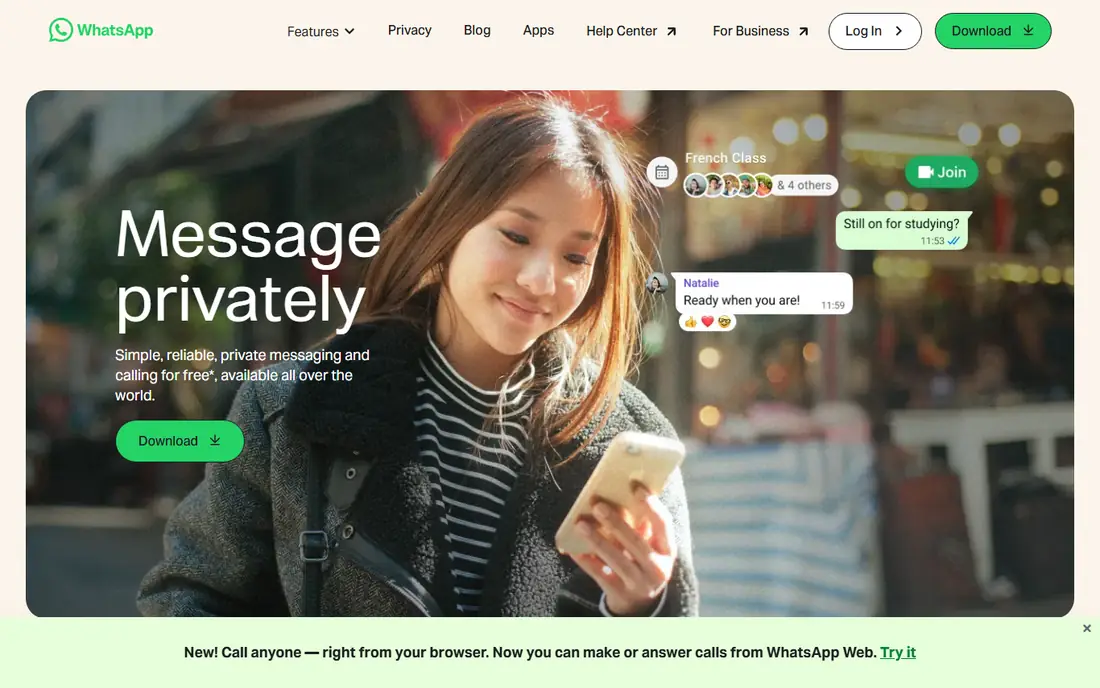
WhatsApp is the pragmatic alternative, since its network is the largest in the world and most contacts already use it. Chats and calls are end-to-end encrypted by default, groups support up to 1,024 members with admin controls, and encrypted backups are available as an opt-in with a password or key. For everyday messaging at scale, nothing else here matches its reach.
Privacy limits are real. Metadata is shared across Meta, backups are unencrypted unless you opt into encrypted backups, and WhatsApp lacks Telegram public channels. Users who prioritize privacy over reach should prefer Signal, while users who prioritize reaching everyone should accept WhatsApp trade-offs and enable encrypted backups.
What we like- Default encryption for chats and calls
- Groups up to 1,024 members
- Everyone already has it
Watch out for- Metadata shared across Meta
- Backups unencrypted by default
- No public channels like Telegram
#3Discord
Best for: Large communities and channels4.6/5 on
G2 (43 reviews, checked Oct 2026)
Visit discord.com
Starting priceFree
Free planYes

Discord is the strongest replacement for Telegram large communities, with organized channels, threads, roles, and voice rooms that go beyond Telegram groups. Servers can host tens of thousands of members with granular permissions, bots, and events, and the core service is free, with Nitro at $9.99 per month adding perks like larger uploads and custom emoji.
Discord is not end-to-end encrypted, so it suits public communities rather than private conversations, and server owners carry the moderation burden. Communities that need structured discussion and voice will find Discord far better than Signal groups, while private chats should stay on an encrypted app.
What we like- Structured channels, threads, roles, and voice rooms
- Huge communities
- Free core service
Watch out for- Not end-to-end encrypted
- Nitro at $9.99 per month for perks
- Moderation burden on server owners
#4Element
Best for: Self-hosted federated communities4.2/5 on
G2 (43 reviews, checked Oct 2026)
Visit element.io
Starting priceFree
Free planYes
Element, built on the open Matrix protocol, is the best open source option for large federated communities. Rooms support end-to-end encryption, teams can run their own homeserver for full control, and bridges connect Matrix rooms to Slack, Discord, and other platforms. Communities that want to own their infrastructure rather than rent it from a vendor will value that freedom.
The interface can feel clunky next to Telegram or Discord, sync can be slower, and a homeserver still sees accounts, rooms, and membership, so self-hosting shifts trust rather than removing it. Tech-comfortable communities get the most from Element, while casual users may prefer Discord simplicity.
What we like- Matrix protocol with federation
- End-to-end encrypted rooms
- Self-hosting supported
- Bridges to other apps
Watch out for- Interface can feel clunky
- Sync can be slower
- Homeserver sees accounts and room membership
Starting priceFree
Free planYes
Session is a decentralized, end-to-end encrypted messenger that requires no phone number or email to register, routing messages through an onion network to hide IP addresses and collecting minimal metadata. Based in Switzerland with over 1 million monthly active users, it is the most privacy-hardened free alternative for users who refuse to link an identity to a phone number.
The network is far smaller than Signal or WhatsApp, so convincing contacts to install it takes effort, and 2026 guides note funding stress at the project, which is a longevity risk. A random Session ID still exists as an identifier, though it is not tied to personal data. For anonymous contact, Session is the strongest free choice.
What we like- No phone number or email required
- Onion routing hides IP addresses
- Minimal metadata
Watch out for- Smaller network
- Project faced funding stress in 2026
- Random ID still exists
Starting price$2.99 one-time
Free planNo
Threema, a Swiss app, requires no phone number or email for signup, assigning a random ID instead, and operates under Swiss privacy law with strong encryption. It costs about $2.99 as a one-time purchase, with no subscription, which appeals to users who prefer paying once over handing over personal data or accepting ads.
The network is smaller than mainstream apps, features trail Telegram on channels and bots, and there is no free tier for testing. Journalists, activists, and privacy-conscious users who accept a small one-time cost for anonymity will find Threema a solid choice, while casual users may balk at paying for a messenger.
What we like- No phone number or email required
- Random ID system
- Swiss jurisdiction
- One-time purchase
Watch out for- Paid app with smaller network
- Fewer features than Telegram
- No free tier
Starting priceFree
Free planYes
SimpleX Chat goes further than Session by removing accounts, phone numbers, usernames, public user IDs, and fixed profiles entirely, using pairwise connections and private invite links instead. That design makes it hard to discover or connect conversations across contacts, which suits journalists, researchers, and privacy-focused users who want separate identities per contact.
The same design limits convenience. You exchange invite links to connect, the network is smaller, and the app is less polished than Signal. For users whose threat model includes identity discovery, SimpleX is the strongest option here, while everyday users will find Signal simpler.
What we like- No account, no phone number, no stable user ID
- Pairwise connections
- Open source
Watch out for- Smaller network
- Invite links required to connect
- Less polished than Signal
#8Wire
Best for: Business teams and enterprises4.2/5 on
G2 (62 reviews, checked Oct 2026)
Visit wire.com
Starting priceFree
Free planYes
Wire serves business teams and enterprises that need end-to-end encrypted messaging plus conferencing with administrative controls. Team management, guest access, and enterprise security features suit regulated departments and companies handling sensitive internal discussions, and a free tier covers personal use.
The consumer network is smaller than WhatsApp or Signal, business features need paid plans, and community tooling trails Discord. For workplace communication where compliance and admin control matter, Wire is the most enterprise-ready encrypted option here, while personal chats belong on Signal.
What we like- End-to-end encrypted messaging and conferencing
- Enterprise security controls
- Team management
Watch out for- Smaller consumer network
- Business features need paid plans
- Less community tooling than Discord
How we chose
We compared 2026 secure messenger guides for each app, checking encryption by default, metadata handling, signup requirements, group and channel features, and network size. We favored apps with encryption on by default and a clear threat model, and we kept Telegram limitations visible rather than repeating its encryption claims, since regular Telegram chats use server-side encryption. We did not claim hands-on testing, and privacy claims here reflect published guides, not legal advice.
Matching the app to your need
Start from what you actually use Telegram for. Private one-on-one chats belong on Signal, large public communities belong on Discord or Element, and anonymous contact belongs on Session or Threema. Users who need everyone reachable should stay on WhatsApp with encrypted backups enabled, accepting Meta metadata trade-offs for network size.
Encryption is not the whole story
End-to-end encryption protects message content, but metadata still reveals who talks to whom, when, and from where. Apps differ sharply here: Signal minimizes metadata with sealed sender, Session hides IP addresses with onion routing, and WhatsApp shares metadata across Meta. Backups matter too, since an unencrypted cloud backup can expose messages that were encrypted in transit. Check encryption, metadata, and backup settings together before trusting any app.
Moving a group without losing people
Migrating a Telegram group works best when you announce the move early, keep the old group open during transition, and pick the app your members will actually install. Signal groups suit small private circles, Discord suits large communities with roles and voice, and Element suits tech-comfortable groups that want self-hosting. Expect some members to stay behind, and keep a bridge or announcement channel running until the new home reaches critical mass. Pin a welcome message explaining why the group moved and how to enable disappearing messages or encrypted backups, since new members often skip those settings and weaken the privacy the move was meant to gain.
Frequently asked questions
Is Telegram actually private?
Not by default. Regular Telegram chats use server-side encryption, meaning Telegram servers can theoretically read them, and only opt-in Secret Chats are end-to-end encrypted. Secret Chats do not sync across devices and do not work for groups, so treat Telegram as social media rather than a private messenger.
What is the most private messaging app?
Signal is the best balance of privacy and usability for most people, with default encryption and minimal metadata. Session and SimpleX Chat go further on anonymity by removing phone numbers and stable IDs, but their smaller networks make them harder to adopt widely.
Can I use Telegram channels on an alternative?
Discord and Element best replace channels, with structured rooms, roles, and large member limits. Signal and WhatsApp focus on private chats and groups rather than public broadcast channels, so channel owners should plan a Discord or Element migration.
Do I need to pay for a private messenger?
No, for most needs. Signal, Session, SimpleX Chat, WhatsApp, Discord, and Element are all free, while Threema costs about $2.99 once. Paid plans mainly add business controls, larger uploads, or perks rather than basic privacy.
Will switching messengers lose my chat history?
Usually, yes, since encrypted messengers do not share history across apps. Export important messages before switching where the app allows it, and keep the old app installed during transition so nothing critical is lost in the move.
Sources we checked (10)
- https://signal.org
- https://www.whatsapp.com
- https://discord.com
- https://element.io
- https://getsession.org
- https://threema.ch
- https://simplex.chat
- https://wire.com
- https://ironclad-network.com/blog/secure-messengers-2026-comparison
- https://appvulture.com/apps-like/telegram/
Is your product missing or out of date?
We review this list regularly. Vendors can request a listing, send updated pricing or ask about featured placement.

Shihab Mia · Founder, Rankite
Shihab has 5+ years in B2B and SaaS SEO. He writes Rankite's software buying guides from pricing pages, documentation and public user reviews. More about Shihab.