How we make this list: we compare pricing pages, product documentation and public user reviews. Ratings come from G2, Capterra or Trustpilot, with the date we checked them.
Key takeaways
- Tavily is a search API built for AI agents and retrieval-augmented generation, with search, extract, and crawl endpoints tuned for LLM input.
- Exa is the closest AI-native alternative, with neural search designed for LLM retrieval rather than keyword matching.
- Brave Search API suits teams that want an independent index with straightforward pricing, while Serper and SerpAPI suit teams that need Google results specifically.
- Jina AI offers reader and search tools with a free tier for small projects, while Bing and Google APIs suit enterprises that already use those clouds.
- The deciding factors are index quality, result freshness, extraction quality, pricing per query, and whether you need general web search or structured SERP data.
Quick comparison
Is your product missing or out of date?
We review this list regularly. Vendors can request a listing, send updated pricing or ask about featured placement.
The best Tavily alternatives
Starting priceSee website
Free planYes
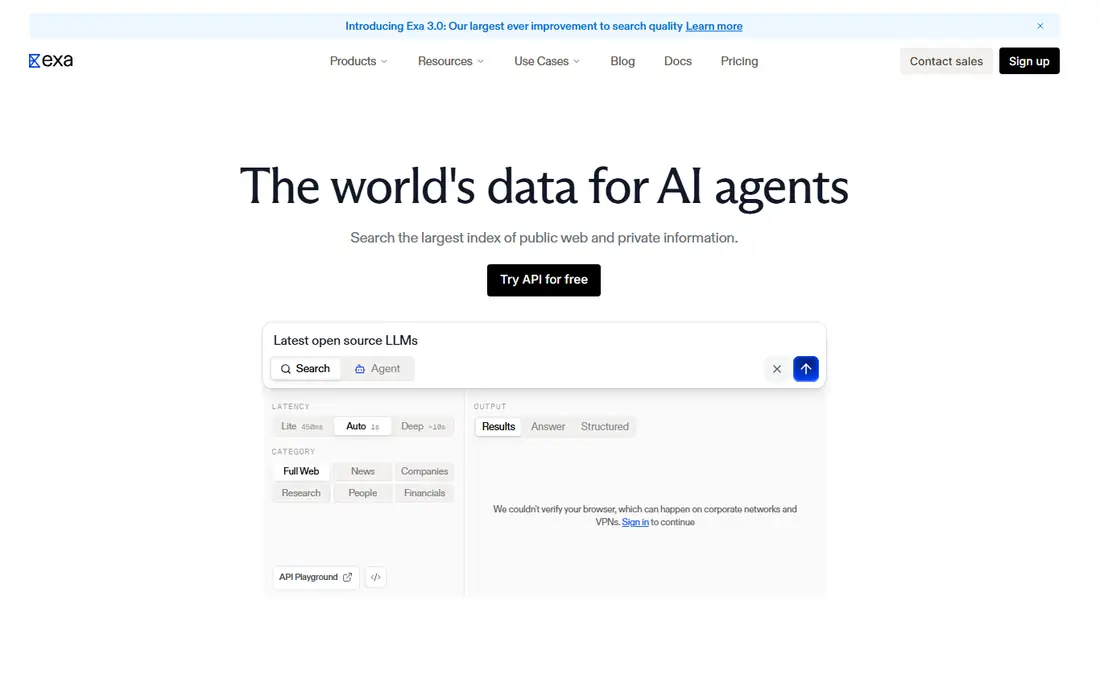
Exa is the closest AI-native alternative to Tavily, built from the start for LLM retrieval rather than adapted from a consumer search engine. Its neural search understands meaning, so a query about a concept returns relevant pages even when they do not contain the exact keywords, which improves retrieval quality for RAG applications. Search and contents endpoints let agents find pages and extract clean text in one flow, much like Tavily's search and extract pair.
Pricing varies by query volume and should be confirmed on the vendor site, and the index history is shorter than Google's for obscure or historical queries. Exa is a newer vendor with an evolving API, so expect changes. For an AI team building RAG or agent search where retrieval quality matters most, Exa is the best pick.
What we like- Neural search built for LLM retrieval
- Semantic understanding beats keyword matching
- Search plus contents endpoints
Watch out for- Pricing varies by query volume
- Smaller index history than Google
- Newer vendor with evolving API
Starting priceSee website
Free planYes
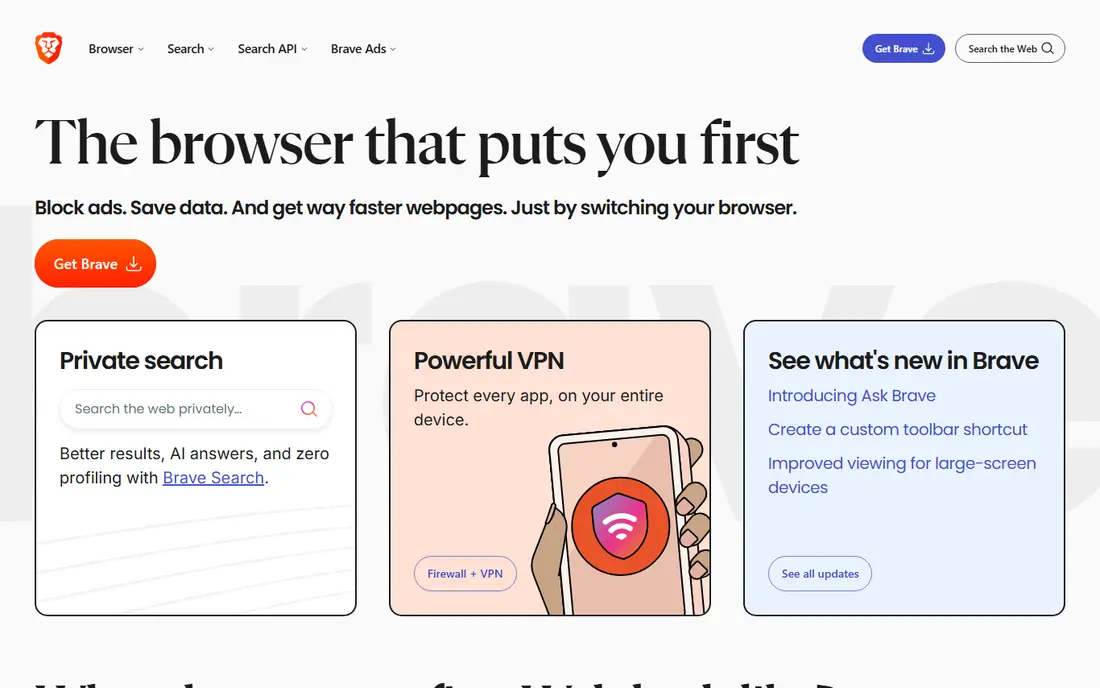
Brave Search API gives developers access to Brave's independent web index, which is built and operated separately from Google and Bing. That independence matters for teams that want results not filtered through the major engines' ranking, and for applications where index diversity improves answer quality. The API is straightforward, with web search, image, news, and video endpoints, and a free tier covers small projects.
Index depth trails Google's for long-tail queries, and AI-specific features like neural retrieval are lighter than Exa's. Pricing tiers should be confirmed on the vendor site, since they have changed over time. For a team that wants an independent index with simple pricing, Brave Search API is a solid choice.
What we like- Independent index not dependent on Google or Bing
- Straightforward API
- Privacy-focused vendor
Watch out for- Index depth trails Google's
- AI features are lighter than Exa's
- Pricing tiers need checking
Starting price$50/month
Free planNo
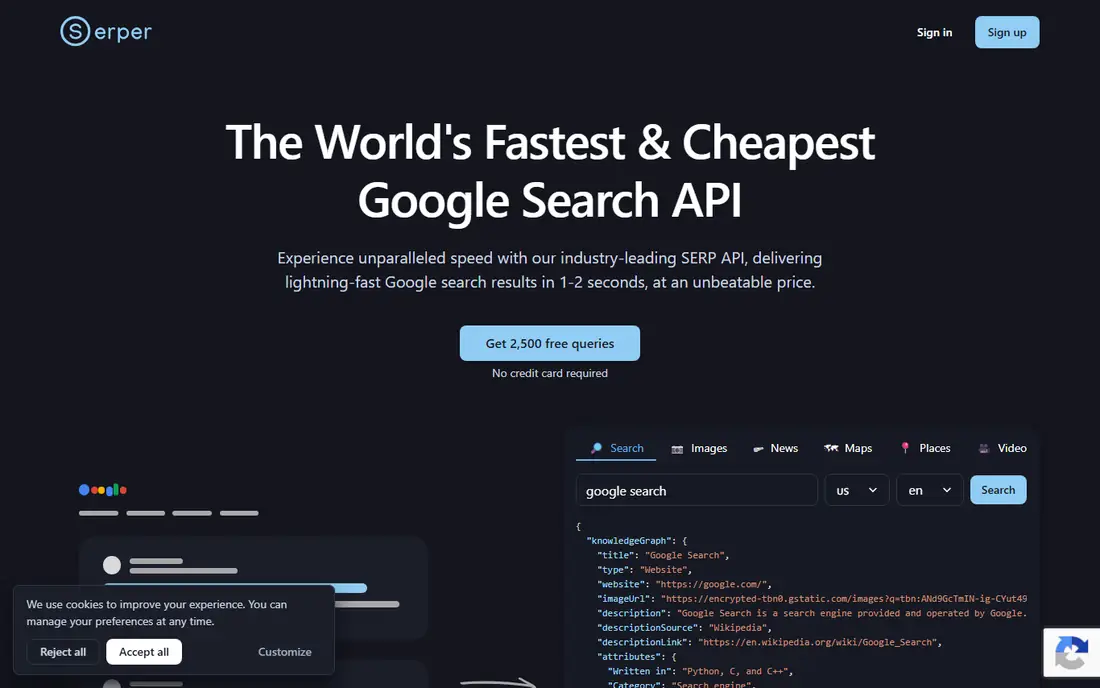
Serper is the budget API for teams that specifically need Google search results. It returns fast, structured Google results through a simple API, with plans from $50 a month, which undercuts SerpAPI's entry price. Developers building tools that need to mirror what users see on Google, such as rank trackers or research assistants, get reliable SERP data without scraping.
There is no free plan, results are raw Google SERPs rather than AI-tuned retrieval, and content extraction needs a separate tool like Jina Reader. For a team that wants Google results cheaply and simply, Serper is the best value.
What we like- Fast Google search results at a low price
- Simple API
- Good for teams that need Google specifically
Watch out for- No free plan
- Results are Google SERPs, not AI-tuned
- Extraction needs a separate tool
Starting price$75/month
Free planNo
SerpAPI is the most complete structured SERP API, covering Google, Bing, Yahoo, Baidu, and other engines with locales, device types, and result types that rank trackers and market researchers need. Its API and documentation are mature, and its parsing handles the many SERP layouts that break DIY scrapers. Plans start at $75 a month.
The entry price is higher than Serper's, results are structured SERPs rather than AI-tuned retrieval for RAG, and costs add up at high query volumes. For a team that needs comprehensive, structured search engine results across engines and regions, SerpAPI is the most capable choice.
What we like- Most complete structured SERP coverage
- Many search engines and locales
- Mature API and docs
Watch out for- Higher entry price than Serper
- Not AI-tuned for RAG
- Costs add up at high volume
Starting priceSee website
Free planNo
Bing Web Search API, available through Microsoft Azure, suits enterprises already on Azure that want search without a new vendor relationship. It offers web, image, news, and video search through a stable, well-documented API, with enterprise support and compliance through Azure. Teams building internal knowledge tools on Azure get procurement simplicity.
Pricing runs through Azure and varies by tier and volume, result quality trails Google's for some query types, and AI retrieval features are basic compared with Exa or Tavily. For an Azure-standardized enterprise, Bing Web Search API is the natural choice.
What we like- Enterprise-grade API from Microsoft
- Good for Azure shops
- Stable and well documented
Watch out for- Pricing is through Azure and varies
- Results quality trails Google for some queries
- AI retrieval features are basic
Starting priceSee website
Free planNo
Google Programmable Search Engine, formerly Custom Search, gives direct access to Google's index, which is the deepest and freshest available. It is best known for site-specific search, letting a website offer Google-powered search over its own pages, but it can also search the whole web with a custom engine configuration. Ranking quality is Google's, which remains the benchmark for general queries.
The free tier covers only 100 queries a day, paid pricing runs per 1,000 queries, and full-web setup needs configuration. For a team that wants Google's ranking quality through an official API, Programmable Search is the legitimate path, avoiding scraping terms violations.
What we like- Direct access to Google's index
- Best for site-specific search
- Familiar ranking quality
Watch out for- Free tier is limited to 100 queries a day
- Paid pricing is per 1,000 queries
- Full web search needs a custom engine setup
Starting priceSee website
Free planNo
You.com API suits agent applications that want search plus direct answers, combining retrieval with LLM-generated responses in one call. Its consumer search product is AI-first, and the API extends that model to developers building assistants and research tools. Teams that want an answer, not just a list of links, get more from You.com than from a pure SERP API.
Pricing for API use is quote-based, the API is newer with less documentation than SerpAPI's, and index depth is less documented than Google's or Bing's. For an agent team that wants AI answers alongside search results, You.com is worth evaluating.
What we like- AI search with direct answers
- Good for agent applications
- Combines search with LLM responses
Watch out for- Pricing is quote-based for API use
- Newer API with less documentation
- Index depth is unclear
Starting priceFree; Paid $20/month
Free planYes
Jina AI offers two tools that pair well with any search API: Reader, which fetches a URL and returns clean markdown text for LLM input, and a search API for grounding responses. A free tier covers small projects, and paid plans start at $20 a month, making it the cheapest entry point here. Developers often combine Jina Reader with Serper or Brave search to replicate Tavily's search-plus-extract flow at low cost.
Search quality is thinner than Exa's neural retrieval, reader output varies by page structure, and Jina is a newer vendor. For a small project or a team building a Tavily-like pipeline from parts, Jina AI's free tier and reader tool are excellent value.
What we like- Reader extracts clean page text
- Search API for grounding
- Free tier for small projects
Watch out for- Search is thinner than Exa's neural retrieval
- Reader quality varies by page
- Newer vendor
How we chose
We compared search APIs that replace Tavily's core job: giving AI applications fresh, relevant web content through search and extraction endpoints. We weighed index quality, retrieval approach, extraction quality, pricing model, and documentation from vendor pages and 2026 AI search comparisons. We left out consumer search engines without APIs and scraping tools without a search index. Where pricing is quote-based or varies by volume, we say so rather than guessing.
How to pick a Tavily replacement
Start with your retrieval need. AI-native RAG teams should shortlist Exa and Tavily itself. Teams that need Google results should shortlist Serper and SerpAPI. Teams that want an independent index should shortlist Brave. Azure shops should shortlist Bing. Answer-focused agents should shortlist You.com. Budget builders should shortlist Jina AI plus a cheap search API. Then benchmark retrieval quality on your actual questions, since benchmark scores hide domain-specific gaps.
Benchmark on your own questions
Search quality varies by domain: a tool that excels on tech questions may fail on legal or medical queries. Build a test set of fifty real questions from your application, run them through each candidate, and score relevance of the top results by hand. A tool that wins benchmarks but loses on your questions is the wrong tool.
Combine search with extraction
Raw search results are rarely LLM-ready: pages contain navigation, ads, and boilerplate that waste tokens and confuse models. Pair your search API with an extraction step, whether built in like Tavily's extract and Exa's contents, or separate like Jina Reader, and measure token efficiency alongside relevance. Clean extraction often matters more than marginal ranking differences.
Model cost per answered question
Search API pricing varies by query, result count, and extraction, so the cost per answered question differs from the headline rate. Model your full pipeline cost: searches per question, results per search, and extraction per result, at your expected volume. A cheap search API with expensive extraction can cost more than an all-in-one API.
Frequently asked questions
Is Exa better than Tavily?
For neural retrieval quality, Exa is at least comparable and often preferred by AI teams for semantic understanding. Tavily's strength is its mature agent-focused endpoints, including crawl and deep research modes. Compare both on your own question set before switching, since the better tool depends on your query types.
What is the cheapest Tavily alternative?
Jina AI is cheapest, with a free tier and paid plans from $20 a month, especially when paired with Serper at $50 a month for Google results. Brave Search API's free tier also covers small projects. For a single all-in-one API, compare Exa's and Tavily's volume pricing at your actual query count.
Do I need extraction as well as search?
Usually yes for LLM applications. Search returns links and snippets, but models need clean page text to answer accurately. Tavily, Exa, and Jina all offer extraction, while Serper and SerpAPI return SERP data that may need a separate reader. Budget extraction into your pipeline cost and design.
Can I use Google results in an AI app legally?
Yes, through official APIs like Serper, SerpAPI, or Google Programmable Search, which license or resell search data. Scraping Google directly violates its terms and breaks frequently. Use an official API path for production applications.
How fresh are AI search results?
Freshness varies by index and query type. News and trending queries update within minutes on major indexes, while niche pages may lag days. Tavily, Exa, and Brave all emphasize fresh crawling, but test freshness on your specific topics, since no vendor publishes a universal freshness guarantee.
Sources we checked (8)
- https://exa.ai
- https://brave.com
- https://serper.dev
- https://serpapi.com
- https://www.microsoft.com
- https://programmablesearchengine.google.com
- https://you.com
- https://jina.ai
Is your product missing or out of date?
We review this list regularly. Vendors can request a listing, send updated pricing or ask about featured placement.

Shihab Mia · Founder, Rankite
Shihab has 5+ years in B2B and SaaS SEO. He writes Rankite's software buying guides from pricing pages, documentation and public user reviews. More about Shihab.
 Exa
 Brave Search API
 Serper
 SerpAPI
 Bing Web Search API
 Google Programmable Search
 You.com API
 Jina AI